

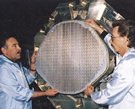
AESA (Active Electronically Scanned Array) radars offer a number of improvements over previous-generation technologies. They are more sensitive. They have better operational “uptime” because moving parts are eliminated, and the failure of one module doesn’t take the entire radar off line or leave it useless. They are also far better at handling large numbers of targets. AESA radars can do many things at once by just dedicating groups of transmit/receive (T/R) modules to each task, instead of switching rapidly between targets to simulate multi-tasking. Among other abilities.
The challenge for AESA radars has been cost, specifically the cost of the thousands of individual T/R modules that make up an AESA array. In July 2008, Raytheon produced a release regarding a variant technology called AESLA, an Active Electronically Scanned Lens Array radar. Their approach was aimed at improving the cost of an AESA radar’s T/R modules, a move that could have industry-wide significance if successful.
To find out more, DID talked to Joe Smolko, Raytheon’s program manager for the AESLA effort.
* AESLA: The Imperative, and the Idea
* AESLA: Employment and Uses
* AESLA: Funding and Next Steps
* Additional Readings & Sources
AESLA: The Imperative, and the Idea
AESLA builds upon some previous DARPA contracts involving higher performance Gallium Nitride circuitry, and also on some internally-funded research at Raytheon. The goal is to address an important gap in active array radar deployments.
Manufacturing advances over the last decade are beginning to make AESA radars a standard feature in the latest American fighter planes, and these radars are also used in larger platforms like AWACS (airborne warning and control) surveillance aircraft. When one begins to contemplate their use in “national level assets” like ballistic missile defense, however, the size of the radars involved brings the AESA cost issue right back to the fore. At the same time, however, the need to track smaller targets, and to differentiate between those targets, continues to rise. In an era where non-proliferation has largely failed, for instance, tasks like differentiating between ballistic missile warheads and decoy systems, or tracking maneuvering systems with lower radar signatures, become that much more important.
Could it be possible to use AESA technologies in the largest radars, creating improved performance at less cost than existing radar technologies? Could the kind of performance once reserved for the nation’s most sensitive radars become common in theater-level defense systems?
Raytheon thinks so, which is why they’ve been investing their own funds alongside the American government’s. AESLA’s overall approach involves leveraging GaN’s performance, sharing the amplifier across a group of elements, and adding a low-cost phase shifter at a higher level.
More specifically, AESLA employs high-power transmit-receive radar modules, enabled by gallium nitride (GaN) monolithic microwave integrated circuits (MMICs) that pack more power and performance than conventional silicon-based electronics. The other important technology is a low-loss, reliable phase shifter employing radio frequency (RF) micro-electro-mechanical systems (MEMS) technology. MEMS combines computational abilities with the perception and control capabilities of microsensors and microactuators, creating smart machines at a cost comparable to integrated circuits.
Raytheon believes they can get 10x-100x the performance of existing radars with this approach, while remaining at the low point of the cost curve.
AESLA: Employment and Uses

(click to view full)
The nature of this approach does not make AESLA suitable for all radars at this point. Its sharing approach can be used at a number of levels, but it offers the most benefits with the largest land and sea based radars – on the scale of the BMEWS system, the XBR floating platform, et. al.
Reducing costs for these radars can still have important benefits, of course, by making the fielding of modernized systems far more affordable. Similar, smaller systems can also be used to enhance theater defense projects like the THAAD missile or naval SM-3 – mobile technologies that have shown the most promise to date in dealing with the ballistic missile threat.
Another example of the technology’s possible uses was provided at the end of July, as the House Armed Services Seapower and Expeditionary Forces subcommittee held hearings to discuss shipbuilding options to 2015-1019, in the wake of changes to the DDG-1000 Zumwalt Class destroyer program. Ronald O’Rourke of the Congressional Research Service offered a brief that sketched out several shipbuilding options, including the option of a minimally-armed “radar ship” similar to the existing T-AGM-23 USNS Observation Island, aka. the “Cobra Judy” monitoring vessel.
The proposed design would carry a larger radar than one would normally find on destroyers and cruisers, along with all of the requisite power and cooling systems. It would travel with key fleet groups, and use Cooperative Engagement Capability to improve the entire battlegroup’s radar coverage against long-range aerial targets and ballistic missiles.
While Raytheon would offer no opinion regarding specific platforms, their description of the AESLA project’s strengths make it clear that a ship of this type would be exactly the sort of system their AESLA radar was designed for. It’s a national/theater class asset with a large radar, that requires improved radar performance at a reasonable cost in order to be a feasible project. Provided, of course, that AESLA technology could be fielded in time and proven to be effective.
Note, too, that Raytheon is leading a $1 billion radar contract for the US Navy’s planned Cobra Judy replacement ship, which will replace T-AGM-23 around 2012 or so.
AESLA: Funding and Next Steps

AESLA in currently a research effort led by the US Office of Naval Research. Raytheon is the contract recipient, and will perform almost all of the work involved through its Integrated Defense Systems unit, and its Space and Airborne Systems unit in Dallas, TX.
The ONR’s contract with Raytheon is initially for $1 million, with a value of up to $14 million over about 4 years. The expected deliverable is demonstration of a sub-array, which means the technology will have reached TRL 5-6 and Milestone B. The next step would be some kind of pilot for a full array, leading to Milestone C and a low-rate production decision.
While Raytheon spokespeople were reluctant to be pinned down, they did say that neither technology nor trained people would be a bottleneck for the AESLA effort. By the process of elimination, one may conclude that the current limit revolves more heavily around funding. Whether internally funded, or funded by the government, it may be that a higher priority effort would be able to deliver faster answers regarding AESLA’s viability, and bring its capabilities into service at an earlier date that the current implied schedule of 2014+.
Additional Readings & Sources
* Thanks to Raytheon and Joe Smolko, Program Manager of the Advanced Technology Group, for their assistance. Having said that, any mistakes or misconceptions are solely our own.
* Raytheon (July 17/08) – Raytheon Technologies Promise to Improve Radar Affordability
* DID Spotlight – GaN: DARPA’s 3-Pronged R&D Strategy. Includes a contract with Raytheon.
* MEMS and NANotech Clearing House – What is MEMS Technology?
* Congressional Research Service (July 31/08) – Statement of Ronald O’Rourke, specialist in naval affairs, before the House Armed Services Committee subcommittee on Seapower and Expeditionary Forces hearing on surface combatant warfighting requirements and acquisition strategy
* DID spotlight – Floatin’ Smokey: The USA’s SBX Radar
* Global Security – Cobra Judy Replacement
* Raytheon (June 20/06) – Raytheon’s Cobra Judy Replacement Program Finishes Final Review; Moves into Build and Integration Phase
* Raytheon (Dec 18/04) – Raytheon Awarded $1.04 Billion Letter Contract For Cobra Judy Replacement Program. Covers the radars, which still need to be integrated into a ship.
* DID FOCUS – CEC: Cooperative Engagement for Fleet Defense (updated)