

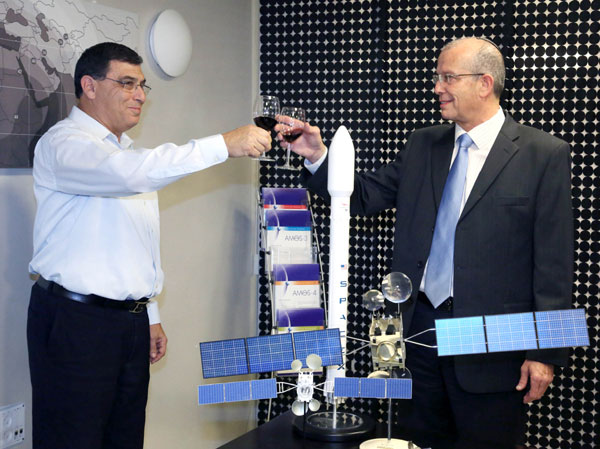
(click to view larger)
In November 2012, Israel Aerospace Industries signed a minimum $185 million contract with Israel’s Spacecom satellite company. In return, IAI will build and operate the dual-use AMOS-6 communications satellite, covering Africa, the Middle East, and Europe. The launch contract will be a separate transaction.
Like most providers, Spacecom has already sold capacity on the satellite, including a $20 million lifetime contract from the Israeli government, who will receive a beam in an agreed-upon frequency band…
AMOS-6
Israel’s 6th Affordable Modular Optimized Satellite satellite has a 5,500 kg launch weight, with end of life payload power rated at 10.3 kW, and power requirements around 9 kW. The communication payload includes 45 transponders in 3 frequency bands (Ku, Ka, S), which enable the satellite to provide communication services that can include direct satellite home internet.
Spacecomm is targeting AMOS-6 at their 4 degrees W ‘hot spot,’ currently occupied by AMOS-2 and AMOS-3. The AMOS-6 array involves 39 segments in the Ku-22 frequency band covering the Middle East & Europe and Pan Europe, 24 active beams in the Ka-19 frequency band covering parts of Africa and Europe, and 2 transponders in the S-4 frequency band.
AMOS-6 satellite delivery is scheduled for August 2015. It will replace AMOS-2, which is expected to end its service during 2016.
Contracts & Key Events
 Falcon 9
(click to view full)
September 6/16: Israel’s Space Communication Ltd may seek either $50 million or a free flight from SpaceX, following the destruction of a Spacecom communications satellite last week by an explosion at SpaceX’s Florida launch site. The failed launch has had a profound impact on Spacecom with its equity expected to decline by $30 million to $123 million following a 9% dip in its share price on Thursday, followed by a further 34% drop when trading resumed. SpaceX said on Friday that it would shift flights to a second launch site in Florida, which is nearing completion and which was last used to launch NASA’s space shuttles.
September 2/16: A SpaceX Falcon 9 rocket exploded during a static test-firing yesterday morning at Cape Canaveral, Florida. The explosion resulted in the destruction of its payload, an Israeli-owned AMOS-6 communications satellite. SpaceX had planned to launch the Falcon 9 and satellite into orbit on Saturday.
Dec 10/12: Sub-contractors. MacDonald, Dettwiler and Associates Ltd. in Richmond, BC, Canada announces that they’ve signed a contract “in excess of CA$100 million” with Israel Aerospace Industries Ltd. to supply AMOS-6’s communications payload.
MDA actually began work im June 2012 under an Authorization To Proceed, while they worked out the exact details of the contract. Source: MDA, “MDA signs contract in excess of CA$100 million to provide communications payload for Israeli AMOS-6 satellite”.
Jan 29/12: SpaceX wins. SpaceX wins the launch contract for AMOS-6, marking another significant step forward for the firm. Launch is scheduled for August 2015, and will take place from Cape Canaveral, FL. Costs weren’t revealed, but they’re above and beyond the contract with IAI. SpaceX has publicly proclaimed Falcon 9 launch costs as being $54 million.
It’s also a market win for the Falcon 9 launch rocket, which will insert AMOS-6 into a geosynchronous transfer orbit (GTO). Under the USAF and NASA’s new framework, successful launches of payloads like this allow providers to progressively improve their ratings, and become eligible for more mission-critical launch contracts over time. SpaceX has now closed out an impressive 14 launch contracts in 2012.
The question is the Falcon 9 v1.1 rocket’s payload to GTO figures. Spacecomm says that AMOS-6 will have a launch weight of 5,500 kg, but Falcon 9’s published figures state only 4,850 kg to GTO – a 13.4% gap. SpaceX.
Launch contract
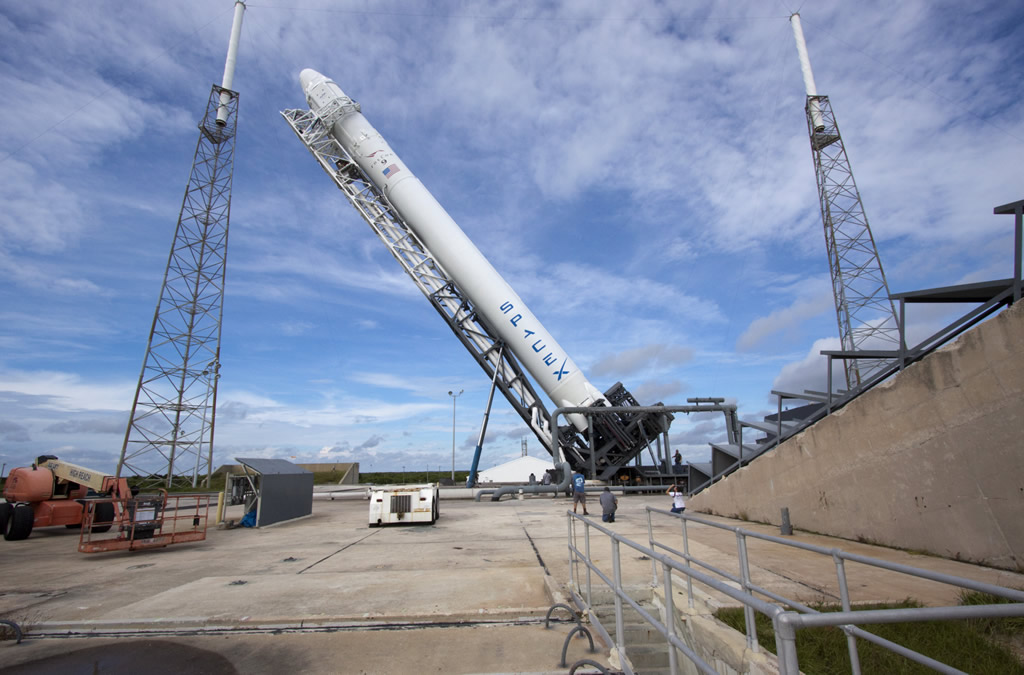
(click to view full)
September 6/16: Israel’s Space Communication Ltd may seek either $50 million or a free flight from SpaceX, following the destruction of a Spacecom communications satellite last week by an explosion at SpaceX’s Florida launch site. The failed launch has had a profound impact on Spacecom with its equity expected to decline by $30 million to $123 million following a 9% dip in its share price on Thursday, followed by a further 34% drop when trading resumed. SpaceX said on Friday that it would shift flights to a second launch site in Florida, which is nearing completion and which was last used to launch NASA’s space shuttles.
September 2/16: A SpaceX Falcon 9 rocket exploded during a static test-firing yesterday morning at Cape Canaveral, Florida. The explosion resulted in the destruction of its payload, an Israeli-owned AMOS-6 communications satellite. SpaceX had planned to launch the Falcon 9 and satellite into orbit on Saturday.
Dec 10/12: Sub-contractors. MacDonald, Dettwiler and Associates Ltd. in Richmond, BC, Canada announces that they’ve signed a contract “in excess of CA$100 million” with Israel Aerospace Industries Ltd. to supply AMOS-6’s communications payload.
MDA actually began work im June 2012 under an Authorization To Proceed, while they worked out the exact details of the contract. Source: MDA, “MDA signs contract in excess of CA$100 million to provide communications payload for Israeli AMOS-6 satellite”.
Jan 29/12: SpaceX wins. SpaceX wins the launch contract for AMOS-6, marking another significant step forward for the firm. Launch is scheduled for August 2015, and will take place from Cape Canaveral, FL. Costs weren’t revealed, but they’re above and beyond the contract with IAI. SpaceX has publicly proclaimed Falcon 9 launch costs as being $54 million.
It’s also a market win for the Falcon 9 launch rocket, which will insert AMOS-6 into a geosynchronous transfer orbit (GTO). Under the USAF and NASA’s new framework, successful launches of payloads like this allow providers to progressively improve their ratings, and become eligible for more mission-critical launch contracts over time. SpaceX has now closed out an impressive 14 launch contracts in 2012.
The question is the Falcon 9 v1.1 rocket’s payload to GTO figures. Spacecomm says that AMOS-6 will have a launch weight of 5,500 kg, but Falcon 9’s published figures state only 4,850 kg to GTO – a 13.4% gap. SpaceX.
Launch contract
Jan 8/13: Sub-contractors. ATK’s Space Components Division in Goleta, CA signs a contract with IAI to power AMOS-6 with their Planar Unfolding Modular Array (PUMA). The contract calls for delivery of ATK’s solar array in 18 months, with the option to perform work on the AMOS-7 solar array should IAI receive the follow-on contract from Spacecom.
PUMA has had more than 50 solar array wings on-orbit with 100% flight success, including programs like Boeing’s GPS-IIF satellites, Orbital’s STAR2, etc. AMOS-6 falls into the “high-power commercial” range, and its PUMA will be designed to provide 10.3 KW even in a sub-optimal state at the end of its life. ATK.
Nov 13/12: Contract. IAI announces the contract. They can earn up to $3 million for early delivery of a launch-ready bird (maximum $198 million), or pay up to $10 million in penalties for its own lateness ($185 million minimum).
There are also opportunities to make money beyond the delivery and launch contract. AMOS-6 is designed to last at least 16 years, and IAI will be motivated to exceed that figure. Beyond a 17-year lifespan, the contract gives IAI 20% of Spacecom’s customer revenues from the satellite. Other reports also mention an option for AMOS-7.
Satellite launch will be a separate contract. The launch facility is not named, but past AMOS launches have taken place from Baikonur Cosmodrome in Kazakhstan. IAI | Spacecomm | Space Daily.
Satellite contract