

(click to view full)
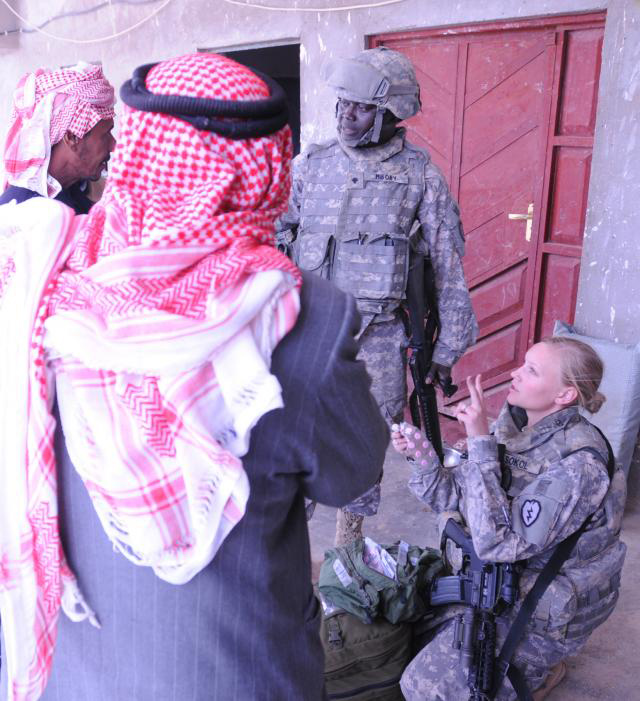
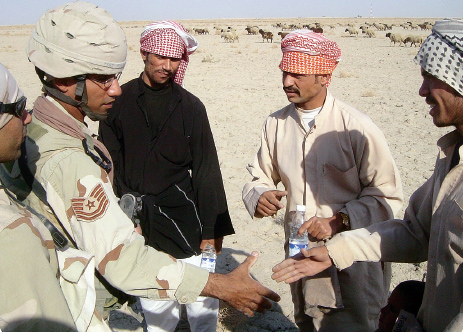
The US military has come to rely more and more on contractors to provide linguist services to function effectively in non-English speaking regions. The need for these services is particularly acute in the Middle East and Central Asia where US troops are actively engaged. Technically, there are 2 primary types of linguist services: interpreters and translators. Contractors usually offer both services as part of their contracts.
This DID FOCUS free sample covers US military linguist services contracts and key events.
Linguists: What do we Need? What do we Mean?
Terrible Terps Can Leave You Tango Uniform
happen to you…
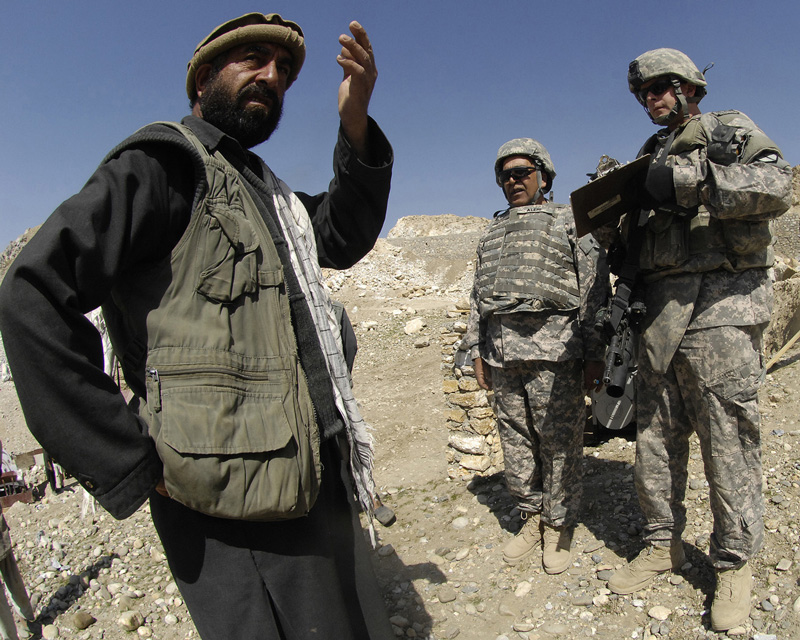
An indication of what could go wrong with an unskilled or hostile linguist is illustrated in a short documentary video produced by journalist John McHugh of The Guardian newspaper. In the video, a US Army sergeant and an Afghan tribal elder engage in a conversation about Taliban rocket attacks.
The US interpreter incorrectly conveys the tribal leader’s response to a question about the security in the area. The elder says that there is no security in the village and that is a problem. The interpreter tells the sergeant that the elder says the security is fine. “We have no problems here.”
The elder then tells the sergeant that he would like to cooperate with the Americans, and points to the direction from where the Taliban attacks are coming. But he says the villagers can’t cooperate under the current conditions because the Taliban are like “ants,” they are everywhere and impossible to stop.
The interpreter translates the elders words by saying, “He is giving many examples, the main point is that if you want to get the ACM [anti-coalition militia] they are behind this road, behind this mountain.”
As they walk away, the interpreter says “I hate these people.”
This video highlights the necessity for the US and allied forces to have interpreters who are reliable and loyal, understand the dialect of the local people, and can serve as cultural liaisons. The success of the US and allied mission, as well as the lives of soldiers, depends on it.
Interpreters versus Translators
(click to view full)
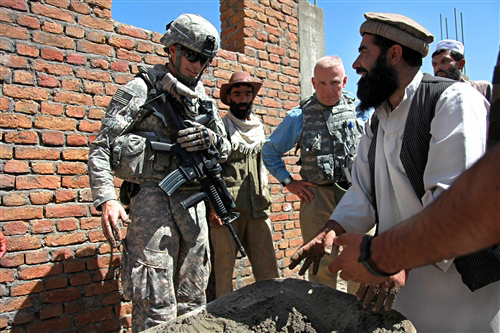
As noted above, there are 2 primary types of linguist services: interpreters and translators. Contractors usually offer both types of services.
Although some people do both, interpretation and translation are different professions, notes the US Bureau of Labor Statistics. Interpreters deal with spoken words; translators with written words. Each task requires a distinct set of skills and aptitudes, and most people are better suited for one or the other. While interpreters often work into and from both languages, translators generally work only into their active language.
Interpreters convert one spoken language into another – or, in the case of sign-language interpreters, between spoken communication and sign language. This requires interpreters to pay attention, understand what is communicated in both languages, and express thoughts and ideas clearly. Strong research and analytical skills, mental dexterity, and an exceptional memory also are important.
The interpreter must become familiar with the subject matter that the speakers will discuss, a task that may involve research to create a list of common words and phrases associated with the topic. Next, the interpreter usually travels to the location where his or her services are needed. Physical presence may not be required for some work, such as telephone interpretation. But it is usually important that the interpreter see the communicators in order to hear and observe the person speaking and to relay the message to the other party.
Translators convert written materials from one language into another. They must have excellent writing and analytical ability. Because the documents that they translate must be as flawless as possible, they also need good editing skills.
Assignments may vary in length, writing style, and subject matter. When translators first receive text to convert into another language, they usually read it in its entirety to get an idea of the subject. Next, they identify and look up any unfamiliar words. Multiple additional readings are usually needed before translators begin to actually write and finalize the translation. Translators also might do additional research on the subject matter if they are unclear about anything in the text. They consult with the text’s originator or issuing agency to clarify unclear or unfamiliar ideas, words, or acronyms.
US Army Recruitment
(click to view larger)
The US Army is a big recruiter of interpreters and translators.
According to the Army recruiting site, Army interpreters/translators convert written or spoken foreign languages into English. The types of services they provide include:
* preparing non-technical translations into the target language and performing sight translations from a target language into English;
* performing oral interpretation;
* assisting a military contracting officer with a local purchase;
* providing interpretation support at a military traffic control point;
* assisting security personnel in screening the local population at military checkpoints; and
* providing interpretation assistance for the Public Affairs Office during local media events and translation of local newspapers or pamphlets.
Contractors perform similar services for the US military. They are important parts of US military operations in Iraq and Afghanistan.
The Congressional Research Service estimates that there were 9,128 translator/interpreter contractors in Iraq as of June 2009, or 8% of the total contractor personnel there.
The US Army estimates [pdf] that it spends $250 million per year on contract linguists. The cost per annum of a single contract linguist varies from $15,000 per year for a locally hired linguist to approximately $200,000 for US citizens. Factors such as clearance and duty location requirements contribute to the total cost.
There are 3 categories [pdf] of contract linguists:
* CAT 1: local national hires with security screening but no clearance;
* CAT 2: US citizen hires with Secret level clearance;
* CAT 3: US citizen hires with TS/SCI clearance.
Only CAT 2 and CAT 3 hires are permitted to work on sensitive intelligence functions.
Key Players and Contract Vehicles Explained
INSCOM: from WLSS to TIMS to DLITE
(click to view full)
The US Army’s Intelligence and Security Command (INSCOM) oversees billions of dollars in contracts to provide linguists services.
In 1999, INSCOM’s Contracting Office awarded a huge $4.5 billion, 5-year Worldwide Linguist Support Services (WLSS) contract to BTG, which was purchased by Titan Corp. in 2001. Titan was then acquired by L-3 Communications in 2005. New “owner” L-3 assigned management of this contract to its Linguist Operations and Technical Support Division (LOTSD).
In 2005, with the current contract nearing completion, INSCOM re-competed the contract. However, a final award decision was delayed as a result of a series of protests brought to the Government Accountability Office (GAO) by L-3 and other companies. On Dec 15/06, Global Linguist Solutions (GLS) in Falls Church, VA won the $4.65 billion Translation and Interpretation Management Services (TIMS) contract.
More protests followed, but the TIMS award to GLS was ultimately upheld in early 2008, when the final protest was withdrawn after L-3 and GLS reached a subcontracting work-share agreement. “L-3 Out, Dyncorp-McNeil in for $4.65B Iraq Translation Contract?” has more on the controversy surrounding the award.
Under the TIMS contract, GLS provides interpretation and translation services to the US Army and US government agencies supporting US forces in Iraq. GLS uses L-3, Northrop Grumman, and other vendors as subcontractors on the contract. Small business subcontractors on the GLS team included Invizion, KMS Solutions, TigerSwan, Thomas/Wright, and Shee Atika Language.
GLS’ management of the TIMS contract came under scrutiny from the US Commission on Wartime Contracting. During an Aug 12/09 hearing, John Isgrigg, Deputy Director for Contracting with INSCOM, said [PDF] that an audit of GLS’ linguist services found that the company had only provided approximately 80% of the contract requirement for linguists, but was burning funds at a rate congruent with a 100% fill rate. US Army INSCOM also identified $5 million in overspending that went to the following items in Kuwait:
* Private 3-bedroom apartments for individual GLS personnel;
* A contractor with deployed dependents at government expense;
* Each management personnel having his or her own automobile;
* Delayed transit of linguists into Iraq from Kuwait.
INSCOM’s demands for cost cutting measures resulted in more than $5 million in cost savings by GLS. However, continued substandard performance by GLS, according to INSCOM, resulted in the issue of a task order for linguists support in Iraq to an unidentified competitor, instead of using the TIMS vehicle.
In 2009, John Houck, general manager of GLS, testified [PDF] that his company employs over 9,000 linguists in Iraq and other Gulf states with a fill rate near 100% in all categories of contract requirements. He told the commission that GLS pursued cost-minimizing measures with subcontractors through economies of scale and other avenues in order to minimize potential cost overruns. At the same time, the work has taken its toll on linguists working in Iraq. In the first full year of GLS’ tenure in Iraq, 12 linguists were killed in action, and 52 were seriously wounded.
In July 2011, INSCOM unveiled a new core contract vehicle called DLITE (Defense Language Interpretation and Transition Enterprise). This 5-year, $9.7 billion contract was “awarded” to a set of 6 contractors, who would compete for specific task orders. GLS was 1 of the 6 eligible firms, but only one among many. If questions arise concerning any contractor’s performance, replacements can be moved in much more quickly, and new task orders can go to competitors immediately.
Sending out an SOS: Other Firms
(click to view larger)
In addition to the DynCorp/McNeil joint venture Global Linguist Solutions LLC in Falls Church, VA, Reston, VA-based SOS International. has been a major supplier of translator/interpreter services in Iraq, Afghanistan, and even the USA. As an example of the services SOS International provides, the company won a contract to supply Arabic linguist and role-playing support to the US Air Force Office of Special Investigations (AFOSI) at Fort Dix, NJ to assist in pre-deployment field training exercises in preparation for missions in Iraq and Afghanistan.
Another major supplier is Northrop Grumman Technical Services, which has for 20 years supported large-scale linguist requirements for the US DoD, including Operations Desert Shield and Storm and operations in Somalia, Haiti, Bosnia, and Kosovo.
Since December 1995, Northrop Grumman has supported the U.S. Army in and around the Balkans, processing some 15,000 candidates while hiring, deploying, and managing more than 5,000 linguists.
Since 1999, L-3 Linguist Operations & Technical Support [PDF] has provided linguist support services for the US DoD and the US intelligence community. L-3 became a major play in the linguist services market when it acquired Titan Corp in 2005 and inherited the $4.5 billion INSCOM contract (discussed above).
L-3 has deployed over 15,000 linguists speaking more than 35 languages across 15 US states and 20 countries.
In addition to these contractors, a number of other companies that have received translator/interpreter contracts from the US military include:
* Acclaim Technical Services (ATS) in Huntington Beach, CA;
* All World Language Consultants in Rockville, MD;
* The Buffalo Group in Reston, VA;
* Calnet in Reston, VA;
* International Management Services in Rumford, ME;
* Mission Essential Personnel in Columbus, OH;
* MultiLingual Solutions in Rockville, MD;
* Mid Atlantic Professionals in Germantown, MD;
* Shee Atika Languages in Rumford, ME;
* Thomas Computer Solutions in Long Beach, CA;
* TRW Systems and Information, Fairfax, VA;
* World Technical Services (incorporating ASRC Airfield and Range Services) in Greenbelt, MD.
Users of contract linguist services include intelligence agencies within the US military services and US federal agencies, as well as the Defense Intelligence Agency. Also, organizations that interact with locals in-country, such as the US Army Corps of Engineers, and commands that carry out clandestine operations, such as the US Special Operations Command, require contract linguist services.
Contracts and Events
Some especially large contracts will be highlighted.
FY 2011 – 2013
Major DLITE & SOCOM contracts; Other orders.

(click to view full)
Aug 22/13: SOCOM. World Wide Language Resources (WWLR) of Fayetteville, NC received a 5-year, $257.2 million firm-fixed-price contract for linguist and translation support, in support of US Special Operations Command. This contract will be funded incrementally, with $1 million committed immediately.
The contract has 1 base year and 4 more 12-month options. Work will be conducted in multiple locations in the United States and overseas. This contract was competitively procured via FBO.gov, with 7 proposals received. US SOCOM manages the contract (H92222-13-C-0053).
March 11/13: MultiLingual Solutions in Rockville, MD receives an $8 million contract modification for linguist/analyst servcies at Offutt Air Force Base, NB; Fort Meade, MD; Fort Gordon, GA; Hurlburt Field, FL; Kadena Air Base, Japan; Royal Air Force Mildenhall, United Kingdom; Lackland AFB, TX; Salt Lake City, UT; Fort Bragg, NC; Goodfellow AFB, TX, and Kunia, Hawaii until July 9/13.
The USAF ISR Agency at Lackland AFB, TX manages this contract – see also March 3/10 entry (FA7037-10-D-0002, PO 0006-01).
Sept 26/12: SOCOM. US SOCOM at MacDill AFB, FL awards 4 vendors indefinite-delivery/ indefinite-quantity contracts to provide foreign language, regional expertise, and cultural training to students from US Special Operations Command’s 4 service components. Each firm will receive a nominal $5,000, then compete for task orders around the world under the maximum $250 million award. The winners, who each receive a 1-year base contract with 2 more 1-year options, are:
* MultiLingual Solutions in Rockville, MD (H92222-12-D-0021)
* Mid Atlantic Professionals in Germantown, MD (H92222-12-D-0027)
* The Buffalo Group in Reston, VA (H92222-12-D-0026)
* Global Technology Solutions in Richmond, VA (H92222-12-D-0028).
A Sept 14/12 announcement mentioned only MultiLingual Solutions.
SOCOM 2012 – 2015
Feb 13/12: INSCOM – Afghanistan. Mission Essential Personnel in Columbus, OH wins a $330 million cost-plus-award-fee contract modification for linguist and interpretation services in Afghanistan. Work will be performed in Columbus, OH, and Afghanistan, with an estimated completion date of Sept 6/12.
The original contract was solicited through the Internet, with 6 bids received by U.S. Army Intelligence and Security Command, in Fort Belvoir, VA (W911W4-07-D-0010). This is not a DLITE contract; see May 10/10 and May 12/10 entries for more background.
July 5/11: DLITE. US Army INSCOM issues a series of 6 indefinite-delivery/ indefinite-quantity, fixed-price, cost-reimbursable, multiple-award-task-order contracts for the global DLITE (Defense Language Interpretation and Transition Enterprise) program, which runs to December 2016. Bids were solicited through the Internet, with 11 bids received. Winners included:
* CACI Premier Technology Inc. in Chantilly, VA (W911W4-11-D-0003)
* DynCorp/McNeil JV Global Linguist Solutions LLC in Falls Church, VA (W911W4-11-D-0004)
* L3 Services Inc. in Reston, VA (W911W4-11-D-0005)
* ABM Industries subsidiary Linc Government Services LLC in Hopkinsville, KY (W911W4-11-D-0006)
* Mission Essential Personnel LLC in Columbus, OH (W911W4-11-D-0007)
* Northrop Grumman Technical Services Inc. in Herndon, VA (W911W4-11-D-0008)
As is typical of multiple-award contracts, the winner will bid on task orders as they come up. The overall amount was listed as $9.7 million in Pentagon releases, but discussions with the Army have confirmed that the actual ceiling amount for all task orders is $9.7 billion, making it the service’s core translation contract going forward.
DLITE: $9.7 billion
Dec 30/10: EURCOM/ AFRICOM. The Defense Language Institute stands up new detachment in Germany to provide sustainment training for military linguists based in Europe. The detachment located at Patch Barracks in Stuttgart will provide direct support to linguists assigned to both US European Command and US Africa Command. Previously, military linguists assigned to those commands had to rely on distance learning or mobile training teams for sustainment training.
FY 2008 – 2010
Wide range of agency contracts; AECOM buys McNeil Technologies
Sept 13/10: SOCOM. McNeil Technologies, Inc. in Springfield, VA wins a $50 million initial task order under a $500 million maximum value, 5-year indefinite-delivery/ indefinite-quantity linguist support services contract for U.S. Special Operations Command (US SOCOM). The contractor will provide foreign language interpretation, transcription, reporting, and translation services (H92222-10-D-0007).
SOCOM 2011 – 2016
Aug 27/10: AECOM announces that it paid $355 million in cash to acquire McNeil Technologies, a Springfield, VA-based defense linguist and IT support services provider, from Veritas Capital. McNeil formed a joint venture with DynCorp called Global Linguist Solutions in 2006 to snag the US Army’s Intelligence and Security Command (INSCOM) multi-billion contract to provide linguists services in Iraq from incumbent L-3 Communications.
AECOM buys McNeil
May 12/10: Who’s MEP. WIRED’s Danger Room runs an article about MEP, with background and links that question both the quality of its services and its treatment of employees:
“Three years ago, Mission Essential Personnel was a miniscule military contractor, banking less than $6 million annually to find a handful of linguists for the American government. Earlier this week, the U.S. Army handed the Columbus, Ohio, company a one-year, no-bid $679 million extension of its current contract to field a small city’s worth of translators to help out American forces in Afghanistan.
Not bad for a company that’s been accused of everything from abandoning wounded employees to sending out-of-shape interpreters to the front lines. MEP vigorously rejects the charges…”
May 10/10: INSCOM. Mission Essential Personnel in Columbus, OH receives a $679 million indefinite-delivery/ indefinite-quantity with cost-plus-award fee contract to continue linguist/translation services with the local populace and with foreign military units, in Afghanistan and beyond. One bid was solicited with one bid received. U.S. Army Intelligence and Security Command (INSCOM) in Alexandra, VA (W911W4-07-D-0010).
Work is to be performed in Afghanistan (86.202%); Bahrain (0.926%); Djibouti (0.102%); Germany (2.081%); HOA (1.230%); Italy (0.92%); Kenya (0.174%); Kirgizia (0.042%); Qatar (0.163%). In America, performance locations will include Redstone Arsenal, AL (0.002%); Camp Pendleton, CA (1.235%); Los Angeles, CA (0.002% – we don’t understand the natives there, either); Atlanta, GA (0.002%); Fort Gordon, GA (4.743%); Hunter Army Airfield, GA (0.504%); Kaneohe Bay, Hawaii (0.401%); Camp Lejeune, NC (0.501%); Fort Bragg, NC (0.127%); Nashville, TN (0.001%); Fort Hood, TX (0.343%); San Antonio, TX (0.0104%); Arlington, VA (0.027%); Fort Belvoir, VA (0.144%); and Quantico, VA (0.017%), with an estimated completion date of April 1/11.
March 11/10: USAREUR. U.S. Army Europe (USAREUR) awards a 4-year, $39 million contract to Northrop Grumman Corporation for interpreter and translator services.
Work will primarily be performed in Kosovo, Romania and Bulgaria, and will include translation from the target language into English and vice versa as well as the translations of documents, written material and media reports. Northrop Grumman release.
March 3/10: USAF. MultiLingual Solutions in Rockville, MD received a $62 million contract to provide foreign language linguist personnel, equipment, tools, materials, supervision, and other items in support of USAF operations. At this time, $11.3 million has been obligated. The Air Force Intelligence, Surveillance, and Reconnaissance Agency in San Antonio, TX manages the contract (FA7037-10-D-0002).
Feb 11/10: SLI Program. The FY 2010 defense spending bill contained $2.88 million in funding for a California State University (CSU) program to train linguists for the Department of Defense and other national security agencies, according to a Los Angeles Times report. The program, called the Strategic Language Initiative, operates on 5 CSU campuses, each focusing on a different language: Cal State Long Beach (Mandarin Chinese), Cal State Fullerton (Persian), Cal State LA (Korean), Cal State Northridge (Russian) and Cal State San Bernardino (Arabic). The new money will help expand the program to San Francisco State (Mandarin Chinese) and San Jose State (Arabic).
Oct 5/09: DIA. SOS International in Reston, VA won a $136.2 million fixed-rate contract for linguist services in support of operations in Iraq and Afghanistan. The company will perform the work in Iraq and Afghanistan with an estimated completion date of Sept 25/14. Bids were solicited via the General Services Administration (GSA) with 4 offers received by the US Army Corps of Engineers and Defense Intelligence Agency (WHHM402-09-F-0658).
Aug 12/09: TIMS hearings. Commission on Wartime Contracting held a hearing to examine the performance of Global Linguist Solutions on the $4.65 billion Translation and Interpretation Management Services (TIMS) contract awarded by the US Army’s Intelligence and Security Command (INSCOM) for contract linguists services in Iraq.
April 21/09: GLS leadership. The Global Linguist Solutions’ board of managers appointed John Houck as general manager, replacing Spider Marks, who resigned “to pursue other interests.”
Aug 21/08: USAREUR. SOS International in Reston, VA won a $10.5 million firm-fixed-price contract for linguist/interpreter services in the US Army Europe (USAREUR) area of responsibility, including Eastern and Western Europe, Africa and Russia. Estimated completion date is Aug 31/12. 15 bids were solicited with 4 received by USAREUR’s Wiesbaden Contracting Center in Wiesbaden, Germany (W912CM-08-D-0018).
June 10/08: US Army NSTA. SOS International won a contract to provide media relations and translation services to the US Army Public Affairs Office (PAO) at the Novo-Selo Training Area (NSTA) in Bulgaria. Under the terms of the contract, SOS will provide personnel with expertise in bilingual media relations at NSTA, part of Joint Task Force-East (JTF-E), who will facilitate interviews, accompany PAO personnel to media events, and assist with press release preparation.
April 28/08: GLS – NGC. Northrop Grumman received a subcontract from Global Linguist Solutions to provide management of translation and interpretation services for the US Army Intelligence and Security Command (INSCOM) in Iraq. The indefinite delivery/ indefinite quantity subcontract has a potential value of $135 million over a 5-year period. The GLS team, which includes Northrop Grumman and 11 other subcontractors, employs approximately 7,000 locally hired Iraqi citizens and more than 2,000 US citizens as interpreters.
April 18/08: USAF OSI. SOS International received a contract to provide linguist and role-playing support to the US Air Force Office of Special Investigations (AFOSI), an investigative arm of the USAF, at Fort Dix, NJ. The contract calls for SOS to provide Arabic linguists and role players to assist in pre-deployment field training exercises in preparation for AFOSI missions in Iraq and Afghanistan. These training exercises are designed to provide realistic scenarios that might occur during a mission. The training also provides enhanced cultural awareness that will assist AFOSI agents in the field and help them communicate with the host nation population. Under the terms of the contract, SOSi will also assist in providing equipment to facilitate this training.
Dec 12/07: TIMS. Global Linguist Solutions, a joint venture of DynCorp International and McNeil Technologies, in Springfield, VA won a delivery order in the amount of $60 million as part of a $4.65 billion cost-plus-fixed-fee contract for interpreter and translator services. The company will perform the work in Iraq, and expects to complete it by Dec 5/12. This web solicitation was posted on Feb 17/06, and 3 bids were received by the US Army Intelligence and Security Command at Fort Belvoir, VA (W911W4-08-D-0002).
FY 2001 – 2007
TIMS contract, others.
September 2007: INSCOM. Mission Essential Personnel (MEP) in Columbus, OH won a 5-year, $700 million contract from the US Army Intelligence and Security Command (INSCOM) to provide translators in Afghanistan.
June 5/07: SOCOM. Shee Atika Languages in Rumford, ME received a requirements contract with an estimated ceiling of $250 million. This contract contains a base year with 4 option years and is for linguist and translation services in support of the US Special Operations Command (H92222-07-D-0021).
Feb 2/07: INSCOM. International Management Services in Rumford, ME received a delivery order amount of $39.5 million as part of a cost-plus-award-fee contract for interpreter and translation services. Work will be performed in Afghanistan, and is expected to be complete by Jan 28/12. There were an unknown number of bids solicited via the web, and 5 bids were received by the US Army Intelligence and Security Command in Fort Belvoir, VA (W911W4-07-D-0005).
Jan 11/07: INSCOM. Thomas Computer Solutions in Long Beach, CA won a delivery order in the amount of $73.9 million as part of a $703 million cost-plus-award-fee contract for procurement of interpreter and translation services. The company will perform the work in Afghanistan and any related mission location, and expects to complete it by Dec 7/11. For this delivery order, 5 bids were received via the web by the US Army Intelligence and Security Command at Fort Belvoir, VA (W911W4-07-D-0004).
Jan 11/07: TIMS. Global Linguist Solutions in Springfield, VA won a delivery order in the amount of $49 million as part of a $4.65 billion cost-plus-award-fee contract for procurement of interpreter and translation services. The company will perform in Iraq and any related mission location, and is expected to be completed by Dec 8/11. Contract funds will not expire at the end of the current fiscal year. There were an unknown number of bids solicited via the World Wide Web on June 29, 2006, and three bids were received. The US Army Intelligence and Security Command in Fort Belvoir, VA (W911W4-07-D-0001).
Dec 18/06: Club Gitmo. The US Army awarded [PDF] a contract to Calnet in Reston, VA, for management of translation and interpretation services in Guantanamo Bay, Cuba. The 5-year contract, with a maximum value of $66 million, was awarded by Intelligence and Security Command (INSCOM) as a small business set aside. Calnet’s partners in this venture are Acclaim Technical Services (ATS) and Aegis MEP. Under the contract, Calnet will provide foreign language interpretation and translation in Arabic, Pashto, Farsi, Dari, Turkish, Urdu, Uzbek and Uighur.
Dec 15/06: Global Linguist Solutions in Falls Church, VA won the $4.65 billion Translation and Interpretation Management Services (TIMS) contract awarded by the US Army’s Intelligence and Security Command (INSCOM) for contract linguists services in Iraq.
GLS beat out incumbent contractor Titan Corp, a subsidiary of L-3 Communications.
TIMS: $4.65 billion
March 26/04: USAREUR. The US Army Europe awarded Northrop Grumman a contract to provide linguist support services in Europe. The 42-month contract has a total potential value of $97 million. The contract’s 6-month base period is valued at $9.5 million with 3 additional 1-year options. Under this contract, referred to as Balkans linguist support, Northrop Grumman recruits, screen and trains translators fluent in Serbo-Croatian, Albanian, Arabic, Bulgarian, Hungarian, Macedonian, Romanian, Russian and Slovenian to serve as interpreters for commanding officials, military intelligence units, political advisors, military patrols and police units. The initial Balkans linguist support contract was awarded in December 1995 with a follow-on contract awarded in September 1999.
March 11/04: Iraq North. ASRC Airfield and Range Services in Greenbelt, MD received a $19 million firm-fixed-price contract for management, planning, execution, communication, interpreter/translation, integration, enrollment and training to teach basic security, patrolling and weaponry skills to high- and mid-level officers and facility and patrol guards. Work will be performed in Baghdad, Iraq, and is expected to be complete by March 9/05. This was a sole-source contract. The Northern Region Contracting Center in Fort Eustis, VA manages the contract (W911S0-04-C-0002).
Dec 4/02: US Army Balkans. TRW Systems and Information in Fairfax, VA won a $12.9 million fixed-price requirements contract for translation and linguist support services in the Balkan Region on Dec 3/02. Work will be performed in and around the Balkans Region, and is to be complete by Oct 17/02. There were 22 bids solicited, and 3 bids were received by the US Army Contracting Center in Wiesbaden, Germany (DABN01-03-C-0003).
Jan 19/01: USAF. All World Language Consultants in Rockville, MD won an $18.6 million firm-fixed-price contract to provide for modern standard Arabic interpretation and translation services for Force Protection/Security Forces troops in Southwest Asia. The work will be performed at various locations in Saudi Arabia and other countries. There were 3 proposals received by the 20th Contracting Squadron at Shaw AFB in South Carolina (F38601-01/F-6002).
Additional Reading & Sources
* Bureau of Labor Statistics – Interpreters and Translators
* Blackfive (May 13/10) – COIN Symposium, Part 1. Explains where interpreters fit into the broader picture of “human terrain intelligence,” which is currently an important missing piece from the military’s perspective.
* The Columbus Dispatch (Nov 8/09) – The Language of War: Columbus-based company provides translators for U.S. forces in danger zone
* Congressional Research Service (Sep 21/09) – Department of Defense Contractors in Iraq and Afghanistan: Background and Analysis
* Commission on Wartime Contracting (Aug 12/09) – Hearing on Linguist Support Services in Theater (transcript)
* Associated Press (Aug 12/09) – Problems cited in Iraq interpreter contract
* GAO (June 2009) – Military Training: DOD Needs a Strategic Plan and Better Inventory and Requirements Data to Guide Development of Language Skills and Regional Proficiency [pdf]
* Christian Science Monitor (Jan 9/09) – Trading a life in Vegas to speak for troops in Afghanistan
* Radio Free Europe/Radio Liberty (Sept 2/08) – Mistakes By Afghan Translators Endanger Lives, Hamper Antiterrorism Effort