

(click to view full)
In December 2005, “Canada Purchases $200M in Equipment for Operation ARCHER in Afghanistan” noted 2 things: the wide variety of emergency equipment that Canada was buying prior to its second Afghan deployment, and the critical omission of battlefield support helicopters from that list. Canada’s absence of helicopter support capability would prove costly in the field, and came up again during Canada’s delayed RFP for 16 CH-47F helicopters. This issue was also discussed in Parliament. The January 2008 Manley Report [PDF] recommended that Parliamentary approval for Canada’s continued participation in the Afghan mission should hinge on having Canadian battlefield transport helicopters available by February 2009. Since Stephen Harper’s Conservative Party government was a Parliamentary minority government, that recommendation became a de facto requirement.
In order to be adequate, however, any helicopters bought would need to deliver useful loads despite Afghanistan’s performance-sapping hot weather season and consistent high altitudes. Which led to the problem: where to get the helicopters? The problem was simple. Available helicopters weren’t adequate. Adequate helicopters weren’t available.
* Greasy Jungle: The Global Helicopter Market
* Trickle Down: Contracts and Key Events [updated]
* Escape Is at Hand for the Travellin’ Man: Additional Readings & Sources [updated]
Greasy Jungle: The Global Helicopter Market

(click to view full)
Canada’s existing fleet was a non-starter. Its Griffon (Bell 412) helicopters might be useful if reconfigured as armed reconnaissance helicopters, but cannot lift useful loads in Afghanistan’s environment. Its naval Sea Kings are so old that they border on being dangerous to fly, and its few civilian EH101 search and rescue helicopters (CH-149 Cormorants) are not equipped for survival in a war zone and have displayed considerable maintenance issues of their own. If Canada intended to field transport helicopters for Afghanistan by 2009, they would have to come from outside.
Sikorsky’s ubiquitous UH-60 Blackhawks don’t have the performance required to carry useful loads in Afghanistan’s conditions, which is why the US Army doesn’t use them very much in theater. The larger H-92 Superhawk was chosen as Canada’s future naval helicopter, but delivery delays rule out a “CH-148” transport option.
At a similar capability level, NH90 production is still badly backlogged for customers who placed orders as far back as 2000 A.D. The larger EH101s have had a cautionary record in Canada due to their maintenance and safety issues, and even key customer Britain was forced to buy Denmark’s EH101 fleet in order to boost its own battlefield support capabilities in time.
Russia’s Mi-17 is used by the Afghan government, and by in-theater NATO allies like Poland. A Canadian firm offers a fully Westernized Mi-17KF version, but if reports of Saudi Arabia’s order for 150 are true, Canada would be forced to buy Mi-17s from a NATO ally’s existing stocks in order to get them in time.
Eurocopter’s new EC725 Cougar is not currently backlogged, and has the performance and capacity required. Two of France’s EC725s have served near Kabul since 2007, and the civil EC225 remains in active production.
At the heavy-lift end, meanwhile, Sikorsky’s H-53D/E/G Stallion family is out of production. They remain in very high demand until the CH-53K can begin to replace them around 2013-14. That leaves the CH-47 Chinook, but the new CH-47Fs Canada is ordering can’t be delivered before 2011-2012, and countries with older model CH-47Ds want to keep them.
That leaves few options: Eurocopter’s EC725 Cougar, the possibility of ordering Mi-17s, or a deal for used helicopters of an acceptable type. Any helicopter ordered also comes with support and interoperability considerations, which must loom large given Canada’s limited defense budget and need to operate them reliably in hostile territory.
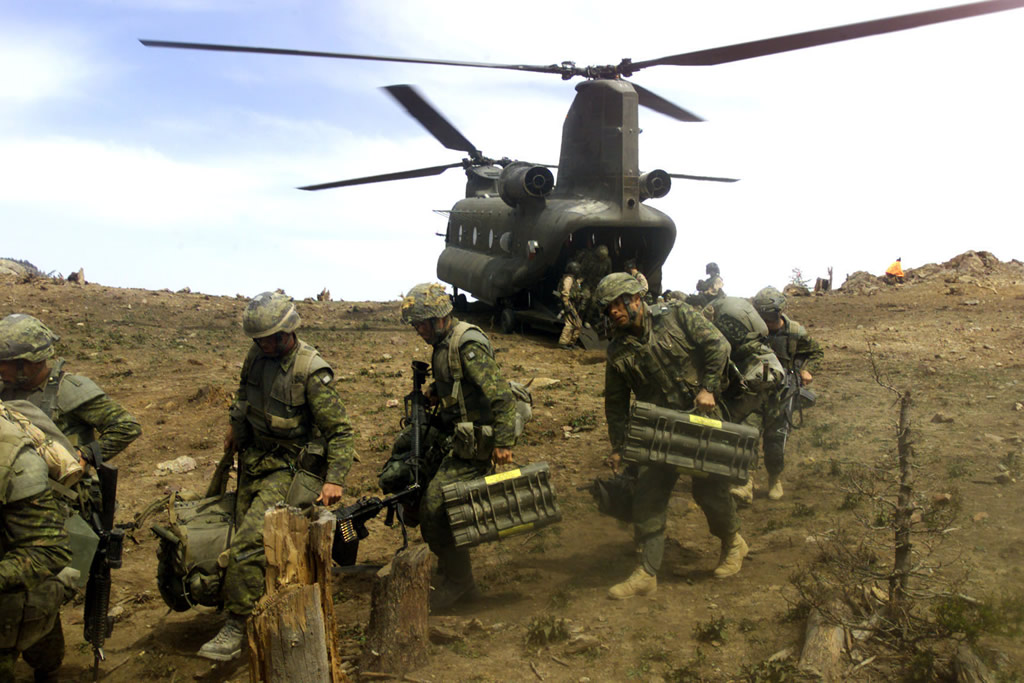
Tora Bora, 2002
(click to view full)
Rather than see a key ally abandon the field, it appears that an arrangement has been worked out with Boeing and the US government for a small force of CH-47Ds. Eventually, they were accompanied by chartered Mi-8s in Afghanistan.
Canada sold its CH-47Ds to The Netherlands in 1991, which means their previous skills base is gone. They will need support from contractor representatives in Canada and in the theater of operations for an unspecified amount of time, in order to field these helicopters and keep them running. About 6 U.S. Government personnel will also participate in program management and technical reviews in-country for 1-2 week intervals twice annually, in order to support site surveys and delivery of the CH-47D helicopters in-country.
The US DSCA added, with some understatement, that:
“Canada needs these helicopters to enhance its capabilities in the Global War on Terrorism (GWOT). Having the same configuration as the U.S. would greatly contribute to Canada’s military capability by making it a more sustainable coalition force to support GWOT.”
Trickle Down: Contracts and Key Events
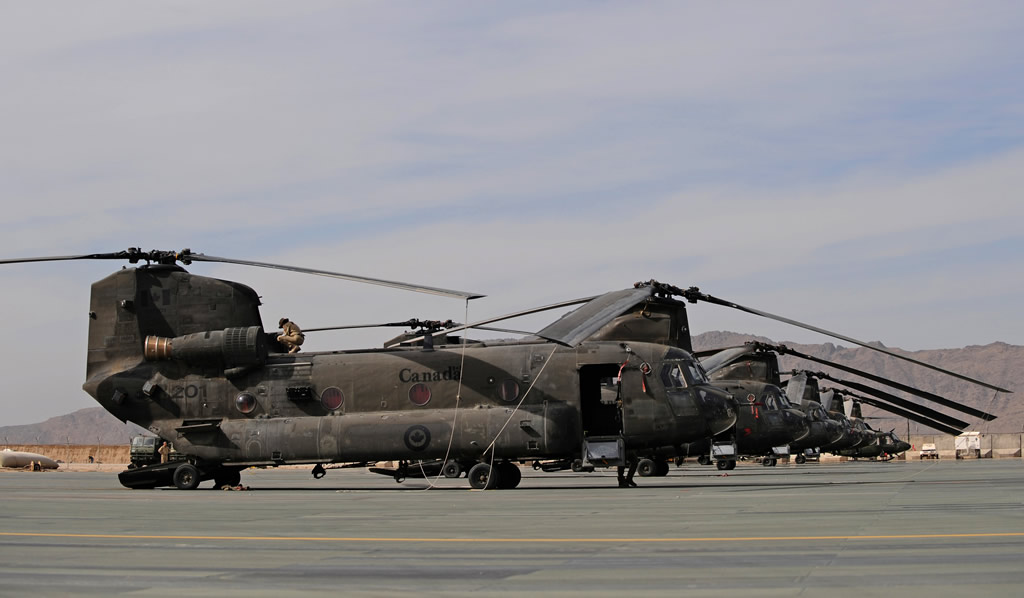
(click to view full)
“These aircraft (selected by the vendor) weren’t exactly sprightly – the oldest was built in 1965 [2] – but these Chinooks were available… The main point of that CP article is that the five remaining CH-147Ds are up for sale only “two years after taxpayers shelled out $282 million to buy them.”… The purchase price for the original 6 CH-147Ds has been listed in the media as: $252M, $282M, and $292M. Why the confusion? Because, as with that replacement CH-47D lease, DND never revealed the actual purchase price let alone details of any terms… [now,] true to form, [DND] refused to provide any “rationale for ditching” the CH-147Ds… Sure, at the time of the sale of the used Chinooks, it was broadly hinted that those aircraft would be returned to the US Army. But where is the proof ? Have you seen the contracts? Nope, and neither has anyone else outside of NDHQ or the Cabinet. Ditto for the terms of the leased Chinook replacement or, indeed, the purchase of 15 CH-147Fs and all the miscellaneous contracts needed to support these new helicopters… A recurring question in all this is why has the Government consistantly allowed DND to hide behind ‘Operational Security’ and other security nonsenses to avoid releasing information of types routinely available to citizens of other NATO nations?”
Chinooks are in demand around the world, so Canada may well find a buyer if the US Army doesn’t want them. The danger in that move is that the new CH-47Fs aren’t scheduled to arrive before 2013, and domestic or international contingencies could require the services of a medium or heavy-lift platform before enough new helicopters have arrived. Air Force Technology | CASR | StrategyPage.
Aug 7/10: The Canadian Forces confirms that a CH-47D Chinook helicopter forced to make an emergency landing 20 km southwest of Kandahar city was shot down by small arms fire. It burst into flames upon landing, but total casualties were only 8 minor injuries. Globe and Mail.
Dec 19/08: Canada’s DND highlights aircraft technicians Corporal Jean-Francois Bournival, Sergeant Pierre Brisson, and Master Corporals Serge Robitaille and Marco Caron, from 430 Tactical Helicopter Squadron, CFB Valcartier. They’ve been immersed in CH-47D Chinook helicopter seasoning training with the Pennsylvania Air National Guard at Fort Indian Town Gap, PA.
Dec 6/08: The Joint Task Force (Afghanistan) 10 Air Wing is officially stood up at Kandahar Air Field (KAF), Afghanistan. The full wing is comprised of 4 units. The first is the Canadian Helicopter Force (Afghanistan) with its 6 CH-147 D-model Chinook helicopters and its 8 CH-146 Griffon light armed scout helicopters. They will be joined by 6 leased Mi-8 helicopters, which are not formally part of the CHF-A but are under its supervision and tasking authority. The 2nd component is the Canadian Heron UAV Detachment, operated by contractor MDA. The 3rd is the remaining Tactical UAV Flight with its Sperwer tactical UAVs. The 4th and last element is the Theatre Support Element, with its CC-130 Hercules aircraft. They are initially C-130E/H models, but will include some new C-130J planes before all is said and done. Photo release.
Aug 18/08: Canada’s Minister for Defence Peter MacKay makes a speech in St. Hubert, Quebec, in which he clarifies Canada’s CH-47D purchase – and adds new information regarding the DND’s interim measures before they arrive:
“We have arrived at a three-step solution to acquire the helicopters we need.
First, in the short-term, Canada will charter up to six commercial helicopters to address our immediate operational requirements in Afghanistan and the recommendations of the Independent Panel on Canada’s Future Role in Afghanistan. We expect them to be available later this summer.
And, by purchasing an additional six used Chinook helicopters from the U.S. Government, we will have in place our own medium-lift military capabilities on current operations by early 2009.”
The speech also refers to Canada’s longer-term effort to buy CH-47F helicopters, as step 3.
April 21/08: The US Defense Security Cooperation Agency announces [PDF] Canada’s official request for 6 older-model CH-47D Chinook twin-engine helicopters, with 12 T55-GA-714A Turbine engines, 4 M240H 7.62mm Machine Guns, 30 AN/AVS-6/7(V)1 Aviation Night Vision Imaging Systems, and 2 spare T-55-GA-714A Turbine engines, plus mission equipment, communication and navigation equipment, ground support equipment, spare and repair parts, special tools and test equipment, publications and technical data, site survey, Quality Assurance Team support, contractor technical and logistics personnel services, and other related elements of logistics support.
The estimated cost is $375 million. There are no known industrial offset agreements proposed in connection with this potential sale, as opposed to the usual Canadian practice of requiring 100% industrial offsets. The prime contractors will be:
* The Boeing Company in Ridley Park, PA (helicopters)
* Honeywell, Inc. in Phoenix, AZ (engines)
* FN Enterprise in Lubbock, TX (machine guns)
The DSCA release’s wording strongly suggests that delivery times and compatibility needs will be served by taking 6 CH-47Ds from US Army stocks, but AMCOM declined to confirm this when asked. The Canadian Forces responded at the time that:
“Following the vote in the House extending Canada’s mission in Afghanistan, Minister MacKay noted the government’s determination to move quickly to fulfil the motion’s requirements by pursuing two avenues – lease and purchase – in both helicopters and UAVs or drones.”
March 20/08: Jane’s Defense Weekly reports that Canada has negotiated the purchase of 6 ex-US Army Boeing CH-47D Chinook medium-lift helicopters for use in Afghanistan, but has no way of supporting the aircraft in theater. “The Canadian Department of National Defence (DND) declined to comment on the acquisition negotiations, stating only that “the department is currently examining a number of options.”
Escape Is at Hand for the Travellin’ Man: Additional Readings & Sources
* DID FOCUS – US Army in Flight on Production of (Re)New H-47 Chinooks. Covers the CH-47F.
* DID Spotlight – On The Verge: Canada’s $4.7B Program for Medium-Heavy Transport Helicopters. These CH-147s will be modified CH-47Fs.
* “The Manley Report” (January 2008) – Independent Panel on Canada’s Future Role in Afghanistan [PDF]. This was an independent panel, but it was called by the Parliament of Canada. This was an independent panel, but it was called by the Parliament of Canada. The money quote:
“Despite recent indicators of imminent reinforcements, the entire ISAF mission is threatened by the current inadequacy of deployed military resources. As well, to improve the safety and operational effectiveness of the Canadian Forces in Kandahar, the Government should secure for them, no later than February 2009, new medium-lift helicopters and high-performance unmanned aerial vehicles. Canadian soldiers currently must rely too much on allied forces for both of these necessary assets. If no undertakings on the battle group are received from ISAF partner countries by February 2009, or if the necessary equipment is not procured, the Government should give appropriate notice to the Afghan and allied governments of its intention to transfer responsibility for security in Kandahar.”
* Canadian Parliament (June 2007) – CANADIAN FORCES IN AFGHANISTAN: Report of the Standing Committee on National Defence [PDF, 174 pages].
* DID (Dec 3/08) – Canada Sending Armed Bell 412s to Afghanistan. Escorts for the Chinooks. Sort of.
* Canadian Military Journal (July 14/08) – The Road to Mobility. By Prof. Martin Shadwick.
* CASR (March 2008) – Canadian Soldiers need Transport Helicopters This Summer Not Next Year – Time to Chat with Our New Czech Mates? Mi-17s in exchange for help with Challenger jets?
* CBC (March 28/08) – Harper plays down Afghan expectations ahead of NATO Summit in Bucharest. Includes notes re: the need to have battlefield transport helicopters in theater by February 2009, per the Manley Parliamentary report.
* CASR (March 22/08) – Defence Minister Hook’d & Hoodwinked Again – All Because Arrogant Air Staff Refuse to Yield in the Interest of Our Nation. “According to a report in Jane’s Defence Weekly, the Canadian government has agreed to buy six used Chinooks – ‘D models’ – from the US Army. The six ex-US Army helicopters in question were selected by the vendor. This is a little like walking into a used car lot and asking the salesman to pick out six ‘previously-owned’ vehicles for your fleet…”
* StrategyPage (March 5/08) – Chinook Replaces Blackhawk in Combat. “For the last two decades, the U.S. Army used the its UH-60 “Blackhawk” helicopter for combat assault missions, while the larger CH-47 “Chinook” was used just for moving cargo. But the army found that, in the high altitudes of Afghanistan, the more powerful CH-47 was often the only way to go in the thin mountain air. While doing that, the army found that the CH-47 made an excellent assault helicopter. In many ways, it was superior to the UH-60, mainly because the CH-47 carries more troops and moves faster and farther.”
* CASR (March 2008) – Afghan Medium-Lift – Searching for Available NATO Mil Helicopters
* CASR (February 2008) – Poland will deploy Helicopters, UAVs, and Troops to S. Afghanistan. They have offered to make 2 Mi-17s available to Canada.
* National Post (June 26/06) – Allies stunned Canadian troops lack helicopters — Choppers save lives, insists U.S. commander