

“Former Iraq Security Contractors Say Firm Bought Black Market Weapons, Swapped Booze for Rockets” says the ProPublica headline. They’re talking about a firm called Triple Canopy, a security contractor who replaced Blackwater (now Xe) as the US diplomatic service’s bodyguards in Iraq, and also had other contracts in theater to protect allied bases and installations, some of which were covered here.
Allegations and legal depositions state that the firm traded booze for weapons, and bought weapons and vehicles on the black market in Iraq between 2003-2004. At least one of those employees have expressed concern that the money used to buy these items may have ended up in the hands of Iraq’s Islamists, who were connected to criminal enterprises in Iraq at a number of different levels.
The article itself turns out to be more balanced than its headline might indicate, and the detailed accusations are linked to detailed responses; both are worth reading. Beginning with the revelation that significant responsibility for this state of affairs traces right back to the US State Department…
* State Department Self-Inflicted?
* Triple Canopy: Allegations & Approach
* Policy Issues
State Department Self-Inflicted?

When Triple Canopy won a contract to protect a number of sites in Iraq at the end of 2003, it immediately applied for a State Department license to bring the weapons it needed from the United Sates into Iraq, along with its employees. That approval took until June 2004, which meant that the US government had simultaneously awarded a contract and denied Triple Canopy the means to fulfill it. In order to cover their assignment, they turned to local suppliers for vehicles, weapons ranging from AK-type rifles to RPG anti-tank rockets, ammunition, even Cuban cigars for use in trade.
Technically, the guns and vehicles were contractor-purchased equipment on behalf of the U.S. government. As the ProPublica article notes:
“Triple Canopy’s frustrations with the U.S. government were hardly unique. In numerous interviews, former U.S. and industry officials described a crazed atmosphere in which U.S. contracting officers demanded guns on the ground and asked few questions.
One private security company official said Iraqi vendors sold weapons at open-air markets, the tables stacked high with AK-47s and other armaments, in full view of U.S. officials.
“It was wide open. It was like a swap meet,” said the official, who works for a Triple Canopy competitor and did not want to be identified. “I’m not aware of any company that didn’t use it.”
Hence the question posed by former Triple Canopy Manager Ronald Boline in his Fairfax, VA legal deposition [YouTube video]:
“We’re spending a lot of money on these rifles, millions of dollars — where do you think that money is going to?… Who are we supporting in doing that? We’re supporting people who are trying to kill Americans is the logical conclusion.”
There are 2 questions concerning this behavior. One is whether it was technically legal. The second involves how a specific company’s operation was conducted, which involves both legal and moral questions.
That is so for commercial reasons, and also because the Iraqi “insurgency” was always a complex intermix of bodies for hire, professional criminal enterprises (man of whom paid the Islamists a cut, in order to be given free rein), Saddam loyalists, foreign al-Qaeda members and their recruits, and professional Iranian army and intelligence operatives.
Triple Canopy: Allegations & Approach
(click to visit)
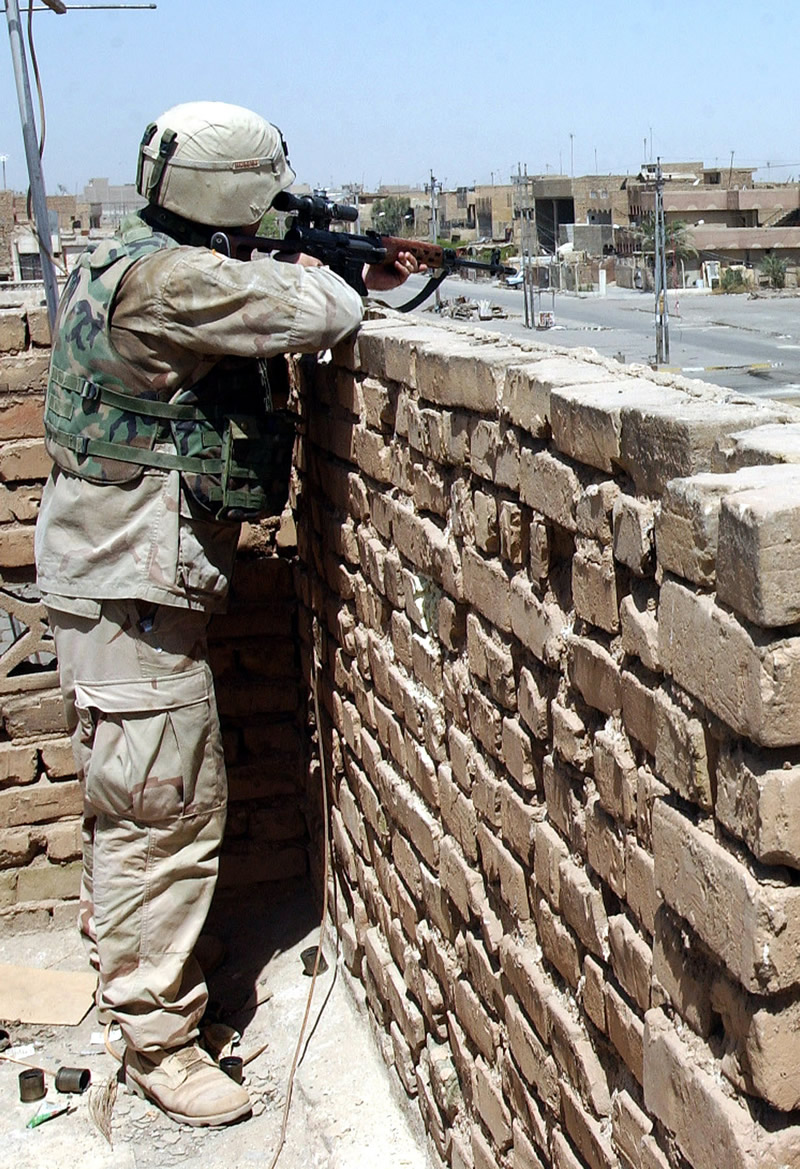
Triple Canopy sourced its equipment in 4 ways. Some was purchased from the Iraqi black market. Some was received through Army collection points, who turned over captured weapons for temporary use by contractors. Some were bought from manufacturers like Colt and Glock, once Triple Canopy received its export license and end user certificate. Some were turned over by American units in theater, as “unserviceable” equipment.
Technically, all of this equipment, except for the very last set, is bought or received on behalf of the US government, and is returned to the government at the end of the contract.
Morally, the Iraqi black market represents by far most significant issue. The ProPublica article quotes several sources in and beyond the security contracting industry, all of whom state that control and oversight of this element by American officials was close to zero, and undertaken, if at all, as contractor company initiatives.
Col. Lee Van Arsdale (ret.) served with US SOCOM’s Delta Force, and was Triple Canopy’s CEO. Before he retired, he laid out his case to ProPublica.
“Not only are we former military, but our former colleagues are still serving in uniform, living, eating and breathing right beside us in some cases. In some cases, we’ve got family members out there… There were a few months in there that, “all right, now what do we do?… The answer [was to] establish a procedure to… mitigate the possibility of that fungible money getting into the wrong hands… We defined the gold standard for training and equipping people at great expense to ourselves as well as great time to ourselves… At a period of hurry up, hurry up, hurry up, we took over two weeks to train guys to make sure they were prepared to go in country. To say that we’re cutting corners and we’re opportunistic and we’re war profiteers, all of the facts argue against that.”
In order to secure weapons, Triple Canopy reportedly turned to a buyer recommended by the U.S. government, one who had been vetted by Defense Department officials and had several letters of recommendation from military officials, praising his work as a translator for U.S. military units. That last element is significant, because translators were and remain a prime target for Islamist death squads. If they fall into Islamist hands, their death is generally the end point of torture. To the extent that Iraqi black market purchases can be safe, a former translator vetted by American officials is probably the best possible bet.
This individual was not the sole source for Triple Canopy, however, as the company also bought cars and other supplies from local dealers and other sources. For instance, Boline adds that about 23-25 of about 56 “soft vehicles” (mostly BMW and Mercedes sedans) bought by Triple Canopy did not have a title associated with them.
That’s not entirely surprising in a middle eastern country whose record keeping was spotty even before the war, but it could also indicate a stolen vehicle. Car theft rings were popular after Saddam’s ouster, and remain a point of focus in Iraq because they generally provide the vehicles used in terrorist bombings. There are even reports that American car theft rings may have provided vehicles used in Iraqi suicide bombings, as part of a transnational criminal supply chain.
Former Triple Canopy manager Boline also adds concerns abut the number of weapons purchased by the firm:
“…generally you have one weapon per man and 10 percent sparing is the standard logistic lowdown for weapons. Once that was exceeded I began to look at it a little closer, because I tracked all expenditures for Triple Canopy’s operations in Iraq every penny the first year…it was a significant cash outlay for those that were actually purchased, approximately $250 per AK; pistols, we probably had 15-20 pistols. They are a lot more expensive because they’re a lot easier to conceal. They’re $600 apiece. PKR machine guns depending on the condition are $800 to $1,200 apiece. The Dragunov sniper rifles are $600. Long barrel AKs, approximately $450, $500…”
Even continued purchases cannot represent intent to amass a permanent arsenal on the government’s dime, unless many of them were not reported. That is not Boline’s allegation. Technically, all of these weapons are purchased on behalf of the government, which means must be given back at the end of contracts. Triple Canopy’s management was reportedly preparing for worst-case scenarios, including the ability to withstand weeks-long sieges.
That leads into Boline’s other allegation, concerning a “Radar O’Reilly” approach to acquiring American military equipment. The range was impressive, involving both equipment declared “unsuitable” under the US military’s high standards, and removed from the books (but still usable at some minor risk), and items that would otherwise have to be shipped home. Boline:
“There was a very strong guidance from Tony Nicholson that U.S. soldiers were not to be paid cash for the equipment that they were giving us… A lot of these units were getting ready to rotate back to the states. They had more gear than they were going to carry back and there was just an unbelievable amount of war material over there. So rather than having to account for it or store it or ship it back to the states, the guys responsible for this equipment were more than happy to give it away, in exchange for that they would be provided with a bottie of liquor or a box of Cuban cigars as a trade or a favor.”
Materials exchanged in this way included officially-unsuitable AT-4 antitank rockets, a 5,000 gallon fuel truck, a tractor, large quantities of bottled water, large quantities of US Army rations, and over $1.5 million worth of medical supplies. Those included over 200 trauma kits for their employees; trauma kits for all of their vehicles, in case the people they were protecting were hurt; even a modern, fully-equipped 2-bed trauma suite.
Now, Informal swaps outside of official channels have been part of military campaigns since the idea was invented, and even the advent of modern RFID tracking hasn’t changed it; if it did, the result would probably be disastrous.
The legal question revolves around the difference between swaps within the military, and swaps with other militaries – or civilians. For a civilian to possess American military equipment, outside of formal alternation and disposal processes, is not legal.
Former Triple Canopy CEO Van Arsdale simply denies that goods were swapped with American soldiers for equipment, saying that the firm investigated Boline’s charges and found no evidence. He also questioned Boline’s motives in making the accusation, and Boline’s own legal deposition acknowledges that he threatened to go public with his charges if Triple Canopy officials blocked his attempts to receive a security clearance in order to obtain a new job. In addition, a criminal investigation begun in 2007 by the District Attorney for the Northern District of New York State ended with the investigation closed, and no charges filed.
Investigators did hear from other employees beyond Boline, however, who said that swaps for a broad range of equipment had taken place with American soldiers. They reportedly decided that it was unclear whether or not the firm had done anything illegal, and couldn’t build what they thought was a suitable case.
Policy Issues

Irrespective of their truth or falsehood, the allegations do bring up some interesting issues concerning the reality of modern front-line, public/private and coalition warfare.
As a mater of perspective, the American penchant for “shiny kit,” and the resources poured into it, has made American troops key sources of critical equipment for allies on the ground in Iraq and Afghanistan. Equipment that has “migrated” in this way includes vehicles, body armor, night vision gear, communications gear, and other important equipment. Technically, that isn’t legal for operationally suitable items covered by Foreign Military Sales requirements. On the front lines, it’s vital to building teamwork, and sometimes even necessary to ensure that allies can help execute the mission alongside American forces. A bit of appropriate paperwork saying that the items were operationally unsuitable, or lost in battle, et voila!
A military run by lawyers and accountants would tighten controls, and prosecute this, and build resentment and strains with allies around the world. It would be terrible policy, terrible leadership, and terrible generalship, all at once.
The issue becomes more dicey, and far more fraught, when the recipients are not other militaries. The military/civilian distinction is blurring in the modern world, in part thanks to modern addenda to the very Geneva Conventions that were originally created to clarify what its founders saw as a critically important dividing line. The process of handing military gear to civilians of any stripe, especially those organized as fighting forces, creates deep concerns that reach far beyond front-line implications. Especially if the equipment handed over has technically been written off, and officially doesn’t exist to be handed back.
The recent discovery of AT4 rockets with Venezuelan serial numbers, at a FARC narco-terrorist base in Colombia, illustrates the far end of this kind of transfer risk.
On the other hand, giving items to a contractor protecting an installation, who is remaining at that location beyond one’s unit’s tour of deployment, does not feel very different from transferring those items to an allied military who is remaining at the same location. In both cases, items are being declared unsuitable and left behind for use on location, rather than shipped in an environment of resource and space limitations, to attract maintenance dollars later. Depending on the item, the transfer could even be technically illegal in both cases, if the item was deemed “suitable.”
Is it different? Should it be different? If so, when, why, and how? Should it be prosecuted? Again, why, when, and how?
These are the kinds of questions that could fruitfully preoccupy military legal minds in the new age of warfare. Hopefully, this will be done from a balanced front-line perspective that the past 8 years of war has developed, and which our future still requires.