


(click to view full)
The RQ-4 Global Hawks isn’t a full successor to the famous U-2 spy plane just yet. It’s close, however, and some people have described the HALE (High Altitude, Long Endurance) UAV as the equivalent of having a photo satellite on station. Flying at 60,000 feet for 30-40+ hours at a time, the jet-powered UAV uses sophisticated radars and other sensors to monitor developments on land, sea, and air over an area of about 40,000 square miles/ 100,000 square km. Reported image resolution has been described as 1 foot or less. The USA has made effective use of Global Hawks since their formal unveiling in 1997, which has prompted interest from other countries. NATO’s AGS system will deploy Global Hawk UAVs as well.
Outside of NATO, however, sales have been much trickier. Four issues have worked to hold up potential sales – 2 of which are acknowledged openly, and 2 of which tend to play out very much behind the scenes. South Korea ran afoul of all 4 of those issues, when the USA rejected their application to buy 4 of the larger RQ-4B UAVs in 2006. Now, it seems, the tide has turned in the USA, but South Korea is less sure. What’s certain is that the USA will be fielding its own Global Hawks over the peninsula. What’s less certain is whether South Korea will buy some of its own.
Global Hawks & South Korea: Challenges and Alternatives
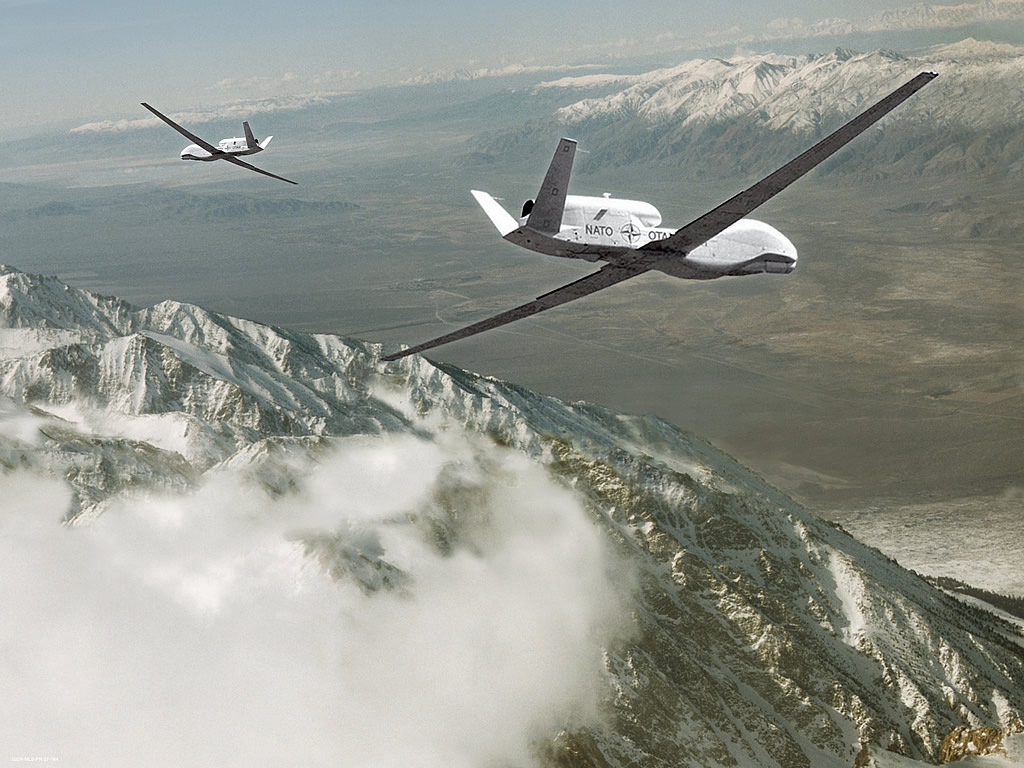
RQ-4B Block 40
(click to view full)
South Korea’s efforts to field a national ISR (Intelligence, Surveillance, Reconnaissance) capability over North Korea, via projects like its modified Hawker Beechcraft 800XR business jets, have fallen short in a key areas. Fortunately for the ROK, the Korean border is narrow, and even North Korea itself is not large. South Korea may only be interested in 2-4 Global Hawk UAVs, but that could be enough to offer continuous coverage.
In some ways, that’s precisely the problem. The RQ-4B Global Hawk is currently a uniquely capable UAV, with no real competitors yet. This has added some export issues that are discussed openly, and others that aren’t discussed in public. International sales of Global Hawks typically run into 4 main issues.
The 4 Challenges

Price. One obvious issue is sticker shock. The basic Global Hawk aircraft itself has a price that approximates a similar-sized high-end business or regional jet, around $35-45 million. By the time its ultra-sophisticated sensors have been added, ground infrastructure put in place, and induction costs for a new platform are factored in, a small fleet of 5 or fewer UAVs can easily fetch a price tag of $150+ million per vehicle. Depending on what South Korea wants, even $300 million per deployed UAV is apparently possible.
International Agreements. Another acknowledged issue is the MTCR (Missile Technology Control Regime) treaty of 1987. South Korea didn’t sign until 2001, but in 1979, the US general in charge of the peninsula’s Combined Forces Command sent a letter asking the ROK to voluntarily impose a similar set of range and payload limits on itself. The move was made with China and Japan in mind as well as North Korea, and the ROK’s large neighbors remain keenly interested in South Korea’s de facto adherence to MTCR limitations. That leaves South Korea semi-bound by an agreement with the USA, which was recently modified, and more durably hobbled by the uncertain terms of the MTCR.
Does a UAV like a Global Hawk qualify? The question seems ridiculous on its face, but when has that ever stopped a lawyer or a transnationalist?
The issue remains a matter of discussion and controversy. In response, the USA has put forward several solutions, including a multinational “Pacific Pool” run with US participation, in a manner similar to NATO’s E-3 AWACS program.
South Korea seems uninterested, and is insisting on its own platforms. If America won’t sell them, they can look elsewhere.
Security. Secrets are one issue that is not discussed openly, because of the sensitivities around telling a country that it cannot be trusted with secrets – even when that belief is well founded. Technology transfer is one aspect of this issue, given the sophistication of the UAV, its payloads, and its control systems. Reports in November 2011 that South Korea is engaged in attempts to reverse-engineer American military technologies have reportedly stalled American interest in a Global Hawk sale, and may do wider damage, if true. A more important sub-issue is discussed even less: the level of trust in the purchaser’s treatment of the kind of intelligence data a Global Hawk UAV can gather.
Stability. Another issue that is not discussed openly involves the relationship between the USA and the purchasing country, along with evaluations of the country’s future political stability and friendliness. Issues in these areas are not typically the sort of thing one airs in public, but any sale of very high-end military equipment must take them into account.
The Roh Moo-hyun administration had antagonized the USA over a number of issues, not least of which was a “sunshine policy” toward the North that often seemed to cross a line into state-supported anti-Americanism. A recent incident in which more ROK army cadets identified the USA as the prime threat to their country than North Korea speaks to that dynamic. When combined with evidence of business ties at senior government levels involving North Korea, there were open questions about both the security of any technology transfers, or of any information South Korean RQ-4s might gather about the North. Revealing what the Global Hawks could and could not see would not only compromise South Korean intelligence collection capabilities, it would also compromise what America could see with its own UAVs.
The successor Lee Myung-bak administration changed some of this dynamic. It not only ended the “sunshine policy” as official writ, it took active steps to stop bureaucrats and public servants from continuing it. Relations with the USA were much improved, and suddenly, the USA believed it had found the required legal formula to sell Global Hawk UAVs to South Korea.
The question is now a matter for negotiations between the 2 governments. It took 4 1/2 years before those negotiations could even produce an official Foreign Military Sale case, and the ROKAF remains uncommitted to the Global Hawk.
Plan B?
(click to view full)
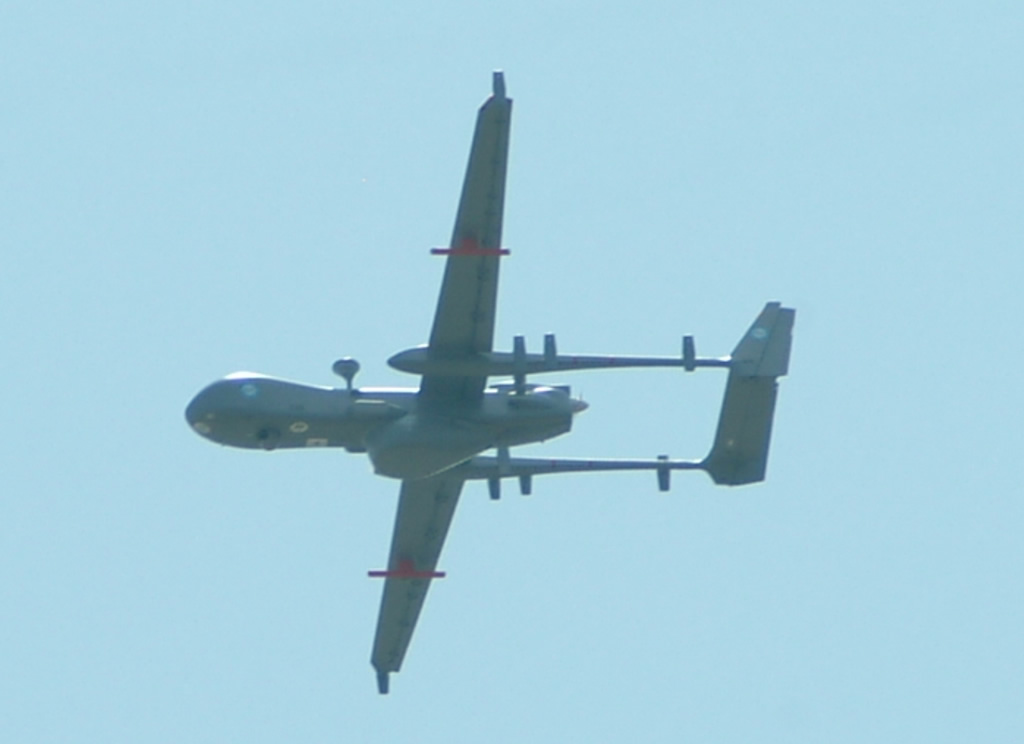
If south Korea proves unable to purchase Global Hawks, or unwilling to pay the cost, it has a few options. Similar coverage might also be possible with a larger number of less-capable UAVs, such as IAI’s Heron-TP, Elbit’s Hermes 1500, or General Atomics’ MQ-9 Reaper. All are proven air vehicles, in service, with sensors already integrated. South Korea already uses Israeli UAVs, but the American MQ-9 offers the widest variety of integrated weapons and add-on reconnaissance modules.
The ROK is also trying to develop its own Medium Altitude, Long Endurance UAV by 2016, but that timeline is risky, and testing and integration of the required sensors adds even more risk. South Korea is likely to continue development as a matter of policy, but the ROKAF would not be prudent to rely on it.
At the higher end, Global Hawk’s potential replacements are all developmental.
EADS’ jet-powered Talarion promised similar capabilities, while side-stepping any issues with US technology exports, Unfortunately, their UAV doesn’t have a stable development path or outside funding, and EADS has halted further work. It would be possible for the ROK to step in as a main development partner, but that commitment could easily double or even triple the cost of simply buying the American RQ-4.
Talarion’s expected competitor, the BAE/Dassault Telemos project, is ahead of Talarion in that its base “Mantis UAV” platform has already flown. It’s still very much a developmental aircraft, however, with development risks that are only slightly lower than Talarion’s.
Aerovironment’s Global Observer offers even longer endurance than the Global Hawk, but less payload, and has been mentioned in the ROK legislature as an alternative. It’s being developed under a US government contract, but the firm has burned through the available funds, and experienced a mishap with one of the test vehicles. Adding the ROK to the program might solve their problem, but this is definitely a higher-risk option from the Koreans. Integrating the required radars and other surveillance gear adds more time and risk, and any sale will face many of the same export issues confronting the sale of Global Hawk UAVs and their sensors.
General Atomics’ jet-powered Predator C has a stable development path and credible corporate funding commitment, but has all of the integration and export issues present for the Global Observer.
Boeing’s Phantom Eye also offers good funding and development certainty, with similar altitude and endurance capabilities to Global Hawk, but lower speed and hence a smaller coverage area per hour. Its 450 pound payload is the smallest of any UAV option in this list, and it would share the same integration and export issues as other American UAVs.
Contracts and Key Events
2011 – 2013
DSCA request; Korea looks at options, and picks Global Hawk; Espionage and treaty issues complicate negotiations.

(click to view full)
March 24/14: South Korea’s government officially ratifies its decision to buy 4 RQ-4 Block 30 Global Hawks, a variety that has had some teething problems. It’s announced alongside their $6.79 billion decision to sole-source 40 F-35As as their next fighter jet, instead of accepting 60 F-15SEs from Boeing’s $7.2 billion bid.
DAPA said it will sign a letter of acceptance within a month, before starting formal negotiations to acquire “the key weapon system for the Kill Chain by monitoring North Korea around the clock to detect early signs of provocations”. Sources: Yonhap, “S. Korea confirms US$6.8 mln deal for 40 F-35s in Q3” and “Lockheed Martin says F-35 will get cheaper in next five years” | Reuters, “South Korea boosts air defenses with about $6.8 billion budget for F-35s”.
Nov 1/13: Negotiations. South Korea will reportedly buy 4 Global Hawk UAVs from Northrop Grumman through the U.S. Foreign Military Sale (FMS) program, with a decision expected to come early in 2014. The ROK had reportedly looked into Boeing’s Phantom Eye and AeroVironment’s Global Observer, but both of those models have much lower payloads, and fell short of the country’s envisioned requirements.
The finance ministry has reportedly approved an extension of funding, and a stronger Won : Dollar ratio may help as well, even as that ratio raises broader concerns in South Korea’s export-dependent economy. Barring any snags, ROKAF Global Hawk deployment is now expected in 2017. Sources: Yonhap, “S. Korea nearing decision to buy Northrop’s Global Hawks” and “(LEAD) Stronger won emerging as risk factor for S. Korean economy”.
Dec 24/12: Request. The US DSCA announces South Korea’s request to buy up to 4 RQ-4 Block 30 (I) Global Hawk UAVs with the Enhanced Integrated Sensor Suite (EISS). By 2015, the ROK is scheduled to take over primary responsibility for battlefield intelligence gathering, but the Global Hawks are unlikely to arrive before 2016.
The EISS includes the standard synthetic aperture radar with ground moving target indicator (SAR/GMTI), an infrared/electro-optical turret, a signals intelligence package, and an imagery intelligence exploitation system.
The Global Hawks will also need a mission control element, a launch and recovery element, test equipment, ground support, operational flight test support, communications equipment, spare and repair parts, personnel training and training equipment, publications and technical data, and other forms of U.S. Government and contractor support. The principal contractor will be Northrop Grumman Corporation in Palmdale, CA, and implementation of this proposed sale won’t require the assignment of any additional U.S. Government or contractor representatives to Korea.
The estimated cost is up to $1.2 billion, which is much higher than previous figures. The USA is abandoning its Global Hawk Block 30 fleet, but the sudden surge in price reportedly covers increased remodeling costs for sale to Korea, performance and technology improvements, and additional development costs. If, indeed, South Korea chooses to buy Global Hawks at all. DAPA representatives have told the press that this will be a competition. The Global Hawks offer greater capabilities than any alternative, but if South Korea can’t work out a deal for $800 million or so, they’ll turn to other options. US DSCA [PDF] | Chosun Ilbo | Yonhap | Agence France Presse.
US DSCA request
July 19/12: South Korea is running into problems with the USA over missile agreements, and those problems extend to its own MALE UAV program as well as its proposed Global Hawk HALE UAV purchase. The USA is making things even worse by insisting that fuel be included in the payload limits for South Korean missiles or UAVs. That kind of mindless obstructionism may backfire, since the USA doesn’t calculate its own equipment that way.
Note that South Korea is not a signatory to the global MTCR treaty. Its missile limits rest solely on agreement with a 1979 letter of request sent by a US general, and in part on pressure from China and Japan. If the ROK concludes that there’s no reasonable way to work with the USA on this, it could simply choose to revoke its agreement, ignore the diplomatic fallout, and proceed independently. Chosun Ilbo | Chosun Ilbo Op-Ed.
Dec 26/11: Negotiations. South Korea’s Yonhap news agency quotes an unnamed government source who says that the HALE UAV acquisition has been put off until 2016, because the USA has yet to send a letter of agreement to sell the Global Hawk. The ROK had expected one by July 2011.
South Korea reportedly plans to invite Aerovironment (Global Observer) and Boeing (Phantom Eye) to enter the bidding, but the same defense export issues would apply to them as well. Yonhap.
Nov 18/11: Espionage issue. South Korea’s left-wing Hankyoreh newspaper reports that a combination of unauthorized examination of an F-15K’s “Tiger Eyes” IRST (InfraRed Search and Track) sensor, and concerns that a number of South Korean products contain copied technologies, has halted “strategic weapons exports” from the USA to South Korea. That reportedly includes the proposed RQ-4B Global Hawk deal. Read “US-South Korea Rift? Of Tiger Eyes & Industrial Spies” for more.
Oct 18/11: Industrial. The RQ-4 is shown at the 2011 Seoul International Aerospace and Defense Exhibition, and Northrop Grumman signs memoranda of understanding with 4 South Korean companies to help manufacture parts for the drones: Korean Air, DACC, Foosung, and KJF.
Their challenge has been working without an agreement framework, which limits what Northrop Grumman can share – or even discuss – with potential partners. Parts reportedly include aerospace-grade wire harnesses, cable assemblies, sheet metal, machine, tubing and composites. UAS Vision | Iran’s Press TV [incl. video].
Sept 22-29/11: Negotiations. South Korea threatens to walk away from negotiations, as reports indicate that the price for its 4 Global Hawks and ancillaries has hit WON 940 billion (about $820 million). Some reports, however, suggest that much of this is the ROK’s own fault, as a direct result of their standard negotiating style.
The package discussed in 2009 was around $400 million, but the Koreans used a tactic the American have seen before, and tried to improve the deal by expanding the contract’s scope. Maintenance and spare parts were added to the negotiations, even as South Korea’s requirements for the UAVs and their payloads remained very vague. That makes price estimation difficult, especially if “demand creep” is expected. The USA’s response appears to be to present a very high price that leaves them certain there’s enough money to fulfill the request, then let South Koreans bring the cost down by negotiating items out, or clarifying them into exact language.
UAVs remain a high priority for South Korea’s army in particular. Wikileaks cables indicate that they’ve also been a high priority for the US State Department, with the Pentagon as the agency that has been more cautious. Chosun Ilbo | Korea Herald | Yonhap | AOL Defense | Asia Times re: Wikileaks.
March 11/11: Negotiations. Aviation Week reports that a “handshake agreement” exists for South Korea to be able to buy 4 RQ-4B Global Hawk Block 30i UAVs, which will include high resolution day/night cameras as well as the synthetic aperture radar. A DSCA notification is expected soon, with 1st delivery targeted for 2014.
The South Koreans are interested in signals intelligence as well, but the USA is reportedly balking at selling their forthcoming ASIP pods. Germany’s EuroHawk has signals intelligence as its primary mission, which could open the door for firms like EADS to offer solutions. The other obvious option would be for South Korea to turn to Israel, which has crafted SIGINT payloads for a variety of aircraft and UAVs, and is expanding its defense ties with the ROK.
March 7/11: Hacked. Reports surface that China hacked South Korean computers, trying to get information that Northrop Grumman had shared about its RQ-4 Global Hawk, in the lead-up to a possible sale. Shin Hak-Yong, an opposition Democratic Party lawmaker and a member of parliament’s defence committee, said that:
“We’ve had a report from a government official that China launched a hacking attack on the Defense Ministry’s computer system and accessed confidential information about the ministry’s plan… The government hasn’t raised this issue with China yet and is apparently still mulling how to handle it.”
After North Korea sank the ROKS Cheonan in 2010, the ROK government earmarked WON 45.2 billion (about $40.4 million) from the 2011 budget to start negotiations. Chosun Ilbo | Agence France Presse.
2005 – 2010
USAF withdraws U-2s in favor of its own Global Hawks; USA does U-Turn, and will now consider a Global Hawk sale; South Korea starts its own UAV programs.

(click to view full)
June 5/09: U-2s out. In light of tensions of the Korean peninsula following North Korea’s 4kt nuclear fizzle test, missile tests, and renunciation of the 1953 ceasefire that ended the Korean War, the USA says it will be replacing its U-2s over Korea with Global Hawk UAVs – and urges South Korea to buy some. Agence France Presse:
“Lieutenant General Jeffrey Remington said the US Air Force in the South would retire decades-old U-2 spy planes and replace them with Global Hawk unmanned reconnaissance planes. Remington’s comments in an interview with Dong-A Ilbo newspaper were confirmed by his public affairs officer.
The general also said South Korea should buy the Global Hawks to improve the surveillance capability of the joint force.”
May 10/09: South Korea’s Defense Reform 2020 initiative is being adjusted to beef up the army, according to a plan that’s expected to be finalized in June. According to Yonhap, the high-altitude UAV’s introduction will be delayed from 2011 to 2015. That date would still be in line with the original integration schedule.
It depends on what Yonhap’s sources mean by “introduction,” but 2011 was supposed to mark the end of initial R&D work. Korea Times.
Dec 7/08: Local MALE. Reports surface that the ROK’s Defense Acquisition Program Administration (DAPA) has selected Korean Air as the main developer of an indigenous medium-altitude unmanned aerial vehicle (UAV) to start missions after 2016. The proposed UAV will be designed to perform missions as high as 50,000 feet / 15 km for more than 24 hours.
Korean Air, the country’s largest airline, reportedly won the WON 450 billion (currently $305.9 million) bid, beating Korea Aerospace Industries (KAI). The firm has assembled UH-60 Black Hawk helicopters, runs maintenance services for both civilian and military customers, and developed and tested its own small UAV in 2007. Even so, the cited source adds that Korean Air will have “the technological help of a foreign defense firm” as they develop and integrate the spy plane’s fuselage and other related systems, including a ground-control station and a mission equipment package (MEP). Preliminary R&D will take place from 2009 – 2011, and system development and integration is scheduled to run from 2012 – 2016.
This decision does not preclude the purchase or lease of Global Hawk UAVs as a bridge buy or supplement to South Korea’s own UAV project. Nevertheless, The Korea Times writes that:
“Earlier this year, the Ministry of National Defense hinted that it would push harder for developing an indigenous UAV rather than purchasing the Global Hawk high-flying UAV from the United States.”
That foreign partner was not named, but the possible field is limited if one restricts it to manufacturers with systems that already meet the ROK’s criteria. Korea currently fields both Israel Aerospace Industries Searcher UAVs and Elbit Systems’ Skylark II for tactical reconnaissance, and has industrial relationships with those firms. Either IAI’s Heron 2/TP or Elbit’s Hermes 1500 would qualify under the ROK’s criteria, and the Heron-TP is also the basis of France’s forthcoming EAGLE UAV. The other possibility is General Atomics, who has a number of UAV variants in the MQ-9 family (Reaper, Altair, Mariner).
As an interesting postscript, Korean Air’s win may trace to a 2006 revision of the law governing the designation of defense manufacturers, which removed preferential treatment for those firms designated as defense manufacturers. The new law allows any companies or partnerships to compete, as long as they can demonstrate adequate production capacity and low-risk status. The revised law is to be put into effect at the beginning of 2009, after a 2-year grace period. Korea Times.
local MALE UAV as “Plan B?”
July 23/08: Negotiations. During a meeting of the bilateral US/ROK Security Policy Initiative the U.S. informally notifies Seoul that it might agree to sell them the Global Hawk UAV. The decision was reportedly communicated during a meeting of the bilateral Security Policy Initiative, and the Chosun Ibo adds that:
“…already in April, after the Lee Myung-bak administration was inaugurated, the U.S. [had] informally notified Seoul there was a possibility it might sell the aircraft to Korea.”
The immediate about-face, at the same time as a change in government, is not a coincidence. Chosun Ibo | KBS | StrategyPage
July 13/06: USA says no. The Dong-A Ilbo reports that:
“According to the Defense Acquisition Program Administration, military authorities requested the U.S. to sell it four Global Hawks in 2008 at last year’s SCC in Hawaii in order to secure independent surveillance ability on North Korea. Korea requested this several times. However, last June, the U.S. put out a “not for sale” policy and have rejected Korea’s requests.
The U.S. is thought to have rejected the request for fear that the core technology might be leaked. Some are known to be worried that confidential information collected on North Korea using the Global Hawk might be leaked to the North.”
No sale
July 13/05: Request. South Korea’s Defense Ministry admits to asking the United States to sell it Global Hawk UAVs, as part of the country’s mid to long-term arms acquisition plan. The request was made at a subpanel session of an annual defense ministerial meeting between South Korea and the U.S. Air Attack.
Additional Readings
* Northrop Grumman – RQ-4 Block 20 Global Hawk. The ROKAF will probably want Block 30s, with added day/night cameras.
* Global Security – RQ-4A Global Hawk (Tier II+ HAE UAV)
* DID (March 9/06) – Australia Rushes AIR 7000 HALE UAV Project, Considers Multi-National Global Hawk Pacific “Pool”
Other UAV Options
* DID – Aerovironment’s Global Observer: Flying High, Again
* Air Force Technology – Talarion MALE UAV, France. Privately funded development.
* Elbit Systems – Hermes 1500. The Hermes 900 might qualify as well.
* IAI – Heron TP
* Boeing – Phantom Eye High Altitude Long Endurance aircraft unveiled. Privately-developed, hydrogen powered.
* General Atomics ASI – Predator C Avenger UAS. Privately-funded development, but may be in use by a US intelligence agency.
* DID FOCUS – MQ-9 Reaper: The First Operational UCAV? Covers the differences between the MQ-1 Predator and the MQ-9 family.
Eyes on Korea
* Seoul Station. R.J. Koehler offers a consistent window into Korean politics, culture, and related international affairs, via links and excerpts from Korean news.
* ROK Drop (Aug 8/08) – South Korea, Elections, Mandates, and Habits… An American military blogger in South Korea offers some thoughts regarding Korean culture, the relationship with the USA, and recent events. Thought-provoking.