Aerovironment’s Global Observer: Flying High, Again
Latest updates: Test crash, funding issues deliver a 1-2 punch to the program.

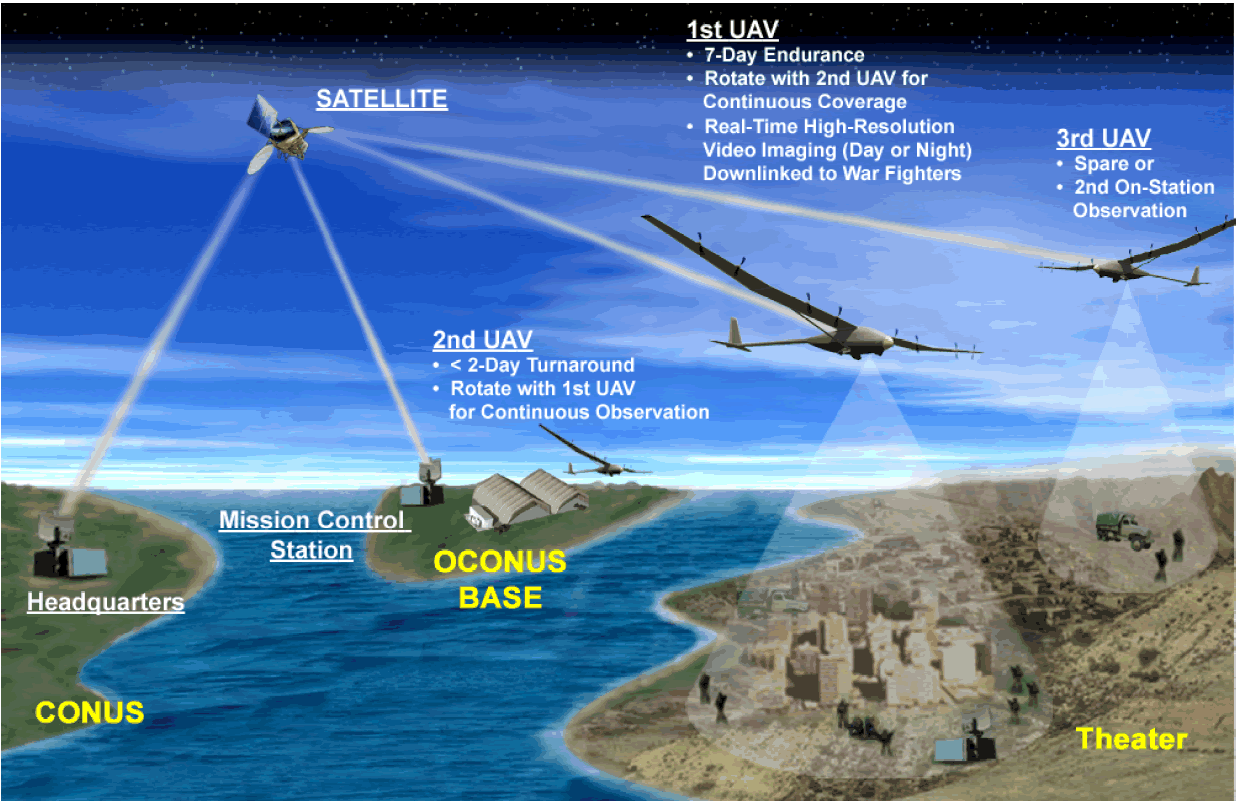
ISR CONOPS(CONcept of OPerationS)
(click to view full)
The late Dr. Paul McReady’s Aerovironment, Inc. has achieved just renown for the success of its small UAVs like the Army’s RQ-11 Raven and the US Marines’ RQ-14 Dragon Eye/Swift. Outside the military sphere, however, it is best known for civil successes like the human-powered Gossamer Condor, the giant, solar-powered Pathfinder and Helios aircraft, and the flying Quetzalcoatlus northropi ornithopter on display in the Smithsonian museum.
Those traditions have fused in a major Advanced Concept/Joint Capability Technology Demonstration (ACTD/JCTD) contract for a UAV that runs on hydrogen fuel cells, and can cruise at 55,000-65,000 feet for up to 7 days at a time, while carrying a 1,000 pound payload. Meet Aerovironment’s Global Observer, which promises formidable advantages in roles as diverse as communications relay, persistent ISR (intelligence, surveillance & reconnaissance), maritime patrol, and even storm tracking and weather applications:
* The Global Observer JCTD
* Contracts & Key Events [updated]
* Additional Readings
The Global Observer JCTD
(click to view full)
Persistent stratospheric/near-space surveillance is a coveted goal of many militaries, not least the USA’s given America’s long shores and wide-ranging ocean interests. As noted above, each aircraft in a Global Observer system is designed to fly at an altitude of between 55,000 – 65,000 feet for 5 – 7 days. That’s above weather systems, and above other conventional airplanes. That height also helps due to the laws of physics, which allow aircraft at that altitude to cover a circular area on the surface of the earth up to 600 miles in diameter, equivalent to more than 280,000 square miles of coverage.
The Pentagon is working to develop lighter-than-air craft like the tethered JLENS aerostats and free-ranging High Altitude Airship blimps for this role, but there’s also a niche for an unmanned vehicle offering less persistence and lift, more speed, and an immediate “Plan B” option in case the blimp-related projects don’t pan out, or satellite programs like AEHF or TSAT fail to deliver the required bandwidth into theater.
When Aerovironment President & CEO Tim Conver talks about delivering “a brand new value proposition – affordable persistence in the stratosphere,” this is what he is referring to.
The goal for Global Observer is for payload capacity of up to 400 pounds for GO-1 & 1,000 pounds for the second GO-2 series aircraft. Propulsion uses liquid hydrogen fuel and fuel cells to drive 8 small rotary engines set along the wings; as noted above, the goal is 7-day flights. Missions could include:
* Wide-area “persistent stare” reconnaissance for defense and homeland security missions, probably using radars rather than optical payloads as the primary sensors;
* Signals and communications intercepts over a wide area, for long periods of time;
* Low-cost, rapidly deployable augmentation for telecom bandwidth, and even GPS;
* Hurricane/storm tracking, weather monitoring, wildfire detection, and sustained support for relief operations;
* Aerial imaging/mapping, for defense uses or for civilian commercial and environmental monitoring, agriculture crop management and harvesting optimization.
A total of 6 government organizations are sponsoring the Global Observer JCTD program, reflecting broad interest in its potential capabilities for military applications. The Deputy Under Secretary of Defense for Advanced Systems and Concepts (DUSD (AS&C)) selected Global Observer as a Fiscal Year 2007 JCTD Rolling Start in the Fiscal Year 2007 Advanced Concept/Joint Capability Technology Demonstration (ACTD/JCTD) Congressional Report, and designated US Special Operations Command as the Technical Manager to lead it. To date, $140 million has been invested to develop it.
Multiple communication and remote sensing applications have already been demonstrated from this operating position, including high definition broadcast (HDTV) video, and third generation (3G) mobile voice, video and data using an off-the-shelf mobile handset. The September 2007 contract will provide for additional testing and demonstrations that could easily translate into full production if the design is successful.
Contracts & Key Events
Global Observer
(click to view full)
August 7/15: An Indian firm is partnering with AeroVironment to develop a new small UAV based on the US company’s Raven and Puma models. The development was outlined as a planned collaborative project in January and formally announced as part of the bilateral Defense Technology and Trade Initiative program. Dynamatic Technologies will partner with AeroVironment to produce a land and maritime-capable UAV, known as the Cheel, which operates from a Ground Control Station also compatible with other AeroVironment systems.
April 1/11: About 18 hours into its 9th “envelope-expansion” test flight, the sole Global Observer demonstrator UAV crashes and is lost. A 2nd demonstrator is almost ready, but the process of investigation, modifications, and fielding could set the program back by up to a year. Aerovironment CEO Tim Conver made the expected points concerning the inherent risks of programs that push technical frontiers, the fact that no-one gets hurt in unmanned vehicles, and the firm’s commitment to learning from the crash and proceeding with their “compelling solution to important government and commercial needs.”
All of that is true, but it is still a very ill-timed setback for the program. In early March 2011, AeroVironment told Aviation Week that the company was looking for incremental bridging funding beyond the end of March, in order to continue Global Observer work until it becomes a procurement program. The firm’s crash release confirmed that most of the $140 million in development funding has been spent, and the bridge to further orders just got noticeably longer. Aviation Week.
Feb 28/11: Ultra Electronics Advanced Tactical Systems of Austin, TX flies its JALN TCS (Joint Aerial Networking Layer Tactical Communications System) on a Global Observer flight. Their system weighs 35 – 150 pounds, depending on options chosen, and translates data to and from a wide variety of datalink and radio formats (JTRS, AIS, Link 16, SADL, S-TADIL J, CDL, TTNT, HNW, VoIP), allowing aircraft and UAVs to communicate with each other and with ground troops. At the altitudes reached by Aerovironment’s UAV, 1 system could cover an area almost the size of Afghanistan. Ultra Electronics.
Jan 11/11: The Global Observer completes its 1st hydrogen-powered flight at Edwards AFB, CA, flying for 4 hours at up to 5,000 feet. Note that despite the headlines in various media, the world’s 1st hydrogen powered flight was achieved by Boeing, using a manned aircraft. Global Observer is unmanned, so it represented a different technical barrier.
The Global Observer’s flight test program will now systematically expand the altitude and duration of test flights, which will include the Air Force’s Joint Aerial Layer Network (JALN) Tactical Communications Suite (TCS) payload for persistent, IP-based aerial communications over a wide area. Aerovironment | c|net News | WIRED Autopia.
Oct 25/10: AeroVironment, Inc. announces that the 1st Global Observer JDCTD aircraft successfully completed initial battery-powered flight testing at Edwards AFB, CA in August and September 2010. That included multiple low-altitude flights to test guidance, manual and autonomous controls, navigation, structural performance, thrust levels and handling in various winds and turbulence conditions.
With respect to next steps, AeroVironment has successfully operated Global Observer’s hydrogen-fueled generator for more than 1,500 hours in a specialized environmental testing chamber, including an uninterrupted 7-day mission cycle. That equipment has now been installed in the aircraft, and will be used during upcoming stratospheric, extreme endurance flights during the joint operational utility assessment phase of the program. See also Aviation Week.
Aug 11/10: AeroVironment, Inc. announces that a full size 175 foot Global Observer wing has successfully completed a series of Wing Load Tests at the Flight Loads Lab in NASA’s Dryden Flight Research Center, Edwards AFB, CA. The goal is to make sure that the design can handle the expected stresses from turbulent air and aircraft maneuvers, as well as create a baseline for future flight test data. Chairman and CEO Tim Conver:
“With ground and wing load testing behind us we look forward to demonstrating Global Observer’s unique ability to fly longer and higher over any location than any other aircraft. That ability can translate into more valuable reconnaissance and communications at a lower cost to military and non-military customers.”
Aug 5/10: First flight. Global Observer Aircraft 1001 (a.k.a. GO-1) takes off from runway 04L at Edwards AFB, CA and climbs to an altitude of 4,000 feet. AeroVironment’s chief test pilot, USAF Lt. Col. Andy Thurling (ret.), operates the aircraft remotely from the portable Launch and Recovery Element (LRE), performing a series of pre-planned maneuvers under battery power before landing successfully one hour later.
The hybrid-electric aircraft will ultimately carry a liquid hydrogen-fueled propulsion system to power it through high altitude, long endurance joint operational utility assessment planned for later in 2010. Aerovironment.
May 25/10: Aerovironment provides a program update. Final assembly of Aircraft 2 is proceeding. With respect to GO-1, a final Flight Readiness Review will be conducted soon. Initial flight testing is expected to consist of low-altitude, battery-powered flights at Edwards AFB, in order to test Global Observer’s airworthiness and handling.
Communications relay and intelligence, surveillance and reconnaissance (ISR) payloads are being prepared for installation into the aircraft, once development flight tests have been completed. Joint operational utility flight demonstrations are the next step after that.
March – April 2010: The joint Department of Defense, NASA and Aerovironment team performs aircraft system tests on Global Observer Aircraft 1 to test hardware and software readiness, and support ground and flight crew training in preparation for the initial flight series. Taxi tests confirm autonomous propulsion, data link operation, steering and braking. Source.
February 2009: The joint team completes ground vibration and structural modes interaction tests on GO-1 at Edwards AFB, California. Source.
December 2009: First Global Observer aircraft (GO-1) shipped to Edwards AFB, CA. Source.
June 3/09: Aerovironment announces that the Global Observer Joint Capability Technology Demonstration (JCTD) program has exercised an option for the assembly of a 3rd Global Observer aircraft, and additional items. The release adds that 6 contract options have been exercised since the program began, bringing the cumulative value to $120 million – $12 million over the original maximum. This 3rd aircraft will still have the 400 pound capacity limit found on early model aircraft.
The order for the 3rd aircraft comes at the midpoint of the JCTD and follows a series of milestones in design, development and testing of the Global Observer system, including successful Preliminary Design Review and Critical Design Reviews. To date, Aerovironment has received contracts for the development, fabrication and testing of 3 aircraft, 2 launch and recovery elements, Systems Integration Laboratory testing, and other development items.
Operation of the advanced hydrogen-fueled power generation system continues in an altitude chamber, after previous successful, multi-day tests.
Paul MacCready
(click for bio)
Sept 27/07: The basic $57 million contract, which will be funded under a cost-plus fixed-fee arrangement, provides for design, fabrication, integration, and ground testing of a hydrogen powered Global Observer Unmanned Aircraft System. The system includes one aircraft and ground control station with integrated modular payloads and spares, contractor operation and logistics support for the Global Observer JCT demonstrations, including flight testing. It also includes options for for the development and delivery of up to 2 additional Global Observer aircraft and an additional ground control system, as well as military utility assessment and engineering trade studies, resulting in a potential contract value of $108 million.
The JCTD is intended to demonstrate the tactical utility of a hydrogen-powered UAS for long duration (five to seven day) missions at altitudes from 55,000 to 65,000 feet. A system consisting of 2-3 aircraft will provide continuous ISR or communications relay over an area of interest. Work will be performed in Monrovia, CA from Sept 21/07 through April 30/11 (H92222-07-C-0072).
Aug 28/07: Dr. Paul MacCready, the entrepreneur, founder and former chairman of the board of directors of AeroVironment, Inc., passes away in his sleep. His work included many of the path-breaking designs that would inform the Global Observer project. Aerovironment.
Additional Readings
* Aerovironment – Global Observer
* DID (July 6/05) – USAF Looking at “Near-Space” Blimps