

(click to view full)
The Alliance Ground Surveillance (AGS) program began in 1995, and it has taken a very long time. Its MoU was late, its contract will be both late and smaller in scope, and it won’t meet even a revised 2012 – 2014 fielding window. At long last, however, one can be assured that it will exist. This is DID’s in-depth FOCUS Article covering the AGS program, from its platforms to its program structure to its long-awaited contracts.
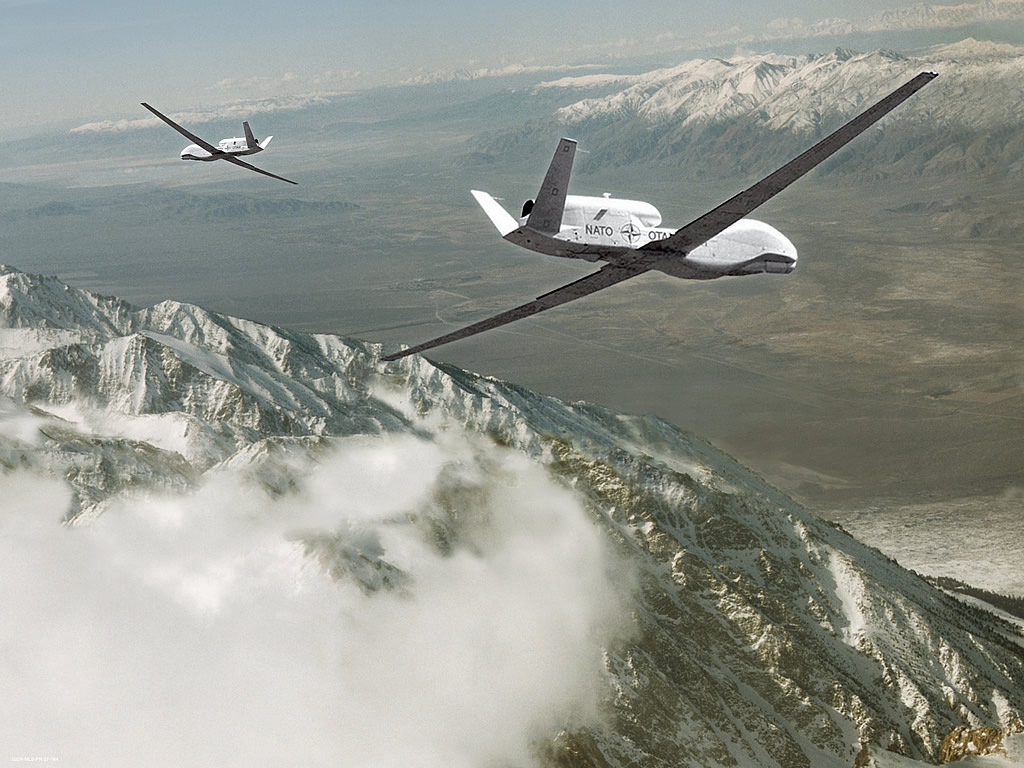
The original AGS plan involved an Airbus A321 counterpart to Northrop Grumman’s E-8C Joint Surveillance Target Attack Radar System (J-STARS), a Boeing 707 derivative whose powerful ground-looking Synthetic Aperture Radar (SAR) offers American commanders combat-changing battlefield surveillance and communications. AGS would be a pooled NATO asset, adding 7 RQ-4B Global Hawk UAVs and dedicated ground stations to complement the manned planes. It has since been reduced to just 5 RQ-4 Block 40 Global Hawk UAVs and dedicated ground stations, but could expand again if countries decide to make some of their national surveillance assets part of the program.
The Need for AGS
(click to view full)
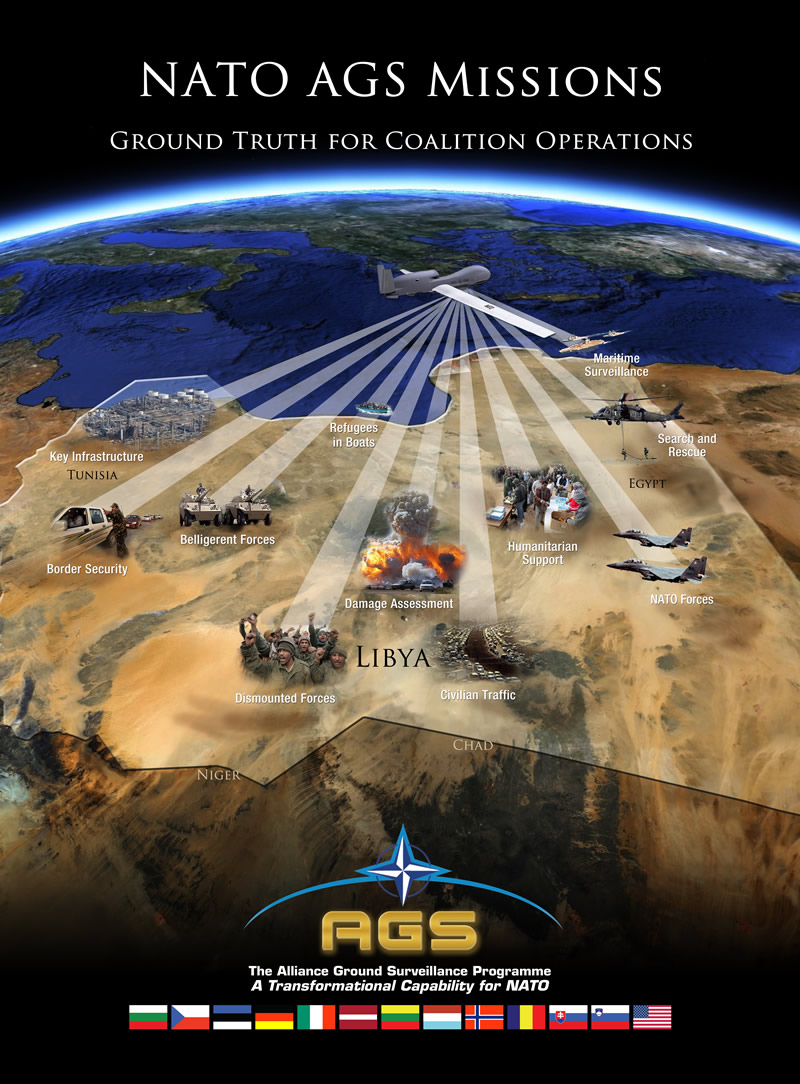
AGS was envisioned as a core component for the NATO Response Force. The war in Libya was a concrete example that didn’t involve regular ground forces, but the usefulness of land surveillance platforms was so keenly felt, that Northrop Grumman’s graphic at the beginning of the article overlays AGS on a not-so-subtle a map of Libya. The AGS fleet will also support a variety of new mission requirements for NATO, including domestic security operations and humanitarian relief.
Writing in (the now-defunct) eDefense Online, Polish Air Force and military intelligence veteran Michal Fiszer had this to say:
click for video
“The key to victory in modern conflict is informational superiority. The side that enjoys the highest degree of information superiority can maneuver its forces quickly and decisively to achieve tactical and operational advantage over its enemy. It can also precisely and effectively engage every vital element of the enemy’s forces to reduce their fighting capabilities to nil. To make a comparison to chess: Imagine that the side that achieves information superiority can see the chessboard and the pieces of both sides, whereas the other side has to play seeing only some of own pieces and having fragmentary information about the positions of his opponent’s pieces – mainly information about where they were a turn or two ago, as opposed to were they actually are.
Five elements are needed to achieve and exploit information superiority. The first is ability to see, and this requires effective intelligence, surveillance, target-acquisition, and reconnaissance (ISTAR) capabilities across the depth of the enemy’s echelons, seven days a week and 24 hours a day. The second element is the command, control, and communications (C3) network, built in accordance with the concept of network-centric warfare, with the ability not only to carry and distribute tremendous amounts of information to users in a timely way but also with the ability to merge (fuse) the collected information to create a common, recognized situation picture in all necessary areas: tactical, operational, logistic, personnel, etc., so that all friendly commanders are aware of all own and enemy forces. The third element is the ability to maneuver, to use the speed of ones own forces to take advantageous positions over the enemy, who is constantly observed. The fourth element is ability to conduct precision strikes against observed and tracked assets of the enemy’s forces that are the most vital to his war-waging capabilities and that pose the biggest threats to friendly forces. And the last but certainly not least element is properly trained personnel – especially commanders and planners who understand the rules of the game and can exploit them fully to their advantage. All these elements are links in the same chain, and if any of them are lacking, then the system is degraded, perhaps to the point of ineffectiveness.”

(click to view full)
At present, European countries lack many of these key capabilities. By creating a NATO pool that can be built up over time, countries whose small defense budgets could not afford the required investment now have a way forward. This is why Fiszer referred to AGS as “the most important European military program since the end of the Cold War.”
Despite the project’s supposed importance, it has been a long slog. The AGS program began in 1995, when the NATO Defence Ministers endorsed the NATO Conference of National Armament Directors (CNAD) recommendation for “a NATO-owned and -operated core capability, supplemented by interoperable national assets.” NATO even had a ready-made model for a program like that, in its very successful pooled E-3 AWACS (Airborne Warning And Control System) program.
Over a decade later, they were just beginning to make procurement decisions. It would take almost 15 years to get a Programme Memorandum of Understanding. It would be almost 2 decades before the AGS program saw anything like a contract.
NATO AGS: Program & History
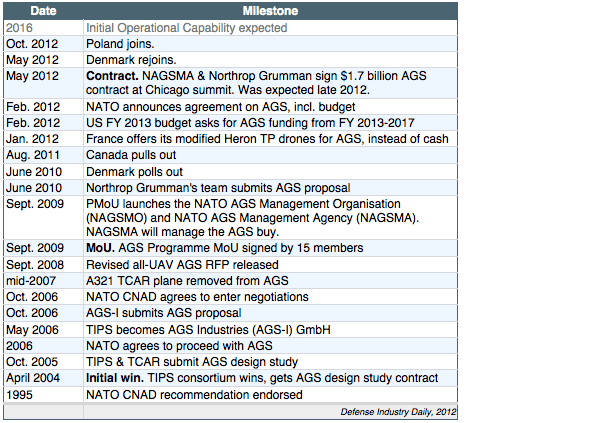
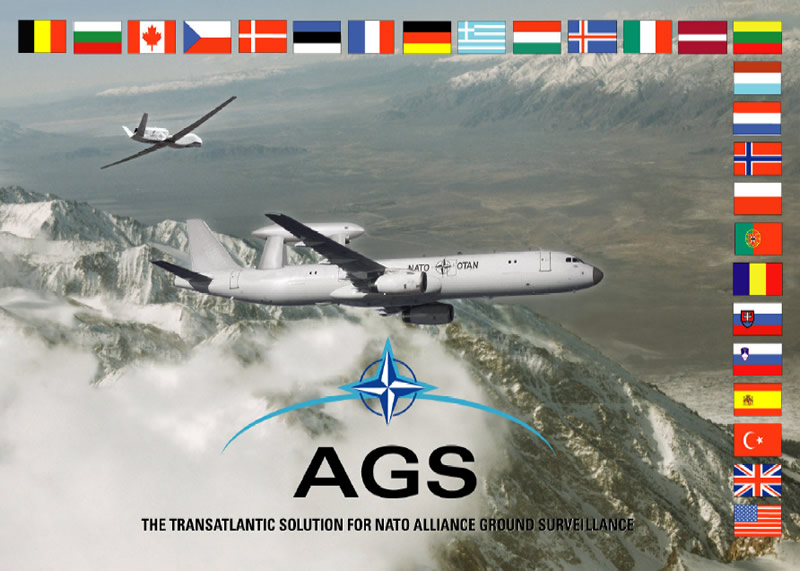
On April 1/04, the AGS Steering Committee decided to sign the design and development contract with the TIPS consortium – a decision endorsed by NATO’s Conference of National Armaments Directors on April 16/04. In addition to Northrop-Grumman and EADS, the winning 2004 Trans-Atlantic Industrial Proposed Solution (TIPS) team included General Dynamics Canada, French defense firm Thales, Spain’s Indra and Italy’s Galileo Avionica (now SELEX Galileo). Their solution would combine Airbus’ A321 single-aisle passenger jet, a new ground-looking radar, RQ-4 Global Hawk UAVs as supplements, and a set of ground stations.
The losing CTAS Consortium was led by Raytheon, and included AMS, Bombardier, Siemens, and 23 other firms. It would have offered AGS a design based on Bombardier’s Global Express jet, used in Britain’s similar ASTOR Sentinel R1 program.
The initial award proved that the nearly two dozen member nations could agree on funding for the program. After that, however, things got rocky.
(click to view full)
NATO was due to decide by early 2006 whether the alliance would go ahead with the full EUR 4 billion ($5.2 billion) program, and the program was cut slightly but survived. The next estimate for a pared-back program was EUR 3.3 billion (about $4.1 billion) for R&D and initial fielding. Optimism remained, as Northrop-Grumman officials noted that its $250 million per plane E-8C J-STARS ground surveillance aircraft also began as a small 5-6 plane order in 1985. Northrop-Grumman eventually delivered 17 of the modified Boeing 707-300s due to customer demand, and the E-8 JSTARS performed well in Desert Storm, Kosovo, Operation Iraqi Freedom, and beyond. Indeed, their capabilities were so valuable that they were the catalyst for NATO’s own AGS program.
The design and development phase for AGS was to last for 2 years, from 2005 – 2007, to be followed by the acquisition phase between 2007 – 2009.
In mid-2007, however, Europe’s declining defense budgets resulted in a program change. NATO chose to move forward with a UAV-only solution. It would be based on an off-the-shelf RQ-4 Block 40 Global Hawk, dropping the A321 and its radar entirely. Alliance member nations were expected to agree to a Program Memorandum of Understanding based on this new plan in early 2008. That didn’t happen until late 2009, and the EUR 3 billion, 20-year program plan wasn’t actually finalized until 2012.
AGS’ core industrial team is still led by Northrop Grumman from its Melbourne, FL facility, but the TIPS team was replaced by a new group. EADS, Finmeccanica’s SELEX Galileo, and Norway’s Kongsberg are listed as the major European players. Participating nations have also changed, and full AGS members now include:
* Bulgaria
* Canada
* Czech Republic
* Denmark (rejoined)
* Estonia
* Germany
* Italy
* Latvia
* Lithuania
* Luxembourg
* Norway
* Poland
* Romania
* Slovakia
* Slovenia
* United States of America
This list is more than enough to make AGS a key NATO capability, but it’s also worth noting that several countries aren’t included. Denmark pulled out in 2010, as part of defense budget cuts, but rejoined in 2012. Canada did the same in 2011, but hasn’t rejoined. Britain and France are missing from that list, as are Greece, Spain, and Turkey.
All alliance members will be eligible to participate in AGS, however, by contributing to the cost of operating the UAVs and accompanying systems.
AGS Initial Operating Capability was initially scheduled for 2010-2011, but since the contract award took until May 2012, IOC isn’t expected before November 2016. Full Operational Capability was scheduled for 2012-2014, and is now likely to be closer to 2018-2020.
Sigonella Air Base, Italy will be AGS’ Main Operating Base, hosting the 5 RQ-4B Block 40 UAVs and the fixed ground segment. AGS will share that base with USAF RQ-4B Global Hawks, and with the USN’s MQ-4C BAMS counterparts.
NATO AGS: Platforms & Technologies
AGS: The Aerial Component
Click this text for full 1.9 MB [PDF]:
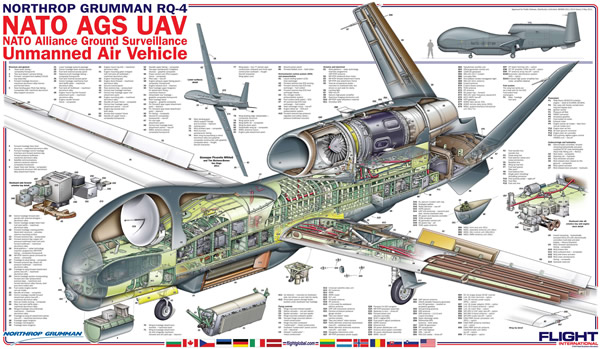
c. Northrop Grumman
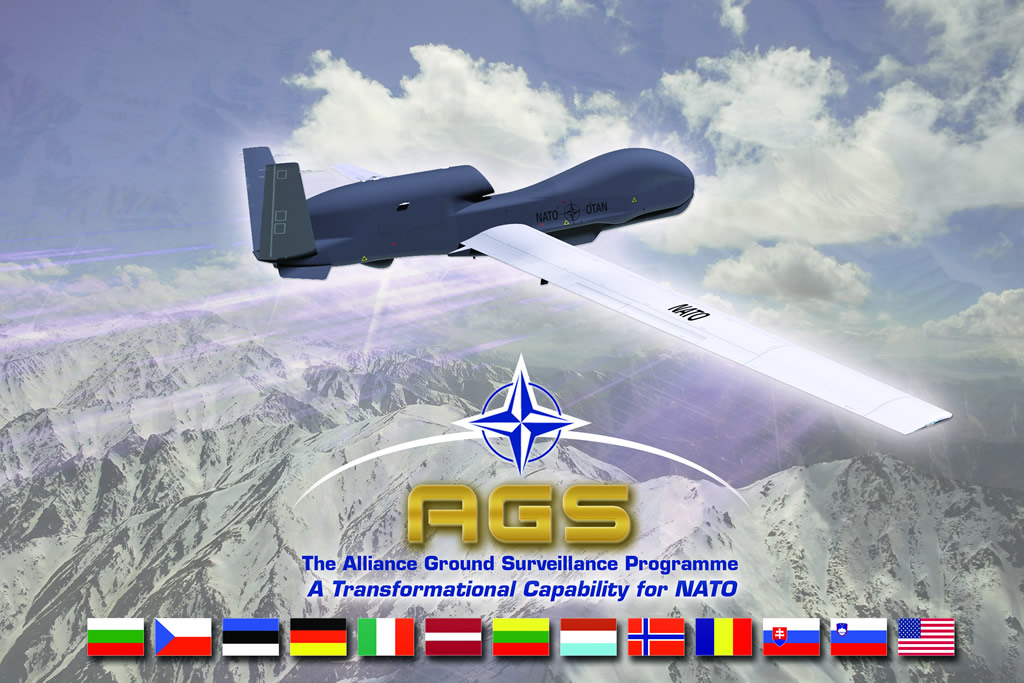
AGS has changed, leaving a core of just 5 RQ-4B Global Hawk Block 40s, bought more or less off-the-shelf. They will be combined with ground control stations that would be developed through the AGS program, via collaboration between Canadian and European firms.
The full AGS was originally slated to include a mixed fleet of both manned and unmanned aircraft. The manned portion initially called for 5 Airbus A321 aircraft, hosting the developmental Transatlantic Cooperative AGS Radar (TCAR). It aimed to create is a high-performance, side-looking, wide area, multi-mode ground surveillance radar, to be developed under an agreement between France, Germany, Italy, the Netherlands, Spain, and the United States. TCAR would reside in the sausage-shaped portion above the Airbus airframe, which beat out the smaller but longer-range ASTOR Sentinel R1/ Bombardier Global Express platform offered by Raytheon’s CTAS consortium.
The A321 TCAR’s unmanned companion set was initially set to consist of 4 Northrop-Grumman RQ-4B Global Hawk Block 40 unmanned aerial vehicles, equipped with new AN/ZPY-2 MP-RTIP (Multi-Platform Radar Technology Insertion Program) radars. MP-RTIP is a high-resolution synthetic-aperture ground surveillance radar made by Northrop Grumman and Raytheon, using next-generation Active Electronically Scanned Array (AESA) technologies. Block 40 and MP-RTIP were already part of the USA’s Global Hawk program, handing NATO the unusual combination of a low-risk developmental program. MP-RTIP may also retrofit some E-8C JSTARS aircraft, and is reported to have a resolution that could improve the current E-8C radar’s rumored 12-14 foot resolution to 1 foot or less.
When the A321 TCAR was removed, therefore, AGS became just 5 Global Hawk Block 40 UAVs. As NATO wrangling continued into its final stages, however, an interesting thing happened. AGS began to become a UAV pool – and may even re-introduce the very manned Sentinnel R1 option that lost the original competition.
AGS: The Ground Component
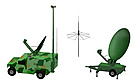
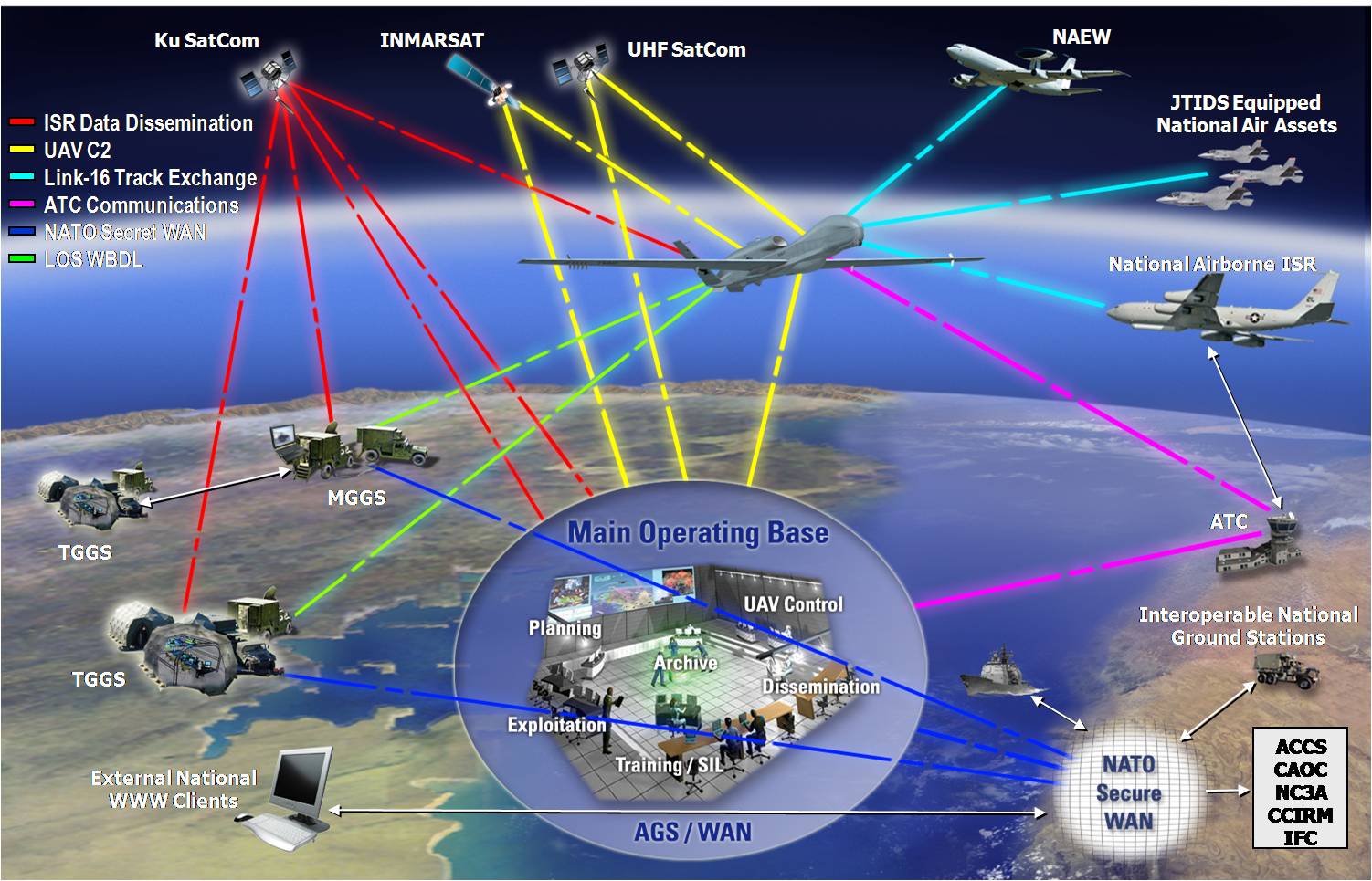
On the ground, the AGS Mobile Ground Stations are designed to support Rapid Deployment and dynamic field situations. The idea is that by sharing common mission equipment with the air segment, full system functionality (including Mission Planning and Control) may be exercised from any authorized source. As usual, the contractors are touting the use of computing and data standards, and promising an AGS that will send its data to national intelligence distribution systems, as well as NATO’s own C3I systems. As usual, the proof will come only with a working ground system, and corresponding national investments, that demonstrates advertised performance.
The ground segment was to be divided into 3 levels:
1. Fixed Ground Station configuration. Available for an office type environment, command center, etc. This will be deployed at Sigonella, Italy.
2. Transportable Ground Stations. Retains common physical and functional capabilities packaged in flexible protective casing, and is suitable for a variety on vehicles or ships.
3. “Software Grounds Stations” Share common software with the Mission Equipment, and brings some of the functionality of a System Workstation to authorized computing systems.
AGS: Go Jump in the Pool

(clickto view full)
The agreement that other members could join AGS by contributing to its operating costs may open a number of doors. Now that Germany has canceled its RQ-4 EuroHawk program, the trail is being blazed by France and Britain.
Britain has already deployed its 5 manned Astor Sentinel R1 aircraft, whose design lost to the AGS TIPS consortium’s initial A321 bid. Like the USA’s Global Hawk UAVs, it proved very popular during the 2011 campaign in Libya. That left the British looking for reasons to keep their new jets, instead of scrapping them per the 2010 strategic review. Britain doesn’t field any high-end UAVs yet, which makes flight-hours for its Sentinel jets a natural fit as the UK’s AGS contribution. Since Britain will usually be participating in any NATO operation that needs AGS, the inclusion of their jets’ flight-hours would mostly serve as double-counting accounting for Britain, while providing extra airframes to NATO. On the other hand, integrating the Sentinel R1s’ feeds into AGS’ ground systems for common distribution will require work.
France suffered through a long political battle over the replacement of its IAI Heron-derived Harfang UAVs, and finally ended up buying unarmed MQ-9 Reapers from the USA. Even before that selection was final, they were offering their MALE UAVs as France’s AGS contribution, and a joint French-British FCAS drone program may add more options after 2020.
These moves could diversify the AGS pool even further.
NATO AGS: Key Events & Contracts
2014
Poland joins.
Aug 18/14: Latvia. The Latvian Safety and Protection Industries Federation want the government to take advantage of Germany’s experience in establishing a joint information center for AGS data. That would add useful infrastructure, while helping Latvia’s small military take maximum advantage of the platform’s data.
On the industrial front, Latvia-registered Komerccentrs DATI grupa is already involved in the program, creating data exchange and data transformation software. Sources: The Baltic Course, “Federation wants Latvia to participate in EUR 1.27 bln unmanned aircraft project”.
July 28/14: The fuselage of the 1st NATO AGS UAV is completed at Northrop Grumman’s Moss Point, MS plant, and is now on its way to Palmdale, CA to finish production. Sources: NATO NAGSMA, “Fuselage of the First NATO AGS UAV Completed”.
April 2/14: Poland joins. Acting on an earlier decision (q.v. Oct 24/12), Polish Brigadier General Wlodzimierz Nowak signs the AGS Programme Memorandum of Understanding on behalf of his country, officially joining the Core AGS Procurement Program. This brings the number of members to 15. Sources: NATO NAGSMA, “Poland Joins AGS.”
Poland joins
2012 – 2013
Denmark back in. Will France join and Germany leave?
(click to view full)
Dec 3/13: Production begins. Northrop Grumman Corporation’s Unmanned Systems Center in Moss Point, MS officially begins production of the first NATO Alliance Ground Surveillance (AGS) Block 40 Global Hawk aircraft. Sources: NGC, “Northrop Grumman Begins On-Time Production of First NATO Global Hawk”.
Sept 19/13: Block 40. A USAF RQ-4B Block 40 takes off from Grand Forks AFB, ND on the type’s 1st combat mission. Sources: USAF, “Flying into the Fight: RQ-4 Block 40 Global Hawk deploys to war for first time”.
Aug 5/13: Canada. The Canadian Press reports that Canada won’t be contributing to AGS’ purchase phase, but Canada’s NATO representative Vice-Admiral Bob Davidson says that they’ll contribute to the system’s operating costs. Sources: Canadian Press, “Decision to withdraw from NATO surveillance programs to cost Cda contracts”.
June 18/13: Infrastructure. At a meeting of the NAGSMA Investment Committee, 1st Stage Authorisation is given for 10 civil works projects that would build out the necessary infrastructure for AGS’ Main Operating Base (MOB) at Sigonella, Italy. Sources: NATOI NAGSMA News, “First Stage Authorisation for MOB at Sigonella”.
May 29/13: Sense and Avoid. Queries to Northrop Grumman confirm that the RQ-4B Block 40 doesn’t have an automatic collision avoidance system – yet:
“The U.S. Air Force has not contracted with Northrop Grumman to develop a collision avoidance system. However, the Air Force Research Laboratory has been developing an airborne sense-and-avoid system since 2008 that the service has slated to be installed and demonstrated on a Global Hawk. I recommend that you contact the Air Force for more information.”
In the wake of Euro Hawk’s cancellation over ruinous civil flight certification costs, German lawmakers are already wondering if AGS remains viable. It’s worth noting that NAS Sigonella in Sicily has already been a base of operations for RQ-4B Block 20 Global Hawks, which lack any form of collision avoidance system. On the other hand, AGS was sold as a system that could be equally relevant during domestic disasters. If AGS UAVs can only fly through the military airspace around “Saigon,” over international waterways, and into combat zones, it’s going to limit the pool’s usefulness.
May 22-24/13: AGS next? German defense minister Thomas de Maiziere (CDU) is taking fire over the Euro Hawk’s cancellation, including criticism from Bundestag allies like Elke Hoff (FDP) and Norbert Barthle (CDU). The criticism stems from the military’s refusal to answer program information requests from Germany’s Federal Audit Office in November 2011 – even though they had known of the civilian certification requirement since 2008, and were aware of fundamental problems as of summer 2011.
A Northrop Grumman spokesperson also told Die Zeit magazine that the delivered Euro Hawk prototype would have been the only example without automatic collision avoidance protection, and such systems are a matter of record as part of the MQ-4C Triton maritime UAVs that will share the air base at Sigonella. The logical question follows: if the presence of collision avoidance in Euro Hawk still left it with an uncertain EUR 600 million path to certification, why would AGS do better?
Accordingly, both Hoff and Barthle are urging that Germany pull out of NATO’s AGS program, too. NATO is offering assurances, and saying that AGS will go ahead. Unfortunately, trust in official assurances is understandably thin right now, and Germany’s AGS commitment is large: EUR 400 million. Der Spiegel | Deutsche Welle.
May 14/13: Cancellation. Germany has decided to end the Euro Hawk UAV project, after spending EUR 562 million on system development and test flights. Not only would it cost hundreds of millions more euros to attempt EASA/ICAO flight certification, but German authorities reportedly lacked confidence that they would receive a certification at the end of the process. Rather than pay another EUR 600 – 700 million for additional UAVs and equipment, and an equivalent amount to attempt EASA certification, Germany will attempt to find another path.
That leaves an equipped Euro Hawk SIGINT UAV open for use, and a problem for AGS founding member Germany. UAV hours were supposed to be a big part of their AGS contribution. The RQ-4B Block 20 SIGINT prototype could transfer fully into AGS, alongside the 4 planned RQ-4B Block 40 UAVs at Sigonella Air Base in Italy. Key questions would include who would pay to upgrade the Euro Hawk and ensure full AGS compatibility, and how to deal with the issue of certification. Germany’s alternative would move Euro Hawk’s sensors into a manned and certified aircraft, then pursue a much simpler and cheaper type certificate amendment. Luftwaffe | Agence France Presse | Deutsche Welle | Deutsche Welle interview: Christian Molling | India’s Economic Times.
April 26/13: France. France has reportedly agreed to join part of the AGS program, and is working out the details of a financial contribution to AGS’ ground systems component. That would be pretty important if France wants to also contribute UAV hours, using its own platforms.
Before they can go ahead, the French General Staff has to validate a draft of France’s joint ISR concept, and an MoU will be required with the USA. TTU [in French]
April 10/13: US FY 2014 Budget. The President releases a proposed budget at last, the latest in modern memory. The Senate and House were already working on budgets in his absence, but the Pentagon’s submission is actually important to proceedings going forward. See ongoing DID coverage. US contributions to AGS continue, from $82.9 million in FY 2012, to $210.1 million in FY 2013, to $264.1 million in FY 2014 – a total of $557.1 million over those 3 years.
The news is not good for the Global Hawk 40, however, whose budget lines do not initially appear to involve further USAF buys. There’s no initial reaction from the AGS partners concerning the threat of an orphan platform.
March – April 2013: Certification. Reports in the French and German media highlight the problems that Germany’s RQ-4 EuroHawk has been having with airspace certification, and say that its cost could end the program entirely. Parliamentary State Secretary of Defense Thomas Kossendey says the program is having problems furnishing the documentation it needs for flight certification in shared airspace, and that those efforts could end up costing EUR 500-600 million on top of the EUR 1.3 billion already spent on development, UAVs, sensors, basing, etc.
AGS’ choice of Sigonella AB should help them avoid similar problems, but this sort of certification hangup will still be an issue if AGS members want the system to help with missions like local disaster surveillance. A worse problem comes from rumors that the USA will abandon the Global Hawk Block 40 in the 2014 budget. If AGS becomes the only Global Hawk Block 40 system in operation, it could become very expensive to support. Shz.de [in German] | TTU [in French] | UASVision re: RQ-4B Block 40.
Jan 4/13: Sub-contractors. General Dynamics Canada receives a C$ 32 million [about the same in USD] contract from Northrop Grumman, to provide the software that will control the AGS Communications Ground Control System (CGCS).
The CGCS will manage radio and satellite communications between the AGS RQ-4B UAVs and the main operating base in Sigonella, Italy. General Dynamics Canada will also deliver ruggedized computer workstations, and the Voice over Internet Protocol (VoIP) intercom systems for communications among operators at the operating base and between mobile command centers. As the final part of its contract, the firm will provide engineering support for the integration of its software and systems at Northrop Grumman’s facilities in the United States, and at the joint base in Sigonella.
Canada has bowed out of the AGS program, but GD Canada won anyway. The firm will be using technology that has been deployed in Canadian P-3/CP-140 fleet upgrades, and on the MH-92/CH-148 maritime helicopter. Their final product is likely to see deployment in Canada’s long-range UAVs, if and when the JUSTAS program ever buys some. GD.
Oct 24/12: Poland in. Polish Minister of National Defence Tomasz Siemoniak announces Poland’s application to join AGS at a NATO ministerial meeting in Brussels. They would pay into the base capability, rather than trying to field their own solution and integrate it. Polish MND.
May 23/12: Welcome back, Denmark. Denmark rejoins AGS, using saving created by “significantly strengthened financial management of Danish defence” to pay for it. That budgetary opportunity was given extra impetus by 2 newer developments. One was NATO’s Libya experience, where surveillance capabilities were so obviously critical. Danish F-16s deployed for that mission, and saw the need first-hand. The other is NATO’s organizational push toward its “Smart Defence” model of shared projects for specialized functions. Danish Forsvarsministeriet.
Denmark returns
May 21/12: Sub-contractors. Norway’s Kongsberg Defence Systems details its AGS sub-contract:
“KONGSBERG signed a EUR 28 million contract with Northrop Grumman ISS International Inc for the development of… solutions for storing, searching and retrieval of advanced sensor data from the RQ-4 Global Hawk. The contract extends over the next 3.5 years.”
May 20/12: Contract. Northrop Grumman and the NATO Alliance Ground Surveillance Management Agency (NAGSMA) sign a $1.7 billion/ EUR 1.2 billion contract for NATO’s AGS system of 5 RQ-4B Block 40s, plus ground equipment.
The primary industrial team will include EADS Cassidian, SELEX Galileo, and Kongsberg, as well as SELEX ELSAG, Elettra Communications, UTI Systems and SES. ICZ A.S., ComTraded.o.o, BIANOR, Technologica, and ZavodZaTelefonnaAparatura Ad (ZTA AD). European industry contributors will be responsible for development and delivery of the transportable ground stations, mobile ground stations for close support to moving operations, and remote workstations for higher echelon commands. NGC.
Contract
Feb 15/12: AGS Set. Reports surface that NATO will spend EUR 3.0 billion (about $3.9 billion) on the AGS program over 20 years, including at least EUR 1 billion for the 5 RQ-4B Global Hawk Block 40 UAVs, plus all of their ground and onboard equipment, which includes the new MP-RTIP radar. The other EUR 2 billion is expected to cover 20 years of operating costs. While the Global Hawks drones are being bought by 13/28 eligible nations, tasking will be open to all NATO allies who will contribute to the cost of operating them.
NATO appears to have bowed to France and Britain here, who will mostly contribute by providing their own UAVs to the pool. France has said that its future Heron TP variants would be made available to AGS as their contribution. That way, they can avoid having to pay cash, while justifying an expensive local UAV adaptation program. Britain doesn’t have any high-end UAVs. What they do have, though, is the ASTOR Sentinel R1 jets that proved so useful over Libya, and which they’ve been looking for a reason to keep.
Meanwhile, this still isn’t a contract to Northrop Grumman. All of this information was provided by an “anonymous NATO official.” Or maybe not so anonymous. From NATO:
“We have with us Ludwig Decamps, Director of Strategy and Smart Defence, in the NATO’s Defence Investment Division and he will update us on NATO’s future Alliance Ground Surveillance – as you know, the final details of this key programme were agreed earlier this month by NATO Defence Ministers and Ludwig will be speaking on background as a “NATO Official.”
Thanks, Ludwig. Aviation Week | Defense News | Reuters.
Feb 13/12: The USA’s FY 2013 budget documents include a set-aside to buy 3 RQ-4B Global Hawk Block 40s, for the NATO AGS program:
“The FY 2013 budget requests funding for 3 NATO Alliance Ground Surveillance (AGS) systems. The NATO AGS, which is based on the Block 40 version of the RQ-4B Global Hawk unmanned aerial vehicle, will enable the Alliance to perform persistent surveillance over wide areas from 4-8 high-altitude, long-endurance, unmanned aerial platforms operating at considerable stand-off distances and in any weather or light condition. Using advanced radar sensors, the NATO AGS will continuously detect and track moving objects throughout observed areas, and provide radar imagery of areas and stationary objects. Funding is $0.2 billion in FY 2013 and totals $0.9 billion from FY 2013 – FY 2017.”
Jan 16/12: France. Defense News reports that France is offering the modified Heron TP drones as its contribution to the NATO AGS program – which wants cash as promised, in order to buy the program’s 5 larger and more capable RQ-4B Block 40 Global Hawk jet-powered UAVs.
The move may be prompted in part by estimates that the bill for France’s proposed Heron-TP UAVs, with additions like satellite communications and de-icing gear, might even reach EUR 620 million total. Having the resulting drones serve double-duty may be appealing to the French, but introduces compatibility and budget issues for the rest of the project. Which is reportedly still stalled:
“The AGS package is still being discussed at NATO,” an alliance press officer said. “It is a topic to be discussed in the February meeting of defense ministers.”
2010 – 2011
Canada and Denmark out.
Aug 18/11: Canada out. Canada’s conservative Party government also withdraws from AGS, as a follow-on to their June 2011 withdrawal from NATO’s E-3 AWACS pool. NATO’s official blog | NAGSMO statement.
No Canada
July 21/11: MP-RTIP. The RQ-4B Block 40 Global Hawk completes its 1st full system flight with the high performance AN/ZPY-2 MP-RTIP radar, at Edwards Air Force Base, CA. Northrop Grumman.
Feb 22-24/11: NAGSMA:
“Italy hosted an AGS Infrastructure meeting at Sigonella AFB… The main objective of the meeting was to facilitate the authors of the AGS Capability Package (CP) amendments to finalise the Infrastructure and Investment amendments and present them to the AGS CAPCO, for Bi-SC staffing & ultimately for submission to the authorities at NATO HQ.”
Dec 1/10: MP-RTIP. The first production MP/RTIP radar has been delivered to Edwards Air Force Base, CA for integration on the Global Hawk Block 40. Northrop Grumman.
June 22/10: Denmark out. Denmark’s center-right government decides to leave the AGS project, prompting criticism from NATO but support from leftist parties. The government has reportedly proposed cutting 1.4 billion Krone (about EUR 190 million) from the defense budget, including about EUR 50 million or so that would have been its contribution to AGS. Denmark’s Terma would have been the industrial beneficiary.
Denmark’s contribution is only about 3.5% of the AGS program’s estimated EUR 1.5 billion budget, but NATO’s biggest concern is that Denmark’s move could spark additional pullouts, amidst a European atmosphere of austerity and budget cuts. Even reviews by participating countries would have the effect of delaying any contract, and hence fielding. To make the cuts even more pointed, NATO’s current Secretary General is former Danish Prime Minister Anders Fogh Rasmussen. Prior to his 2009 appointment, he led the same Liberal/Conservative Party coalition that currently governs Denmark. NATO statement | Copenhagen Post re: cuts | Copenhagen Post re: NATO reaction | defpro: statement from Terma’s CEO | Europolitics | Reuters.
Denmark withdraws
June 7/10: RFP response. Northrop Grumman formally submits its proposal for NATO AGS, with a contract award expected in October 2010. Their industry team contains “more than 25 companies from the 15 nations participating in this program,” and is based on the RQ-4B Global Hawk Block 40 with MP-RTIP radar. Other major industry participants in the final bid include EADS, SELEX Galileo, General Dynamics Canada, and Kongsberg. The NATO Alliance Ground Surveillance Management Agency (NAGSMA) will manage the acquisition.
Spain’s Indra had been part of the AGS TIPS consortium, but Spain is not an AGS participant, and Indra wasn’t named as a major partner.
The proposal also includes the required mobile and transportable ground stations, and a mission operation support center at the main operating base in Sigonella, Italy. Those elements will be wholly produced by European industry, and Northrop Grumman believes that this offers the potential for national re-use in other programs, as a common UAV control/ data distribution solution. Northrop Grumman.
2007 – 2009
RFP and Memorandum of Understanding.
(click to view full)
Sept 25/09: PMoU. The 15 nations participating in NATO’s AGS program finish signing the Programme Memorandum of Understanding (PMOU). The PMOU, along with the AGS Charter, sets the legal, organizational, and budgetary framework for AGS, and launches both the NATO AGS Management Organisation (NAGSMO) and NATO AGS Management Agency (NAGSMA). NATO | Northrop Grumman.
AGS PMoU
June 25/09: Block 40 rollout. USAF and Northrop Grumman officials unveil the first RQ-4 Block 40 Global Hawk at Air Force Plant 42 in Palmdale, CA. The USAF plans to field 15 of them, while AGS will field another 5. Edwards AFB.
RQ-4B Block 40
Feb 20/09: The NATO nations participating in the AGS program begin the process to sign the Programme Memorandum of Understanding (PMOU). Once the signature process is complete, the NATO AGS Management Agency (NAGSMA) will be established to expeditiously prepare for the award of the AGS contract. Source.
September 2008: RFP. A Request for Proposal (RFP) is released, on the basis of which AGS Prime Contractor Northrop Grumman identifies a transatlantic team made up of industry from the AGS participating nations. A NATO spokesperson identified the main subcontractors as EADS, General Dynamics Canada, and Finmecanica’s SELEX Galileo. These main sub-contractors themselves have subs from other European participating nations. Source.
AGS RFP
Nov 22/07: Basing. NATO has pushed back a main operations base decision for the 4-8 Global Hawk UAVs that will operate under the AGS program, as it evaluates the various proposals.
Italy offered Sigonella air base in Sicily, which hosts a U.S. Naval Air Station and became a base for US Global Hawks and future USN BAMS Global Hawk variants. It eventually won.
Germany proposed Schleswig-Jagel Air Base in its northernmost province. Their big selling point was commonality benefits for spares, training, maintenance, etc., as it will also host Germany’s Eurohawk RQ-4 derivatives beginning in 2010.
Greece proposed Aktion Air Base, which is currently a forward operating base for NATO’s fleet of E-3A AWACS.
Other offers on the table included Poland’s Powidz AB, Portugal’s Beja AB, Spain’s large air base outside Zaragoza, and Slovenia’s Cerklje AB. Closer to the middle east, but also closer to ballistic missile range, are Romania’s Timisoara AB, and Turkey’s Corlu AB. Aviation Week Ares report.

(click to view full)
Nov 19/07: A321 out. The USAF announces new studies to define the NATO AGS “core capability resulting from a UAV-only based approach,” and explore options for greater program integration with the USAF’s RQ-4 Global Hawk program. A 2-phase acquisition approach is reportedly still planned, starting with a design, development and demonstration effort and subsequent full-scale production. A week later, a corresponding Flight International report confirms that :
“…[the A321] manned aircraft was deleted from the programme in mid-2007 because of affordability issues and NATO is now pursuing an AGS solution based on Global Hawk with the MP-RTIP sensor.”
Airbus 321… 0
2004 – 2006
Initial study, picking platforms.
Oct 26/06: NATO reports that the CNAD(Committee of National Armament Directors) agreed to enter into negotiations for the design and development of an Alliance Ground Surveillance system, on the basis of a proposal recently submitted by ASG Industries, while continuing to address a number of important issues in parallel.
Oct 16/06: Proposal. The renamed AGS Industries GmbH partnership announces the submission of its NATO AGS Proposal for the Design and Development Phase. The major objective of the AGS-I Design and Development proposal was to achieve full design maturity for the AGS system, to include the conversion of the Airbus A321 into a high performance mission aircraft.
AGS Industries’ proposal response confirms a EUR 3.3 billion procurement cost ceiling for a NATO AGS core capability, and now places the programme start as an agenda item for action at the upcoming Conference of National Armament Directors (CNAD) meeting at the end of October. The new cost ceiling is achieved by limiting the number of Global Hawk UAVs to 4 (from 7), limiting the number of ground stations, and additional system-wide reductions. See corporate release.
May 26/06: The TIPS consortium formally becomes AGS Industries GmbH, with its main office in EADS Ottobrun, Germany facilities and a second office in Brussels, Belgium near NATO HQ. See corporate release [PDF format].
Oct 26/05: The TIPS industrial consortium, working with the Transatlantic Cooperative AGS Radar (TCAR) team, announce that they have submitted the study commissioned under the initial EUR 23 million NATO contract. It addresses issues such as overall system and radar-sensor development, cost issues and program risk reduction, and integration. See corporate release [PDF format, site defunct] and DID’s article; note that the study itself is not publicly available.
Initial study delivered
June 18/04: Sen. Partty Murray [D-WA] represents the state of Washington, where Boeing is a significant force in the economy. She issues a release:
“Senator Patty Murray today expressed concern about the Department of Defense’s handling of the Alliance Ground Surveillance System (AGS) program at the North Atlantic Treaty Organization (NATO). The AGS program is the largest single NATO contract in history. With American taxpayers primed to contribute up to 45 percent of the funding for the new program, Senator Murray called on the Department of Defense to follow their established policy of pursuing more interoperable, more coordinated weapons systems and to consider the consequences to the U.S. aerospace industry of militarizing the Airbus aircraft for the AGS and future NATO requirements.
…Great Britain has opted out of paying for the program, and France and Germany may opt out as well. “Our allies haven’t committed to paying for the AGS program but that hasn’t stopped them from convincing the DoD to fund the largest contract in NATO’s history and new jobs at Airbus. Why would we agree to pay up to $2 billion dollars to militarize an Airbus aircraft for the first time at NATO when the Europeans themselves have not agreed to fund the AGS program,” Senator Murray said.”
April 16/04: TIPS wins. TIPS industries wins a NATO design and development contract for EUR 23 million to move the Alliance Ground Surveillance (AGS) programme forward, following an April 1 decision to begin the program and the endorsement by NATO’s Conference of National Armaments Directors. The award came during the Conference of National Armament Directors meeting on April 16th, 2004, which ratified the go-ahead decision. See corporate release [PDF format, site defunct].
The losing CTAS Concortium was led by Raytheon, and included AMS, Bombardier, and Siemens; its primary manned platform was the longer-range but smaller Bombardier Global Express, a large business jet that has been modified for similar roles as the British ASTOR Sentinel R1.
TIPS leader Northrop Grumman, which employs about 2,000 people in Florida around Melbourne and Daytona Beach, said in response that it plans to shift 25 workers to the AGS program in 2005, and could add 100 engineering positions on the contract over 2006-2007. The jobs would pay an average of $75,000 a year.
Platforms picked
Additional Readings & Sources
* NATO – NAGSMA program office page.
* NATO (December 2004) – Briefing: Improving capabilities to meet new threats; Item #7: Improving Ground Surveillance. 2010 snapshot.
* Northrop Grumman – NATO AGS.
* Northrop Grumman – RQ-4 Block 40 Global Hawk [PDF].
* Kongsberg – Alliance Ground Surveillance Program. Note that the presentations and other collateral are all dead links.
* GlobalSecurity.org – Multi-Platform Radar Technology Insertion Program. Will include some E-8 JSTARS retrofits, as well as a smaller version on the RQ-4 Global Hawk UAV. Was also designed for use of the E-8 JSTARS/ E-3 AWACS successor E-10A, but that program was canceled.
* Northrop Grumman – AN/ZPY-2 Multi-Platform Radar Technology Insertion Program (MP-RTIP).
* TIPS-AGS – Alliance Ground Surveillance [dead link]. This TIPS-AGS.com consortium site is now defunct.
* DID – RQ-4 Euro Hawk UAV: Death by Certification. The Global Hawk Block 20 variant would have added new sensor packages for SIGINT roles, but the cost and risk of getting EASA flight certification outside military airspace sank the program. AGS will need to solve the same problem.
* US Air Force Fact Sheets – E-8C Joint STARS. Manned alternative, USAF only.
* GlobalSecurity.org – E-8 Joint Surveillance Target Attack Radar System (Joint STARS / JSTARS).
* Strategic Review (Fall 2000) – Brittle Swords: Low-Density, High-Demand Assets [42k, PDF]. Helps to explain why systems like AGS that use less expensive platforms for high-demand missions may be a very good idea over the long run.
* Lexington Institute (Sept 10/09) – New Global Hawk Undercuts Insurgent Advantages. Discusses the Block 40 in the context of the USA’s own budget wars.
* AGS Industries GmbH (Oct 16/06) – AGS Industries Submits NATO AGS Proposal for Design and Development Phase [dead link].
* DID (May 17/06) – E-10’s MP-RTIP Ground Surveillance Radar to Test Aboard Proteus.
* eDefense Online (Feb 22/06) – The Eyes of Europe. Subtitled “NATO’s AGS: Europe’s most important military program.” Regrettably, eDefense Online has folded, so the full article is inaccessible.
* DID (Oct 27/05) – NATO TIPS-AGS “Eye In the Sky” Consortium Submits Initial Risk Reduction Study
* FloridaToday.com (April 29/05) – Northrop takes first step toward NATO spy plane
* Reuters – NATO Signs Initial ‘Eye in the Sky’ Contract.
* Raytheon – (Jan 21/04) – CTAS Consortium Delivers its Report Addressing NATO’s Air to Ground Surveillance Requirements. Its report was delivered from Los Angeles, CA to Brussels onboard a Bombardier Global Express aircraft, which the CTAS consortium recommended as the primary manned platform for AGS. Britain’s ASTOR Sentinel R1 surveillance and electronic eavesdropping aircraft is already based on the Global Express, which has a longer range than the Airbus A321 but less internal volume.