


(click to view full)
In July 2009, The Korea Times reported that ROKAF was looking to upgrade its F-16C/D fleet’s radar and armament, as part of the 2010-2014 arms acquisition and management package submitted to President Lee Myung-bak for approval.
Under the Peace Bridge II and II deals, The ROKAF bought 140 “KF-16” Block 52 fighters, which were assembled in Korea between 1994-2004 under a $5.5 billion licensing agreement. Key upgrades to this fleet will include new radars to replace the existing APG-68v5/v7 systems, modern avionics and computers, and upgrades of the planes’ cabling and databuses to MIL-STD-1760. The centerpiece AESA radar competition has a winner now, and South Korea has picked its contractor for the overall upgrade program. Now the effort is turning that into binding contracts, and beginning the upgrade process. Other countries within the region and beyond are interested in similar high-value F-16 upgrade programs, so the ROk’s experiences will be watched carefully.
Korea’s KF-16 Radar
The Benefits of AESA Technology
[youtube:v=JZnrtB9rRT8]
click for video
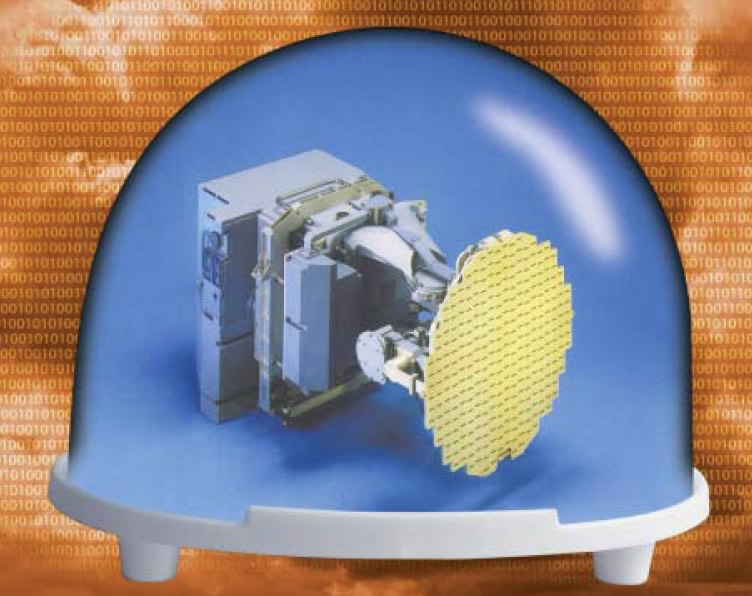
Active Electronically Scanned Array radars offer dramatic increases in fighter performance, and an equally dramatic drop in maintenance costs, thanks to their large array of independently excitable and steerable transmit/receive modules. Advantages over mechanical phased array radars like the KF-16s’ APG-68 include 2x-3x range or performance, simultaneous ground and air scans, and near-zero maintenance over the fighter’s lifetime. The fixed AESA antenna in American designs cuts out high-maintenance motors and hydraulics, and if one T/R module out of thousands burns out or breaks, it matters so little that it’s just left on. More advanced functions like high speed communications, and even focused electronic disruption of enemy radars, also become possible.
South Korea was very interested in AESA performance, but we were told by contractor sources that their calculations of the long-term maintenance savings over existing mechanically-scanned APG-68 radars helped them decide to make the investment in AESA.
F-16s have several AESA radar versions to choose from.
Northrop Grumman supplies the AN/APG-68 radars that equip most current F-16s, as well as the AN/APG-80 radar that equips the United Arab Emirates’ F-16E/F Desert Falcons. The firm has gone on to develop a more generic AESA system called SABR (Scalable Agile Beam Radar) as a drop-in AESA replacement for existing F-16 radars like the APG-68.
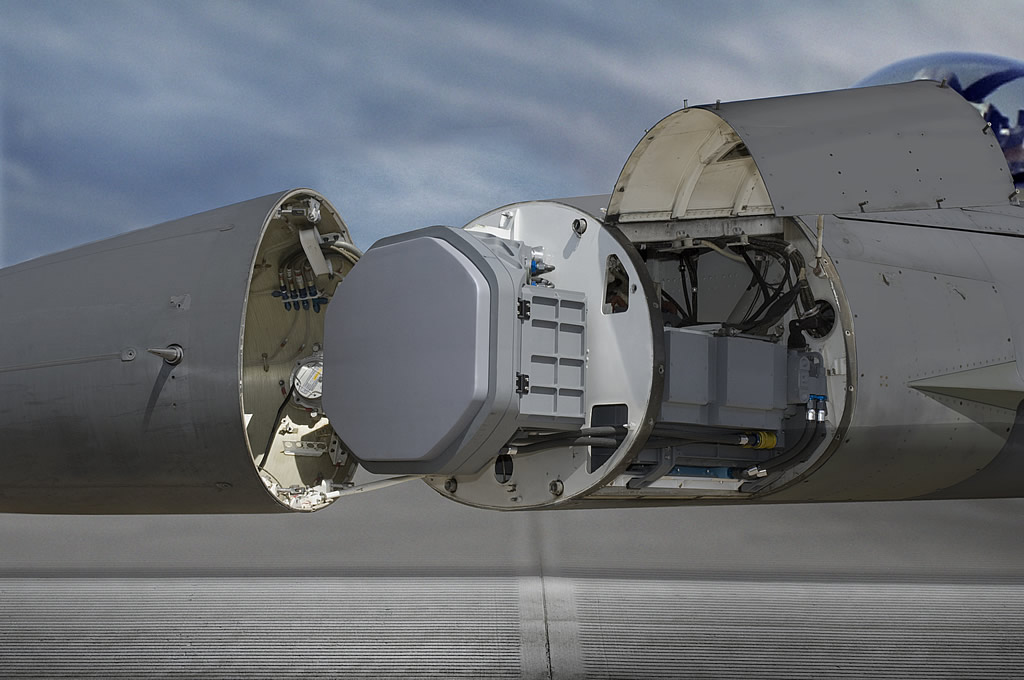
Raytheon has taken similar steps, developing an AESA radar called RACR (Raytheon Advanced Combat Radar) for the same purpose. Their radar won, and will equip up to 134 KF-16s.
A 3rd possible choice is IAI ELta’s EL/M-2052. It was originally developed for Israeli F-16s, and would probably have been fitted to the F-16I if the USA hadn’t threatened to cut of all manufacturer support for the fighters. This raises the specter that the US government would use the same tactics in export competitions, so perhaps it’s not surprising that the M-2052’s most promising sales prospects currently involve non-American fighters in India.
Raytheon’s Speed RACR
[youtube:v=RSVziY1Zwn8]
click for video
Raytheon’s resizable RACR AESA radar is aimed at a very large potential market, as a retrofit for F-16s and F/A-18 Hornets around the world, and as an option for new planes. Raytheon’s goal was to keep the existing aperture and form of existing F-16 and F/A-18 Hornet radars, and keep the same power requirement. That allows customers to just drop it into the smaller fighters without structural or power changes.
The translation of received data is mostly handled within the RACR modules already, minimizing other changes to the receiving fighter, and this same flexibility is possible for other platforms with previous-generation radars. Aperture sizes can be varied for different platforms by changing the number and arrangement of T/R modules, and power back-ends can be varied as well.

(click to view full)
The RACR radar’s core design and architecture owes a large debt to the AN/APG-79 AESA radar that equips F/A-18 family Super Hornets. The APG-79’s in-service reliability record became an important selling point for Raytheon in South Korea, and in discussions, Raytheon representatives referred to their technology maturity as an important edge.
Part of that edge involves the hardware, which has served on American & Australian Super Hornets. RACR uses the same “LRM slice” approach as the Super Hornet’s APG-79, and the modernized F-15E Strike Eagle’s APG-82. This maximizes front line maintenance by using internal diagnostics plus swap out sub-modules, instead of using larger “black box” LRUs that require more Tier 2+ depot maintenance. Many aspects of the architecture and active technologies are also similar between APG-79, APG-82, and RACR.
The other facet of RACR’s value proposition involves software. Raytheon has designed their radar families to maximize the role of software in giving them new “modes” and capabilities, even as they work to ensure a common architecture and set of technologies. Raytheon employees have told DID that it’s possible to develop a radar mode like RCDL high-bandwidth communications for a platform like the F/A-18E/F, and have it made available to RACR or APG-82 customers. For a customer like South Korea, the process would have to go through the usual export control channels as a modification to the original FMS case, but development is no longer an expense, and installation involves minimal engineering work, followed by software reprogramming and relatively quick check-out testing. The reverse would also be true, allowing innovations requested by RACR customers to find their way back to other radar fleets.
The bad news is that the APG-79’s software is known to be buggy, and is the subject of repeated and continuing reports from the Pentagon’s Department of Testing & Evaluation.
AESA After-Effects

(click to view full)
Korea Aerospace Industries has a very broad set of cooperation agreements with Lockheed Martin, from licenses to build and maintain the ROKAF’s F-16s, to the T-50 family’s development and international marketing agreements. One of those agreements states that the T-50 family of trainers and lightweight fighters may not be equipped with radars more sophisticated than the ones carried in the ROKAF’s KF-16s.
That clause is what forced KAI to abandon SELEX’s Vixen 500E AESA radar for the FA-50, and select IAI Elta’s EL/M-2032 mechanically-scanned radar instead. Adding AESA radars to the KF-16s would remove those strictures, opening the door for similar additions. The result would be a $30-35 million AESA-equipped FA-50+ lightweight fighter for the global export market, which could be a strong competitor for existing F-16s at $40-55 million each. It could even affect broader F-35 exports (currently $120 million per), thanks to its combination of advanced capabilities and traditional lightweight fighter price.
Contracts and Key Events
2013 – 2018
Korea picks Raytheon’s RACR as their KF-16 AESA radar, Taurus’ KEPD 350 as their long-range cruise missile; Is the BAE deal in trouble?
(click to view full)
February 23/18: New Helmet Orders Rockwell Collins ESA Vision Systems (RCEVS), a joint venture between Israel’s Elbit Systems and Rockwell Collins, will incorporate the Joint Helmet Mounted Cueing System II (JHMCS II) helmet-mounted display into the Republic of Korea Air Force’s F-16 fighter aircraft. The value of the contract was not disclosed. In a statement announcing the deal, Elbit said the new system will give South Korea’s F-16 operators with “enhanced situational awareness during day and night missions with immediate and accurate visor-projected display of friendly, threat, and unknown targets. The JHMCS II Night Vision Goggle (NVG) and Digital Eyepiece (DEP) solution allows pilots to easily convert from day to night operations by using one hand while airborne and without removing the helmet. With the JHMCS II NVG/DEP night solution, pilots are able to fly with HMD symbology during both day and night missions.” RCEVS will also supply the F-35 Helmet Mounted Display System. In 2016, it was announced that 35 of Seoul’s Block 32 fighters were successfully upgraded to include new AESA radar and the ability to launch more advanced munitions.
December 21/16: A $250 million upgrade of South Korean F-16s has been completed as part of the F-16 Peace Bridge Upgrade (PBU) project. 35 of the Block 32 fighters underwent the modernization and are now capable of launching the AIM-120 missile as well as dropping the GBU-31 JDAM. Seoul also plans to further improve the fleet by installing advanced equipment including active electronically scanned array (AESA) radars.
November 18/16: South Korean investigators have raided the offices of the Defense Acquisition Program Administration (DAPA). An official from DAPA is suspected of leaking confidential information on military equipment to BAE Systems during a mismanaged project to upgrade the KF-16 fighter jet. The 2011 modernization award with the company has since been dissolved.
December 18/15: South Korea has selected Lockheed Martin to carry out work on its KF-16 upgrade program. The move comes after the $1.58 billion contract had been initially awarded to BAE Systems but had been on hold over demands for a cost increase by BAE. The work will look to upgrade the radar, armament and other integrated electronic systems of 134 KF-16s currently in service in the SKAF. The new contract also sees the Koreans drop the Raytheon produced AN/APG-68 radar for the AN/APG-83 produced by Northrop Grumman.
Jul 10/15: In a counter-lawsuit, South Korea’s Defense Acquisition Program Agency (DAPA) has filed charges against BAE Systems and Raytheon over the companies’ alleged failure to complete a $1.7 billion KF-16 upgrade program. BAE originally filed a lawsuit in November 2014 to prevent the company from receiving a $43 million penalty over the canceled upgrade program; DAPA also demanded $18 million from Raytheon.
Nov 13/14: Legal. BAE sues in US court to block South Korea’s attempt to make BAE forfeit a $43.25 million Letter of Guarantee:
“That $43 million is a fee that was built into the F-16 contract in case BAE broke its agreement. But BAE is arguing DAPA is punishing the company for not being able to convince the US government that the extra costs created by government requirements for more testing were unnecessary. In BAE’s eyes, that simply isn’t fair.”
What’s remarkable here is the fact that the clear language of the lawsuit is saying that the US government basically destroyed the agreement between BAE and South Korea. That’s not exactly a common event, and must be seen as a major institutional and program failure. There seems to be no discussion occurring about that, in an environment where a major American company had a great deal to gain from any failure. Sources: Defense News, “BAE Sues South Korea Over F-16 Upgrade Cancellation Fees”.
Nov 5/14: Terminated. South Korea has terminated its deal with the US government over the KF-16 upgrade, which means the end of the deal with BAE. The contract was technically terminated “for convenience,” but they’re still going to have to negotiate termination fees.
Lockheed Martin can offer to step in now, and the questions are twofold. Once, will South Korea move to cut the US government out via a Direct Commercial Sale contract next time? Two, if the contract remains a Foreign Military Sale, what will the US government’s price be? An abrupt change in that price would raise a lot of questions. Sources: Defense News, “South Korea, Pentagon Kill BAE F-16 Upgrade Contract”.
Deal terminated
Oct 15/14: Deal dying? Korean media report that a proposed $753 million price hike for the KF-16 upgrade deal could result in cancellation. Lockheed Martin waits in the wings, and is reportedly extending an offer that would include more technical help with the multinational KF-X fighter program if the ROKAF switches.
The US government is reportedly demanding another WON 500 billion (about $471 million) for unspecified added “risk management,” while BAE is reportedly requesting another WON 300 million ($282 million) to cover a 1-year program delay. DAPA has been talking to the US government about these issues since August 2014, but their public statements are becoming visibly frustrated and distrustful, especially with respect to the risk fee. Words like “ludicrous” are not what you want to hear from an official negotiating partner in an Asian country. The risk for BAE is that cancellation would really hurt its push to export F-16 upgrades as a growth line of business, and Raytheon also stands to lose big by losing its cornerstone customer for the RACR AESA radar. Unfortunately, since it’s a Foreign Military Sale managed by the US military rather than a Direct Commercial Sale process managed by the purchasing government, the US government is inextricably involved in program management and in financial negotiations. That sharply limits maneuvering room for BAE, Raytheon, and South Korea’s DAPA.
Lockheed Martin’s angle is a spinoff from their recent F-35A deal, which will supply 42 aircraft to the ROKAF. Part of their industrial offsets involved help designing the proposed KF-X fighter, which is currently a collaboration between South Korea and Indonesia. They were cautious about providing too much help, but they reportedly see enough benefit in badly wounding an F-16 upgrade competitor to offer another 400 man-years of support for KF-X (total: 700) if the ROKAF switches. Sources: Chosun Ilbo, “U.S. in Massive Price Hike for Fighter Jet Upgrade” | Defense News, “F-16 Upgrade: Problems With S. Korea-BAE Deal Could Open Door to Lockheed” | Korea Times, “Korea may nix BAE’s KF-16 upgrade deal”.
June 25/14: Phase 1. BAE has received a pair of ROKAF F-16s at the company’s Alliance Airport facility in Fort Worth, TX. Phase 1 will see them used as testbeds and prototypes. They’ll be equipped with advanced mission computers, new cockpit displays, advanced radars and targeting sensors, and integrated with advanced weapons. Once the changes are proven out and accepted, Phase 2 will be ready to begin, and BAE believes that will happen before the end of 2014.
BAE says that this will be the first time that any of America’s “teen series” fighters has received a major upgrade that isn’t coming from the original manufacturer. That’s actually a debatable point. The Israelis have made wide-ranging modifications to F-16s, and the cumulative effect of the Falcon-UP and subsequent programs is arguably as extensive as BAE’s work for Korea. Unlike Israel Aerospace’s work creating the clearly superior “F-4 [Phantom II] 2000/2020,” however, it’s possible to argue that Israeli F-16 upgrades were more of an alternative configuration/ refurbishment. The Israelis might disagree. Sources: BAE, “First South Korean F-16s Arrive at BAE Systems for Upgrades”.
May 8/14: Phase 1. BAE Systems Technology Solutions & Service in Rockville, MD receives an unfinalized $140 million firm-fixed-price contract, covering initial development and long lead production of KF-16 upgrades for 134 aircraft. There’s more to come, as the full program is scheduled to be added to this contract in Summer 2014.
$68.6 million is committed immediately. Work will be performed at Ft. Worth, TX and the first upgraded KF-16 aircraft are scheduled for delivery starting 2019. USAF Life Cycle Management Center/WWMK at Wright-Patterson Air Force Base, OH (FA8615-14-C-6023).
Phase 1 contract
Dec 22/13: Phase 1. BAE Systems announces that:
“The Republic of Korea has finalized an agreement with the U.S. government for BAE Systems to perform upgrades and systems integration for its fleet of more than 130 F-16 aircraft. The company will now begin the first phase of the work under contract through the U.S. Department of Defense’s Foreign Military Sales program.”
Jan 24/14 sees Raytheon announce a corresponding signed contract with BAE Systems, without disclosing the amount for Phase 1. Raytheon is a sub-contractor, responsible for the RACR radar, ALR-69A all-digital radar warning receiver, advanced mission computing technology, and weapon systems integration. Phase 2, as proposed, would begin in late 2014, and would involve actual production and installation of the 130 upgrade kits over several years. Sources: BAE Systems, “South Korea Finalizes Agreement For BAE Systems To Perform F-16 Upgrades” | Korea Times, “S. Korea finalizes BAE deal to upgrade F-16s” | Raytheon, “Raytheon secures first international customer for its F-16 RACR AESA radar”.
Nov 25/13: Phase 1. Plans change. Instead of a single FMS case, the US DSCA announces that South Korea’s official request to upgrade 134 KF-16C/D Block 52 fighters has been broken in 2.
Phase 1 is worth up to $200 million, and the DSCA request only covers government and contractor services to support the upgrade’s initial design and development, plus some actual work and infrastructure. On the support side, they’ll produce detailed design requirements and reports for the new system design, computers, displays, sensors and weapons, pilot-vehicle interface, Group A engineering installation design, and support and training requirements. They’ll also initiate software design and development, build an avionics systems integration facility with test stations, and secure some long lead-time materials. That seems like little tangible progress for $200 million, but the DSCA doesn’t mention that 2 ROKAF F-16s will be fully outfitted as prototypes.
Phase 2 would be the full fleet upgrade with the RACR radar, updated avionics etc. That will require a separate DSCA notification.
The Koreans picked BAE Systems Technology Solution & Services, Inc. in Arlington, VA as their contractor back in March, and that’s still true. Once a contract is negotiated, implementation will require 1 BAE representative in Korea as an intermediary. Source: DSCA 13-62.
DSCA: Phase 1 upgrade planning
April 10/13: BAE & RACR AESA. South Korea’s DAPA picks Raytheon’s RACR radar to upgrade its locally-built KF-16C/D Block 52 fighters. Actually getting to a contract will be a bit more work. The ROK is using a hybrid Foreign Military Sale (FMS) structure, which retains the USAF’s role as the contract manager, but left the ROKAF to manage the selection process and decision. The ROK has made its picks, and the procedural outcome of the current government-to-government negotiations will be a single FMS case and US DSCA export notice that covers both the lead contractor for the overall KF-16 upgrade (BAE picked, confirmed no contract yet), and the provision of the AESA radar component (Raytheon picked). Once the mandatory 30-day post-notice period has passed, contracts can be issued and work can begin.
Subject to that process, Raytheon will deliver 134 RACR systems to the ROKAF, beginning in late 2016. The ROKAF received a total of 140 F-16 Block 52s/”KF-16s” under the Peace Bridge II and III contracts, on top of the original 40 F-16C/D Block 32s in Peace Bridge I. Some losses are inevitable, from landing mishaps or on-base damage to full-on crashes into the Yellow Sea. The first KF-16s were delivered almost 20 years ago in 1994, and the radar numbers could be taken as a de facto acknowledgement that the ROKAF has about 130-134 KF-16s left in inventory.
This contract’s scope includes “AESA radar development, production of test assets for the system design and development program, and production.” Discussions with Raytheon clarified that this development and testing applies only to integration with the ROKAF’s exact KF-16 configuration, which will differ even from other F-16C/D Block 52s. RACR itself is a finished product. Raytheon release | Raytheon feature.
BAE picked, RACR AESA for KF-16s
April 4/13: Cruise missiles. The ROKAF has taken about 5 years (q.v. May 18/11, April 25/08 entries), but they appear to have picked their long-range cruise missile: Taurus’ KEPD 350, with an expected order of 200 weapons. An ROKAF officer is quoted as saying that they “urgently need more long-range air-to-surface missiles due to the mounting nuclear threat and the increasing possibility of provocations from North Korea.”
It was clear from the outset that the ROKAF was looking beyond the 40 or so Boeing AGM-84K SDLAM-ER missiles in its arsenal, with particular interest in Lockheed Martin’s AGM-158 JASSM/JASSM-ER. Unfortunately, the current administration has made it difficult for South Korea to join Australia as a JASSM export customer. Parliamentary defence committee member Kim Kwan-jin is quoted as saying that:
“U.S. missiles were one of the options we were considering, but because it is difficult for them to be sold to Korea, the only option we have is the Taurus.”
Chalk up another “own goal” for American weapons export processes and administration. The KEPD 350 is currently integrated with the Tornado and F/A-18 Hornet, is partially integrated with Saab’s JAS-39 Gripen, and is expected to be integrated with the Eurofighter by 2015 or so. The ROKAF will have to fund additional integration and testing on its own, in order to use the new missile with its F-15Ks and KF-16s.
Technically, the ROKAF could have ordered MBDA’s Storm Shadow and paid for its integration instead. The thing is, it’s more expensive to buy, thanks to an added level of stealth that isn’t really helpful against North Korea. Storm Shadow also lacks the KEPD 350’s void sensing fuze, which is especially useful against the multi-level bunkers so beloved of North Korea’s tyranny. The KEPD 350’s 500 km/ 310 mile range matches or exceeds the Storm Shadow’s, and almost doubles the SLAM-ER’s reach. Chosun Ilbo | Reuters.
Cruise missile picked: Taurus’ KEPD 350
2011 – 2012
BAE picked for overall KF-16 upgrade; JDAM capability added; South Korea looking for long-range cruise missiles; AESA radar competition.

(click to view larger)
July 31/12: South Korea picks BAE Systems as the preferred bidder for a 1.3 trillion won (about $1.05 billion) project to upgrade the KF-16s’ mission computers, operating systems, ethernet and other wiring, Link-16/MIDS, etc. They’ll also work to incorporate an AESA radar, once DAPA makes its choice between Raytheon (RACR) and Northrop Grumman (SABR). This isn’t completely unexpected. BAE has won related F-16 work in the USA and Turkey, and already provides about 40% of the mission equipment in the global F-16 fleet.
“Baek Yoon-hyeong, spokesman for the Defense Acquisition Program Administration (DAPA), said his agency will send a letter of request to the U.S. government in early August for a U.S. foreign military sale (FMS) of the BAE’s KF-16 upgrade package… “DAPA is expected to ink the deal with the U.S. government in December this year,” Baek said, adding that the multi-year project calls for upgrading some 130 KF-16 fighters…
Joe McCabe, president of BAE’s South Korea office, said the strength of his company’s offer was flexibility in terms of technology transfer. He said BAE would seek the U.S. government’s approval for the sharing of share codes of F-16 flight and weapon control operational flight programs with Korea.”
Sharing codes would be a big deal, because it would allow South Korea to integrate its own weapons onto the jets without outside assistance. If negotiations with BAE fail, F-16 manufacturer Lockheed Martin could step back into the picture, but that seems unlikely. A contract is expected by the end of 2012. If and when it’s signed, most work will be performed in Fort Walton Beach, FL; San Antonio, TX; and Warner Robins, GA, with some additional work at the company’s aviation hangers in Mojave, CA and Crestview, FL. BAE Systems, who is recruiting | Korea Times | AFP | Sky News Australia | Wall Street Journal.
BAE picked for deep upgrade
July 12/12: AESA. Flight International reports that South Korea’s F-16 upgrade RFP involved 132 F-16s, and required a full suite of AESA radar modes, including the interleaving of air-to-air tracking and air-to-ground mapping.
It reportedly left out advanced modes like electronic attack/ protection, but did require an industrial offset package worth 50% of the value of the contract. Raytheon VP of international strategy and business development Jim Hvizd says that they’ll transfer some hardware production to the ROK if they win.
March 14/12: Upgrade lead? Lockheed Martin and BAE are both pushing to perform South Korea’s KF-16 upgrades, which could run up to $1.6 billion for 134 KF-16s. It’s part of a wider competition in this area between the 2 firms. BAE’s recent wins in providing fire-control and advanced ethernet capabilities for 270 US ANG F-16s, and some Turkish planes, sends notice that Lockheed can expect competition in Taiwan, South Korea, and Singapore.
In South Korea, DAPA has reportedly accepted bids from both firms, and is expected to pick a winner for the US government to negotiate with by summer 2012. South Korea wants access to AESA technologies, which neither BAE or Lockheed can provide, but Lockheed Martin’s pedigree in advanced avionics may trump BAE’s edge in advanced ethernet networking systems. Defense Update.
Nov 22/11: AESA RFP. Raytheon declares that it is “responding to the Republic of Korea’s official launch of the F-16 radar upgrade competition with the Raytheon Advanced Combat Radar system (RACR).”
RACR is designed as a drop-in AESA radar for F-16 fighters, and is based on the technologies in the AN/APG-79 radar that equips US Navy Super Hornets. No word yet on other competitors from Israel (vid. earlier entries) or elsewhere.
AESA upgrade RFP
Oct 27/11: New weapons? Fight International reports on the specifications process for South Korea’s proposed KF-X fighter. The part of the vision that matters to the KF-16 fleet involves a complementary set of South Korean weapons. LiG Nex1 would develop a compatible line of short and medium range air-to-air missiles, strike missiles, and precision weapons to complement the DAPA procurement agency’s 500 pound Korea GPS guided bomb (KGGB).
That weapons array may well survive as a program, even if KF-X itself crashes and burns. Which means DAPA will be thinking hard about how to include compatibility in the KF-16 upgrade program.
May 18/11: Cruise missiles. South Korea is looking for advanced cruise missiles to equip its aircraft. South Korea’s F-15K Slam Eagles are so known because they can carry the AGM-84K Standoff Land Attack Missile – Expanded Response (SLAM-ER), a Harpoon derivative with extra range and dual GPS/IIR guidance. The ROKAF has been looking to buy Lockheed Martin’s stealthy AGM-158 JASSM cruise missile for its fleet of F-15Ks, and presumably its KF-16s as well.
The missiles would give South Korea a way of striking even North Korea’s most heavily defended targets if necessary, while remaining out of range of the North’s air defenses. Indeed, it recently prosecuted an ex-ROKAF Colonel who leaked information about its JASSM plans. JASSM’s long history of technical difficulties have reportedly given South Korea’s DAPA procurement agency pause, however, and an anonymous DAPA official now says that a broader RFP will go out in June 2011.
Likely contenders include Lockheed Martin’s JASSM and JASSM-ER, Boeing’s SLAM-ER, MBDA’s Storm Shadow, the MBDA/Saab Taurus KEPD-350, and Raytheon’s JSOW-ER. Of these contenders, Boeing, Lockheed, and Raytheon have the advantage of owning platforms that have already been integrated for use on the F-16 and F-15 Strike Eagle. MBDA’s products would incur integration costs, but it’s possible that their Storm Shadow’s combat-proven high-end capabilities, or KEPD-350’s combination of reliable capability and lower cost, could still make them attractive buys. Yonhap News | Flight International.
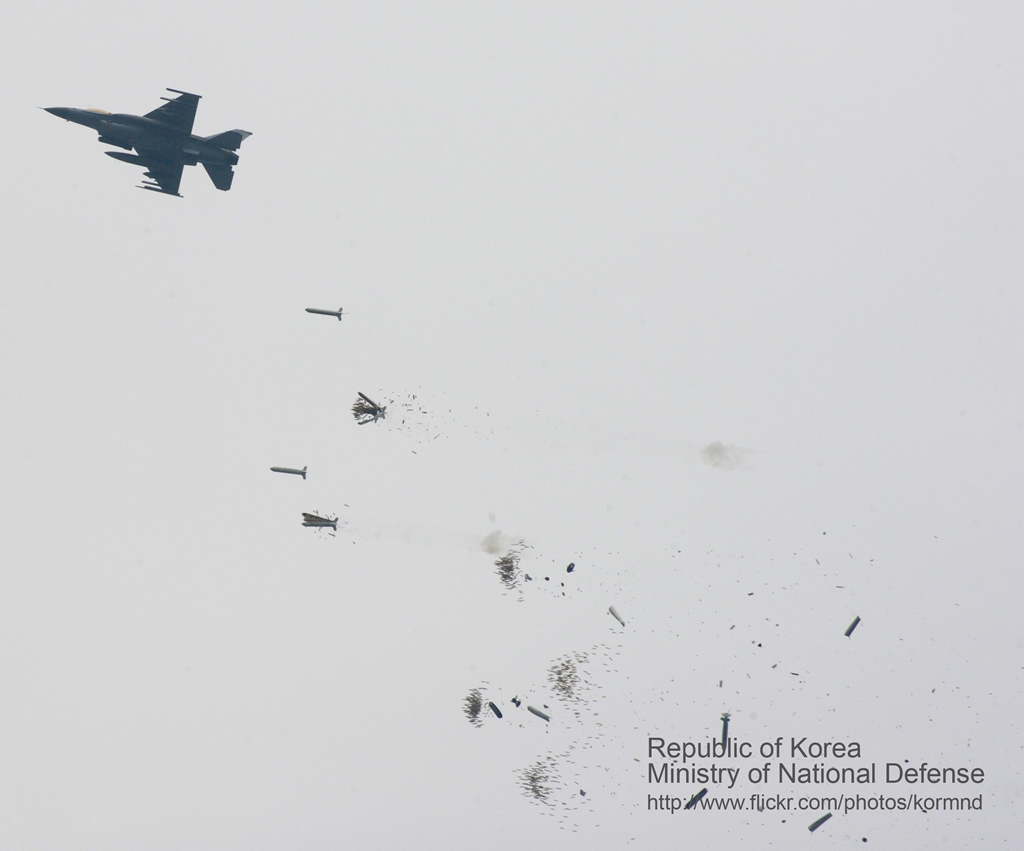
Feb 8/11: JDAM GPS. The Chosun Ilbo quotes the South Korean ROKAF, who says it has integrated the 2,000 pound GBU-31 JDAM GPS-guided bomb with its KF-16 fighters, as well as its F-15K “Slam Eagles.” After developing the software, the ROKAF successfully carried out 3 tests, and finished pilot training at the end of January 2011.
Looks like the F-16 upgrades to allow GPS-guided weapons (vid. May 26/09 entry) have been performed. The report also mentions JDAM wing kits, which are absent from normal JDAMs – but not from the locally-developed KGGB extended range 500-pound GPS-guided bomb.
2009 – 2010
Peace Bridge I F-16C/D Block 32s to be upgraded; KF-X delays make F-16C/D Block 52 upgrades more attractive.
(click to view full)
June 15/10: KF-X. Indonesia and South Korea will produce a KF-X jet together, with the aim of bringing it into service beginning around 2020. South Korea has bowed to realism and greatly reduced the specifications. Instead of trying to develop an F-35 or F-22 analogue, KF-X aims to begin with its FA-50, and improve on that to produce a jet that’s roughly equivalent to an F-16C/D Block 50, or a Chinese J-10.
The KF-X partners don’t expect to even begin fielding until 2020, and they’ll only reach that date in the unlikely event that technical issues don’t delay the project. That timing makes KF-16 upgrades more attractive as an interim measure. Read “” for full coverage.
Oct 22/09: From KF-X to KF-16+? Flight International reports that the stalled KF-X indigenous fighter program, is contributing to renewed assessments of KF-16 upgrades, in order to keep the existing fighters in service for another decade. KF-X has been hampered by the economic crisis, and by a mismatch between an ambitious wish list and realistic costs. If the ROKAF’s focus shifts to KF-16 upgrades as a substitute, upgraded radars and avionics are said to be the priorities.
The report adds that the Raytheon Advanced Combat Radar (RACR) is the only AESA option that the US government has declared to be available for export, and is specifically designed as a drop-in upgrade for the F-16. Note that Northrop Grumman also has its scalable agile beam radar (SABR) drop-in AESA option. Flight International does not cover South Korea’s partnerships with IAI Elta, and the possibility of extending the EL/M-2032 partnership around EL/M-2052 AESA technology.
The other question involves engines. Seoul has opted for a mix the latest GE’s F110 and Pratt & Whitney F100 engines in its Boeing F-15K fighters, and upgrading KF-16 engines to a variant that matches its F-15s would offer longer engine life, and fleet commonality.
July 23/09: EL/M-2032 radar deal. The Korea Times reports that South Korea’s LIG Nex1 will sign a deal with Israel’s IAI Elta Systems on Sept 3/09. That deal will involve the first phase of development for an indigenous radar based on the EL/M-2032 mechanically scanned phased array radar, to equip T/A-50 and F/A-50 aircraft.
An official from the ROK’s DAPA procurement agency told the Times that the radar is expected to be built by the end of 2010, and enter service in 2011. In the mid- to long-term, sources told The Kora Times that the domestically-built radar is likely to be installed on upgraded KF-16 fighters. The Times adds that the effort may even lead to Korean development of an active electronically scanned array (AESA) radar under future agreements with IAI Elta, who has also developed the EL/M-2052 AESA. That positions the EL/M-2032 as a potential Plan B for the KF-16s, and could even make IAI Plan A if AESA cooperation picks up.

(click to view full)
May 26/09: The US Defense Security Cooperation Agency announces the South Korea government’s official request for equipment and services to support the upgrade of 35 F-16 Block 32 Aircraft. The estimated cost is $250 Million.
The announcement is as significant for what it does not contain, as it is for the few details it does mention. There is no mention of radars, which would require notification. Instead, the announcement simply mentions a request:
“…to support the upgrade of 35 F-16 Block 32 aircraft to allow employment of Joint Direct Attack Munitions, Advanced Medium Range Air-to-Air Missiles [DID: AIM-120 AMRAAM], Improved Data Modem, and Secure Voice capabilities…”
The contract is likely to involve wiring, avionics and computing module upgrades, including the installation of MIL-STD-1760 databuses to accommodate GPS-guided weapons like JDAM, or the WMD variant of the CBU-97 cluster bomb. Test and support equipment, spare and repair parts, and other forms of support are also part of this request. The prime contractor will be F-16 manufacturer Lockheed Martin Aeronautics Company in Fort Worth, TX, and a follow-on contract would require temporary travel for U.S. Government or contractor representatives to the Republic of Korea for in-country support.
The lack of any radar request has 3 possible meanings: 1. Speculation that Korean-Israeli defense ties are about to take another step forward, via a contract for IAI Elta’s EL/M-2032 radars; 2. An AESA radar comeptition to follow; or 3. The low-end, non KF-16 part of the fleet will be brought this high and no higher.
Weapon upgrade request
May 1/09: The Korea Times reports that the ROKAF is looking to upgrade its F-16s, but is having problems obtaining the advanced AESA radars it wants. Israel’s EL/M-2032 radar is mentioned as a likely upgrade instead.
Appendix A: The Long Road to AESA
(click to view full)
In 2013, South Korea picked their AESA radar. The challenge has been getting to this point.
A 2009 Korea Times report said that US weapons export restrictions were a problem, and when an official 2009 request to the USA didn’t include radars, it lent weight to quotes like this:
“The Air Force actually wanted the more advanced U.S. active electronically scanned array (AESA) radar but modified the plan due to the U.S. law forbidding the export of state-of-the-art and sensitive weapons systems, [the military source] said.”
In the wake of those reports, other reports focused on a non-AESA alternative. IAI’s EL/M-2032 radar has been exported to several countries for use on several different aircraft types, and equips some F-16s. It will equip the ROKAF’s future FA-50 lightweight fighters, and was said to be the basis for a jointly-developed upgrade to ROKAF KF-16s as well.
IAI’s M-2032 radar is still slated to equip the FA-50, in partnership with Korea’s LIG Nex1. By 2011, however, South Korea’s radar options for its F-16 fleet were growing. Development and fielding of AESA radars was underway in several countries, Raytheon and Northrop Grumman had finished private development of drop-in AESA upgrades for F-16s, and the USA had re-thought its position on exporting that equipment to South Korea. A 2011 RFP focused on American AESA radars, therefore, with provisions for a full suite of air and ground radar modes, and industrial offset provisions that were designed to help South Korea gain some expertise manufacturing AESA components.
Northrop Grumman’s SABR and Raytheon’s RACR were the principal competitors in Korea, as they are in Singapore, Taiwan, and in the US Air National Guard’s proposed upgrade. The US State Department has yet to issue a formal export request for the ROK, but after the September 2011 DSCA announcement of an AESA upgrade for Taiwan’s F-16s, export approval for South Korea is expected to be a mere formality.
Additional Readings
* F-16.NET – South Korea Han-guk Kong Goon. The Republic of Korea Air Force – RoKAF.
* F-16.NET – F-16C/D Block 50/52. The ROKAF Block 52 variant is the locally-built KF-16.
* F-16.NET – F-16C/D Block 30/32.
* BAE Systems – F-16 Avionics upgrades.
* Raytheon – Raytheon Advanced Combat Radar (RACR).
* Lockheed Martin Code One Magazine (Sept 15/08) – F-16 Evolution.
* Lockheed Martin Code One Magazine (Oct 1996) – Moving Mountains: F-16 Production in Korea
Other
* DID – Raytheon’s APG-79 AESA Radars. See also coverage of the radar’s problems. Commonalities across radar types has risks as well as benefits.
* DID – KF-X Fighter: Pushing Paper, or Peer Program? May replace F-16s at the end of their service lives, but program timing ensures that it won’t compete.