


(click to view full)
In 2009, the Ottawa Citizen’s defense reporter David Pugliese reported that the US military was about to spend $100 million to upgrade the facilities at Kandahar, Afghanistan, in order to accommodate up to 26 aircraft for a local “Task Force ODIN”. At first glance, this might seem like just another infrastructure play – unless one realizes that Task Force ODIN (Observe, Detect, Identify & Neutralize) may be the second-most underrated fusion of technology and operating tactics in America’s counter-insurgency arsenal.
Task Force ODIN was created on orders of Gen. Richard A. Cody, the US Army’s outgoing vice chief of staff. Its initial goal involved better ways of finding IED land mines, a need triggered by the limited numbers of USAF Predator UAVs in Iraq, and the consequent refusal of many Army surveillance requests. Despite its small size (about 25 aircraft and 250 personnel) and cobbled-together nature, Task Force ODIN quickly became a huge success. Operating from Camp Speicher near Tikrit, it expanded its focus to become a full surveillance/ strike effort in Iraq – one that ground commanders came to see as more precise than conventional air strikes, hence less likely to create the kind of collateral damage that would damage their campaigns. From its inception in July 2007 to June 2008, the effort reportedly killed more than 3,000 adversaries, and led to the capture of almost 150 insurgent leaders.
With Secretary of Defense Gates paying particular attention to improving ISR(Intelligence, Surveillance, and Reconnaissance) capabilities, replication in Afghanistan was inevitable. The coming construction at Kandahar marks the beginning of that effort.
* Drawing from the Well of Wisdom: Task Force ODIN in Iraq
* Additional Readings
Drawing from the Well of Wisdom: Task Force ODIN in Iraq
(click to view full)
Task Force ODIN’s success stems from a combination of 4 elements. The result is a surveillance/strike package whose elements contribute diverse strengths and cover for each others’ weaknesses, achieving results that each element could not achieve on its own:
The first element is inexpensive, modern-day “Bird Dog” type propeller planes like the Cessna Caravan 208B, C-12R “Horned Owl” or C-12 MARSS-II King Air ISR aircraft, etc. Advanced surveillance and targeting turrets, hyperspectral sensors, and ground-looking radars like General Atomics’ APY-8 Lynx, are integrated with these aircraft, which have higher carrying capacities than most UAVs. Manned aircraft also have much wider fields of view than UAVs, and allow pilots to use other senses like hearing.
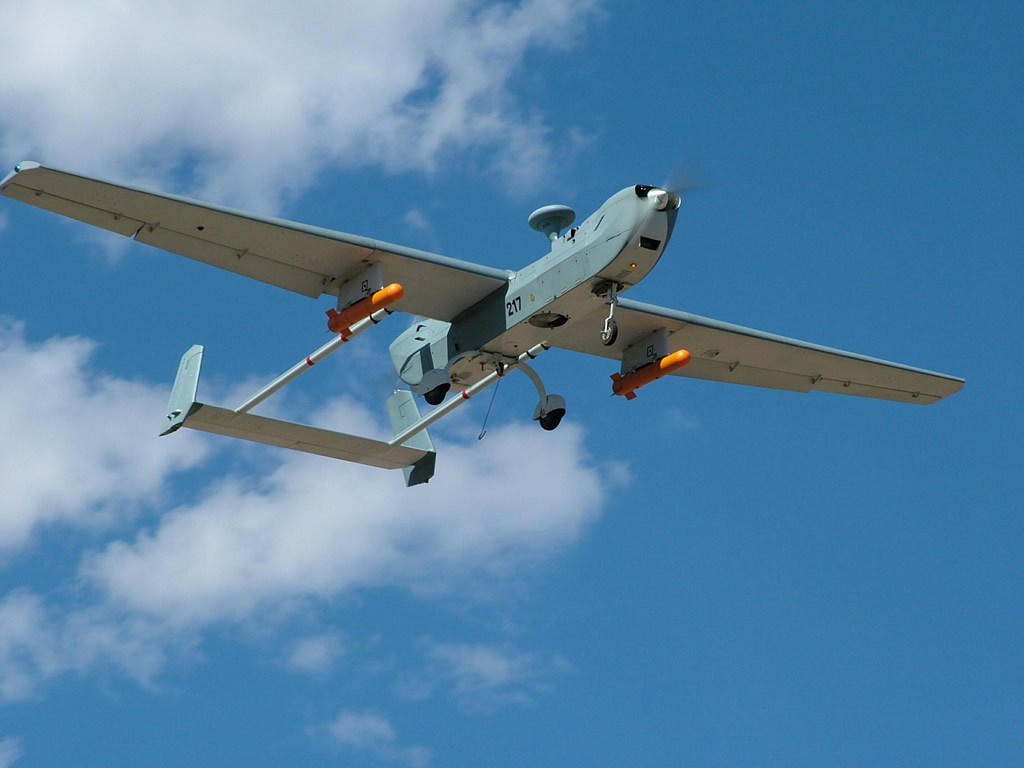
The second element is UAVs like the Army’s RQ-5 Hunters, RQ-7 Shadows, MQ-1C Sky Warriors, et. al. At the high end, these drones are actually more expensive than their companion manned aircraft. Smaller UAVs do offer cost advantages, but all UAVs have the problem of “looking through a soda straw,” which makes them better suited to more focused surveillance of marked areas or key infrastructure like roads, power lines, etc. UAVs’ biggest advantages are twofold: longer time-on-station for persistent surveillance, and the ability to carry precision weapons like Viper Strike, Hellfire missiles, and perhaps even GPS-guided 81mm mortar bombs that would allow the Army to arm its Shadow UAVs as well.
During the task force’s initial operations in Iraq, however, the UAVs were unarmed. QRC-1 of 4 MQ-1C SkyWarriors was unarmed, and the RQ-5/Viper Strike combination was tested but not deployed until several years later in Afghanistan.
The third element is math. Its role is highly under-rated, but new and improved algorithms have made both UAVs and manned “bird dogs” more useful, by offering better analysis of what’s in their scans. A new technology called “Constant Hawk,” mounted on a C-23 Sherpa aircraft, can identify changes in an area, based on multiple scans sing hyperspectral sensors and other equipment. One obvious thing to look for is the signature of disturbed earth or new pavement, which may indicate a new land mine.
Better targeting and attention is the scarcest resource in counter-insurgency operations. Nothing can substitute for human intelligence sources on the ground, but better technologies can mitigate harm by seeing threats in advance – and if their cues are timely enough, they can help begin the capture and interrogation of low-level operatives. This may seem like wasted effort, but with a proper approach, those captures allow investigators to begin working their way up the chain successfully.

(click to view full)
The last element is close co-ordination with Army ground elements, including special forces, and army aviation elements like the AH-64 Apache attack and OH-58D Kiowa Warrior scout helicopters. The AH-64’s 30mm cannon has received significant use, as a weapon that offers exceptional accuracy, usefulness as an inducement to surrender rather than just being a simple shoot/kill weapon, and almost no collateral damage beyond the identified target’s immediate area.
That integration is also a kind of fifth element, beyond the individual resources it calls. Dispensing with the need for special personnel embedded with ground units, long pre-request and decision times for air surveillance, or additional layers of approval up and down both Army and Air Force commands, is another major contributor to Task Force ODIN’s success. Minutes matter during the kinds of operations Task Force ODIN carries out. These lower integration requirements both expand the number and type of forces that can both call on ODIN’s assets, and expand the forces that can and will be called on in response to the task force’s efforts.
The end result has been success, and now replication. In the valleys of the blind, the one-eyed king is da man.
Additional Readings
* DID – US Military Orders More King Air 350ER Aircraft. Most are MC-12W Liberty ISR aircraft, a more advanced variant of the C-12 ARMS.
* DID – Standing Up the IqAF: King Air 350s. Most will be dedicated ISR variants, similar to Horned Owls but using a newer model of King Air as the base. These aircraft are also scheduled to be armed with Hellfire missiles.
* DID – MARSS: Quasi-Civilian Spy Plane Service Ordered by Pentagon, Canada. Includes Dash-7 and King Air Aircraft.
* DID – Walking Back the Cat: The US Army’s Constant Hawk. They key component of “change detection,” which includes software, specialty Shorts 360/C-23 and King Air 350 aircraft, and reportedly ground sensors as well.
* DID – Bird Dogs for the Iraqi Air Force. See esp. the items re: the use of Cessna Caravan 208Bs with advanced sensors.
* DID – Warrior ER/MP: An Enhanced Predator for the Army
* Armada International, via L-3 (February 2010) – ISR in Afghanistan: SR Easier than I [PDF]
* Defense Update (Sept 2009) – Night Eyes for the Constant Hawk
* StrategyPage (Dec 19/08) – Afghanistan Attacked By The Math Machine. Notes that math-based pattern analysis, esp. a technology called Constant Hawk, also played a big role in Task Force ODIN’s success.
* Defense Tech (July 24/08) – Code name alert: Is Liberty Ship a new Big Safari? “Liberty Sip” appears to be an umbrella acquisition program designed to get inexpensive ISR aircraft into theater quickly, bypassing the Pentagon’s bureaucratic processes and service infighting.
* NY Times (June 22/08) – At Odds With Air Force, Army Adds Its Own Aviation Unit. Covers an effort known as Project ODIN, which has been very successful and will soon spread to Afghanistan.
* CASR (June 22/08) – Counterinsurgency Legacy – US Army Aviation Supports its Own: US Air Force turns out to be too Tardy to be Tactically Useful.
* StrategyPage (Oct 12/07) – Constant Hawk Versus Angel Fire Deathmatch
* Pentagon DVIDS (Sept 20/07) – Task Force ODIN Using innovative technology to support ground forces
* Flight International (Aug 22/06) – Shorts 360 Constant Hawk system heads for Iraqi theatre. Based on the civilian counterpart of the C-23 Sherpa.
* Edwards AFB, va Google Cache (May 22/06) – Engineer takes flight testing to fight, wins award. Discusses the C-12 Horned Owl variant, part of Project ODIN.
* Aviation Week (May 8/05) – Rise in Suicide Attacks in Iraq Propels Search for Better IED Detection. Includes details re: the C-12R Horned Owl aircraft, with ventral APY-8 Lynx radars and electro-optical sensors.
* DID – MARSS: Quasi-Civilian Spy Plane Service Ordered by Pentagon. Involved leased DC-7s augmented with surveillance equipment, flown and operated by contractors.
* DID – US Military Orders More King Air 350ER Aircraft. Many appear to be destined for use as ISR platforms.
* Defense Tech (July 23/09) – COIN Air Force on its Way – in the US, as well as Iraq. Its exact shape remains TBD.
* DID (Aug 24/08) – CENTCOM Looks to Boost ISR Capabilities in 2008-2009. Explains the surveillance/strike concept in more detail, marked in part by profound changes in the use of artillery.