


note ISR turret
(click to view full)
Iraq’s air force has been very slow in getting to its feet. A handful of Seeker light observation aircraft with their distinctive bubble-shaped fronts, a few Comp Air light propeller aircraft, a couple of old, refurbished C-130E transports, and a slowly growing fleet of helicopters. A few Hawker Beechcraft King Air 350s have been ordered for transport and surveillance duties, and an RFP for armed counterinsurgency aircraft has only given Iraq a set of unarmed T-6B trainers. Even subsequent orders for F-16C/D fighters and L-159 advanced trainer and attack jets leave the Iraqi air force a long way from being able to secure Iraq’s sovereignty and territorial integrity. While it continues to grow<, the IqAF’s primary duties remain troop/medical transport, light supply duties, and surveillance of roads and infrastructure.
That kind of surveillance doesn’t require high tech, high-end aircraft. The USAF was using F-16 and F/A-18 aircraft at $15,000 per flight hour, plus recapitalization amortization. Iraq’s solution takes a page from the US military’s own past, and offers a significant contrast to the American approach.
Hey, Bird Dog

(click to view full)
Light propeller aircraft like Cessna’s L-19 “Bird Dog” and O-2 successor worked very well in Vietnam. Their modern descendants can be outfitted with modern surveillance turrets plus “Mk1 eyeballs and ears” for a fraction of a fighter jet’s acquisition and amortization cost, in order to do more or less the same ISR (Intelligence, Surveillance, and Reconnaissance) job. They’ll also crash less often than expensive UAVs, and are more suitable for fledgling air forces.
Specialty models like the Schweizer RU-38 Twin Condor even add acoustic silencing, plus more mission space for dedicated surveillance equipment.
The “Bird Dog” concept certainly fits the IqAF’s profile and support capabilities, and Cessna 172s were initially slated to serve as a trainer aircraft. Unsurprisingly, statements from people on the front lines quickly revealed that larger Cessna 208B Caravan aircraft were picking up key surveillance roles, and that a push was on to arm the planes with the same kinds of Hellfire missiles carried by more expensive attack helicopters and Predator drones.
The process has continued in close lockstep with the growth of the Iraqi Air Force’s own professionalism and capabilities, and the Iraqis are now fielding armed “Bird Dog” aircraft as one of their primary domestic options for close air support.
Contracts & Key Events
[youtube:v=04PC72lH5p4]
click for video
Note that some planes may have been ordered under the “Special Defense Acquisition Fund.” Its ostensible purpose is to buy items quickly for friendly governments. It actual effect is to hide which governments are receiving the items. The US military announced SDAF orders for 8 C-208B aircraft in CY 2012, but 2009 releases already showed a significant difference between Iraqi C-208 numbers and public Pentagon announcements.
2011 – Today
Iraq able to use AC-208s on their own, to limited effect; Support contracts.

(click to view full)
December 23/20: Cessna 208 and 172 Northrop Grumman, doing business as Alliant Techsystems Inc. was tapped for a $15.2 million modification for contractor logistic support for the Iraqi Air Force’s Cessna 208 and 172 fleet. The Cessna 208 and 172 are utility aircraft. An Iraqi Air Force Cessna 172 Skyhawk training aircraft crashed during a training mission in Salah ad Din Governorate in central Iraq on October 31 killing the pilot and co-pilot. Work will take place in Balad Airbase, Iraq and estimated completion date is June 30, 2021.
July 4/14: Intelligence? A weapon deficiency may not be Iraq’s biggest problem. The way they’re employing their forces makes it hard to use them effectively, and seems geared to stoking massive sectarian conflict:
“But even before the U.S. military left the country, the Iraqi government purged many of its best intelligence officers and assets because they were either Sunnis or Kurds… according to a senior intelligence official who spoke anonymously so that he could speak freely…. Michael Pregent, a former Army intelligence officer working on contract as an embedded adviser to the Iraqi security forces in 2008, obtained evidence that showed how politicized the Iraqi targeting process had become…. A confidential analysis of the [3,000 target] list by Americans in a targeting cell at the Baghdad Operations Center found that 95 percent of the targets were either Sunni men of military age, tribal leaders or other Sunnis listed simply as “the friend of a terrorist, father of a terrorist, grandfather of a terrorist,” Pregent said. No direct evidence of terrorist involvement was provided, he said.”
The Saddam approach to crushing an insurgency can work as long as you have the guns and technological superiority to pull it off. Iraq is shaky in terms of the weapons advantage, and that gets shakier if the rebels receive competent outside assistance. Can Iran help drown the Sunnis in manpower? And will the USA be able to continue supporting the Iraqi government if it plays by standard Mideast rules in a sectarian civil war? Sources: Washington Post via Stars and Stripes, “Iraq lacks ability to fly F-16s it seeks, US trainer says”.
June 30/14: Missile deliveries. As the Iraqi government’s authority collapses in the north and west, US Defense Department spokesman Army Col. Steven Warren says that:
“I know we’re down to having delivered all but 100 of the recent purchase of 500 [Hellfire missiles] that the Iraqis made. There were shipments within the last week…. We expect that purchase of a total of 500 Hellfires to be closed out within the coming two or three weeks.”
The Hellfire’s main platform in Iraq is currently their AC-208 fleet. Sources: Pentagon, “U.S. Continues Military Aid to Iraqi Government”.
June 21/14: Out of Hellfires. As its northern cities and Sunni areas steadily fall, Iraq has a minor but significant problem:
“The Iraqi military ran out of Hellfire missiles six days ago, and though the U.S. is rushing more missiles into the country, Iraq has only two modified Cessna aircraft to launch them in their battle against the radical Islamic militia ISIS…. The losses have left the Iraqi military with no offensive capability, and no real air force. “
Iraq hasn’t had a real combat air force since Saddam Hussein’s era, and the best estimates didn’t expect one before 2017 at the earliest. The Iraqis do have armed Russian Mi-17 helicopters that don’t use Hellfires, and French EC635 scout helicopters whose armed status is uncertain. Russia has also agreed to sell them Mi-28 attack helicopters, but there are no signs of any in service. ABC News, “Iraqi Military Out of Hellfires in Battle Against ISIS”
May 30/14: Hellfires. US Security Assistance Command touts its role in delivering 300 Hellfire missiles to Iraq through the Foreign Military Sales program. The Ac-208B is the missile’s key platform.
“Upon receiving a letter of request in January, USASAC began to work closely with the Aviation and Missile Command, Joint Munitions Command, the vendor and various other organizations in order to implement an emergency case…. “USASAC had the lead from an overall program management perspective,” said Will Collins, country program manager for Iraq…. A case for 300 Hellfire missiles completed formal congressional notification Feb. 22. Within a week USASAC received a signed letter of acceptance from the government of Iraq, and on Feb. 27 USASAC began implementing the case…. providing weekly updates to the Defense Security Cooperation Agency.”
It wasn’t quite enough (q.v. June 21/14). Sources: US Army, “USASAC meets request”.
May 5/14: Support. ATK in Fort Worth, TX receives a maximum $15.2 million firm-fixed-price unfinalized contract modification to to continue contractor logistic support services for the Iraqi Air Force’s RC-208 ISR (intelligence, surveillance, reconnaissance) and armed AC-208 Cessna Caravan light planes, without a break in service. They’re Cessna planes, but ATK equipped them to be full-fledged Bird Dogs instead of just initial flight trainers. The firm will also provide student training for Iraqi aircraft maintenance specialists.
$7.6 million is committed immediately. Work will be performed at Joint Base Balad, Iraq, and is expected to be complete by Dec 31/14. USAF Life Cycle Management Center/WLKCL at Tinker AFB, OK manages the contract (FA8106-10-C-0010, PO 0039).
May 1/14: On the ground… A Wall Street Journal report offers a poor review of the Iraqi military’s performance, citing desertion, poor logistics, and insufficient support. Prime Minister Maliki’s policies of ethnic division haven’t exactly helped, and the conflict next door in Syria ensures that many Sunnis are returning home with even more battle experience. Close air support is especially problematic:
“In January, Gen. Dulaimi says, he was passing through a dense urban area of Ramadi in a column of nearly 50 Humvees, tanks and armored cars. They were ambushed by what he describes as hundreds of militants carrying machine guns, grenade launchers and improvised explosives…. [but] he was told that there were no airplanes capable of operating at night…. After nearly five hours, Baghdad sent a Russian-made prop plane loaded with two missiles—its maximum capacity. One of the missiles landed a direct hit, scattering the antigovernment commandos.”
The prop plane was almost certainly a very American AC-208 Combat Caravan, but the anecdote illustrates the problem. A few Cessnas won’t fix it, though buying a lot of them might have made a much bigger difference. Sources: WSJ, “Fledgling Iraqi Military Is Outmatched on Battlefield: On Eve of Elections, Demoralized Army Is Losing Fight Against Islamist Militants” | See also: Defense One, “Iraq’s Elections Setting Up ‘Worst Case Scenario’ “.
April 24/13: Alliant Techsystems Inc. in Fort Worth, TX receives a maximum $31.5 million firm-fixed-price contract modification “to continue contractor logistic support servces [sic] for the Iraqi Air Force’s Cessna 208s and to provide maintenance student training”. ATK is closely involved in the armed AC-208 Combat Caravan program, but that maintenance is separate (q.v. May 5/14).
Work will be performed in Tikrit, Iraq, and is expected to be complete in April 2014. $13.8 million is committed immediately, and USAF Life Cycle Management Center/WLKCL at Tinker AFB, OK acts as Iraq’s FMS agent (FA8106-10-C-0010, PO 0030).
April 19/13: Support. L-3 Vertex Aerospace LLC in Madison, MS received a maximum $45.2 million firm-fixed-price contract modification, extending their support work with IqAF C-208 Caravan family and C-172 aircraft for another 12 months. They’ll also continue to teach maintenance students training on both aircraft.
There is a significant gap in public announcements re: these support contracts.
Work will be performed at Tikrit Air Base, Iraq, and is expected to be complete by April 20/14. The USAF Life Cycle Management Center/WLKLC at Tinker AFB, OK acts as Iraq’s FMS agent (FA8106-10-C-0012, PO 0012).
March 23/11: AC-208s. An AC-208B Combat Caravan successfully attacks a target called in by Iraqi Special Operations Forces at the Aziziyah Training Range. A 2-ship formation of Iraqi air force Cessnas from Squadron 3 at Kirkuk Air Base, Iraq, fired a single air-to-ground missile, after receiving ground target coordinates and direction from Iraqi forward air controllers, inserted near the target area by Mi-17 helicopters flying from Camp Taji. The exercise marked the 3rd time an Iraqi air force aircraft has fired an AGM-114 Hellfire missile in 3 years, as the scenarios increase in complexity and scope. Even more important, it was an ISOF Forward Air Controller calling the shot. Pentagon DVIDS.
All-Iraqi AC-208 shot
2009 – 2010
Mismatch between announced deliveries and announced orders; RC-208 recce & AC-208 armed variants in service; Mx-15 sensor contract; Support.
(click to view full)
Nov 8/10: AC-208s. An Iraqi AC-208B Combat Caravan fires a Hellfire missile at a vehicle on on the Aziziyah Training Range, south of Baghdad, achieving a direct hit. This is the first time since the American invasion that the Iraqi Air Force has run a live-fire missile training exercise, from start to finish, all on its own. It’s the 2nd time an Iraqi AC-208B has fired a Hellfire. The human infrastructure is actually more important than the technical achievement. USAF Maj. Devin Traynor:
“Think of it this way… First we have to find our target. Then we fix the location and continue tracking it. Next we target and then engage the adversary. Finally, we make an assessment on whether or not we achieved the results we wanted. Each of these elements of this type of mission must be done perfectly and coordinated perfectly for the mission to succeed. The air advisers have played a crucial role in developing these capabilities within the Iraqi air force.”
Nov 16/09: C-208s. ATK announces delivery of the 3rd AC-208B Combat Caravan aircraft to the Iraq Training and Advisory Mission in Kirkuk, Iraq. To date, ATK has delivered 11 modified C-208 aircraft in support of U.S. Government contracts for rebuilding the Iraqi Air Force: 3 RC-208B reconnaissance aircraft, 5 C-208B trainer aircraft and 3 AC-208Bs. Which is interesting, because the relevant contract announcements cover just 5.
The AC-208B Combat Caravan aircraft is a specially modified Cessna Grand Caravan that incorporates an electro-optical targeting system with integrated laser designator, Hellfire laser guided missiles, an air-to-ground and air-to-air data link and aircraft self-protection equipment. ATK’s STAR Mission System provides both day and night reconnaissance and fire control capabilities for the mission crew.
The Combat Caravan program was awarded to ATK in 2008. Within 11 months, ATK completed live fire testing and delivered its first aircraft to Iraq. The aircraft holds both a Military and Civil Certification.
Nov 4/09: AC-208s. A 3-man Iraqi aircrew from Squadron 3 fires an AGM-114 Hellfire missile from an AC-208B Caravan at a target on a bombing range near Al Asad Air Base, Iraq. Pentagon AFPS.
Oct 5/08: AC-208s. Aviation Week reports that IqAF AC-208 Combat Caravans have been fitted with launchers, and will be cleared to start shooting laser-guided Hellfire missiles later in October 2009. The report adds that:
“On the intelligence-collection side, operating the C-208 Caravans, Hawker Beechcraft King Air 350s and SAMA CH2000s also has progressed well. As a result, coalition advisers are focusing more on teaching the Iraqis how to exploit the sensor information.”
Sept 22/09: Sensors. L-3 WESCAM announces an indefinite delivery/indefinite quantity (ID/IQ) contract to provide more than 50 MX-15D surveillance turrets with laser designation and rangefinding capability to the U.S. Army, in support of the Army’s Iraqi Air Force Reconstruction Program.
The MX-15D will likely be used to equip several Iraqi platforms, including its AC-208B Combat Caravans. Iraq’s larger MC-12W King Air twin-turboprops also use the MX-15, and it may end up equipping Iraq’s counter-insurgency aircraft – currently projected to be HawkerBeechcraft’s AT-6B, which is still in development.
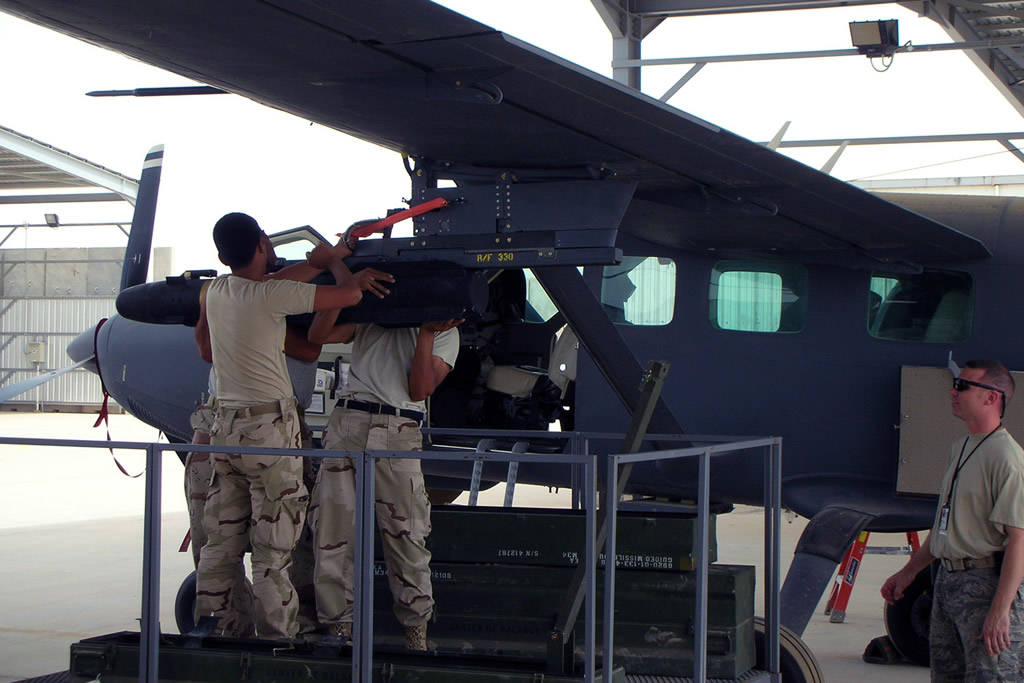
Aug 19/09: Training. At Kirkuk AB, 3 Iraqi airmen, assigned to Iraqi Air Force Squadron 3, become the first Iraqi weapons loaders certified as a lead weapons crew. As a lead weapons crew, they are qualified to load weapons, and to train and evaluate their fellow Iraqi service members. The associated pictures show them working to fit a dummy Hellfire missile onto the weapons pylon of a Cessna AC-208 Caravan. Pentagon DVIDS.
March 25/09: Support. L-3 Communications Vertex Aerospace in Madison, MS receives a $15.6 million firm fixed contract to provide fleet maintenance and training support on 12 Cessna 173 aircraft and 5 Cessna 208B trainer aircraft owned by the Iraqi Government. At this time, $7.6 million has been committed. The 727 ACSG/PKB at Tinker Air Force Base, OK manages this contract (FA8106-09-C-0004).
2007 – 2008
Purchase of 18 C-172s and 5 C-208s.

(click to view full)
Oct 14/08: AC-208s. Aviation Week reports that armed Cessna 208Bs destined for Iraq are flying out of an airport near Fort Worth, TX, and are set to be delivered in December 2008. The airport is used by ATK Integrated Systems for its projects:
“Two Cessna Grand Caravan 208Bs, armed with a pair of AGM-114 Hellfire missiles each, have been photographed flying out of Meacham Airport earlier this month… In December the Iraqi Air Force will receive the first three armed Caravans – with laser designators for the missiles – followed by two more in early 2009, says USAF Brig. Gen. Brooks Bash, current chief of the Coalition Air Force Transition team.”
some Cessna Caravans are already in service with the IqAF, as unarmed reconnaissance planes.
July 9/08: U.S. forces transfer ownership of 11 aircraft to the Iraqi air force during a ceremony at New Al Muthana Air Base. Army Lt. Gen. Frank Helmick, commander of Multi-National Security Transition Command Iraq, signed over 8 Cessna 172s and 3 Cessna Caravan 208s worth more than $9 million to Iraqi Defense Minister Abd al-Qadir al-Mufriji.
Hawker Beechcraft’s new King Air 350 intelligence, surveillance and reconnaissance aircraft and King Air 350 light transport aircraft were also unveiled during the ceremony.
Brig. Gen. Brooks Bash said the Cessna 127 and 208 aircraft would be part of the IqAF training program at Kirkuk Regional Air Base in northern Iraq, allowing more than 130 new pilots to train and graduate by 2010. “As of now, the Iraqi air force is just beginning to grow,” [Bash] said. “They will double in size within the next year, giving them up to 6,000 airmen and 133 aircraft by the end of 2009.” USAF release.
New array of light aircraft unveiled

(click to view full)
Nov 29/07: C-208s armed? Cue more Cessna Caravans. The Cessna Aircraft Co. of Wichita, KS received a firm-fixed price contract for $23.7 million to buy 5 Cessna C-208B Caravan aircraft along with minor aircraft modifications, logistic support services, and one year of spares for the Iraqi Air Force. The contract also includes an option for 2 additional aircraft, At this time, all funds been obligated. The 337th AESG/FMS at Wright-Patterson Air Force Base, OH issued the contract (FA8617-08-C-6183).
5 C-208B Caravans ordered
Oct 31/07: C-208s. U.S. Air Force Col. Michael Wobbema, Chief of Staff for the Coalition Air Force Transition Team, says in an interview that: “And then we’ve got this Cessna [208B] Caravan. The Cessna Caravan will also become — there will be an armed variant of that that will come online.”
Aug 3/07: C-172s. Cessna Aircraft Co. in Wichita, KS has received a firm-fixed-price contract for $10.6 million. The aircraft will reportedly be used primarily in a trainer role, and for about the price of a high-end Predator UAV system, this contract action will procure 18 Cessna C-172 aircraft (with an option for 10 more), logistics support services, and 1 year of spares for the Iraqi Air Force. At this time, $7.5 million has been obligated. Work will be complete December 2008. Air Force Materiel Command at Wright-Patterson Air Force Base, OH issued the contract (FA8617-07-C-6181).
18 C-172s ordered
Additional Readings & Sources
Thanks to sharp-eyed reader Steve Sommer of Corporate Skyways, Inc., who first brought our attention to a long-standing mis-labeling in one of the Cessna photos.
Background: Aircraft
* ATK – AC-208 Combat Caravan.
* Air Force Technology – AC-208 Combat Caravan Light Attack Aircraft, Iraq.
Related
* DID – Standing Up the IqAF: King Air 350s. Many are 350ER-ISR specialty variants. They aren’t really “Bird Dog” aircraft, however – more like the low end of long-endurance, dedicated surveillance aircraft, with armament comparable to a Predator or the Caravan 208Bs.
* DID – Task Force ODIN: In the Kingdom of the Blind…. The USA discovers that low-cost manned aircraft, plus UAVs, plus better organizational approaches, can yield significant success.
* DID – “Bird Dog” Light Planes for Afghanistan. They picked Cessna 182 turbos for high-altitude terrain, and 208Bs as their mainstay.
News & Views
* Defense Tech (July 23/09) – COIN Air Force on its Way – in the US, as well as Iraq. Its exact shape remains TBD.
* USAF (May 21/08) – Iraqi air force postured to break records [dead link]. As long as you begin history with the end of Saddam’s regime.
* StrategyPage (Feb 19/08) – Iraq Seeks Cessna Solution. “The 208Bs are being equipped with the same sensors and targeting pods used on the Predator UAV. The 208B can be rigged to carry Hellfire missiles as well, giving the Iraqis an aircraft that can act as an Predator clone, a personnel transport or a cargo hauler. Many are available on the used aircraft market for about $2 million each. And pilots can be quickly trained on the 172, and easily transition to the 208B.”
* Defense Tech (Oct 31/07) – Rebuilding the Iraqi Air Force.
* USAF, Wright-Patterson AFB (Oct 31/07) – Wright-Patt plays a part in training future Iraqi pilots.
* USAF (Oct 5/07) – Iraqi air force flying training school opens at Kikuk. They mean Kirkuk, where the 52nd Expeditionary Flying Training Squadron operates.
* USAF Guy’s Milblog (June 11/07) – Manners & Mustaches (pics). “Got to fly up in the Iraqi Air Force’s newest aircraft–a modified Cessna Caravan. It’s a great little aircraft and has a large forward looking infrared and video pod the Iraqis will use for reconnaissance.” The Author is a US Air Force officer deployed at that time to Basrah Air Station, Iraq where he is embedded in an Iraqi Air Force squadron as a military advisor.