


(click to view full)
DID’s recent coverage of Australia’s Canberra Class LHD project wondered about the overall contract’s cost differences between Navantia’s EUR 1.412 billion (A$2.2 billion) and the government’s A$ 3.1 billion. A chat with the Australian DoD has provided us with some answers, as well as some additional insights into the ship’s defensive systems and armament.
The short answer is: both figures were correct. The Australian Government had initially budgeted about A$2 billion, and the contract signed with Navantia was indeed for the figures claimed. When the Australian government moved to calculate the final program cost, however, they also looked at inflation from 2007-2015. Within that period, forecasts were made regarding inflation and materials costs in several locales: Spanish labor rate indices and costs, US inflation projections, relative currency projections, and Australian inflation indices for the 23% “Australianization” work. Putting them together yielded a sort of “basket” of projected inflation tables for the project as a whole, which was used to estimate actual dollar costs. On top of that, Australian planners added project management costs, project contingency funds for required infrastructure improvements to ports and berthings, etc. to arrive at the likely “actual dollar costs” over the entire program.
Overall management of the contractors now go through Tenix, who subcontracts to Navantia for the core ship, Saab Systems for the combat system, and American firm L-3 for the communications, internal LAN, etc. Economic Price Adjustment clauses allow the subcontracts to adjust as the appropriate material and labour costs rise over time due to inflation et. al.
With respect to armament…
(click to view full)
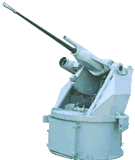
The 27,500t Canberra Class ships will have minimal defensive armament and systems. Though they will share Saab’s 9LV combat system with the ANZAC Class frigates, their radars will be designed for aviation control, not targeting. This situation could be improved in future by mounting phased array CEAFAR/CEAMOUNT radars; Australia’s ANZAC frigates are already receiving these radars as part of their anti-air upgrades, and integrating them with the same common combat system. Initially, however, the Canberras will mount only 4 RAFAEL Typhoon 25mm remote weapons systems at the corners, for fending off asymmetric attacks like small boats.
The lack of anti-air missiles or even last-ditch CIWS defensive systems is an unusual decision for such a large and important ship. France’s 21,300t Mistral Class LHDs, for instance, carry a pair of Simbad launchers for short-range Mistral surface-air missiles, in addition to 30mm cannons for asymmetric warfare defense. South Korea’s 18,900t Dokdo Class LHDs sport a pair of 30mm Golakeeper CIWS cannons, and RAM missiles. Italy’s 27,000t Cavour Class will carry advanced Aster 15 missiles in a vertical launcher and Oto Melara 76mm cannons for defense, while the much larger 45,000t US LHD-1 Wasp Class pack a mix of Evolved Sea Sparrow missiles, RAM missiles, and Phalanx CIWS cannons for 3-layered anti-air coverage.
On the other hand, Australia’s Department of Defence told DID that the Canberra’s concept of operations involved relying on protection from Hobart Class anti-air frigates and upgraded ANZAC Class ships, along with aerial coverage from E-737 Wedgetail AWACS et. al. (other available assets would include P-8A Poseidon sea/land surveillance aircraft, and possibly long range UAVs) to ensure overwatch and protection. The Canberras would thus have the benefit of protection from SM-2 Standard and evolved Sea Sparrow missiles, as well as the Phalanx CIWS systems on escorting Hobart Class ships if they manage to interpose themselves between the LHD and incoming missiles.
Australia’s DoD did not add that the Canberra Class has the prerequisites to carry F-35B Lightning II STOVL fighters for additional aerial protection, as Australia has not made any decisions to buy this version or to outfit the Canberra Class with fighters. Nevertheless, this is also future possibility, alongside the potential to add systems like CEAFAR radars, CIWS/ SeaRAM systems, et. al.