

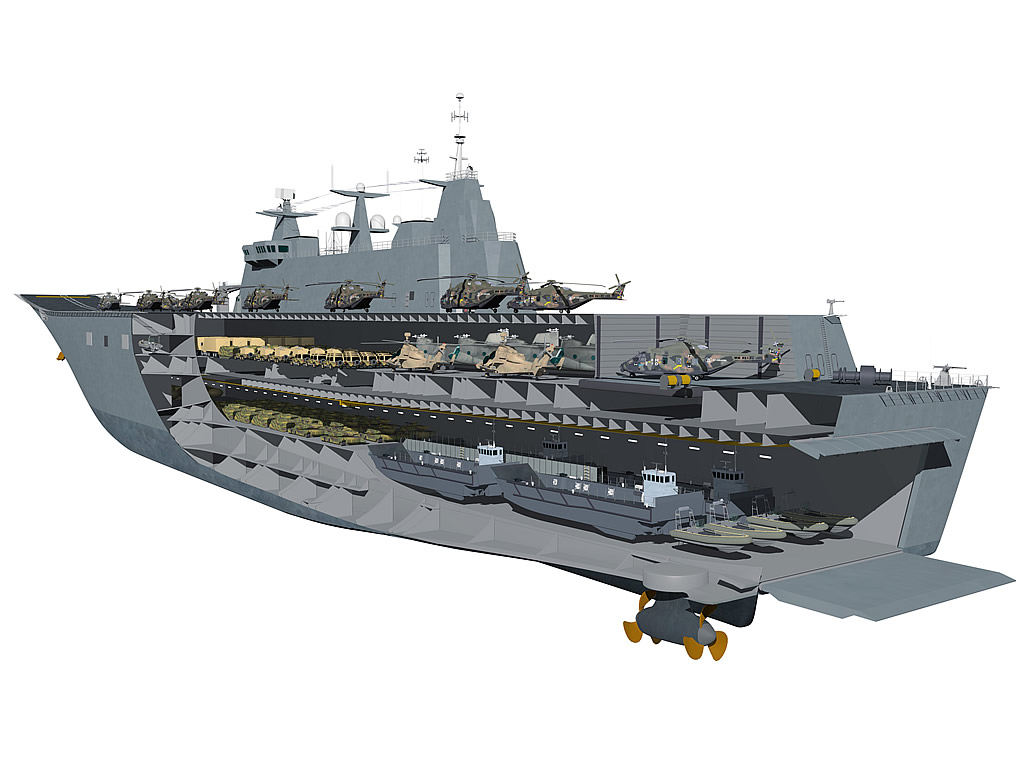
(click to view full)
In May of 2006 the Royal Australian Navy announced its decision to expand its naval expeditionary capabilities. HMAS Manoora and Kanimbla would be replaced with substantially larger and more capable modern designs, featuring strong air support. Navantia and Tenix offered a 27,000t Landing Helicopter Dock (LHD) design that resembled the Strategic Projection Ship (Buque de Proyeccion Estrategica) under construction for the Spanish Navy. The DCNS-Thales Australia team, meanwhile, proposed a variation of the 21,300t Mistral Class that is serving successfully with the French Navy.
Navantia’s larger design eventually won, giving the Spanish firm an A$ 11 billion clean sweep of Australia’s “Air Warfare Destroyer” and LHD programs. These 5 ships will be the core of Australia’s future surface navy. The future HMAS Canberra and HMAS Adelaide will be able to serve as amphibious landing ships, helicopter carriers, floating HQs and medical facilities for humanitarian assistance, and launching pads for UAVs or even short/vertical takeoff fighters.
Project 2048
This is what Australia wanted from their 2 LHDs:
* Carriage, in addition to the crew, of approximately 1,200 troops and 800 support personnel for helicopter operations, logistics, command and intelligence, etc.;
* About 2,400 lane meters of space, with deck strength to carry around 100 armoured vehicles, including tanks, and 200 other vehicles;
* Hangar space for at least 12 helicopters and an equal number of landing spots to allow a company group to be simultaneously landed;
* 45 days endurance for crew and embarked force including sustainment, medical, rotary wing and operational maintenance and repair support to these forces whilst ashore for 10 days;
* Command and control of the land, sea and air elements of a Joint Task Force; and
* The ability to conduct simultaneous helicopter and watercraft operations in conditions up to Sea State 4.
Reality set in for some of these specifications, but the ship ended up fulfilling most of these needs. On the other hand, it fails to deliver in at least one key area.
Winner: The Navantia-Tenix LHD
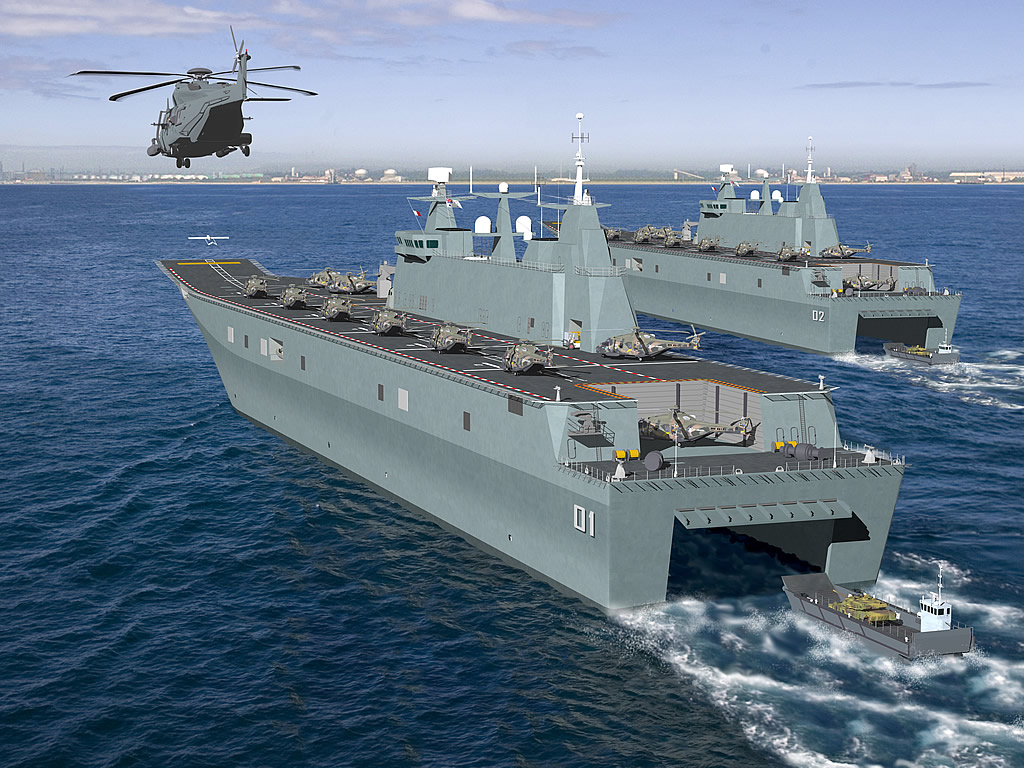
(click to view full)
The Tenix (BAE)-Navantia team won with a variation of their Strategic Projection Ship (Buque de Proyeccion Estrategica) under development for the Spanish Navy. In Spain, it’s known as the Juan Carlos I aircraft carrier, and flies AV-8B fighter jets as well as helicopters.
Australia’s doesn’t plan to use their ship that way, but they’re an F-35A customer, and could choose to buy F-35B STOVL fighters at some future date. They’re more likely to use their LHDs as a UAV platform, in order to extend surveillance reach, but 2014 revelations made it clear that Australia is thinking about fighters as well. Statistics for the Australian ships follow:
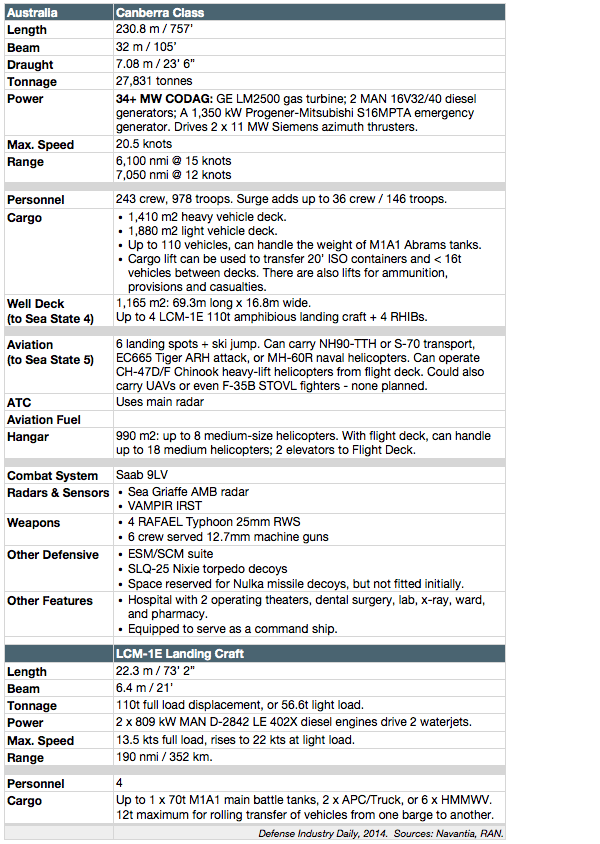
By comparison to the above statistics, the retired Kanimbla Class LPAs carried 450 troops, and could accommodate just 4 helicopters. HMAS Tobruk, which will retire when HMAS Canberra enters service, is even smaller than that. Neither could launch medium-size UAVs, let alone fighter jets.
Canberra’s Design Gap

(click to view full)
There is one major gap: weaponry. Despite their size, capacity, and importance to the RAN, Australia’s Canberra Class ships will have minimal defensive armament and systems.
Tenix (now part of BAE Systems) managed the RAN’s ANZAC Class frigate program, and their Canberra Class LHDs will share the same Saab 9LV combat system. The Canberra Class will also share the ANZAC Class’ VAMPIR NG infrared track and scan sensors, which allow short range detection of fast attack boats, UAVs, and incoming missiles under all weather conditions.
On the other hand, the ships’ Sea Giraffe AMB radars will be slated for aviation control, not missile or naval targeting. This situation could be improved in future by adding basic defensive systems, and future improvements could mount CEAFAR/CEAMOUNT phased array radars. Australia’s ANZAC frigates are already receiving these advanced radars as part of their anti-air upgrades, and integrating them with the same common combat system.
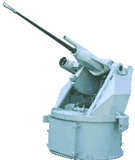
(click to view full)
As the above statistics show, however, the Canberra Class will be nearly defenseless.
The lack of anti-air missiles, or even last-ditch CIWS defensive systems, is an unusual decision for such a large and important ship. Even France’s lightly-armed 21,300t Mistral Class LHDs carry a pair of Simbad launchers with short-range Mistral surface-air missiles, along with 30mm cannons for asymmetric warfare defense. South Korea’s 18,900t Dokdo Class LHDs sports a 2-layer defense of 30mm Golakeeper CIWS cannons, and RIM-116 RAM short-range missiles. Italy’s 27,000t Cavour Class extends its defensive reach with advanced medium-range Aster 15 missiles and Oto Melara 76mm cannons, while the much larger 45,000t US LHD-1 Wasp Class pack a mix of Evolved Sea Sparrow missiles, RAM missiles, and Phalanx CIWS cannons for 3-layered anti-air coverage.
Australia’s Department of Defence told DID that the Canberra’s concept of operations involved relying on protection from Hobart Class air defense destroyers and upgraded ANZAC Class ships, along with aerial coverage from E-737 Wedgetail AWACS etc. Other overwatch and protection will have to come from Australia’s future P-8A Poseidon sea/land surveillance aircraft, and long-range MQ-4C Triton UAVs.
Program & Construction Plans
(click to view full)
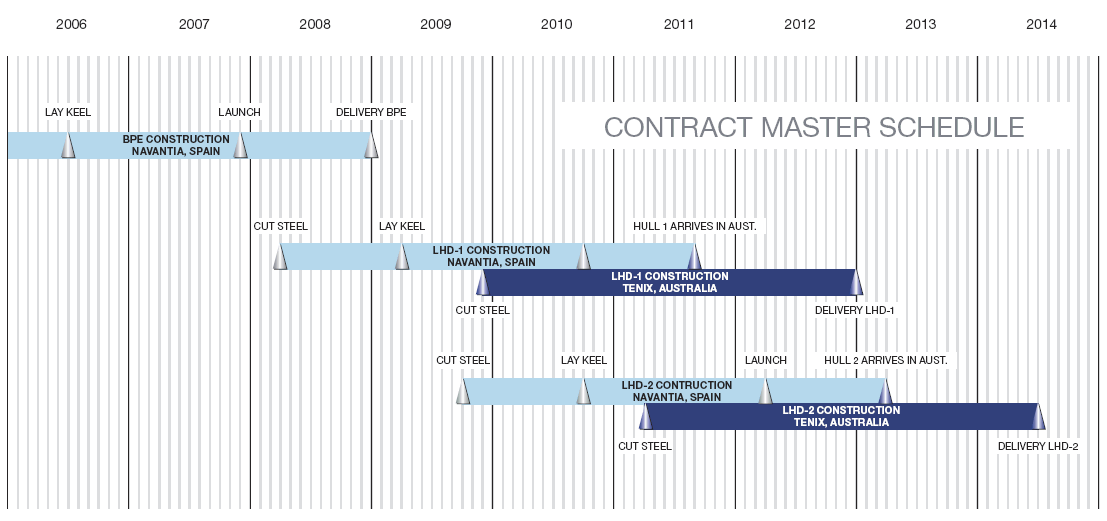
The Canberra Class were initially expected to replace Australia’s existing ships in 2012 (HMAS Canberra) and 2014 (HMAS Adelaide). Those dates have since slipped to November 2014 (HMAS Canberra) and November 2016 (HMAS Adelaide), but so far, the program has avoided Australia’s infamous “Projects of Concern” list.
“Joint Project 2048” did receive a nasty price hike very early in the process, however, from A$ 2 billion to about A$ 3 billion. Oddly enough, that’s an example of good news.
The main thrust of Australia’s Kinnaird Report post-mortem, undertaken after the Collins Class submarine program’s massive cost overruns, was the need to do more up-front work, in order to improve cost and delivery estimates on defense projects. As a result, approximately A$ 23 million was spent over 3 years on Canberra Class design studies.
The outcome was a mixed blessing. By the time 1st Pass Approval came, the Government was told at 1st Pass Approval that the Project was likely to cost at least A$ 600 – $900 million more than the allocated budget over the life of the program. Inflation was part of the story. When the Australian government moved to calculate the final program cost, they looked at the entire program from 2007-2015, when HMAS Adelaide is scheduled for delivery. Within that period, forecasts were made regarding inflation and materials costs in several locales: Spanish labor rates indices and costs, the 20% of the project in US dollars for L-3’s components, and Australian indices for the 23% “Australianization” work. Putting them together yielded a sort of “basket” of inflationary indices for the project as a whole. On top of that, Australian planners also added project management costs, project contingency funds for required infrastructure improvements to ports and berthings, etc.
The result was something of a price shock, as the program cost rose to A$ 3 billion, instead of the original budget figure of $2 billion. A 50% total cost increase is never palatable news. On the other hand, there is much to be said for this approach. Knowing the full price in budgeted dollars before a contract is awarded, and planning accordingly, certainly beats the intense project gyrations and political fallout that would follow if the government had “discovered” the issues after construction was underway, amidst political controversy over the cost “increases.”
So far, the realistic revised estimate has held up well.
Project 2048: Management

Overall management of the contractors belongs to lead contractor Tenix (now BAE), who is partnered with Navantia for the core ship, Saab Systems for the combat system, and American firm L-3 for communications, internal LAN, etc. All of these decisions were made in conjunction with the Australian DoD, who were presented with options at each stage and made their decisions.
The 3D model of the ship structure, construction plans, and all naval architecture calculations were carried out using the FORAN System, developed by Spain’s SENER.
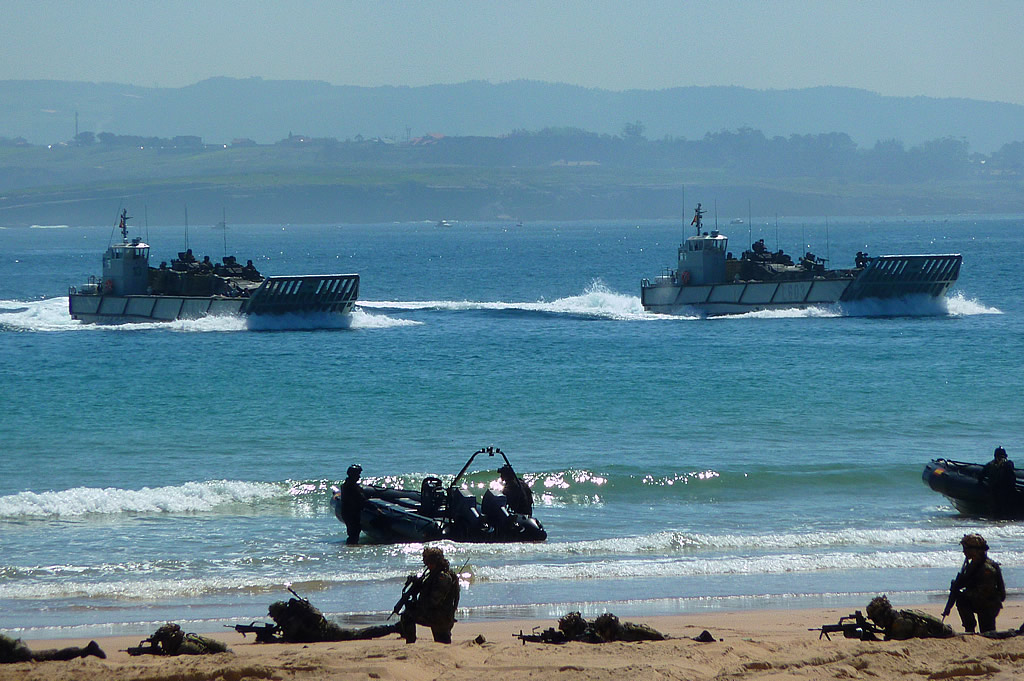
The ships’ hulls from keel to flight deck were built in Navantia’s modern naval shipyard in Ferrol, Spain, and have now been shipped to Australia. Navantia is also building the LCM-1E landing craft that will accompany Australia’s amphibious ships.
(click to view full)
After the ships’ hulls were built, they were brought to BAE Australia’s Williamstown shipyard in Melbourne by heavy lift ship, where the locally built superstructure (the part that rises above the flight deck) will be joined to the hull. This phase has an estimated value of up to A$ 500 million.
The majority of combat system design and integration work will take place in Adelaide, at a cost of up to A$ 100 million. There will also be further work contracted to other states, and total Australian content is expected to be about 23%, or A$ 700 million.
After construction is done, Australian industry will also be providing full in-service support for the life of the ships, creating a reduced but reliable source of demand for Australian industry. Over the ships’ expected lifetimes of 30 years or more, the figures involved will probably amount to several times the value of the construction program.
A Surprise Companion
and cruise ship
(click to view full)
Long before the new Canberra Class could arrive, however, HMAS Manoora and HMAS Kanimbla had to be retired early due to mechanical issues. With HMAS Tobruk laid up for heavy refits, Australia was left without a serving amphibious ship when Cyclone Yasi hit, in February 2011.
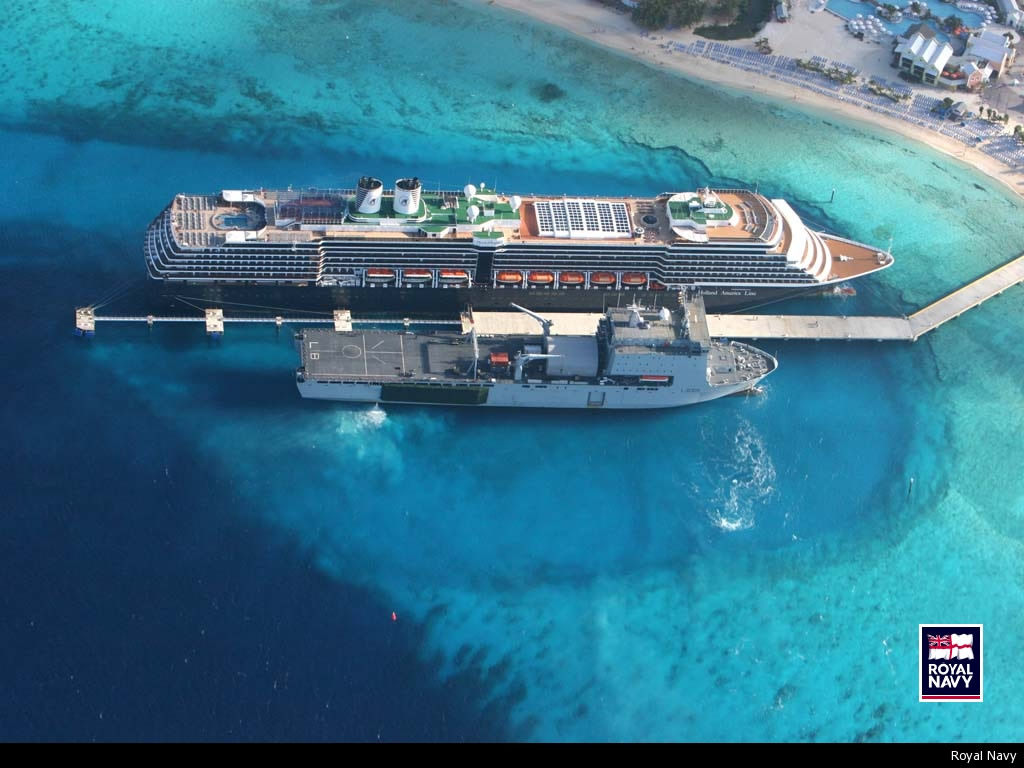
Bad timing, that. Thereafter, good timing came to the Royal Australian Navy’s rescue. By August 2011, Australia was busy preparing the Bay Class LPD HMAS Choules for service, after drastic British budget cuts forced the Royal Navy to sell RFA Largs Bay very early in its planned service life. HMAS Choules will be joined by a refurbished HMAS Tobruk, and by the ADV Ocean Shield cargo & support vessel, until HMAS Canberra arrives.
Once Canberra does arrive, Tobruk will be retired, and Ocean Shield will transfer to Australia’s Customs and Border Patrol, alongside her sister ship ACV Ocean Protector. Australia’s emergency LPD purchase will remain, however, offering the Royal Australian Navy an unexpected 3rd amphibious ship for long-term service in the fleet.
Read “Amphibious Ships For Sale, Sold: Australia’s Interim Buys” for full coverage.
Contracts and Key Events
2019
May 30/19: Tailed by China The Australian Navy was tailed by the Chinese Military as it travelled towards Vietnam on the South Chinese Sea. The HMAS Canberra was ending a three-month-long tour of seven Asian nations involving three other Australian warships, aircraft and more than 1,200 defense personnel. The ships journeyed near islands controversially claimed by Beijing. Defense officials confirmed, that the ships had a “professional” and “friendly” interaction with the People’s Liberation Army during Indo-Pacific Endeavour 2019, an Australian Defense Forces regional engagement mission.
2015
2nd ship in class.
May 22/17: Vice Adm. Tim Barrett, the head of the Royal Australian Navy, has admitted that there might be a design problem on the Canberra-class landing helicopter dock (LHD). The two vessels, who will now miss out on the Talisman Sabre exercise in the US next month, are suffering from oil leaks found in their propulsion systems, while one, the HMAS Adelaide, had metal particles detected in the vessel’s lubricants and is now dry docked. Built by Spanish firm Navantia using a propulsion system made by German firm Siemens, while British firm BAE Systems has integrated the ship’s systems, each vessel comes at a cost of approximately $1.11 billion USD.
September 11/15: The Royal Australian Navy’s second Canberra-class Landing Helicopter Dock (LHD), the Adelaide, has completed sea trials off the country’s south east coast. The trials began in August and are the final series of tests ahead of an anticipated entry into service in 2016. The first ship in class, the Canberra, was commissioned last November, with the two ships jointly constructed by BAE Systems and Navantia following a $2.8 billion contract awarded in October 2007.
August 20/15: The future HMAS Adelaide, the Royal Australian Navy’s second Canberra-class Landing Helicopter Dock (LHD) vessel, has begun final sea trials ahead of an anticipated commissioning into service next year. The ten days of trials will take place just south of Sydney, with the RAN’s first LHD, the HMAS Canberra, commissioned in November last year. The second LHD was launched in July 2012. The joint construction of the two vessels by Navantia and BAE Systems follows a $2.8 billion contract announced in October 2007.
2014
1st ship in class.

Nov 28/14: LHD01 commissioned + deck handling. As (re)scheduled, HMAS Canberra is formally commissioned in Sydney by the Royal Australian Navy, as the largest ship in its history. The certification process begins with deck handling trials, using an MRH-90 from 808 Squadron and an S-70B-2 Seahawk from 816 Squadron.
HD01
Nov 17/14: F-35Bs? The Australian Strategic Policy Institute issues a paper that looks at the viability of F-35Bs on Australia’s 2 Canberra Class LHDs, which are based on a Spanish design that expected to carry the fighters at some point. Australia is looking at this possibility, as part of its 2015 White Paper.
“Overall, this report concludes that the benefits would be marginal at best, wouldn’t be commensurate with the costs and other consequences for the ADF, and would potentially divert funding and attention from more valuable force structure enhancements.”
Their rationale is that operating the Canberra Class in escort carrier mode would be vast overkill for most missions, which are better served by the planned combination of EC665 Tiger ARH and NH90 helicopters. On the flip side, “…if the adversary were such as to merit strike operations against targets distant from Australia using the STOVL option, it would be quite capable of posing significant risk to the maritime strike force being used to project power in this way.” Removing much of the ship’s amphibious capability in exchange for 10-14 F-35Bs isn’t seen as enough airpower to both protect the ship, and offer useful offensive help.
Their estimated cost to try begins with about A$ 500 million in ship modifications to add deck coatings, beefed-up air traffic control, requisite weapon storage & maintenance facilities, etc. Helicopters would have to be added to the MH-60R anti-submarine force, alongside new airborne early warning helicopters for the LHD. Only then could one reasonably pay about A$ 5 billion to buy 2 squadrons of more expensive F-35B fighters, which have shorter range and more limited weapon carriage than F-35As. Finally, the semi-permanent nature of the modifications would force Australia to either depend on just 2 amphibious ships (uncoverted Canberra Class + HMAS Choules), or buy a 3rd ship. RAN non-availability during disaster season has been a recent sore point, which is why they bought Choules from Britain in the first place.
The best use we can envision for the F-35Bs would be as long-duration, no-refueling protection for the RAAF’s on-station KC-30B aerial refueling aircraft during long-range strikes. That probably isn’t enough of a draw, unless Australia also forsees hostile air bases being built on South Pacific island chains of interest within its sphere. If Australia wants to supplement helicopters on its LHDs, marinized MALE UAVs like the MQ-9 Reaper may offer a more useful set of capabilities, providing a new dimension of both general surveillance and support ashore. Sources: ASPI, “Jump jets for the ADF?” (incl. PDF link) | ASPI’s The Strategist blog, “‘Jump jets’ for Australia?”
Oct 9/14: LHD01 accepted. Australia’s Defence Materiel Organisation (DMO) has formally accepted NUSHIP Canberra from contractor BAE Systems, at a ceremony in Canberra’s hangar. This will make DMO the ship’s custodian at BAE Systems’ dockyard in Williamstown, until the ship sails to Sydney for the formal handover to the Royal Australian Navy in late November. Sources: RAN, “First Landing Helicopter Dock accepted by Defence Materiel Organisation”.
July 15/14: Defects. If recent reports are to be believed, Canberra’s 6-7 month construction delay isn’t the result of “go-slow” industrial action (q.v. May 15/14), so much as low productivity at Williamstown shipyard, poor skill levels, and a shortage of trained supervisors. In other words, the normal consequences of preferring a less competent local industry to the original manufacturer’s workforce.
Recent reports use the figure of 14,000 defects, but it’s worth remembering that only a percentage of the variances found are serious enough to need fixing. One unnamed defense official is quoted as saying that “Electrical and systems work planned for and conducted in Australia have been the main cause for the delay,” which fits reports of problems on the 1st shakedown cruise (q.v. June 4/14). So do unaligned propulsion pods; leaking seals and corrosion in propellers have also been cited. Sources: The Australian, “New warship’s 14,000 defects” (subscription) | China’s Xinhua via Shanghai Post, “New Australian warship has 14,000 defects: media”.
June 27/14: Support. The Australian government takes pains to portray subsidiary Kellogg, Brown & Root Pty Ltd (KBR) as “an Australian company” when they award an A$ 52 million contract to be the LHDs’ Capability Support Coordinator (CSC) over the next 5 years. The CSC role is a mix of fixed and tasked services to keep the ships in good repair and ready for missions, but it’s more of a coordination role than hands-on work. Sources: Australian DoD, “Australian company wins LHD sustainment contract”.
June 18/14: Infrastructure. The Australian government uses an exemption under the Commonwealth Procurement Rules to give Pacific Services Group Holdings Pty Ltd an A$ 6 million sole-source contract to refurbish LCM-1E related infrastructure and buildings at HMAS Waterhen in Sydney.
The exemption allows sole-source contracts without a full tender process to small/medium enterprises, if they’re at least 50% owned by people certified to have Australian aboriginal ethnicity. There’s a vague condition that the contract “must represent value for money.” Sources: Australian DoD, “Minister for Defence and Parliamentary Secretary to the Prime Minister – Indigenous enterprise awarded contract in milestone decision”.
June 4/14: Shook, down. LHD01 Canberra’s 1st shakedown cruise, crewed by Teekay Shipping Corporation, reportedly displayed rather more shaking and more down than planned. First the electric-powered stern pods (azimuth thrusters) were operated independently in low-speed mode instead of in tandem, when the ship was traveling above 8 knots. The result? The same result you’d get in a car with very misaligned tires: a whole lot of shakin’ goin’ on. There are conflicting reports re: whether any paint was cracked off the hull.
The down part reportedly happened when the crew forgot to disconnect the emergency power after a temporary power issue. When main power went back on, it blew the circuit breakers, cutting steerage and forcing the ship to drop anchor for 4 hours.
Teekay denies that the electrical system melted down, or that there was any damage to the vessel. Of course the electrical system didn’t melt down, that’s what circuit breakers do. And even stripped paint isn’t really damage. It still sounds like a poor show all around. Sources: News Corp. Australia, “A brand new 27,000 tonne Australian Navy ship was damaged during maiden sea trials” | UK’s Daily Mail, “Brand new $1.5 billion pride of Australia’s fleet crippled after electrical meltdown during sea trials”.
May 17/14: Defence Minister David Johnston tells The Weekend West that Australia is still considering the F-35B STOVL naval stealth fighter:
“Now that aircraft is more expensive, does not have the range but it’s an option that has been considered from day one…. The deck strength is there [on the Canberra Class LHDs] for such an aircraft,” he said.”
That’s more open than Australian governments have previously been on this subject, and his assertion is true. Spain’s similar Juan Carlos I ship is likely to operate F-35Bs as substitutes for the Armada’s AV-8B Harrier II jump jets, if the country’s economy and military spending levels allow them to continue to operate fixed-wing naval aviation. Adding even 6 F-35Bs to a Canberra Class LHD wing would make a big difference to its power projection options, at a significant cost to helicopter support capabilities.
The question is whether this is far-future speculation, or something that could happen within the time frame of Australia’s impending 58-plane F-35 deal. At this point, nobody knows. It will depend on the terms negotiated for the contract, and whether the deal includes cost adjustment provisions for other F-35 variants and their associated equipment within Australia’s annual orders. It’s worth remembering that choosing F-35Bs comes with added requirements for new spare parts sets and training, new simulators, etc.
The alternative is that this is blue-sky speculation revolving around Australia’s possible 18-plane F-35 order beyond 2030. In which case, it would mean almost nothing right now. Sources: The West Australian, “Jump jets on Defence radar”.
May 15/14: Industrial. News Corp. Australia quotes “a government source” who says that LHD01 Canberra’s delivery will be another 6 months late, due to “go slow” workplace action at the Williamstown dockyard in Melbourne.
BAE Systems, which is facing late delivery penalties over A$ 10 million, has denied that there was a formal go slow. On the other hand, unions are warning of massive layoffs that could affect around 3,800 workers, thanks to the “valley of death” between major shipbuilding projects. That certainly creates plenty of motivation for informal slowdowns, in an environment where skilled trades are reportedly taking jobs elsewhere.
A June decision could add 2 replenishment ships to Australia’s build queue, but the big decisions re: larger programs will depend on the new government’s 2015 Government Defence White Paper and Capability Plan. Sources: News Corp., “Delays extend delivery of HMAS Canberra by six months”.
March 8/14: LCMs. Australia’s first 4 LCM-1E landing craft depart Navantia’s Puerto Real shipyard, aboard M/V Dijksgracht. They should arrive in Australia around mid-April 2014, and Navantia will eventually delivery a total of 12. Sources: Navantia, “Navantia delivers first four landing crafts to Australia”.
(click to view full)
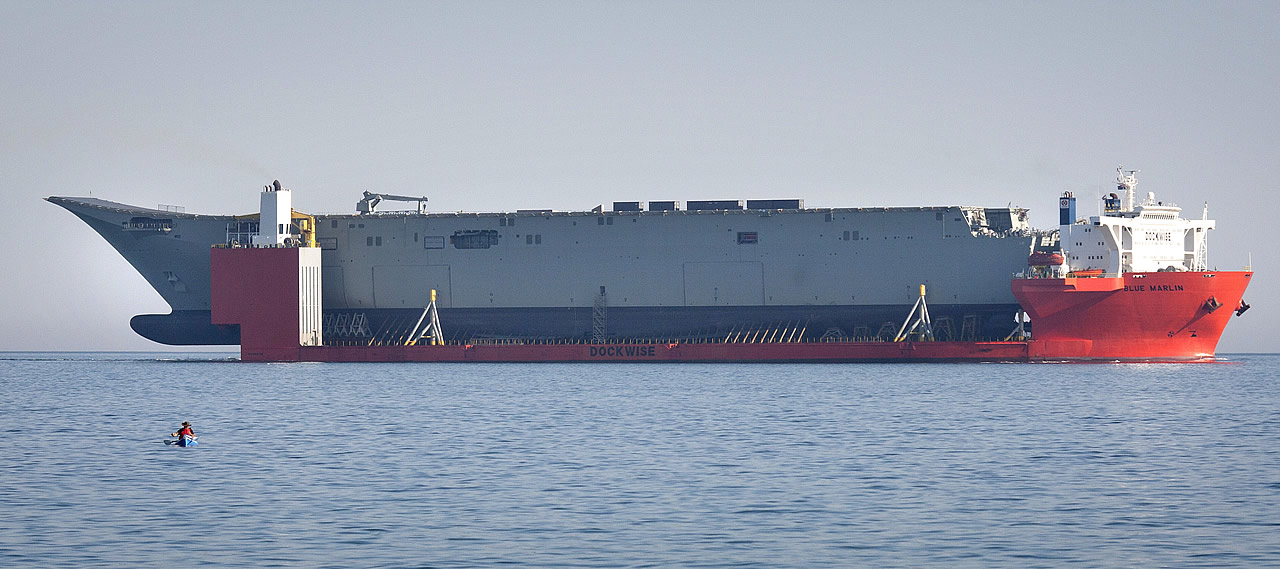
Feb 7/14: LHD02 arrives. The heavy-lift ship MV Blue Marlin is back in Australia with another LHD hull, on schedule this time, after a 10,000 nmi journey that took 8 weeks.
LHD02 Adelaide arrives in Port Phillip Bay, Melbourne, and will be taken to the Patrick Webb Dock for removal of the sea fastenings and unloading. A tugboat with take her to the Williamstown dockyard in the suburbs for superstructure and fit-out work, and the hull is expected to be there within a week.
Things will be busy in Williamstown. LHD01 Canberra arrived back on Oct 17/12, and sea trials will begin within a few weeks. Sources: Australia DoD, “Landing Helicopter Dock Ship arrives in Melbourne” | Australia Defence, “Second LHD dock arrives in Australia”.
2011 – 2013
Both LHDs launched; LCM-1E landing craft companion buy approved; ESM systems; Infrastructure build-out; ANAO Report.
[youtube:v=a3mWg9x_rSg]
Dec 17/13: ANAO Report. Australia’s National Audit Office releases their 2012-13 Major Projects Report. For the Canberra Class, they don’t see any major risks, and DMO believe they can complete the project within budget. The total program budget as of June 2013 is A$ 3,073.5 million, of which A$ 2.39 billion (about 77.8%) has been spent. The program is about 62-65% complete, and has A$ 682.9 million left.
Some of that is going to spent hiring contractor help for the program office, because the LHD Project Organisation doesn’t have enough “appropriately qualified personnel.” They’re also pushing BAE Australia to try and recover the 66 days created by the late arrival of LHD 01’s hull at BAE. Initial Operational Capability (IOC) is now expected 6 months earlier than originally planned, in December 2014. We shall see. Final Operational Capability (FOC) remains unchanged at November 2016. The one thing ANAO does mention is that:
“While the LHD ships are based on the existing Spanish LHD design, the Australian combat and communication capability requires design and integration work…. The task of integration of the Australian elements, such as the combat system and internal/external communications systems, has proved to be more complex than initially thought. Additional time has been required to address integration issues and has resulted in some minor movement of combat and communication system integration milestones. This has not impacted the major milestone of ship delivery.”
July 11/13: Infrastructure. The Australian government announces that Baulderstone Pty Ltd. will be appointed to manage an A$ 170.2 million project to build new and refurbished LHD and Air Warfare Destroyer berthing and support facilities in Sydney. The firm has a long history managing large construction projects, including the iconic Sydney Opera House.
The award is split, with A$ 60.3 million allocated to the Canberra Class LHDs and $109.9 million for the Hobart Class Air Warfare Destroyers. Baulderstone will manage the build-out of berthing infrastructure, permanent maintenance, and systems support facilities for the new ships at Garden Island, and nearby training facilities at Randwick Barracks and HMAS Watson. Construction is expected to begin in late July 2013, with completion scheduled for late 2015. Australia DoD.
March 28/13: ESM. ITT Exelis announces a $102 million contract to provide their ES-3701 Electronic Support Measures (ESM) suite for Australia’s 6 upgraded ANZAC frigates and 2 Canberra class LHD ships. Work will be performed by the Exelis Electronic Systems, radar, reconnaissance and undersea systems business area in Morgan Hill, CA.
ESM systems track enemy radio frequency emissions, such as an anti-ship missile with its radar on, back to their source. ITT’s ES-3701 has also been picked for Australia’s forthcoming Hobart Class Air Warfare Destroyers, so the new award will give a common ESW suite aboard their future fleet of combat ships.
Dec 3/12: A ministerial visit to BAE’s Williamstown, Melbourne facility sparks a brief update. Canberra’s hull has arrived, and the 300 tonne Block 811 has recently been lifted onto the hull for consolidation. This year alone, BAE has completed more than 750,000 hours of work, and plans to have one million hours of work completed by the end of this year. By which point, the remaining superstructure blocks are expected to be consolidated on the hull. The Minister for Defence adds that:
“The fact that we’ve got some Marines in Darwin, 250 this year and next year, moving to over the next five or six years, 2500, will also ensure greater interoperability with the United States Marine Forces on ship to shore missions and exercises. They are the world’s experts so far as ship to shore capability is concerned, so we will value very much the input and the training that we do with them.”
See: Australia DoD | Minister’s Doorstop Interview transcript.
Oct 17/12: LHD01 arrives. MV Blue Marlin arrives in Australia with Canberra. Australian DoD | Navantia | SENER Naval.
Aug 4/12: LHD01 shipped. Canberra is loaded onto the float-on/ float-off (Flo-Flo) heavy lift ship MV Blue Marlin, for transport to Australia and final fitting out. See also Aug 25/08 entry, for the transport contract. Navantia [in Spanish].
[youtube:v=tpqFXKhfALs]
click for video
July 3/12: LHD02 launch. Adelaide is launched at Navatia’s shipyard in Ferrol, Spain. RAN | Navantia | YouTube video.
LHD02 launch
Dec 13/11: Australia’s Minister for Defence Materiel Jason Clare provides an update on Project 2048.
LHD01 Canberra is on track with its revised schedule. All 105 hull blocks have been built, and the hull is now complete (vid. Feb 18/11 entry). She is currently undergoing final fit out, and the installation of her hospital, storeroom, and crew berths. Canberra will leave Spain in July 2012 aboard a heavy lift ship, to arrive in Melbourne in August 2012. June 2011 saw work begin at the Williamstown Shipyard in Australia on the 4 superstructure and 3 mast blocks, and the superstructure and hull are expected to be consolidated in Melbourne in late 2012.
LHD02 Adelaide is ahead of the revised schedule. The keel was laid in February 2011, and so far 60 of the 105 blocks have been erected on the slipway. Of the remaining blocks, 27 are currently in construction and final fit-out, and 18 are in final paint and fit-out prior to moving to the slipway. The hull is expected to be launched in Spain in Q3 2012.
(click to view full)
Sept 27/11: Landing Craft. The Australian government gives 2nd pass approval to Joint Project 2048, Phase 3, which will buy 12 of Navantia’s 110t LCM-1E landing craft to equip the Canberra Class. Under this approval, the total cost is capped between A$300 – $500 million; the exact price will be resolved as a contract is negotiated. Subsequent releases confirm that a contract was signed in Dec 16/11, but don’t discuss the amount.
Australian forces currently rely on a heavily modified version of the American LCM-8 for this role, which may continue service aboard HMAS Choules (formerly RFA Largs Bay).
Delivery of the first batch of 4 LCM-1Es will be coordinated with the delivery of HMAS Canberra, expected in 2014. Maintenance and support for the LCMs will be provided by Australian industry. Australia DoD | Navantia, “Navantia signs two contracts in Australia”. See also May 8/09 entry.
12 LCM-1Es

(click to view full)
Feb 18/11: LHD01 Launch. Canberra’s hull is launched at Navantia’s Ferrol shipyard, in northern Spain. Canberra is still set to arrive in Victoria in 2012, where its superstructure will be completed and it will be fitted out, before a planned acceptance into service in 2014.
Her sister ship Adelaide is scheduled for launch in 2012. Australian DoD | Australia DoD photos.
LHD01 launch
2009 – 2010
US bureaucratic interference; LHD02 cuts steel; IFF.

(click to view full)
Feb 2/10: LHD02. Navantia of Spain cuts the first steel for LHD 02 at its shipyard in Ferrol, Spain, 7 weeks ahead of schedule. Keel laying of LHD 01 Canberra took place place exactly one year to the day from first steel being cut, and the next milestone will be the launch of LHD 01 in Spain in March 2011. LHD 01 is expected to arrive at Williamstown dockyard in 2012, with LHD 02 arriving in 2014. Australia DoD.
Dec 3/09: Sub-contractors. EADS Defence Electronics announces a contract from BAE Systems to deliver a pair of MSSR 2000 I IFF (Identification Friend or Foe) systems for installation aboard The Canberra Class. Integration into the Combat Management System will be performed by Saab Group, who makes the 9LV combat system.
IFF systems are so-called secondary surveillance radars that collect precise data on the origin, course, speed etc. of individual aircraft by automatically sending interrogation signals which are answered by encrypted transponders on-board the incoming aircraft. The goal is reliable identification of incoming aircraft, in order to avoid targeting one’s own forces or allies. The MSSR 2000 I is operated by the naval forces of Germany, France, Norway and Finland; and as a land-based system in countries like Bulgaria and Slovakia. The system has received civil certification, and EADS DE also makes related identification systems used for civil air traffic control in Portugal and the Philippines.
July 20/09: BAE Systems Australia announces successful completion of the Canberra’s class’ Whole of Ship Preliminary Design Review phase. That review examined major subsystems including communications, navigation, combat systems, support systems and platform systems. Success allows the ship to proceed to the detailed design phase, which will create the production blueprints.
PDR
May 8/09: LCM-1E. Australia’s Labor Party government announces first pass approval to equip its Canberra Class LHDs with Navantia’s LCM-1E landing craft as Joint Project 2048, Phase 3. Australia’s DoD will now begin negotiations with Navantia, which will include the possibility of building the Landing Craft, Mechanized in Australia. A final decision on the LCM-1E was to be made by Government in 2010, but 2nd pass approval actually took until late September 2011.
March 6/09: India’s Business Times reports that an overzealous US State Department bureaucrat appears to have created a 3-4 month delay in the Project 17 program, after ordering GE to stop work on the LM2500 turbines it was supplying for India’s Krivak III Class frigates. The given reason? A 3-4 month internal State Department review of American relationships with other countries. The article reports that “GE has been told to stop work even with close US allies like the UK and Australia.” Whose Canberra Class also uses the LM2500.
Read “US State Dept. Throws A Wrench Into Exports, Allied Shipbuilding” for more updates, and a look at the timelines and implications.
2008
BAE buys Tenix; LHD transport to Australia arranged; Engines; VAMPIR passive infrared surveillance.

Oct 28/08: SAFRAN Group’s Sagem Défense Securité Australasia announces a contract from BAE Systems Australia to supply its VAMPIR NG (Veille Air-Mer Panoramique Infrarouge Nouvelle Génération/ New Generation Infrared Panoramic Air-Sea Surveillance) infrared surveillance systems for the Canberra Class. The VAMPIR was selected following a general tender, but it entered with an advantage thanks to its 2005 selection as part of Australia’s ANZAC Class frigate upgrades.
VAMPIR NG offers a high-resolution panoramic image, that provides short range surveillance and warning of incoming UAVs, fast boats, or even missiles, without creating traceable radar emissions. It calls on state-of-the-art image processing technology, and deploys 3rd-generation gyrostabilized infrared sensors for maximum efficiency. VAMPIR NG is integrated with the ships’ Saab 9LV combat system, and an also be used as a helicopter landing aid, and to help control the movements of landing craft. Sagem DS release | VAMPIR NG data sheet [PDF].
Aug 25/08: Dockwise Ltd. of Hamilton, Bermuda announces that its subsidiary Dockwise Shipping has entered into contracts with the Spanish naval shipyard Navantia, to transport 2 Canberra-class amphibious helicopter carriers (LHD). The combined value of this contract, plus a contract to bring 2 Russian nuclear powered submarines from Kamchatka to the Russian naval shipyard Zvezda to be dismantled, is around $40 million.
The hull and outfitting of the Canberra Class vessels will largely be completed by the Spanish yard at Ferrol, but final construction, outfitting and commissioning will be performed by Australian contractors. The ships will be transported from Ferrol to Melbourne on the deck of the semi submersible (float-on, float-off, or FLO-FLO) Blue Marlin transport vessel in 2012, and again in 2014.
Aug 25/08: Sub-contractors. Northrop Grumman’s Sperry Marine business unit announces an USD$8.4 million contract from Tenix Pty Limited of Melbourne, Australia (now part of BAE Australia), to supply integrated navigation systems for the Canberra Class. The contract also includes engineering and technical support for configuration, installation, commissioning, a land-based test site, and sea trials.
The navigation systems will include 2 Sperry Marine MK39 Mod 3A ring laser gyro navigator (RLGN) inertial navigation systems. They will be integrated with the ships’ radars, electronic charting system, autopilot, steering control, speed and depth sensors, GPS and DGPS positioning systems, automatic identification systems, voyage data recorder and other systems and sensors, using Sperry Marine’s NavDDS data distribution network.
Sperry Marine is headquartered in Charlottesville, VA, and has major engineering and support offices in New Malden, United Kingdom and Hamburg, Germany. NGC release.
July 14/08: Sub-contractors. GE Marine announces the contract from Navantia for 2 LM2500 aeroderivative gas turbines. Each Canberra Class LHD will rely on an LM2500 gas turbine, placed in a CODAG (COmbined Diesel Electric And Gas) configuration with diesel engines. GE will manufacture the LM2500 gas turbines at its Evendale, OH facility, and will deliver the gas turbine-generator sets in August 2009 and November 2010.
The LM2500 powers every major surface combatant class in the Royal Australian Navy: 12 have powered Australia’s FFG-7 Adelaide-class frigates, another 11 turbines and spares were delivered for the RAN’s ANZAC-class frigates, and the LM2500 family will be part of the propulsion system for Australia’s forthcoming Hobart Class air warfare frigates.
June 27/08: Tenix = BAE. BAE Systems completes its acquisition of Tenix Defence. BAE release.
Jan 31/08: BAE Systems formally buys Tenix Defence, and proposes to merge it into BAE Systems Australia. The GBP 347 million/ A$ 775 million purchase would include Tenix Defence Marine, Navantia’s partner for the Canberra Class. The Australian | Bloomberg | Reuters | UK’s Times UPI
Jan 18/08: Tenix takeover. BAE Systems Australia offers A$ 775 million in cash to the Tenix Corporation, in a takeover bid for Tenix Defence. The deal is accepted. Tenx Defence had proforma earnings before interest, tax, depreciation and amortisation (EBITDA) of A$56 million on sales of A$699 million in the year to the end of June 2007.
Other rumored bidders included L-3 Communications, The Carlyle Group, and Australian conglomerate Leighton Holdings, Ltd. BAE Page | Reuters | The Deal.com.
BAE buys Tenix
2007
Navantia picked, contract signed; 9LV combat system.

(click to view full)
Nov 23/07: Sub-contractors. Saab Systems signs an A$105 million (USD $87 million) contract with Tenix Marine to design, develop, and integrate their 9LV combat management system and Sea Giraffe AMB radar into the Canberra Class. According to Saab’s release, special features of the system will include helicopter control, watercraft control, and close in self defense against military and asymmetric threats. The Sea Giraffe’s known features include counter-battery fire tracking. Saab release.
Oct 11/07: DID explains the differences between Australian figures, and Navantia’s contract figures, following a briefing with Australia’s DoD. The short answer: both figures are correct. Navantia’s figures are current-dollar costs for construction contracts, but that contract includes economic price adjustment clauses for inflation et. al. Australian government figures attempt to take inflation over the project’s lifetime into account, then add project management and contingent costs to arrive at a figure for actual dollars spent over the project’s lifetime. See “Canberra Contract Costs Clarified.”
These clarifications regarding cost and armament have been incorporated into the text above.
Oct 9/07: It’s official. Australian Prime Minister John Howard announces the signing of a contract with Tenix, worth about A$ 3.1 billion ($2.787 billion) over 8 years [PM release | Event photo gallery | Tenix release | Navantia English release | Navantia Spanish release]. HMAS Canberra will be delivered in 2013, and HMAS Adelaide in 2015. Prime Minister Howard said :
“These 27,000-tonne ships will greatly enhance Australia’s ability to deploy forces when necessary in our region or beyond, and to provide assistance in time of natural disaster. Using their integrated helicopters and watercraft, each vessel will be able to land approximately 1,000 personnel, along with their vehicles, the new Abrams tanks, artillery and supplies. They will also be equipped with medical facilities, including two operating theatres and a hospital ward, and will be capable across the full spectrum of maritime operations, including aid to the civil community in times of natural disaster at home or abroad.”
N.B. Navantia’s release sets the contract value at a divergent EUR 1.412 billion (A$ 2.22 billion), of which EUR 915 million (A$ 1.44 billion) would go to Navantia for production estimated at 9.35 million work-hours. that reflects the current-dollar costs of the construction contract without including inflation over 8 years, project management costs, and contingent costs like improving port infrastructure etc. See Oct 11/07 entry for more.
Australian LHD Contract
June 20/07: Winner! The Australian DoD announces that subject to successful contract negotiations, the preferred tenderer is Tenix, with intended delivery of the ships between 2012 – 2014. The cost, meanwhile, has grown by 50% to A$ 3 billion. Navantia’s design was larger and more capable, but unlike the French Mistral Class it did not have a previous build history. In addition to capability advantages, however, Navantia-Tenix has an additional ace card to play that DCNS-Thales Australia did not:
“So that we could ensure the best possible outcomes for Australian industry and the ADF, the Government decided to consider the Amphibious Ship and Air Warfare Destroyer proposals in concert. Our decisions today mean that for decades into the future Navy’s ships will be backed by world-class industry support from Australia’s naval engineering and electronics industries. They also mean that hundreds of smaller and medium enterprises can now look to the future with confidence.”
See full DoD release.
Tenix/ Navantia picked
Additional Readings
Background: The Canberra Class
* RAN – Canberra Class.
* TomW Communications – Australian Defence Amphibious Ships Project. Compares the 2 contenders.
* Spanish Navy – LHD Juan Carlos I. The BPE temnplate from which the Canberras were derived [in Spanish].
Background: Key Onboard Systems & Aircraft
* Saab Systems Australia – Naval Systems. See also 9LV CMS [PDF]. Their Combat Management System.
* RAN – Landing Craft, Mechanised (LCM). the LCM-1Es.
* Navantia – Lanchas de desembarco LCM-1E [PDF].
Canberra Class Aircraft
* DID – NH90: Europe’s Medium Helicopter Contender. Australia’s 47 MRH90 medium helicopters will be the LHDs’ primary air wing. They’re the NH90-TTH army utility variant, but heavy use of non-rusting composites helps at sea.
* Australian Aerospace – Military: Helicopters. Airbus subsidiary. This section covers the MRH90 and the Tiger ARH.
* Australia Army – ARH Tiger. Scout and attack helicopter; Australia bought 22, and has conducted naval compatibility tests.
* DID – Australia’s MH-60R Maritime Helicopters. They’re slated for surface combatants, but the Canberras could embark them to become a potent anti-submarine ship with de facto attack helicopters.
* DID – Australia Raises their F-35 Commitment. The F-35A is their preferred variant, but statements in 2014 confirmed the naval F-35B STOVL as a future possibility.
Background: Companion Ships
* DID FOCUS Article – Aussie Anti-Air Umbrella: The Hobart Class Ships.
* DID – Amphibious Ship For Sale, Sold: Australia’s Interim Buys. This LPD was bought from the Royal Navy, after Manoora and Kanimbla were forced out of service early. Now HMAS Choules, accompanied by a combination of chartered and purchased stopgap vessels.
News & Views
* The Australian (Nov 4/08) – All Hands on Deck. “…these are testing times for the navy. There are not enough sailors to man its fleet, many of its ships and helicopters are ill-equipped for war, half of its submarine fleet lives in dry dock and a new generation of young Australians are baulking at a life on the high seas.”
* StrategyPage (June 27/07) – The Three Amphibs. Compares the Juan Carlos I, Mistral, ad Wasp LHD classes.
* Australia DoD (June 20/07) – LHD Questions & Answers [PDF].
* Australia DoD (June 20/07) – $3 Billion Amphibious Ships Will Strengthen ADF, Boost Australian Industry. Cost is up by 50% to A$ 3 billion, as Navantia’s larger design wins.
* DID – MH-60R Wins Australia’s Maritime Helicopter Competition. They aren’t slated for the Canberas, but could certainly fly there in a revival of the anti-submarine escort carrier role. The question would be datalinks and other interoperability issues, in order to go beyond mere “lily pad” status.
* Defense News (May 28/07) – France Shows Off Amphib [link now broken]. Explains how France worked to keep the cost of the Mistral Class the same as its smaller predecessors, the 12,400 ton Foudre and Siroco. France spent about EUR 650 million ($875 million) for the Mistral and Tonnerre, thanks to a modular construction approach that used several shipyards and contractors to build different ship sections: DCN (prime contractor, aft part of the ships, integrated the combat system and completed the vessels in Brest; subcontracted more than half of the aft section to Stocznia Remontowa in Gdansk, Poland); Alstom Marine-Chantiers de l’Atlantique (fore sections including all living and most working spaces, propulsion pods); and Thales (design, radar surveillance system, communications system).
* Australia DoD (May 2/06) – Requests For Tender For $2 Billion Amphibious Ships Released To Australian Industry.