
(click to view full)
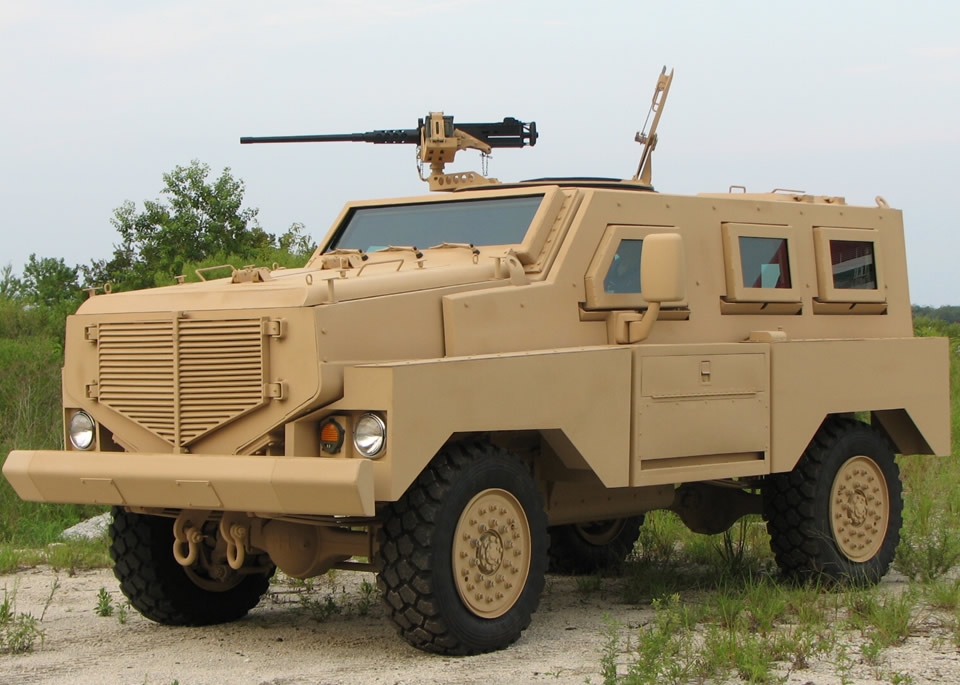
Textron Land Systems’ M1117 Guardian Armored Security Vehicle has already been disqualified from the USA’s MRAP competition, though purchases for American military police continue. Now Oshkosh Truck’s Category 1 partnership with Protected Vehicles, Inc. to produce the Alpha may have joined the casualty list, in the wake of testing at Aberdeen. The Alpha vehicle was a partnership with PVI and Battelle, whose ShieldAll(TM) ceramic armoring has reportedly survived recent testing against EFP land mines. The 13-ton Alpha was one of the 6+ person CAT I patrol vehicle’s heavier entries, but it had been an early winner in the MRAP field thanks to a 100 “low risk” rapid-fielding order on Feb 14/07 before testing had commenced. A July 12/07 DefenseLink announcement listed a revised contract completion time frame of July 2007 for this order.
Bloomberg’s July 27/07 article “Oshkosh Mine-Resistant Truck Rejected By Pentagon” excerpts a June 29/07 letter from the Marine Corps to Oshkosh Truck official Moss Ruedinger – and has significant implications for both Oshkosh and PVI going forward…

(click to view full)
The USMC’s letter allegedly said that explosives testing of the Alpha had “caused concern regarding overall vehicle survivability,” and unspecified “automotive” and “human factors” also “preclude safe vehicle operation.” These issues were, said the letter “borne out” by a limited troop evaluation and the military “is convinced that remediation of this issue would require significant redesign… The result would be an unacceptable delay to future production orders.”
In plain English: rejected.
Oshkosh also has yet to see any orders for its Bushmaster vehicles, a CAT-II vehicle partnership with Thales Australia. Bushmaster vehicles make up Australia’s mine-protected vehicle patrol fleet, and they have served successfully in Iraq and Afghanistan for several years with the Australians – and now the Dutch as well. Surprisingly, the Bushmaster received no “low risk” orders in the MRAP program’s early stages, nor any following orders despite rumors of a 1,500 vehicle MRAP purchase and the recent placement of additional production orders by Australia.
(click to view full)
To date, therefore, Oshkosh has largely been relegated to the sidelines. Meanwhile, competitor Navistar’s MaxxPro has rocketed to the top of the MRAP competition thanks to a highly producible design created in conjunction with Israeli firm Plasan Sasa.
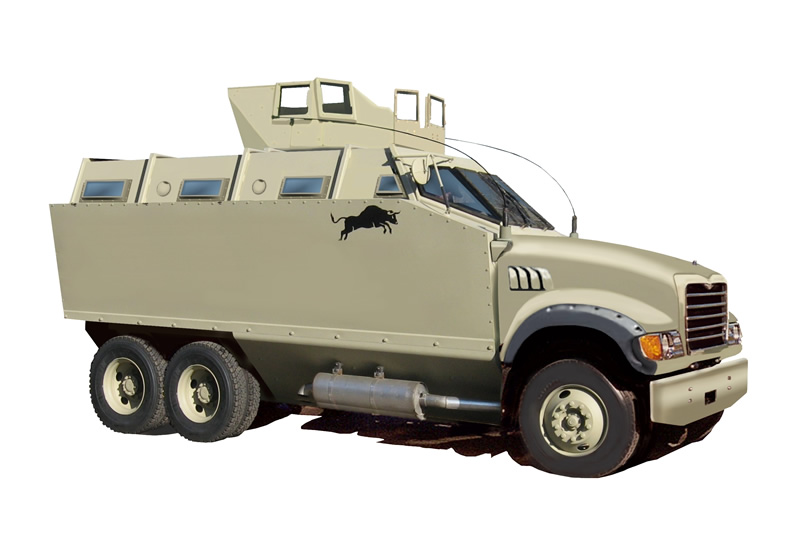
On July 27/07, Oshkosh announced a partnership with Ceradyne and I3 to produce The Bull using Oshkosh truck chassis. Their solution has significant applications for the logistics vehicles that travel the roads to supply combat units, but infantry carrier versions have also been designed and may qualify for the new MRAP-II solicitation. Its upgraded protection requirements are believed to include protection against EFP land mines, which makes it a solid ‘Plan B’ in light of emerging circumstances.
On August 2/07, Jane’s Defence Weekly reported that the US Department of Defense is preparing to further evaluate The Bull in anticipation of buying around 100 armored vehicles.

(click to view full)
Oshkosh’s smaller partner Protected Vehicles, Inc. will be hit harder if news concerning the Alpha is true. Force Protection’s Cougar vehicles had a 2-year ramp up period thanks to slow orders and slowly-dawning awareness. PVI, on the other hand, is introducing its offerings at the height of awareness and competition. That’s a less forgiving environment, where there’s little tolerance or time for modifications, and significant production capacity is required to play. A July 30/07 Jane’s Defence Weekly interview with PVI CEO Garth Barrett, the original licensor of the Cougar and Buffalo designs whose firm was acquired by Force Protection in 2002, indicates that he never expected the massive push now underway to acquire thousands of mine-resistant vehicles for the US military. Nevertheless, that is where the situation now stands.
Neither the Marines, Oshkosh, or PVI would comment on the Alpha situation when questioned by Bloomberg, or by DID; if true, however, the firm may begin to find itself in a Catch-22 situation. In order to become a serious contender and reap substantial MRAP orders, PVI needs significant expansion of its production capacity. In order to finance that investment, of course, PVI needs contracts and orders – or reliable expectation of same. A failure with the Alpha throws that reliability into serious question, and will complicate attempts at private financing.
The firm isn’t out of the competition yet, however. they’ve just unveiled a JLTV-type competitor in The Protector, and PVI is still producing its initial Feb 14/07 order for 60 of its Golan CAT-II squad/specialty vehicles. Golan was developed in conjunction with Israeli firm RAFAEL and that country’s ManTak tank program office and offers a number of advanced features. These include the same explosive reactive armor that protects US Bradley armored vehicles against threats including anti-tank rockets and EFP land mines, and is designed into the vehicle in such a way that the vehicle’s appearance doesn’t change whether it’s protected by reactive armor or not. This makes the Golan another potential competitor in the upcoming MRAP-II program, and even one additional order for a couple hundred vehicles before MRAP-I closes would make a big difference to the firm’s ability to ramp up future production.
So, too, would a major strategic production partner for its Golan vehicle. The best features in the world won’t win a production race, which is what the MRAP competition has unquestionably become.