


(click to view full)
In 2005 children’s toys were being used by American soldiers on the front lines, to help them look for roadside bombs. It would appear that someone took notice, because there has since been a flurry of activity on the robotic explosive ordnance disposal (EOD) front. The Man Transportable Robotic System program took off, and its military ground robots began making a difference long before protected MRAP vehicles began to arrive in numbers.
The Academy-award winning movie “The Hurt Locker” made bomb disposal famous, but the reality of it involves far more robots, and far fewer wearable bomb suits. MTRS robots are the larger, heavy duty options for Explosives Ordnance Disposal technicians, though smaller options are also in service. So, what exactly is the MTRS program?
MTRS: Why Send a Man to Do a Robot’s Job?

(click to view full)
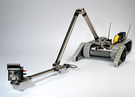
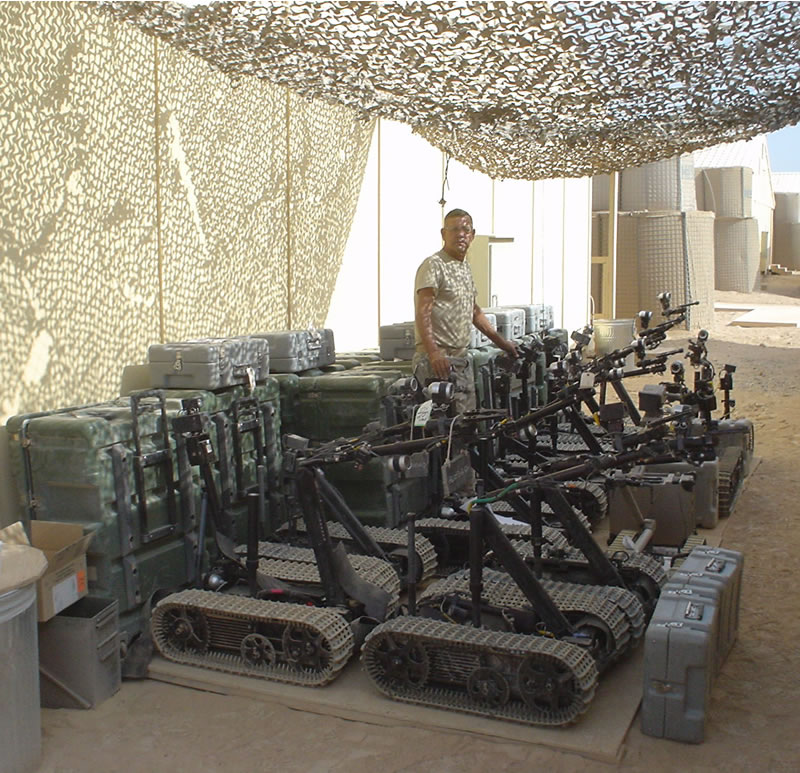
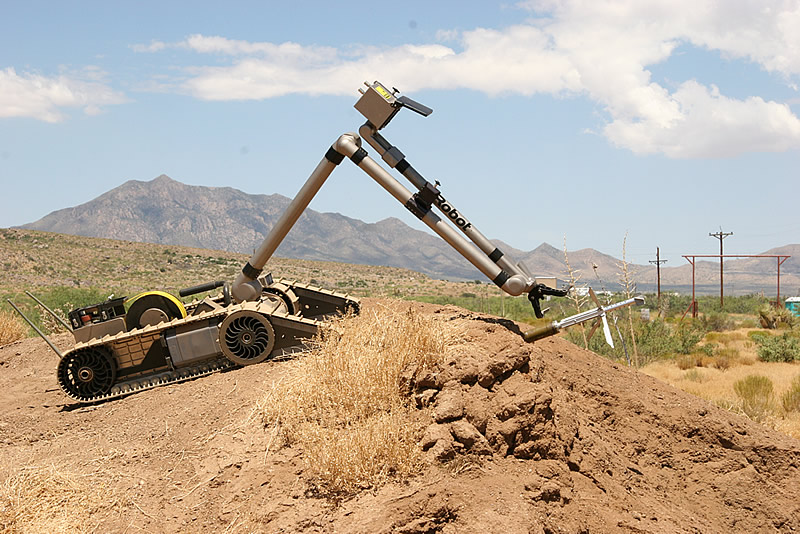
The Man Transportable Robotic System (MTRS) is a modified commercial, 2-man portable system consisting of a robotic vehicle with a manipulator, imaging sensors, and a control station. In the field, MTRS units are equipped with a variety of sensors and tools to perform reconnaissance of danger areas and suspected IED land mines. Robots also disrupt and disable unexploded ordnance (UXO) and suspected land mines, usually by placing C4 explosive on the device with its robot arm. If the land mine goes off, the robotic vehicle is positioned to take the damage that a human operator would face.
Both base platforms bought under MTRS are still in production.
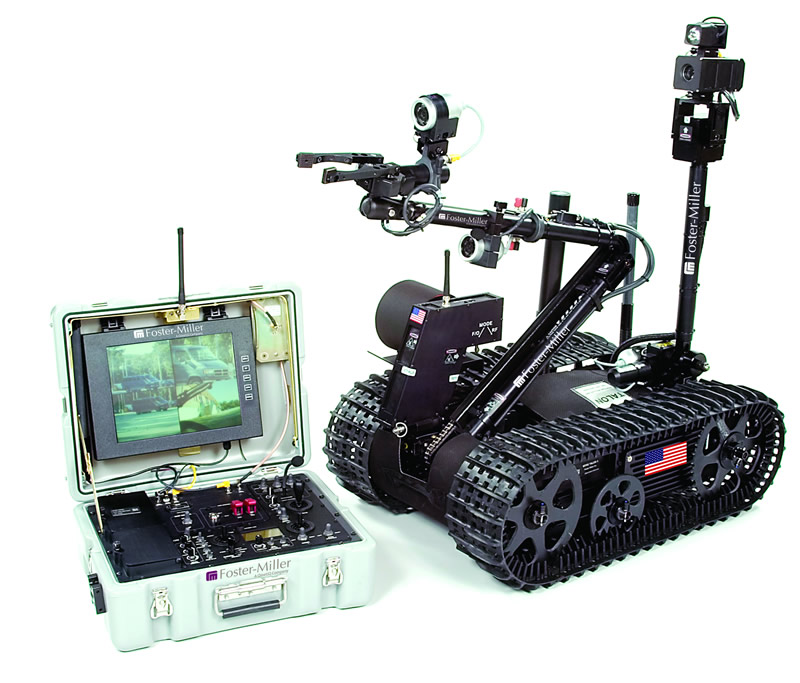
Foster-Miller QinetiQ North America’s 100 pound/ 45kg TALON EOD robots were first used abroad used in Bosnia in 2000 for the safe movement and disposal of live grenades. They were used again in search and recovery efforts at Ground Zero after 9/11, where they managed to last through the entire mission without requiring a major repair, despite facing decontamination twice per day. They have since been deployed by US special forces and regular forces in Afghanistan and Iraq.
In one amusing story, one TALON was mounted on the roof of a Humvee in Iraq while it was crossing a bridge over a river. The wind blew it off, whereupon it plunged into the river below. Soldiers used its operator control unit to drive the robot back out of the river, and up onto the bank for retrieval.
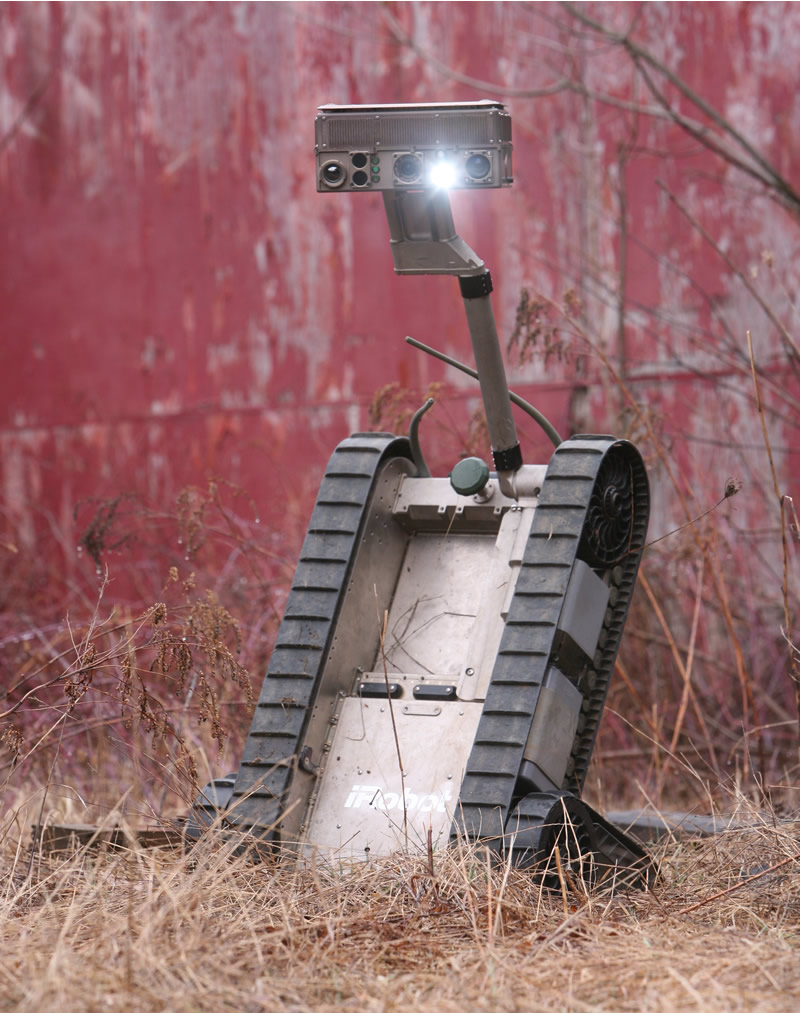
iRobot’s 53 pound/ 24kg PackBot EOD had its genesis in a 1998 DARPA project. The makers of those nifty Roomba robot vacuum cleaners would also see their Packbot creation used in the ruins of the World Trade Center, in Afghanistan, and in Iraq. A newer design became part of the Army’s $160+ billion Future Combat Systems program, and remains one of the program’s very few survivors.
Fast Growth
The spring of 2005 saw rush orders for both models, and demand rose as high as production would allow. Inventory objectives as of June 22/05 were: U.S. Army – 461 systems, U.S. Marine Corps – 205, U.S. Navy – 154 and U.S. Air Force – 140, for a total of 960 systems.
The final numbers subsequently shot far beyond those totals. To get an idea of how fast “The Army of the Grand Robotic” formed, an AP/CNN report in April 2007 stated that there were already nearly 5,000 robots of all types (MTRS among them) in Iraq and Afghanistan. In 2004, there had been about 150.
The 2007 AP/CNN report added that Foster-Miller had recently completed delivery of about 1,000 new robots to the military, while iRobot cranked out 385 robots in 2006, up from 252 in 2005. Production has been steady since then, thanks to orders from in-theater, and both iRobot and QinetiQ passed the “3,000 manufactured” milestone long ago.
Specialty Versions

(click to view full)
Explosives Ordnance Disposal robots comprise the majority of front-line systems, but they have a lot of company on the market. New variants and snap-on kits have proliferated quickly, and are still being refined.
Foster-Miller has now added a TALON Engineer model with more reach and lifting power, designed to help combat engineers remotely investigate suspicious objects. There’s also a CBRNE/ HAZMAT TALON, a lighter TALON Recon version weighing just 60 lb/ 27 kg but lacking an arm or gripper, a TALON X-Ray version for security screening, and more.
There’s even an armed variant for militaries and law enforcement: the MAARS Modular Advanced Armed Robotic System. For law enforcement uses, TALON SWAT/MP equipment can include things like a taser with laser dot aiming, loudspeaker, audio receiver, night vision and thermal cameras, and a choice of other weapons. The military MAARS can be configured with M240 or M249 machine guns, and its size and weight adds .50 caliber sniper rifles as an option with really serious punch. Earlier TALON SWORDS systems was evaluated by the 5th Special Forces in Iraq, and 3 systems completed evaluation with the 3rd Infantry Division, but MAARS has yet to see widespread combat deployment.
(click to view full)
iRobot’s lineup is also changing. Packbot EOD systems are being joined by “Fido ICx” versions with integrated explosives sniffing capabilities and HAZMAT capabilities of their own. The US Army’s Edgewood Chemical Biological Center has developed a dedicated HAZMAT version. Packbot Explorer systems come with multiple cameras and a GPS receiver for surveillance into caves, collapsed buildings, or city streets; while Packbot Scout weighs only 40 pounds/ 18 kg. The Packbot 510 became the base for the current “iRobot MTRS MK1 MOD 1” robot, and features a new videogame-style controller and more speed. There’s also a Packbit Engineering variant, a partnership with Red Owl led to a sniper detection Packbot, and a partnership with Taser is underway which will presumably result in a police/MP variant. PackBot was also the base platform for Future Combat Systems’ SUGV 320 small ground robot – though it may not be the most popular robot in theater, it does have a patented “flipping treads” system that gives it a mobility advantage.
iRobot Corp. filled the military’s first order of 100 “Fidos” at a at a GEM City Manufacturing and Engineering plant in Dayton, OH, for shipment during the first half of 2007. Since then, total orders from around the world have passed 4,000.
MTRS: Contracts and Key Events
Overlapping Offices
Unless otherwise specified, all contracts were issued by the Naval Surface Warfare Center, Indian Head Division in Indian Head, MD. The actual issuing unit is the Naval Explosive Ordnance Disposal Technology Division (NAVEODTECHDIV), who is the single service manager purchasing Explosive Ordnance Disposal (EOD) robots for the US Air Force, Army, Navy and Marines. As MTRS robots’ usefulness becomes clear and other services gain experience, however, that unified procurement model was split.
Other American contract holders include the Naval Air Warfare (NAVAIR) Training Systems Division’s Robotic Systems Joint Program Office (RSJPO). RSJPO procures some EOD robots, supplies non-EOD TALONs to other parts of the military, and staffs the “Robot Hospital” repair centers in Iraq and Afghanistan.
The U.S. Army Program Executive Office for Simulation, Training, and Instrumentation (PEO STRI) was originally handled under the Naval Air Systems Command’s (NAVAIR) contracting authority. In mid-2007, however, PEO STRI established its own contracting authority, and the contract was handed over. The U.S. Army Program Executive Office for Simulation, Training, and Instrumentation now places its own orders on behalf of the Army’s Robotic Systems Joint Project Office (RSJPO) at Redstone Arsenal, AL.
The common denominator is that contracts are all IDIQ (indefinite-delivery/ indefinite quantity), which means the government can order any number, at any time, until the allotted money is gone. This allows them to change funding levels very quickly in order to meet urgent military requirements, instead of going through a long procurement process many times a year.
Note that contracts are divided by robot type, so all TALON contracts are together and all Packbot contracts are together.
General Contracts
Sept 6/12: Support. The US Army Contracting Command in Picatinny Arsenal, NJ issues a $9.9 million firm-fixed-price multiple award contract between 6 contractors. The winners will bid to provide MTRS prototyping and engineering services. Work locations will be determined with each task order, and the umbrella contract runs until Aug 30/17. The bid was solicited through the Internet, with 11 bids received. The winners were:
* iRobot Corp. in Bedford, MA (W15QKN-12-D-0106)
* Science Applications International Corp. in McLean, VA (W15QKN-12-D-0108)
* Savit Corp. in Rockaway, NJ (W15QKN-12-D-0109)
* Stratom Inc. in Boulder, CO (W15QKN-12-D-0113)
* Honeybee Robotics Ltd. in New York, NY (W15QKN-12-D-0114)
* RE2 Inc. in Pittsburgh, PA (W15QKN-12-D-0115)
Foster Miller QinetiQ North America

TALON maker Foster-Miller, Inc. became an independent, wholly owned subsidiary of British firm QinetiQ’s North American arm in November, 2004, and is now known as “Foster Miller QinetiQ North America.”
QinetiQ FY 2011 – 2012
March 19/12: TRC, etc. QinetiQ North America displays its new technologies at the NDIA Ground Robotics Capabilities Conference 2012, in San Diego, CA.
“In addition to a comprehensive display of scalable unmanned ground robots ranging in size and capability from heavy vehicles to ten-pound throwable robots, QinetiQ North America will showcase the Tactical Robotic Controller (TRC) and its recent integration with the US Marine Corps’ MAARS robot and the US Army’s Minotaur counter-IED robotic vehicle.”
TRC is the final result of the Aug 5/09 CRC contract (q.v.). QinetiQ NA.
April 8/11: Foster-Miller, Inc. in Waltham, MA receives a $166.1 million contract modification for MTRS robot systems, depot level repair parts, spare kits, depot repair services, parts supply, training, engineering enhancements, configuration management, and approved accessories.
Work will be performed in Waltham, MA and is expected to be complete by April 2014. The Naval Surface Warfare Center’s Indian Head Division in Indian Head, MD manages the contract (N00174-10-D-0019).
MTRS: 3-year, $166M
March 28/11: QinetiQ North America announces that the government of Japan has accepted its offer to provide unmanned vehicle equipment and associated training. The equipment being staged in Japan for on call includes kits that turn Bobcat loaders into unmanned vehicles that can operate all 70 Bobcat vehicle attachments in day or night conditions, plus radiation sensors, and can be operated from more than a mile away.
They’re also staging TALON robots with CBRNE (Chemical, Biological, Radiological, Nuclear and Explosive) detection kits, and Dragon Runner robots for use in small spaces. In addition to the unmanned equipment, a team of QinetiQ North America technical experts will provide training and support to Japan’s disaster response personnel.
Off to Fukushima…
Feb 24/11: Infrastructure. QinetiQ North America signs a 70,252-square-foot lease in North Stafford, VA, in the Quantico Corporate Center. QinetiQ already leases about 50,000 square feet of space at a few sites in Stafford, and they will now consolidate their offices and have space to grow. QinetiQ NA release [PDF] | Fredricksburg.com.
Oct 14/10: New Tech. QinetiQ North America touts new technologies they’re demonstrating at the Fort Benning, GA Robotics Rodeo. They include a new, wearable Tactical Robotic Controller with integrated FalconView mapping capabilities, that weighs less than 10 pounds, and can be used to control UAVs like the RQ-11 Raven as well. They also included a TALON UGV equipped with a full suite of chemical, biological, radiation, nuclear, explosive, and thermal sensors (CBRNE-T), and the MAARS (Modular Advanced Armed Robotic System) TALON variant.
QinetiQ FY 2009 – 2010
w. Mine detector
(click to view full)
Sept 30/10: Foster-Miller, Inc. in Waltham, MA received a $71.3 million modification to a firm-fixed-price, cost-plus-fixed fee, indefinite-delivery/ indefinite-quantity contract for MTRS production systems, depot-level repair parts, spare kits, depot repair services, parts supply, training, engineering enhancements, configuration management, and approved accessories.
Work will be performed in Waltham, MA, and is expected to be complete by March 2011. $8,553,952 will expire at the end of the current fiscal year, on Sept 30/10. This contract was not competitively procured by the US Naval Surface Warfare Center, Indian Head Division in Indian Head, MD (N00174-09-D-0004).
MTRS: 1 year, $71.3M
April 2010: QinetiQ’s TALON robots are deployed by the British MoD in Afghanistan, under a multi-firm GBP 180 million effort called Project Talisman. Thales leads the Urgent Operational Requirements project, which includes Force Protection’s blast-resistant Mastiff and Buffalo vehicles, JCB’s up-armored engineer/excavators, Talon robots, and Honeywell’s RQ-16 T-Hawk UAVs.
The Talon robots join 100 of QinetiQ’s smaller Dragon Runner robots on British Counter-Improvised Explosive Device (C-IED) and ordnance disposal operations. The order for Talons also includes training, spares and a support package. UK MoD | QinetiQ.
UK: TALON & Dragon Runner
Aug 5/09: QinetiQ North America announces a 2-year, $2 million contract from the U.S. Marine Corps to develop a universal wearable controller. The Common Robotic Controller (CRC) from this contract would operate a wide variety of unmanned systems from different manufacturers, including UGV robots, Unmanned Air Vehicles (UAVs), and Unattended Ground Sensors (UGSs).
The CRC is a challenge, but the contract offers QinetiQ the chance to match iRobot in the universal controller race. The CRC’s biggest challenge is that it must coexist with all the other equipment that Marines must wear and carry. The project must include a robust, miniature computer, a reliable power source, a user-friendly touch-sensitive display, and an effective gaming style input device.
CRC controller
June 15/09: Foster-Miller in Waltham, MA received a sole-source $56.4 million firm-fixed-price, cost-plus-fixed-fee, indefinite-delivery/ indefinite-quantity contract for MTRS systems, depot level repair parts, spare kits, depot repair services, parts supply, training, engineering enhancements, configuration management, and approved accessories. This contract combines purchases for the US Navy (72.4%), and a Foreign Military Sales order for the government of Australia (27.6%).
Work will be performed in Waltham, MA, and is expected to be complete by March 2010. Contract funds in the amount of $561,000 will expire at the end of the current fiscal year. This contract was not competitively procured (N00174-09-D-0004).
USN, Australia
June 10/09: QinetiQ North America announces a 2-way hailer module for its TALON robots, which provide secure encrypted 2-way wireless audio communications between a TALON robot and an operator within line-of-sight up to 2,600 feet / 800 meters away. The robot listens continuously, and 2-way conversations can be conducted at 4 volume levels from whisper mode to loud, the module can be integrated with a laptop or MP3 player, and a 120-decibel siren can be used to warn, distract, or disrupt voice communications.
Initial systems have been delivered to police SWAT (Special Weapons And Tactics) teams in Texas and Florida.
SWAT hailer
March 24/09: QinetiQ North America formally announces a new “plug and play” module for its TALON IV: a modular CBRNE (chemical, biological, radiological, nuclear, explosive) kit that includes sensors for radiation, nerve agents, excessive temperatures, explosives, TNT, and volatile gases.
In May 2009, a GEN IV TALON EOD/CBRNE robot is delivered to the Walnut Creek, CA Police Department, near Concord and west of Oakland.
TALON IV CBRNE
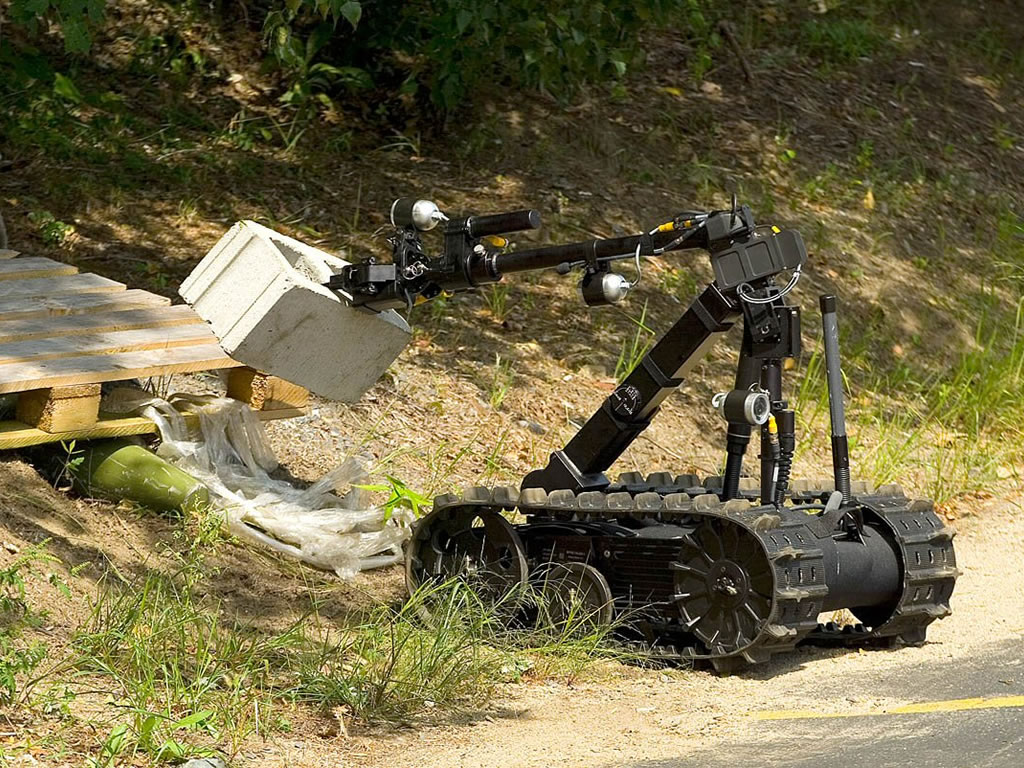
thick as a brick
(click to view full)
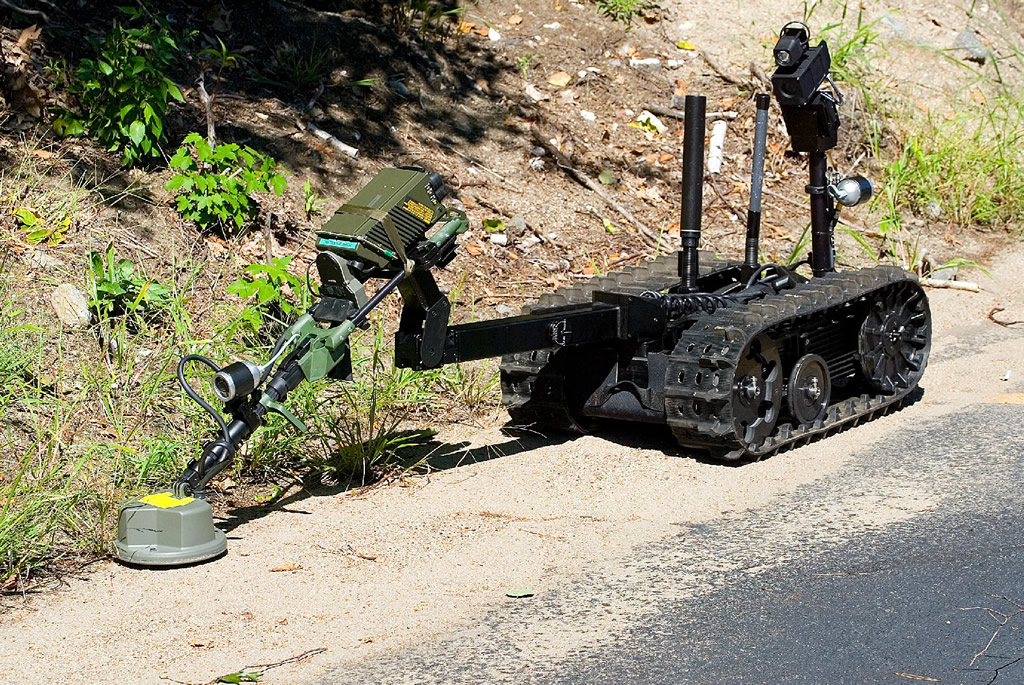
Dec 10/08: QinetiQ North America formally announces the TALON IV engineer model, which adds a full-swivel manipulator arm with a 7-foot reach, and 65-pound lifting capacity. That makes it possible to place mine detection devices once carried by soldiers it on the robot, or use the arm to clear heavy debris during investigations. Mines are an especial problem in Afghanistan due to the country’s history of war, as well as enemy action.
Competitor iRobot also has an engineer model. It lacks the TALON IV variant’s 7-foot reach, but claims a lifting capacity of 100 pounds.
Engineer model
Dec 1/08: QinetiQ North America announces that Foster-Miller has been awarded a total of $58.5 million in funding for additional TALON robots and replacement parts between May 1/08 – Nov 1/08. At this time, the firm announces that a total of 2,500 TALON robots are deployed around the world.
The new delivery orders include $48 million against the new $400 million May 2008 contract, and $10.5 million against the $295 million contract awarded by the Navy’s Explosive Ordnance Disposal Technology Division (NAVEODTECHDIV).
QinetiQ FY 2007 – 2008
May 28/08: A $400 million firm-fixed price contract for the procurement of Foster-Miller’s TALON robotics systems, upgrade kits, spare parts, training and engineering services. This is a follow-on to the $150 million contract awarded in the spring of 2007, which was fully funded and needed a replacement.
Work will be performed in Waltham, MA and is expected to be complete by May 25/13. While the DefenseLINK announcement cites PEO-STRI in Orlando, FL, QinetiQ NA’s release states that the contract award was made by the US Army’s Robotic Systems Joint Program Office (RSJPO), under PEO-STRI. One bid was solicited on May 23/08 (W900KK-08-D-0037).
Army: 5-year, $400M
May 6/08: #2 ,000. Production is speeding up. QinetiQ North America delivered 1,000 TALON robots between 200-2007. Today, they announced delivery of the 2,000th TALON® robot to the U.S. military.
#2,000
April 14/08: SWORDS/ MAARS. QinetiQ North America releases the following item re: its armed SWORDS robots, which are being succeeded/ supplemented by the MAARS(Modular Advanced Armed Robotic System) line:
“Contrary to what you may have read on other web sites, three SWORDS robots are still deployed in Iraq and have been there for almost a year of uninterrupted service.
There have been no instances of uncommanded or unexpected movements by SWORDS robots during this period, whether in-theater or elsewhere. (A few years ago, during the robot’s development, there were several minor movement issues that were expected, identified and addressed during rigorous stateside testing –prior to the Army’s safety confirmation back in 2006. Any comments made after that timeframe about “setbacks” related to the robotics industry are hypothetical — never in response to some nonexistent SWORDS incident after the safety confirmation.)
There has been no withdrawal of funding from the SWORDS program. The Army funded three robots, and that’s what they are using today in Iraq. TALON Robot Operations has never “refused to comment” when asked about SWORDS. For the safety of our war fighters and due to the dictates of operational security, sometimes our only comment is, “We are unable to comment on operational details.”
Armed TALONs
April 8/08: QinetiQ N.A. announces a $22 million order for additional TALON robots and spare parts from the Naval Explosive Ordnance Disposal Technology Division (NAVEODTECHDIV) in Indian Head, MD. This award falls under a $291 million IDIQ (indefinite delivery/indefinite quantity) contract.
(click to view full)
Aug 29/07: Ceiling raised. Foster-Miller, Inc. announces that the NAVSEA’s NAVEODTECHDIV has raised the ceiling of its $257 million indefinite delivery/indefinite quantity contract to $290 million, and ordered another $37 million of TALON MRTS robots and replacement parts. Total funding actually released from this contract now stands at $165 million.
USN up to $290M
Aug 8/07: +250. Foster-Miller, Inc. announces $51.5 million of new orders, on the Naval Air Warfare Training Systems Division’s (NAVAIR) a $150 Million indefinite delivery / indefinite quantity contract, for over 250 more TALON robots and replacement parts. In May, Foster-Miller announced the increase in its NAVAIR contract from $63.9 to $150 million; the fully funded contract value is now $115.4 million and is expected to rise further; 50 robots have already been delivered against these contracts, and the balance will be shipped this year.
The contract announcement was made at the Unmanned Systems of North America (AUVSI) conference.
June 11/07: +114. Foster-Miller, Inc. announces that it has received an additional $18.5 million from NAVEODTECHDIV for 114 more TALON EOD robots and spare parts. This brings the total funding actually released to $132 million against the 6-year, $257 million IDIQ (indefinite delivery/indefinite quantity) contract Foster-Miller initially announced in September 2005.
May 31/07: NAVAIR contract increase. Foster-Miller, Inc., announces that the NAVAIR contract from the Robotic Systems Joint Program Office (RSJPO) has been increased from $63.9 million (vid. May 22/06 entry) to $150 million, in order to accommodate the purchase of additional TALON robots and replacement parts for service in Iraq and Afghanistan. The release adds that:
“Military personnel at the Joint Robotic Repair and Fielding Activity (JRFF) “Robot Hospitals” in Iraq are repairing more than 400 bomb-damaged robots a week to put them back into service remotely neutralizing improvised explosive devices (IEDs). Soldiers, sailors, marines and air force personnel conduct more than 30,000 counter-IED missions per year in Iraq and Afghanistan.
Insurgents have been purposely blowing up robots, but they are being repaired and returned to the fight within just four hours. JRFF records show that TALON robots, because of their ruggedness and durability, represent 75 percent of the bomb-damaged robots that are rebuilt and returned to action so the robot hospitals need to be constantly restocked with TALON replacement parts.”
There isn’t going to be much of a durability difference between robots this size; if the repair records show 75% TALON, it’s very likely that this represents a front-line preference for the model.
RSJPO contract to $150M
April 23/07: Foster-Miller, Inc. announces that it has purchased Pittsburgh-based robotics companies Automatika, Inc., and Applied Perception, Inc. The corporate culture vibes should be a fit – both firms were founded by faculty and graduates of Carnegie Mellon University’s Robotics Institute and Business School in Pittsburgh, while Foster-Miller was founded more than 50 years ago by 3 Massachusetts Institute of Technology (MIT) graduates. The acquisitions are completed on June 6/07.
Automatika provides invention, design, system prototyping, and product manufacturing for a wide variety of automated and robotic systems used in military and civil defense, oil and gas exploration, remediation and utilities inspection. Their best known military robot is Dragon Runner, a 14-pound urban warfare scout robot that was co-developed with Carnegie Mellon University and funded by the U.S. Marine Corps. Automatika will operate as a wholly-owned subsidiary, and all operations will remain in Pittsburgh.
Applied Perception creates standardized perception, planning, and control software and development tools to support the navigation of unmanned ground vehicles (UGVs). Applied Perception’s software is JAUS (Joint Architecture for Unmanned Systems) compliant, and interfaces with radar and laser object detection systems, omni-directional cameras, and global positioning systems (GPS).
2 acquisitions
(click to view full)
April 5/07: +151. Foster-Miller, Inc., announced an additional $26 million delivery order from the Naval Explosive Ordnance Disposal Technology Division (NAVEODTECHDIV) in Indian Head, MD, for 151 more TALON EOD robots and spare parts. This brings the total purchases to $109 million, against the six-year, $257 million IDIQ (indefinite delivery/indefinite quantity) contract Foster-Miller initially announced in September 2005.
Dr. William Ribich, president and CEO of Foster-Miller. add that “We just shipped them our 1,000th TALON robot at the end of March. Foster-Miller will begin filling the new order for 151 more TALON robots this month and expects to complete the order during the summer.”
Dec 21/06: Foster-Miller, Inc., announces that Electronic Design magazine has chosen the TALON/SWORDS robotic platform as its “Military Design of the Year.”
Oct 5/06: Foster-Miller, Inc. announces an additional $20 million worth of TALON robots and replacement parts, ordered by the Naval Air Systems Command (NAVAIR) on behalf of the Robotic Systems Joint Program Office (RSJPO), for immediate use by “robot hospitals” in Iraq and Afghanistan. The funds have been released from a $63.4 million contract with the US Navy (q.v. May 22/06 entry) – one of two that Foster-Miller has for TALON robots and replacement parts.
QinetiQ FY 2003 – 2006

(click to view full)
Sept 26/06: Foster-Miller, Inc. announces an additional $22.8 million from NAVSEA’s NAVEODTECHDIV for about 80 more TALON EOD robots and spare parts. This brings the total funding actually released to $76.4 million against the 6-year, $257 million IDIQ contract Foster-Miller announced in September 2005.
Aug 14/06: +200. Foster-Miller, Inc. announces $33.7 million worth of orders by the Naval Air Systems Command (NAVAIR) on behalf of the Robotic Systems Joint Program Office (RSJPO) to deliver approximately 50 more TALON MRTS EOD robots, 125 of its new TALON Engineer robots, and more than 5,000 spare parts to Iraq and Afghanistan. This means that more than 50% of the $63.9 million indefinite delivery/ indefinite-quantity contract (q.v. May 22/06 entry) has now been funded.
July 18/06: QinetiQ ships 6 TALON explosive ordnance disposal (EOD) robots to the Royal Netherlands Army for immediate deployment in Afghanistan with its Air Force.
Dutch
May 22/06: Foster-Miller Inc. in Waltham, MA received a $63.9 million firm-fixed-price, indefinite-delivery/ indefinite-quantity contract for operator and technician training, TALON spare parts, and new robots for the Robotic Systems Joint Project Office. These parts and services are tasked to the Joint Robotics Repair Facilities and embedded repair teams deployed in support of contingency operations in Iraq and Afghanistan in support of the Global War on Terror.
Work will be performed in Waltham, MA and is expected to be complete in May 2008. This contract was not competitively procured by the Naval Air Warfare Center Training Systems Division in Orlando, FL, and Foster Miller’s release confirms that the RSJPO award is separate from the $257 million NAVAIR contract (N61339-06-D-0013).
New RSJPO contract
Sept 16/05: MTRS jumps. Foster-Miller Inc. received a $133.3 million firm-fixed-price, indefinite-delivery/ indefinite-quantity modification of previously awarded contract N00174-03-D-0002 to provide lifecycle support and spare parts for additional TALON IV MTRS systems as noted on September 7, 2005. Work will be performed in Waltham, MA, and is expected to be complete by October 2012. This contract was competitively procured and advertised on the Internet.
Foster Miller’s release confirms that this contract brings the MTRS contract’s maximum value to $257 million.
MTRS to $257M
Sept 7/05: +950. Foster-Miller Inc. in Waltham, MA received a $96.1 million firm-fixed-price, indefinite-delivery/ indefinite-quantity contract modification, for an additional 950 Man Transportable Robotic System (MTRS) production units. This modification also adjusts unit prices as stipulated in the original contract.
Work on this contract will be performed in Waltham, MA, and is expected to be complete in October 2012. This order means that the overall contract has increased from $27.5 million for 250 TALON IV robots to $124 million for 1,200. Foster-Miller’s release says that the US military has more than 250 TALON robots deployed in theater in Iraq and Afghanistan, which have successfully completed more than 50,000 Explosive Ordnance Disposal (EOD) missions (N00174-03-D-0002).
Sept 8/04: QinetiQ announces a purchase agreement with Foster Miller Inc, the Boston-based engineering and technology development company that counts TALON robots among its products.
The GBP 91.8 million ($163 million) deal represents QinetiQ’s first US acquisition. Dr David Anderson, President and CEO of QinetiQ Inc, QinetiQ’s US subsidiary says that “Strategically, the acquisition of Foster-Miller will be key to achieving QinetiQ’s goal of growing our US business significantly.”
QinetiQ buys Foster-Miller
Oct 28/02: Foster-Miller, Inc. in Waltham, MA won a $27.6 million firm-fixed-price, indefinite-delivery and for the Man Transportable Robotic System (MTRS), associated repair parts, troubleshooting assistance, post-production support services, and data.
Work will be performed in Waltham, MA and is to be complete in October 2012. The contract was competitively procured and advertised in Federal Business Opportunities Web site, with four offers received (N000174-03-D-0002).
Initial MTRS contract
iRobot
click to play video
iRobot has a number of contracts under the MTRS program, but it also won the US Army’s similar $286 million xBot competition outright in October 2007, after legal efforts removed Robotic FX as the original winner. The xBot contract is also covered here.
Their long-term advantage was cemented by Boeing and SAIC’s 2003 selection or iRobot’s products for the Future Combat Systems’ SUGV role, which transferred to the Early – Infantry Brigade Combat Teams spinout. E-IBCT was eventually shut down, and iRobot’s SUGV was moved back into regular military robotics acquisition channels, as one of the FCS program’s very few survivors. Those SUGV contracts are not covered here.
iRobot FY 2011 – 2012
April 12/13: Support iRobot Corp. in Bedford, MA receives a $28.8 million contract modification to buy MTRS robot systems, depot level repair parts, spare kits, depot repair services, parts supply, training, engineering enhancements, configuration management and approved accessories.
Work will be performed in Bedford, MA, and is expected to be complete by April 2014. No funding is committed immediately; orders will be placed as needed using FY 2013 Army & Navy Operations and Maintenance funds. The US Naval Surface Warfare Center at Indian Head, MD manages the contract (N00174-11-D-0013).
July 17/12: MK1 MOD 1 upgrades. iRobot Corp. announces a $7.7 million order from US NAVSEA. The order calls for iRobot Aware 2 software upgrades, and the delivery of advanced sensor suites for 248 MTRS MK 1 MOD 1 robots. Sensor suites include the iWARVVS (iRobot Wide-Angle Robot Vehicle Vision System) camera with a better field of view, thermal camera, and iRobot’s User Assist Package (UAP). UAP adds improvements to the operator control unit, GPS mapping and critical semi-autonomous features to 510 PackBot, including self-righting, retro-traverse and heading hold.
MTRS MK 1 MOD 1 is modeled after the iRobot 510 PackBot, and iRobot expects to complete these deliveries by November 2012.
May 29/12: Spares. iRobot Corp. announces 2 orders from the U.S. Army’s Robotic Systems Joint Program Office (RSJPO) totaling $6 million. The orders call for the delivery of spares for iRobot 510 PackBot robots, including operator control units, manipulator arms and radios. All deliveries will be completed by Nov 30/12.
March 12/12: TI & iRobot. Texas Instruments Incorporated and iRobot Corp. announce a partnership to develop robotic technologies using TI’s smart multicore OMAP(TM) platform. The two companies will achieve this vision by leveraging iRobot’s long history in advancing the field of robotics, and TI’s strength in applications processors and related technologies.
OMAP is a high performing, ultra-power-efficient system-on-chip that’s smaller than a dime. The OMAP platform’s smart multicore architecture sends processing tasks to cores and engines that can best do the job using the least amount of power possible. TI complements this fundamental computing experience with several unique features, such as sophisticated image and video accelerators.
Texas Instruments tie-up
Sept 7/11: iRobot Corp. announces that it had received a partial termination for convenience notification from The Boeing Company of the contract for the design and development of the model 320 SUGV robot, effective as of the end of FY 2011: Sept 30/11. iRobot developed the technology as a subcontractor to Future Combat Systems’ Leads Integrators, and it had been one of the few survivors of the initial BCTM Increment 1 spinout. iRobot’s Government and Industrial Robots division President, Robert Moses said that they expected this development, adding that:
“Given current budget pressures, the Department of Defense is pursuing more cost-effective contractual arrangements. iRobot is in continuing discussions directly with the Army to help it reduce costs for the development and acquisition of SUGVs in 2011 and 2012.”
One obvious approach would be to just extend the existing MTRS contract. In this case, the US Army decides to keep control of the contract, and issue SUGV contracts directly to iRobot.
SUGV: Boeing termination
Aug 22/11: 100+. iRobot announces a $21 million order from US NAVSEA for “more than 100” MTRS MK1 MOD 1 robots, which are derivatives of the Packbot 510, plus spares kits. It’s the 4th order under the $230 million contract announced on April 12/11, and brings total orders under this contract to $36 million.
iRobot says they have now delivered more than 4,000 unmanned ground vehicles to military and civil defense forces worldwide.
June 2/11: +86. iRobot announces a $14.1 million delivery order, as the 1st order under the $230 million contract announced on April 12/11. The order covers 86 MTRS MK 1 Mod 1 robots, plus spare parts and accessories. MTRS MK 1 Mod 1 is modeled after the iRobot 510 PackBot, and iRobot expects to complete delivery of these robots by the end of Q2 2011.
April 12/11: iRobot Corp. in Bedford, A receives a $230.1 million indefinite-delivery/ indefinite-quantity MTRS contract for production robots, depot level repair parts, spare kits, depot repair services, parts supply, training, engineering enhancements, configuration management, and approved accessories.
Work will be performed in Bedford, MA, and is expected to be complete by April 2015. $305,960 will expire at the end of the current fiscal year, on Sept 30/11. The Naval Surface Warfare Center’s Indian Head Division in Indian Head, MD manages the contract (N00174-11-D-0013).
MTRS: 4-year, $230.1M
iRobot FY 2009 – 2010
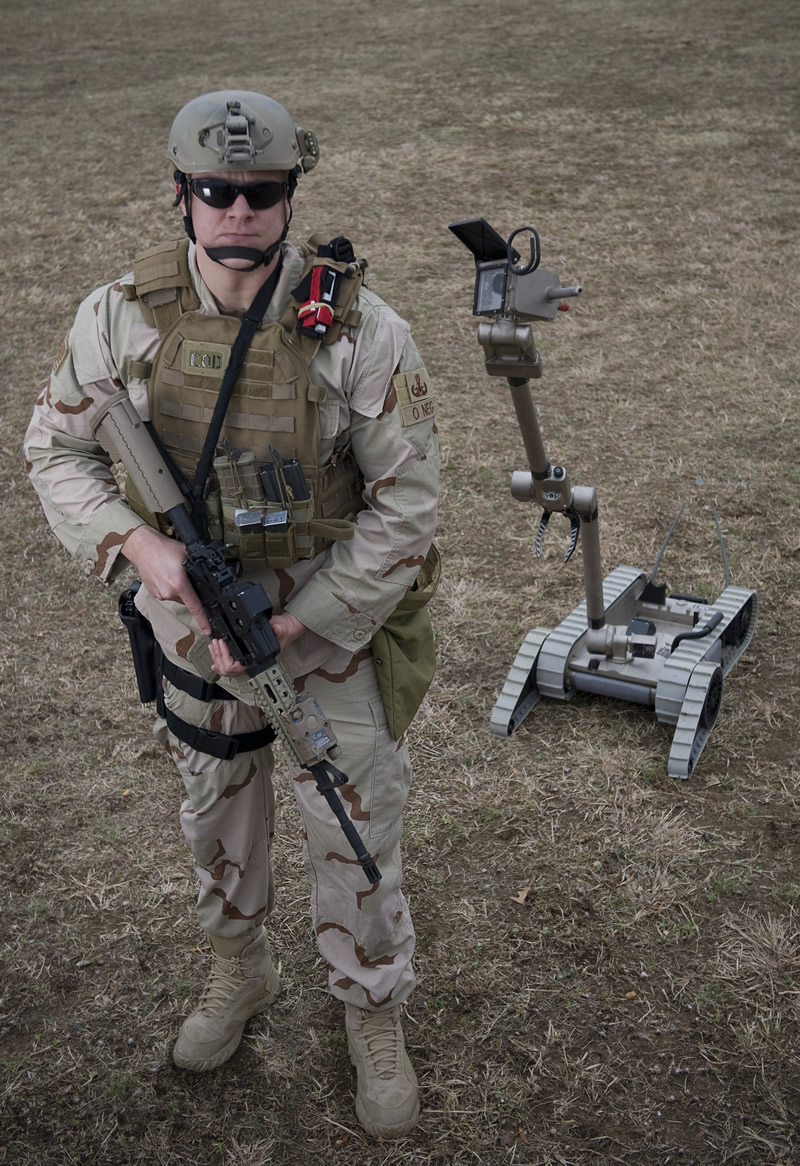
(click to view full)
Sept 7/10: Aware 2 upgrades. iRobot Corp. announces a $14 million order from the U.S. Army TACOM Contracting Center in Warren, MI for iRobot’s Aware(R) 2 robot intelligence software, and spare parts for iRobot PackBots. This order will allow the Army to upgrade their existing iRobot 510 FasTac fleet to the iRobot 510 PackBot multi-mission robot.
This is the 20th order under the $286 million Indefinite Delivery/Indefinite Quantity (IDIQ) xBot contract, whose total value now stands at approximately $143 million. iRobot says that has now delivered more than 3,500 unmanned ground vehicles to the military and civil defense forces worldwide.
July 22/10: +125. iRobot Corp. in Bedford, MA received a $20.5 million firm-fixed-price contract for 125 MTRS production systems, depot level repair parts, spare kits, and depot repair services.
Work will be performed in Bedford, MA, and is expected to be complete by March 2011. This contract was not competitively procured by the Naval Surface Warfare Center’s Indian Head Division in Indian Head, MD (N00174-10-C-0030). See also iRobot release
Feb 16/10: iRobot announces delivery of the 3,000th Packbot.
#3,000
Sept 8/09: Spares. iRobot Corp. announces a $6.1 million order from the U.S. Army’s PEO STRI, for Packbot spare parts. This is the 12th order under an existing $200 million contract, and brings the total contract value so far to about $30 million.
Sept 1/09: xBot. iRobot Corp. announces a $35.3 million xBot delivery order from the U.S. Army TACOM Contracting Center in Warren, MI. The delivery order covers 486 iRobot PackBot 510s with FasTac Kits, by March 31/10. This brings the total xBot contract value to $125 million of a possible $286 million.
The PackBot 510 is controlled through a ruggedized laptop with game-style controller, operates at speeds of up to 5.8 miles per hour and provides up to 4 hours of mission run time.
July 30/09: iRobot Corp. in Bedford, MA receives a $13.5 million firm-fixed-price cost-plus-fixed-fee, indefinite-delivery/ indefinite-quantity contract for the procurement MTRS production systems, depot level repair parts, spare kits, depot repair services, parts supply, training, engineering enhancements, configuration management, and approved accessories for the US Army (58%) and Navy (42%).
Contract funds in the amount of $150,000 will expire at the end of the current fiscal year. This contract was not competitively procured by the Naval Surface Warfare Center, Indian Head Division in Indian Head, MD (N00174-09-D-0005). See also iRobot release.
May 6/09: +125. iRobot announces a $16.8 million, 125 robot order from the U.S. Army PEO STRI, marking the 1st purchase of iRobot’s advanced PackBot 510 series under an existing $200 million contract – see Sept 2/08 entry. This is the 6th order under that PEO STRI contract, whose previous orders involved the Packbot 500 series, and whose current total value now stands at approximately $22 million.
The PackBot 510 with EOD Kit has advanced vision and surveillance capabilities, with improved lift and manipulation capabilities, greater speed, military-standard batteries, a hardened laptop with game-style hand controller, and a variety of other upgrades. To date, iRobot has delivered more than 2,400 PackBot robots.
Feb 10/09: xBot. iRobot Corp. announces a $7.8 million xBot contract order from the U.S. Army PEO STRI. The order calls for 90 iRobot PackBot 510s with FasTac Kit robots and spare parts.
This is the 9th order under the $286 million indefinite-delivery/ indefinite quantity (IDIQ) xBot contract, bringing the current total contract value to approximately $80 million. See Dec 18/07 entry for more details.
Jan 29/09: +72. iRobot Corp. announces a $5.5 million order from the U.S. Army PEO STRI. The order calls for 72 iRobot PackBot 510s with FasTac Kit robots, spare parts, and repairs. To date, iRobot has delivered more than 2,200 PackBot robots.
This is the 8th order under the $286 million indefinite-delivery/ indefinite quantity xBot contract, bringing the total order value to approximately $73 million. See Dec 18/07 entry for more details.
Nov 17/08: SBIR p-II Grants. iRobot Corp.announces 6 new Small Business Innovative Research (SBIR) Phase II grants, worth a total of $4.4 million, to develop technology related to human-robot interaction, unmanned ground and air vehicle coordination, semi-autonomous unmanned ground vehicle tele-operation and navigation, and electronics diagnostics and health monitoring. iRobot sees the awards as steps toward improving PackBot, SUGV and Warrior by making them smarter, easier to use, and integrated with unmanned aerial vehicles (UAVs).
These projects are to be funded by the U.S. Army Tank Automotive Research, Development and Engineering Center (TARDEC), the U.S. Army Armament Research, Development and Engineering Center (ARDEC), the Office of Naval Research (ONR) and the U.S. Army Research Office (ARO).
Oct 29/08: iRobot announces that it has delivered 2,000 PackBot robots to the U.S. military, public safety organizations and a variety of international customers, under a variety of contracts.
As a yardstick of comparison, competitor QinetiQ placed its own figure at 2,500 TALON robots, as of Dec 1/08.
#2,000
Oct 27/08: +17. iRobot announces a $3.7 million MTRS program order from NAVSEA for 17 PackBot robots and repair parts, to be delivered by Jan 31/09. The PackBot MTRS robots are customized for NAVSEA and are modeled after iRobot’s PackBot 500 with EOD Kit. This order brings the total value of iRobot orders under MTRS to approximately $102 million, out of a possible total of $264 million.
Oct 6/08: xBot. iRobot Corp. announces a $3.5 million order from the U.S. Army PEO STRI. The order calls for 26 iRobot PackBot 510s with FasTac Kit robots, spare parts, and repairs.
This is the 7th order under the $286 million indefinite-delivery/ indefinite quantity xBot contract, bringing the total order value to approximately $67 million. See Dec 18/07 entry for more details.
iRobot FY 2008
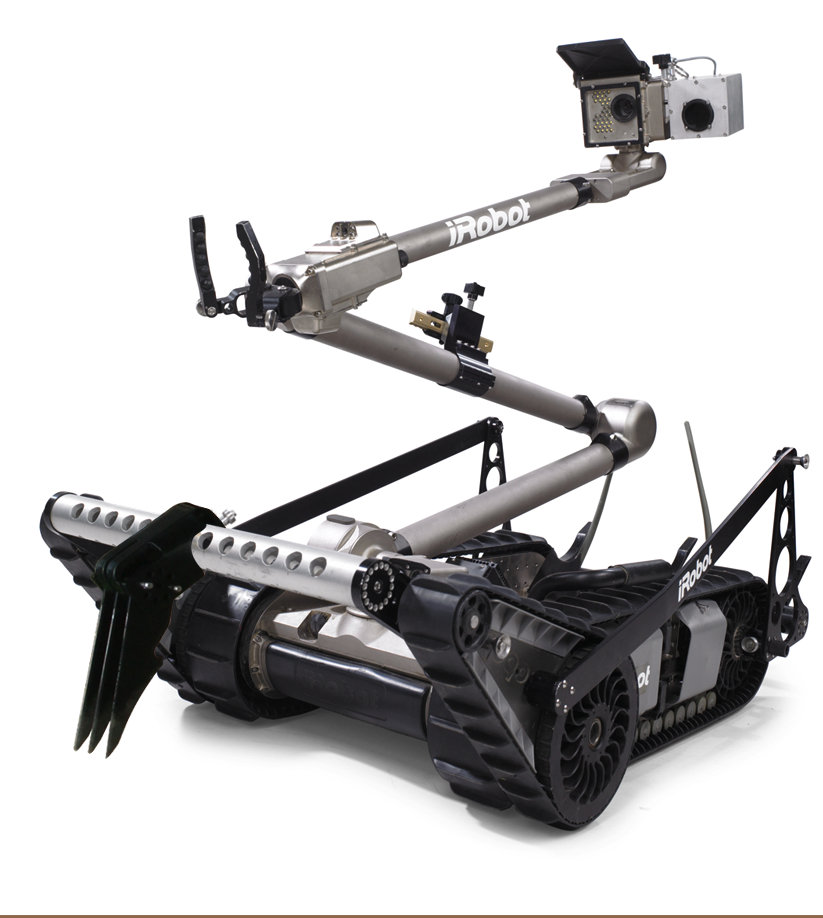
(click to view full)
Sept 2/08: iRobot Corp. announces a $200 million ceiling priced indefinite-delivery/ indefinite-quantity (IDIQ) contract from the U.S. Army PEO STRI, on behalf of the Robotic Systems Joint Project Office in Warren, MI. Under the terms of the contract, the Army could order up to the full $200 million value in military robots, spare parts, training and repair services over the next 5 years.
This award replaces a previous contract that expired in May 2008. Unlike the previous contract, or even the Army’s xBot contract, it does not limit orders to the Packbot. Orders can be placed for any of iRobot’s government and industrial models, or add-on offerings.
Army: 5-year, $200M
May 22/08: iRobot announces 2 orders under 2 two separate contracts from the U.S. Army’s PEO STRI, who manages these contracts on behalf of the Robotic Systems Joint Project Office at Warren, MI and Huntsville, AL.
The first is a delivery order totaling $6.3 million under a PEO-STRI (Program Executive Office for Simulation, Training, and Instrumentation) contract. It includes a combination of iRobot PackBot 510s with EOD kit, iRobot PackBots with ICx Fido Explosives Detection Kits, as well as spare parts and equipment. Total orders under this $64 million IDIQ contract have now risen to $52 million, and iRobot expects to complete delivery by the end of Sept 30/08.
The second contract is a $16 million order under the Army’s xBot contract, raising the order total to $27 million out of a possible $286 million. See Dec 18/07 entry for more details. So far, iRobot announces that over 1,500 PackBots have been delivered to all customers.
Dec 18/07: Beyond MTRS – xBot. iRobot announces that it has been awarded the xBot contract, after the original winner Robotic FX was disqualified. iRobot had launched lawsuits against Robotic FX, claiming that key technologies in their Navigator were rip-offs of protected Packbot features. The original September 2007 win for Robotic FX was set aside by the Army in late October 2007.
This $286 million indefinite-delivery/ indefinite-quantity (IDIQ) contract is managed by the U.S. Army Program Executive Office for Simulation, Training, and Instrumentation (PEO STRI), on behalf of the Robotic Systems Joint Project Office at Redstone Arsenal, AL. Under the terms of the contract, the Army could order up to 3,000 military robots, spare parts, training and repair services over the next 5 years. the biggest difference from the MTRS contract is that the Army is ordering them for general infantry use, expanding their missions beyond explosive ordnance disposal.
iRobot’s xBot platform is the iRobot PackBot 510 with FasTac Kit. These robots are smaller and lighter than the iRobot PackBot 510, with a robust gripper and an observation mast equipped with a low-light-capable zoom camera. iRobot immediately begins to deliver the first 101 robots for urgent deployment. By February 2009, 9 orders have been placed under the xBot contract, worth $80 million.
xBot: $286M “win”
Dec 18/07: iRobot Corp. in Burlington, MA received an $8.9 million firm-fixed-price contract for robotic systems, parts and training. Work will be performed in Dayton, OH and is expected to be complete by Sept 30/12. There were 5 bids solicited on Aug. 3, 2007, and 2 bids were received by the U.S. Army Program Executive Office for Simulation, Training and Instrumentation (US Army PEO-STRI) in Orlando, FL (W900KK-080D-0033).
Dec 12/07: Mapping module. iRobot Corp. announces iRobot PackBot with Mapping Kit. Through a state-of-the-art combination of sensors and artificial intelligence, PackBot with Mapping Kit can relay a real-time 2-dimensional structural map of the environment it is moving through back to its operator, while simultaneously detecting and avoiding obstacles in its path. The soldier still maintains control of the robot, but if an obstacle is encountered, PackBot is capable of autonomously changing course to avoid imminent collisions.
As part of the development project, iRobot is designing a 3-D Flash Laser Radar (LADAR/LIDAR) sensor for unmanned ground vehicles with Santa Barbara, CA based Advanced Scientific Concepts. This sensor technology will enable future advancements of the Mapping Kit to provide mapping and obstacle avoidance. iRobot release.
Mapping, LIDAR
Oct 21/07: iRobot officially declares victory in its legal battles with Robotic FX over the Army’s $286 million xBot contract, as judges in Massachusetts and Alabama sign off on settlements that effectively put Robotic FX out of business. Their legal efforts over patent infringement reportedly cost iRbot $2.9 million, but by August 2008, the firm began selling its own version of Robotic FX’s bargain-priced Negotiator robot. xconomy Boston | Full xconomy Robotic FX archives | April 2008 WIRED Magazine in-depth story: “Who Stole the Plans for iRobot’s Battle Bots?“.
Lawfare kills Robot FX
Oct 16/07: +40. iRobot Corp. announces an $8.8 million delivery order for 40 iRobot PackBot robots, plus spare parts and equipment. This order from the US Army’s PEO STRI, on behalf of the Robotic Systems Joint Project Office at Redstone Arsenal, AL brings the curent total odered to $45 million. Under the terms of the existing IDIQ contract, US Army PEO STRI could order up to $64.3 million value in robots, spare parts, training and repair services. iRobot expects to complete delivery of this order by the end of June 2008.
The current order covers a range of iRobot systems, including PackBot with the ICx Fido Kit as well as the Army’s first orders for the PackBot 510 robot. All robots will ship with iRobot’s new game-style hand controllers for faster training and easier operation in the field. In addition, more than 300 new high-performance radios will be retrofitted onto existing iRobot PackBots in theater, to increase their working range and flexibility.
iRobot FY 2007
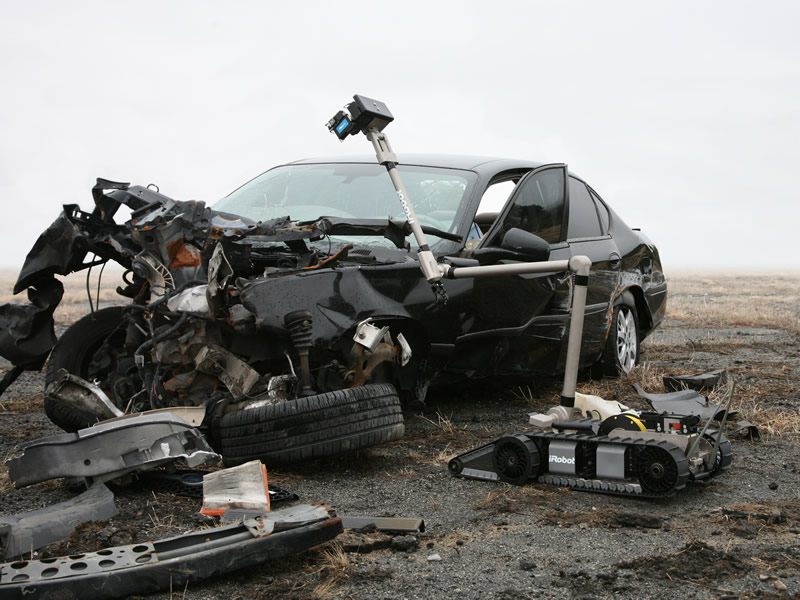
Smells like a bomb…
(click to view full)
Sept 18/07: +128. iRobot Corp. announces 2 US NAVSEA delivery orders totaling $19 million for 128 additional bomb-disposal robots to be shipped to U.S. forces overseas. These latest awards bring the current total value of NAVSEA iRobot orders to $94 million. iRobot expects to deliver the additional MTRS robots by mid-2008. They add that:
“Under the terms of the previously existing Indefinite-Delivery/Indefinite-Quantity (IDIQ) contract, the military could order up to the full $264 million value in robots, spare parts, training and repair services. The U.S. military’s MTRS program has requirements for up to 1,800 robots through 2012.”
See the April 2/07 release, and note that the numbers are rising while the dollar value remains stable.
July 11/07: US Army. iRobot Corp. announces it has received 2 delivery orders totaling $17.5 million for PackBot MRTS robots. The U.S. Army Program Executive Office for Simulation, Training, and Instrumentation (PEO STRI), on behalf of the Robotic Systems Joint Project Office at Redstone Arsenal, AL and the Naval Sea Systems Command (NAVSEA) both placed orders; iRobot expects to complete delivery by the end of January 2008.
The initial PEO STRI contract was awarded under the Naval Air Systems Command’s (NAVAIR) contracting authority. PEO STRI has recently established its own contracting authority, and this contract was transitioned under that authority. PEO STRI placed an order valued at more than $8.6 million for 14 iRobot PackBot robots with the ICx Fido bomb-sniffing Kit, and 5 iRobot PackBot EOD robots, plus spare parts. The PackBot robots will ship with iRobot’s new game-style hand controllers, and this order brings the PEO STRI total to approximately $36 million. Under the terms of the existing contract, PEO STRI could order up to $64.3 million in robots, spare parts, training and repair services.
In addition, NAVSEA ordered 60 iRobot PackBot MTRS robots and spare parts valued at $8.9 million for Joint Service Explosive Ordnance Disposal use, bringing NAVSEA’s total orders to date to more than $74 million. Under the terms of NAVSEA’s previously existing IDIQ contract, the military could order up to the full $264 million value in robots, spare parts, training and repair services.
Army handling its own buys now
June 28/07: iRobots bringing the zap. iRobot Corp. announces a strategic alliance with TASER International, Inc. to develop new Packbot robots that “can remotely engage, incapacitate and control dangerous suspects with integrated TASER electronic control devices.” The working proof-of-concept model is an iRobot PackBot Explorer with a TASER X26 device.
The competing TALON SWAT/MP also comes with a Taser system; still, we can understand how dealing with financiers might help spur iRobot’s development cycle…
iTaser
June 19/07: Financing. Expansion and success can kill a business if it isn’t prepared. iRobot Corp. announces a 3-year agreement with the Bank of America for a $35 million unsecured revolving line of credit, available to the company for general corporate purposes, including strategic acquisitions. The firm also signed a one-year agreement with the Banc of America Leasing & Capital, LLC, and TD BankNorth for a $15 million equipment-financing facility, available for financing leasehold improvements and other assets acquired over the next 12 months for a term of 60 months. The new credit facilities replace a May 2005 secured revolving credit agreement for $20 million. iRobot release.
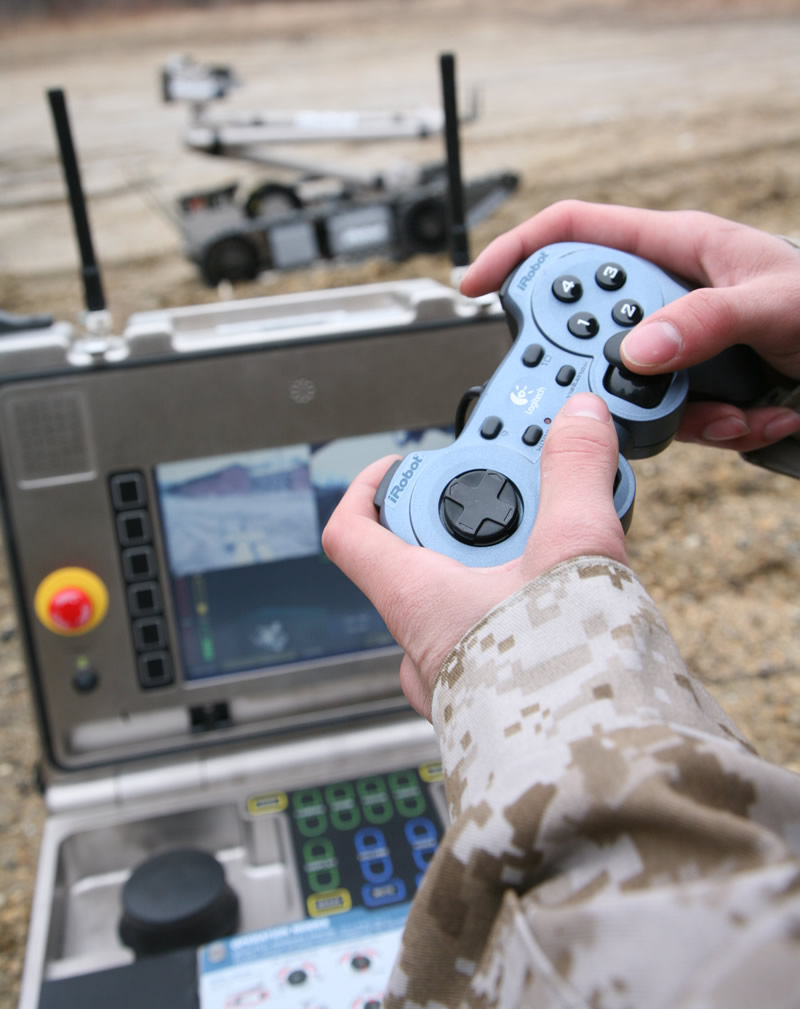
(click to view full)
June 14/07: Future Controller Systems. iRobot Corp. announces it has been selected by Lockheed Martin to be a key supplier of design and development for the US Army’s $160+ billion Future Combat Systems’ “Centralized Controller Device” for all robots and UAVs in an FCS brigade. At present, each system comes with its own controls and display, which makes managing multiple unmanned vehicles difficult. iRobot’s role will be to develop controls and display designs for the Centralized Controller, through its estimated delivery in 2015.
The Future Combat Systems meta-program is managed by a corporate Lead Systems Integrator team of Boeing and partner Science Applications International Corporation (SAIC), with US Army supervision. The Lead Systems Integrators had contracted Lockheed Martin to develop the Centralized Controller Device, who subcontracted in turn with iRobot. iRobot has already developed a control system based on a Logitech device that is very similar to the Sony Playstation’s controls; they are also developing the SUGV as Future Combat Systems’ ground reconnaissance/ EOD/ light utility platform. iRobot release
FCS controller
.
June 6/07: iRobot holds a ceremony to mark the 1,000th Packbot delivery, and unveil the new Packbot 510 with 30% more speed and a new videogame-style controller. Various add-on modules from bomb sniffing to sniper detection are also showcased.
#1,000
April 2/07: +101. 101 Packbot delivery order. iRobot Corp. announces a $14 million delivery order from the U.S. Navy NAVSEA to build an additional 101 Packbots, plus field repair spares, for shipment to U.S. forces overseas. They add that this latest award brings the total value of the orders placed to date to $66 million. iRobot shipped the initial lot of PackBot robots for this order in late March 2007, and the company expects to finish this delivery order before Dec 31/07.
Under the terms of the previously existing Indefinite-Delivery/ Indefinite-Quantity (IDIQ) contract, the military could order up to the full $264 million value in robots, spare parts, training and repair services, with requirements for up to 1,200 robots through 2012. To date, iRobot has delivered more than 800 PackBot robots to a broad range of military and civilian customers worldwide.
March 7/07: Bundeswehr adds 22 more Packbots. iRobot Corp. announced an order from the German Bundeswehr worth more than $2.8 million, exercising an option for 22 additional iRobot PackBot EOD robots and spare parts on top of the 18 machine order placed in 2006 (TL = 40). The German Federal Defense Force first ordered PackBot EOD robots after conducting a competitive market search followed by an intensive 18-month test. iRobot expects to deliver the 22 new robots by Q2 2007.
Germany to 40
iRobot FY 2002 – 2006
(click to view full)
Sept 6/06: Non-MTRS iRobot Packbot order from the German Bundeswehr for 18 systems, and a July 2006 legal settlement that provides 30 Packbots to the UK MoD.
Northrop Grumman subsidiary Remotec would eventually become the UK’s new EOD robot standard, winning the CUTLASS program contract in December 2006.
UK & Germany
May 31/06: Small business qualifier iRobot Corp. in Burlington, MA received a $64.3 million firm-fixed-price, indefinite-delivery/ indefinite-quantity contract for operator and technician training, Packbot spare parts, and new robots. These will be delivered to the Robotic Systems Joint Project Office for use by the joint robotics repair facilities and embedded repair teams deployed in support of contingency operations in Iraq and Afghanistan in support of the Global War on Terror. Under its terms, the military could order up to $264 million value in robots, spare parts, training and repair services.
Work will be performed in Burlington, MA and is expected to be complete in May 2008. This contract was not competitively procured by the Naval Air Warfare Center Training Systems Division in Orlando, FL (N61339-06-D-0015).
New MTRS contract
Sept 23/05: Support. iRobot Corp. in Burlington, MA received a $140.7 million firm-fixed-price, indefinite-delivery/ indefinite-quantity contract modification to provide lifecycle support and spare parts for additional systems being procured under the Man Transportable Robotic System program. Work will be performed in Burlington, MA and is expected to be complete by October 2012 (N00174-03-D-0003).
Sept 14/05: +1,000. i-Robot Corp. in Burlington, MA received $95.6 million firm-fixed-price, indefinite-delivery/ indefinite-quantity contract modification. This contract will increase the number of available iRobot Packbot MTRS units from 250 to 1,200. Work will be performed in Burlington, MA and is expected to be complete by October 2012.
May 31/05: The US Navy’s Explosive Ordnance Disposal (EOD) Program Office receives approval for full-rate production of the Man Transportable Robotic System (MTRS). Rear Adm. William E. Landay III, Program Executive Office (PEO), Littoral and Mine Warfare, convened an Acquisition Review Board and approved the program. US Navy PEO-LMW release.
MTRS FRP
Oct 28/02: iRobot Corp. in Milford, NH won a $27.3 million firm-fixed-price, indefinite-delivery and indefinite-quantity completion, supply and service type contract for the Man Transportable Robotic System (MTRS), associated repair parts, troubleshooting assistance, post-production support services, and data. Later releases reveal that the contract covers up to 250 robots.
Work will be performed in Waltham, MA and is to be complete in October 2012. The contract was competitively procured and advertised in Federal Business Opportunities Web site, with 4 offers received (N00174-03-D-0003).
Initial contract: 250
MTRS’ Mini-Mes: MARCbot, BomBot & Dragon Runner
Since RadioShack doesn’t charge $80,000 – $150,000 per item, DID expects soldiers to continue the practices noted in our earlier report, continue buying remote-controlled toys for universally-available but limited assistance with the threats they face.
On the other hand, RadioShack toys weren’t usable in the rubble of 9/11’s Ground Zero or the caves of Afghanistan; Foster-Miller’s MTRS platform was at Ground Zero, and iRobot vehicles were used shortly thereafter to scout Afghan caves. They’re much bigger and more capable than any store-bought offering, and having more of them available on the battlefield will be a big plus from the troops’ point of view.
Still, it’s hard to beat that Toys R Us price point. Which may help to explain why there’s also some new help in-theater that approximates those toy Hummer offerings.
Based upon the first Exponent robots sent to Afghanistan in 2002, the first improved MARCbot IIs for IED sweeps were initially sent to Iraq in May 2004. They weren’t fully ready for combat, but they were useful in much the same way remote-control toys were useful. Colonel Gregory Tubbs, Director of the Rapid Equipping Force, spoke highly of them in his August 12, 2005 presentation as he related stories from troops in the field:
“Now we don’t compete with explosive ordnance device type robots, and what we do is try to put a robot at the lowest echelon, where soldiers can interrogate potential improvised explosive devices. We had one — in a one-week period interrogated 32 potential improvised explosive devices, and of those 32, 26 were actual improvised explosive devices.
Now for $5,000 investment for this type of device…. we think that’s a pretty good investment….”
This article doesn’t cover these smaller robots, but their presence on the battlefield is worth noting.
With fast spiral improvements made in direct response to soldier feedback from IED sweep missions, the MARCbot has improved and was soon fielded more widely in Iraq and Afghanistan. “Mighty Mites: MARCbots Add Exponent to IED Land-Mine Detection” offers more details regarding the MARCbot and its ongoing procurements.
The BomBot is a comparable system, and was originally developed by the US Air Force Research Laboratory. Innovative Response Technologies Inc. in Fairmont, WV received a $10 million firm-fixed-price contract for 309 explosive ordnance disposal “BOMBOT” vehicles, described by its proponents as a “high-tech toy truck with a camera and a dump bed.” The BomBot can neutralize mines, too, if it’s properly equipped. A bit of remote-controlled plastic explosive dropped off next to a bomb can take care of the problem. See “Radio Shack v2.0: Bombots, Start Your Engines!” for further coverage.
Finally, there’s QinetiQ North America’s 5-pound Dragon Runner. A steady stream of modifications have pushed models up to Dragon Runner 10, and it has been ordered by the US military’s RSJPO, US Marines, Australia, Britain, and others.
All of this is part of the evolution of battlefield robots.
MTRS: Additional Readings & Sources
* Foster Miller QinetiQ North America – TALON Military Robots, EOD, SWORDS, and Hazmat Robots. See also Project Examples: TALON Robots.
* iRobot – Government & Industrial robots & accessories.
* iRobot – Packbot (link now inoperative)
* iRobot – Packbot 510
* DID (Jan 16/12) – (Toy) “Trucks to Troops” Fights Land Mines. Still.
* Defense Systems (Feb 23/11) – Robot ranks expand on the battlefield. Now reportedly at almost 1 per 50 troops deployed. By 2013 the ratio should increase to 1 robot for every 30 troops.
* Pentagon DVIDS (May 31/10) – 18th Engineer sharpen their TALON Robot skills [in Iraq]
* US Army (June 5/07) – Saving Robots to Save Battlefield Lives. Describes the activities of Camp Victory’s Joint Robotics Repair Facility, which has become busy – and is also well-stocked with spares that allow repairs.
* Associated Press via CNN Technology (April 3/07) – Robots sniff out bombs. Covers “Fido,” a version of the iRobot Packbot with integrated explosives sniffing capabilities. iRobot Corp. is filling the military’s first order of 100 at a at a GEM City Manufacturing and Engineering plant in Dayton, OH, and will ship the robots over the next few months,
* National Defense Magazine (March 2007) – Navy Begins Work on Next-Generation Bomb Disposal Robot. This would replace MTRS and BomBot with a family of small robotic vehicles. Current plans call for development to begin in 2008, with fielding in 2012-2013.
* National Defense Magazine (November 2006) – Army Lab Channels Expertise to Non-Traditional Areas. In June 2006, the US Army’s Edgewood Chemical Biological Center fielded a PackBot unmanned ground vehicle equipped with sensors to detect radiation and chemical agents. “It can collect air samples and detect oxygen levels, lower explosive levels, volatile organic compounds, gamma radiation, toxic industrial materials, and chemical warfare agents.”
* National Defense Magazine (July 2006) – Bomb Disposal Teams Deliver Blunt Talk on Robots. Excellent article, with clear opinions from the front lines and some requested features. Some prefer TALON. Others prefer Packbot. All hated the Allen-Vanguard Vanguard robots, which were pulled from Iraq.
* DID (March 29/06) – MTRS Robots Continue to Head to the Front. Roomba-maker iRobot announces a contract order under MTRS.
* UPI (Feb 26/06) – iRobots PackBot On The Front Lines.
* WIRED (Issue 13.11, November 2005) – The Baghdad Bomb Squad
* National Defense Magazine (October 2005) – Far From Sea, Navy Specialists Defuse Roadside Bombs. Navy specialists were needed to augment the Army and Marines, as neither had enough EOD specialists. Covers both TALON and Packbot, and notes the TALON’s armament options. These are generally used to explode bombs, rather than targeting people.
* DID (May 18/05) – Remote Control Toys Used By Iraq Patrols
* National Defense Magazine (February 2004) – Rapid-Fielding Team Tasked To Transform Army Acquisition. Discusses an Army rapid-fielding initiative that put iRobot’s Packbot to use in Afghan caves.
“MTRS Mini-Me” Robot Additional Readings & Sources
* QinetiQ North America (Aug 18/11) – QinetiQ North America Introduces Micro-Robot for Military Missions Dragon Runner 10 – The ideal robot for dismounted forces.
* DID (June 1/06) – Mighty Mites: MARCbots Add Exponent to IED Land-Mine Detection.
* DID (Dec 21/05) – Radio Shack v2.0: Bombots, Start Your Engines! DID’s anchor article for coverage of this MarcBOT competitor, which was explicitly developed as a less-expensive alternative to MTRS.