


(click to view full)
On Sept 12/06, The Sydney Morning Herald reported that Australia’s A$ 400 million ALR2002 project, aimed at putting radar and infrared missile warning systems (RWRs) in Australia’s helicopters, transports and F/A-18s, had ended in at least partial failure with the scrapping of F/A-18 integration under the HUG 2.3 upgrade program. Sticking with the offering from
BAE Systems Australia’s electronic warfare division, they said, would deliver the project at least 2 years late and A$ 200 million over budget.
In response, a decision was formally announced on Nov 13/06. RAAF F/A-18A/B fighters would not use “Project Echidna’s” system, but its helicopters and C-130s would. More than 4 years after the original Phase 2A award, the scope of fielding for “Project Echidna” is about to be reduced again…
ALR-67: In Through the Out Door
(click to view full)
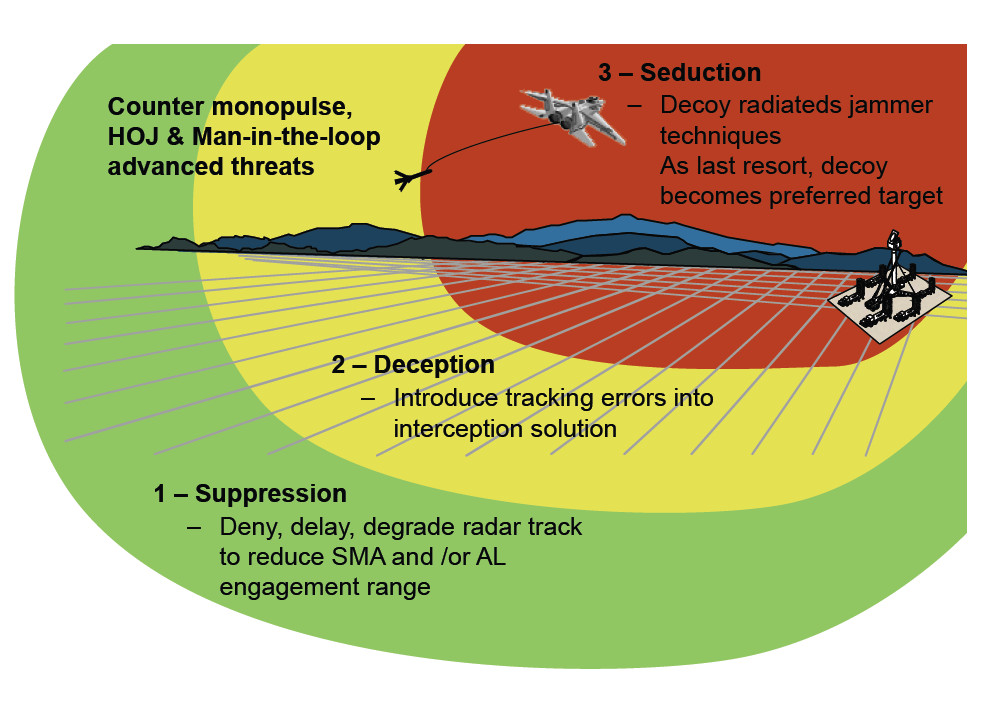
A fully integrated countermeasures system can detect air and ground radar signals, identify threats, provide aircrew with situational awareness and threat warning and activate countermeasures such as flares, chaff or jamming to protect the aircraft, either automatically or under aircrew control.
Project Echidna (an Australian Spiny Anteater) Phase 2A aimed deliver an integrated Electronic Warfare Self Protection Suite for the ADF’s helicopters consisting of the EADS AAR-60 Missile Warning System, the Thales VICON 78 Countermeasures Dispensing System, and BAE Systems ALR 2002 Radar Warning System. The heart of the Suite is the EW Controller that consists of a hardware box provided by SBS and EW Controller Software (SIIDAS – Sensor Independent Integrated Defensive Aids Suite) developed by BAE Systems. The ALR 2002 would also equip the RAAF’s F/A-18 Hornets.
The contract was issued in February 2005. By September 2006, problems with the proposed Hornet installations were apparent. Without BAE’s RWR systems, however, Australia’s fighter fleet would be left without defensive warning systems to notify them of incoming anti-aircraft missiles. A gap that would leave those fighters unable to operate in even medium-threat environments without high risk.
In response to reports of contract cancellation, the Minister issued a Sept 13/06 statement noting that the system was “under review,” and offering reassurances re: BAE’s jobs if the F/A-18 integration should be canceled. According to the Minister’s September 2005 release, only A$ 94 million was spent on the ALR 2002 project for Hornet integration, a significant percentage of the program’s budget.
The follow-on Nov 13/06 release confirmed the choice of Raytheon’s offering in its stead for the F/A-18 HUG program, and commits the Australian government to using BAE’s technology only on its helicopter fleet:
“The ALR-67(V)3 will be progressively fitted to the F/A-18 from 2008 with Full Operational Capability achieved in 2011.
Working variants of the ALR-2002 RWR, developed by BAE, will be fitted to our helicopter, and possibly, transport fleets… the CEO of BAE Systems Australia, Mr Jim McDowell, has assured me that no jobs will be lost as a result of this action.”
Raytheon’s ALR-67 is already installed in other F/A-18 fighters around the world as standard equipment, including F/A-18 E/F Super Hornets. A paper from Raytheon Australia originally touted the ALR-67 (V)3, which is the most up-to-date version, as the ideal choice for the HUG 2.3 Hornet upgrades. It was also said to be the preferred choice of the panel of experts that advised the government on this contract.
Contracts and Key Events

(click to view full)
Sept 18/09: The Labor government’s Minister for Defence Personnel, Materiel and Science, Greg Combet, announces scope reductions for project AIR 5416 Phase 2 (Project Echidna). Australia’s 12 C-130H Hercules medium transports and CH-47D Chinook heavy-lift helicopters have already received their Project Echidna modifications.
Per recommendations from the Department of Defence, Australia will complete modifications to 12 S-70 Black Hawk helicopters to provide a basic level of electronic warfare self protection similar to the ADF’s 6 CH-47Ds, but discontinue work on a more advanced equipment suite including the Australian developed ALR-2002 radar warning receiver. So far, 5 of the S-70s have been modified, and the remaining 7 will be completed before mid 2010.
Issues with the project included the effect on S-70 availability while full modifications were performed, and the usefulness of spending an extra A$ 50 million, given the expected phase-out of the S-70 fleet in a few years. Combet was careful to state that:
“…the performance of the prime contractor BAE Systems on the Echidna project had met all expectations and that development of the skills, capabilities and technology by BAE Systems during the conduct of the project will pay dividends for Defence and the company into the future.”
April 3/09: Small business qualifier Tech Resources, Inc. in Milford, NH received a $5.9 million firm-fixed-price contract for 16 AN/ALR-67(V)3 antenna coupler interconnecting groups, for the upgraded F/A-18+ Hornet fighters flown by the Royal Australian Air Force and for the government of Canada. Purchases are divided 50/50, at $2.945 million each.
This contract was not competitively procured, pursuant to the FAR 6.302-1. The Naval Air Systems Command in Patuxent River, MD issued the contract (N68335-09-C-0133).
March 11/09: BAE Systems announces a successful Australian flight test of its “Echidna” Electronic Warfare Self-Protection (EWSP) system’s ability to detect, identify and track radar emitters. BAE Systems Australia Managing Director Jim McDowell said that a 2nd airborne trial is planned for May 2009 to exercise and test the full system, using a final release of the EW Controller software and final configurations of the EW sub-systems.
The Echidna Phase 2A Project now comprises EWSP systems for the S-70 Black Hawk and CH-47 Chinook helicopters, pre- and post- mission support facilities for the Joint Electronic Warfare Operational Support Unit (JEWOSU), and mission planning and training systems.
Feb 27/09: Raytheon Co., Electronic Warfare Operations in Goleta, CA received a $9.9 million cost plus fixed fee contract for products and engineering services in support of the AN/ALR-67v3 operational flight programs for US Navy F/A-18E/F Super Hornets ($5.4 million, 55%) and the F/A-18 A-D and E/F aircraft owned by the Governments of Canada ($1.5 million, 15%), Australia ($1.5 million, 15%), and Switzerland ($1.5 million, 15%). The estimated level of effort for this contract is 57,686 man-hours.
Work will be performed Goleta, CA (80%) and Point Mugu, CA (10%); and China Lake, CA (10%), and is expected to be complete in February 2011. Contract funds in the amount of $1.15 million will expire at the end of the current fiscal year. This contract was not competitively procured by the Naval Air Warfare Center Weapons Division in China Lake, CA (N68936-09-C-0029).

(click to view full)
July 11/07: Raytheon Electronics Systems in Goleta, CA received a $24.4 million modification to a previously awarded firm-fixed-price contract (N00019-04-C-0123), exercising an option for 24 Full-Rate Production Lot 10 AN/ALR-67(V)3 Radar Warning Receiver (RWR) systems for the Royal Australian Air Force under the Foreign Military Sales Program. Raytheon’s Aug 2/07 release confirms that the order is for Australia’s F/A-18F Super Hornets.
Work will be performed in El Segundo, Calif. (27%); Goleta, CA (23%); Lansdale, PA (23%); Forest, MS (21%); Portland, OR (3%), and McKinney, TX (3%), and is expected to be complete in September 2010. Contract funds will not expire at the end of the current fiscal year. The Naval Air Systems Command in Patuxent River, MD issued the contract.
April 19/07: Raytheon Electronics Systems in Goleta, CA received a $77.8 million modification to a previously awarded firm-fixed-price contract (N00019-04-C-0123) to exercise an option for the full-rate-production of 97 Lot 9 AN/ALR-67(V)3 Radar Warning Receivers (RWR) for the U.S. Navy (24) and the Royal Australian Air Force (55), including spare weapon replaceable assemblies for the U.S. Navy (6) and for the Royal Australian Air Force (12). An Aug 2/07 Raytheon release confirms that these systems will be used as part of its F/A-18A Hornet UpGrade (HUG) program
Work will be performed in El Segundo, CA (27%); Goleta, CA (23%); Lansdale, PA (23%); Forest, MS (21%); McKinney, TX (3%); and Portland, OR (3%), and is expected to be complete in March 2010. This contract combines purchases for the U.S. Navy ($25.1 million; 32.23%) and the Government of Australia ($52.7 million; 67.77%) under the Foreign Military Sales Program. The Naval Air Systems Command in Patuxent River, MD issued the contract.
March 19/07: Raytheon formally announces the Australian ALR-67(v)3 radar warning receiver contract, which will be part of the Hornet Upgrade (HUG) program. The RAAF intends to procure 66 ALR-67(V)3 systems as part of a continuing production contract Raytheon has with the U.S. Navy’s Naval Air Systems Command, Patuxent River, MD.
To kick off the program, Raytheon recently received a $6.3 million antenna contract from the Navy that includes delivery of 20 antenna sets for the RAAF and forward antenna development effort for the RAAF and the Finland Air Force. Kathy Weiler, Raytheon’s ALR-67(V)3 program director: “This program will not only provide the RAAF F/A-18 fleet the most advanced, effective radar warning receiver available, it will also bring new technology and in-country work content to Australia.”
Nov 13/06: The Australian government announces that Raytheon’s ALR-67v3, which equips most Hornets around the world in this role, will be acquired instead of BAE’s ALR 2002.
Sept 13/06: Australia’s defence minister issues a Sept 13/06 release noting that the ALR 2002 system was “under review,” while offering reassurances re: BAE’s jobs if the F/A-18 integration should be canceled.

Afghanistan, 2006
(click to view full)
Feb 16/05: Defence Minister Robert Hill announces an A$ 135.5 million contract to BAE Systems for the design, development, integration and installation of an Electronic Warfare Self Protection capability for the Australian Army’s fleets of S-70 Black Hawk and CH-47 Chinook aircraft.
“Additionally and subject to satisfactory contract negotiations, this capability will also include an Australian designed and manufactured radar warning receiver for the Hornet aircraft… At the peak of activity, over 130 engineer and technician jobs will be sustained within BAE SYSTEMS over a three year period and around 15 positions will be created within MICREO Ltd. Additional orders of the ALR2002 Radar Warning Receiver, locally or internationally, could sustain this employment for up to a decade.”
Feb 4/05: The government signs a contract with BAE for AIR 5416 Phase 2A, with an approved budget of A$ 241.2 million. Phase 2A will deliver an integrated Electronic Warfare Self Protection Suite consisting of the EADS AAR-60 Missile Warning System, the Thales VICON 78 Countermeasures Dispensing System, and BAE Systems ALR 2002 Radar Warning System. The heart of the Suite is the EW Controller that consists of a hardware box provided by SBS and EW Controller Software (SIIDAS – Sensor Independent Integrated Defensive Aids Suite) developed by BAE Systems.
Also being developed under Phase 2A is an Integrated Electronic Warfare Mission Support System, which will include a EWST RF Stimulator, to be located at JEWOSU Source.