
(click to view full)
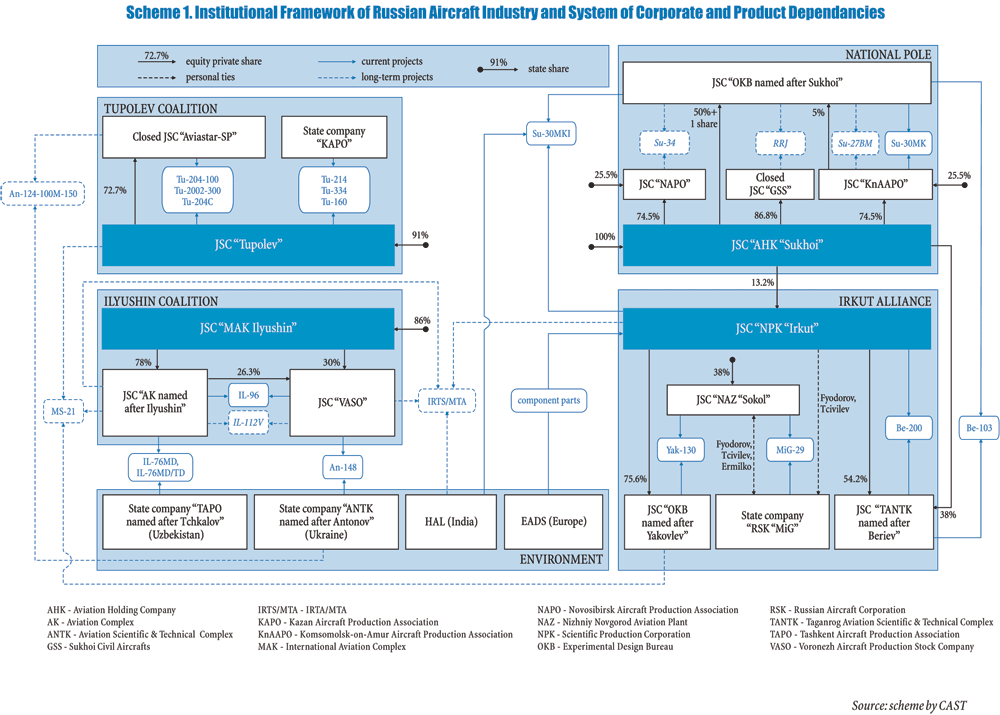
Russia’s aircraft industry remains one of the country’s defense export standbys, and Russian companies are beginning to partner with foreign firms in ways that could increase their reach. In December 2005, Moscow Defense Brief took a look at key trends, especially the consolidation trends as private maneuverings and state ‘encouragement’ to join a “Unified Aircraft-Building Corporation” (UABC) began to consolidate the various players.
At the time, names like Mikoyan, Sukhoi, Antonov, Ilyushin, Yakolev et. al. appeared to be coalescing around Irkut Corporation, with a second smaller pole around Sukhoi. Recent events are shifting away a French “sesquipolar” model, and toward a unipolar model. The question is whether this will result in success and profitability for a Russian defense industry that is struggling to regain its footing. Recent announcements at the MAKS 2009 indicate that more financial aid is on the way, but the powers that be are less than happy…
* Makienko’s 2005 Analysis
* Key Events & Developments
* Additional Readings
Makienko’s 2005 Analysis
(click to view full)
Konstantin Makienko, December 2005:
“It is now clearly evident that the Russian government has decided in favor of creating a ‘Unified Aircraft-Building Corporation’ (UABC), which will consolidate all the aircraft manufacturing activities of the country into a single framework. The practical implementation of this concept, however, presents serious organizational, legislative and political obstacles… Assuming the slowest pace for the establishment of UABC and a high probability for the revision of the concept in the future, the natural course of events reveals two poles opposed in conditions of uncompromising bureaucratic, political and market competition. These poles are the Irkut Alliance and Sukhoi holding…”
“Such a system could be called ‘sesquipolar’ (lat. ‘sesqui’ – one and a half). The majority of the French aircraft manufacturing industry is integrated into the European aircraft-industry zone – more concretely, in EADS. At the same time, however, the national pole of aircraft manufacture is maintained in the form of Dassault Aviation, which with state support (from significant defense orders from the state) makes a highly competitive showing in two sectors of the aviation market: light fighters (the Mirage 2000-5) and business jets (the Falcon).
There are significant cultural commonalities in both Russian and French aircraft-industry politics: the role of the state in the economy, the presence of a deep rooted aviation tradition, and, significantly in the era of globalization and the trans-nationalization of industries, the desire to preserve an expressed state and national-cultural identity in the industry, which only two decades ago was exclusively the province of the state. Further, given the present rate of growth of the Russian economy, the economies of the two countries viewed in terms of purchasing capacity will be comparable in the foreseeable future. These common attributes provide a basis for the reasonable assumption that the institutional configuration of their respective aircraft industries may follow similar patterns.”
EADS’ recent acquisition of 10% of Irkut Corporation made these developments even more interesting, and readers are also urged to recall Rosoboronexport’s maneuverings and desired role when considering or modeling the potential future shape of the Russian defense industry.
Key Events & Developments

(click to view full)
Aug 20/09: At Russia’s MAKS 2009 air show, Russian Prime Minister Putin criticizes UABC management, while announcing financial support. “A number of the UABC’s contracts for aircraft supplies both to domestic and foreign consumers have resulted in direct losses, instead of profits,” he said, as he warned that state support would not continue indefinitely, and instructed relevant government departments to draft a financial rehabilitation program for the national aircraft making sector by Oct 1/09. The intent appears to be rationalization, which will focus state money and support on companies deemed competitive and capable of succeeding on their own. The challenge is how to achieve effectiveness in an industry consolidated under a single umbrella, and deemed too important to fail. Vladimir Putin:
“We shall keep supporting the aircraft-building. Without aviation the Russian economy has no future, and the defense capabilities cannot be maintained without advanced complexes… We have identified aircraft-building, alongside space, shipbuilding and nuclear power, as one of the key priorities, and it is our hope these sectors will considerably increase the share of high technology enterprises in the domestic economy, enhance its stability and diversify export… As far as combat aircraft are concerned, it is one of the focal points of the state program for armaments
…This year alone we have disbursed 80 billion rubles, anti-crisis measures included… Just days ago the government made a decision to increase the capitalization of the holding company Sukhoi by 3.2 billion rubles [about $100 million]… In the past we purchased for the Air Force very few samples of modern technologies – one, two, three pieces, six at the most. Last year we shifted to long-term contracts and signed contracts for the purchase of 32 Su-34 jets 40 billion rubles worth [DID coverage], and 34 MiG-29 SNT 15 billion rubles worth [Algerian returns]… A number of contracts unparalleled in Russia’s modern history were signed here today for the purchase of 48 Su-35s, twelve Su-27SMs and four Su-30Ms over 80 billion rubles worth [DID coverage]. The supplies are to be effected by 2012″
The government is also considering giving RUB 15 billion (about $480 million) to new UABC subsidiary RAC MiG. According to RIA Novosti, Russia currently owns a 91.34% stake in UABC, which has charter capital of RUB 110.28 billion (about $3.45 billion). Unfortunately, the state corporation and its subsidiaries owe some $3.7 billion to creditors, and previous plans to pay the debt through selling unprofitable assets, refinancing, or floating shares have failed due to the global credit crunch. RIA Novosti | ITAR-TASS | defpro.

(click to view full)
Jan 18/09: The appointment of UAC Vice President and Sukhoi general director Mikhail Pogosyan to head up RAC MiG, while retaining his existing titles, is accompanied by declarations that the struggling firm will be folded into Russia’s UAC. Read “MiG to Fold Into UAC With Sukhoi?” for more.
June 17/08: EADS will sell its 10% stake in Irkut to UAC as part of a buyout effort. In March 2008, UAC reportedly offered EADS RUB 2.16 billion, or RUB 22.28 (approximately $0.95) per share, as part of its attempt to net 49.9% of the company’s charter capital. With this purchase, UAC effectively consolidates the 38.22% of Irkut transferred from private share holders and the 11.89% it absorbed from Sukhoi, into a 50.1% majority share.
EADS has indicated that it is still interested in maintaining a share in Russia’s state-owned United Aircraft Corporation (UAC) holding company, and is “willing to acquire the equivalent amount in UAC as soon as the financial valuation of this company will have been achieved as planned, and the operation will be made technically possible.” Forecast International.
Jan 26/07: Irkut announces that the entire $38.22% stake of its core shareholders has now been delivered as a contribution to the shareholders’ capital of Russia’s United Aircraft Corporation, pursuant to the offer that was accepted by UAC’s Board of Directors on Dec 12/06.
Additional Readings
* The entire Moscow Defense Brief article is very worthwhile reading for anyone who seeks to understand the Russian defense market, and its ongoing place in the global arms trade.
* DID (2008) – Russia’s Military Spending Jumping – But Can Its Industry?
* Flight International (Aug 10/09) – Russia’s United Aircraft reaches maturity. In-depth discussion of projects and plans.
* DID (Jan 18/09) – MiG to Fold into UAC With Sukhoi? Engine manufacturers Klimov and Chernyshev may also be caught up.
* Aerospace Technology (July 28/08) – Russia Reconsolidates Military Aerospace Arena
* Moscow Defence Brief (Q3 2007) – The Launch of Engine-Building Reforms
* RIA Nvosoti, via SpaceMart (Feb 13/07) – Can UABC Take Russian Aircraft Makers Out of Spin
* Moscow Defence Brief (Q1 2007) – Russia’s Defense Industry in 2006
* US Congressional Research Service (Nov 8/2000) – Russian Fighter Aircraft Industrial Base: Parallels with the United States? [PDF format]. Thought-provoking.