

(click to view full)
A February 2006 report noted that a $4 billion arms sale was brewing between Algeria and Russia involving fighter aircraft, tanks, and air defense systems, with the possibility of additional equipment. Those options came through the following month, as a high-level Russian delegation in Algeria closed up to $7.5 billion worth of arms contracts. The Algerian package remains post-Soviet Russia’s largest single arms deal. As an instructive comparison, annual Russian weapons export orders from all customers were just $5-6 billion per year in 2004 and 2005.
Reuters South Africa quoted Rosoboronexport chief Sergei Chemezov as saying that “Practically all types of arms which we have are included, anti-missile systems, aviation, sea and land technology.” The actual contents of that deal were murky, though DID offers triangulation among several sources to help sort out the confusion. A number of these deals have evolved over time, and other public-source information has helped to sharpen the picture a bit. The subsequent crash of Algeria’s MiG-29 deal, and its ripple effects, are also discussed.
The Algerian Package: What’s the Big Deal?
Absent any confirming releases by Rosoboronexport, reports regarding this deal have varied. Russia’s ITAR-Tass, for instance, initially reported that Algeria would buy 40 MiG-29 fighters, 20 Sukhoi-30 fighters and 16 Yak-130 training planes as well as 8 S-300 PMU2 Favorit rocket systems and about 40 T-90 tanks. This was the composition most often reported in the press, but it doesn’t come close to a $7.5 billion dollar deal.
A better and more detailed report came from Vedomosti, and later from the June 2006 issue of Moscow Defense Brief (MDB). Other sources have also helped to sharpen and clarify certain equipment numbers and costs. What follows is a composite picture, built up from ITAR-Tass and subsequent reports.
Aircraft
click for video
44 Su-30MKA Flanker 2-seat multi-role fighters. Up from 28.
DID’s earlier report, MDB’s June 2006 update, and Defense News’ February 2008 report, all agreed on the numbers: 28 planes for $1.5 billion. A follow-on deal in 2010 eventually replaced the MiG-29s with 16 more SU-30MKAs. If all reported MiG monies were simply shifted without further payment, it would place the total Flanker deal at $2.8 – $3.3 billion for 44 fighters.
Accounts of this variant, with some saying that it’s similar to the advanced canard-winged SU-30MKI/M delivered to India and Malaysia, while others cited it as a generic SU-30MK export model. Pictures and other reports settled the issue: it’s a canard-winged SU-30MKM variant. The SU-30MKI/M series adds new avionics, full thrust vectoring, and canard wings to the basic SU-30 design, among other enhancements. The Algerian SU-30s are closer to the SU-30MKMs, using Thales’ avionics and a French Damocles targeting and surveillance pod.

Algeria reportedly took delivery of its first 3 fighters between December 2007 and January 2008. As of March 2008, 6 fighters had been delivered, before deliveries were suspended over payment disputes related to the MiG-29s. By November 2009, all 28 of the original batch had arrived. The rest should have all been delivered by the end of 2012.
34 MiG-29SMT Fulcrum lightweight multi-role fighters.
MDB updated the order to include 28 MiG-29SMT fighters and 6 two-seat MiG-29UBT aircraft (28+6=34), and noted this segment as $1.8 billion, of which $300 million will go back as a trade-in for 36 of Algeria’s existing MiG-29s, to be resold to third countries. A February 2008 Defense News report agreed on the number and composition, but described this segment as a $1.3 billion contract.
The MiG contract was eventually canceled, in favor of more SU-30 fighters.
16 Yak-130 Mitten combat trainers and light attack aircraft.
DID’s earlier report had noted the Yaks as an additional option, with the possibility of up to 50 aircraft. They will complement/ replace Algeria’s older L-39 ZA Albatros aircraft from Czechoslovakia. MDB reports 16 Yak-130s, for a total of $200 million, an assessment later confirmed by Air Inrternational News at Farnborough in July 2006.
Moscow Defense Brief added that while the content of the options is not known, it is likely that 12-20 more MiG-29SMT fighters and 14-16 more Yak-130 trainers would be purchased if the options are exercised. The MiG options certainly won’t be exercised, but the Yak-130 options might be.
Helicopters. In 2013, Algeria added a separate deal for 42 Mi-28NE attack helicopters. These have a much slimmer and more dedicated profile than the Mi-24s Algeria currently flies.
According to Vedomosti, other contracts in the package included:
Ground Forces
300 T-90S main battle tanks. For tanks, the ‘S’ designation signifies an export version ($1+ billion).
MDB agreed, and believed that the first 40 tanks will be delivered in 2006. In July 2006, however, an Algerian representative reportedly noted to Jane’s that the figure was actually 180 tanks. A February 2008 Defense News report put the number at 185, which has been repeated by Russian media in 2012. Those same media reported a follow-on 120-tank order, reportedly completed in autumn 2011 for $470-$500 million. Which makes 305 tanks, for over $1 billion.
Upgrades of 250 T-72 main battle tanks (over $200 million). Not mentioned by MDB, or Defense News.
AT-13 Metis-M wire-guided and AT-14 Kornet semi-automatic laser beam-riding anti-armor guided missiles.
Both missile types can also be fitted with thermobaric warheads for devastating anti-personnel effects within buildings, caves, etc. This component was also mentioned by MDB, and a February 2008 Defense News report gives a figure of 216 Kornet-E missiles. This figure seems low based on comparable TOW-2 missile requests from similar countries, however, especially given Algeria’s ongoing civil war. 216 AT-14 launchers is more likely, with an undetermined number of missiles and the AT-13s still unaccounted for. These numbers remain very unclear.
A February 2008 Defense News report mentioned 8 Krasnopol laser-guided artillery shells as part of the deal.
This would barely cover basic testing needs, but testing before buying might be well advised. India has identified serious defects with its Krasnopol shells.
Air Defense

radar & launchers
(click to view full)
30 self-propelled M1 Tunguska gun/missile systems for low-level, short-range air defense and light fire support (up to $500 million, disputed).
Each 34t tracked M1 vehicle carries 8 short range 9M311-M1 (SA-19 Grison) missiles. Range is from 15 – 6,000m for ground targets, and 15 – 10,000m for aerial targets. They’re coupled with pair of twin-barrel 30mm cannon that have a maximum firing rate of 5,000 rounds per minute and a range of 3 km against air targets, or 4 km against ground targets. A target acquisition radar and target tracking radar, optical sight, and digital computing system guides these weapons, with a detection range of 18 km and a tracking range of 16 km. MDB mentioned these systems as well, but put no specific value on them.
If it is in fact the M1 Tunguska, Algeria would join its neighbor and sometime rival Morocco. Who signed a December 2004 contract for 12 Tunguska systems. On the other hand, A February 2008 Defense News report claimed that the Algerian contract covered 38 Pantsyr S1/SA-22 truck-mounted mobile gun/missile systems instead. Each carries 12 “97E6” missiles, which appear to be advanced SA-19/9M311 derivatives, and a pair of 30mm cannon. The Pantsyr S1 offer slightly longer reach against air targets vs. the Tunguska M1 (12km vs. 10km), and has also been ordered by Jordan, Syria, and the UAE.
8 of Russia’s advanced S-300 PMU-2 Favorit anti-air missile systems (aka. SA-10E, $1 billion).
MDB agrees with the number and figure, but Defense News put the number at 4; the range is thus 32-64 launchers.
According to eDefense Online, a S-300PMU2 Favorit battalion is equipped with a 30N6E2 fire-control radar, a 96L6E target-acquisition and designation radar, 8 launchers (5P85SE), and a set of 48N6E2 missiles (4 per launcher) with a range of 200 km against aircraft and 40 km against ballistic missiles. Each battalion complex is designated 90Zh6E2. The system can engage 6 targets at a time with up to 12 missiles using its own 96L6 target-acquisition radar, at altitudes ranging anywhere from 35 feet (10m) off the deck to 90,000 feet (27km). The 83M6E2 regimental command and control system adds to these capabilities, and can support a mass engagement of 36 targets at a time.
Navy

(click to view full)
The deal also reportedly includes unspecified work on Algeria’s navy. According to Haze Gray, Algeria’s Russian combatant ships include 2 Kilo Class submarines, 3 Koni class frigates, 3 Nanuchka class corvettes, and 11 Osa I and II Class missile boats (which may not be operable). Most entered service between 1975-1985, with the most modern ship being a Kilo Class sub that entered service in 1988. Repairs and upgrades had already begun on a limited basis during the 1990s, but more extensive refurbishment and upgrades are likely to be necessary.
By 2006, Algeria had bought 2 new Kilo Class submarines. By 2013, they had also bought 2 modified Stergushchy Class corvettes, and were reportedly looking for 2 more submarines.
Structuring the Deal: Anatomy of a Euro-Squeeze

(click to view full)
The biggest issue hanging over the deal was a $4.7 billion debt outstanding from past purchases of Soviet arms. As the next section notes, buying advanced Russian arms is nothing new for Algeria. UPI notes that the logical question arose: if there was no money to pay the debt, how would Algeria pay for all of this new equipment?
Enter Russia’s energy sector, in the persons of LUKoil CEO Vagit Alekperov, Gazprom chief Alexei Miller, and Igor Makarov of independent gas producer Itera. UPI believes the final arrangement is that Algeria will give gives Russian companies access to oil- and gas-rich regions, with the proceeds split between the producer and the Algerian government. The Algerian government is then bound to immediately transfer the revenues to Russian arms manufacturers, until such time as the debt is paid off.
Meanwhile, OPEC member Algeria develops more of her energy reserves, and the projects create local employment in the bargain. Indeed, the St. Petersburg Times reports that an $80 billion, 5-year program is underway aimed at boosting growth and drawing more investments to Algeria as it recovers from an extremely bloody civil war. That war against the Wahhabist/Salafist al-Qaeda affiliate GSPC and other Islamist terrorist groups has lasted over a decade and is still ongoing, but government successes over the last few years have sharply reduced the size of the threat.
The Morocco Times notes that Algeria has the world’s seventh-largest natural gas reserves with 4.55 trillion cubic meters, and is the world’s fourth-biggest gas exporter after Russia, Canada and Norway at 60 billion cubic meters per year. Russia, meanwhile, is the number one gas exporter to Europe, with about 26% of the market. By coordinating its export policies with number three exporter Algeria (about 10% of the European market), Russia may be able to increase its leverage within Europe, complicate the EU’s efforts to diversify its sources of supply, and leverage that improved position into greater participation in and influence over Europe’s pipeline projects.
That prospect looked good in 2006, anyway. Since that date, the growth of “fracking” techniques to extract natural gas from shale has changed the global energy picture. While some European countries are choosing to sit on their reserves, Poland isn’t one of them, and should soon find itself acting as a major gas provider for the continent. Their own especial fear of dependence on Russia is expected to ensure the required commitment. They will eventually be joined by Greece and Israel, who discovered huge offshore gas fields between Cyprus and Israel, and have begun cooperating with an eye to joint European exports. Russia is playing a smart game on that front, but no matter how the situation is played, supply and demand will govern deals. The reality is that each new player increases the difficulty of market control, and Russia’s prospects of achieving it are dim.
Contracts and Key Events
2015 – 2016
Algeria due to receive a pair of Mil Mi-26T2 heavy lift helos with two more to come in 2016.
April 11/16: Algeria has upped its orders of Mi-28NE helicopters from the eight initially reported in January to 42, according to a Russian newspaper. A further 19 of the “Night-Hunter” helicopters will also make their way to Iraq. The helicopters have recently seen action in Syria battling Islamic State militants, and it has been said that the radio-electronic jamming systems on board easily suppressed man-portable air defense systems (MANPADS) deployed against them by the insurgents. With interest being expressed from over half a dozen nations spanning from Latin America to South East Asia, the helicopter is certainly selling itself well during its recent military activity.
March 4/16: Russia and Algeria are expected to sign an agreement for 12 Su-34 fighter-bombers by the end of 2016. Russian news source TASS reported that contracts on the deal were waiting on approval of export licenses. Negotiations on the deal were opened last November, and could also be extended to a larger purchase of up to 40 of the aircraft. When the deal is confirmed, it will cement Algeria as manufacturer Sukhoi’s best customer in the region following last September’s order of 14 Su-30 fighters. The North African nation already operates 44 Su-30 aircraft.
January 4/16: After eight years of negotiations, Algeria seems to have formally ordered Su-34 fighters from Russia. The procurement is said to be for about twelve of the aircraft’s export variant, the Su-32, to replace the aging MiG-25s in service. The announcement was made in an interview with director of Novosibirsk Aircraft Production Association, Chkalov Sergey Smirnov.
September 14/15: Algeria is ordering an additional fourteen Su-30MKI multirole fighters from Russia to supplement the 44 already in service with the Algerian Air Force. Algeria is an important export customer for the Russian defense industry, with the North African country ordering a significant number of attack and transport helicopters last June. The Indian Air Force also operates the Su-30MKI, with the IAF suffering a high crash rate among its fleet in recent months. This latest deal is thought to value approximately $420 million, with deliveries expected between 2016 and 2017.
August 20/15: Russia intends to deliver another pair of Mil Mi-26T2 heavy lift helicopters to Algeria later this year, with another two following in early 2016, according to Russian media reports. The first two helicopters were delivered to the North African country in July, with reports indicating that a second contract – covering eight further helicopters of the type – is likely to complete deliveries by the end of 2017, bringing the total of heavy lift helicopters operated by Algeria to 14. The Mi-26T2 re-entered series production in May, with Algeria also reported to be ordering attack helicopters from Russia.
2010 – 2014
Algeria buys 16 more SU-30MKAs instead of MiG-29s; Mi-26 and Mi-28 helicopters; More T-90 tanks ordered; All 28 initial SU-30MKAs arrive; 2 Kilo Class submarines arrive; Yak-130 preps for fielding.
(click to view full)
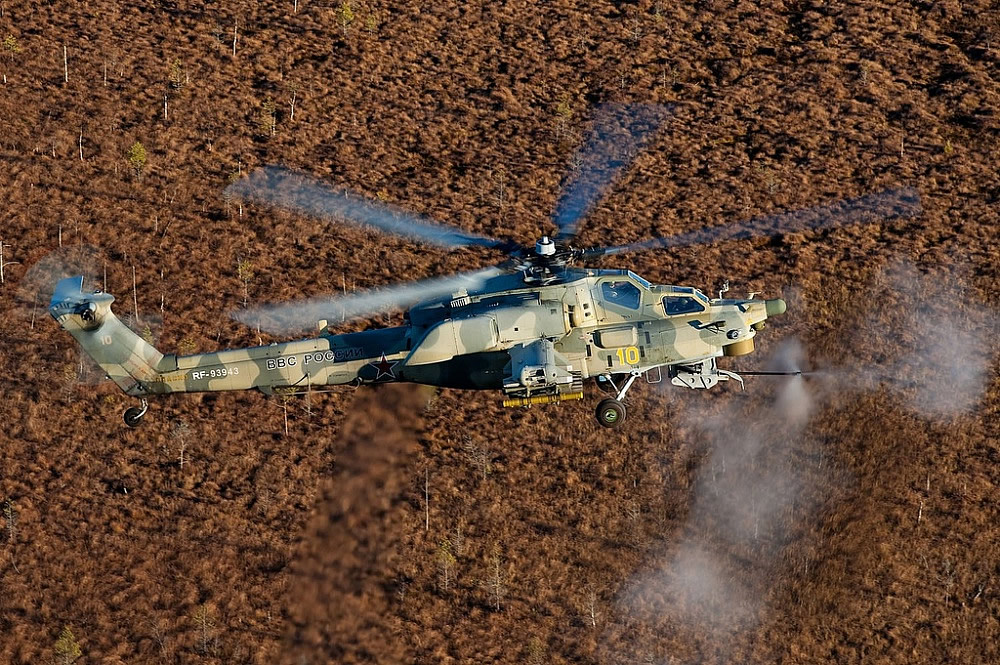
June 12/14: Mi-28s. Rosvertol’s 2013 annual report contains a number of interesting details regarding its orders. Algeria [foreign customer 012] ordered 6 Mi-26T2 ultra-heavy lift helicopters on June 26/13, and 42 Mi-28NE attack helicopters on Dec 26/13.
Mi-28NEs are dedicated attack helicopters, without the secondary transport capabilities of Algeria’s 36 Mi-24 Mk.IIIs. This order makes Algeria the type’s 2nd export customer after Iraq (15), but they are the type’s largest customer. Unless prospects in Egypt [customer 818], Turkmenistan [customer 795], or Uzbekistan [customer 860] really step up, they’re likely to remain so. Sources: Rostvertol PLC, “Annual Report ‘Rosvertol’, ZA2013 Year | LiveJournal bmpd [in Russian, incl. photos].
Mi-28NE attack & Mi-26T transport helos
June 7/13: RIA Novosti offers an update on Russian criminal prosecution of people involved in the canceled Algerian MiG-29 sale. There have been consequences, but…. it’s Russia.
The Moscow city court just handed down a 4-year suspended sentence to former Rezon director general Mikael Kazaryan. Rezon is charged with selling MiG outdated equipment, amd covering it up with forged certificates and tags. In earlier proceedings, Aviaremsnab head Musail Ismailov had 2 years added to his 5.5 year sentence, giving him 7.5 years for ripping off the Polish and Algerian air forces. May 2012 saw another 3 people convicted, with one sentenced to 5 years in prison, and the others fined.
On the other hand, this is Russia. MiG’s former First Deputy Director General Sergei Tsivilev, and his deputy Oleg Fadeyev, both escaped sentencing in December 2012, on grounds that the 6-year statute of limitations for their offense had expired. If you start too late, then yes, that happens. RIA Novosti.
March 11/13: UPI offers some snapshot updates of Algeria’s arms imports, which extend beyond Russia and look set to grow, thanks to a 14% increase in their 2013 military budget. $10.3 billion isn’t huge by some standards, but it’s enough to keep the new acquisitions coming, and the oil and gas revenues underpinning that budget seem stable.
“Delivery of the Su-30MKA aircraft, worth $1 billion, should have been completed at the end of 2012 by Rosoboronexport, Russia’s state arms exporter.
Delivery of the last of 120 T-90 tanks under a $470 million 2006 contract is still under way. Delivery of 180 T-90s under an earlier contract was completed in 2009.
Algiers is also looking for two Project 636 advanced variants of the SSK Type 877EKM Kilo class submarines. These diesel-electric boats are stealthier than the Algerian navy’s four Kilos delivered in 1988 and 2010.”
Beyond its initial umbrella buy covered here, Algeria has ordered 2 Stergushchy (Project 20382 Tiger export variant) corvettes from Russia. Beyond Russia, 2011 saw an order for an Italian San Giorgio Class LPD derivative and associated landing craft. 2012 saw Algeria buy 2 German Meko A200 frigates and 6 Super Lynx helicopters, along with a reported agreement to purchase up to 1,200 of Rheinmetall’s Fuchs armored personnel carriers, which came through later in 2014. There’s even a reported purchase of 3 light frigates from China pending, depending on whom one asks.

(click to view full)
Feb 14/12: Tanks! Russian media report that Algeria has added another 120 T-90 tanks to its orders, at a cost of $470-500 million, bringing its total fleet to around 305. Russia media sources attribute the buy to the Arab Spring’s toppling of nearby regimes, but a closer look shows that a fleet of 305 T-90s is about what Algeria was initially expected to order. This may just be the completion of their planned buy, with an added push from external events.
Meanwhile, Russia is reportedly moving to upgrade its T-72 tanks as a cheaper alternative to new T-90s, while the army awaits a new tank design. Which means they’re looking to sell T-90 production abroad:
“In 2009, Russia’s defense export giant Rosoboronexport completed the delivery of 185 T-90C tanks to Algeria… in the fall of 2011, Algeria signed another contract with Russia for the delivery of 120 brand new Russian tanks, the Vedomosti newspaper wrote with reference to its sources at Rosoboronexport and Russian Technologies… In 2011, the Russian Defense Ministry stopped purchasing T-90 tanks… Instead, the Russian tanks will be delivered abroad. Russia will soon catch up with China on the sales volume of this hardware. In the summer of 2011, Russia signed a contract with Turkmenistan for the delivery of 20 T-90C tanks. Russia is also in talks with Kazakhstan, Azerbaijan and Indonesia.”
120 more T-90 tanks
Sept 1/11: Yak-130. Algerian pilots training at the Irkutsk Aviation Plant’s airfield perform their 1st first solo flights, following 3 months of training and over 100 flights with Irkut crews. Irkut says they’ve also been training Algerian engineers and technicians on the Yak-130 aircraft, as Algeria prepared to induct the planes. JSC Irkut.
Nov 7/10: Submarines. South Africa’s DefenceWeb reports:
“Algeria has reportedly received two Kilo-class (Project 636) diesel-electric submarines from Russia, ordered as part of an arms package signed in mid-2006. The new arrivals take the fleet to four, French media say.”
The naval components of this deal have always been hazy, but Kilo Class submarines are diesel-electric powered hunter-killer boats, and Algeria had already fielded 2 boats of this type.
Subs delivered
June 21/10: SU-30s. Arabian Aerospace reports that Russia is selling Algeria another 16 SU-30MKAs:
“The Algerian additional order was negotiated earlier this month by Rosoboroneksport which said additional prospects for the aircraft in the region are possible… The Su-30MKA is a variant based on India’s Su-30MKI and Malaysia’s Su-30MKM developed by Sukhoi OKB and Irkut and produced by the Irkut Aircraft Production Association plant in Irkutsk. The Su-30MKA features French avionics, including the Thales Damocles laser designation and targetting pod, but is said to be closer to the Su-30MKI than the Su-30MKM.”
That last appears to be based on a RIA Novosti report that wasn’t worded entirely clearly; the MKM is itself an MKI variant whose biggest modifications involve the replacement of Indian and Israeli avionics and onboard equipment with French and Russian equipment, much as the Algerians have done.
June 2/10: Deliveries. Russia’s RIA Novosti:
“Russia will supply Su-30 Flanker fighters and Yak-130 Mitten trainer/light attack jets to Algeria in 2011, the deputy head of the Russian Federal Service for Military Technical Cooperation, Vyacheslav Dzirkalin, said. “The delivery of Su-30s and Yak-130s [to Algeria] is due to begin next year, this is no military secret,” Dzirkalin said. Earlier in April, the head of Russian Technologies state Corporation, Sergei Chemezov, in an interview with the Novaya Gazeta weekly said Russia would ship to Algeria “a party of modern Russian fighters” at a price of about $1 billion. Dzirkalin did not specify the number of aircraft to be delivered to Algeria.”
Back in 2006, Moscow Defense Brief had said that the Algerian contract contained an option for another 14-16 Yak-130 trainer and light attack planes. Irkut’s December 2009 release announcing delivery of all Algerian Yak-130s would strongly indicate that more deliveries would involve an option order. The first batch of SU-30MKAs have already finished delivery as well, but more deliveries would be expected in 2011 as part of the reported MiG-29 substitution deal.
April 5/10: Switch. Reports surface that a deal has been struck to replace Algeria’s MiG-29s with 12-16 “SU-30MKI (A)” fighters. Later reports (vid. June 21/10) confirm the number at 16, which would raise total SU-30MKA deliveries to 44.
The deal is not reported independently, but as one of a $1.2 billion pair of deals that also includes 6 SU-30MK2 fighters for Uganda. Stop us if you’ve heard this song before, but: “Since Uganda is short of real money to pay for the planes, Russian LUKoil is negotiating its potential participation in developing large oil fields in Uganda, implying a possible swapping.” RIA Novosti | RTT News | Voice of Russia | Brahmand.
Switch from MiGs to 16 more SU-30MKAs
Dec 22/09: Irkut Corporation announces in passing that “The Irkut Corporation concluded the contract with Algeria on delivery of Yak-130 and carrying out its contractual obligations.”
Nov 18/09: Irkut announces that Russia has completed the delivery of 28 Su-30MKA Flanker multi-role fighters to Algeria. Via RIA Novosti:
“Under a $2.5 billion contract, signed in 2006, the Irkutsk manufacturer in affiliation with Irkut Corporation has built a total of 28 Su-30MKA fighters for Algeria… The Su-30 MKA is a Flanker variant based on the Su-30MKI model and features customized avionics to meet Algerian specifications.”
28 initial SU-30MKAs delivered
June 15/09: Yak-130s. Russia’s RIA Novosti quotes Irkut head Oleg Demchenko at the Le Bourget airshow in Paris:
“We will have a contract with Russia’s Defense Ministry for 62 aircraft, and we will supply 16 Yak-130 planes to Algeria… Demchenko said the first Yak-130 to be delivered to Russia’s Air Force in July is undergoing flight tests in the city of Nizhny Novgorod on the Volga. “The first two planes from the Algeria contract are in the final assembly,” Demchenko said. Demchenko also said Irkut would complete the delivery of Su-30 Flanker-C [DID: the base SU-30 type] fighters to Algeria in 2009.”
May 13/09: SU-30s. The World Tribune reports that:
“A key element in the project has been the Algerian procurement of 180 T-90 MBTs from Russia. In 2008, the last of the tanks arrived in Algeria, with deployment expected later in 2009… Algeria was also said to have received most of its order of Su-30MK fighter-jets. SIPRI said Algeria has acquired 18 out of 28 Sukhois. The next stage of the Russian military modernization project would focus on naval platforms. Algeria has ordered two Project 636 Kilo-class submarines from Moscow.”
Jan 13/09: MiG-29s. RIA Novosti quotes “a Russian Defense Ministry source”, and says that Russia’s Air Force will receive Algeria’s 34 MiG-29 SMT and MiG-29 UBT fighters later in 2009, and induct them into service. Note that the picture used with RIA Novosti’s story is of a MiG-29K, the carrier-based variant that has been sold to India.
Aviation Week adds that the Russian government has signed a RUB 20 billion (about $615 million) agreement to buy the 28 MiG-29SMTs, and is negotiating for the 2-seat MiG-29UBTs, while making plans to fold RAC MiG into its United Aircraft Corporation alongside Sukhoi.
2006 – 2009
Algeria signs the big deal; MiG-29 order frozen.

(click to view full)
May 28/08: MiG-35s? Russia’s RIA Novosti quotes MiG Corp. CEO Anatoly Belov as saying that:
“We are currently in negotiations on delivering our fighter aircraft, including MiG-35s, to Algeria.”
The MiG-35 is the most modern variant, with full thrust vectoring for supermaneuverability and the possibility of an AESA radar. It is currently in the running for India’s MMRCA competition, but is not in service anywhere yet. As for Algeria’s delivered MiG-29SMTs, RIA Novosti reports that:
“The aircraft were eventually returned to Russia in April this year and following additional tests could go in service with the Russian Air Force.”
A same-day report quotes Irkut’s head Oleg Demchenko at the Berlin Air Show ILA2008″
“We have a contract with Algeria to supply 16 [Yak-130] aircraft… We are planning to start deliveries in January 2009.”
May 15/08: Fighter switch? The Russian daily Kommersant reports that Algeria may be prepared to settle for 14-16 extra SU-30 fighters from NPK Irkut, instead of the MiG-29s. The financial issues have yet to be worked out, however, including the fate of Algeria’s $250 million down payment and any extra costs created by substituting the larger Sukhoi aircraft.
Feb 28/08: Despite assurances earlier this week, the SU-30MK deal is feeling the after-effects. Kommersant reports that Russia has postponed deliveries of Su-30 fighters after Algeria failed to transfer payment for 28 aircraft in early February, per the contract. Algeria froze all payments under military contracts with Russia in October 2007, and has said the freeze would not be lifted until Russia takes back 15 MiG-29 fighter jets whose quality is in dispute. RIA Novosti | Algeria’s El Khabar | Forbes | StrategyPage, incl. other security developments in Algeria this month.
See also Reuters April 1/08 op-ed article “Algeria spat shows challenge to Russian arms sales.”
Feb 24/08: According to a RIA Novosti press report, the head of Russia’s Federal Agency for Industry, Andrei Dutov, told the Vedomosti newspaper that Algeria had cancelled the MiG-29 deal outright. While Dutov said that the termination “will not threaten other contracts [with Algeria],” his other comments referred to larger political motivations:
“The reasons for the termination of the Algerian contract are likely to lie in the sphere of politics. It has nothing to do with industry… Every country chooses its own allies, and part of the arms trade is the search for such allies.”
A later Reuters article adds that the Algerian captain who discovered the alleged failings won a promotion and a decoration.
MiG-29s canceled

(click to view full)
February 2008: Rushin’ for refunds. On Feb 18/07, the Russian newspaper Kommersant reported that after paying $423 million under the arms package:
“For the first time in the history of Russian military cooperation, a foreign customers is returning a military hardware purchase. Last week, an agreement was signed on the return of 15 MiG planes acquired by Algeria in 2006 and 2007. …Kommersant has learned that proposed returning the planes immediately, that is, before the president’s visit to Moscow, “on the basis of an oral agreement,” with documentary formalities to be taken care of later. However, according to a source in the United Aviation Construction Corp., the Federal Service for Military-Technological Cooperation, Rosoboronexport, the MiG Corp. and the Algerian Air Force signed an official agreement on the return of the planes to Russia… The contract will not be completely renounced, however, according to a UACC source. He said that Algeria was being offered more up-to-date MiG-29M2 or MiG-35 models or nonaviation hardware in exchange. The cost of one MiG-29M2 or MiG-35 is $5-10 million higher than of a MiG-29SMT. A Kommersant source in the aviation industry says that the lot of Su-30MKI(A) models for Algeria may be increased.”
The report set of a firestorm of coverage, and more than a little bit of speculation, including reports that the entire $7.5 billion arms deal was in danger of renegotiation. A few reports even spoke of cancellation.
The official complaint regarding the MiG-29s is that technical problems led to deeper investigations, whereupon the Algerians concluded that the planes included used/older parts from the 1990s, as well as new-build parts. The Russians have essentially admitted this; Defense News quotes a Russian official who said the parts were not used, but “produced in the late 1990s and stored since then.” This is actually a very plausible story. Russia’s 1990s economic crash, and accompanying defense budget crash, would certainly have left a number of work-in progress assemblies available. During this period, it’s also true that MiG-29 exports have been very slow due to the popularity of rival Sukhoi’s larger SU-30 family. The official also said that “Russian technicians were fixing the problems – all of which were minor and technical – in Algeria.”
The use of stored parts may not necessarily lead to technical problems by themselves; indeed, American aircraft are regularly returned to flying condition and front-line service after prolonged storage at AMARG in the Arizona desert. Poor Russian storage procedures could create legitimate technical issues, however, and so could poor craftsmanship generally. The latter is a real and acknowledged problem for the Russian defense industry (vid. Appendix B).
Even so, few observers seem to be taking the situation at face value. Nikita Petrov noted in his RIA Novosti Op/Ed that: “Off the record, Russian arms exporters maintain that before being sent to the south Mediterranean coast, the fighters were approved by Algerian experts. They also checked them up upon arrival in the country, and even started flying them. How can they now complain of defects, used spare parts or rusted units?”
One set of speculations and reports from anonymous sources has Algeria switching the MiG order for more Yak-130 trainer/light attack aircraft, more advanced MiG-29 variants, or more SU-30MKAs. This would be a fairly straightforward adjustment within the contract, and offers the least disruption to the current deal. Other speculations are more involved, and more consequential. Along those lines, number of speculations have been advanced as the real reasons behind the cancellation. Many of them are quite interesting:
* As is true in Saudi Arabia and other middle eastern countries, arms deals involve middlemen who take a cut of the proceedings. The selection of those middlemen ties into tribal politics, and connection to different political groups and clans. Intrigues involving these factions can easily boil over into defense acquisitions. For instance:
* Algerian President Bouteflika intends to seek a third term. Russian defense analyst Nikita Petrov notes in his RIA Novosti Op/Ed that “A competing clan is represented in the security forces of that country. They are using the crisis of the Russian planes to weaken the position of Ahmed Gaid Salah, who is loyal to the president.”
* Another set of speculations concerns France, who retains surprisingly good ties to Algeria given their mutual history. The French had been working hard to sell Algeria Rafale fighters – and after they lost, they kept working to counter Russia’s 2006 energy squeeze play. New President Sarkozy has apparently stepped up the diplomatic offensive, and one set of speculations from various sources involves energy and/or fighter deals with France that would end up redefining the Russian contract.
* Andrew Brooke of the International Institute for Strategic Studies even adds China to the mix, noting that they are willing to undercut its rivals to break into the valuable North African arms and energy market.
* One piece of information helping to fuel speculation re: outside influences is the fact that in August 2007, the Algerian Minister of Energy announced the discontinuation of an MoU between Russia’s Gazprom and the Algerian company Sonatrach. This ended the legal cooperation agreement to produce hydrocarbons and liquefied natural gas in Algeria, though negotiations to resurrect it are ongoing.
October 2007: Algeria stops payments on other military contracts, pending the return of the MiGs. Source. Kommersant’s Feb 18/08 report adds that $423 million had been paid to this point.
Stop payment
May 2007: Algeria begins refusing deliveries of MiG-29 SMTs, demanding that Russia take back the first 15 aircraft it had delivered and citing the “inferior quality” of certain components and units. Source. Defense News reports that each of the 15 jets had been flown 80 to 90 hours by this time.
June 2006: Submarines. Rosoboronexport signs a contract with the Algerian Navy for 2 Project 636 Kilo Class submarines. The contract is reportedly worth around $400 million, though that seems a bit low.
Construction of the first submarine started in 2006 and the second began in 2007. They were handed over to the Algerian Navy in March 2010 and September 2010, joining Algeria’s 2 earlier model Project 877EKM Kilo diesel electric submarines, which Algeria received in 1987-1988. defenceWeb.
2 Kilo Subs
March 14/06: Russia and Algeria reportedly sign the deal, detailed above. St. Petersburg Times | Vedemosti | Morocco Times | Reuters South Africa | UPI.
Umbrella arms purchase
Appendix A: Algeria’s Appetite for Advanced Arms

(click to view full)
This level of advanced equipment is not altogether surprising. In 1999, Algerian President Abdel Aziz Boutefliqa announced a new military policy aimed at modernizing Algeria’s army and shifting it toward a modernized, professional force. Yet military observers would note that modern equipment is hardly new to the Algerians.
Algeria had been a client for Soviet arms throughout the Cold War, and country data notes that they typically received and operated some of Russia’s most advanced export equipment. The ANP was one of the first armies outside Eastern Europe to be equipped with the T-72 tank. Algeria also received the BMP-1 and BMP-2 infantry fighting vehicles, MiG-23 Flogger and MiG-25 Foxbat fighters, Mi-24 Hind attack helicopters, modern rapid-firing artillery, and SA-2 and SA-3 air defense missile systems.

(click to view full)
Algeria currently flies the lightweight MiG-29 Fulcrum fighter, and a previous UPI story noted that Algeria received 18 SU-30MK multi-role fighters in 2005, along with a $120 million deal for 22 of Russia’s SU-24 Fencer tactical bombers that proved so popular in Chechnya. In 1999, Algeria also became one of the first customers for Russia’s Smerch-M 300mmm multiple rocket launcher system.
In many ways, therefore, this purchasing wave is simply a continuation of what Algeria’s military government is used to. Even so, there is one important way in which this proposed deal would represent a break with the recent past.
Moscow Defense Brief magazine editor Ruslan Pukhov noted to The Moscow Times that after the Soviet Union’s breakup, Algeria’s military contracts largely switched to firms in Belarus and the Ukraine. We’d add that rather than dealing with Russian firms, Algeria even worked closely with South Africa’s ATE Aerospace to upgrade its Mi-24 Hind attack helicopters with new avionics, sensors, weapons, and logistics infrastructure. the result was the fully-modernized “Mi-24 Superhind Mk3“.
“This [$4 billion] contract will be Russia’s triumphant return to North Africa,” said Pukhov. “In the coming years, Algeria will account for 20% of Russian’s arms exports, while China and India will plummet from 70% to 50%” as a result of saturated markets and diversification of those of those countries’ arms sources.
Appendix B: Russia’s Arms Industry Woes
Coming as it does around the same time that its major export client India appears to be slipping away, and is in very prominent negotiations with Russia over a bungled refit of the aircraft carrier Gorshkov, the Algerian return serves to underscore a very real issue for Russia’s defense industry.
Fast-rising prices for gas, oil, and key metals like titanium have made Russia’s government cash-rich again, but that may not be enough. The complete defense budget collapses of the 1990s may have left Russia a lasting legacy – and made its current situation a canonical example of what happens when you damage your industrial base. Russian defense analyst Nikita Petrov explains, in a February 2008 RIA Novosti Op/Ed:
“…the Algerian experts are right when they talk about a drop in quality of Russian arms exports. This is openly admitted by top-ranking officials in charge of the Russian military-industrial sector… At a recent Academy of Military Sciences conference, Putilin said that “although the enterprises of the military-industrial sector have increased their turnout by more than 14% (military production went up by 19.1%, and civilian by 7.6%), some of them are simply unable to fulfill state-awarded contracts. Moreover, they cannot even use the allocated funds…” …Highly qualified personnel have come close to retirement age. Machines and technologies are becoming obsolescent – capital equipment in the defense industry is more than 30 years old. Major technologies have been lost, usual contacts severed, and the required raw materials and equipment are in short supply. The price of energy… greatly exceeds the deflators fixed by the Ministry of Economic Development and Trade. Graduates of technical colleges are reluctant to work in the defense industry. Salaries are rather low, and career opportunities cannot compete with those in the oil and gas industry… Before, young people were not drafted if they worked at a military plant called a mailbox. Now this benefit does not exist… technical vocational schools no longer exist…”
This isn’t the first time RIA Novosti has covered these issues. Nikita Petrov again, this time from a January 2007 RIA Novosti article:
“In the last few months, defense factories have expanded production by 14.1%, boosting military-equipment and civilian output by 19.1% and 7.6%, respectively. Nevertheless, some of them are simply unable to fulfil the state defense order and to effectively spend federal-budget allocations… Only 36% of strategic defense enterprises are solvent, while another 23% are tottering on the verge of bankruptcy… The lack of qualified personnel and up-to-date production equipment will inevitably impair product quality. In fact, India, Algeria and some other countries are beginning to file quality claims [emphasis DID’s]… Since 1992, not a single state defense order has been fulfilled completely and on time.”
All this despite a 2008 official Russian defense budget of 800 billion rubles ($32.6 billion), rising to RUB 900 billion/ $36.7B in 2009 and RUB 1.1 trillion/ $45B in 2010. But money alone won’t instantly provide production lines with the required tools, some of which must be bought abroad. Or produce technically qualified graduates from thin air to operate them. Or fix the gap between real and official prices, including poorly-set energy cost adjustments. Or handle the property right issues and state interference that prevent the creation of efficient holding companies, and make it very difficult to restructure the assets and production of the holding companies that are created.
Recovery from that situation will take more than just cash. It may even take more than time.
Russia’s policy of non-interference with its customers use of military equipment is giving them an opening on the military export front, and steadily rising arms export totals (about $6 billion in 2005, about $7 billion in 2007) back that up. But the opportunity can, and will evaporate quickly if a consensus grows that an exporter cannot deliver reliably or at acceptable quality levels.
Continued domestic defense spending may eventually begin to fix some of the problems with Russia’s defense industry, if it is coupled with political will. Even that happy scenario may not be enough to fix its export reputation, however, unless improvement comes rather more rapidly.
Appendix C: Additional Readings & Sources
* DID – Russia’s Military Spending Jumping – But Can Its Industry? Expanded, updated version of Appendix B.
News & Views
* DID (June 19/14) – Fox Among the Hans: Algeria’s Big Fuchs APC Order. They ordered 980 German 6×6 wheeled APCs. Germany is also a significant arms supplier, including 2 MEKO A200 frigates.
* defenceWeb (Nov 14/12) – Algeria increasing military spending. With a heavy focus on naval assets.
* Bloomberg (June 22/12) – Gazprom Biggest Loser as Shale Gas Upends World Markets. The premise of the Algerian deal looks increasingly outdated.
* ISN (Nov 17/09) – Arming the Maghreb. Discusses recent and prospective North African arms purchases in Libya, Morocco, and Algeria. ISN is a project of the Swiss Federal Institute of Technology’s Center for Security Studies (ETH Zurich’s CSS), and is jointly funded by the Swiss Department for Defence, Civil Protection and Sport (DDPS) and ETH Zurich.
* Reuters (April 1/08) – Algeria spat shows challenge to Russian arms sales [dead link].
* Defense News (Feb 25/08) – Algeria Wants To Return MiGs: Fighter Tiff May Sink $8B Arms Sale – and Energy Deal.
* Flight International (Feb 25/08) – Algeria returns ‘faulty’ MiG-29s.
* StrategyPage (Feb 25/08) – The Bandit King to the Rescue. Of al-Qaeda in North Africa; the article has interesting information re: leadership changes, the ongoing civil war in Algeria, and the spillover elsewhere. Mentions the MiGs in passing.
* UPI (Feb 25/08) – Analysis: European defense contracts. Includes 2007 Russian arms export figures. Reportedly $7 billion, of which $6.2 billion went through government-controlled Rosoboronexport, who has an estimated order backlog between $25 billion and $32 billion. Divides as 52% aircraft & helicopters, 21% weapons and land equipment, 10% air defense systems, and 8% navy.
* Kommersant (Feb 20/08) – Putin Orders to Buy More Modern Aircraft for Defense. Looks like he’s got 15 to start…
* RIA Novosti, Nikita Petrov Op/Ed (Feb 19/08) – Returning fighters, Algerian style. Very interesting rumors, and adds much more definite information re: the Russian defense industry and its quality issues.
* Moscow Times (Feb 19/08) – MiG Denies Algeria Jets Deal in Trouble.
* RIA Novosti (Feb 18/08) – Algeria to return 15 MiG aircraft to Russia over inferior quality.
* Kommersant (Feb 18/08) – Algeria Lays Down Russian Arms.
* RIA Novosti (Jan 9/07) – Russian defense industry still faces problems. Points out, inter alia, that: “The management of the Novosibirsk Aircraft Plant had promised to supply six, rather than two, Su-34 bombers in late 2006.” Other items in the report are also highly relevant to the larger remarmament picture, including production difficulties, paper factories, and insolvency levels within the industry.
* Moscow Defense Brief #1 (7) 2007 – The Venezuela Contracts. Includes Algeria in the overall Russian arms & policy overview.
* Moscow Defense Brief #2 (6) 2006 (June 2006) – The Algerian Deal.
* Moscow Defense Brief #2 (6) 2006 (June 2006) – Risk Factors of the Delivery of Russian Arms to Algeria. Their conclusion? “…it should be emphasized that the likelihood of the successful implementation of the Russian-Algerian arms deal is very high. But in order to ensure this result, Russia should work closely not only with the Algerian General Staff, but with its oil and gas lobby as well.”
* Vedomosti (March 13/06) – Russian arms trade freed from “Sino-Indian ghetto” – expert.