

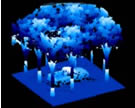
DID has covered the potential capabilities and value of LIDAR/LADAR in June 2005, including its ability to see through cover and create 3-D pictures; UAV LIDAR research has also extended to maritime UAVs. Especially astute readers might also recall our coverage of Lockheed’s September 2005 merger with LIDAR specialist Coherent Technologies, in order to create a laser radar center of excellence.
Those trends came together in May 2006, and the PILR R&D award has now morphed into a new surveillance turret from Lockheed that could give them a real edge in the electro-optical market for UAV, helicopter, and aircraft systems.

(click to view full)
A May 24, 2006 DefenseLINK announcement noted that Lockheed Martin Corp. in Grand Prairie, TX had received a $7.8 million cost-plus-fixed-fee contract modification for the Predator Imaging Laser Radar (PILR) program, which demonstrates a 3-dimensional imaging laser radar sensor. Work will be complete by May 2009. The Air Force Research Laboratory, Wright-Patterson Air Force Base, OH issued the contract (F33615-01-C-1419/P00010).
The program was intended to demonstrate that a LIDAR sensor can be produced in a size and weight that’s compatible with a UAV, while maintaining sensor performance that meets mission requirements for a combination attack and surveillance craft like the Predator (whose shift from RQ-1 to MQ-1 reflects its multi-role nature).

(click to view full)
Now an August 1, 2006 release from Lockheed touts a $7.8 million AFRL award along with its new Real-time Active Imaging in 3-D at Extended Range (RAIDER) multi-sensor system. A query to Lockeed confirmed that this is the same May 2006 award.
RAIDER uses 20-inch turret that will still fit a medium sized UAV, and includes an enhanced Forward Looking Infrared (FLIR) system and TV camera. It also includes an upgraded Laser Detection and Ranging (LADAR) capability, which offers high-resolution, three-dimensional target imaging for military and civil uses.
Lockheed claims that the improved LADAR in RAIDER allows the system to see over twice as far as the original PILR’s 15-inch turret, and fly at higher altitudes while mapping terrain. They also note that the new RAIDER turret offers “vastly enhanced image quality” over PILAR, improves the speed at which the imagery is processed and transmitted, and can cover significantly wider search areas on the ground. Both of these LADAR/LIDAR systems can be operated in various modes, ranging from long-range search, detection and identification to high resolution terrain mapping mode.
Except for the lack of a laser designator and possibly GPS coordinate designation, RAIDER seems to have everything one would expect to find on a conventional military surveillance turret. The ability to undertake wide-area searches and identify targets partially obscured by camouflage or foliage, however, will give Lockheed’s products a strong edge over competitors that lack LADAR/LIDAR capability. Especially since the other capabilities are known systems and can be engineered in if Lockheed wishes.
In its August 1, 2006 release, Lockheed made it clear that they were touting their LADAR/LIDAR capabilities, and throwing down the gauntlet to competitors. References to “Lockheed Martin’s extensive LADAR portfolio” were coupled with a note that:
“Lockheed Martin has a family of proven LADAR sensors that range from very short-range navigation systems to missile seekers to long-range reconnaissance assets.”
If LIDAR/LADAR really is the next frontier in the growing military electro-optics market, Lockheed Martin appears to be ready to compete.