

have a bad day
Boeing Co. subsidiary McDonnell Douglas Corp. received an $18.5 million contract modification to exercise Lot 1 Option for Small Diameter Bomb Increment I (Fixed/Stationary Target) Low Rate initial Production for munitions, carriage, and associated trainers and technical support.
The GBU-39 Small Diameter Bomb (SDB) is considered one of the most significant programs on the books because it will dramatically increase the strike capability of every combat aircraft in the U.S. inventory. This 250 pound guided weapon has the same penetration capabilities as a 2000lb BLU-109 thanks to its length to diameter ratio, smart fuse and nose shape, demonstrating penetration of more than 6 feet of reinforced concrete with only 50 pounds of explosive.
The fixed/stationary target version is INS/GPS guided like the JDAM, giving the winged bomb a range of up to 60 km and an accuracy rating of just 5-8m CEP. The size and accuracy of SDBs allows aircraft to carry more munitions to more targets, and strike them more effectively with less collateral damage. Because of its capabilities, the system is an important element of the U.S. Air Force’s Global Strike Task Force.

(click to view full)
Follow-on SDB integration may occur with the F-16 (Block 30/40/50), F-117, A-10, B-52, B-1, and B-2, as well as the forthcoming F/A-22 Raptor and F-35 Joint Strike Fighter. The B-2 is set to carry between 64 and 216 SDBs on one mission; at the other end of the scale for manned aircraft the F/A-22 would carry just 8. The SDB is also a potential weapons load for the MQ-9 Predator B and X-45 UCAV drones, as well as standoff carrier vehicles such as Tomahawk cruise missiles, JSOW and JASSM missiles, and even Conventional ICBMs.
The overall SDB program could be worth as much as $2.7 billion, including development and future orders. It has also been the subject of some controversy as a result of the Boeing procurement scandals.
Bethesda, MD-based Lockheed Martin has argued that Boeing’s victory over it for the initial SDB development contract was tainted by Darleen Druyun, an ex-Air Force weapons buyer who admitted at her Oct. 1 sentencing to having steered billions of dollars in business to Boeing before taking a $250,000-a-year VP job there in December 2002.
In a Feb. 18, 2005 decision, the Congressional Government Accountability Office (GAO) sustained Lockheed’s protest. It found Druyun had played a role in a process that led to changes in the bomb’s technical requirements and the deletion of related evaluation criteria. The GAO recommended the Air Force conduct a competitive procurement for the program’s $1.7 billion second phase, which will produce a weapon that can seek and hit mobile targets as well. That second phase had previously been awarded to Boeing and Northrop-Grumman.
(click to view full)
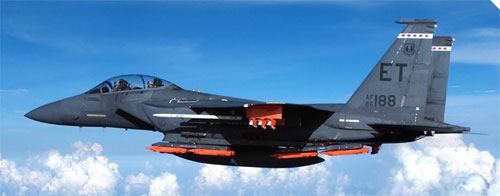
For this LRIP contract, Boeing said it would produce 201 SDBs and 35 weapons carriages, which will be mounted on Boeing F-15E Strike Eagles in 2006. This work will be complete September 2006. The Air Armament Center at Eglin Air Force Base, FL issued the contract (FA8682-05-C-0132).
See also:
* UPDATE: DID (Sept 20/05) – USA Reopening $1.7B SDB Phase II Procurement.
* GlobalSecurity.org – GBU-39 Small Diamater Bomb/ Small Smart Bomb. Includes details of the program’s history.