

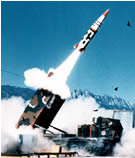
Lockheed Martin Corp. in Grand Prairie, TX received a $79.4 million modification to a firm-fixed-price contract for Block IA Army TACMS Variants (Unitary) XM57 Guided Missile and Launching Assembly.
Fired from the MLRS modified M270 launcher (2 missile capacity) or M142 HIMARS launcher (1 missile), Army TACMS is designed for deep attack of enemy second-echelon forces at ranges beyond that of current cannons and rockets. The extended range Army TACMS Block IA operates at range up to 300 km in near all-weather conditions, approximately twice the range of its Block I predecessor. The systems can operate day or night, and is air transportable by C-17 or, in the case of the HIMARS, by C-130. The Block IA missiles use an inertial system plus GPS to guide them accurately over the target area. Each TACMS missile replaces 6 of the launcher’s normal payload of 227mm rockets, with ranges from 32-70 km.
While the normal TACMS Block IA is armed with 300 dual purpose M74 bomblets dispensed from the warhead section, the Unitary Block IA replaces the M74 submunitions with a 500-pound unitary warhead. This warhead reduces collateral damage likelihood, while making it possible to attack hardened targets such as fortifications and bunkers deep inside enemy territory. The Block IA Unitary missile with its improved guidance system will be capable of flying over obstacles, such as mountainous terrain and buildings, and then dive vertically to better engage its intended target. The angled descent feature is specially well suited to perform engagements in urban environments.
The ATACMS ballistic missile was employed for the first time in 1991 during the Gulf War military campaign in Kuwait and Iraq. Block IA Unitary missile was combat proven during operation Iraqi Freedom in 2003.
Lockheed-Martin received a $45 million contract for production of ATACMS Block IA Unitary missiles for the US Army on February 7/05. These missiles were the first equipped with the new guidance, control and fuse systems together. On April 13/05, Lockheed-Martin successfully tested ATACMS Block IA Unitary with an upgraded guidance and control system and new flight software for the second time at White Sands Missile Range, NM. This test validated the new upgraded components and software for the 2005 production line of ATACMS Block IA Unitary.
The US Army has also made public news that it’s pursuing a new multi-mode warhead with three fuse options for the ATACMS beginning in FY 2006, and the BROACH multi-stage blast/fragmentation and penetration warhead has also begun initial tests as a candidate payload.
Work on this 79.4 million ATACMS Block IA Unitary missile contract will be performed in Dallas, TX and is expected to be complete by Dec. 31, 2007. This was a sole source contract initiated on Nov. 7, 2003 by the U.S. Army Aviation and Missile Command at Redstone Arsenal, AL (DAAH01-03-C-0203).