

not DARPA
(click for more)
A February 2008 Pentagon DefenseLINK story touted the progress of prosthetic limb development, fueled by a combination of combat need and the steadily advancing capabilities inherent in modern electronics and robotics. Army Col. Geoff Ling manages DARPA’s Revolutionizing Prosthetics programs.
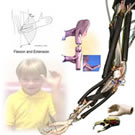
For instance, researchers at Dean Kamen’s DEKA Research and Development Corp. in Manchester, NH (inventors of the Segway, the stair-climbing iBot wheelchair, and those PowerSwim fins that I want), have developed a “strap-and-go-arm” that requires no surgery, just 1-2 hours of training. The process of picking up a pen, key, coffee cup, or power drill obviously differs. Embedded electronics in DEKA’s arm enable the wearer to activate a switch with a foot or chin, to cycle through 5 different gripping actions to match the task at hand. One tester who lost his arm at the shoulder was reportedly able to field strip and reassemble an M-16 rifle using the prosthesis, which comes in 3 models: [1] amputees who have lost a complete arm, [2] amputations above the elbow, and [3] amputations below the elbow. See a picture here.
A recent program begins the first large-scale testing of an advanced artificial arm that can pick up a key or hold a pencil…
By early 2008, the US Department of Veterans Affairs, the National Institute of Health and the Food and Drug Administration had all shown interest in the program. They were expected to join forces with the Defense Department in the months ahead, and getting a governmental agreement in place would be a big step forward to getting the devices mass-produced.
DEKA Follow-ons

May 29/09: The Department of Veterans Affairs (VA) announces a 3-year study, marking the first large-scale testing of of an advanced artificial arm that easily allows those with severe limb loss to pick up a key or hold a pencil. Veterans fitted with the arm will provide feedback to refine the prototype, before it is commercialized and made generally available through the VA health care system. Dr. Linda Resnik at the Providence, RI, Veteran’s Affairs Medical Center will direct the study, in collaboration with DARPA.
This arm’s control system uses an array of sensors embedded in a shoe; wearers maneuver the arm by putting pressure on different parts of the foot. The current version uses wires, but future versions will be wireless, and can also be adapted to work with other control systems like in-body myoelectric switches. The V.A. release adds:
“Frederick Downs Jr., director of VA’s Prosthetic and Sensory Aids Service who lost his left arm during combat in Vietnam, said he was “brought to tears” recently when the prosthetic arm allowed him to smoothly bring a water bottle to his mouth and drink. “Learning to use the controls is not difficult,” he said, due in part to a sensor in the artificial hand that sends a vibration signal that tells how strong the grip is. A stronger grip causes more vibration.”
Feb 20/09: DEKA Integrated Solutions Corporation in Manchester, NH a $7.1 million cost-plus fixed-fee contract to refine a novel upper extremity prosthetic device to meet the needs of injured soldiers, and to pursue Food & Drug Administration approval for the final medical device.
Work is to be performed at Manchester, NH, with an estimated completion date of Feb 8/ 2011. One bid was solicited and one bid received by the U.S. Army Research Office, Research, Development & Engineering Command Contracting Center – RTP Division in Triangle, NC (W911NF-09-C-0035).
Other Projects

Johns Hopkins University is working on a device that connects into the peripheral and central nervous systems under Revolutionizing Prosthetics 2009; a Phase 2 contract is expected. Read “Defense Agency Makes Big Advances in Prosthetics Research” for more, and see also WIRED’s feature on the JHU project: “The World’s Most Advanced Bionic Arm.”
See also DID’s coverage of one sub-program: “Johns Hopkins Working to Develop A Mechanical Human Arm.”