

(click to view full)
Satellites are currently big, expensive to build and launch, vulnerable, impossible in practice to upgrade on-orbit, difficult to replace – and critical to military effectiveness. That’s a really bad combination. Now add program risk and cost inflation driven by those issues, as the military tries to launch the most advanced technologies it can, in a uniquely ‘no fail’ environment.
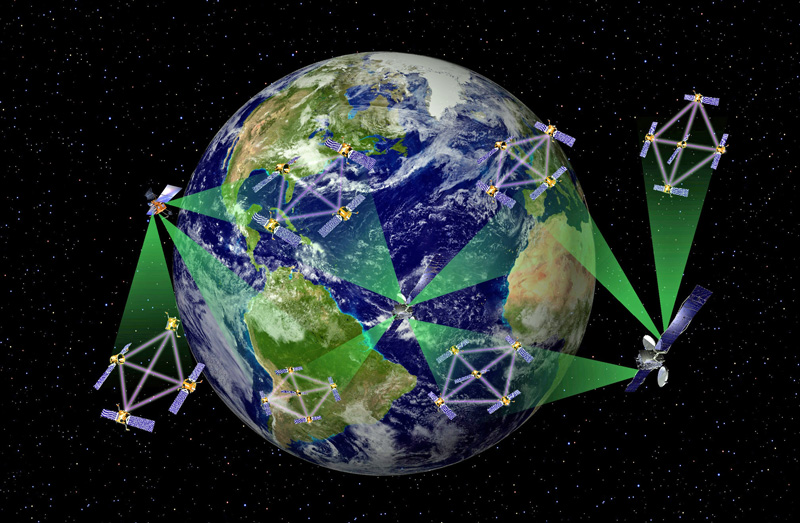
DARPA’s System F6 program aims at nothing less than a revolution in satellite technology, aimed at removing those constraints. If successful, it will develop and demonstrate the basic building blocks of a totally new space architecture, in which traditional integrated satellites are replaced by clusters of smaller, cheaper, wirelessly-interconnected space modules that form a “virtual” satellite.
* Fractionated Space: The F6 Program [updated]
* Contracts and Key Events [updated]
* Additional Readings [updated]
Fractionated Space: The F6 Program

(click to view larger)
The F6 program rides on a number of trends, including the rapidly changing face of computing, and a steady rise in mini and micro-satellites. System F6 will partition the tasks performed by a large satellite (power, receivers, control modules, etc.) and assign each task to a dedicated micro-satellite. By working together in a cluster, the idea is that the cluster would provide the same overall capability.
By allowing the various functions of a spacecraft to be developed and launched separately, this type of “fractionated” system reduces overall program risk, provides budgetary and planning flexibility, speeds initial deployment, offers greater survivability – and allows future technologies to build on existing efforts, in order to create something totally new. We’re used to that when it comes to terrestrial systems, but it wasn’t always so. DRAPA is hoping that F6 can bring the same kind of creativity explosion to space.
Teams from Orbital Sciences, Boeing, Lockheed Martin Space Systems, and Northrop Grumman Space and Mission Systems won DARPA Phase 1 contracts in 2008.
That was narrowed to a single Phase 2 team winner in October 2009: Orbital Sciences’ team.
Phase II
Orbital’s industry partners include IBM, NASA’s Jet Propulsion Laboratory, Georgia Institute of Technology, SpaceDev, and Aurora Flight Sciences.
In this next phase of the System F6 program, the team will develop the detailed design of the spacecraft modules, ground elements and launch options; a hardware-in-the-loop test-bed ground demonstration with new technology prototypes; and release of an F6 Developer’s Kit, which will allow third-parties to design compatible fractionated modules.
That’s important because the program also has an explicit objective to supply infrastructure capabilities to 1 or more independent payload spacecraft supplied by a mission partner; an RFI to that effect is now in the works, and that partner’s needs seem likely to affect the F6 test’s orbital profile as either a Geosynchronous or Low-Earth launch.
Phase 3 will reportedly take the F6 concept from engineering development to production flight units. Phase 4 is the on-orbit demonstration.
The 3 DARPA-provided F6 infrastructure modules will provide the following resources to the networked cluster: mission payload processing via distributed spacecraft computing systems, high-bandwidth X-band downlink, persistent high-availability ground communications via a commercial GEO communications spacecraft (for LEO missions only), navigation (GPS for low-earth orbits, relative reference for geosynchronous orbits), solid-state data storage, and selective cluster-level redundancy of certain spacecraft functions.
DARPA is hoping for a planned flight demonstration in 2013-2014. A series of on-orbit tests will demonstrate a number of key capabilities, including:
* Cluster reconfiguration to accommodate new spacecraft “modules”;
* The addition of new components as network-accessible resources. These first 2 capabilities are also referred to as a “virtual mission bus”, which uses a packet-switched IP network on orbit;
* Rapid defensive cluster scatter and re-gather maneuvers. that’s part of “multi-body formation flight,” which also includes collision avoidance;
* The transfer of mission-critical processes throughout the cluster, and to terrestrial network nodes.
System F6 incorporates most key technology development in an “open source” format, a new and radical concept in spacecraft systems. All software source code, interfaces, standards and operating systems will be available to everyone, including the public. This will eventually allow any interested 3rd party to develop modules compatible with the existing F6 spacecraft network.
Contracts and Key Events

April 26/10: In FedBizOpps RFI #DARPA-SN-10-44, the agency solicits 3rd party participation in the F6 cluster, as a way of testing the concept on-orbit. Benefits to the 3rd party could include improved fault tolerance, expanded processing capabilities, and high-bandwidth communications links via the rest of the F6 cluster. The tests would take place in 2013-2014, and the needs of that 3rd party module seem poised to affect the F6 experiment’s launch profile into either Geosynchronous or Low-Earth Orbit. They might even affect the cluster’s long-term use.
Any such 3rd party module will need to incorporate an F6 Technology Package (F6TP) of technologies, components, and algorithms to enable real-time distributed resource sharing and semi-autonomous multi-body cluster operations. An F6 Developer’s Kit (FDK), consisting of a standards document, a complete set of interface definitions, a set of open-source software, and reference hardware designs for third parties wishing to develop their own F6TP, will also be available in increasingly higher-fidelity versions over the course of the 2010 calendar year, with a final version available in the first quarter of calendar 2011. DARPa adds that:
Dec 4/09: The Defense Advanced Research Projects Agency (DARPA) awards a $74.6 million, 1 year contract to Orbital Sciences’ team for Phase 2 of the System F6 (Future, Fast, Flexible, Fractionated, Free-Flying Spacecraft) fractionated spacecraft demonstrator program. The team will develop a detailed system design, complete the majority of software development, deliver additional iterations of the hardware-in-the-loop testbed to include breadboard implementation of critical hardware, and conclude with a Critical Design Review. DARPA Awards Contract for Detailed Design of Fractionated Spacecraft Program“>DARPA release [PDF] | Orbital Sciences release.
Feb 26/08: The Defense Advanced Research Projects Agency (DARPA) announces the full set [PDF] of 4 contracts for Phase 1 of the System F6 (Future, Fast, Flexible, Fractionated, Free-Flying Spacecraft) fractionated spacecraft demonstrator program. Contracts include:
* $12.9 million to Team Boeing in Huntington Beach, CA; incl. L3 Communications, Millennium Space Systems, Octant Technologies, and Science Applications International Corp. ($12.9 million)
* $5.8 million to Team Lockheed Martin Space Systems in Palo Alto, CA; incl. Aurora Flight Sciences, Colbaugh & Heinsheimer Consulting, Vanderbilt University, and Lockheed Martin Integrated and Global Systems
* $6.2 million to Team Northrop Grumman Space & Mission Systems in Redondo Beach, CA; incl. Alliant Tech Systems, Aurora Flight Sciences, Juniper Networks, L3 Communications, BAE Systems, Cornell University, Jet Propulsion Laboratory, Massachusetts Institute of Technology, University of Southern California, and University of Virginia
* $13.6 million total to Team Orbital Sciences in Dulles, VA; incl. IBM, NASA’s Jet Propulsion Laboratory, Georgia Institute of Technology, SpaceDev, and Aurora Flight Sciences
Feb 19/08: Orbital Sciences Corp. in Dulles, VA wins a $7.4 million cost plus fixed fee completion contract for research, development, design and testing to support Defense Advanced Research Project Agency’s System F6 (Future, Fast, Flexible, Fractionated, Free-Flying Spacecraft united by Information exchange) program.
Work will be completed in multiple locations including: Dulles, VA (59.97%), San Jose (22.29%) and Pasadena (13.24%), CA; Atlanta, GA (1.32%); Cambridge, MA, (2.56%); and Louisville, KY (0.62%). The estimated completion date is Feb 12/09. Bids were solicited by Broad Agency Announcement, with 6 bids received. The reporting contract office is the Defense Advanced Research Projects Agency, Arlington, VA (HR0011-08-C-0031).
Additional Readings
* DARPA – System F6 Website
* Aviation Week (Jan 7/10) – Darpa Pursues On-Orbit Networking
* AFA’s Air Force Magazine (September 2009) – Game Changers [PDF]
* DARPA (November 2009) – Acquiring Space Systems in an Uncertain Future
* Aviation Week (Sept 30/09) – DARPA Sat Project Could Change Industry
* DARPA (September 2009) – Value-Centric Design Methodologies for Fractionated Spacecraft: Progress Summary from Phase 1 of the DARPA System F6 Program [PDF]
* DARPA (September 2008) – Application of Value-Centric Design to Space Architectures:
The Case of Fractionated Spacecraft [PDF]
* DARPA (Feb 26/08) – DARPA Awards Contracts for Fractionated Spacecraft Program [PDF]
* DARPA (September 2006) – The Value Proposition for Fractionated Space Architectures [PDF]