
COBRA GOLD 1997
(click to view full)
Thailand’s extensive territories, unrest on its borders, and placement in a zone prone to natural disasters all make helicopters a critical aspect of its military capabilities. About 50 Vietnam-era UH-1H Hueys and similar Bell 212/412s twin-Hueys form the bulk of its force, and a small detachment of S-92 Superhawks serve as transports for the Royal Family, but Thailand needs new helicopters. Unfortunately, newer machines must be bought via Thailand’s limited defense budget and much smaller aid grants, instead of arriving as part of a flood of war-related aid.
Thailand began its efforts by buying a handful of H-60 family helicopters, but rather than standardize, they’re buying a widening variety of helicopters in very small lots. This article chronicles the timeline of Thai requests, buys, and deliveries since 2003.
Thailand’s New Fleets
(click for video)
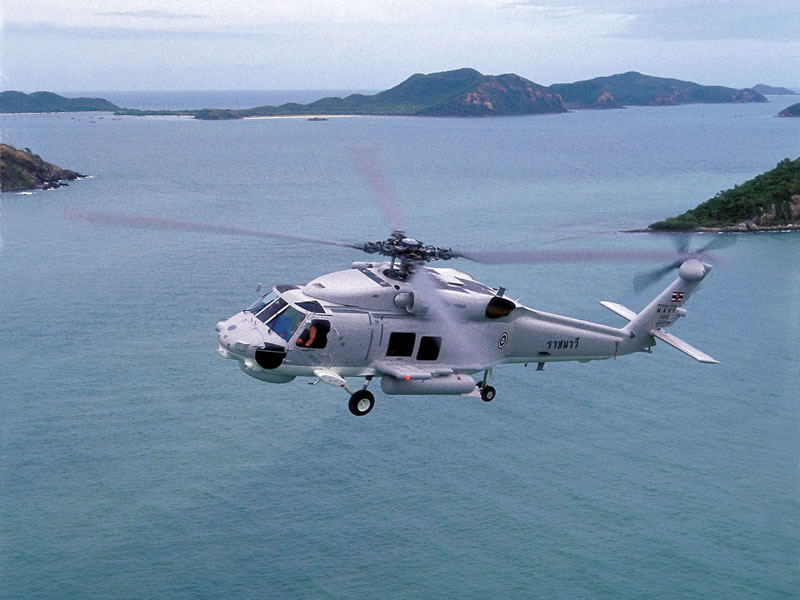
Thailand’s small aircraft carrier HTMS Chakri Naruebet [CV911] carries a contingent of 6 S-70B (SH-60B) Seahawk surveillance and utility helicopters. The navy recently added 2 new Sikorsky MH-60S naval utility helicopters to complement the older S-70Bs, and Thailand’s 6 S-76 search & rescue machines. The navy also operates 2 AgustaWestland Super Lynx 300 anti-submarine helicopters.
The question is why Thailand has moved to fragment their fleet so badly in small lots, with different requirements for spares, training, and support. In some countries, the simple answer would be corruption and payoffs from the orders and the support contracts. In others, extreme regional or factional autonomy can drive widely varying buys. We can’t speak to Thailand’s internal rationale, and the Thais haven’t discussed it in reports, so we’ll just present their buys.
(click to view full)
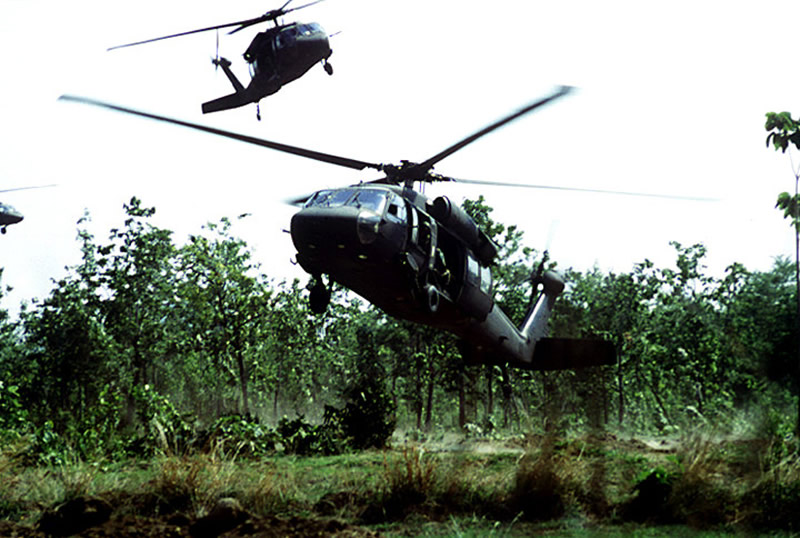
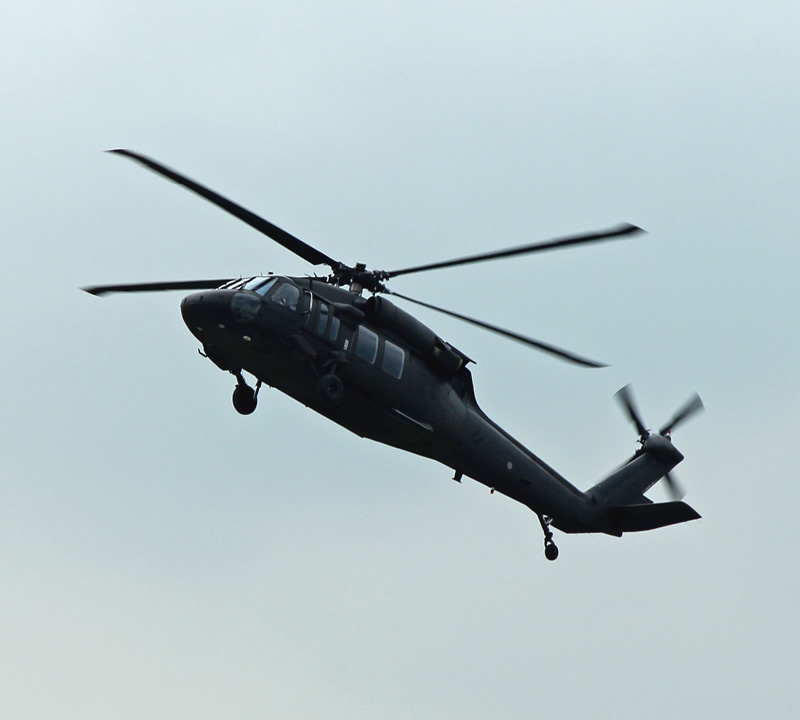
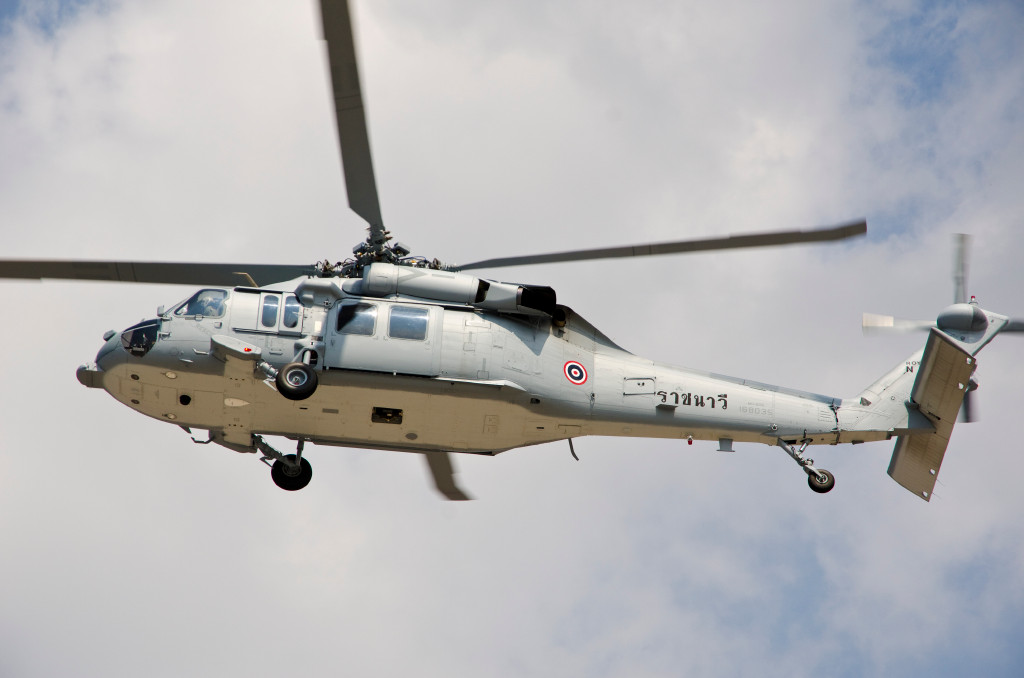
Medium Utility: The Army reportedly had 5 S-70A-43 (UH-60L) Black Hawks left in service, before recent deliveries expanded their fleet again. Thailand has official requests and orders in place for more UH-60Ls and for upgraded UH-60M Block Hawks, but even if all of them end up in Thailand, it will still be a small force compared to the retired Hueys. The Black Hawks share significant commonalities with the Navy’s S-70s and MH-60S Seahawks, and the whole set can be thought of as a single family of helicopters.
A 2008 buy of 6 Russian Mi-17s was a cheaper way to quickly supplement Thailand’s dwindling helicopter inventory, providing similar capabilities to the Black Hawks in a larger but less expensive machine.
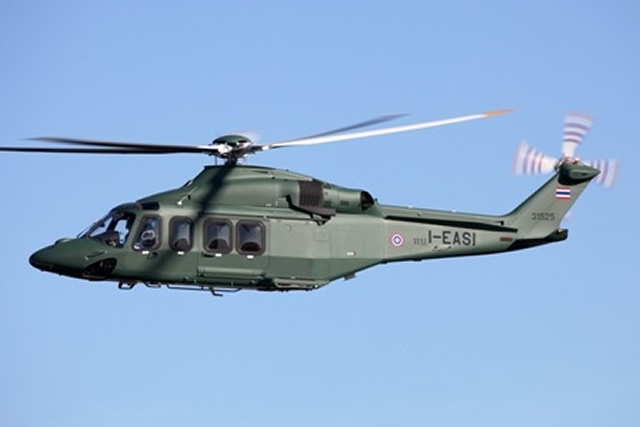
Finally, Thailand bought 2 AW139 light-medium utility helicopters in October 2012. The AW139 is used by commercial operators in Thailand, including its offshore oil and gas industry. Official announcements cite “transport and utility missions”, but they already have several medium helicopters in those roles. Which raises the question: what induced the generals to buy a whole new type? There are suggestions that the AW139s are filling a VIP niche for times when Royal Flight S-92s aren’t an option, but that seems like a really good way to highlight high value military targets.
Specialty: The Black Hawk family’s HH-60M was passed over for Thailand’s Search And Rescue role, in favor of the more expensive Eurocopter EC725’s size, capacity, and range. The Air Force has now ordered 6, and neighboring Malaysia and Indonesia also operate EC725s in this role.
(click to view full)
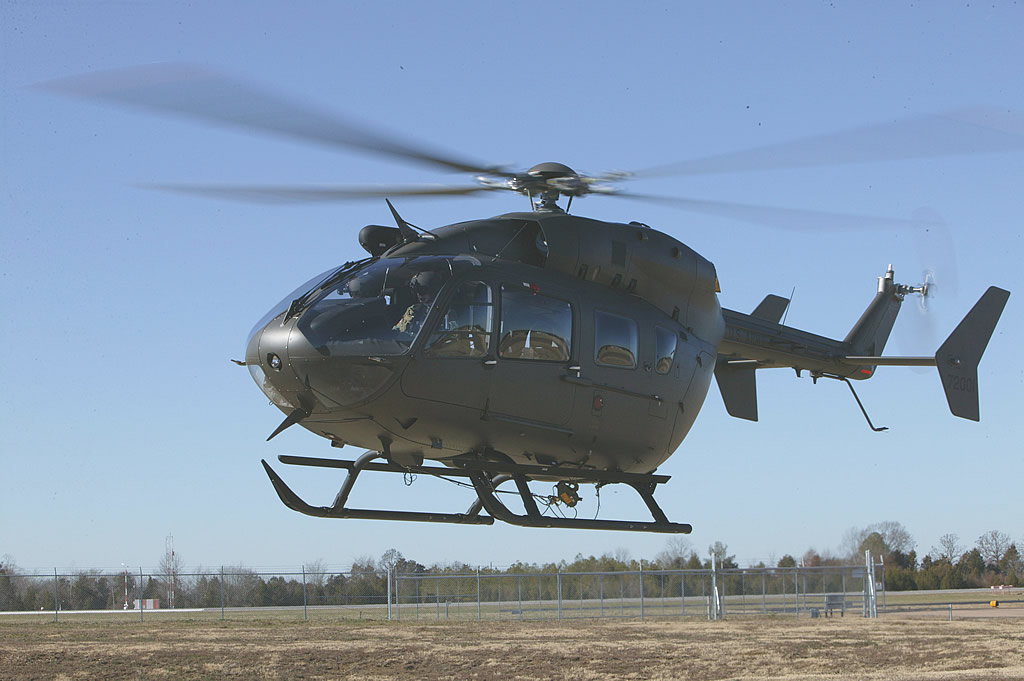
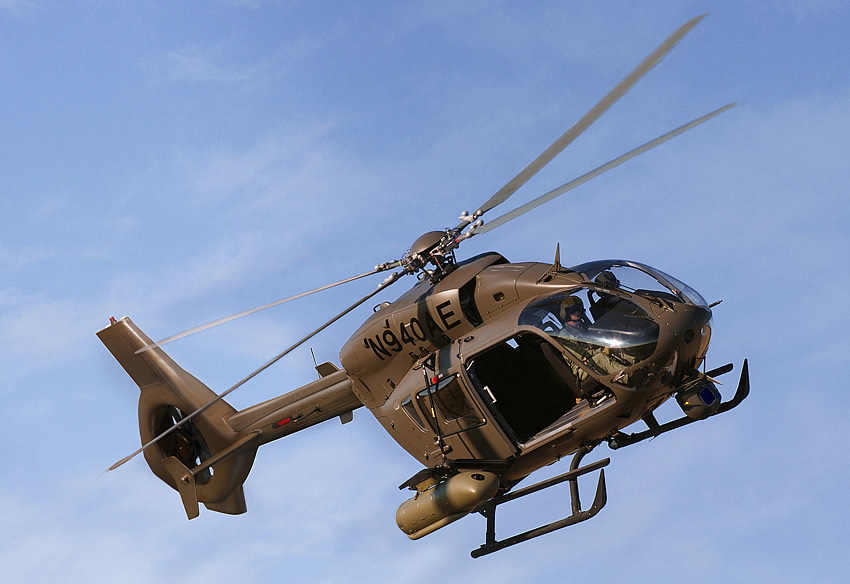
Light utility: For non-combat light utility roles, Thailand is buying Airbus UH-72A/ EC145 light utility helicopters, which sit between the AS550 and AW139 in size and capabilities. The new machines offer rear clamshell doors and quick-change kits that make them very well suited for special duties like MEDEVAC, and for VIP flights that don’t require the Royal Guard’s S-92s or Bell 412 twin-Hueys. The USA uses the Lakotas as in-country supplements that free up UH-60 Black Hawks for heavier tasks, and Thailand could use them in the same way.
Then again, Thailand could also use Fennecs or AW139s for these purposes. The Thais seem to like the UH-72s, though, and have placed additional requests that seem to position the UH-72 as a future mainstay. Not only has the Army expanded its requested orders to 15, the Navy has bought the related EC645-T2 for light utility, gunship and patrol roles.
The Royal Thai Army’s existing handful of Schweizer S-300Cs are just small observation helicopters that can’t perform utility or armed scout roles.
click for video
Armed Scout: Thailand’s UH-1H/ Bell 212 Huey fleet is aging out, but it still forms the backbone of that country’s current helicopter lift. More powerful H-60 family helicopters are beginning to replace them, but the new machines’ cost is also pushing Thailand to adopt smaller helicopters that cost less to buy and operate.
The Army bought 8 of Eurocopter’s AS550 Fennec helicopters for light utility and armed scout duties, after the Cabinet approved the purchase in late 2011. Their civil AS350 Ecureuil counterpart is already in local commercial use.
The Navy bought 5 EC645-T2s for this role, which are armed and militarized derivatives of the EC145/ UH-72A Lakotas purchased by the Army. It was originally developed by Airbus and Lockheed Martin for the now-canceled American Armed Aerial Scout competition.
If the Thais need heavier firepower, they have a handful of AH-1F Cobra attack helicopters. Meanwhile, the Fennecs and EC645s fill a light gunship niche that other models can’t. Sikorsky sells armed Black Hawk kits, but offers nothing in this lighter and less expensive weight class. More sophisticated Super Lynx helicopters similar to those used by the Navy would have been very suitable in this role as well, but they’d also cost more.
Contracts & Key Events
2013 – 2015
(click to view full)
October 14/15: Thailand has awarded a follow-up order to AgustaWestland for eight more AW139 helicopters to supplement the two currently in service. The first two helicopters were delivered February 2014 following a contract in October 2012 and are thought to be employed in a VIP transport capacity. The eight new AW139s are slated for delivery next year. Thailand operates a fragmented helicopter fleet, including various US, European and Russian models.
Oct 22/14: RTAF/Navy buys. Thailand signs a deal with Airbus Helicopters (formerly Eurocopter) for 2 helicopter types. Amounts aren’t announced.
The RTAF’s 2 ordered EC725s will be operated in the same Search and Rescue role as their existing fleet of 4, bringing the total fleet to 6.
The Navy’s 5 ordered EC645-T2s are a close relative of the Army’s UH-72A Lakota. The electronics and fenestron rotor tail are very different, but there are substantial commonalities elsewhere. The Thais are this type’s 2nd customer, after the EC645-T2/ AAS-72X was developed by Airbus and Lockheed Martin for the recently-canceled American Armed Aerial Scout helicopter competition. Germany was the type’s 1st customer, ordering 15 for their KSK special forces in 2013. Sources: Airbus Helicopters, “The Royal Thai Navy and Air Force acquire five EC645 T2 and two EC725 rotorcraft from Airbus Helicopters”.
2 RTAF EC725-SAR, 5 Navy EC-645-T2
Sept 29/14: DSCA – UH-72 request. The US DSCA announces Thailand’s official export request for up to 9 UH-72A Lakota Helicopters, an Aviation Mission Planning Station, plus warranty, spare and repair parts, support equipment, communication equipment, publications and technical documentation, personnel training and training equipment, and other Government and contractor support.
The estimated cost is up to $89 million, and the principal contractor will be EADS North America in Herndon, VA. Implementation of this proposed sale will require 10 contractor representatives to travel to Thailand for a period of five weeks for equipment deprocessing/fielding and system checkout.
Thailand has already requested (q.v. June 20/13) and ordered (q.v. March 28/14) 6 UH-72As, alongside 8 A550 Fennes and 2 AW139s. Turning this request into a contract would make 15, which would seem to indicate that the UH-72A is emerging as Thailand’s preferred light helicopter below their H-60s and handful of Mi-17 medium helicopters. The Fennecs, meanwhile, fill more of an armed scout role, which the UH-72 can’t play without extensive conversion. Sources: US DSCA #14-27, “Thailand – UH-72A Lakota Helicopters”.
DSCA request: Army UH-72A (9)
March 28/14: UH-72s. EADS-NA in Herndon, VA receives a $34 milllion contract modification to sole-source, foreign military sales contract for 6 UH-72A Lakota helicopters with AN/ARC-231 radios, the Mission equipment package, and environmental control units to deal with Thailand’s heat.
All funds are committed immediately. Work will be performed in Columbus, MS, and is estimated to be complete by April 3/15. US Army Contracting Command in Redstone Arsenal, AL manages the contract on Thailand’s behalf (W58RGZ-06-C-0194, PO 0772).
6 Army UH-72As
Feb 11/14: AW139. AgustaWestland announces that Thailand’s Army has taken delivery of its 2 AW139s (q.v. Oct 8/12). Thhey will reportedly be used as VIP platforms.
The AW139 is used by commercial operators in Thailand, including its offshore oil and gas industry. The release says that Thailand’s military plans to use them for “transport and utility missions”, and doesn’t mention a VIP role directly. Which leaves the question: what induced the generals to buy a whole new type for that? Among other things, it’s terrible for OPSEC as a dead giveaway if used for military VIPs. Sources: AgustaWestland, “Royal Thai Army Takes Delivery of Two AW139 Helicopters”.
AW139s delivered
June 20/13: DSCA – UH-72 request. The US Defense Security Cooperation Agency announces [PDF] Thailand’s formal request for 6 ready-to-fly UH-72A Lakota Helicopters, communication equipment, an Aviation Mission Planning Station, plus spare and repair parts, support equipment, publications and technical documentation, personnel training and training equipment, and other forms of contractor and government support. The estimated cost is up to $77 million.
It’s part of an effort by Thailand to add a new light utility helicopter to its fleet, and would represent the UH-72A’s 1s export order, but the base EC145 has been exported to a number of other countries already.
If the UH-72A gets a contract, the principal contractor will be EADS North America, in Herndon, VA. Implementation will require U.S. Government or contractor representatives in Thailand for a period of 5 weeks for equipment de-processing/fielding, system checkout and new equipment training; plus a Contractor Furnished Service Representative (CFSR) for a period of 1 year.
DSCA request: Army UH-72A (6)
May 8/13: +1 UH-60M. Sikorsky in Stratford, CT an $11.4 million firm-fixed-price contract modification, to buy 1 UH-60M base helicopter and related equipment for Thailand. The cumulative total face value of this multi-year contract is $4.819 billion, but Thailand is an incidental player.
Note that this sum is less than half of the Pentagon’s stated fly-away cost for UH-60Ms, which means the announcement isn’t the full contract value. US Army Contracting Command in Redstone Arsenal, AL manages the contract on behalf of their FMS client (W58RGZ-12-C-0008, PO 0055).
1 Army UH-60M
April 8/13: Delivery. Another 3 UH-60L/S-70 helicopters arrive at the port of Laem Chabang.
3 UH-60Ls delivered
March 21/13: UH-60Ms. Sikorsky, Stratford, CT receives a $26.9 million firm-fixed-price contract modification to convert “green” UH-60Ms from the production line to Thai specifications, and to provide associated services for the Royal Thailand Army as they bring the new type into their fleet.
Numbers weren’t announced, but Thailand has a Letter of agreement for 2 machines (q.v. July 9/12), which is the most likely connection to this contract. Official export requests are in place for up to 5 more UH-60M helicopters (q.v. July 25/12 and July 13/11).
Work will be performed in Stratford, CT with an estimated completion date of April 30/16. One bid was solicited, with 1 bid received by the Thai Army’s FMS agent: US Army Contracting Command in Redstone Arsenal, AL (W58RGZ-12-C-0008).
2? Army UH-60Ms
2011 – 2012
(click to view full)
Oct 26/12: Media reports say that the Pentagon has offered to sell Thailand 1,150 Humvees used in military operations in Iraq, 3 Black Hawk helicopters (type unspecified) for the army, 5 used F-16s for the RTAF, and 2 used FFG-7 Oliver Hazard Perry Class frigates for the navy. That’s not an official export case yet, but the offer was described as “amicable.” Bangkok Post.
Oct 8/12: AW139s. AgustaWestland announces that the Royal Thai Army has signed a contract for 2 AW139M twin-engine utility helicopters, to be delivered in 2014. The contract includes a comprehensive maintenance and training package.
Unlike the UH-60, the AW139 is a popular civil helicopter, with over 500 in service in roles that include police, rescue, and offshore supply. The AW139 offers a cruise speed of 165 knots/ 306 kph, a range in excess of 500 nm/ 927 km, endurance of 5 hours, and a cabin that can accommodate up to 15 passengers, with a 3.4 cubic meter/ 120 cubic foot baggage compartment. Carrying and sling load capacities are lower than the Black Hawk, but both sit in the medium helicopter class. The helicopters are meant for VIP duties that don’t require the Royal Flight’s S-92s, but they represent further fragmentation of Thailand’s utility helicopter fleets. Those fleets now include various Hueys, plus tiny fleets of UH-60s, Mi-17s, and AW139s.
2 Army VIP AW139s

(click to view full)
Sept 17/12: Eurocopter for SAR. Thailand’s Air Force signs a contract with Eurocopter for 4 search and rescue helicopters. The twin-engine EC725 Cougar features a unique digital 4-axis autopilot, which is very useful for precise positioning during retrievals. It’s also a good deal larger than the Army’s H-60 Black Hawks and UH-1 Hueys, with seating on board for up to 25 persons.
The purchase follows a 2011 Thai Army buy of 8 Eurocopter AS550-C3 Fennec scout helicopters, and sends clear notice that Sikorsky will face competition from Europe, as well as from Russia. Based on contracts elsewhere, a price of around $180-220 million seems likely for this buy. Deliveries will take place in 2015, at which point Thailand will join their neighbor Malaysia and Singapore as local military operators of the Super Puma family.
4 RTAF EC725s for SAR
July 25/12: UH-60M request. The US Defense Security Cooperation Agency announces [PDF] Thailand’s request to buy 4 UH-60M Black Hawk Helicopters, 10 T700-GE-701D Engines (8 installed and 2 spares), plus warranties, support equipment, spare and repair parts, training, and support. The estimated cost is $235 million, but exact costs will depend on a negotiated contract.
The principal contractors will be Sikorsky in Stratford, CT (helicopter) and General Electric Aircraft Company in Lynn, MA (engines). Implementation of this proposed sale will require U.S. Government representatives to travel to Thailand for a period of 5 weeks for equipment deprocessing/fielding, system checkout and new equipment training, plus a Contractor Furnished Service Representative (CFSR) for a period of 1 year.
DSCA request: Army UH-60M (4)
July 9/12: UH-60M. Sikorsky announces that the Royal Thai Army has signed a Letter of Offer and Acceptance (LOA) to acquire 2 UH-60Ms through the US Foreign Military Sales channel. Upon delivery, Thailand will become the first member of the Association of Southeast Asian Nations (ASEAN) to fly the UH-60M.
Thailand’s July 13/11 FMS request was for 3 helicopters, which leaves 1 more that can be bought at a later date.
2 Army UH-60M
Sept 29/11: AS550 Fennecs approved. The Thai cabinet approves the army’s THB 1.59 billion (about $51.4 million) proposal to buy 8 French-made AS550 Fennec light utility and armed scout helicopters, but the THB 2.8 billion Black Hawk helicopter procurement plan has yet to be considered by the Budget Bureau.
The purchase eventually goes through, but is not widely announced. Bangkok Post, via Defense Studies, “Thailand’s Cabinet Approves Fennec Procurement”.
8 Army AS550 Fennec armed scouts
(click to view full)
Aug 8/11: MH-60S. A pair of MH-60S Seahawk helicopters fly from Owego, NY into the Port of Baltimore, MD, for ship transport to Thailand. Once there, they’ll join an existing fleet of 6 S-70B Seahawks, and 6 marinized S-76 utility helicopters. Sikorsky adds that: “The [Thai] Navy has expressed interest in additional MH-60S purchases” for utility missions, and search and rescue duties using the standard surveillance turret, searchlight and rescue hoist.
MH-60S delivery
July 19-24/11: CRASH! Talk about your bad run for Army Aviation. An old Thai UH-1H crashed on July 16th, so they sent a UH-60 Blackhawk to recover remains etc. It crashed in challenging weather on July 19th. So they sent a UH-1N/212 twin-Huey. Which… crashed on the 24th.
Toll: 17 dead, and Thailand’s 54 UH-1Ns are now grounded.
Triple crash
July 13/11: UH-60M request. The US DSCA announces [PDF] Thailand’s official request for 3 UH-60M Black Hawk Helicopters, with 8 T700-GE-701D Engines (6 installed and 2 spares), Dual MXF-4027 VHF/UHF-AM/FM communication radios, AN/ARC-201E Export SINCGARS Airborne Radios, AN/AXP-117 CXPs (Common Digital IFF Transponder), plus other government furnished equipment, engineering changes, spare and repair parts, support equipment, publications and technical documentation, an Aviation Mission Planning Station, a Transportable Blackhawk Operations Simulator (TBOS), and other U.S. Government and contractor technical and logistics support. The estimated cost is $235 million.
The prime contractors will be Sikorsky Aircraft Company in Stratford, CT; and General Electric Aircraft Company in Lynn, MA. Implementation of this sale will require the U.S. Government or contractor representatives to travel to Thailand for 5 weeks for equipment de-processing/fielding, system checkout and new equipment training, and a Contractor Furnished Service Representative for 1 year.
The associated infrastructure and cost raises the possibility of larger plans, and there is certainly room for more utility helicopters in Thailand. The RTAF is looking to replace its UH-1 Iroquois, while large fractions of the Army’s Vietnam-era UH-1H helicopters are not mission-ready.
DSCA request: Army UH-60M (3)
2008 – 2010

(click to view full)
Aug 6/09: UH-60L request. The US DSCA announces [PDF] Thailand’s formal request to buy 3 UH-60L Black Hawk helicopters, along with their 6 T700-GE-701D engines with C controls, AN/APX 100 (V) Identification Friend or Foe Mark XII Transponder Set or a suitable substitute/commercial equivalent, internal hoist kits, plus related warranty, spare and repair parts, tools and support equipment, publications and technical data, personnel training and training equipment, and other support. Total cost could be up to $150 million, if a contract is signed. The DSCA release adds that:
“Thailand needs these helicopters to fulfill its strategic commitments for search and rescue and self-defense within the region without being dependent upon assistance from other countries. This proposed sale will upgrade its air mobility capability and provide for the defense of vital installations and close air support for ground forces.”
The principal contractor will be Sikorsky Aircraft Corporation of Stratford, CT. Implementation of this proposed sale will require the assignment of 1 contractor representative to Thailand for 2 years.
DSCA request: Army UH-60L (2)
Oct 28/08: Mi-17s. Thailand elects to order up to 6 Russian Mi-17s, despite stated desires to reduce the number of aircraft types in service. The reason? Money. See “Thais Go Russian, Buy Mi-17 Helicopters,” which quotes one Thai official as saying that:
“We are buying three Mi-17 helicopters for the price of one Black Hawk. The Mi-17 can also carry more than 30 troops, while the Black Hawk could carry only 13 soldiers. These were the key factors behind the decision.”
There’s no way we’d put 30 people in an Mi-17 in Thailand, but the core point is clear.
6 Army Mi-17s
(click to view full)
Dec 14/07: The USA negotiates its Multi-Year VII initial year (MY VII, FY 2007) contract award, under a framework worth several billion dollars over its 5-year lifetime. It covers UH-60M, MH-60S, and MH-60R helicopters, and the initial order includes Thailand’s 2 MH-60S. The bottom line is that Thailand buys its helicopters at the same price as US Navy volume orders.
June 18/07: The Royal Thai Navy becomes the first international customer to buy the MH-60S helicopter, after signing a Letter of Offer and Acceptance with the U.S. Government to purchase 2 Sikorsky MH-60S aircraft for an estimated program value of $58 million inclusive of spares, support and training. They can buy another 4 under the approved FMS announcement.
The agreement, signed by the U.S. Navy and the Royal Thai Navy, specifies delivery of the aircraft in 2009. That will eventually come about 2 years late, and until then, the Navy’s existing S-70B and S-76 helicopters will have to suffice.Sikorsky release.
2 Navy MH-60S
2003 – 2006

(click to view full)
April 7/06: MH-60S request. The US Defense Security Cooperation Agency announces [PDF format] Thailand’s request to buy up to 6 MH-60S Seahawk helicopters and 14 T700 engines (12 equipped, 2 spare), plus spare and repair parts, support equipment, publications and technical data, personnel training and training equipment, contractor engineering and technical support services and other related elements of logistics support. The total value, if a contract is signed, could be as high as $246 million.
The Royal Thai Navy (RTN) will use the helicopters in a utility role, alongside their existing and closely-related S-70B Sea Hawk helicopters. Though the Thai government’s response to recent tsunami was given very positive ratings, the event highlighted Thailand’s need to enhance its maritime defense and disaster relief capabilities. As the most modern naval utility variant of the H-60 series, the MH-60S apparently fit their requirements better than the Army-optimized UH-60Ms or the MH-60R strike and multi-role variant.
There are no known offset agreements proposed in connection with this potential sale. Implementation will require up to 10 U.S. contractor representatives for periodic short-term visits not to exceed three months for each visit. One field service representative will be available for up to 2 years in Thailand. The principal contractors would be:
* Sikorsky Aircraft Corporation in Stratford, CT (manufacturer)
* Lockheed Martin Federal Systems in Owego, NY (cockpit & avionics, systems & weapons integration, training system)
* General Electric Corporation in Stratford, CT (engines)
DSCA request: Navy MH-60S (2)
July 21/05: UH-60L. The US DSCA announces [PDF] Thailand’s formal request to buy 2 UH-60L BLACK HAWK helicopters with engines, spare and repair parts, support equipment, publications and technical data, personnel training and training equipment, contractor engineering and technical support services and other related elements of logistics support. The estimated cost is $46 million. Even though they’re S-70A/UH-60Ls, which are generally used by the Royal Thai Army, the DSCA release adds that:
“The Royal Thai Navy (RTN) requires the helicopters to fulfill utility lift requirements. This was emphasized during the heightened operation tempo during the recent tsunami search and rescue operations. The RTN intends to reduce the variety of airframe platforms in its inventory.”
When and if a contract is negotiated and the helicopters arrive, implementation will require 8 U.S. contractor representatives for 2 weeks, and 1 field service representative for up to 2 years in Thailand.
DSCA request: Navy UH-60L (2)
Nov 29/04: Sikorsky delivers 2 S-70 Black Hawks to the Royal Thai Army at a ceremony. With the delivery, the Royal Thai Army now has 5 S-70s, acquired through the U.S.Foreign Military Sales (FMS) program. The S-70 is a designation that’s sometimes used for export versions of the UH-60.
Sikorsky says they had had previously delivered 6 S-70B Seahawks for shipborne service and 6 S-76s for search-and-rescue to the Royal Thai Navy via FMS. Sikorsky release.
2 S-70s delivered
March 18/03: The US DSCA announces [PDF] Thailand’s formal request to buy 2 UH-60L BLACKHAWK helicopters with T-700 engines, 2 spare T-700 engines, M130 chaff dispenser, receivers, spare and repair parts, gun pods, tools and support equipment, publications and technical data, personnel training and training equipment, U.S. Government Quality Assurance Team (QAT), contractor engineering and technical support services and other related elements of logistics support. The estimated cost is $35 million.
“This procurement will upgrade its air mobility capability and provide for the defense of vital installations and close air support for ground forces. Thailand will have no difficulty absorbing these helicopters into its armed forces. The proposed sale of this equipment and support will not affect the basic military balance in the region.”
The principle contractor will be Sikorsky Aircraft of Stratford, CT. Implementation of this sale will require the assignment of several U.S. Government Quality Assurance Teams for 1-week intervals, twice annually, to participate in program management and technical reviews. There will be several U.S. Army National Guard Personnel, for a month, and a contractor field service representative, for 2 years, in Thailand.
DSCA request: Army UH-60L (2)
Additional Readings and Sources
* Wikipedia – Royal Thai Army.
* Wikipedia – List of equipment in Royal Thai Navy.
* AgustaWestland – AW139M.
* Army Technology – AS 550 Fennec Light Military Helicopter, France. See also Eurocopter’s page.
* Army Technology – EC645 T2 Light Utility Helicopter (LUH), France. Actually an armed scout helicopter, developed with Lockheed for the American AAS competition.
* DID – Thailand Orders Eurocopter’s EC725 for SAR Missions. Coverage moved into this article.
* Eurocopter – Cougar EC725.
* Sikorsky – BLACK HAWK Helicopter.
* Sikorsky – SEAHAWK Helicopter.
* Army Technology – S-70A Black Hawk Multi-Mission Helicopter, USA.
* Naval Technology – S-70B Seahawk – Naval Helicopter, USA.
* DID FOCUS – MH-60R/S: The USA’s New Naval Workhorse Helicopters.
* Naval Technology – MH-60S Knighthawk – Multi-Mission Naval Helicopter, USA.