

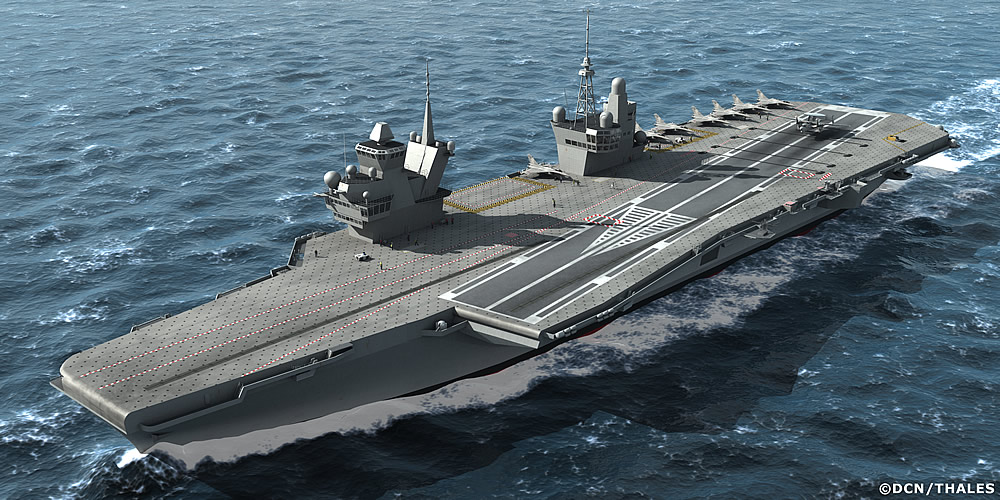
(click to view full)
Throughout most of the Cold War period, France maintained two aircraft carriers. That changed when the FNS Foch, the last Clemenceau Class carrier, was retired in November 2000 (it now serves the Brazilian Navy as the Sao Paolo). As Strategis notes, France has lacked the capacity to ensure long-distance air coverage during the FNS Charles de Gaulle’s maintenance cycles or during other periods when the carrier is not available for active duty (approximately 35% of the time). In 2015, the ship will be taken out of service for an extensive maintenance overhaul. Despite a slippage in initial construction dates from 2005 to 2007-2008, the French still hope to take delivery by 2014 so the new ship can be operational by the time their sole operational aircraft carrier goes off line for repairs.
That was the original idea, anyway. Recent developments once again cast doubt on the PA2’s future. The time for a decision was postponed to 2011, but in 2013, DCNS was still waiting, and became increasingly clear France couldn’t afford a second carrier. In fact, the firm is taking its case to the export market. Who might be interested within the next decade is unclear.
PA2: The Design & Acquisition Program

(click to view full)
The PA2 project was entrusted to the “MOPA2” (Maitrise d’Oeuvre Porte Avions No 2) consortium composed of DCN and Thales. The design was originally though to be for a ship of about 58,000t, but detailed design work pushed it up into the 74,000t range, fully 72% larger than the FNS Charles de Gaulle, before dropping it back down near the original figure at around 62,000t. Unlike the problematic nuclear-powered de Gaulle, however, the PA2 as currently envisioned will be a conventionally-powered ship with an all-electric power system driven by Rolls Royce gas turbines.
The PA2 design phase was officially launched by French Minister for Defense Mme Michele Alliot-Marie on Jan 24/05. The studies undertaken since early 2005 have focused on the opportunities for cooperation between the French PA2 and the British CVF future carrier programs. These studies concluded that the basic 55,000-65,000t CVF design put together by the BAE-Thales Alliance team could meet the French Navy’s requirements with only limited tailoring. Unlike the 43,000t CVN Charles de Gaulle Class, therefore, the new PA2 carrier will feature conventional as opposed to nuclear engines.
The program faces obstacles in France, where a slow economy, aging population, and large array of public spending programs made funding somewhat uncertain beyond the May 2007 Presidential elections. Back at the Euronaval 2006 show, Aviation Week quoted Michele Alliot-Marie as reportedly saying that:
“[Her] ambition is to render this program as irreversible as possible.” She not only sees the project as vital to “ensure that our overseas deployment capacity remains permanent,” but also as a foundation for constructing “a consolidated European industry and a solid European defense.”
Suffice to say that 7 years and 4 defense ministers later, it didn’t work. As of 2013, France has been unable to find the budget to build PA2. And the 2013 White Paper delivered a verdict by omission. Fiscal prospects going forward are exceedingly poor, which is why DCNS has begun to look abroad. Brazil may become the PA2’s only lifeline.
PA2: The Design

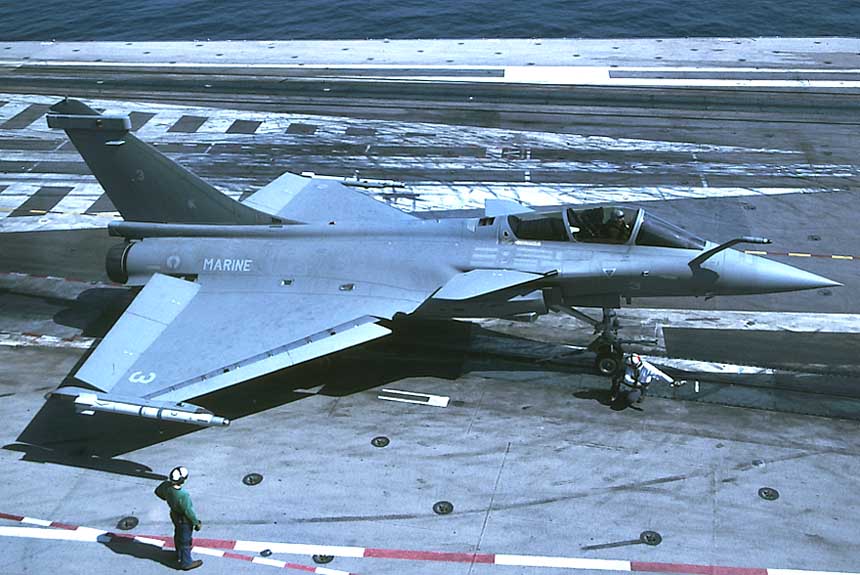
If it’s ever built, the PA2 would operate about 32-40 aircraft of various types, including Rafale-M fighters, E-2C/D Hawkeye airborne early warning aircraft, and AS565 Panther or NH90 NFH naval helicopters. The PA2 went through several design iterations (q.v. Appendix A), but based on 2010 design figures and public material from DCNS, envisioned specifications include:
Length (flight deck): 285 m
Beam (flight deck) : 67.5 – 69 m (37.5 at waterline)
Displacement: 62,000t
Range: 5,000 – 8,000 nautical miles, depending on detail design decisions
Endurance: 5-week mission without replenishment at sea.
Speed: 26 knots
Crew: 1,550: 900 ship + 650 air wing
Passengers: 220
Powerplant: 3 diesel engines + 1 gas turbine (CODAG/ CODLAG)
Catapults: 2 steam, with associated powerplants
Other: SATRAP list compensation system
By comparison, the nuclear-powered FS Charles de Gaulle is 261 meters long and about 45,000t.
Defensively, a SETIS combat system will be paired with a Herakles radar, giving the boat commonality with France’s new Aquitaine Class FREMM frigates. Defensive systems will include 2 x 8-cell SYLVER vertical launch sets. MBDA/Eurosam Aster 15 PAAMS missiles are already integrated with Herakles and SETIS, but cheaper and shorter-range VL-MICA missiles could also be substituted. Close-in air defense would be provided by Mistral short-range missiles, probably using the same 6-missile, remotely-controlled Sadral launcher found on the Charles de Gaulle (which mounts 2). A last-ditch CIWS system like Thales’ 30mm Goalkeeper is also a possibility. ECM and decoy systems would provide last-ditch “soft-kill” capability.
PA2: Developments and Updates
2018
Hopes dying in France; DCNS looks to Brazil, but they’re not in a hurry to buy.
[youtube:v=HdB7MYqldkU]
October 2/18: Relaunch? The French procurement office and the Navy are currently in the process of building a basic frame of reference for France’s future aircraft carrier. Defense News reports that the Direction Générale de l’Armement (DGA) and the Navy have been working on a “reflection for definition studies,” with those studies required to launch the carrier project. The studies will outline the future carrier’s must have capabilities including the embarkment of Rafale fighter jets, its successors and UAVs. A first study was launched on August, examining lessons learned on aircraft carriers in operation and the second study will focus on technology and overall architecture. The overall dossier comprising the two studies is expected to be completed at the end of 2019 or early 2020, and will allow the authorities to decide the capabilities of the ship. Fance has been interested in building another aircraft carrier for many years, however it cancelled its promising PA2/CVF carrier project due to financial constraints back in 2013.
2011 – 2014
Dec 4/14: Brazil buys time. According to Brazilian weblog Poder Naval, Brazil intends to put NAe Sao Paulo (A12) through an extensive 4-year “Ship Modernization Period” (Período de Modernização de Meio – PMM. Note. DID initially mistranslated “Meio” as “Midlife” since the word means middle, but a savvy reader pointed out our error in this context). Sao Paulo would then return to the fleet in 2019 for another 20 years of use. Among listed upgrades, improvements to the 2 aircraft elevators so they can lift 20+ tons, which should be enough to handle fully loaded Sea Gripens, on the assumption that these aircraft will materialize.
No other public online sources mention this PMM in such detail yet, but on November 24 Brazil’s official diary did feature a non-competed €1.7 million 2-year contract award ($2.1M) for DCNS to maintain and modernize the ship’s propulsion system, and officials did announce the PMM back in March. At the time defense minister Amorim had said the country wanted to build a new carrier in Brazil, based on an existing design and with help from a foreign partner.
In November 2013 DCNS performed two quick dry-fire checks of the ship’s forward catapult, which had already performed more than 5,000 launches at the time. With a much more extensive and expensive overhaul coming, an embattled economy, and the lack of a clear case for a ship displacing 50,000+ tons in Brazil’s navy, the future acquisition of a big carrier by Brazil has lost any shred of urgency it might have had.
Sources: Poder Naval: Porta-aviões ‘São Paulo’ será modernizado de 2015 a 2019, para operar até 2039; DCNS; public statements by Brazilian officials relayed by various media; Diario Oficial.
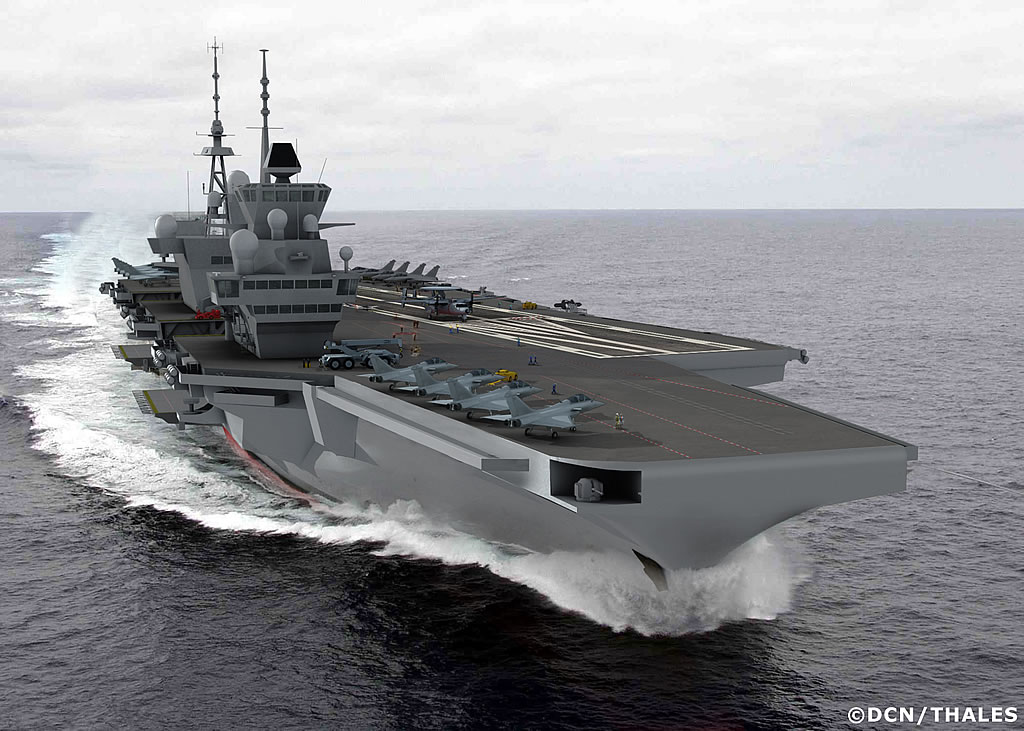
Feb 4/14: DEAC? As India’s Defexpo 2014 approaches, DCNS touts products that include a new aircraft carrier design. It doesn’t seem to be PA2, however:
“Providing power projection, sea control and air defence and based on French Navy CVN Charles de Gaulle’s combat proven design and aviation system, the DEAC is compatible with all CTOL aircrafts (including Airborne Early Warning aircraft) and features the latest technologies including cutting-edge Combat System (SETIS), UAV integration, advanced conventional propulsion and state-of-the-art platform stabilisation system (SATRAP/COGITE). In addition to the design, DCNS offers customised transfer of technology, material packages, dedicated infrastructures development (i.e. naval base and construction/maintenance shipyard) as well as life support solutions.”
India recently accepted a similarly sized Russian carrier (now INS Vikramaditya) into its fleet, and is building a pair of 35,000 – 40,000 tonne carriers locally with help from Fincantieri. A 45,000t non-nuclear ship is probably an easier international sell than a 65,000t carrier. The really interesting question is who France imagines its customers might be. Sources: DCNS, “DCNS to showcase wide range expertise at Defexpo India 2014”.
(click to view full)
April 28/13: France exits. France’s 2013 Defense White Paper (Livre Blanc) formally ends France’s plans for a 2nd aircraft carrier. What it doesn’t do, is change France’s breadth of strategic commitments. If the design survives, it will be as an export that might even be built abroad. White Paper [PDF].
France ends PA2
April 8/13: Looking abroad at LAAD. DCNS is touting its PA2 carrier to Brazil, as a future replacement for Brazil’s aircraft carrier. The 32,800t NAe Sao Paolo is a second-hand ship, formerly France’s own Foch. With Brazil reportedly favoring the Rafale for its F-X2 competition, the PA2 design would be a natural replacement. The Marinha do Brazil is thinking big, and issued an RFP for aircraft carrier specifications in 2012. They’re thinking in terms of 1-2 carriers by 2025, when the Sao Paolo must retire. Shephard adds:
“Perrot noted that following the collapse of the BAE Systems-DCNS collaboration on aircraft carrier design, the French company had continued the design work and produced the PA2 design with conventional propulsion and a catapult assisted launch and recovery system. “From the French side, we see the future is with the catapult system and the Brazilian Navy has a history of using catapult-launched aircraft,” Perrot said.”
Unless Brazil buys the F-35B, France’s PA2 is close to being the only viable game in town for buying a new carrier, and second-hand opportunities won’t be an option. F-X2’s Rafale and Super Hornet finalists both require catapults, and the “JAS-39 Sea Gripen” remains a paper concept that hasn’t confirmed its ability to use STOBAR (Short Takeoff But Assisted Recovery). Since Britain’s CVF relies on a ski-jump for takeoff, and the Royal Navy’s experience has already confirmed how difficult it would be to add a catapult, the class may not be much of an option for Brazil. If DCNS isn’t building the PA2 for France, however, Brazil may well insist on nearly full construction in-country. It would be ironic if the outcome of the PA2 program was carrier construction capability in Brazil, and its atrophy in France. DCNS | Shephard.
July 18/12: Giving up. Admiral Bernard Rogel, the Chief of Staff of the French Navy, states in a parliamentary hearing [in French] that operational availability will have to suffer, but a second carrier is not vital in light of other investments sorely needed by the French military within a challenging fiscal framework:
“Une décision devait être prise en 2012 sur le deuxième porte-avions, mais je me vois mal aujourd’hui réclamer entre 3 et 5 milliards d’euros à cet effet, ce qui ne veut pas dire qu’il n’est pas indispensable ! Quand on n’en a qu’un, on prend nécessairement le risque de n’en avoir aucun disponible à certaines périodes ! Pour autant, il serait inopportun de déséquilibrer la cohérence de nos armées afin d’acquérir cet équipement.
A new defense whitepaper in early 2013 should settle the issue for good, but with friends like this the odds in favor of a second French carrier are low.
July 18/11: CdG out. France withdraws FS Charles de Gaulle from Libyan operations, as the ship prepares for autumn maintenance. Once it enters maintenance, neither Britain nor France will have an operational aircraft carrier. Despite pledges of cooperation in this area, in order to offset the absence of CVF carriers, may need to get used to it. the de Gaulle will be undergoing a full reactor refueling around 2015, that will remove her from service for well over a year. Reuters.
2008 – 2010
Big changes to PA2 design; Discussions continue with UK, but delay after delay on the French end.
Nov 2/10: UK & France. The “UK-France Summit 2010 Declaration on Defence and Security Co-operation” has this to say:
“9. Aircraft carriers. The UK has decided to install catapults and arresting gear to its future operational aircraft carrier. This will create opportunities for UK and French aircraft to operate off carriers from both countries. Building primarily on maritime task group co-operation around the French carrier Charles de Gaulle, the UK and France will aim to have, by the early 2020s, the ability to deploy a UK-French integrated carrier strike group incorporating assets owned by both countries. This will ensure that the Royal Navy and the French Navy will work in the closest co-ordination over the next generation.”
In the end, the premises are changed, and Britain reverts back to a non-catapult design for the Queen Elizabeth Class.
UK-French summit declaration
Oct 31/10: CdG out. France’s carrier Charles de Gaulle is meant to be heading to Afghanistan, but instead is penned in her home port with a faulty propulsion system. The problem could take until late December 2010 to fix. UK’s Daily Mail.
Oct 27/10: Carrier sharing? As Britain and France prepare to sign a military cooperation treaty, French defense minister Herve Morin is already discussing the possibility of sharing a carrier:
“Beyond joint exercises, we are in favor of sharing the accompanying of aircraft carriers… I’ve [also] asked our military command to consider the feasibility of stationing British aircraft on our aircraft carrier and vice versa,” Morin said. “We’re looking into other areas such as refueling planes.”
It’s widely believed that any agreement by the British and French to share carriers means the end of PA2. With a new in-service date of 2020, however, the Queen Elizabeth Class is not going to be ready before the FS Charles de Gaulle needs its long overhaul, making it unlikely to solve the problem of how France can maintain a carrier force during their own carrier’s long drydocking. Britain is also considering selling one of its carriers, which will be mothballed as soon as it’s delivered. See: Mer et Marine [in French] | The Telegraph | UPI | Turkey’s Today’s Zaman.
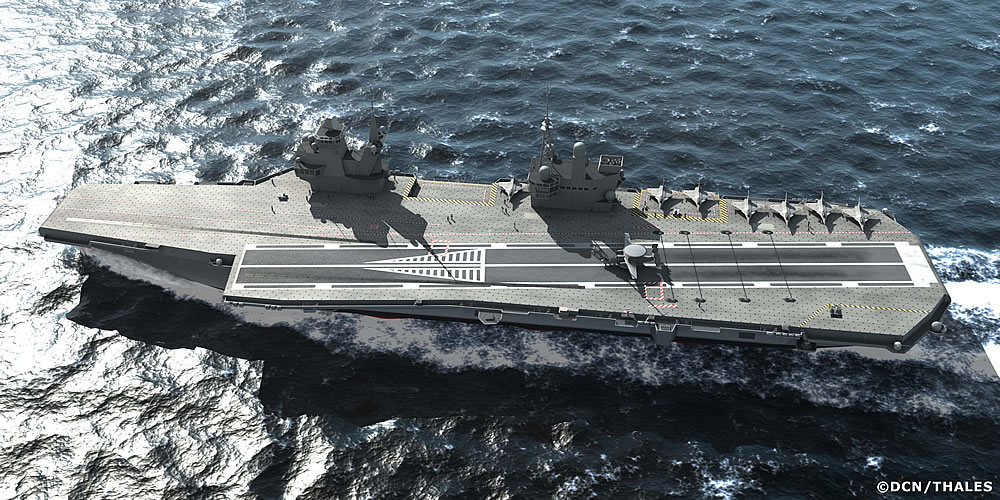
Oct 26/10: At Eurovaval 2010, senior DCNS manager Thierry Lagauche discusses some of the changes made to France’s PA2 design. DCNS recently redesigned the underbody to streamline the hull, and have replaced the two-island layout up top with a single, smaller superstructure. That reduction was reportedly helped along by a reduction in the size of the propulsion plant, which was trimmed from 4 diesel engines and 2 gas turbines to 3 diesel engines and 1 gas turbine. That plant will now drive 3 propellers, however, instead of 2, and they will push a ship that has reportedly dropped to 60,000 tonnes.
The ship’s planned aviation set remains at 32 Rafale fighters, plus NH90 helicopters and E-2C Hawkeye 2000 AWACS aircraft. The design changes are happening in part because France needs to keep its designers busy, in order to avoid losing that part of its industrial base before construction can begin. More changes may also be in the offing. Defense News reports that:
“French Defense Minister Hervé Morin, in his morning remarks to open the Euronaval exposition here, noted that further design changes could take place in the carrier, possibly to bring the British Queen Elizabeth and PA2 more in line with each other.”
See also Defense et Securite Internationale [in French].
June 17/08: More delay. French President Sarkozy unveils his defense white paper plan in a speech. The French military will shrink, bases will close, and the monies will be used to invest in space reconnaissance, ad extra funds for the Army. See full DID coverage.
The PA2 project will have its decision delayed until 2011 – and rising fuel prices have France reconsidering nuclear propulsion. The full excerpt from the White Paper’s press briefing follows:
“Après analyse, la décision sur la construction d’un second porte-avions est reportée pour les principales raisons suivantes :
– un tel choix induirait aujourd’hui un déséquilibre par rapport à l’articulation générale des priorités retenues pour la stratégie de sécurité nationale : lancer maintenant la construction d’un second porte-avions pourrait obérer des investissements considérés comme essentiels, pour la protection des forces au combat, le renseignement et la préparation de l’avenir ;
– un fort risque d’éviction affecterait d’autres programmes majeurs ;
– les délais de construction rendent d’ores et déjà aléatoire la possibilité de disposer d’un deuxième porte-avions au début de la prochaine période d’entretien majeur du Charles-de-Gaulle, au milieu de la prochaine décennie ;
– les conditions économiques ont changé depuis le choix fait en 2003 de la propulsion classique pour le nouveau porte-avions ; des études complémentaires sont aujourd’hui nécessaires pour apprécier le bilan des options classique et nucléaire.
S’agissant de l’objectif de permanence de l’outil de projection de puissance et sans préjuger de la décision qui sera prise vers 2011-2012, l’accent sera mis en premier lieu sur l’initiative de coopération aéronavale européenne, à partir de la coopération franco-britannique lancée en 2008 et ouverte à d’autres partenaires. Une priorité nouvelle sera par ailleurs mise sur les moyens de frappe à distance de sécurité par missiles de croisière naval, qui seront développés et acquis. Enfin, l’accord de nos partenaires sera recherché pour que le dispositif français à l’étranger puisse servir de point d’appui pour nos forces aériennes vers et sur les théâtres d’opération potentiels.”
May 18/08: PA2/CVF. The Times of London reports on talks that may lead to the building of just 2 CVF type carriers, with no French PA2.
The “bilateral carrier group interoperability initiative” was proposed by the French president, Nicolas Sarkozy, at his March 2008 summit with Prime Minister Gordon Brown. The idea is that either navy could borrow an aircraft carrier from the other if their own was unavailable as a result of a breakdown or refit, and there was agreement on the military mission and objectives. That latter requirement is what makes any arrangement of this kind so unlikely. British MoD officials reportedly dismissed the talks as “aspirational” and insisted there were “no current plans” to share carriers with the French.
April 25/08: Delay. Ouest France points out that existing program commitments will not fit within the French budget as it is:
“Hervé Morin, le ministre de la Défense, a-t-il voulu préparer les esprits, dimanche, en expliquant que la « situation budgétaire rendait difficile la construction du second porte-avions » ? Difficile ? Plutôt impossible. Le budget de la Défense pèse 48 milliards dont 16 consacrés aux programmes d’armement. Mais pour honorer les engagements (achat de Rafale, de missiles M 51, d’hélicoptères NH 90 et Tigre, de frégates Fremm, de sous-marins Barracuda, d’avions A 400 M, de véhicules blindés…), il faudrait déjà accroître les dépenses d’au moins 40 % entre 2009 et 2013.”
The article puts forth 3 options: (1) abandon the second carrier, (2) delay it considerably, or (3) launch it immediately, paid for in part via a partial privatization of France’s giant nuclear firm Areva, which is reportedly being studied.
April 20/08: Delay. Defense News report – French Defense Minister Herve Morin once again casts doubt on the PA2 project given its expected EUR 3-3.5 billion cost, telling the Europe 1 radio and the TV5 Monde television channel:
“It is clear that the budgetary situation concerning the equipment of our forces makes the construction of a second aircraft carrier difficult… It’s a decision that we will have to take in the coming weeks… The president of the republic will decide.”
As it happens, the President did not decide until June 2008. Le Monde
2006 – 2007
Design contract; Anglo-French cooperation; French review passed, but no decision.
(click to view full)
Nov 19/07: PA2/CVF. DCNS announces that French (DCNS and Aker Yards) and British (BAE Systems, VT Shipbuilding, Thales Naval and Babcock Support Services) have signed an agreement that lays down the general provisions for co-operation for the development, manufacture and in-service support of the PA2 and CVF carriers. One aspect of the agreement is that the teams will study the feasibility of making all equipment requests joint acquisitions, in order to maintain commonality and drive down costs. See also Aviation Week’s Ares, who correctly notes that PA2 hasn’t been approved for procurement yet.
May 7/07: Catapults. The French defense ministry signs a 50-million Euro ($67.5-million) contract for two American-made C13-2 steam catapults, the same type of catapult in use by the U.S. Navy on its Nimitz Class carriers. Source.
Jan 16/07: PA2/CVF. Mer et Marine updates the status of the PA2/CVF program, and excerpts are translated by Defense-Aerospace. The article quotes a MOPA2 official as saying that “there is a strong will on both sides to reach the next milestone” – the French ‘Dossier de Lancement et de Realisation,’ which is similar to ‘Main Gate project approval’, by end of March 2007, following a fully detailed design and binding offer to the French defence procurement agency DGA on December 20, 2006. If, as currently planned, the British program also reaches Main Gate Approval around March 2007, there is some optimism that an industrial cooperation agreement could be signed and made public in April 2007, during the final Anglo-French ministerial meeting before the French presidential election in April.
Oct 25/06: Still together. Le Monde reports a very firm position being taken by Minister for Defense Michele Alliot-Marie, who played up the difficulty of canceling an international program and stood firm on the EUR 700 million invested under the 2007 Finance Law. Despite the increasing drift of the French design away from the UK’s Queen Elizabeth Class CVF, French officials claimed over 90% commonality and portrayed the international project as all or nothing.
A notification of the contract is expected in March or April 2007, though a May 2007 deadline could be pressed if the French government vacillates. See also Oct 21/06 interview.
September 2006: Delay. The French 2007 Defense Budget within the 2007 Finance Law proposes another EUR 700 million for the PA2 program, taking total funding so far to EUR 1.63 billion. The 2007 Finance Law is scheduled to be passed in December 2006. Navy Matters adds that:
“France has delayed a decision from December 2006 to March/April 2007 on whether to place contracts for further detailed CVF-FR design work and the procurement of long lead items – which would trigger a further EUR 50 million payment to the UK. The long lead equipment would reportedly include American designed and manufactured steam catapults and arresting gear.”
Aug 29/06: Recommendation in. A report in La Tribune newspaper claims that recommendations re: a CVF-based design were made to the DGA on schedule in July 2006. The DGA later confirms this, and so does a Thales briefing from Euronaval 2006. The proposed changes would reportedly increase displacement by 9,000t (to 74,000t) increase maximum flight deck width by 4 m (to 73 m) increase draft by 2 m (to 11.5 m). These increases stem from the need to incorporate the changes discussed above.
June 22/06: An internal review of CVF-FR design is passed. See Mer et Marine article [French]. MOPA2 was also due to present the General Delegation for Armament (DGA) at the end of July with the results of its study re: modifying the British CVF design, as well as a first detailed financial estimate.
Internal review
Jan 24/06: As noted in “UK & France Reach Agreement on CVF Carrier Development” the cooperation agreement was hammered out on Jan 24/06; the contract was worth GBP 100 million ($178.6 million/ EUR 145.5 million at current conversion), which marked the first steps in the design of a “tailored CVF.” By March 6/06, all details had been wrapped up and the cooperation agreement was formally signed at the EU defense ministers meeting in Innsbruck, Austria. The French got access to the detailed design specifications required in order to finalize their variant, and in return the financial and technical cooperation details were set.
The milestone marking the end of the design phase and the start of the production phase was scheduled for late 2006, but developments have changed that date to April or even May 2007. Navy Matters has further details regarding the sequence of events.
Franco-British cooperation agreement
Dec 12/05: The French DGA defense procurement agency formally awarded the “MOPA2 consortium” of DCN and Thales a EUR 20 million (about $23.6 million) ‘relay contract’ to continue their work on the design of France’s planned PA2 aircraft carrier. This enabled the PA2 team to proceed with a detailed preliminary design. These studies will be undertaken by MOPA2, the integrated DCN/Thales prime contract office.
Design contract
Appendix A: The PA02’s Shifting Design
(click to view full)
In June 2006, PA2 ship design recommendations were made made to the French DGA. They included substantial changes from initial concepts, increasing displacement over the CVF design by 9,000t (to 74,000t, cut back to 62,000t in 2010), maximum flight deck width by 4 m (to 73 m), and draft by 2 m (to 11.5 m). These increases stemmed from the need to incorporate American-designed 90 meter C13-2 steam catapults and accompanying boilers, internal hangar space changes, a significant increase in carried fuel, and nuclear weapons storage. These changes would also reduce speed from 26.3 knots to about 25-26 knots, a disappointment as the Marine Nationale was hoping for an increase to 29 knots.

Invincible Class
(click to add Nimitz)
There had been a lot of talk, and some serious behind the scenes work, to unify the French and British carrier programs, in order to make them more affordable and supportable. Aviation Week reports that the extent of the June 2006 PA2 design modifications alarmed the British, to the extent that the joint program was called into question. By Sept 21/06, however, it was accepted that the French PA2 would be only 90% compatible, and that both sides were willing to offer maximum cooperation. Though some features like the engine room and controls will be identical on both classes, the pressing need to cooperate entailed concessions on both sides, and some key design differences. These talks eventually failed, but the outline of the French changes and proposed compromises is interesting:
* The PA2 must be fitted with steam catapults and arresting gear for the Rafale M fighters, plus the necessary piping, maintenance shafts, and boilers. The French are working to get US export clearance for the C13-2 system. Britain initially picked F-35B STOVL Joint Strike Fighters, which would use a ramp for take off and can land vertically. Later decisions moved the Queen Elizabeth Class closer to compatibility, as Britain decided to field a catapult on at least one carrier, and operate naval F-35Cs instead.
* PA2’s elevators from the aircraft hangar up to the flight deck will be slightly wider to accommodate the Rafale-M’s wingspan. There may also be some hangar space changes.
* PA2 would embark 300 more sailors (1,720) than the CVF Queen Elizabeth Class.
* PA2 would have secure storage spaces for nuclear weapons. As a matter of policy, the Royal Navy only delivers nuclear weapons from its SSBN Vanguard Class Trident missile submarines, so they have no need for such spaces on their carriers.
* PA2 would have more space for fuel, because the French navy refuels less often.
* PA2 would use the same French SATRAP list compensation system used on the Charles de Gaulle aircraft carrier, which uses a combination of fins, rudders, and compensation weights on train tracks. SATRAP can maintain stabilization to within 0.5 degrees of horizontal, allowing aircraft launch and recovery up to Sea State 5/6.
On the other hand, the French also made several design concessions in 2006, to try and keep the joint program steaming along:
* Accommodations would be by rank (British style, officers in back), not by functions (French style)
* The air wing operations room would also be at the back of the ship, away from carrier operations and the admiral’s staff room where the French usually position it.

(click to view full)
On the British side, the British government wanted its shipbuilding industry to begin restructuring in accordance with the Defence Industrial Strategy before it awards the future aircraft carrier (CVF) contract. British shipyard personnel visited French facilities looking to benefit from their improvements – and the French offered to help, for a price. The quid pro quo was that British shipyards adopt French production standards and methods, and that the British agreed to design changes that accommodate French requirements (provision for larger ammunition storage holds, special secure storage areas the French can use for nuclear weapons, etc.)
It was a valiant effort, but ultimately, it went nowhere. Britain went forward on its own, and so did France.
2010 changes to PA2 redesigned PA2’s underbody to streamline the hull, and replaced the 2-island layout up top with a single, smaller superstructure. That size reduction back to 62,000t was accompanied by a reduction in the size of the propulsion plant, from 4 diesel engines + 2 gas turbines to 3 diesel engines + 1 gas turbine. That combined plant will now drive 3 screws, however, instead of 2.
As of 2013, the British were well underway building their 2 Queen Elizabeth Class carriers, while France had its own design but virtually no prospect of financing and building it.
Additional Readings & Sources
* DCNS – Aircraft Carriers
* Thales – PA2: A second aircraft carrier for the French Navy. From 2007, via Wayback Machine.
* Navy Matters – Deuxieme porte-avions francais / French Second Aircraft Carrier (PA2)/ CVF (FR).
* Naval Technology – Charles De Gaulle Nuclear Powered Aircraft Carrier, France
* DID FOCUS Article – Design & Preparations Continue for Britain’s New CVF Future Carrier.
Other Coverage
* Rafale News (Oct 29/10) – DCNS Rxx aircraft carrier proposal
* World Security Institute Brussels (May 21/08) – France’s Second Carrier: Is the PA2 Project Already Dead in the Water?
* Aviation Week’s Defense Technology International (Jun 13/07) – Britain and France Develop New Carriers. Among other things, has very interesting data on cruise ship vs. aircraft carrier waste management and load/costs. PA2/CVF carriers are incorporating some of those lessons.
* Aviation Week’s Defense Technology International (February 7/07) – Joint U.K.-France Aircraft Carrier Steams Ahead. Adds useful details re: key differences between the British CVF and French PA2.
* Mer et Marine (Jan 16/07) – Aircraft Carriers: What’s the Status of the Anglo-French Project? (Excerpt). Translated by Defense-Aerospace.
* Mer et Marine (Oct 21/06) – Interview: Michele Alliot-Marie, French minister of Defense. English version.
* RUSI Defence Systems (Summer 2006) – Franco-British Co-operation: A Booster to the PA2 Design Definition Challenge in 2006 [PDF format]. By Louis Cazaubon, project director of the PA2 program for MOPA2. Provides some additional details re: Anglo-French co-operation in the design and development of the future aircraft carriers, and discusses the 80% commonality goal.
* Mer et Marine (Aug 8/06) – DCN et Thales proposent un porte-avions plus lourd [Francais].
* Mer et Marine (June 28/06) – Porte-avions : MOPA2 passe avec succes la revue de conception interne [Francais].
* DID (Jan 26/06) – UK & France Reach Agreement on CVF Carrier Development.
* Thales (Dec 12/05) – French PA2 carrier programme advanced to next design phase
* Industry Canada Strategis (Feb 25/04) – France Chooses Conventional Propulsion for its New Aircraft Carrier
* StrategyPage (Dec 7/03) – How NOT to Build an Aircraft Carrier. The Charles de Gaulle Class has had more than its share of problems, which may help to explain why building a second ship of that class wasn’t a very appealing option.