

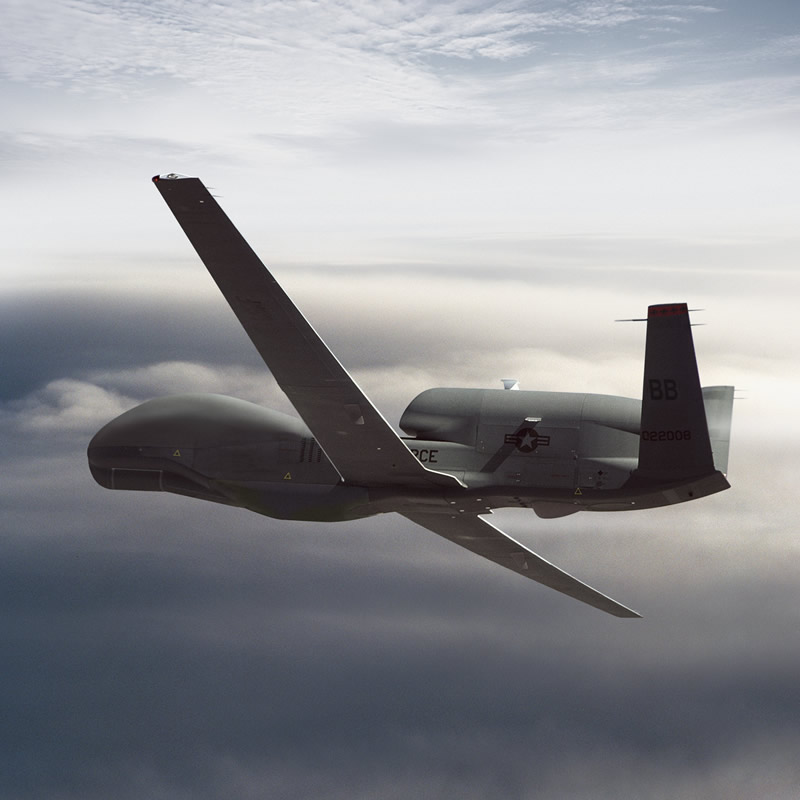
(click to view full)
DID has covered the US military’s RQ-4 Global Hawk reconnaissance UAVs, which can cruise at 65,000 feet for 32 hours and cover thousands of miles in the process. Forecast International notes that 7 Global Hawks have been delivered, 17 are in various stages of production, at least 2 have been lost in crashes, and 2 more are on loan to the Navy for experiments. Over 5,400 combat hours have been flown, and foreign interest is also high. NATO is looking at Global Hawk as part of its AGS battlefield surveillance project in combination with a JSTARS-like Arbus 319, and there has even been talk of setting up a multinational “Pacific Pool” of Global Hawks along similar lines to NATO’s E-3 AWACS program. As the Pentagon looks to retire its U-2 fleet, this UAV’s operational role and importance will only increase.
DID discusses a $60 million contract that was just issued for the RQ-B Global Hawk, whose 131-foot wingspan and larger size give it an extra 5,00 pounds of payload capacity vs. the 116-foot A model. We also point to a National Defense Magazine article that raises questions about the program’s costs and accounting.
Northrop Grumman Systems Corp., Integrated Systems Air Combat Systems, San Diego, CA received a $60.6 million firm price incentive – firm target contract to provide for long lead parts/ advance procurement. At this time, total funds have been obligated. Work will be complete March 2007. The Headquarters Aeronautical Systems Center, Wright-Patterson Air Force Base, OH is the contracting activity (FA8620-06-C-3002). The contract covers the following low rate initial production lot 6 items:
* 6 RQ-4B air vehicles;
* 3 mission control elements;
* 3 launch recovery elements;
* Support segment-support equipment and
* Initial spares.
Procurement budgets for the RQ-4 Global Hawk have risen from $359.1 million in FY 2005 (for 4 UAVs, also $382.6M RDT&E), to $359.6 million this year (for 5 UAVs, also $327.7M RDT&E) and $504.5 million in FY 2007 (6 UAVs, also $247.7M RDT&E). RDT&E costs, meanwhile Meanwhile, on the program management front, a dispute has risen regarding the Global Hawk’s cost increases, which DID flagged as an issue back in April 2005.
In 2005, the Air Force informed the Defense Department that Global Hawk was running 18% above its projected cost. The Government Accountability Office, meanwhile, said the figure was 31%. Both figures were subsequently revised upwards, but the key issue remains the question of whether airframe and sensor upgrades et. al. should be included in those calculations.
The “spiral” approach to developing weapon systems, which calls for incremental additions of new equipment and capabilities, is often touted as a lower-risk approach to developing weapons systems. If upgrades are factored into cost above baseline calculations, it is likely to discourage the spiral development approach because the “Nunn-McCurdy rule” forces the Pentagon to highlight programs that exceed initial baselines by a given percentage. The article notes that this isn’t a small issue, either – in FY 2007, the US Air Force requested $14 billion for operational system development efforts, much of which goes to incremental improvements and research.
On the other hand, the GAO notes the Global Hawk’s requirements pile-on from the RQ-4A to the RQ-4B model, and note that some elements like the sensor payload are pushing the envelop and therefore high-risk. The issue in their view isn’t so much spiral development, as out-of-control requirements creep and failure to comply with the USAF’s own acquisitions recommendations.
Both perspectives have some validity.
Additional Readings
* National Defense Magazine (May 2006) – Soaring Costs Not Likely to Slow Down Global Hawk
* StrategyPage (May 24/06) – Justifying Sharp Global Hawk Price Increase… to $145+ million per, including RDT&E costs.