

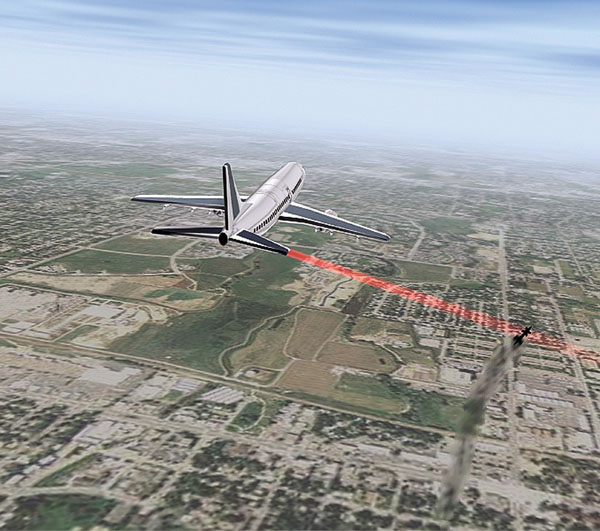
(click to view larger)
Early deployment of a system called Flight Guard aboard civilian jet liners came following a November 2002 incident in which shoulder-fired anti-aircraft missiles (MANPADS) were launched unsuccessfully at an Arkia plane in Mombasa, Kenya. That FlightGuard system is a civilian version of IAI/Elta’s popular ELM 2160, and costs about $1 million per plane for sensors and flares. The flares were the sticking point. Even though they were redesigned to be larger (to divert from larger targets), burn for a shorter time (to minimize ground hazard), and almost invisible to human eyes (to prevent panics), many locations were leery about allowing a flare-dispensing system near civilian airports.
In contrast, Elbit Subsidiary El-Op’s MUSIC (Multi-Spectral Infrared Countermeasures) system takes the DIRCM (Directed Infrared Counter-Measures) approach – a wise decision given civilian concerns, and key military trends. Now, the firm has its first large civilian order…
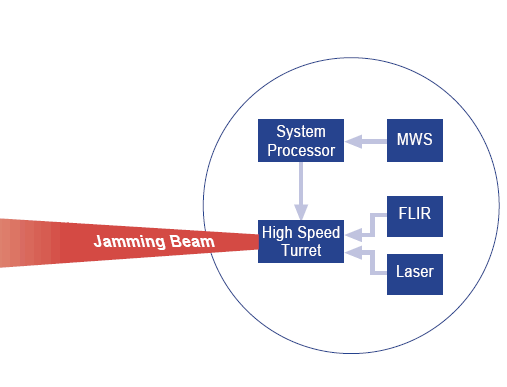
(click to view full)
MUSIC is actually more like a symphony. A missile approach warning system (MAWS, using radar plus infrared or ultraviolet to reduce false positives) detects approaching missiles, then an advanced FLIR (Forward Looking Infra Red) system tracks it and guides the high-speed turret as it automatically slews and fires a human-safe laser beam at the missile. The laser’s pulses blind the missile’s sensors, either confusing the seeker away from the plane, or simply overloading its sensors and turning it into a rocket. It’s a very big sky; an unguided rocket is going to miss an aircraft, which will be taking evasive action because the pilots received their warning from the MAWS.
Older MANPADS like the common SAM-7 Strela produced under license by Iran rely on infrared detection of an aircraft’s exhaust plume. This makes their effectiveness questionable against military jets, who are almost always in a ‘tail chase’ position when lock is achieved, and can put on a burst of speed to cruise out of its range. Large civilian jets with bright exhaust plumes and slow acceleration are another matter, of course, though the Mombasa incident proved that even civilian aircraft are hardly sitting ducks. Both flares and DIRCM systems will be used instead.
The complicating factor for future threats is the fact that since the 1980s, shoulder-fired missiles have been diversifying their guidance systems, carrying dual infrared/ultraviolet detectors, and/or using advanced algorithms that help them ignore diversionary defenses like flares. As more advanced weapons proliferate via state support for terrorists or black market sales, the advantage begins to shift rather clearly away from diversionary decoys. In their place, customers will want systems that interfere with the missile more directly, and can be upgraded for additional threat types. DIRCM systems will be around for a long time, therefore, and could well be considered a strategic defense technology for nations under threat.
Which may help to explain why a system that was originally developed for helicopters has just received project approval from Israel’s Security Cabinet in order to equip Israel’s civilian aircraft. Investment in the MUSIC airliner project is expected to commence in early 2008, but the Reuters report quotes El-Op deputy director Yisrael Anschel as saying that adapting MUSIC for bigger aircraft could take another 2 years. That would mean a 2009-2010 fielding date. The reports add that IAI’s Flight Guard will remain on some Israeli passenger planes, even after the new MUSIC system is phased in.
As the Israelis have learned from hard experience, it pays to be careful.
Contracts and Key Events
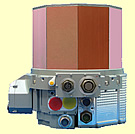
November 7/16: Israeli news outlets have reported the presence of the Elbit Systems’ C-MUSIC anti-missile defense system on France’s Presidential Jet. Priced at $1 million per unit, the system consists of smart thermal cameras that identify an incoming missile and target the missile with a laser beam. The specialized beam interferes with the missile’s targeting system, deflecting it off its trajectory and allowing it to explode at a safe distance from the plane. A French official confirmed the reports.
December 18/15: Elbit Systems is to install the Commercial Multi-Spectral Infrared Countermeasures (C-MUSIC) systems to an unidentified Asia-Pacific nation. The two year contract is worth $26.5 million. The C-MUSIC system has been developed for fixed-wing aircraft and helicopters, and gives advanced protection from heat-seeking shoulder-fired surface-to-air missiles by using fiber-laser-directed infrared countermeasure technology. Whoever the mysterious buyer is, the purchase of the system may have been influenced by incidents such as the shooting down of a Malaysian Airlines plane on the Ukraine-Russia border in July 2014. Pro-Russian separatists fighting in east Ukraine shot down the plane using a Buk SA-11 surface-to-air missile.
June 25/09: Elbit Systems Ltd. announces a contract with the Israeli Ministry of Transportation, to supply its C-MUSIC system (commercial multi-spectral infrared countermeasure) under a $76 million contract. C-MUSIC is a larger version of the MUSIC system designed for helicopters and business aircraft. Israeli airliners will be among the word’s first passenger aircraft equipped with active defense systems.
The Elbit Systems Electro-optics El-Op Ltd. devices will be installed aboard a variety of commercial aircraft owned by Israeli commercial airlines El-Al, Arkia and Israir, and as part of the comprehensive ‘Sky Shield’ air transport defense plan. The Israeli airliner that was fired at near Mombassa, Kenya in 2002 was an Arkia 757. IEICI | Elbit Systems [PDF] | Defense Update | Flight International.
Additional Readings & Sources
* JIJNSA (June 8/06) – Protecting Commercial Airliners from Short-Range Missiles: Airlines, Defense Firms Debate Threat and Cost. Discusses a number of commercial systems proposed for use in the USA.
* Armada International (Dec 04/Jan 05) – Shake It Off Your Tail!. Excellent overview of the systems on the global market.
* AIAA, Aerospace America magazine (May 2002) – IRCM: The place to be in EW. Market forecast by the Teal Group.
* Elbit Systems – Multi-Spectral Counter MANPADS System (MUSIC)
* Reuters (Oct 10/07) – Israel switching to lasers to defend civilian jets
* Israeli Weapons – Flight Guard
* IAI (Sept 8/03) – IAI/Elta’s “Flight Guard” Commercial Aircraft Protection System Funded By Israel Ministry Of Transportation
* Israel21c (June 15/03) – World’s first self-protection system for commercial aircraft at Paris Air Show. MUSIC was beginning development as a cooperative venture between Elbit & RAFAEL at the time,. RAFAEL has since dropped out of the joint project.