


(click to view full)
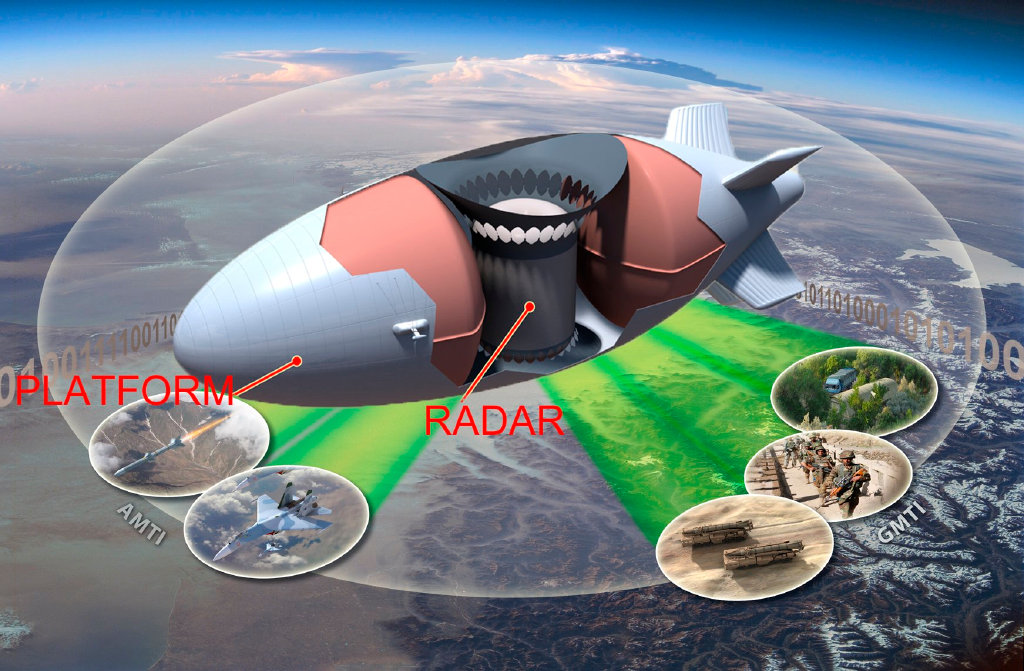
DARPA’s ISIS program is developing a stratospheric airship with sensor antennas that will include a radar nearly as large as the airship. This would create a battlefield surveillance platform with extreme endurance, and equally extreme resolution for its air and battlefield scans via radar and other carried sensors. This project is associated with Lockheed’s High Altitude Airship program, which is intended to soar at over 65,000 feet for over 30 days at a time, and ISIS could even play a significant role in ballistic missile and cruise missile defense.
Like all DARPA projects, HAA and ISIS pushed the limits of technology, as they work to field a capability set that could revolutionize the US Air Force. If they succeed, these airships could serve as a future substitute for an array of platforms, from UAVs to high-end jets like the E-8 JSTARS and E-3 AWACS. Critical technology areas include low aerial-density advanced airship hull material, bonding systems that will keep the radar attached in a hostile environment, extremely low-power transmit-receive modules for the radars, and novel power systems for long-endurance stratospheric airship operation. HAA has become a US Army program, but ISIS remains with DARPA – for now.
HAA & ISIS: Capabilities & Objectives

(click to view full)
Under this latest demonstration contract, Lockheed Martin will develop an unmanned and untethered prototype airship with the requirement of remaining on station for one continuous month at a nominal cruise altitude.
Nav Log notes that “according to the US Army Space and Missile Defense Command, HAA is to have an endurance of one month at 65,000 feet, carry a payload of at least 500 pounds, provide at least 3 Kw of continuous power, have a cruise speed of 25 knots, and station-keeping accuracy of less than 2 kilometers 50% of the time and less than 150 kilometers 95% of the time.” This actually refers to the prototype HALE-D vehicle, as opposed to the operational HAA which will have a payload of 4,000 pounds (about 1,800 kg).
Dave Kier, Lockheed Martin’s vice president and managing director for missile defense, said that the firm hopes to keep the unit cost of the operational airship at roughly $50-60 million before its advanced radars, sensors etc. are installed. If so, its long endurance would give it operating costs in the tens of dollars per payload-pound per hour, as opposed to aircraft or even satellites whose comparable costs are hundreds or even thousands of dollars.
Kier also told C4SI Journal that an operational version of the airship would have a volume of about 5.3 million cubic feet, about 25 times the volume of the Goodyear blimps. Preliminary specifications call for the operational payload to consist of a forward/upward-looking radar for ballistic missile tracking and discrimination, plus a look-down radar for ocean/land surveillance capability.
ISIS: Integrated Sensor Is Structure

(click to view full)
While conventional radars and power systems could fit within that payload limit, the full potential of high-altitude airship platforms like the HAA depends on a related but separate DARPA project called ISIS.
It aims to incorporate radar antennas that are over 6,000 square meters/ 64,500 square feet. That compares to about 55 square feet for the radar on the current E-8C Joint Stars battlefield surveillance aircraft, and is likely to involve over 4 million Transmit/Receive (T/R) modules. On the other hand, it’s not a linear comparison, since the ISIS radar is consciously trading a much weaker power draw for larger size.
Even at very low power draws, however, a radar that big would have incredible resolution, and using AESA radars adds a number of new capabilities. These include easier maintenance, better readiness rates, dual air-air and air-ground capability simultaneously, and possibly even massive communications bandwidth. In terms of radar performance, DARPA wants ISIS’ dual-band X-band and UHF radar to track even stealthy cruise missiles at 600 km/ 373 miles, dismounted enemy combatants at 300 km/ 186 miles, and ballistic missiles at 1,500 km/ nearly 1,000 miles. Simultaneous tasks and capabilities would include air, ground, and maritime surveillance modes, along with moving target indicator (MTI) capabilities, “coherent change detection” that can compare old ad new images, and even UHF foliage penetration (FOPEN) modes to see through trees and such.
Like all DARPA programs, ISIS could be a success even if some goals are not reached. For example, a smaller ISIS system that could deploy on the HAA airship for a month at a time instead of a year, and track aerial and ground targets but be unable to use FOPEN or maritime modes, would still be a success. Even that “failure’s” scanning power, reach, and ultra-low operating costs could push an array of advanced, expensive surveillance aircraft like the E-3 AWACS and E-8 JSTARS into marginal niche roles – or even into outright obsolescence. It would represent a very valuable asset, with room for future upgrades.
HAA: Challenges

(click to view full)
Lockheed Martin received its first production contract for a lighter-than-air vehicle, the rigid USS Akron airship, in 1928 from the U.S. Navy. There has been a long hiatus between those Navy airships, however, and the advanced craft contemplated under HAA. There is also a large gap between those earlier technologies, and what HAA will need.
Solar cells and an advanced fuel cells that can deliver up to 500 kW must be developed to power the craft.
An aerodynamic design and a control system must be developed to help keep the airship steady amid the high winds at that altitude, without consuming excessive power.
Another important factor is determining how the airship would react to changing temperatures as the sun rises and sets every day, heating and cooling the helium.
Then there’s the major challenge of finding materials for the airship’s skin that are capable of withstanding the extreme ultraviolet radiation and cold such high altitudes for extended periods, without becoming brittle.
ISIS: Challenges

(click to view full)
The development of reliable and versatile AESA radars, software-driven radar functionality, and experimental work to begin putting radar T/R modules on chips, have made a radar like ISIS thinkable. As difficult as HAA is, however, ISIS is even more so. While radars like the floating SBX are much more powerful than ISIS in certain modes, its construction and incredible versatility makes an argument for ISIS as the USA’s most technically advanced public-domain radar project.
DARPA’s notional concepts for ISIS’ airship, with its goal of year-long unmanned missions, have involved up to 1 million cubic meters/ 10.76 million cubic feet of internal space, which translates into shapes about 60m high, and either 300m long or 200m in diameter. That size alone would create huge hoop stress within the hull, which must also handle propulsion, storage, and payload weights that include a radar with 30% of the airship’s own mass. That’s a challenging set of materials specifications, and their expected time aloft adds yet another dimension, with the need to retain more than 85% of their strength-to-weight at the end of 5 years.
ISIS’ radar, avionics, and communications systems together are expected to draw just 50 kW of power, but the ISIS power system will need double HAA’s capacity: up to 1 MW of sustained power draw for 3-5 days, in order to let the airship handle difficult weather and winds.
In short, ISIS shares all of the High Altitude Airship’s challenges, and more. Then, there’s the radar. Raytheon describes the radar’s task this way:
“Imagine a radar antenna that spans the length of a football field, yet weighs less than the 22 players in action on it.”
Although it would contain “millions of electronic components,” the thickness of the antenna as envisioned by Raytheon would be about one centimeter (0.4 inch).
Those components will need to channel enough energy to produce the kinds of scans necessary for ISIS performance, without creating heat issues or overloading the airship’s limited onboard generating capacity. Hence the need for extreme low-power emitters on a chip. The huge array of emitters and receivers, which will not have a flat shape, must also be coordinated so that they can all work smoothly as a single device, or have specific group of T/R modules focus on specific things.
If all that wasn’t hard enough, an external antenna would need to be made of material, and placed on a substrate that can weather every environmental shock that the craft’s skin must endure. It must also use some sort of bonding technique that lets it continue to remain part of the hull, despite having materials with different thermal properties sitting in temperatures that can cycle between 100 degrees F to -110 degrees (40C to -80C).
These challenges may explain why the radar is placed within an unmanned blimp per some conceptions. Even then, however, the challenges of lightness, significant durability despite a hostile environment, and ultra-low power consumption would remain.
HAA and ISIS: Programs

(click to view full)
In April 2008, the HAA program transferred from the Missile Defense Agency to the U.S. Army Space and Missile Defense Command (USASMDC), located at Huntsville, AL. ISIS remains a DARPA program for now.
The HAA hardware and HALE-D prototype airship’s structure are under construction, with first inflation set for mid-2007 and hopes for first testing of the single prototype in 2009. Completion of this HAA contract was expected by November 2010. In reality, first flight of the HALE-D demonstrator didn’t take place until mid-2011, and resulted in a crash. Until the failure is understood and testing is conducted, the program’s timeline is uncertain.
After Phase 3 testing has been completed, the Missile Defense Agency has the option to conduct an Extended User Evaluation Period Phase for for up to a year, to continue its evaluation of the HAA as a military vehicle.
The ISIS radar was always expected to take longer, and has.
A smaller-size ISIS radar/airship demonstrator was supposed to fly in 2012, but is now expected to make its maiden flight some time in 2013, in order to ensure proper bench testing of key radar components. Flight tests over the Florida Keys are expected for around 3 months, followed by 9 months of operational testing by regional commands in and around US airspace. The USAF would need to decide to fund the program some time around 2014 for it to become a full weapons program, and 2015 is the current notional date for an operational system, assuming that the USAF commits the money.
Meanwhile, work on both the High Altitude Airship and ISIS’ demonstrator will take place at an historic site. Lockheed Martin’s “Airdock” facility in Akron, OH is a cavernous 1,175 feet long, 325 feet wide and 211 feet high. The City of Akron, The Summit County Port Authority, and the State of Ohio are active supporters of the program to rebuild and update the Airdock, a historical building built in 1929 and last used to assemble the US Navy’s airships of the 1930s.
The airships of the 2010s could turn out to be far more influential.
HAA/ISIS: Contracts and Key Events
Lockheed Martin Skunkworks
(click for full)
Unless otherwise specified, all contracts are issued by The Air Force Research Laboratory in Rome, NY.
Jan 25/11: ATK announces that Lockheed Martin has picked them to provide the ISIS radar’s Thermal Control Subsystem. The scope of work includes designing, developing, building, and testing hardware that performs heat acquisition, heat transport, and heat rejection for 2 complete thermal systems. The baseline design is a pumped 2-phase fluid loop, which interfaces with large, lightweight radiator panels attached to the vehicle power bay.
Work on the contract will be performed at ATK’s Beltsville, MD facility. ATK Spacecraft Systems and Services General Manager Tom Wilson sees the win as strategic to a long term presence in the “high altitude, near-space defense market.”
April 27/09: Lockheed Martin Aeronautics Co. in Palmdale, CA receives a $100 million increment of a $399.9 million cost plus fixed fee contract as the lead for Phase 3 of the ISIS program. Of the funds being obligated at time of award, $24 million will expire at the end of the current fiscal year, on Sept 30/09.
Under the contract, Lockheed Martin will lead an industry team to design, build, test and flight-demonstrate of a 1/3 scale airship featuring Raytheon’s new, low-power density radar. The autonomous flight test system must be able operate on station for 90 days, and is expected to prove out several key technologies over an anticipated total demonstration period of 1 year.
Work will be performed in Palmdale, CA (33%); El Segundo, CA (37%); Akron, OH (3%); Denver, CO (14%); Sunnyvale, CA (1%); Litchfield Park, AZ (3%); Monrovia, CA (2%); Frederica, DE (2%); Mesa, AZ (3%); and Huntsville, AL (2%), and is expected to be complete in March 2013. This contract was procured under a limited source competition with 2 bids solicited and 2 bids received by the Defense Advanced Research Projects Agency in Arlington, VA (HR0011-09-C-0036). See also Lockheed Martin/ Raytheon joint release | The DEW Line | The Register.
April 2008: The HAA program transfers from the Missile Defense Agency to the U.S. Army Space and Missile Defense Command (USASMDC), located at Huntsville, AL.
USASMDC is the Army specified proponent for space, high altitude, ground-based midcourse defense and serves as the Army operational integrator for global missile defense; and conducts mission-related research and development. It conducts space and missile defense operations and provides planning, integration, control and coordination of Army forces and capabilities in support of U.S. Strategic Command. Source.
Oct 10/06: Lockheed Martin announces a $4 million DARPA contract under the Large Area Coverage Optical Search-While Track and Engage (LACOSTE) program. The 18-month Phase I effort is intended to prove the core concept of image collection using an electronically controlled array of apertures. The direction and resolution of the system would be varied by electronically controlling which apertures are open or closed, which would allow a smaller, less expensive system to provide high resolution coverage over a large area. Dr. Abhijit Mahalanobis, manager and technical lead for the Automatic Target Recognition programs at Lockheed Martin:
“[LACOSTE is a] first-of-a-kind sensor that takes full advantage of high-altitude platforms, such as the High Altitude Airship, to provide continuous surveillance capabilities. It employs novel sensing concepts for high and variable resolution imaging over very large areas, equivalent to an entire urban area. It automatically allocates sensing resources to different regions, as needed, to maintain detection and tracking on a large number of objects. This sensor can provide day/night, persistent tactical surveillance of all moving vehicles in a large urban battlefield.”
June 2/06: Lockheed Martin Corp. Maritime Systems and Sensors in Akron, OH received a $10.3 million cost-plus fixed-fee contract as part of the ISIS Critical Technology Development Program. Lockheed will perform preliminary design/analysis, development, production and validation testing of an advanced hull material, as well a process to adhere both solar panels and radar arrays to the materials. Thirty hull material samples will be delivered to other ISIS contractors. Solicitations began September 2005, negotiations were complete in May 2006, and work will be complete May 2008 (FA8750-06-C-0050).
May 12/06: Raytheon Systems Co. in El Segundo, CA received an $8 million indefinite delivery/indefinite quantity contract to develop Lightweight, Low-Power Density Active Electronically Scanned Array (AESA) technology for the DARPA ISIS program. The Air Force can issue delivery orders totaling up to this maximum amount. Negotiations were complete April 2006, and work will be complete April 2008 (FA8750-06-C-0048).
The AESA radar to be developed is to be dual band (UHF and X-Band) and bonded to the flexible hull material of the airship. If it’s possible, this could allow the radar’s ‘aperture’ to be almost as large as the blimp itself, providing incredible resolution! See Raytheon’s August 8, 2006 feature and accompanying press release regarding this contract. Note, also, the similar award to Northrop Grumman on April 21, 2006.
April 28/06: Lockheed Martin Corp. in Littleton, CO received an $8.8 million cost-plus fixed-fee contract associated with the Integrated Sensor IS Structure (ISIS) critical technology development program. The goal is to perform preliminary design/analysis, development and validation testing of a direct current efficient transceiver to minimize the prime power requirement of large aperture phased array platform.
Prototype testing will occur during the course of this effort, and monthly status and final technical reports will be delivered. Lockheed will also be cooperating with other contractors in the ISIS program and sharing information. Work will be complete by April 2008 (FA8750-06-C-0046).
April 21/06: Northrop Grumman Corp. Electronic Sensors and System Section in Linthicum Heights, MD received an $8.7 million cost-plus fixed-fee contract to develop a lightweight, low-power density Active Electronically Scanned Array (AESA) radar technology for the DARPA Integrated Sensor is Structure (ISIS) program. The AESA radar to be developed is to be dual band (UHF and X-Band) and bonded to the flexible hull material of the airship. The final deliverable is a feasibility study for this Flexible Scanned Array.
Solicitations began in March 2006, negotiations were complete in April 2006, and work will be complete by April 2008. The Air Force Research Laboratory in Rome, NY issued the contract (FA8750-06-C-0049).
Dec 8/05: Lockheed Martin Maritime Systems & Sensors in Akron, OH receives a $149.2 million cost-reimbursable contract to build and demonstrate the technical feasibility and military utility of the High Altitude Airship (HAA). The Missile Defense Agency issued this contract (HQ0006-06-C-0001), and reportedly plans to deploy approximately 10 blimps to provide overlapping coverage of U.S. coastal regions. See also DefenseTech.
Late 2004: HAA Critical Design Review concludes Phase 2. Over 40 fabrics were designed, produced, and tested to determine the airship’s best “skin,” and after propulsion testing, hull design, and manufacturing procedures testing a 12,000 cubic foot volume aerostat was built. Source.
Sept 29/03: Lockheed Martin receives a $40 million design and risk reduction contract for HAA. StratCom International LLC in Keedysville, MD subcontracted to the program.Lockheed Martin release.
April 8/03: Lockheed Martin receives a $2 million contract for preliminary HAA concept work. Lockheed Martin release
Additional Readings
* FBO.gov (Sept 23/05) – A – Integrated Sensor Is Structure (ISIS) Critical Technology Development (ISIS CTD). Reference-Number-BAA-05-11-IFKA
* DARPA STO Presentation – ISIS
* Claremont Institute, MissileThreat.com – High Altitude Airship
* GlobalSecurity.org – High Altitude Airship (HAA). Describes the evolution of the technology, and some of the challenges.
* Lockheed Martin – High Altitude Airship
* Nav Log – Anti-Terror High Altitude Airship Project Moves into Third Stage
* DID – Rise of the “Blimps”: The US Army’s LEMV. A smaller airship, with more limited ISR capabilities, all well within the abilities of today’s technology.
* Flight International – (Aug 1/11) – ISIS poised to become the ultimate eye in the sky
* Fast Company (March 19/10) – DARPA’s Smart Blimp: Mysterious, Hovering Future of Battlefield Surveillance
* DID (Nov 15/07) – Cruise Missile Defense Hits the USA’s Political Radar Screen
* Lexington Institute (Oct 16/07) – High Altitude Airship: Buy a Blimp, Save Billions
* DID (May 19/06) – Akron Airdock Fire: from Refurbishment to Rescue 9-1-1
* C4SI Journal (Jan 10/05) – Protoype Airship to Fly in 2009.
* Science Daily (April 1/05) – Purdue Team To Float High-altitude Airship For Weather, Security. The problem they’re working on has a great deal of overlap with the HAA,and this article deals with many of the technical issues they’re grappling with.
* Avionics Magazine (April 1/04) – Airships: Making a Comeback. Very strong re: links between ISIS and HAA.
* Defense Tech (March 12/04) – DARPA Wants All-Seeing Blimp
* Space Daily (Sept 30/03) – Lockheed Martin To Develop High Altitude Airship for Missile Defense