

launches SM-3
(click to view full)
The AEGIS Ballistic Missile Defense System seamlessly integrates the SPY-1 radar, the MK 41 Vertical Launching System for missiles, the SM-3 Standard missile, and the ship’s command and control system, in order to give ships the ability to defend against enemy ballistic missiles. Like its less-capable AEGIS counterpart, AEGIS BMD can also work with other radars on land and sea via Cooperative Engagement Capability (CEC). That lets it receive cues from other platforms and provide information to them, in order to create a more detailed battle picture than any one radar could produce alone.
AEGIS has become a widely-deployed top-tier air defense system, with customers in the USA, Australia, Japan, South Korea, Norway, and Spain. In a dawning age of rogue states and proliferation of mass-destruction weapons, the US Navy is being pushed toward a “shield of the nation” role as the USA’s most flexible and most numerous option for missile defense. AEGIS BMD modifications are the keystone of that effort – in the USA, and beyond.
The AEGIS Naval Ballistic Missile Defense System
What Is AEGIS?

(click to view full)
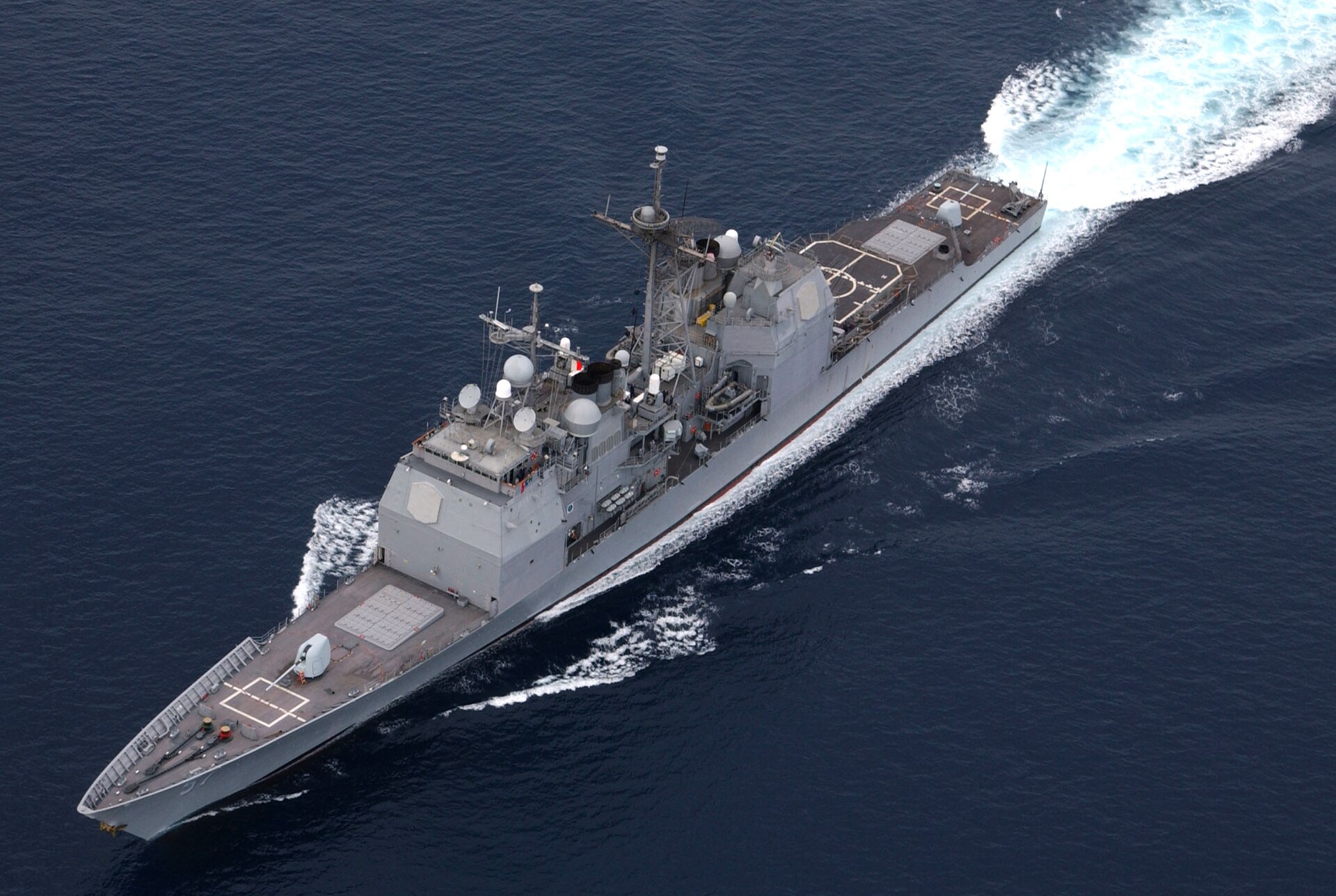
Aegis, named after the legendary protective shield of Zeus, is deployed on over 80 serving naval ships around the globe, with many more Aegis-equipped ships planned or under contract. It’s the primary weapons control system on board American Ticonderoga Class Cruisers (CG-47) and Arleigh Burke Class Destroyers (DDG-51), as well as Japan’s Kongo & Atago Class destroyers, Korea’s KDX-III Class destroyers, Norway’s Fridtjof Nansen Class frigates, and Spain’s F-100 Alvaro de Bazan Class frigates. Australia’s Hobart Class F100 derivatives will join this set shortly.
The heart of these ships’ defensive suites is the AN/SPY-1 Radar System, a 3D air/surface search and tracking radar. This high-powered phased array radar is able to perform search, track and missile guidance functions simultaneously, with the ability to track over 100 targets at over 100 miles. Terminal guidance depends on mounted illuminators, since current SM-2 missiles are limited to semi-active radar homing.
The other key to Aegis is the Aegis combat system software, which takes input from a number of systems in order to create a unified picture of the threat environment. AEGIS equipped ships are key elements in modern carrier and battleship battle groups, providing fleet area defense and communicating an integrated air picture for more effective deployment of naval aircraft.
Most Aegis suites can be converted to missile defense, with the addition of hardware upgrades and a set of software updates. We refer to these upgraded systems as AEGIS BMD. The AN/SPY-1B radar variants that equip Ticonderoga class cruisers CG 59-73, and the AN/SPY-1D variant that equips DDG-51 destroyers and foreign Aegis ships in Japan, South Korea, and Spain, can be upgraded to support missile defense. On the other hand, the AN/SPY-1A radar on some Ticonderoga class cruisers is reportedly ineligible. The much smaller AN/SPY-1F hasn’t received a BMD upgrade design, and may or may not be capable.
Aegis was designed from the outset to operate with the Standard missile family, and both systems reach their maximum potential when deployed together. The current mainstay for air defense is the SM-2 Block IIIB. For missile defense, the longer-range SM-3 is the system’s main option, and it’s capable of exo-atmospheric kills up to 200 miles away, as ballistic missile prepare to re-enter the atmosphere. The “Burnt Frost” intercept showed that modified SM-3s were even capable of killing satellites in lower orbits.
A new variant of the SM-2 Block IV is being revived and fielded as the Near Term Sea-Based Terminal weapon (NT-SBT), for last-phase endo-atmospheric intercepts as the warhead descends toward its target. The new SM-6 will begin taking over that terminal defense role as of 2015.
As a ship combat system, Aegis can and does operate with a variety of other weapons, but Raytheon’s Standard family missiles are the only ones with ballistic missile defense capabilities.
AEGIS BMD: Versions & Capabilities

note rocket booster
AEGIS BMD went to sea with its initial operating capability in October 2004. During at-sea tests, the system and its missiles have been successful in 25/31 interception attempts – and 80.6% success rate.
AEGIS BMD 3.0. Its Long Range Surveillance & Tracking (LRS&T) wasn’t recommended for engaging ballistic missiles, but it reportedly extended the ship’s radar tracking range to 500 km/ 300 miles. That allowed equipped vessels to support engagements by other ships. Over time this version was phased out, as AEGIS BMD ship systems were upgraded.
AEGIS BMD 3.6 Supports full engagement, and was certified for tactical deployment by the U.S. Navy and the USA’s Missile Defense Agency in September 2006. The most recent certified version as of November 2014 is AEGIS BMD 3.6.3. This system retains long range tracking, can engage enemy missiles, and adds the capability to target short-range ballistic missiles as they re-enter the atmosphere in their final stage of flight. This allows them to make full use of SM-2 Block IV variants like NT-SBT, alongside longer-range options like the SM-3. Testing has demonstrated some unplanned bonus capabilities, including the ability to launch using another system’s tracking data, and to intercept MRBMs (1,000 – 3,000 km range).
AEGIS BMD 4.x Improvements include both hardware inserts and software development. Incorporation of the Aegis Ballistic Missile Defense Signal Processor (Aegis BSP) into the AN/SPY-1 radar helps the system detect, track and classify objects more effectively, in order to defeat more complex ballistic missile threats like decoys and multiple warheads. The Aegis BSP, which has been installed in all new Aegis destroyers beginning in 2010, is an open architecture design. BMD 4.x also adds an adjunct computing suite that will continue AEGIS BMD’s migration toward open architecture electronics, and supports the improved SM-3 Block IB missile. The 4.0.2 sub-version on a number of current ships changes the timing of SM-3 rocket pulses, as a response to the FTM-16E2 test failure.
BMD capability will be included in modernized, open architecture combat systems in Aegis cruisers and destroyers starting in 2012, and even US Navy Aegis ships that are not slated for BMD will be changing over to a full open architecture (OSA/ MOSA) system as part of ongoing upgrades to the DDG-51 and CG-47 ships. The move lets the Navy buy commercial electronics components from a much wider variety of suppliers, saving money and ensuring easier future upgrades.
AEGIS BMD 5.0. AEGIS BMD 5.0 is expected to complete the system’s open architecture shift, with a new multi-mission processor and new computing workstations and display systems. There are proposals to upgrade all American Aegis ships with AN/SPY1B/D radars to have AEGIS BMD capability, so the full OSA/MOSA migration could prove significant.
In 2015 – 2016, a BMD 5.0 CU upgrade will restore terminal phase intercept capability within the atmosphere, allowing ships to use the SM-6 as a 2nd line of defense. This upgrade is also known as Aegis Baseline 9.C1, and has already been fitted to some ships, but they haven’t tested terminal intercept capability yet.

(click to view full)
AEGIS BMD 5.1. The next big step forward for AEGIS BMD will be a new missile, coupled with the AEGIS BMD 5.1 software. The SM-3 Block IIA will use a different design that’s 21″ in diameter, instead of 13.5″ like the Block Is. That will allow for more powerful rocket motors, and considerable increases in range. The SM-3 Block I is mostly designed for use against short and medium-range ballistic missiles (SRBMs/MRBMs), and lacks the range to defend countries like Poland or The Czech Republic from the sea.
The Block II’s range will put most of the Czech Republic and Poland within range of inshore ships, and could allow just 2 ships to offer full coverage of Japan. Its improved range and speed will add effectiveness against Intermediate Range Ballistic Missiles (IRBMs) that have ranges of 3,000 – 5,000 km, as well as some capability against full Intercontinental Ballistic Missiles (ICBMs). It’s due in 2018.
AEGIS BMDS: The Program

(click to enlarge)
Tracking program spending on ship modifications is difficult to do in isolation, as Pentagon budget documents tend to treat “AEGIS BMDS” as a single category, which includes both ship upgrades and SM-3 missiles. The floating “SBX” radar deployed in the Pacific is also used in naval ballistic missile defense, but it is not an Aegis system and so does not come under AEGIS BMD budgets.
Based on Pentagon documents and outside sources, funding patterns include R&D, ship conversions, and SM-3 missile purchases. A GAO study gives totals over the years as:
FY 1995: $75 million.
FY 1996: $200.4 million.
FY 1997: $304.2 million.
FY 1998: $410 million.
FY 1999: $338.4 million.
FY 2000: $380 million.
FY 2001: $462 million.
FY 2002: $476 million.
FY 2003: $464 million.
FY 2004: $726.2 million.
FY 2005: $1.16 billion.
Beyond that:

The US MDA states that an in-service Aegis ship with no BMD capability can be given AEGIS BMD 3.6.1 capability for about $10 million to $15 million, or a AEGIS BMD 4.0.1 capability for about $53 million. An in-service ship with AEGIS BMD 3.6.1 installed can be upgraded to AEGIS BMD 4.0.1 for about $45 – $55 million more, for a total upgrade cost of $55 – $70 million if you have to do it twice.
BMD Ships & Deployment

We talked to the US Navy in order to confirm the ships, homeports, and combat system details of the fleet’s ships. As of October 2013, every ship from DDG 51 – DDG 77 will have received AEGIS BMD or have entered conversion. Conversions will continue within the fleet, and new ships under the current multi-year contract for DDG 117 – DDG 123 will all be delivered with BMD capabilities pre-installed – likely 5.0CU to start.
It has been a steady rvolution for the fleet, as it morphs toward its new “shield of the nation” role.
In March 2007, just 6 American warships had the ability to engage ballistic missiles, while another 10 were equipped with AEGIS Long Range Surveillance & Tracking version 3.0.
By July 2009, the number of fully BMD-capable ships had grown to 18, with 42 SM-3 missiles and 47 SM-2 Block IV variants available for use.
By the time CRS issued its FY 2012 report, there were 22 ships with AEGIS BMD 3.6.1, 2 with BMD 4.0.1, a store of 104 SM-3 missiles (92 Block IA and 12 Block IBs) to accompany about 100 SM-2 Block IVs.
The FY 2012 budget brought the total number of ordered BMD ship conversions to 35, and a combination of conversions, upgrades, and new-build ships will keep growing that number. From a FY 2013 CRS report:

In the end, these CRS charts reinforce the belief that a significant portion of America’s destroyer and cruiser fleets will eventually receive these upgrades. Indeed, the US Navy’s FY 2015 – 2043 long-term plan will plateau between 80 – 97 BMD-capable ships.
AEGIS BMD Test History

Beyond the USA

(click to view full)
American ballistic missile defense ships won’t be alone on the seas. Japan has its own AEGIS BMD program, and began full installation of AEGIS BMD 3.6.1 systems in its Kongo Class Aegis destroyers in 2007. All 4 ships have now finished their installations, deployed SM-3 Block I missiles, and participated in BMD tests. The Japanese are also partnered with the USA to develop the SM-3 Block II: a larger, faster missile variant with an improved kill vehicle. This implies long-term upgrades for JMSDF combat systems to AEGIS BMD 5.1.
According to the US Congressional Research Service, other countries that the US military views as potential naval BMD operators of American equipment include the United Kingdom (Type 45 Daring Class, PAAMS/Aster-30 and possibly SM-3 too), the Netherlands (De Zeven Provincien Class, Thales BMD/SM-x), Spain (F100 Class, AEGIS BMD/SM-x), Germany (F124 Class, Thales/SM-x), Denmark (Ivar Huitfeldt Class, Thales/SM-x), South Korea (KDX-III, AEGIS/SM-6 confirmed), and Australia (Hobart Class, AEGIS/SM-6 confirmed, could add SM-3). Note that all countries listed here as potential operators could add SM-3s to Mk.41 vertical launch systems on board, as well as shorter-range SM-6 point defense BMD missiles. Infrastructure for one equals infrastructure for the other.
Aegis ships operate variants of the passive array SPY-1D radar, and one country has already taken steps. Spain already has ships equipped with AEGIS Long Range Surveillance & Tracking version 3.0, and ESPS Menendez Nunez has participated in US missile defense exercises as a tracking ship. The non-Aegis European countries mentioned here use variants of Thales’ SMART-L for long-range scans, coupled with modern active-array fire control radars. The Dutch De Zeven Provincien Class ship HNLMS Tromp has participated in US missile defense exercises as a tracking ship, sporting its Thales combat system and advanced Thales APAR/SMART-L active array radars. The Dutch are currently working to extend the class’ radar range even farther, in preparation for full BMD capabilities.
The US CRS omits France and Italy, even though they host the PAAMS combat system and BMD-capable Aster-30 missile on their 4 Horizon Class ships. France is also committed to building a national BMD system, so their omission is especially puzzling.
Contracts & Updates
FY 2015 – 2025
May 5/25: Lockheed Martin’s Rotary and Mission Systems division in Moorestown, New Jersey, has received an additional $9.96 million to support a previous Navy contract. The funding will go toward continued engineering work, software updates, maintenance, integration, logistics, and deployment support for the AEGIS combat system, which is already in use or being delivered to the Navy. This contract includes funding from two US allies: Japan is contributing 69% (about $6.83 million), and South Korea is contributing 31% (about $3.13 million). All work will be carried out in Moorestown and is expected to be finished by December 31, 2025. The US Naval Sea Systems Command in Washington, DC, is overseeing the contract, which was awarded on April 28, 2025.
March 28/25: Lockheed Martin has demonstrated the hypersonic defense capabilities of its Aegis Combat System in a US Navy test conducted aboard the USS Pinckney destroyer. The live exercise, dubbed Flight Test Other-40 (FTX-40) or “Stellar Banshee,” simulated a real-world engagement with a hypersonic medium-range ballistic missile target. Supported by the Missile Defense Agency and industry partners, the demonstration involved using the Aegis system with a simulated SM-6 Block IAU interceptor to detect, track, and engage the hypersonic threat. The Aegis multi-mission combat system combines various sensors and weapons to provide integrated air and missile defense with both sea-based and land-based configurations.
February 5/25: Lockheed Martin won a $25 million modification to keep working on the AEGIS system for ships. This work includes keeping the system running well, making sure all parts work together, writing instructions and helping people use it. The Navy office in Washington, D.C. that handles ship-related contracts gave them this extra work on January 30, 2025.
January 23/25: Lockheed Martin won a $92 million modification for AEGIS combat system configurations. This contract combines purchases for the governments of Japan, South Korea and Australia under the Foreign Military Sales (FMS) program. Work will be performed in Moorestown, New Jersey, and is expected to be completed by December 2025. Naval Sea Systems Command, Washington, DC, is the contracting activity.
January 20/25: Lockheed Martin won a $280.4 million for combat systems engineering efforts of the planned modernization and new combat system capabilities selection for international partner Canadian Royal Navy ships operating AEGIS. Work will be performed in Moorestown, New Jersey and is expected to be completed by January 2028. Naval Sea Systems Command, Washington, DC is the contracting activity.
October 29/24: Lockheed Martin won a $21 million contract for in-Service AEGIS combat system baseline sustainment, Baseline 10 System Integration and Fielding, and product documentation. Work will be performed in Moorestown, New Jersey, and is expected to be completed by December 31, 2024. Naval Sea Systems Command, Washington DC, is the contracting activity.
September 6/24: The US State Department has agreed a Foreign Military Sale (FMS) of follow-on technical support for Japan’s Aegis-class destroyer fleet, at an estimated cost of $150 million. The sale will include sustainment support and services, Aegis computer software updates, system integration and testing, in-country and on-site engineering support, familiarisation and sustainment. Additional, the deal will involve all necessary emergent support engineering and technical support services, operational support, system overhauls and upgrades, and on-the-job practical operations and maintenance. The payment will also buy Japan combat systems integration, development, testing, and installation of program patches; adaptation data and annual service agreements; coverage of any technical inquiries, operation, integration and maintenance; field service engineering, problem investigation and solutions to the technical problems arising from post-production; and testing capabilities. US government and contractor technical assistance will form a vital part of the package.
July 16/24: NATO announced the official operational status of a new US ballistic missile defense site in Redzikowo, Poland. The Aegis Ashore facility strengthens NATO’s integrated missile shield designed to detect, track, and intercept ballistic missile threats. NATO Secretary General Jens Stoltenberg underscored the significance of this development, highlighting its contribution to transatlantic security and collective defense. He emphasized the growing threat posed by ballistic missiles, particularly in light of recent conflicts, and stressed the importance of missile defense as a core element of NATO’s mission.
June 5/24: Lockheed Martin won a sole-source, firm-fixed-price contract modification under Aegis Ballistic Missile Defense (BMD) weapon systems contract HQ085121C0002. The total value of this contract modification is $8 million. Work will be performed in Moorestown, New Jersey, with an expected delivery date of June 1, 2025. The Missile Defense Agency, Dahlgren, Virginia, is the contracting activity.
April 25/24: Lockheed Martin Rotary and Mission Systems won a $102 million deal for capability package development and fielding, system integration and fielding, and in-service sustainment in support of current configurations of the AEGIS combat system. Work will be performed in Moorestown, New Jersey, and is expected to be completed by Dec. 31, 2024. Fiscal 2024 research, development, test and evaluation (Navy) funds in the amount of $24,803,348; fiscal 2020 shipbuilding and conversion (Navy) funds in the amount of $6,183,214; fiscal 2024 operation and maintenance (Navy) funds in the amount of $2,029,852; fiscal 2023 research, development, test and evaluation (Navy) funds in the amount of $999,114; fiscal 2017 shipbuilding and conversion (Navy) funds in the amount of $394,513 and fiscal 2019 shipbuilding and conversion (Navy) funds in the amount of $9,546 will be obligated at time of award, and funds in the amount of $3,028,966 will expire at the end of the current fiscal year. The Naval Sea Systems Command, Washington, DC, is the contracting activity.
February 22/24: Raytheon won a $38.2 million order for the procurement of AEGIS modernization kits for Navy guided-missile destroyers and allied nations. This contract combines purchases for the US. Navy; and the governments of Japan and Australia, under the Foreign Military Sales (FMS) program. Work is expected to be completed by February 2028. Naval Sea Systems Command, Washington DC, is the contracting activity.
January 11/24: Lockheed Martin won a $101.5 million deal for AEGIS development and test sites operation and maintenance. Work will be performed in Moorestown, New Jersey and is expected to be completed by January 2028. The Aegis Combat System is an advanced integrated naval weapons system developed by the United States. It is primarily designed for missile defense, but it also has capabilities for anti-air, anti-surface, and anti-submarine warfare. The Aegis system is used on various naval vessels, including cruisers and destroyers.
December 26/23: Lockheed Martin won a $141.5 million modification to exercise options for capability package development and fielding, system integration and fielding, and in-service sustainment in support of current configurations of the AEGIS combat system. Work will be performed in Moorestown, New Jersey, and is expected to be completed by December 31, 2024.
November 21/23: Fielding Lockheed Martin won a $30.5 million modification for capability package development and fielding, system integration and fielding, and in-service sustainment in support of current configurations of the AEGIS combat system. Work will be performed in Moorestown, New Jersey, and is expected to be completed by December 31, 2024. Naval Sea Systems Command, Washington, DC is the contracting activity.
September 6/22: ACB Lockheed Martin won a $17.6 million modification, which will exercise options for ship integration and test of the Aegis Weapon System (AWS) for AWS baselines through Advanced Capability Build (ACB) 16. Work will take place in New Jersey, Virginia, California, Washington DC, Mississippi, Florida and Maine. Estimated completion will be by May 2023.
August 12/22: Engineering Services Lockheed Martin won a $12.9 million deal for AEGIS design agent field engineering services. Aegis is an integrated missile guidance system used on US Navy and allied ships to protect the battle group. Work will take place in Virginia, California, Hawaii, Japan, Washington and California. Estimated completion date is in September 2023.
June 29/22: CSEA Lockheed Martin won a $13.3 million cost-plus-incentive-fee modification to previously awarded contract N00024-13-C-5116 for AEGIS Combat System Engineering Agent (CSEA) efforts. Work will take place in New Jersey. Expected completion will be by December 2022. The Naval Sea Systems Command, Washington, DC, is the contracting activity.
June 20/22: Modernization Lockheed Martin Rotary and Mission Systems won a $62 million deal for fiscal 2022 AEGIS modernization, DDG new construction, and Frigate new construction production requirements. Work will take in New Jersey and Florida. Estimated completion will be by September 2025.
April 14/22: CLIN Increase Lockheed Martin won a $13 million contract modification under the previously awarded Aegis Weapon Systems contract HQ085121C0002. This in scope modification increases the ceiling on Contract Line Item Number (CLIN) 0012. This CLIN and contract modification will be incrementally funded at time of award. Work will take place in New Jersey. Estimated completion is October 31, 2022.
March 30/22: Advanced Capability Build 20 Lockheed Martin won a $92.5 million contract modification for Aegis Combat System Engineering Agent efforts for the design, development, integration, test and delivery of Advanced Capability Build 20. The Aegis Combat System is an American integrated naval weapons system. It uses powerful computers, radar and digital signal processing algorithms to track and guide weapons to destroy enemy targets. Work will take place in New Jersey. Expected completion is by December 2022.
March 9/22: Support Raytheon won a $13.6 million deal, which provides test, evaluation and systems engineering support, to include mission planning, test plans and procedures, mission conduct and data collection, real-time range safety mission support, mission data analyses and reporting, operations research support, and technical management support for the Missile Defense Agency/AEGIS Ballistic Missile Defense Program. Work will take place in California, Hawaii, New Mexico. Expected completion date is in March 2026.
February 3/22: SPY-7 Lockheed Martin said it integrated demonstrated the integration of the AN/SPY-7(v)1 radar into Japan’s Aegis Weapon System. Through the demonstration, the company said it executed the processing required to detect, track and discriminate ballistic missile threats, and successfully guide interceptors to those threats.
November 24/21: Advanced Capability Build 20 Lockheed Martin won a $114.6 million modification to exercise an option for AEGIS Combat System Engineering Agent efforts for the design, development, integration, test and delivery of Advanced Capability Build 20. The Aegis Combat System is the Navy’s most modern surface combat system. It was designed as a complete system: the missile launching element, the computer programs, the radar and the displays are fully integrated to work together. This makes the Aegis system the first fully integrated combat system built to defend against advanced air and surface threats. The word “aegis” comes to use from classical mythology. Aegis is the name of the shield of the sky god and war goddess of the ancient Greeks and Romans. Work will take place in New Jersey. Expected completion will be by December 2022.
October 4/21: Australia Surface Combatant Program Lockheed Martin won a $28.7 million contract for engineering and technical services for land based test site support for the Australia Surface Combatant Program AEGIS Combat and Weapon System baseline development. This contract involves Foreign Military Sales to the government of Australia. Work will take place in New Jersey, Ohio, Maryland and Florida. Estimated completion will be by September 2025.
August 6/21: Japan The US State Department has made a determination approving a possible Foreign Military Sale to the government of Japan of AEGIS Class Destroyer Support and related equipment for an estimated cost of $134 million. The Defense Security Cooperation Agency delivered the required certification notifying Congress of this possible sale.
August 3/21: CSEA Lockheed Martin won a $108.8 million modification for AEGIS combat system engineering agent (CSEA) efforts for the design, development, integration, test and delivery of Advanced Capability Build 20. The Aegis combat system uses powerful computers and radar to track and guide weapons to destroy enemy targets. More than 100 Aegis-equipped ships have been deployed in five navies worldwide. Aegis, not an acronym, refers to the shield of the mythical Greek God Zeus. Work will take place in Moorestown, New Jersey. Expected completion date will be in December 2021.
April 20/21: Japan Lockheed Martin won a $66 million contract modification for Japan’s AEGIS weapons system. The deal extends performance and expands Aegis FMS in-scope work including Aegis Combat System computer program development and radar integration/test support services under new contract line item numbers. Case JA-P-NCO funds in the amount of $65,354,942 are being obligated at the time of award. Work will take place in New Jersey. The period of performance will be through through December 31, 2022.
April 8/21: AMOD Lockheed Martin won a $79.3 million deal for AEGIS modernization (AMOD) and guided missile destroyer new construction production requirements. The contract combines purchases for the US government; and the government of the Commonwealth of Australia under the Foreign Military Sales (FMS) program. The Aegis Combat System is an American integrated naval weapons system developed by the Missile and Surface Radar Division of RCA, and now produced by Lockheed Martin. It uses powerful computer and radar technology to track and guide weapons to destroy enemy targets. Work will take place in New Jersey, Florida and is expected to be finished by March 2025.
March 31/21: Build 20 Lockheed Martin won a $67.5 million contract modification to exercise an option for the Advanced Electronic Guidance and Instrumentation System (AEGIS) — Combat System Engineering agent efforts for the design, development, integration, test, and delivery of the Advanced Capability Build 20. The Aegis Combat System is an American integrated naval weapons system developed by the Missile and Surface Radar Division of RCA, and now produced by Lockheed Martin. Work will take place in New Jersey. Estimated completion date is December 31, 2021.
December 28/18: Aegis Mk-99 FCS The US Navy is continuing with its Aegis modernisation efforts. Raytheon is being awarded with a $72.5 million contract that sees for the production of the systems’ fire control system. The Mk 99 Fire Control System (FCS) is an essential component of a ship’s Aegis combat system. The FCS gives Aegis its deadly punch by controlling the loading and arming of the used weapon, it launches the weapon and provides terminal guidance for anti-air-warfare missiles. Work will be performed at multiple locations – including, but not limited to – Andover, Massachusetts; San Diego, California and Chesapeake, Virginia. Performance is scheduled for completion by April 2022.
December 4/18: Aegis ACB support Lockheed Martin is receiving a contract modification to exercise options for ship integration and test of the Aegis Weapon System (AWS). Issued by the Naval Sea Systems Command, the $20.5 million modification supports Aegis baselines through Advanced Capability Build (ACB) 12. Efforts covered under this contract include shipboard integration engineering; Aegis test team support; Aegis modernization team engineering support; ballistic missile defense test team support and AWS element assessments. The contract provides for work on five new-construction DDG 51-class ships and for modernisation work on another five Arleigh Burke-class destroyers. The deal also covers integrated combat system modifications and upgrades for all ships with Aegis baselines up to and including advanced capability build 12. The AWS is a centralized, automated, C2 and weapons control system featuring a radar that can perform search, track and missile guidance functions simultaneously, with a track capacity of more than 100 targets. Work will be performed at multiple locations – including, but not limited to – Bath, Maine; San Diego, California and Deveselu, Romania.
September 26/18: AEGIS The Naval Sea Systems Command is modifying a contract that sees for the development of the Aegis Advanced Capability Build (ACB) 20. The contract modification awarded to Lockheed Martin is valued at $78.3 million and provides for the design, development, integration, testing and delivery of the new capability build. ACB 20 is the next effort in the Aegis modernization program. It will integrate the new AN/SPY-6 radar, RIM-162 ESSMs, and CIWS sensor data. This development effort is planned for fielding on new construction Aegis DDG 51 Flight III ships that will enter service in 2023. Work will be performed at Lockheed’s facility in Moorestown, New Jersey and is expected to be completed by December 2021.
September 5/18: Engineering support Lockheed Martin will perform a variety of engineering services in support of the Navy’s AN/SPY-1 radar. The cost-plus-fixed-fee job order is valued at $12.9 million and is expected to be completed by August 2023. The AN/SPY-1 is at the heart of the Aegis ballistic missile defense system. The 3D air/surface search and tracking radar is able to perform search, track and missile guidance functions simultaneously, and has the ability to track over 100 targets to over 100 miles. Terminal guidance depends on mounted illuminators, since current SM-2 missiles are limited to semi-active radar homing. The effort provides for radar readiness enhancements and improvements. Work will be performed at Lockheed’s facility in Moorestown, New Jersey.
August 9/18: More cash for Aegis The Missile Defense Agency is procuring further efforts for the Aegis Ballistic Missile Defense (BMD) from Lockheed Martin. The cost-plus award fee valued at $15.8 million provides for the procurement of materials and work necessary to support the BMD Increment 3 Capability Concept Development; and raises the total cumulative contract value to $2.8 billion. Aegis can simultaneously attack land targets, submarines, and surface ships while automatically protecting the fleet against aircraft, cruise missiles, and ballistic missiles. Aegis has become a widely-deployed top-tier air defense system, with customers in the USA, Australia, Japan, South Korea, Norway, and Spain. Work will be performed at the company’s location in Moorestown, New Jersey and is scheduled for completion by the end of this year.
June 28/18: FMS request by Spain The government of Spain is looking into purchasing five Aegis Weapon Systems from the US. The DSCA announced that it has made a determination to approve the requested foreign military sale valued at $860,4 million. Aegis, named after the legendary protective shield of Zeus, is deployed on over 80 serving naval ships around the globe. It equips Spain’s fleet of F100 Alvaro de Bazan Class frigates. Its radar system can perform search, track and missile guidance functions simultaneously, with the ability to track over 100 targets at over 100 miles. The Aegis combat system software takes input from a number of systems in order to create a unified picture of the threat environment. The proposed deal also includes the purchase of MK 54 torpedoes, SM-2 Block IIIB missiles and countermeasure systems. Spain currently operates five Aegis frigates and is proficient at using the AEGIS system to its fullest capability. The prime contractors will be Lockheed Martin, Raytheon and General Dynamics.
May 17/18: Zeus upgrades his shield The Missile Defense Agency (MDA) is contracting Lockheed Martin’s Rotary and Mission Systems Division in support of the Aegis Ballistic Missile Defense system. The awarded modification of $12.8 million allows for the procurement of material necessary to support the Aegis 6.0 modelling and simulation. Aegis, named after the legendary protective shield of Zeus, Aegis has become a widely-deployed top-tier air defense system. It is deployed on over 80 serving naval ships around the globe, with many more Aegis-equipped ships planned or under contract. The Aegis combat system software takes input from a number of systems in order to create a unified picture of the threat environment. Aegis equipped ships are key elements in modern carrier and battleship battle groups, providing fleet area defense and communicating an integrated air picture for more effective deployment of naval aircraft. Modeling and simulations are computer representations that simulate the system’s performance to assess the capabilities and limitations of how elements or the BMDS perform under a wider variety of conditions than can be accomplished through the limited number of flight tests conducted. Ground tests enable MDA to repeatedly conduct scenarios that may be too costly or subject to constraints as a flight test. The modification increases the total cumulative contract value to $2.8 billion. Work will be performed in Moorestown, New Jersey and is scheduled for completion by September 2018.
January 3/18: Contracts-Sustainment Support Lockheed Martin received last Thursday, a $20.5 million contract for upgrades and services for the AEGIS weapon system (AWS). Under the terms of the agreement, Lockheed will provide for logistics and sustainment support for the in-service AEGIS ship fleet in order to prevent delays in the delivery of the AWS upgrades and schedule and operational impacts to the effected ship availabilities. Options, if exercised, will bring the cumulative value of the contract to $27.05 million. Work will be performed in Moorestown, New Jersey, with contract completion scheduled for December 2018.
November 8/17: Japan’s Defense Minister Itsunori Onodera is scheduled to visit the US Navy’s Aegis Ashore test facility in Hawaii during a visit to the volcanic archipelago US state next January. Washington conducts missile intercept tests at the complex on Kauai Island, and Onodera will visit to learn more about the operation of the system and issues it should take into account when introducing the system to its self-defense forces. Tokyo is keen to procure the system as part of its land-based air defense network from North Korean ballistic missiles.
August 31/17: Japan is seeking powerful new radar from the US to boost the operational range of its planned procurement of a land-based version of the Aegis ballistic missile defense (BMD) system, due in 2023. So far, previous efforts by Tokyo to acquire the AN/SPY-6 AESA radar have not come to fruition, leaving them to rely on existing radar technology that has less range than a new generation of BMD interceptor missiles available. While the US Navy is seemingly behind Japan receiving the technology, there may be a reluctance from the MDA, which is responsible for developing BMD technology, to release such advanced technology before it is fully fielded by the US. Developed by Raytheon and integrated into the Aegis system by Lockheed Martin, SPY-6 radars will also form part of the Pentagon’s new Aegis-equipped Arleigh Burke-class destroyers, due to be operational in 2022. In order for Japan to receive the Spy-6 in time for the planned deployment of its Aegis Ashore system in 2023, it will need to be cleared long before that 2022 date, in order to give the manufacturers time to build the system.
May 25/17: General Dynamics Ordnance and Tactical Systems has received a $40.8 million modification to an existing contract for production of the MK 82/MK 200 Missile Fire Control System director controller equipment. The Navy contract calls for the delivery of fully functional systems with testing and engineering support and covers systems scheduled to be delivered as part of the Aegis Weapon System for the Republic of Korea and Japan under the Foreign Military Sales Program. The work is not expected to affect current ship deployment or operational use and is expected to be completed by December 2021.
April 30/17: Japan is moving ahead with a study into the possibility of deploying the Aegis Ashore missile defense system in the country. Seen as a cheaper alternative to the high profile deployment of the Terminal High Altitude Area Defense (THAAD) system in South Korea, only two Aegis sites (compared with six THAAD sites) would be needed to cover the entire country from a potential ballistic missile launch from North Korea. At present, Tokyo’s air defense network includes naval-based Aegis destroyers as well as the Patriot system. However, the inclusion of a permanently deployed, land-based Aegis system will allow Japanese forces to respond much quicker to any incoming missile threats.
December 19/16: Recent testing on board the USS John Paul Jones by the US Missile Defense Agency have successfully demonstrated the ability of the Aegis baseline 9.C1 to tackle against a “complex medium-range ballistic missile target. A salvo of two SM-6 Dual I interceptors was fired during the December 14 exercise, using their explosive warheads to defeat the target. Program officials will continue evaluating system performance based upon telemetry and other data obtained during the test.
October 19/16: October 19/16: Aegis or THAAD? With the expectation that Tokyo will request additional money external link to fund missile defense upgrades to repel North Korean ballistic missiles, a study will be funded on whether to buy the Terminal High Altitude Area Defence (THAAD) system or Aegis Ashore. It’s believed that money will also be provided to improve their existing PAC-3 air defense system as well. However, any purchases or modernizations will take time to implement as North Korea continues with its escalation of missile tests.
September 7/16: The US Navy will field-test the latest Aegis Baseline 9.2C alongside the first intercept test for the SM-3 Block 2A interceptor next month. A new feature added to the software build is the “engage-on-remote” capability that will allow the SM-3 missile to target a ballistic missile during data derived from another sensor such as a satellite. However October’s test will not see that feature tested.
August 22/16: The US Missile Defense Agency (MDA) has scheduled the testing of the SM-3 Block 2A ballistic missile defense interceptor this October. A joint development involving both the MDA and Japan, the interceptor has been previously flight tested twice by the agency without any target intercepts initially planned. October’s test will see it engage and destroy a medium-range ballistic missile target. If successful, the SM-3 will be in full-rate production in 2017.
August 18/16: Lockheed Martin has received $112 million as part of the 2016 Aegis modernization program. The US Navy contract modification covers the production of multi-mission signal processor equipment sets, ballistic missile defense 4.0.2 equipment, Aegis weapon system modernization upgrade equipment, as well as associated spares to support the fielding of Aegis modernization capabilities to the fleet. Under the program, vessels receiving the upgraded systems will experience increased computing power as well as improved detection and reaction capabilities of its radars.
August 17/16: Japanese and South Korean destroyers are to receive the latest variant of the Aegis combat system after contracts were issued by the US DoD. Two upcoming Japanese and three new Korean vessels will receive the Aegis Baseline 9 system alongside all future US Navy destroyers. Completion of the $490 million deal is expected for June 2022.
June 27/16: Lockheed Martin has been awarded a $357 million contract for Advanced Electronic Guidance and Instrumentation System (AEGIS) in-service combat systems for several nations. The contract will see the company provide computer program maintenance, annual inspection and regular overhaul execution support, in-country support, and staging. Replacement of legacy cathode ray tube character readout devices for Japan, logistics depot support for Norway unique line replaceable unit, and AEGIS implementation studies for future Foreign Military Sales (FMS) AEGIS shipbuilding programs to fulfill AEGIS lifetime support requirements of the Japan Maritime Self Defense Force, Republic of Korea Navy, Spanish Armada, Royal Australian Navy, and Royal Norwegian Navy. Completion is expected for November 2019.
June 2/16: Raytheon has been awarded a $365.8 million contract for the production of Aegis Weapon System AN/SPY-1D(V) Radar Transmitter Group, Missile Fire Control System MK 99 equipment, and associated engineering services. The contract combines purchases for the US Navy, South Korea, and Japan and contain options that could amount to $423 million. Completion of the contract is expected by October 2022.
May 26/16: USS John Paul Jones was used to validate the ability of the Aegis Baseline 9 to track Medium Range Ballistic Missile (MRBM) targets within the Earth’s atmosphere recently. Supported by the Navy, Missile Defense Agency, and Lockheed Martin the use of the missile destroyer marks the first demonstration of Aegis’s ability to conduct a complicated tracking exercise against an MRBM during its endo phase of flight. The development comes as targets and threats have become more advanced, with Aegis BMD evolving over the last 20 years from a tracking experiment to today’s capability in which it can detect, track and engage targets.
December 9/15: The crew of the USS John Paul Jones got quite a workout while testing the Aegis combat system during an exercise off Wake Island on October 31. They first intercepted a short range air launch target (SRALT) missile with the THAAD missile defense system. The Aegis was then tested as a C-17 then launched an extended medium range ballistic missile (EMRBM) through the debris of the first intercept. If that wasn’t enough, the crew were simultaneously engaging a BQM-74E air-breathing target with a Standard Missile-2 Block IIIA guided missile at the time. The tests were aimed at improving and enhancing the Aegis Ballistic Missile Defense, which is the naval component of the Missile Defense Agency’s Ballistic Missile Defense System.
Nov 6/14: FTM-25. USS John Paul Jones [DDG 53] successfully engages 1 short-range ballistic missile target with an SM-3 Block IB missile, and 2 cruise missiles with a par of SM-2 Block IIIAs, in the FTM-25 Stellar Wyvern test.
DDG 53 has the Aegis 9.C1 combination, which represents the next evolutionary step. It finishes the system’s open architecture shift, adding a new multi-mission processor and new computing workstations and display systems. The upgrade’s goal is to rapidly switch between BMD and the area air defense role, allowing full use of SM-6 missiles in a terminal BMD role as well as multiple engagements like this one.
Other test participants included discriminating sensors flown on two MQ-9 Reaper unmanned aerial vehicles and sensor systems ashore; Command and Control, Battle Management, and Communications (C2BMC) Enterprise Sensors Lab; C2BMC Experimentation Lab; and the Aegis Ashore Missile Defense Test Complex located at PMRF. Sources: US MDA, “Aegis Ballistic Missile Defense System Completes Successful Intercept Flight Test” | Defense Update, “System upgrades are key in Aegis destroyer’s success defeating ballistic, cruise missile raid on the recent test”.
Oct 17/14: FTX-20. USS John Paul Jones [DDG 53] engages in the FTX-20 tracking test of a ballistic missile target, testing both the combined Aegis 9.C1 combat system (Aegis Baseline 9 with BMD 5.0 Capability Upgrade), and the ability to launch and engage based solely on tracks from remote airborne sensors.
Other test participants included the Sea-Based X-band Radar (SBX), Space Tracking and Surveillance System (STSS) Demonstrators; Discrimination Sensor Technology (includes a UAV – likely MQ-9 – with an MTS-B optical sensor turret); Command and Control, Battle Management, and Communications (C2BMC) Enterprise Sensors Lab; C2BMC Experimentation Lab; and the Aegis Ashore Missile Defense Test Complex located at PMRF. Sources: US MDA, “Aegis Ballistic Missile Defense System Detects and Tracks Medium-Range Ballistic Missile Target”.
FY 2014
BMD 5.0 contracted for development, but won’t become universal; CRS highlights program cuts, GAO highlights software glitches and Euro deployments.
[youtube:v=JVaxpBrGF5I]
Jan 15/15 29/14: Raytheon announced that the Navy has approved the SM-6 for additional Aegis systems, to include those Arleigh Burke-class guided missile destroyers from the 1994-keel-laid The Sullivans (DDG-68) onward.
This appears to put to rest concerns that the Zumwalt-class (DDG-1000) program wouldn’t be able to employ (see “Weapons” section) the standard family of missiles.
Sept 29/14: Lockheed Martin Mission Systems and Training in Moorestown, NJ receives an $8.1 million contract modification for a single FY 2015 AEGIS BMD 4.0.2 ship installation, bringing the contract’s total value to date to $2.0106 billion.
Work will be performed at Moorestown, NJ, with an expected completion date of March 27/16. The US Missile Defense Agency in Dahlgren, VA manages the contract (HQ0276-10-C-0001, PO 0154).
Aug 8/14: 4.1/ 5.0. Lockheed Martin Mission Systems and Training in Moorestown, NJ receives a $193.6 million contract modification for necessary material, equipment, and supplies to define, develop, integrate and test Aegis Ballistic Missile Defense 4.1 and 5.0 Capability Upgrade baselines through their respective certifications. At present 4.0.2 is the most recent fielded version. $19.5 million in FY 2014 Navy RDT&E funds is committed immediately, and the entire modification brings the contract’s cumulative face value to $2.003 billion.
Work will be performed at Moorestown, NJ, with an expected completion date of May 31/16. fiscal 2014 research, development, test and evaluation funds in the amount of $19,500,000 are being obligated at time of award. The Missile Defense Agency, Dahlgren, Virginia, is the contracting activity (HQ0276-10-C-0001, PO 0150).
July 23/14: Lockheed Martin Mission Systems and Training in Moorestown, NJ receives a $40.7 million not-to-exceed contract for 1 multi-mission signal processor equipment set, ballistic missile defense 4.0.2 equipment (the most modern fielded variant), and Aegis Weapon System upgraded equipment to support fielding Aegis modernization capabilities to the fleet. $20.3 million is committed immediately, using FY 2014 budgets.
Work will be performed in Moorestown, NJ (57.8%); Clearwater, FL (41.5%); and Owego, NY (0.7%), and is expected to be complete by March 2016. This contract was not competitively procured, pursuant to 10 U.S. C. 2304(c)(1), as implemented by FAR 6.302-1. US NAVSEA in Washington, DC manages the contract (N00024-14-C-5106).
May 27/14: Limited Upgrades. USNI reports that many existing BMD ships won’t receive an upgrade to Aegis Baseline 9, which lays a foundation for the use of missiles like the new SM-6 beyond the ship’s radar range, and for terminal ballistic missile defense:
“Out of 28 early Arleigh Burke-class DDGs (Flight I/II), 21 will not receive a full upgrade to their Aegis combat systems and instead have a midlife upgrade that will focus on the mechanical health of the ship and some will have upgrades to the ships’ anti-submarine warfare systems as part of a cost saving strategy, Naval Sea Systems Command told USNI News on Friday…. The estimated cost of the reduced upgrades is about $170 million per ship for the news systems and testing. The full upgrade costs about $270 million…. Ships without a combat system refresh at some point — usually during a midlife upgrade — only average from 17 to 19 years in the fleet, several naval experts told USNI News.”
Our chart of BMD ships has been updated accordingly. Sources: USNI, “Navy Quietly Downscales Destroyer Upgrades”.
April 8/14: CRS Report. The Congressional Research Service updates their backgrounder covering the Aegis Ballistic Missile Defense system. They confirm DID’s charts regarding these areas, though CRS doesn’t divide general naval BMD from the land-based European implementation.
The FY 2015 budget cuts 132 SM-3 missiles from the FY 2014 budget’s 2015-2018 buys, and it will also change the composition and makeup of the naval BMD fleet via a combination of slower upgrades, and the mothballing of 4 BMD ships. The US Navy’s FY 2015 decision to sideline its 11 newest Ticonderoga Class cruisers (CG 63 – 73) will remove 4 ships from the BMD fleet until the late 2020s, and the damaged USS Port Royal will probably never return to service. Expected returnees include CG 67 USS Shiloh (2024, BMD 4.0.1 now), CG 70 USS Lake Erie (2026, BMD 4.0.2 now) and CG 72 USS Vella Gulf (2027, BMD 3.6.1 now).
Aegis BMD 4.0 is at an advanced stage, but there are still a few things everyone would like to see. They include a test featuring remote authorized engagement with an SM-3 Block IB against a medium/intermediate-range ballistic missile target, operationally realistic testing using its improved engagement coordination with THAAD and PATRIOT missiles, and
an Aegis BMD 4.0 test featuring simultaneous BMD/cruise missile intercepts.
April 7/14: Lockheed Martin Mission Systems and Training in Moorestown, NJ receives a $13.7 million modification to contract for support of Aegis BMD Program Office advanced concepts initiatives, to identify technology for introduction into present and future Baselines/Spirals. This modification brings the total cumulative face value of the contract to $1.789 billion, from $1.775 billion.
All funds are committed immediately, using MDA FY 2014 RDT&E budgets. Work will be performed at Moorestown, NJ, with an expected completion date of June 30/14. The US Missile Defense Agency in Dahlgren, VA manages the contract (HQ0276-10-C-0001, P00138).
April 1/14: GAO Report. GAO-14-351 focuses on acquisition goals and reporting for missile defense in general. A 17 month delay in the modernized Aegis system is at a problematic point:
“Discovery of software defects continues to outpace the program’s ability to fix them; fixes may have to be implemented after software is delivered.”
March 14/14: GAO report. The GAO releases GAO-14-248R, regarding the USA’s EPAA plans for defending Europe from ballistic missiles. With respect to Aegis Ashore, they note that the Phase 2 system in Romania will be installed with an interim version of its software. The final version won’t be ready until 2017, which makes one wonder about the AEGIS BMD v5.1 software that supposed to be ready for deployment by 2018. This is a wider theme for GAO, who say that:
“A highly concurrent schedule for Aegis Ashore installations and Aegis weapon system development mean issues discovered during testing could require fixes, possibly after operational deployment. DOD believes that concurrency risk is properly balanced… flight testing will not affect technical design.”
March 4/14: MDA Budget. The MDA finally releases its FY15 budget request, with information spanning from FY 2014 – 2019. AEGIS BMD has a number of related budget lines: Aegis Ashore Phase II & III construction, BMD Aegis R&D, Land-Based SM-3 R&D, Aegis SM-3 Blk IIA R&D, Aegis Initial Spares procurement, Aegis Ashore Phase III procurement and AEGIS BMD O&M.
That’s $2.135 billion in FY15, for a diverse set of programs from missiles to ship refits to land-based installations. If BMD testing and BMD targets are added, on the grounds that most MDA testing involves AEGIS BMD systems, the FY15 total rises to $3.006 billion.
Jan 28/14: DOT&E Testing Report. The Pentagon releases the FY 2013 Annual Report from its Office of the Director, Operational Test & Evaluation (DOT&E). The SM-3 Block IA went 4/5 this fiscal year, thanks to a faulty IMU chip in the FTI-01 test’s missile (q.v. Oct 25/12). That chip is only present in a few Block IAs, and isn’t in Block IB. The SM-3 Block IB went 3/3 in FY13, but after a string of 5 successful flights, the report notes an issue with the 2nd missile’s TSRM cold gas regulator during FTM-21. Overall:
“With the completion of FTM-21 and FTM-22, the IOT&E flight testing phase for Aegis BMD 4.0 and SM-3 Block IB guided missiles is nearly complete. However, the program needs to complete Flight Test Other-18 (FTX-18) and planned HWIL testing of raid engagement capability and Information Assurance testing using accredited models and simulations in the test runs-for-the-record before an assessment of effectiveness and suitability can be made. Additionally, the program needs to test Aegis-Aegis, Aegis-THAAD, and Aegis-Patriot engagement coordination; only the first of these three types of engagement coordination is planned for live-target testing before the SM-3 Block IB Full-Rate Production decision in 4QFY14.”
Oct 3/13: FTM-22. An SM-3 Block IB missile from the cruiser USS Lake Erie destroys a medium-range, separating ballistic missile target that was launched from the Pacific Missile Range Facility on Kauai, Hawaii. It represents the 5th successful test in a row of the SM-3-IB/ AEGIS BMD 4.0.x combination since the September 2011 failure. Sources: MDA release, Oct 4/13 | Lockheed Martin release, Oct 4/13 | Aerojet Rocketdyne release, Oct 4/13.
FY 2013
BMD 5.x development contracts; BMD 4.x installation contracts; SM-3 Block IIB is terminated after reports cast doubts on it; Glitches in FTI-01 test, but successes in 3 others.

(click to view full)
Sept 23/13: R&D. Lockheed Martin Mission System and Training in Moorestown, NJ receives a $20 million sole-source cost-plus-award-fee contract modification. They’ll identify technology for introduction into present and future Aegis Ballistic Missile Defense Baselines and upgrades. Initial funding begins with just $50,000 in RDT&E dollars.
Work will be performed in Moorestown, NJ, with an estimated completion date of June 30/14. The US Missile Defense Agency in Dahlgren, VA manages the contract (HQ0276-10-C-0001, P00125).
Sept 18/13: FTM-21. USS Lake Erie [CG 70] ripple-fires 2 SM-3 Block IB missiles at a short range, separating ballistic missile target. As it happens, missile #2 isn’t needed, because the 1st one hits. The bad news is that missile #2’s TSRM cold gas regulator, which was redesigned after the FTM-15 fail, glitched out during the 2nd pulse rocket motor firing. It didn’t affect the score, but the Navy wants to know if there’s a common underlying root cause they haven’t quite fixed.
As usual, the test centers around the Pacific Missile Range Facility on Kauai, Hawaii. It’s the 4th consecutive success for the SM-3 Block IB since the Sept 1/11 failure. Sources: the FY 2013 Annual Report | US MDA release, Sept 18/13 | Lockheed Martin release, Sept 19/13.
Sept 10/13: FTO-1. A successful joint test of AEGIS BMD and land-based THAAD missiles from the Pacific Kwajalein Atoll/Reagan Test Site destroys 2 medium range target missiles.
The test involved full inter-operation. A land-based TPY-2 radar was positioned forward as the warning radar. It acquired the targets, and passed that onto the joint C2BMC (Command, Control, Battle Management, and Communications) system. C2BMC cued DDG 74 USS Decatur, outfitted with AEGIS BMD 3.6.1 and the SM-3 Block IA missile. Decatur acquired the track, then launch and killed its target. C2BMC also passed the track to a land-based THAAD battery’s own TPY-2 radar, which provided the intercept guidance for a successful pair of THAAD missile shots. The 2nd THAAD missile was actually aimed at the SM-3’s MRBM, in case it had failed to achieve intercept, but that turned out not to be necessary this time. Sources: US MDA, Sept 10/13 release | Lockheed Martin, Sept 11/13 release | Raytheon, Sept 10/13 release.
July 1/13: 5.1 + Increment 2. Lockheed Martin Mission Systems and Training in Moorestown, NJ, receives a sole-source, cost-plus-incentive-fee/cost-plus-award-fee/cost-plus-technical-schedule incentive fee contract modification worth $295 million, raising the total contract value to date to $1.73 billion. This covers system engineering and program management for BMD 5.1 software through the Critical Design Review (CDR), and SM-6 interceptor Increment 2 through Preliminary Design Review (PDR).
Work will be performed in Moorestown, NJ until March 2015. SM-6 Increment 2 will provide terminal-phase ballistic missile defense capability, allowing the missiles to act as a 2nd layer beneath SM-3. BMD 5.1 software and SM-6 Increment 2 are scheduled to reach Initial Operational Capability (IOC) by 2018 (HQ0276-10-C-0001).
May 16/13: FTM-19. An SM-3 Block IB missile is launched from the cruiser USS Lake Erie [CG 70, BMD 4.0.2], and hits a separating, short-range ballistic missile target. This is the 3rd consecutive successful test for the SM-3 Block IB, after its September 2011 failure. Which should clear the way for the full FY 2013 missile order. Overall, this test brings the SM-3 family to 25/31 (about 80%) in ballistic missile intercept tests. US MDA | US DoD | ATK | Lockheed Martin.
April 25/13: BMD 5.0. Lockheed Martin Mission Systems and Training in Moorestown, NJ receives a $69.4 million sole-source, cost-plus-incentive-fee, cost-plus-award-fee contract modification to continue developing AEGIS BMD 5.0, increasing the total contract value from $1.34 billion to $1.41 billion.
Work will be performed in Moorestown, NJ, and is expected to be complete by May 31/14. The US Missile Defense Agency in Dahlgren, VA manages the contract (HQ0276-10-C-0001).
April 10/13: FY 2014 Budget. The President releases a proposed budget at last, the latest in modern memory. The Senate and House were already working on budgets in his absence, but the Pentagon’s submission is actually important to proceedings going forward. See ongoing DID coverage. The biggest news is the SM-3 Block IIB Next-Generation Aegis Missile’s effective termination into a technology demonstration program. Its ability to defend the USA from European bases became questionable, and its timelines were never realistic. The USA will buy the originally-planned number of land-based GBI missiles instead.
March 15/13: R&D. Lockheed Martin MS2 in Moorestown, NJ receives a sole source, cost-plus-award-fee contract modification. The $24 million option supports Program Office efforts to identify technology for introduction into present and future Aegis Ballistic Missile Defense Baselines/Spirals. The total contract value jumps from $1.316 billion to $1.34 billion.
The work will be performed in Moorestown, NJ through Dec 31/13. The contract has no Foreign Military Sale components, and the US Missile Defense Agency in Dahlgren, VA manages it (HQ0276-10-C-0001).
Feb 13/13: FTM-20. CG-70 USS Lake Erie uses AEGIS BMD 4.0.2 and an SM-3 Block IA missile to hit a medium-range ballistic missile target, based on tracking data from in-orbit Space Tracking and Surveillance System-Demonstrator (STSS-D) satellites. The 4.0.2 system incorporates the changes made in the wake of the FTM-16E2 failure, and changes the timing of SM-3 rocket pulses.
Tracking from space can extend ship launch ranges, which allows one ship to cover a larger area. On the other hand, a September 2012 NRC report saw the system’s PTSS successor constellation as a waste of money, which provides very little value beyond existing satellites. They recommended that the USA should invest in upgrading the land-based GMD and its radars instead, in order to improve ICBM intercepts.
The missile target was launched from the Pacific Missile Range Facility, as usual. The SM-3 destroyed its target, and initial indications are that all components performed as designed. MDA’s release says that FTM-20 is the 24th successful SM-3 intercept in 30 flight test attempts since intercept tests began in 2002. US MDA | US DoD | ATK | Lockheed Martin | Northrop Grumman | Raytheon.
Feb 11/13: GAO Report. GAO-13-382R: “Standard Missile-3 Block IIB Analysis of Alternatives” throws cold water on the idea that the SM-3 Block 2B can defend the USA from bases in Poland or Romania. The geometry isn’t very good, and success may require a boost-phase intercept. Those are very tricky, and have limited range, because you have to hit the enemy missile within a very short time/ distance.
Some members of the military think it’s possible, at an initial estimated budget of $130 million extra. The problem is the tradeoffs. Liquid propellants can boost speed, but are unsafe on Navy ships due to the fire risks. On the other hand, the middle of the North Sea offers much better missile intercept geometries. Maybe Block 2B shouldn’t be land-based at all, but then why replace Block 2A in such an expensive way? MDA still needs to set the future missile’s performance requirements and limits. Where should the tradeoffs be made?
This brings us to the GAO’s point about the MDA developing the SM-3 Block IIB under a framework that dispenses with a good chunk of the usual paperwork, including an Analysis of Alternatives. On reflection, this is more than a bureaucratic point driven by “records show that programs doing the paperwork usually fare better.” One of the EPAA’s key underlying assumptions is now in question, and the proposed solution must now be in question as well. Is the best solution for land-based European missile defense still SM-3 Block IIB? What are the tradeoffs vs. using a system like the NRC’s recommended GMD-I from the USA (vid. September 2012 entry), and making Block 2B a ship-deployed missile? Does Block 2B even make sense now? Without good answers regarding capability, options, and maintainability, how does the MDA decide – or pick the right winning combination among the Block 2B competitors? A full AoA could improve those answers, and hence the odds of a smart pick.
Feb 7/13: +3 destroyers. Lockheed Martin Mission Systems and Sensors in Moorestown, NJ has its sole-source-cost-plus-incentive-fee/ cost-plus-award-fee contract limit raised by $30.2 million, in order to install AEGIS BMD 4.0.1 on 3 US Navy destroyers. This raises the overall contract from $1.286 billion to $1.316 billion.
Work will be performed in Moorestown, NJ; Pearl Harbor, HI; San Diego, CA, and Norfolk, VA through March 15/15. Initial funding will use FY 2013 Research, Development, Test and Evaluation funds. The Missile Defense Agency, Dahlgren, Va., is the contracting activity (HQ0276-10-C-0001).
Oct 25/12: FTI-01. The US Army and Navy conduct a combined developmental and operational tests that involves the back-end C2BMC system, Army PATRIOT PAC-3 and THAAD missile intercepts, and Navy SM-2 and SM-3 missiles launched from USS Fitzgerald [DDG 62]. The PAC-3, THAAD, and SM-2 intercepts all work. The SM-3 Block IA intercept does not.
“The flight test began with an Extended Long Range Air Launch Target (E-LRALT) missile airdropped over the broad ocean area north of Wake Island from a U.S. Air Force C-17 aircraft, staged from Joint Base Pearl Harbor-Hickam, Hawaii. The AN/TPY-2 X-band radar, located with the THAAD system on Meck Island, tracked the E-LRALT and a THAAD interceptor successfully intercepted the Medium-Range Ballistic Missile. THAAD was operated by Soldiers from the 32nd AAMDC.
Another short-range ballistic missile was launched from a mobile launch platform located in the broad ocean area northeast of Kwajalein Atoll. The PATRIOT system, manned by soldiers of the 94th AAMDC, detected, tracked and successfully intercepted the target with a PAC-3 interceptor. Additionally, a second PAC-3 interceptor also intercepted a low flying cruise missile target over water.
The USS FITZGERALD (DDG 62) successfully engaged a low flying cruise missile over water. The Aegis system also tracked and launched an SM-3 Block 1A interceptor against a Short-Range Ballistic Missile (SRBM). However, despite indication of a nominal flight of the SM-3 Block 1A interceptor, there was no indication of an intercept of the SRBM.”
Sources: US MDA, “MDA completes BMDS FTI-01 live-fire demonstrations” | Lockheed Martin, “Lockheed Martin’s Missile Defense Systems Engage Multiple Targets During First Ever Integrated Ballistic Missile Defense System Test” | Raytheon, “U.S. Military Engages Targets With Raytheon Equipment in Largest Missile Defense Test in History”.
FTI-01: mixed results
FY 2012
BMD 4.0.1 certified; BMD 5.0 install contract Navy wants to scrap 7 cruisers, Congress wants to keep damaged CG 70; CRS report lays out BMD ship plans; European deployments to Rota planned; 2 tests go well; Key NRC report analyzes ballistic missile defense in-depth, says SM-3-IIB can’t protect USA from European bases.

(click to view full)
Sept 28/12: Keep USS Port Royal? In the wake of Senate Appropriations Committee support, and partial agreement from the House Appropriations Committee support, the US Navy is now saying that it wants to keep USS Cowpens (CG-63), USS Anzio (CG-68), USS Vicksburg (CG 69) and USS Port Royal (CG-73) in service, instead of decommissioning them in March 2013.
USS Port Royal, which ran aground off of Hawaii in 2009 (q.v. Feb 8/09 entry), is the only BMD-capable ship in that set, and her required repairs will pose a separate problem for the Navy and for Congress. It may well be cheaper to pay $55 million and convert one of the other 3 rescued cruisers for the BMD role, than it would be to repair USS Port Royal. Naval Technology.
Sept 25/12: Lockheed Martin Mission Systems & Sensors in Moorestown, NJ receives a $27 million contract modification to previously awarded contract for the production of 2 multi-mission signal processor equipment sets that upgrade a SPY-1D radar for BMD, 3 AEGIS BMD 4.0.1 equipment sets, and 5 Aegis Weapon System upgraded equipment sets.
Work will be performed in Moorestown, NJ (74%); Clearwater, FL (25%); and Akron, OH (1%), and is expected to be complete by December 2014. $11.8 million will expire at the end of the current fiscal year, on Sept 30/12. US Naval Sea Systems Command in Washington, DC manages the contract (N00024-11-C-5118).
Sept 14/12: Lockheed Martin Mission Systems & Sensors in Moorestown, NJ receives a $58.1 million contract modification to produce 1 one FY 2012 multi-mission signal processor equipment set (which upgrades a SPY-1D radar for BMD), 2 AEGIS BMD 4.0.1 equipment sets, and 1 upgraded Aegis weapon system equipment set.
Work will be performed in Moorestown, NJ (74%); Clearwater, FL (25%); and Akron, OH (1%), and is expected to finish by December 2014. US Naval Sea Systems Command in Washington DC (N00024-11-C-5118).
September 2012: NRC report. The US National Research Council publishes “Making Sense of Ballistic Missile Defense: An Assessment of Concepts and Systems for U.S. Boost-Phase Missile Defense in Comparison to Other Alternatives.” The report staff have deeply impressive backgrounds related to missile defense, and their main conclusion is that very fundamental reasons of geography and physics make boost-phase defense systems a waste of time.
This includes AEGIS BMD systems. The report explains very clearly that the window for stopping a warhead before it has enough energy to hit “defended” areas makes it difficult to impossible to position a ship in a place that allows even future SM-3 Block II missiles to hit their target. The report still believes that AEGIS BMD has a strong role to play, and will form the core defense of critical locations like Hawaii.
Aug 29/12: BMD 5.0 for 4. Lockheed Martin Mission Systems and Sensors in Moorestown, NJ receives a $7.9 million sole source cost-plus-incentive fee/ cost-plus-award-fee contract modification. It exercises an option to install, test and check out the Aegis Ballistic Missile Defense Baseline 5.0 Weapon System on up to 4 Arleigh Burke Class Destroyers, raising the total contract value from $1.272 billion to $1.28 billion. These ships will enter service in FY 2013 and FY 2014.
BMD 5.0 will finish the system’s migration into the DDG Modernization Program’s Open Architecture (OA) efforts, which would allow the installation of Aegis BMD capability as a retrofit to all serving American destroyers. Firing the longer-range US/Japanese SM-3 Block IIA missile will require another upgrade, however, to AEGIS BMD 5.1.
Work will be performed in Moorestown, NJ from Aug 29/12 through Dec 31/15. FY 2012 Research, Development, Test and Evaluation funds will be used, but they won’t expire at the end of the current fiscal year. The US Missile Defense Agency in Dahlgren, VA manages the contract (HQ0276-10-C-0001).
Aug 10/12: CRS Report. The US Congressional Research Service issues its latest update of “Navy Aegis Ballistic Missile Defense (BMD) Program: Background and Issues for Congress” [PDF]. Key issues highlighted or examined by Mr. O’Rourke include the cost of forward-deploying 4 destroyers to Spain, the FY 2013 budget’s proposal to slow the 2013-2020 ramp-up rate for BMD ships, the potential for European contributions to naval BMD, the inability to simulate China’s DF-21 ship-killing ballistic missile, SM-3 Block IIB risks, and concurrency and technical risk in the AEGIS BMD program generally.
Issues involving the SM-3 Standard missile family are covered in that FOCUS article, while European missile defense is covered in a separate DID Spotlight piece. Other key excerpts:
“As can be seen Table 4, under the FY2013 budget, there are to be 36 BMD-capable Aegis ships by FY2018 [32 converted + 4 new destroyers], or 7 less than projected under the FY2012 budget for FY2018 [37 converted + 6 new destroyers]. The proposal under the FY2013 budget to retire seven Aegis cruisers early, in FY2013 and FY2014… may explain part of the difference… Some observers have been concerned that demands for BMD-capable Aegis ships are growing faster than the number of BMD-capable Aegis ships… [in addition] The Navy projects that implementing the 30-year plan would result in a cruiser/destroyer force that remains below 90 ships every year… except FY2027, and that reaches a minimum of 78 ships… in FY2014-FY2015 and again in FY2034. The projected cruiser-destroyer shortfall is the largest projected shortfall of any ship category…”
June 27/12: FTM-18. USS Lake Erie [CG-70] with its AEGIS BMD 4.0.1 system successfully launches an SM-3 block IB missile to hit a separating ballistic missile target. This is the same configuration that will be used for the land-based Phase 2 of the USA’s European missile defense plan, and represents an important success for the SM-3 block IB after the FTM-16 failure. This firing makes the AEGIS & SM-3 combination 23/28 in intercept tests so far (82.1%), vs. 31/40 (77.5%) for all other missile defense system intercept tests.
The Aegis BMD 4.0.1 configuration and its improved signal processor were certified in March 2012. It is now operational on 2 Navy ships, with installations underway on 2 more. US MDA | Lockheed Martin | Raytheon.
May 9/12: FTM-16E2a. This test goes better than FTM-16E2 (q.v. Sept 1/11), as USS Lake Erie [CG 70] successfully fires its SM-3 Block IB missile and intercepts the target. Sources: US MDA, “Second-Generation Aegis Ballistic Missile Defense System Completes Successful Intercept Flight Test”.
March 15/12: Scrapping CG 73. The US Navy proposes to scrap 7 Ticonderoga Class cruisers, in order to reduce operations and refit expenses as part of proposed budget cuts. USS Port Royal, an AEGIS BMD capable cruiser that ran aground in 2009, is scheduled for scrapping in March 2013. Information Dissemination on NAVADMIN 087/12.
Feb 16/12: DDGs to Europe. The US Navy announces the 4 Arleigh Burke Class guided-missile destroyers which will be forward deployed to Rota, Spain in FY 2014 and 2015. See also DoD Buzz.
“The four include three from Norfolk, Va; USS Ross, USS Donald Cook, and USS Porter, and one from Mayport, Fla., USS Carney. The ships are in support of President Obama’s European Phased Adaptive Approach to enhance the security of the European region… Ross and Donald Cook will arrive in fiscal 2014 and Carney and Porter in fiscal 2015.”
FY 2011
Equipment and test event contracts; DSB reaffirms support for Aegis/SM-3 combination; CRS lays out ballooning demand, upgrade costs; GAO criticizes MDA’s baselines and cost estimates; FTM-15 test shows early launch-on-remote capability, but FTM-16 Event 2 fails.

(click to enlarge)
Sept 1/11: FTM-16E2. The first ABM test of the new SM-3 Block 1B missile does not go well, as the launch from the AEGIS BMD 4.0.1-equipped USS Lake Erie [CG-70] fails to intercept the target missile during “FTM-16, Event 2”. The US MDA is now 21/26 for SM-3 missile intercept attempts, plus one successful satellite kill.
The root cause of failure turns out to be abnormal performance in the 3rd stage, during thrust pulses for final rocket maneuvers. That stage is common to Block IA and Block IB missiles, so the program decides that the least disruptive approach is to change the ship’s Aegis BMD 4 software to control the timing between pulses. There are no further problems in the next 3 SM-3 Block IB tests. US MDA | Aviation Week pre-test | GAO report explains cause.
FTM-16E2 test failure
Aug 23/11: BMD 5.1. Raytheon Missile Systems Co. in Tucson, AZ receives a $9.8 million sole-source, cost-plus-award-fee contract modification. The CLIN 0008 option, “Future Upgrades and Engineering Support,” will help the Missile Defense Agency execute technical analysis for the Aegis BMD 5.1/SM-3 Block IIA combination, and increases the total contract value from $276.7 – $286.5 million.
Work will be performed in Tucson, AZ through Sept 30/16, and will be incrementally funded by FY 2011 research, development, test, and evaluation funds. Though the SM-3 Block IIA is a cooperative program with Japan, this is not a foreign military sales acquisition. The US MDA in Dahlgren, VA manages the contract (HQ0276-10-C-0005, PO 0015).
July 29/11: Mod Kits. Lockheed Martin Mission Systems & Sensors in Moorestown, NJ receives a $118.6 million fixed-price-incentive contract for 2 multi-mission signal processor (MMSP) equipment sets; 3 AEGIS BMD 4.0.1 equipment sets; and 5 Aegis Weapon System upgraded equipment sets, to support fleet BMD modernization. Sets will be delivered to 7 ships: the Ticonderoga Class cruisers USS Princeton [CG 59]; USS Cowpens [CG 63]; and USS Gettysburg [CG 64]; and the Arleigh Burke Class destroyers USS Arleigh Burke [DDG 51]; USS Barry [DDG 52]; USS John Paul [DDG 53]; and USS Benfold [DDG 65].
Work will be performed in Moorestown, N.J. (74%), Clearwater, FL (25%), and Akron, OH (1%), and is expected to be complete by September 2013. This contract was not competitively procured by US Naval Sea Systems Command in Washington Navy Yard, DC (N00024-11-C-5118).
July 6/11: In an open letter, the US Defense Science Board aims to dispel impressions that they recommended against the SM-3, which by its nature is a mid-course or terminal phase interceptor:
“The DSB concluded that the Missile Defense Agency is on the right track in developing European Phased Adapted Approach (EPAA) options, including continued evolution of the SM-3 family of missiles… The DSB also examined the potential in the EPAA context for EI [Early Intercept] in regional defense against short-range missiles before threat payloads could be deployed, and concluded that this was not a viable option because of technical constraints… The fact that this form of EI is not viable in shorter-range regional applications does not imply that either SM-3 family interceptors or the EPAA concept are flawed… MDA is on the right track in pursuing this capability for national missile defense, and examining the potential application in regional defense as a function of the range of threat missiles.”
June 23/11: CRS Report. The US Congressional Research Service releases the latest update of “Navy Aegis Ballistic Missile Defense (BMD) Program: Background and Issues for Congress” [PDF]. Key excerpts:
“Some observers are concerned… that demands from U.S. regional military commanders for BMD-capable Aegis ships are growing faster than the number of BMD-capable Aegis ships. They are also concerned that demands from U.S. regional military commanders for… BMD operations could strain the Navy’s ability to provide regional military commanders with Aegis ships for performing non-BMD missions… Options for Congress include, among other things, the following: accelerating the modification of Aegis ships to BMD-capable configurations, increasing procurement of new Aegis destroyers, increasing procurement of SM-3 missiles, and providing funding for integrating the SM-2 Block IV BMD interceptor missile into the 4.0.1 version of the Aegis BMD system.
…MDA states that an in-service Aegis ship with no BMD capability can be given a 3.6.1 BMD capability for about $10 million to $15 million, or a 4.0.1 BMD capability for about $53 million. MDA states that an in-service ship with a 3.6.1 BMD capability can be upgraded to a 4.0.1 BMD capability for about $45 million to $55 million.”
July 5/11: Testing. Lockheed Martin has begun testing its AEGIS ACB-12/ Baseline 9 combination (SPY-1 radar & multi-mission signal processor (MMSP)) against live aircraft in a “stressing electronic-attack environment.” The instrumented, pod-equipped Learjets are operated by firms like L-3, on behalf of the US Navy.
ACB-12 will equip both retrofitted ships and new DDG-51 destroyers. Lockheed Martin’s delivery date for Baseline 9 is November 2012, with certification about a year later. Next steps include simulations of a modern Midway-style scenario involving enemy aircraft and ballistic missiles, which have gained new urgency with reports of China’s DF-21 ballistic anti-ship missile. Jim Judd is currently Lockheed Martin’s technical director for ACB-12. Aviation Week.
June 3/11: FTM-16. Raytheon Missile Systems in Tucson, AZ receives a $219.5 million cost-plus-award-fee, cost-plus-incentive-fee, and cost-plus-fixed-fee contract modification, finalizing work for the FTM-16 ballistic missile defense test. This finalizes the total contract at $294.5 million, which includes the engineering, development, testing, support and material necessary to deliver an SM-3 Block 1B missile; and to provide engineering support, production engineering and obsolescence, surveillance and flight test support, and travel during the 55-month (about 4.5 year) performance period.
FTM-16 is scheduled for late summer 2011. It will demonstrate AEGIS BMD 4.0.1 mounted in USS Lake Erie [CG 70], in conjunction with the 1st flight test of the SM-3 Block IB interceptor. Work will be performed in Tucson, AZ through Sept 30/15, and about $32 million in FY 2011 research, development, test and evaluation (RDT&E) funds will be used. The US Missile Defense Agency at Dahlgren Naval Base, VA manages this contract (HQ0276-11-C-0002). See also US MDA testimony to HASC [PDF].
June 1/11: Support. Photon Research Associates in San Diego, CA receives a $9.5 million cost-plus-fixed-fee contract for specialized technical systems analysis services in support of Aegis Ballistic Missile Defense, as well as the land-based THAAD program, on behalf of the US Navy ($8 million/ 85%) and the government of Japan ($1.4 million/ 15%).
These services involve operations research support, physics analysis, test plans and procedures, test data collection analysis and test data review, test monitoring, real-time mission support, technical management support, technical reports and briefing preparations, in support of test and evaluation and systems engineering activities related to various national test ranges as required.
Work will be performed in San Diego, CA (70%), and the Pacific Missile Range Facility at Barking Sands, Kauai, HI (30%). Work is expected to be complete in May 2013, and $401,000 will expire at the end of the current fiscal year, on Sept 30/11. This contract was not competitively procured pursuant to FAR 6.302-2, by the US Naval Air Warfare Center Weapons Division at China Lake, CA (N68936-11-C-0023).
April 15/11: FTM-15. Flight Test Standard Missile-15 fires an SM-3 Block 1A missile against an intermediate-range (officially, 1,864 – 3,418 miles) target, based on AN/TPY-2 ground-based radar data, before the USS O’Kane (DDG 77, equipped with AEGIS BMD 3.6.1) could pick the target up using its own radar. Initial indications are that all components performed as designed, and the missile recorded the 21st successful AEGIS BMD intercept in 25 tries.
The target missile was launched from the Reagan Test Site, located on Kwajalein Atoll in the Republic of the Marshall Islands, approximately 2,300 miles SW of Hawaii. The AN/TPY-2 radar, which is also used as part of the THAAD missile system, was located on Wake Island, and crewed by Soldiers from the 94th Army Air and Missile Defense Command. It detected and tracked the missile, then sent trajectory information to the 613th Air and Space Operations Center’s C2BMC (Command, Control, Battle Management, and Communications) system at Hickam Air Force Base, HI. That was relayed to USS O’Kane, sailing to the west of Hawaii, which launched the SM-3-1A missile about 11 minutes after target take-off. O’Kane’s own AN/SPY-1 radar eventually picked up the incoming missile itself, and controlled the missile until impact.
FTM-15 was less dramatic than the SM-3’s 2008 satellite kill, but it’s equally significant. Launch on remote track was supposed to wait for AEGIS BMD 5.1, and SM-3 Block IB was supposed to begin addressing IRBMs, with full capability only in SM-3 block II. Instead, the test also combined to extend the current system’s proven capabilities, while validating the difficult connections that make a missile defense system more than the sum of its parts, and proving out an important early warning element (STSS satellites) in the system. US MDA | Lockheed Martin | Raytheon | Lexington Institute.
Launch-on-Remote, anti-IRBMs come early
April 6/11: BMD 4.0.1. Lockheed Martin Mission Systems and Sensors in Moorestown, NJ receives a $34.4 million cost-plus-incentive-fee/ cost-plus-award-fee modification with technical/schedule performance incentives. That money will be used to fund schedule and “within scope” adjustments to AEGIS BMD Baseline 4.0.1 development, and to multi-mission signal processor (MMSP) development under two separate contract line items (CLINs). Work will be performed in Moorestown, NJ, and runs through December 2014. FY 2011 research, development, test and evaluation funds will be used to fund this effort, and the US Missile Defense Agency manages the contract (HQ0276-10-C-0001).
For AEGIS BMD 4.0.1, the contract funds an initial delay in the certification schedule, and an adjustment to the original test plan.
For MMSP, it covers an extension to the development schedule, to account for alignment with changes to the ACB-12 overall combat system development and integration program plan. Those changes are “attributable to a delay in delivery of government furnished equipment.”
March 31/11: Raytheon Integrated Defense Systems in Sudbury, MA receives a not-to-exceed $10.4 million delivery order for a set of AEGIS BMD radar electronics upgrades. Items include a stable master oscillator (STAMO); radio frequency (RF) combiner; ordnance alteration kits; and associated spares, material and installation services. The STAMO provides a very precise and pure RF source that is amplified in the Continuous Wave Illuminator, so the Fire Control System can illuminate targets for a missile engagement. The RF Coherent Combiner modification improves the accuracy of power and phase monitoring, reducing the need for sphere tracks to assess radar performance.
Raytheon confirmed to DID that these items were AEGIS BMD related. Work will be performed in Norfolk, VA (45%); Burlington, MA (28%); and Andover, MA (27%), and is expected to be complete by August 2013 (N00024-11-G-5116, #0010).
March 24/11: GAO Report. The US GAO issues report #GAO-11-372: “Missile Defense: Actions Needed to Improve Transparency and Accountability.” Key excerpts:
“In 2010, MDA was able to meet or exceed its delivery goals for several MDA activities, such as missile defense upgrades to Aegis ships… MDA finalized a new process in which detailed baselines were set for several missile defense systems… [but] GAO found its unit and life-cycle cost baselines had unexplained inconsistencies and documentation for six baselines had insufficient evidence to be a high-quality cost estimate… GAO makes 10 recommendations for MDA to strengthen its resource, schedule and test baselines, facilitate baseline reviews, and further improve transparency and accountability. GAO is also making a recommendation to improve MDA’s ability to carry out its test plan. In response, DOD fully concurred with 7 recommendations. It partially concurred with 3…”
FY 2010
Equipment and test event contracts; Multi-year support contract; BMD on 21 ships now; Navy panel on Aegis readiness issues.

(click to view full)
Jan 5/10: Update. Lockheed Martin provides a year-end update of AEGIS BMD progress to date. It is now installed on 21 American ships, as well as all 4 of Japan’s Kongo Class destroyers.
AEGIS BMD 4.0.1 was formally tested in June 2010, with at sea tracking exercises of medium and intermediate range targets during the last quarter of 2010. That iteration will finish AEGIS BMD’s transition an open electronic architecture during the “Advanced Capability Build 12” software and hardware upgrades, scheduled for 2012.
July 7/10: AEGIS Readiness Issues. A Gannett’s Navy Times story discusses their copy of a fleet review panel report. The panel, headed by Vice Adm. Phillip Balisle (ret.), says that:
“The SPY radar has historically been the best supported system in the surface Navy, and coincidentally supports one of the most critical Navy missions today: ballistic-missile defense. Yet SPY manpower, parts, training and performance are in decline… it can be assumed that less important systems could well be in worse material condition.”
Problems behind the rise in requests for technical assistance, and poor performance in inspection reports, include a lack of top-qualified personnel, sailors who aren’t fully trained on maintaining the radars, and a Navy bureaucracy and maintenance funding shortages that make it so difficult to order replacement parts, crews are giving up and commanders are choosing to take risks with lower performance, in order to avoid sidelining the ship. Retired Office of Naval Intelligence analyst and longtime “Combat Fleets of the World” editor A.D. Baker III, offered this summation:
“The Aegis readiness shortfall is just one of a vast number of problems related to pushing people too far and not giving them the training or funding resources to carry out their duties properly… This will significantly affect our putative BMD capability. The money is going to missile development and procurement, not to maintenance of the detection and tracking system – without which the best missiles in the world won’t be of much use.”
June 14/10: Lockheed Martin, Mission Systems and Sensors in Moorestown, NJ receives a $131.6 million modification to previously awarded contract (N00024-09-C-5101) for 4 multi-mission signal processor equipment sets, 4 ballistic missile defense 4.0.1 equipment sets, and 6 Aegis weapon system upgraded equipment sets.
Work will be performed in Moorestown, NJ (82%); Clearwater, FL (13%); and Eagan, MN (5%), and is expected to be complete by September 2013. $9.1 million will expire at the end of the current fiscal year, on Sept 30/10. The Naval Sea Systems Command in Washington Navy Yard, DC manages this contract.
April 26/10: BMD 4.0.1. Lockheed Martin Maritime Systems and Sensors in Moorestown, NJ receives a $151.9 million cost-plus-incentive-fee/ cost-plus-award-fee modification, exercising options to complete the development and test of the Aegis BMD Baseline 4.0.1, then install and verify it in 4 Aegis cruisers or destroyers.
Work will be performed in Moorestown, NJ from April 2010 through Dec 31/13, and $10 million in research, development, test and evaluation funding from the FY 2010 budget will be used to get this effort underway for the US Missile Defense Agency (HQ0276-10-C-0001).
Feb 10/10: Testing. Lockheed Martin announces that the US Navy awarded the company a $160 million follow-on contract for technical and engineering support at its land-based test facility for the Aegis Ballistic Defense (BMD) System. The Combat Systems Engineering Development Site (CSEDS) in Moorestown, NJ, develops and integrates computer software for the Aegis BMD System. In addition to ongoing support for CSEDS, the new contract calls for Lockheed Martin to support, operate and maintain the Naval Systems Computing Center (NSCC) and the SPY-1A naval radar test suite located near CSEDS.

(click to enlarge)
Nov 12/09: +6 ships. The U.S. Missile Defense Agency announces the next 6 ships that will be modified for AEGIS BMD. All will be stationed on the East Coast, which currently has just 2 BMD-capable ships. Defense News.
Oct 21/09: AEGIS BMD. Lockheed Martin Maritime Systems and Sensors in Moorestown, NJ receives a Cost-Plus-Incentive-Fee / Cost-Plus-Award-Fee contract with a total value of $1.035 billion, to serve as the Aegis Ballistic Missile Defense Combat System engineering agent and the Aegis Ballistic Missile Defense Weapon System design, development and computer program source for Aegis cruisers and destroyers.
Work is to be performed in Moorestown, NJ from Oct 1/09 through Dec 31/14. FY 2009 RDT&E funding will be used to incrementally fund this effort for $15.2 million. The Missile Defense Agency in Dahlgren, VA issued the contract (HQ0276-10-C-0001).
FY 2007 – 2009
Equipment and test event contracts; Satellite killer; Japanese score 1st foreign intercept; Pacific Blitz test failure; USS Port Royal runs aground; BMD 4.0.1 developed and installed; BMD 3.6 testing complete.

(click to view full)
June 23/09: BMD 4.0.1. Lockheed Martin announces that it has installed the latest BMD 4.0.1 evolution and new Aegis BSP signal processor on the cruiser USS Lake Erie [CG-70]. Over the next year, USS Lake Erie will complete a series of tests, leading up to full certification of the system upgrade by the U.S. Navy in early 2011.
BMD 4.0.1 installed
May 12/09: Mod Kit. Raytheon, Integrated Defense Systems in Sudbury, MA received a $6.5 million cost-plus-fixed-fee delivery order, with delivery incentives, for one AN/SPY-1 radar transmitter multi-mission capability ordnance alteration kit, including radio frequency monitor coherent combiner, technical manual changes and installation/checkout spares.
The AN/SPY-1 radar transmitter multi-mission capability modifications are part of the Aegis modernization program along with the multi-mission capability enhancement, a commercial-off-the-shelf based multi-mission signal processor which is being developed in parallel with this procurement. The multi-mission signal processor, and these transmitter modifications, will provide the AN/SPY-1D radar system with near AN/SPY-1D (V) radar performance, augmented with full AEGIS ballistic missile defense signal processor capabilities.
Work will be performed in Norfolk, VA (67.5%); Sudbury, MA (20.5%); and Andover, MA (12%), and is expected to be complete by October 2010. This contract was not competitively procured by the Naval Sea Systems Command in Washington Navy Yard, DC (N00024-06-G-5109).
Feb 8/09: Aegis, Involuntarily Ashore. The guided missile cruiser USS Port Royal [CG-73], one of just 3 cruisers with AEGIS BMD installed, runs aground off of Hawaii. The warship suffers heavy damage to the underwater bow sonar dome and to her propellers and propeller shafts, and is drydocked. Bubbleheads has a link roundup.
Port Royal runs aground
Nov 1/08: Pacific Blitz. The US Navy has 2 ships fire SM-3s at 2 incoming ballistic missiles. Only 1 of them hots its target. USS Paul Hamilton [DDG 60] fired 1st and was successful, but USS Hopper’s [DDG 70] ability to successfully detect, track and engage the target wasn’t enough to get an interception. The US Navy’s record for intercept tests is now 16 of 19. Sources: US MDA, “Navy Intercepts Ballistic Missile Target in Fleet Exercise Pacific Blitz”.
Mixed test results
Oct 21/08: BMD 3.6. Operational Testing of the Aegis BMD 3.6 System completed.
BMD 3.6 testing done
[youtube:v=pDqNjnUNUl8]
Feb 20/08: Burnt Frost. USS Lake Erie [CG 70] launches a modified SM-3 missile, aimed at a malfunctioning American reconnaissance satellite [USA-193] instead of an enemy missile. The intercept is successful, adding a new dimension to American BMD capabilities.
The 5,000 pound satellite was probably a radar satellite, but the fact that the USA had lost control shortly after launch on Dec 1/06 meant that most of its toxic hydrazine fuel was still on board. Analysis from the Joint Space Operations Command at Vandenberg AFB, CA says that the on-board hydrazine propulsion fuel was successfully and completely neutralized, with “nearly 100 percent of the debris safely burned-up during reentry within 48 hours,” and the remainder of the satellite expected to safely re-enter the atmosphere and burn up “within the next few days.” Sources: US MDA, “One-Time Mission: Operation Burnt Frost” | USAF, “Operations Group blazes new trail during Operation Burnt Frost”.
Satellite kill!

(click to view full)
Dec 17/07: Japan test. Japan’s JS Kongo AEGIS destroyer [DDG-173] becomes the first ship beyond the US Navy to destroy a ballistic missile, launching an SM-3 Block 1A to successfully intercept a medium-range ballistic missile target fired from the U.S. Navy’s Pacific Missile Range Facility on Kauai, Hawaii. The veteran ABM test participant USS Lake Erie [CG 70] sailed from its homeport of Pearl Harbor to participate as a secondary, using its radar to track the target.
This marks the 12th successful intercept overall for the SM-3. Read “Japanese Destroyer JS Kongo Intercepts Ballistic Missile” and “Japan’s Fleet BMD: Upgrades & UORs” for more in-depth coverage. We won’t be covering further Japanese tests beyond the article’s master chart.
Japan: 1st BMD intercept
March 10/07: Support. General Dynamics Information Technology announces a contract by Naval Sea Systems Command (NAVSEA) to provide support to the Missile Defense Agency’s Aegis Ballistic Missile Defense (BMD) program directorate. The contract has a total potential value of $191 million over 5 years, if all options are exercised. Under the contract, General Dynamics will provide systems engineering and program management assistance to Aegis BMD for production, fleet introduction and fleet operations and support. The company also will provide test and evaluation engineering management and safety, quality and mission assurance engineering; and support international programs including Foreign Military Sales (FMS) and cooperative development activities.
Feb 28/07: BMD 4.0.1. Lockheed Martin Maritime Sensors and Systems in Moorestown, NJ received a $979.2 million cost-plus-award-fee contract modification to continue design, test, and deliver the AEGIS Ballistic Missile Defense (BMD) Block 2006/2008 (Consolidated) Weapon System capability (BMD Baseline 4.0.1). Updates will include an improved signal processor, and continue the AEGIS BMD’s migration to open architecture electronics.
Work will be performed at Moorestown, New Jersey and is expected to be complete by Dec. 2010. The contract funds will not expire at the end of the fiscal year. FY2007 research and development funds will be used. The Naval Sea Systems Command, Washington, D.C. is the contracting activity (N00024-03-C-6110).
Additional Readings
Background: AEGIS BMD and Missile Defense
* US MDA – Aegis Ballistic Missile Defense: Future Capabilities
* Wikipedia – AEGIS Combat System
* US NAVSEA – AEGIS upgrade. Details Advanced Capability Build 2012 (ACB 12) and Technical Insertion 2012 (TI 12).
* GlobalSecurity.org – AEGIS Weapon System Mk7
* HighFrontier.org – Sea-Based Platforms
* GlobalSecurity.org – AN/SPY-1 Radar. Interesting analysis of some of the systems weaknesses as well.
* Information Dissemination (Sept 23/09) – Fact Check – Technicals of AEGIS BMD
Background: Other BMD Assets
* DID FOCUS Article – Raytheon’s Standard Missile Naval Defense Family. Includes ongoing information re: naval anti ballistic missile tests.
* DID FOCUS Article – Dead Aim, Or Dead End? The USA’s DDG-1000 Zumwalt Class Program. Its Raytheon SPY-3 active array radar is not an AEGIS family component, but it will have superior performance and offer its own built-in ballistic missile defense capability, while allowing Cooperative Engagement Capability with AEGIS ships. In addition, the Open Architecture listing in the article’s Additional Readings section contains more materials on that topic.
* DID Spotlight – Japan’s Fleet BMD Upgrades. Covers their Kongo Class AEGIS destroyers.
Official Reports
* US GAO (April 11/14, #GAO-14-314) Ballistic Missile Defense: Actions Needed to Address Implementation Issues and Estimate Long-Term Costs for European Capabilities.
* US Congressional Research Service (#RL33745) – Navy Aegis Ballistic Missile Defense (BMD) Program: Background and Issues for Congress [PDF]. Last update April 8/14.
* US GAO (April 1/14, #GAO-14-351) – Missile Defense: Mixed Progress in Achieving Acquisition Goals and Improving Accountability.
* US GAO (Apr 26/13, #GAO-13-432) – Opportunity to Refocus on Strengthening Acquisition Management. Despite the bland title, it had a lot to say re: naval BMD.
* USN PEO-IWS, via WayBack (April 11/11) – Surface Navy Combat System Development Update [PDF]. Presented to The Navy League Sea Air and Space Symposium by Bill Bray. AEGIS evolution features prominently.
* US GAO (March 24/11, #GAO-11-372) – Missile Defense: Actions Needed to Improve Transparency and Accountability
News & Views
* Aviation Week (Jan 8/09) – Sea-Based BMD Gains Credibility. Dead link.
* Marshal Institute (Aug 3/09) – “Update on Aegis Ballistic Missile Defense and the Navy Air and Missile Defense Center,” Rear Admiral Alan B. Hicks
* DID (Dec 18/07) – US Missile Defense Shifting Toward More Realistic Testing?
* Information Dissemination (June 21/07) – US Navy Ballistic Missile Defense. Well researched article covering the USA’s plans in this area, including ships slated to receive ABM capability.
* Lockheed Martin, via WayBack (Feb 28/07) – Lockheed Martin Awarded $ 979 Million For Aegis Ballistic Missile Defense
* US NOAA, via WayBack (July 10/02) – NOAA Researchers Helping Develop Radar of the Future. Apparently, it has uses in weather forecasting.