

(click to view full)
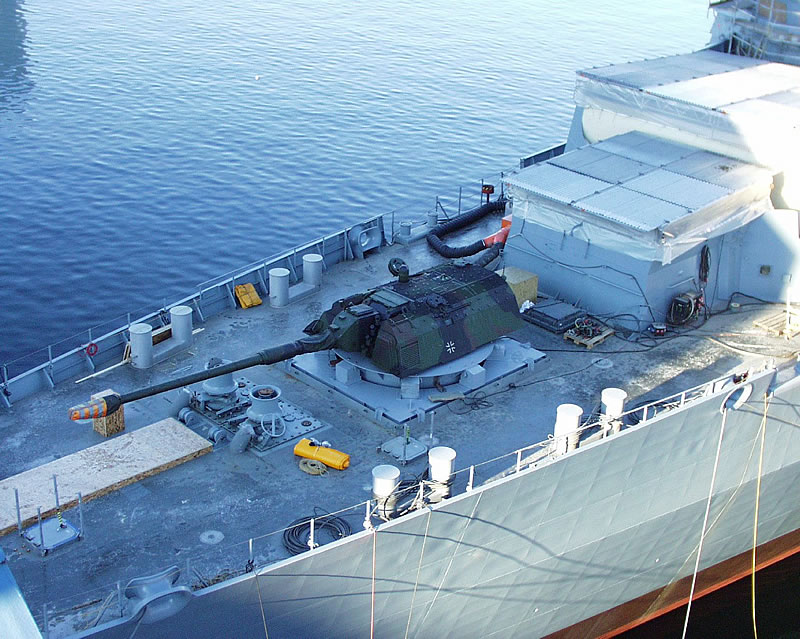
Medium caliber naval guns confront naval planners with a divergence of opinions: mount large caliber, slower-firing 5″/127mm guns used mostly for naval fire support, or smaller caliber 100-57mm guns with far more rapid rates of fire that can be used against smaller boats, UAVs, missiles et. al. as well? In recent years, a 3rd option has entered the scene: 155mm guns adapted from Army platforms. Key advantages include potential commonality of ammunition stocks, greater destructive power, and better leveraging of R&D into long range and specialized variants with some land/sea commonality. Hence projects like the American AGS system for its Zumwalt Class destroyers, and Germany’s aborted MONARC that would have mounted a turret from their PzH 2000 self-propelled howitzer on the new F125 expeditionary frigates.
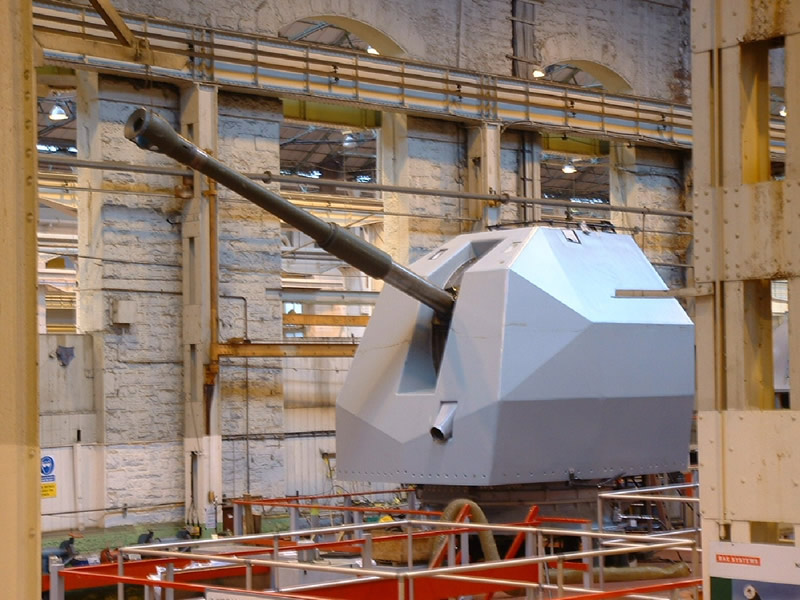
AGS is rather large, however, which leaves the question of what to do with ships smaller than the DDG-1000 Zumwalt’s Graf Spee sized 14,500t. The Royal Navy has become the latest navy to jump into this fray, undertaking a relatively low cost research program that looks at the AS90 Braveheart howitzer’s potential for future warships, and for refits to the existing fleet.
They’ll have a number of significant challenges to overcome before they can declare success, but a recent release says the project is moving on to Phase 3 now…
(click to view full)
During the first study phase, valued at GBP 1.5 million (about $3.1 million), CORDA examined a low risk route to fitting an AS90 self-propelled howitzer ordnance onto the existing 4.5 inch Mk8 Mod 1 gun mounting structure. The second phase, worth around GBP 700 thousand, built on this research and examined some of the technology risks in more detail. Phase 3 involves initial land-based firing trials, possibly lading to initial production if all goes well.
The difficulties involved are not insuperable, but neither are they trivial.
The foremost difficulty involved in placing 155mm howitzer-class guns on ships of destroyer size or smaller is the higher level of recoil, which can play havoc with a smaller ship’s stability.
The German KMW/HDW ‘MONARC’ system used a self-sufficient PzH-2000 mobile howitzer turret mounted on an intricate elastic mounting system that handled this recoil. Unfortunately, the next big problem of adapting all of the PzH-2000’s systems for the corrosive naval environment proved more difficult than expected, and MONARC was removed from plans for the new F125 Class expeditionary frigates.
A third issue is the use of modular propellant charges in land howitzers that are loaded separately from the shell, in the turret. Naval guns moved away from several decades ago, but real commonality with Army 155mm stocks will require either an approach that uses rigid cases instead of the Army’s preferred bag charges, or an integrated shell variant for naval use. That solution, in turn, can affect the required design of the gun itself.
Can a naval variant gun be developed, alongside an ammunition system that allows both the integrated shell naval approach and the army’s modular charge system? Automated systems can certainly use dual-load techniques to get around the problem – but only at a penalty to rate of fire. Assuming that the automated systems can keep up, a 155mm gun’s tolerance for higher fire rates can be increased by moving from conventional air cooling to a water cooled system – but this carries a noticeable weight penalty, which feeds into issues of tonnage, balance, and available space on smaller warships.

(click to view full)
If BAE can solve all these problems, the rewards could be very considerable. A 155mm gun that could drop into existing ships may find a market that stretches beyond the Royal Navy, as the USA closes production of its $3 billion Zumwalt Class destroyers at 2 ships, while retaining the naval gunfire support dilemmas that led to the DDG-1000’s creation.
Clearly, the stealthy Zumwalt Class sits at one end of the solution scale, offering an expense greater than reactivating an Iowa Class battleship, while delivering a less terror-inducing punch for a shorter period of time. Finland’s innovative solution of marrying 120mm automatic mortar turrets and small boats sits all the way at the other end of the scale.
In between, sit solutions that can fit into existing surface fleets. The simple compromise solution involves 100-127mm systems, firing extended-range precision rounds developed to have some commonality with similar Army 155mm ammunition options, but offering less kinetic punch. Germany replaced the MONARC system with Oto Melara’s 127mm lightweight naval gun, and the Germans will probably integrate Ota Melara’s Vulcano extended range guided shells or develop a similar concept. With proper terminal guidance, rounds like Vulcano can participate in 2 key ship roles: land attack capabilities from safer stand-off ranges, and ship to ship hitting power and range that compares to small anti-ship missiles like the Exocet. The Vulcano munitions family will have land-based 155mm counterparts, allowing partial achievement of a 155mm naval gun’s ancillary benefits without the weight and issues.
Given the size of the naval 127mm installed base, this approach is likely to herald a trend.
The step up from that, and below the Zumwalt Class’ AGS system, is a 155mm gun that fits existing ships and can use same caliber, or even the exact same ammunition, as 155mm land howitzers; one providing the same kinetic punch at extended ranges, and offering both land and naval forces more ammunition variety. There is some sacrifice in ship to ship gunnery capabilities when compared with a 127mm solution, but if small boats are handled by other systems and the gun is seen as a land-attack weapon only for the most part, this becomes be a very attractive option.
That solution may not be able to replace a battleship in the naval fire support role, but it would definitely hit a market sweet spot – if it could be done. The US Navy already uses BAE guns in quantity, and will be cycling its Arleigh Burke Class destroyers and Ticonderoga Class cruisers in for refits and upgrades over the next decade. Adding 155mm naval gunfire support weapons to some of those ships would surely be a tempting option for the US Navy.
The naval AS90 study is part of a 3-year Maritime Surface Effects (MSE) research program. It will be led by BAE Systems’ specialist consultancy arm CORDA, alongside its Land Systems business and a team that ranges far and wide across the corporation. Members include BAE Surface Fleet Solutions, BAE Integrated System Technologies (Insyte), Armament Systems in the US, and BAE Bofors in Sweden. Britain’s newly-privatized research arm QinetiQ rounds out the team.
Contracts & Updates:

(click to view full)
Aug 14/08: BAE announces that Phase 3 is getting underway, with a GBP 4 million contract awarded by the UK Ministry of Defence.
Previous phases examined the feasibility of fitting the gun and ammunition systems from an AS90 Braveheart onto the existing 4.5 inch Mk8 Mod 1 gun mounting structure. Phase 3 is a full scale Technology Demonstrator Programme, leading to a trials gun mount and firing trials are scheduled to take place on an MOD range in 2009.
If those trials go well, the door opens for full manufacture, installation in future surface combatants, and possible retrofit to the existing Type 23 frigate and/or Type 45 destroyer fleet. MoD release | BAE release.
Feb 26/08: In a UK MoD release, Commander Clive Murgatroyd of Above Water Effects in the MOD’s Equipment Capability organization says:
“This requirement cannot be met by the current 4.5 inch [11cm] gun which is limited in range and precision… The team at BAe Systems Land Systems, Barrow-in-Furness, is making good progress, and has already designed some elegant engineering solutions, making the return of a 6 inch (15cm) naval gun look more viable as each phase progresses.”
Should this phase of research prove successful, a further work package will be undertaken in 2008 to perform initial land-based firing trials.
Dec 14/07: BAE Systems announces the study’s Phase 2 award.
During the GBP 1.5 million Phase 1, CORDA examined a low risk route to fitting an AS90 self-propelled howitzer ordnance onto the existing 4.5 inch (11cm) Mk8 Mod 1 gun mounting structure. It would later emerge that Phase 2 was worth GBP 700,000. Its goal is to build on this research, and examine some of the technology risks in more detail.
Additional Readings
* US Joint Forces Staff College (May 15/07) – JAWS Masters Thesis by Col. Shawn Welch, USARNG: Joint and Interdependent Requirements: A Case Study in Solving the Naval Surface Fire Support Capabilities Gap. National Defense University 2007 Award for best thesis. Persuasively argue that current capabilities are insufficient, casts doubt on the DDG-1000 Class as a solution, and makes a case that faulty assumptions have helped to create this problem. Includes a number of interesting anecdotes, as well as analysis:
bq. “The history of NSFS, current national strategy, joint and service specific doctrine, current and alternative capabilities associated with providing NSFS are evaluated against current attempts to bridge NSFS gaps with naval aviation and missiles alone. This study will demonstrate a credible case for re-examining major caliber guns and the ships that mount them as part of the NSFS solution set. This thesis identifies five [5] courses of action to meet the NSFS requirements to defeat a future near-peer competitor in the littorals in a timely and affordable manner.”