

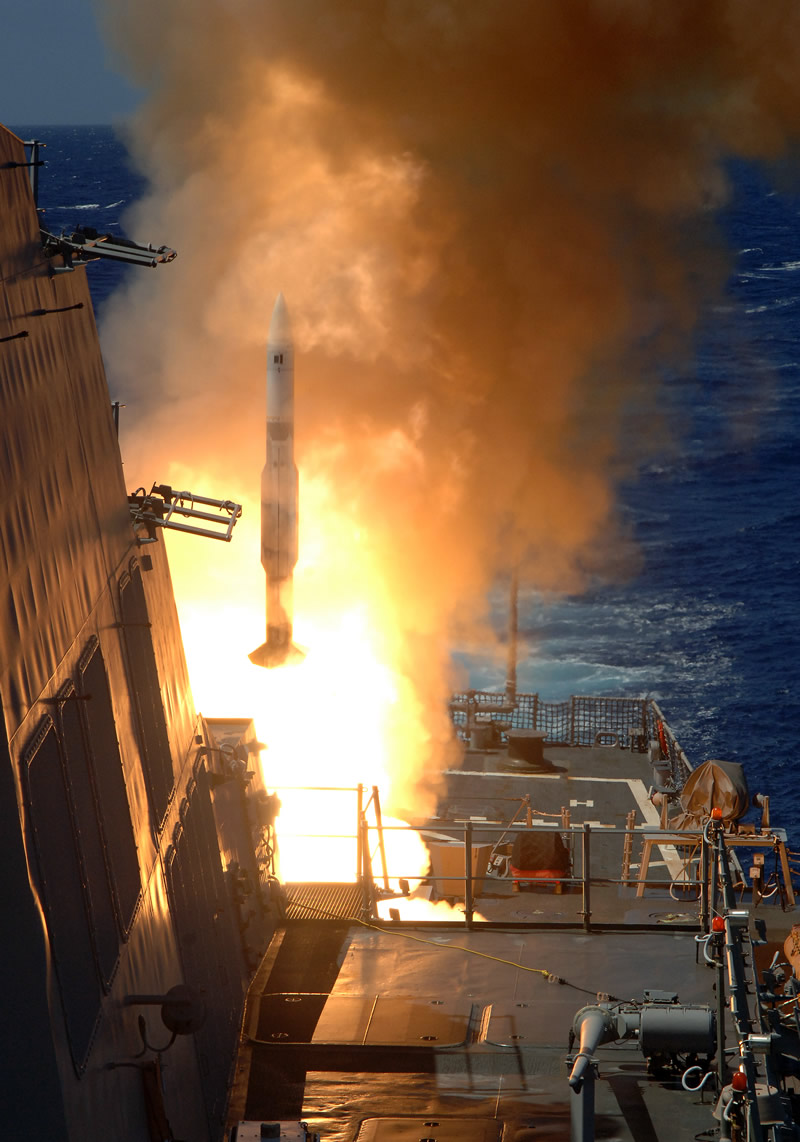
(click to view larger)
Variants of the SM-2 Standard missile are the USA’s primary fleet defense anti-air weapon, and serve with 13 navies worldwide. The most common variant is the RIM-66K-L/ SM-2 Standard Block IIIB, which entered service in 1998. The Standard family extends far beyond the SM-2 missile, however; several nations still use the SM-1, the SM-3 is rising to international prominence as a missile defense weapon, and the SM-6 program is on track to supplement the SM-2. These missiles are designed to be paired with the AEGIS radar and combat system, but can be employed independently by ships with older or newer radar systems.
This article covers each variant in the Standard missile family, plus several years worth of American and Foreign Military Sales requests and contracts and key events; and offers the budgetary, technical, and geopolitical background that can help put all that in context.
The Standard Missile Naval Defense Family: Missiles and Plans
[youtube:v=F2fXChvE6WQ]
click for video
Johns Hopkins University Applied Physics Laboratory (APL) is the technical direction agent for Standard missile. They work with the US navy, other naval customers, and Raytheon to manage ongoing technical improvements.
Within Raytheon, a long-term effort is underway toward capability-based development, and common components. As each SM-x missile advances, the expectation is that it will use components from other members of the missile family, while contributing new component and software advances that can be re-used elsewhere.
SM-1: Allied Legacy
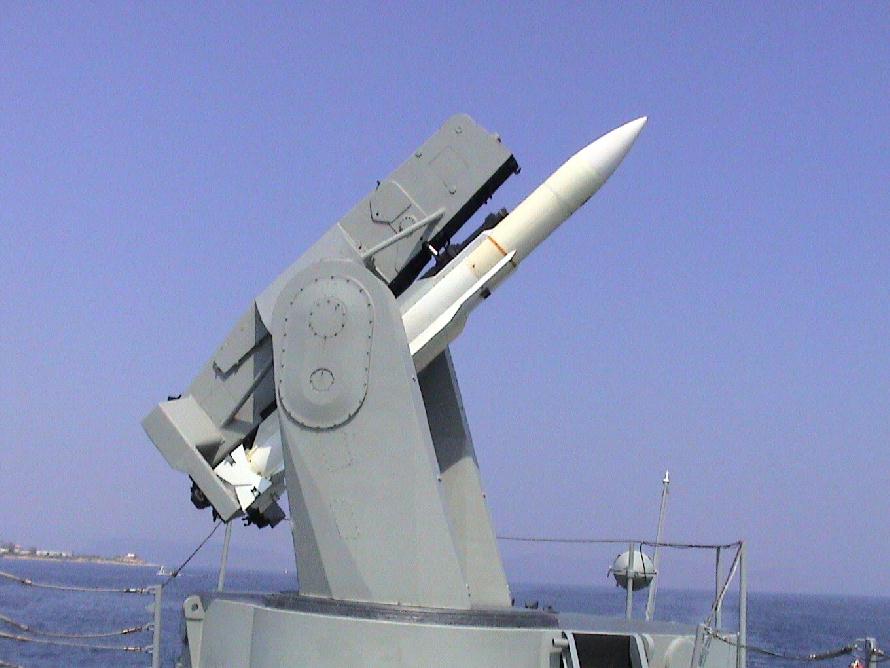
(click to view full)
The SM-1 was phased out of US service in 2003, but still serves with some allied navies; most US and international orders are currently SM-2s, but many countries operating FFG-7 Oliver Hazard Perry Class frigates and similar vintage ships still use them. The “growth space” inherent in its basic design is a big reason that the Standard missile family remains relevant to this day.
Support for foreign SM-1 missiles has transitioned from the US government to Raytheon, who leads a team of companies that provides customers with continued access to spares and repair services. The SM-1 FSS Program consists of core support (program management, asset storage, test equipment support, logistics support and tasking to demilitarize hardware no longer needed for long-term support of the SM-1 Program), intermediate level maintenance (re-certification of SM-1 Block VI, VIA, VIB missiles), depot level maintenance (repair and maintenance of, or preparation, upgrade and installation of SM-1 Block V, VI, VIA and VIB sections, assemblies, sub-assemblies, and components), MK56 Rocket Motor Regrain Program (qualification and production), test equipment support, All-Up-Round (AUR), and technical engineering services. Countries listed in SM-1 support contracts over the past few years have included: Bahrain, Canada, Chile, Egypt, France, Italy, Japan, the Netherlands, Poland, Spain, Taiwan, and Turkey.
SM-2: The Mainstay
The RIM-66K-L/ SM-2 Standard. This is the most commonly encountered variant, and a long series of upgrades have kept it current over the years. SM-2 Block IIIA missiles have greater capability at even lower altitudes than previous SM-2 versions, a more powerful fragmentation warhead, and can use Interrupted Continuous Wave Illumination (ICWI) to improve performance against supersonic maneuvering anti-ship missiles. SM-2 Block IIIB is the most popular version at present, swapping ICWI capability for an infrared (IR) guidance mode capability developed by the Missile Homing Improvement Program (MHIP). IR guidance offers a form of backup guidance in saturation missile attacks, where the limited number of illuminators on a ship without active array radars may have to switch back and forth during the targeting process. It also helps against enemy missiles with stealth features, which can be tracked by the infrared plume created by their engines or by air friction.
These SM-2 versions are provided as medium range (50 mile) rounds that can be fired from AEGIS rail launchers, AEGIS vertical launch systems, and Tartar rail launchers. SM-2 has recently completed an upgrade that gives it improved maneuverability via improved steering, thrust-vectoring, and software. This is especially important against supersonic wave-skimming cruise missiles, which offer less than 1 minute to impact from the moment they break the horizon to become visible on a ship’s radar. Tests have also demonstrated a secondary SM-2 capability against small, fast-moving naval targets.
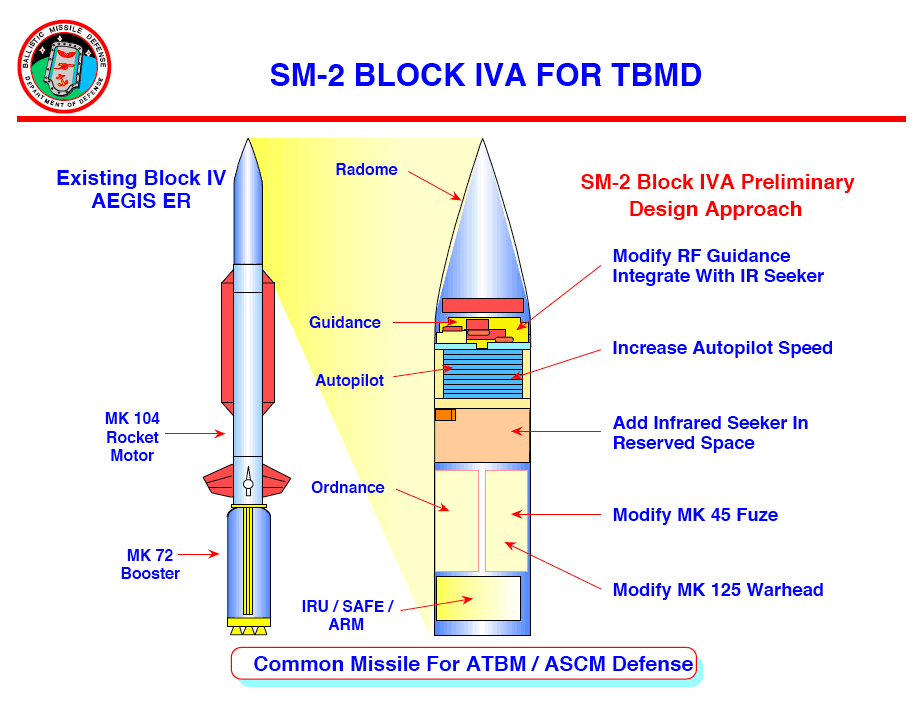
An extended range SM-2 Block IV missile added a booster rocket; it had been developed and tested, but few Block IV missiles were bought. They were to be replaced by the SM-2 Block IVA that would add theater ballistic-missile defense capability, but SM-2 Block IVA was canceled in December 2001, with the project over 2 years behind schedule, and average unit costs more than 50% beyond original goals. It has now been revived as the Near Term Sea-Based Terminal weapon (NT-SBT) for last-phase intercepts, following a number of modifications. The May 2006 Pacific Phoenix sea trial, in which an NT-SBT successfully intercepted a Lance missile target, paved the way for production approval, and modifications for the 100 Block IV missiles in stock began in July 2007. NT-SBT is described as an interim solution aimed at the very last phase of a ballistic missile’s flight, just before impact. It will offer extended-range air defense, but its main function is to acting as a second line of defense against incoming ballistic missiles, similar to the Patriot PAC-3 on land.
Raytheon believes that updated SM-2 variants will remain in service for 20-30 years, which means they’ll need to be kept current. Replacing the US Navy’s entire SM-2 stock would be a huge undertaking, and would perpetuate another problem since the Navy already has low stockpiles of missiles for its vertical launch cells. An MoU with Canada, Germany, and The Netherlands reflects long-term foreign interest in upgrades, and these countries have contributed technical development and funding of their own to SM-2 development. Key improvements on the drawing board include combining ICWI and IR guidance capabilities, 3rd party cueing capabilities that allow it to be used “over the horizon” against low-level targets, further aerodynamic and maneuverability improvements, and the insertion of key SM-6 capabilities including reprogrammability and built in test. An SM-2 Block IIIC proposal with some of these capabilities is on the table, but is not funded yet.
SM-3: Ballistic Missile Killer
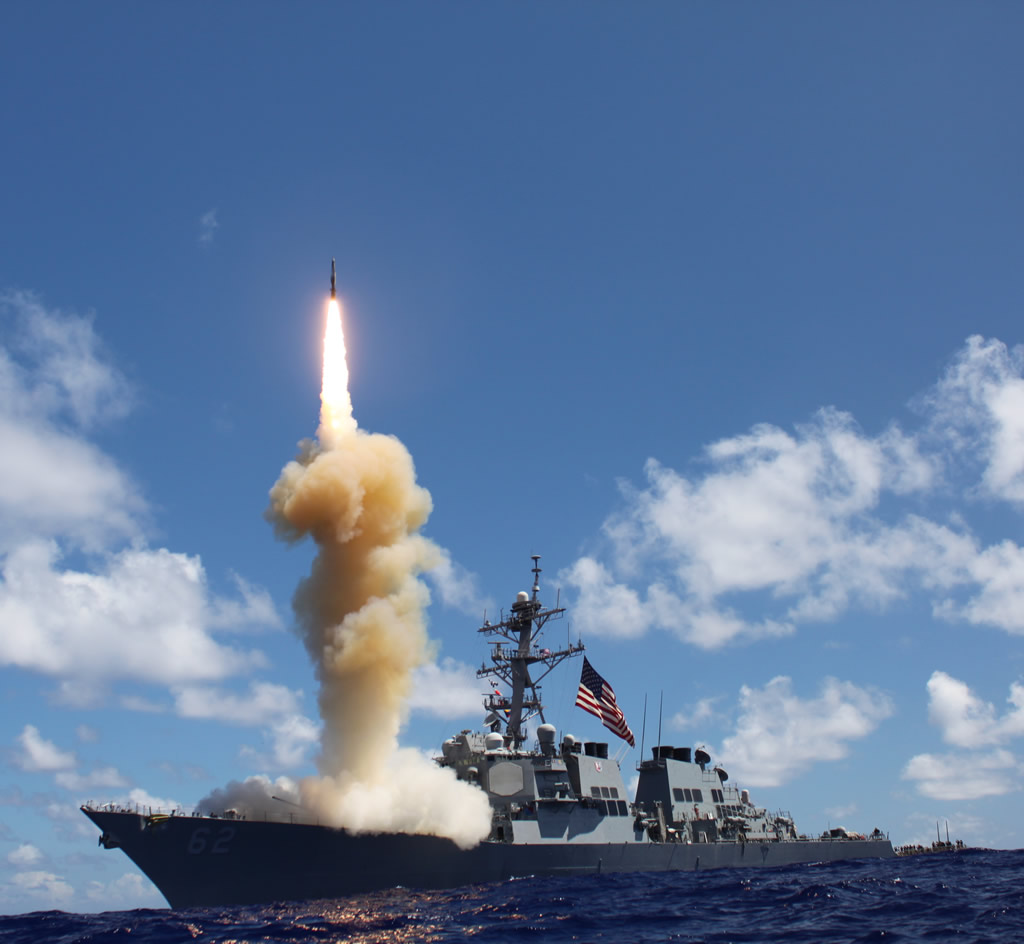
(click to view full)
SM-3 ABM variants, aka. RIM-161. This larger missile will be the mainstay of naval Anti Ballistic Missile defense, and can also fulfill an “outer air” role via long-range kills of bombers carrying cruise missiles. The SM-3 uses the RIM-156 (SM-2 Extended Range Block IV) test program’s airframe and propulsion/booster, then adds a third-stage rocket motor (a.k.a. Advanced Solid Axial Stage, ASAS, made by ATK), a GPS/INS guidance section (a.k.a. GAINS, GPS-Aided Inertial Navigation System), and a LEAP (Lightweight Exo-Atmospheric Projectile) kinetic warhead (i.e. a non-explosive hit-to-kill maneuvering warhead). At present, SM-3 is in naval service with the USA and Japan, may be ordered by the Netherlands for its air defense destroyers, and is set to play a key role in Europe’s land-based missile defenses from bases in Romania and Poland.
Launching ships, usually CG-47 Ticonderoga Class cruisers or Japanese Kongo Class destroyers, are updated with AEGIS LEAP Intercept (ALI) computer software and hardware (the current version under development is AEGIS BMD Block 2006/2008, Baseline 4.0.1), as well as the Long Range Surveillance and Track (LRS&T) AEGIS enhancements that will be implemented across all AEGIS ships that take the upgrade. When used in conjunction with the USA’s Co-operative Engagement Capability components, the result is a single integrated “picture” available to all CEC-equipped ships in the area – a picture that can even be used to help guide long-range anti-air missiles launched from other ships.
This SM-3/AEGIS LEAP combination plays a prominent role in near-term US and Japanese missile defense plans. These interceptors have a better record in ABM tests than their land-based counterparts to date, and their naval mobility makes them well suited for forward defense. They will also be deployed on land, under current American plans to protect Europe.
The SM-3 Block IA version provides an incremental upgrade that improves reliability and maintainability at a reduced cost. It’s finishing its build run alongside production SM-2s, in Raytheon Missile Systems’ factories in Tucson, AZ, and Camden, AR. The SM-3 kinetic warhead (KW) is built and tested at a state-of-the-art kill vehicle manufacturing facility in Tucson, AZ, and the entire upper stage including KW and third stage also is integrated in Tucson before going to Camden, AR for all up round integration. Work on SM-3 also is done in Anaheim, CA; Sacramento, CA; and Elkton, MD. Raytheon leads an integrated team that includes The Boeing Company, Aerojet, and Alliant Techsystems.
The missile was supposed to end production with FY 2009 orders, but testing problems with its successor kept orders coming until 2012. According to a June 2011 CRS report, its estimated cost per missile is about $9 million.
SM-3 Block IB has become the main variant for orders, as of Q2 FY 2011, but the subsequent FTM-16 test failure put a big dent in orders and deliveries. With Block IB and associated ship-based upgrades, the Navy gains the ability to defend against medium range missiles (MRBM, 1,000 – 3,000 km range) fielded by countries like North Korea and Iran, and some Intermediate Range Ballistic Missiles (IRBM, 3,000 – 5,500 km range) under development by those rogue regimes. Upgrades include an advanced 2-color infrared seeker, and a 10-thruster solid throttling divert and attitude control system (TDACS/SDACS) on the kill vehicle to give it improved capability against maneuvering ballistic missiles or warheads. Solid TDACS is a joint Raytheon/Aerojet project, but Boeing supplies some components of the kinetic warhead.
The MDA wanted to buy 472 SM-3 Block IBs by 2020, but flight test issues cut initial orders, and there were still issues to resolve as as of 2014. The FY15 budget seems to indicate a new target of just 332, at an estimated cost per missile of $12 – 15 million.
SM-3 Block II: Next-Generation

(click to view full)
SM-3 Block II will widen the missile body above the booster from 13.5″ to 21″, while shrinking the maneuvering fins. The resulting missile will be faster, and have longer range. That changes the kinds of targets it can take on, and changes its deployment, too. Instead of being able to defend just Israel’s tiny land mass and parts of nearby countries from a ship sailing near Crete, for instance, it becomes possible to defend most of Europe with that same ship. Instead of requiring 3 AEGIS ships to cover Japan, it becomes possible to cover most of Japan with just 1 ship. That’s a strong attraction for the Japanese, who have signed on as development partners.
The SM-3 Block IIA is the co-operative US-Japanese program. It adds the larger diameter, a more maneuverable “high-divert” kill vehicle, plus another sensor/ discrimination upgrade to help deal with harder targets, countermeasures, and decoys. It’s a joint development effort with Japan, which has exceeded both its expected 9-year development time frame, and $2.1 – 2.7 billion price tag. At the end of FY 2011, there were still technical difficulties with the 2nd and 3rd stage rocket motors, and the alternate propellant picked for the DACS thruster system may leave kill vehicle performance below program targets.
The program was rescheduled by joint agreement in September 2011, with flight tests pushed back to FY 2016. It’s currently scheduled to debut around 2018, and Japan has given the go-ahead for exports under certain conditions. Once it’s deployed, the US Navy, Japanese JMSDF, and other customers will have a weapon that can handle the near-strategic IRBM threat, and even engage some Inter-Continental Ballistic Missiles (ICBM). Its estimated cost per missile is $20 – 24 million.
The SM-3 Block IIB NGAM: The “Next Generation Aegis Missile,” was to be an open competition, with the potential to field a new design missile that could destroy IRBMs and even ICBMs. April 2011 contracts for phase 1 concept development included Boeing, Lockheed Martin, and Raytheon. The new missile was originally meant to be land-based, and set to integrate with AEGIS BMD 5.1 for debut in 2020.
The FY 2014 budget relegated it to a component R&D program, and killed the missile. Technical analysis had concluded that its launch sites in Europe couldn’t protect the USA from Iranian missiles (vid. Feb 11/13 entry). One solution would have involved expanding it from a 21″ diameter missile to a 27″ missile, and switching from solid fuel to liquid fuel, in order to boost speed for earlier intercepts. The bad news is that liquid-fueled missiles aren’t safe on board ship, and 27″ wouldn’t fit in standard strike-length Mk.41 Vertical Launch Systems, even though the North Sea was the best European location from which to defend the USA. So the program wanted land and sea deployment, but didn’t know what propellant it would use, or whether it would fit current BMD ships. On-time development was doubtful, and the development schedule for other SM-3 variants is also backlogged. The final capability will be missed, but the outcome isn’t really a surprise.
SM-6 ERAM: Next-Generation Air Defense
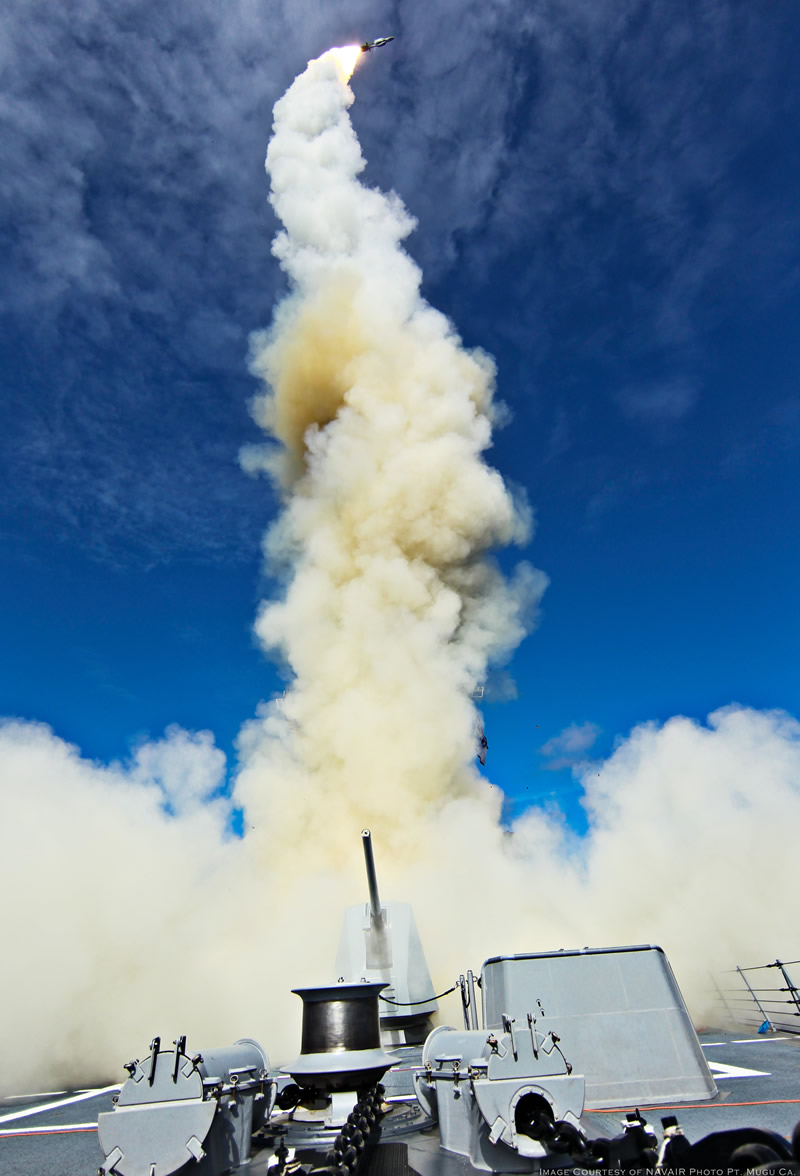
(click to view full)
The SM-6 Block IA ERAM is in full-rate production following a March 2013 approval, despite a rocky test history that hasn’t fully sorted itself out yet. Present plans call for 1,800 SM-6s to supplement the SM-2 missiles in the air/surface defense role against cruise missiles and aircraft. It was approved for Full Rate Production in May 2013. The SM-6 is expected to become useful for ballistic missile defense in 2015, as the Sea based Terminal (SBT) Increment 1 combines SM-6 + Aegis BMD 5.0. Fall 2015 is the expected date for Full Operational Capability, and in 2018, SBT Increment 2 will deploy the SM-6 in conjunction with Aegis BMD 5.1. Production is currently expected to end in FY 2024.
Initial versions of the SM-6 will rely heavily on existing technology, including the airframe of the SM-2 Block IV, and advanced seeker technology derived from the AIM-120 Advanced Medium Range Air-to-Air Missile (AMRAAM). Radar improvements over the AMRAAM include a much larger and more sensitive seeker (13.5″ vs. 7″ diameter), along with redesigned antennas that boost radar power even further. Active guidance in the missile’s own radar improves anti-jam resistance, and is especially helpful during saturation attacks against ships without active array radars, because it removes some of the combat load from the ships’ limited number of targeting illuminators. Semi-active guidance using large, powerful ship radars remains very useful, however, so the missile retains that option.

(click to enlarge)
The SM-6 extends and combines those advantages by allowing an “over-the-horizon” targeting mode, where it’s cued by other ships or even aircraft, then uses its own seeker for the final approach. Some of its launch platforms aren’t ready for that yet, so SM-6 ERAM missiles will be launchable in “legacy” mode like an SM-2, or in SM-6 Enhanced Mode that will add 3rd party over-the-horizon targeting and other new capabilities.
Other SM-6 improvements translate into cost performance rather than targeting performance. At present, 25-30% of SM-family missiles must be re-certified each year, a process that involves unloading and moving the missiles. Instead, customers will be able to bring portable testing equipment to a ship and press a button on the SM-6’s “All Up Round” container, whereupon it will test itself. The other big “under the hood” improvement is a design that stresses software programming rather than hardware swap-outs when conducting upgrades. This makes improving the existing missile stock via “spiral development” inserts much easier, much faster, and much cheaper.
The SM-6 program has led the way for Raytheon’s adoption of Earned Value Management as a program management approach; see Sept 5/08 entry, below. It is now in Low-Rate Initial Production. The missile received its first LRIP order in September 2009, and 1st delivery was in April 2011, even as testing continues. Testing has been rocky, as the SM-6 experienced failures in 5 of 12 intercept attempts. Even so, the USA switched all SM-2 missile orders to the SM-6 in FY 2012. Australia has formally declared their intent to order the SM-6, and they are likely to be its 1st export customer. South Korea has also expressed interest.
The Standard Missile Naval Defense Family: Programs
Budgets

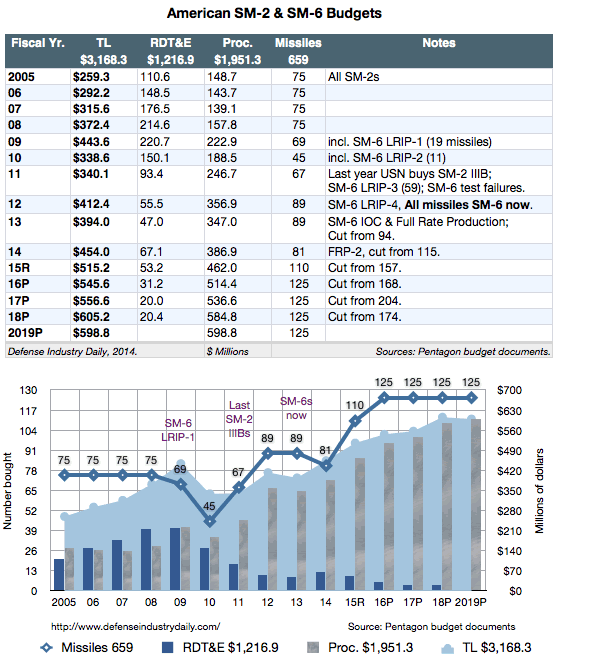
American budgets for the Standard family of naval air defense missiles are split. One line continues production of the SM-2, and continues development of its follow-on the SM-6 Standard Extended Range Active Missile (ERAM). The usual American annual production order for SM-2 Standard missiles is 75, but that has been dropping lately, even as production budgets rise.
The long-range SM-3, which can be used in a ballistic missile defense role, is part of a separate budget line for “AEGIS BMD,” which also includes radar improvements, ship updates, and other changes required in order to use the SM-3 to its full potential.
American budgets for SM-2/SM-6 work include:
Naval Ballistic Missile Defense is a separate program, run by the US Missile defense Agency (MDA). It involves DDG-51 destroyers and CG-47 cruisers with AEGIS BMD systems, using a combination of AEGIS BMD radar improvements, and SM-3 missiles. For full coverage of those US Navy efforts, read “Serious Dollars for AEGIS Ballistic Missile Defense Modifications (BMD)“.

Across the Pacific, Japan will deploy 4 Kongo Class and 2 Atago Class AEGIS BMD destroyers of its own. Japan has purchased SM-3 Block IA missiles, but are scheduled to eventually receive the jointly-developed SM-3 Block IIA. The USA’s forthcoming DDG-1000 Zumwalt Class destroyers may have potential ABM capability of their own via the SPY-3 radar/ SM-3 combination, if additional software is added.
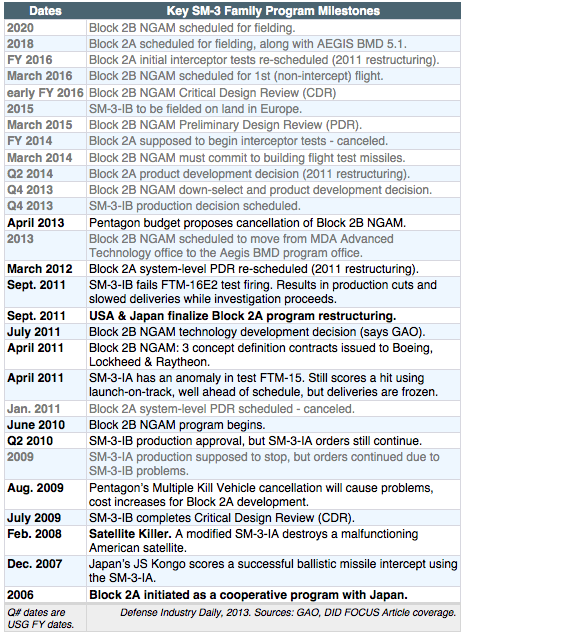
SM-3 Programs: 2006-2020 Timeline
[youtube:v=idC8XvMgEwM]
click for video
With so many versions in play, it can be challenging to keep track of the SM-3 family of missiles. This timeline covers the period from 2006 to the present, and also includes planned events out to 2020.
The Standard Missile Naval Defense Family: US Contracts & Events

(click to view larger)
Unless otherwise specified, all contracts are issued to Raytheon in Tucson, AZ, at the request of US Naval Sea Systems Command (NAVSEA). Note that All Up Rounds (AURs) are missiles in storage containers that contain appropriate electronics, and can be moved from storage to loading as is. ORDALT stands for “ordnance alternation,” i.e. modifications to existing weapons.
Procurement contracts are predominantly American buys, but some foreign customers will also be found in this section due to grouped purchases.
Note that all missile tests have been moved to be part of our in-depth AEGIS BMD coverage. We will cover tests that have a direct impact on missile production, which unfortunately means greater attention to failures. The AEGIS BMD article includes a full chart of naval BMD tests, for a better sense of perspective.
FY 2016 – 2024

(click to view full)
October 26/22: Japan The US Defense Security Cooperation Agency announced on October 20 that the State Department has made a determination approving a possible Foreign Military Sale to the Government of Japan of Standard Missile 6 (SM-6) Block I missiles and related equipment for an estimated cost of $450 million. The Defense Security Cooperation Agency delivered the required certification notifying Congress of this sale. The Government of Japan has requested to buy up to thirty-two (32) Standard Missile 6 (SM-6) Block I missiles (in two tranches of 16). Also included are Mk 21 Vertical Launch System (VLS) canisters; obsolescence engineering, integration and test activity; canister handling equipment, spares, training and training equipment/aids; technical publications/data; U.S. Government and contractor engineering, technical and logistical support services; and other related elements of logistical and program support. The estimated total program cost is $450 million.
July 1/22: IIIC Raytheon won a $57.9 million contract modification to exercise options and incrementally fund existing contract line items for fiscal 2022 Standard Missile-2 Block IIIC low rate initial production and spares. The SM-2 missile is a surface-to-air missile primarily intended for fleet area air defence and ship self-defense. Work will take place in Alabama and Arizona. Expected completion will be by December 2024.
June 17/22: RIMPAC South Korea intends to test-fire the SM-2 air defense missile interceptor from two warships during RIMPAC 2022 next month. Korean Herald reports that Sejong the Great and Munmu the Great destroyers will each fire one missile off Hawaii.
May 27/22: Technical Support Raytheon won a $9.7 million modification to exercise options and incrementally fund existing contract line items for engineering and technical support of Standard Missiles 2 and 6 (SM-2/6). This contract combines purchases for the U.S. government (23%); and the governments of Japan, Germany, Spain, Denmark, South Korea, and Chile (77%) under the Foreign Military Sales (FMS) program. Work will take place in Arizona, Alabama, Missouri, Connecticut, Massachusetts and Maryland. Expected completion will be by February 2025.
December 23/21 SM-2 Raytheon Missiles & Defense won a $578.3M firm-fixed-price modification to procure Standard Missile-2 (SM-2) production requirements. Requirements include all up rounds, instrumentation kits, engineering services and spares; and to definitize the long-lead-material undefinitized contract action in support of the Navy and the governments of Korea, Denmark, Taiwan, Netherlands, Spain, Chile, Japan and Germany. Estimated completion will be by December 2026.
July 27/21: Complex Fire The US Missile Defense Agency has carried out its most complex test so far on July 24 by firing four SM-6 Dual II missiles at two short-range ballistic missile targets. While one target was destroyed, the agency was not sure if the other target was intercepted. This is the third flight test of the SM-6 Dual II missile from a Aegis BMD-equipped warship. The firing ship for the test was the USS Ralph Johnson (DDG 114) and it took place off Hawaii.
June 3/21: SM-3 The USS Paul Ignatius fired two Standard Missile-3 interceptors at the end of May in order to engage ballistic missile targets launched from the Hebrides Guided Weapon Range off the west coast of Scotland, the Navy announced. The test was carried out as part of a cooperative engagement with the Royal Netherlands Navy, which used its advanced combat system suite to warn the maritime task group of a threat, allowing the Ignatius to fire missiles and negate it, officials said.
June 1/21: Failed Test The US Missile Defense Agency announced that the Flight Test Aegis Weapon System 31 Event 1 has failed. Two SM-6 missile interceptors were supposed to intercept a medium range ballistic missile target as the test object. The agency said “an intercept was not achieved.” It also failed to revealed the location of the test and the warship involved. A review to determine the cause of any problems has been initiated.
February 9/21: Chile The Chilean Government is seeking to procure Standard Missile-2 (SM-2) Block IIIA missiles through the US foreign military sale (FMS) programme. Approved by the US State Department, the potential FMS has an estimated value of $85 million. Under the proposed sale package, Chile has requested for the supply of 16 SM-2 Block IIIA rail launched missiles, two MK 89 Mod 0 guidance sections, and one target detection device kit, including shroud and MK 45 Mod 14. The principal contractor will be Raytheon Missiles and Defense, Tucson, Arizona. There are no known offset agreements in connection with this potential sale.
January 13/21: FMS Raytheon Missiles and Defense won an $8.5 million contract for procurement of long lead material in support of Standard Missile-2 (SM-2) Foreign Military Sales production requirements to include all up rounds, instrumental kits, engineering services and spares. This contract involves FMS to Korea, Denmark, Netherlands, Spain, Taiwan and Japan. The Standard Missile-2 (SM-2) is a fleet-area air defense weapon that provides anti-air warfare and limited anti-surface warfare capability against today’s advanced anti-ship missiles and aircraft. With a range of 90 nautical miles and an altitude of 65,000 feet, the SM-2 is an integral part of layered defense that protects naval assets, giving warfighters greater operational flexibility. Work will take place in the Netherlands, Texas, Arizona and is expected to be finished by March 2023.
November 9/20: Canada The US State Department approved a possible $500 million deal to sell Standard Missile 2 Block IIIC missiles and related equipment to Canada, the Defense Security Cooperation Agency said. Canada’s government wanted to buy 100 SM-2 Block IIIC missiles and 100 MK 13 vertical launch systems. According to the DSCA, obsolescence engineering; integration and test activity associated with production of subject missiles; canister handling and loading/unloading equipment and associated spares; training and training equipment/aids; technical publications and data; US Government and contractor engineering, technical, and logistics support; and other related elements of logistical and program support are also included in the request. The prime contractor on this deal would be Raytheon. The company has received a $19 million contract for engineering and technical services on the Standard Missile-2 and Standard Missile-6 in 2019. According to Raytheon, the SM-2 missile provides anti-air warfare and limited anti-surface warfare capability against advanced anti-ship missiles and aircraft out to 90 nautical miles. The SM-2 “gives warfighters a greater reach in the battlespace,”
November 6/20: 2021 The Navy contracted Raytheon Missiles $ Defense with a $24.8 million modification for procurement of fiscal 2021 Navy Standard Missile-2 intermediate level provisioned items ordered spares; and to exercise one-year options for fiscal 2021 Standard Missile-2 and Standard Missile-6 repairs and maintenance. The SM-2 is the U.S Navy’s primary surface-to-air defense weapon and is part of the AEGIS Weapon System along Ticonderoga-class cruisers and Arleigh Burke Class destroyers. The SM-6, also known as RIM-174, is a ship-launched extended range variant of the anti-air and anti-surface interceptor missile developed by Raytheon Company. It is also a key part of the AEGIS Weapon System. Work will take place in Arkansas, Arizona and California. Expected completion date is in July 2024.
July 20/20: Technical Service Raytheon Missiles and Defense won a $15.3 million contract modification to exercise options for engineering and technical services and obsolescence solution in support of Standard Missile-2/6. The designation refers to the SM-2, or RIM-166 missile, and its new and upgraded version, designated SM-6 or RIM-174. Each is a surface-to-air missile designed to intercept both hostile aircraft and high-performance anti-ship missiles. The SM-6 variant can be used against fixed and rotary wing aircraft, unmanned aerial vehicles, land attack cruise missiles and anti-ship cruise missiles. Each is vertically launched and compatible with the Aegis Weapon System. Work will take place in Tucson, Arizona. Estimates completion date will be inJune 2021.
December 6/19: Repair and Maintenance Raytheon won a $28.9 million contract modification for fiscal 2020 Standard Missile-2 and Standard Missile-6 repairs and maintenance and support material. The modification combines purchases for the Navy as well as the government of the Kingdom of Spain under the Foreign Military Sales program. The deal will provide for engineering and technical support, depot and intermediate level repair, maintenance and recertification of standard missiles, sections, assemblies, subassemblies, components for fiscal 2020. The Standard Missile-2 (SM-2) is a fleet-area air defense weapon that provides anti-air warfare and limited anti-surface warfare capability against today’s advanced anti-ship missiles and aircraft. The Standard Missile-6 (SM-6) retains the Standard Missile airframe and propulsion elements and incorporates the advanced signal processing and guidance control capabilities of the Advanced Medium-Range Air-to-Air Missile (AMRAAM). It is the latest addition to the Standard Missile family of fleet air defense missiles and provides Joint Force and Strike Force Commanders fleet air defense against fixed- and rotary-wing aircraft, unmanned aerial vehicles, and land-attack anti-ship cruise missiles in flight. Work under the modification will take place in Arkansas, Arizona and California and expected completion is in December 2020.
November 5/19: Japan Raytheon Missile Systems won a sole source, cost only contract modification to increase the CLIN 0014 undefinitized contract action not-to-exceed value by $267.2 million from $387.2 billion to $654.4 billion. Under the modification the “pacing items only” restriction is removed and the contractor is now authorized to work the full, unchanged, effort to manufacture, assemble, test and deliver 20 Standard Missile-3 Block IIA missiles and related efforts, and four missiles under Foreign Military Sales case JA-P-ATB to Japan. SM-3 Block IIA is a weapon system, the US Navy uses to target short- to intermediate-range ballistic missiles and a key part of the European missile defense system. It has a larger kinetic warhead and rocket motors built to home in on ballistic missile threats.
May 29/19: Formidable Shield Raytheon’s Standard Missile-3, Standard Missile-2 and evolved SeaSparrow Missile played a part in a NATO exercise called Formidable Shield 2019. The two-week exercise took place at the UK defense ministry’s Hebrides Range located on the Western Isles of Scotland. The Naval Striking and Support Forces NATO conducted the exercise on behalf of the US 6th Fleet. The SM-3 was fired at a simulated target, the SM-2 and the Evolved SeaSparrow Missile engaged targets simulating anti-ship cruise missiles. The SM-3 interceptor is a defensive weapon used to destroy short- to intermediate-range ballistic missiles. The SM-2 provides superior anti-air warfare and limited anti-surface warfare capability against advanced anti-ship missiles and aircraft out to 90 nautical miles. The Evolved SeaSparrow Missile provides self-defense battlespace and firepower against high-speed, highly maneuverable anti-ship missiles in the naval environment.
May 20/19: FMS to South Korea The US State Department approved a possible Foreign Military Sale of SM-2 Block IIIB Standard missiles to South Korea. The deal is valued at $313.9 million. The State Department has cleared the Republic of Korea to procure up to 94 rounds of SM-2 Block IIIB Standard Missiles and twelve MK 97 MOD 0 Guidance Sections for SM-2 Block IIIB. Also included is technical assistance: training and training equipment; publication and technical data; and related logistics support, and other related elements of logistics and program support. South Korea’s military already uses the SM-2, and is in the process of building more missile defense capable destroyers that use the weapons.
April 22/19: SM-2 and SM-6 Services The US Navy awarded Raytheon a $19 million modification for engineering and technical services on the Standard Missile-2 and Standard Missile-6. The SM-2 missile provides anti-air warfare and limited anti-surface warfare capability against advanced anti-ship missiles and aircraft out to 90 nautical miles. According to Raytheon, the SM-6 is the only missile considered a “triple threat,” with anti-air warfare, anti-surface warfare and sea-based terminal ballistic missile defense enabling the US and its allies to cost-effectively increase the offensive might of surface forces. The missiles are deployed on cruisers and destroyers in the US Navy, as well as by international customers approved by the Defense Department. The combined contract is 90 percent for the Navy, with the rest under Foreign Military Sales for Australia, Germany, Denmark, Korea and Japan. Work will take pace in Tucson, Arizona and is scheduled to be completed by April 2020.
April 11/19: Japan The State Department approved a possible Foreign Military Sale to Japan regarding 56 Standard Missile-3 (SM-3) Block IB missiles for an estimated cost of $1.2 billion. Also included are missile canisters, US Government and contractor representatives’ technical assistance, engineering and logistical support services as well as other related elements of logistics and program support. Prime Contractor for the Missile System will be Raytheon. For the canisters BAE Systems will be the prime contractor. The supersonic SM-3 Block IB interceptor is an upgraded variant of the original SM-3 missile fitted with an enhanced two-color infrared seeker and features an upgraded steering and propulsion capability. The SM-3 Block IB, first flight tested in 2011, is designed to destroy incoming short- to intermediate-range ballistic missile targets in midcourse. The weapon system became first operational with the Navy in 2014.
March 8/19: SM-3 The Missile Defense Agency awarded Raytheon with a $14.2 million contract modification to provide continued support and engineering for the Standard Missile SM-3 Block IB program. The SM-3 is a ship-based missile system used to intercept short and intermediate range ballistic missiles as a part of Aegis Ballistic Missile Defense System. The SM-3 Block IB interceptor has an enhanced two-color infrared seeker and upgraded steering and propulsion capability that uses short bursts of precision propulsion to direct the missile toward incoming targets. It became operational in 2014. Work will take place in Tucson, Arizona and is scheduled to be completed by October this year.
December 18/18: New variant incoming Raytheon is being contracted to kick-off development of a new Standard Missile variant. Awarded by the Naval Sea Systems Command, the $149 million contract provides for engineering, manufacturing and development of the SM-2 Block IIIC variant. This new variant will fill the gap between the Navy’s new advanced – but quite expensive – long-range SM-6 missile, and the short-range ESSM. The Block IIIC upgrade substitutes the SM-2’s the legacy semi-active radar homing system for the SM-6 active seeker while leaving intact the other aspects of the SM-2 airframe, making it a medium-range missile. The upgrade allows the Navy to use the SM-2 in offensive strikes against enemy aircraft and surface ships. Work will be performed at Raytheon’s facilities in Tucson, Arizona; Wolverhampton, England; East Aurora, New York; Middletown, Ohio and Englewood, Colorado. The Navy plans to field the new missile from October 2022 onwards.
November 29/18: Maintenance Raytheon is receiving additional funding to support the Navy’s stockpiles of SM-2 and SM-6 Standard surface-to-air missiles. Awarded by the Naval Sea Systems Command, the $37,3 million cost-plus-fixed-fee modification provides for intermediate-level repair and maintenance work. The SM-2 Standard is a series of surface-to-air missiles deployed on guided-missile destroyers and cruisers, designed to engage enemy missiles and aircraft to ranges of up to 100 miles. The SM-6 IA ERAM is supersonic missile designed as a supplement to the SM-2. It is designed to target a variety of targets ranging from aircraft to ballistic missiles in their terminal phase of descent. Work will be split between Raytheon’s facilities in Tucson, Arizona; Camden, Arkansas and Huntsville, Alabama. Performance of the contract is set to run through November, 2019.
November 22/18: Tokyo buys The US State Department is determined to approve a possible Foreign Military Sale to Japan. The $561 million sale includes the delivery of 8 SM-3 IB missiles and 13 SM-3 IIA missiles. Block IB missiles allow the Japanese navy to defend against medium range and some intermediate range missiles developed by rouge regimes such as North Korea. IB upgrades include an advanced 2-color infrared seeker, and a 10-thruster solid throttling divert and attitude control system. Block IIA is a co-operative US-Japanese program, that adds a larger, more maneuverable “high-divert” kill vehicle. Once deployed the IIA missile will handle the near-strategic IRBM threat, and even engage some ICBMs. The contract also includes the provision of missile canisters and contractor support ranging from technical assistance, engineering and logistical support services. Prime contractors will be Raytheon and BAE Systems, who will respectively produce the missiles and canisters.
November 12/18: GEUs Raytheon is being tapped to continue work on its Standard Missile-3 (SM-3) Block IIA. The awarded contract modification is priced at $74.8 million and provides for the procurement of more Guidance Electronics Units (GEU). The SM-3 Block IIA is the co-operative US-Japanese program. It adds the larger diameter, a more maneuverable “high-divert” kill vehicle, plus another sensor/ discrimination upgrade to help deal with harder targets, countermeasures, and decoys. The Block IIA model is capable of engaging ballistic missiles as they begin their descent in low space at long ranges. This order is part of a 2016 SM-3 Block IIA contract that sees for Raytheon to continue efforts for qualification, test and integration of the enhanced GEU capability to the missile. The total contract value is now $1.1 billion. Work will be performed at Raytheon’s facility in Tucson, Arizona and is scheduled for completion by September 30, 2020.
October 26/18: South Korean tests Raytheon says the the Republic of Korea Navy (ROKN) conducted five flight tests of the Standard Missile-2 (SM-2) interceptor over the summer. During the tests the navy fired three SM-2 Block IIIB missiles to destroy simulated aerial threats. The SM-2 is the most commonly encountered variant, and a long series of upgrades have kept it current over the years. SM-2 Block IIIB is the most popular version at present, swapping ICWI capability for an infrared (IR) guidance mode capability developed by the Missile Homing Improvement Program (MHIP). SM-2 versions are provided as medium range (50 mile) rounds that can be fired from AEGIS rail launchers, AEGIS vertical launch systems, and Tartar rail launchers. Raytheon discontinued production of the missile in 2013, but restarted the SM-2 line in 2017 after demand from Australia, Japan, South Korea and the Netherlands, according to the company.
October 15/18: BMD for South Korea The South Korean military is opting for Raytheon’s Standard Missile family to thwart potential missile attacks from North Korea. Maj. Gen. Kim Sun-ho, the head of Joint Chiefs of Staff’s force buildup planning bureau recently confirmed that the military will procure the naval-based SM-3 interceptor. The SM-3 will be part of the Korea Air and Missile Defense network (KAMD) and serve along the US Army’s Terminal High Altitude Area Defense system. The SM-3 is designed to destroy short- to intermediate-range ballistic missiles, and its Block IB variant allows for defense against medium range missiles fielded by countries like North Korea and Iran, and some Intermediate Range Ballistic Missiles developed by those regimes. No details about the timetable for adopting the SM-3 have been given so far.
October 2/18: Full-rate Raytheon’s SM-6 naval defense missile enters full rate production. The US Navy is awarding the company with a $395.6 million contract modification that provides for the missile’s procurement in FY17 and FY18. The SM-6 ERAM is a next-generation air defense missile, which will eventually supplement SM-2 missiles in the air/surface defense role against cruise missiles and aircraft. The SM-6 comes with an “over-the-horizon” targeting mode, where it’s cued by other ships or even aircraft, then uses its own seeker for the final approach. The missile incorporates technology from existing technologies such as the the airframe of the SM-2 Block IV, and advanced seeker technology derived from the AIM-120 Advanced Medium Range Air-to-Air Missile (AMRAAM). Work will be performed at multiple locations, including – but not limited to – Tucson, Arizona; Wolverhampton, United Kingdom and Anaheim, California. Initial production for this order is expected to be completed by September 2022.
September 14/18: Intercept Raytheon’s SM-3 Block IB missile is proving itself to be a reliable interceptor. The Japanese Kongo-class destroyer JS Atago (DDG-177) fired the SM-3 during an intercept flight test in cooperation with the US Navy off the coast of Kauai in Hawaii. Block IB missiles are equipped with an advanced 2-color infrared seeker, and a 10-thruster solid throttling divert and attitude control system. This increment allows to defend against medium range missiles and some Intermediate Range Ballistic Missiles. This test marks a significant milestone in missile defense cooperation between Japan and the US.
September 4/18: The Japanese government plans to spend about $118 million on missiles for its new guided missile destroyer Maya. The Aegis-equipped Maya will be commissioned in 2020 and will receive several SM-6 missiles. SM-6 integration is part of Japan’s Integrated Air and Missile Defense initiative that will intercept missiles through the integrated use of Aegis vessels, early-warning aircraft, radars and other equipment, mainly in view of the threats posed by cruise missiles owned by China and under development by North Korea. The SM-6 is the latest variant of Raytheon’s combat proven missile system. Integrated with the Aegis BMD the missiles provide protection against anti-ship and ballistic missiles.
August 2/18: SM-2s for Denmark The US State Department is currently in the process of approving a possible foreign military sale to Denmark. The North-European country has requested the purchase of up to 46 SM-2 Block IIIA All-Up Rounds and other related equipment for an estimated cost of $152 million. SM-2 Block IIIA missiles have greater capability at even lower altitudes than previous SM-2 versions, a more powerful fragmentation warhead, and can use Interrupted Continuous Wave Illumination (ICWI) to improve performance against supersonic maneuvering anti-ship missiles. The missiles are provided as medium range (50 mile) rounds that can be fired from AEGIS rail launchers, AEGIS vertical launch systems, and Tartar rail launchers. The deal would also include a telemetry omni-directional antenna, warhead dud capable missiles, the Mk13 Vertical Launching System Canisters and operator manuals. The system will be installed on the Royal Danish Navy’s IVER HUITFELDT Frigate Class ships. In combination with the Anti-Air Warfare System (AAWS) combat system the missiles will enhance anti-air warfare capabilities. The principal contractors will be Raytheon and BAE Systems.
July 9/18: New datalink The Missile Defense Agency is procuring a new digital data link solution for its ballistic defense missiles. The awarded contract is valued at $7.4 million and enables Raytheon Missile Systems to develop, build, test, qualify and integrate a digital data link (DDL) solution to resolve existing Plate 3A transceiver obsolescence for the SM-3 IB missile. SM-3 Block IB has become the main variant for orders since 2011. With Block IB and associated ship-based upgrades, the Navy gains the ability to defend against medium range missiles fielded by countries like North Korea and Iran, and some Intermediate Range Ballistic Missiles under development by those rogue regimes. A DDL is needed to send guidance commands to the missile. This modification increases the total cumulative face value of the contract t $1,7 billion. Work will be performed in Tucson, Arizona, with an expected completion date of December 2019.
June 11/18: More incoming Raytheon is being tapped for the procurement of missiles in support of the Navy. The $44 million cost-only modification provides for the full-rate production and spates for the Standard Missile-6. The Raytheon-manufactured Standard Missile-6 is both an offensive and defensive long-range weapon system that is designed as an anti-air and surface warfare weapon, in addition to being capable of targeting incoming sea-based ballistic missiles. The SM-6 is based on technology derived from the SM-2 Block IV, and the AIM-120. Active guidance in the missile’s own radar improves anti-jam resistance and is especially helpful during saturation attacks against ships without active array radars. The missile comes with a “over-the-horizon” targeting mode, where it’s cued by other ships or even aircraft, then uses its own seeker for the final approach. The US Navy typically arms both naval cruisers and destroyers as the Standard Missile-6 can integrate with the AEGIS missile defense system. Work will be performed at multiple locations, including Wolverhampton, United Kingdom and Warrington, Pennsylvania, and is expected to be completed by March 2020.
May 02/18: A batch of 20 missiles has been added Raytheon Missile Systems Co., Tucson, Arizona, has been awarded a contract modification in support of ballistic missile defense efforts. The contract is valued at over $387 million and allows Raytheon to procure a limited subset of items necessary to maintain schedule for eventual manufacture, assembly, test and delivery of 20 Standard Missile-3 (SM-3) Block IIA missiles and related efforts. SM-3 Standard missiles, also known as Ballistic Missile Killers, have been the backbone of the US Navy’s ballistic missile defense plans for many years now. The missile will be the mainstay of naval Anti-Ballistic Missile defense and can also fulfill an “outer air” role via long-range kills of bombers carrying cruise missiles. The SM-3 uses the RIM-156 test program’s airframe and propulsion/booster, then adds a third-stage rocket motor, a GPS/INS guidance section and a LEAP) kinetic warhead. At present, SM-3 is in naval service with the USA and Japan, may be ordered by the Netherlands for its air defense destroyers, and is set to play a key role in Europe’s land-based missile defenses from bases in Romania and Poland. The modification increases the total cumulative face value of the contract to $1.1 billion. The work will be performed in Tucson, Arizona and is set to be completed by April 2022.
February 21/18: Options-Engineering & Technical Services The US Navy will exercise an option with Raytheon Missile Systems for engineering and technical services on the Standard Missile-2 and Standard Missile-3. Valued at $12.1 million, the agreement tasks the firm to provide engineering and technical services in support of SM-2 and SM-6 production to ensure continuity in production, design integrity and total systems integration of the missile round and its components. It will support missiles used by the Navy, Australia, Japan, South Korea and the Royal Netherlands Navy. Work will primarily take place at Raytheon’s Tucson, Arizona operation, with some work to take place in Boston, Massachusetts. Contract completion is expected by December 2019.
February 2/18: Inquiry begins on SM-3 miss Reuters reports that a SM-3 Block IIA missile launch from an Aegis Ashore site in Hawaii has failed to shoot down an incoming dummy missile launched from an aircraft. A US military official, speaking on the condition of anonymity, said the reason for Wednesday’s failure remained unclear and that an analysis into the cause is underway. Developed by Raytheon, with participation from Japan, a previous intercept test of the SM-3 last June also failed, but there was a successful test in early 2017. The Missile Defense Agency did not comment on the outcome of the test, but confirmed that one had taken place.
January 12/18: DSCA Approval—FMS The US State Department’s Defense Security Cooperation Agency (DSCA) has cleared the potential sale of four SM-3 Block IIA missiles to the government of Japan. Valued at an estimated $133.3 million, the sale also includes four MK 29 missile canisters, US Government and contractor representatives’ technical assistance, transportation, engineering and logistics support services, and other related elements of logistical and program support. Raytheon will act as prime contractor on the SM-3 production, while BAE Systems, based out of Minneapolis, MN, will supply the MK 29 canisters. Since the SM-3 Block IIA is being designed jointly by the US and Japan for defense against medium- and intermediate-range ballistic missiles, the sale is believed to pass by Congress with ease, and can be deployed on Aegis-class destroyers or on land by the Aegis Ashore program—both of which Japan either has, in the form of its destroyers, or is planning to procure, in its Aegis Ashore procurement.
January 9/18: Procurement—Maintenance The US Naval Sea Systems Command awarded Raytheon Friday, a $27.2 million contract for the procurement of the Navy’s Standard Missile-2 (SM-2) between fiscal years 2018 and 2022. Under the agreement, the firm will also provide Standard Missile-6 (SM-6) depot and intermediate level maintenance, all-up round re-certifications and special maintenance tasks. 100 percent of the base award will go towards the US Navy, but will also include options to provide SM-2 repair and maintenance services to the navies of Australia, Canada, Germany, Japan, Netherlands, South Korea, Spain and Taiwan. If all options are exercised, the value of the contract could reach $227.7 million. Work will take place across Arizona, Arkansas and Alabama, and is expected to be completed by December 2018.
October 25/17: A NATO-led international ballistic missile defense exercise off of the coast of Scotland concluded with the successful interception of a medium-range missile with a Standard Missile-3. Known as Formidable Shield, the exercise ran from September 24 to October 17 with participants from Canada, France, Germany, Italy, the Netherlands, Spain, Britain and the United States, and was designed to assess the capabilities of allied ballistic missiles and air warfare defenses at sea, with the goal of improving NATO allies’ ability to respond to incoming threats. During the SM-3 test, the Arleigh Burke-class guided-missile destroyer USS Donald Cook (DDG 75) successfully detected, tracked and intercepted a medium-range ballistic missile target with a Standard Missile-3 Block IB guided missile. Simultaneously, the Spanish frigate SPS Alvaro de Bazan (F101) fired an Evolved SeaSparrow Missile (ESSM) against an incoming anti-ship cruise missile while the Netherlands frigate HNLMS Tromp (F803) fired ESSMs against a pair of incoming anti-ship cruise missiles. Manufacturer Raytheon added that the first land-based version of the SM-3 to became operational in Romania in 2016, and a site in Poland is expected to be in service by next year.
August 31/17: The US Missile Defense Agency (MDA) and US Navy have successfully conducted a scheduled test of a Standard Missile-6 guided missile (SM-6) off the coast of Hawaii. Launched from the deck of the USS John Paul Jones, the missile intercepted a medium-range ballistic missile target, and comes just one day after North Korea fired a ballistic missile over Japan. The MDA said the test gives the naval component of the missile defense system higher ability to intercept ballistic missiles in their terminal phase.
August 30/17: Raytheon has been awarded a $614 million modification for a contract previously valued at $630 million by the US Missile Defense Agency (MDA). The modification calls for the production of 17 Standard Missile-3 Block IIA missiles, perform production support and engineering efforts, perform obsolescence monitoring, perform technical baseline engineering support, perform quality assurance and audit efforts, and provide containers. Work will be performed in Tucson, Arizona, and is estimated for completion in March 2020.
August 9/17: The US Missile Defense Agency (MDA) has given Raytheon a $66.4 million contract modification for the Standard Missile-3 Aegis Ashore ballistic missile defense program. Work will be carried out in Tuscon, Ariz and includes engineering work, support services and analysis of the SM-3 Block IIA missile and BMD 5.1 flight testing and certification. Scheduled completion has been given for Sep. 30, 2018. This modification brings the total contract cost to $2.07 billion.
July 27/17: The US Navy has awarded Raytheon a $11.5 million contract modification for engineering and technical services for Standard Missile-2 and Standard Missile-6 surface-to-air missiles. As well as the US Navy, Japan, Denmark, South Korea, Taiwan and Germany will receive services under the award which includes engineering work for production and integration of the system into Navy and foreign missile platforms. Work will be conducted in Tucson, Ariz. and has an expected completion date of June 2018. The SM series feature as a key element of the AEGIS Weapon System mounted on Ticonderoga and Arleigh Burke-class Navy warships, while variants are also in use with 15 allied countries.
July 27/17: Last month’s failed SM-3 Block IIA interceptor test conducted by the US Navy and Missile Defense Agency (MDA) was caused by human error, according to an anonymous source close to the test. The June 21 test saw the missile self-destruct after it tracked a medium-range ballistic target missile launched from the Pacific Missile Range Facility at Kauai, Hawaii. Now, it is believed that a tactical datalink controller, in charge of maintaining encrypted data exchanges between ships and aircraft, accidentally identified the incoming ballistic missile target as a friendly in the system, causing the SM-3 missile to self-destruct in flight. So while the incident is slightly embarrassing, there doesn’t seem to be anything wrong with the interceptor.
June 26/17: A Standard Missile-3 Block IIA intercept test conducted by the US Missile Defense Agency (MDA) and the Japan Ministry of Defense has failed. Launched from the USS John Paul Jones at the Pacific Missile Range Facility on Kauai, Hawaii, the SM-3 successfully detected and tracked the missile with its AN/SPY-1 radar and engaged, but failed to score a hit. This is the fourth test launch of the Block IIA and the second intercept test. The first attempted intercept earlier this year was successful. Further details are expected to be released at a later date once test data is reviewed by program officials.
June 23/17: Land-based testing of Raytheon’s SM-6 Block IA interceptor has been successfully completed, paving the way for the new missile to enter at-sea testing before it is expected to enter low-rate production later this year. The test, conducted at a test site in southern New Mexico, involved the interceptor engaging and destroying a sub-sonic target. Improvements on the earlier SM-6 BLK 1 version include an enhanced precision guidance section that allows the missile to seek and destroy a wide variety of threats.
June 19/17: Raytheon is to restart the Standard Missile 2 (SM-2) production line after a $650 million dollar order from the Netherlands, South Korea, Japan and Australia. The sale calls for the delivery of a total of 280 SM-2 Block IIIA and IIIB missiles, and the sale is expected to keep the company’s Arizona production line open through 2035 as Raytheon anticipates more orders from the US and its allies as they rebuild their inventories using the modernized production line. Congress are expected to be notified of the sale in the coming days.
April 30/17: Raytheon’s Standard Missile-6 (SM-6) is expected to be declared fully operational in the near future, after the missile was successfully put through a series of rigorous Navy testing. Four missiles were fired from surface ships using the MK 41 Vertical Launch System—deployed on Ticonderoga-class cruisers and Arleigh Burke-class destroyers—at a variety of land-launched targets, including supersonic and subsonic missiles, with all four test fires successfully intercepting their targets. Furthermore, the missile has been approved for international sales to select countries as of January this year.
April 19/17: The US Navy has selected Raytheon to perform engineering and technical services for several Standard Missile variants used by the service. Valued at $113 million, work to be carried out under the agreement calls for the procurement for other government agencies and foreign military sales to undisclosed customers, as well as engineering work for the Standard Missile 2, 3 and 6. Other tasks to be carried out by Raytheon include research and development efforts, component improvement, shipboard integration and evaluation services. Scheduled to be completed by April 2022, the contract contains options that if exercised, could bring the cumulative value of the contract to $466 million.
January 26/17: Raytheon has been selected to provide SM-6 missiles and spares, to be deployed on AEGIS-equipped cruisers and destroyers. Valued at $235 million, the award comes following several testing and milestone events for the weapon that verified the weapon’s capability to intercept incoming medium-range ballistic missile attacks. This contract represents funding for the fourth year of full-rate production for the multi-mission missile and deliveries are expected to begin in 2018.
January 12/17: Raytheon’s SM-6 missile has been cleared for international export by the US DoD. At present, the missile is in use by the US Navy, providing anti-aircraft and anti-ship defenses for its fleet. First deployed in 2013, testing of different variants of the SM-6 have progressed over the last several years, the most recent in December 2016, which confirmed the missile’s ability to be used against ocean surface targets. During the trials, the SM-6 set a record for the longest range surface-to-air interceptor.
October 3/16: An SM-6 air defense missile interceptor fired from the USS Princeton has set a new distance record for an intercept during testing at the Point Mugu Test Range on September 22. Using data from a remote airborne sensor and equipped with the latest Aegis Baseline 9, the missile beat the previous long-distance intercept record held by the USS John Paul Jones’ test in January.
March 9/16: Raytheon’s recent SM-6 anti-air missile test was used to engage the decommissioned USS Reuben James, (FFG 57) made famous for its appearance in the 1990 movie The Hunt for Red October. The test was a demonstration of the Navy’s concept of “distributed lethality,” employing ships in dispersed formations to increase the offensive might of the surface force, and enabling future options for the joint force commander. The USS John Paul Jones fired the SM-6 while another Arleigh Burke-class destroyer was on station as the assist ship.
February 5/16: The Pentagon is to invest in the development of Tomahawk and SM-6 missiles which will be capable of hitting moving vessels. $2 billion has been requested for the purchase of 4,000 Tomahawk missiles with manufacturer Raytheon. Raytheon has invested in a multi-modal seeker that would allow the missiles to hit moving targets so that missiles may be adapted from land missiles into anti-ship missiles. A further $2.9 billion will also be made available for the purchase of 650 SM-6 interceptors as well, to advance them to become anti-ship missiles for the first time. This will allow the SM-6 to operate in an offensive capability instead of operating solely as an anti-ballistic weapon.
October 22/15: A Standard Missile-3 Block IA interceptor, fired from an Arleigh Burke-class destroyer, has successfully intercepted a short-range ballistic missile. The target missile was launched from the UK’s Hebrides Range, off the northwest coast of Scotland, with the test also seeing two anti-ship missiles fired simultaneously. The ballistic missile was intercepted in space by the SM-3 fired from USS Ross (DDG-71), with USS The Sullivans (DDG-68) downing the anti-ship missile using SM-2 missiles. The Sullivans saw a SM-2 Block IIIA explode soon after launch in July, with this test the first time a ballistic missile has been intercepted in the European theater.
FY 2014 – 2015
SM-6 buy; MDA considers SM-3 IB MYP; SM-6 reached IOC.
August 5/15: The Navy has successfully demonstrated the use of a Standard Missile-6 to intercept a short-range ballistic missile. The tests, conducted off Hawaii, also included the use of a SM-2 Block IV missile against a ballistic missile and two more SM-6s against cruise missile targets. Moving from initial-rate to full-rate production in May, the Navy ordered 74 SM-6 missiles from Raytheon in June. The Navy also announced in January that the missile will be deployed on more than 35 vessels equipped with the Aegis combat weapons system.
June 4/15: Following a contract modification worth $149 million, Raytheon will manufacture 74 Standard Missile-6 (SM-6) air defense rounds for the Navy. This follows a $110 million contract in March and the transition of the SM-6 from low-rate to full-rate production last month.
May 8/15: Raytheon’s Standard Missile-6 (SM-6) has moved from low-rate to full-rate production, following the Navy’s decision in January to expand the number of ships the missile is deployed on from 5 to over 35.
May 1/15: Raytheon was awarded a $559.2 million undefinitized contract action by the Missile Defense Agency for multiple fixed-price incentive firm, firm-fixed-price and cost reimbursable contract line items. The first of these is an order for 44 Standard Missile-3 Block IB missiles.
Aug 24/14: SM-2/6 Support. Raytheon Missile Systems in Tucson, AZ receives an $8.5 million contract modification for SM-2 and SM-6 engineering and technical services. This contract combines purchases for the US Navy (84.5% / $7.2M) and Japan (15.5% / $1.3M), using a combination of FY 2014 US Navy weapons and RDT&E budgets, and Japanese funds.
Work will be performed in Tucson, AZ (86%); Maizura, Japan (11%); Huntsville, AL (2%); and Camden, AR (1%), and is expected to be complete by July 2015. US NAVSEA in Washington, DC manages the contract, and acts as Japan’s agent (N00024 13 C-5403).
Aug 14/14: SM-6 Testing. The US Navy conducts flight test “Juliet,” in which an SM-6 successfully intercepts a subsonic, low altitude target over land. That’s a tough shot, due to the radar clutter created when looking for a small object against the ground’s own moving signature. Juliet is one of 10 follow on operational test and evaluation (FOT&E) events planned for SM-6’s missile performance and demonstration. Sources: US Navy, “Standard Missile Shows Versatility With “Juliet” Flight Test”.
Aug 1/14: SM-6. Raytheon Missile Systems in Tucson, AZ receives a $7.5 million contract modification for a lifetime buy of obsolete SM-6 components. All funds are committed immediately, using FY 2012 – 2014 US Navy weapons budgets; $6 million will expire on Sept 30/14.
It may be hard to believe this is needed with a new missile, but then, how many of you use 8 year old electronics? Long development times make this a common military problem, and stocking up on items that are ending or have ended production is one way to deal with it.
Work will be performed in Malaga, Spain (67%); Melville, Y (19%); Camden, AR (5%); Dallas, TX (4%); Sandy Hook, CT (2%); Los Alamitos, CA (2%); Wilmington, MA (less than 1%); and Austin, TX (less than 1%); and is expected to be complete by December 2014. US NAVSEA in Washington Navy Yard, Washington, DC manages the contract (N00024 13 C-5407).
June 19/14: SM-6 Testing. Raytheon touts a June 2014 series of tests, in which the Arleigh Burke Flight I destroyer USS John Paul Jones [DDG 53] successfully used SM-6 missiles against 2 tough threats. The 1st involved destroying low-flying cruise missile targets flying ‘over the horizon’ – which is to say, beyond the ship’s own radar. That’s similar to a Aug 23/13 test, and represents an important part of US Navy Naval Integrated Fire Control-Counter Air (NIFC-CA) plans, which involve the ability to cue SM-6 targets using aircraft like the E-2D AWACS or F-35C fighters, or other ships.
Separately, the destroyer used another Raytheon SM-6 to intercept a supersonic target, which simulates modern Russian and Chinese missiles. Sources: Raytheon, “Raytheon Missiles Make History in Long-Range, Supersonic Tests”.
June 27/14: SM-6 FRP-2. Raytheon Missile Systems, Tucson, AZ, is being awarded a $275.4 million contract modification for FY 2014 SM-6 all-up rounds, and SM-6 and SM-2 spares and containers. All funds are committed immediately, using a mix of FY 2012 and 2014 USN weapons budgets, and FY 2014 USN O&M budgets. $14.3 million will expire at the end of the current fiscal year, on Sept 30/14.
Numbers aren’t given, but the FY 2014 budget projected 81 missiles, a cut from the original 115. Note that the missile still has some technical issues (q.v. Jan 28/14).
Work will be performed in Tucson, AZ, (33.7%); Camden, AR (28%); Wolverhampton, United Kingdom (11.6%); Andover, MA (8.6%); Middletown, OH (2.7%); San Jose, CA (2.6%); Huntsville, AL (2.3%); Dallas, TX (2.1%); Anniston, AL (1.4%); Clarkston, GA (1%); San Diego, CA (1%); Warrington, PA (1%); Wichita, KS (1%); Middletown, CT (1%); Thousand Oaks, CA (1%); and Anaheim, CA (1%); work is expected to be completed by March 2017. US NAVSEA manages the contract (N00024-13-C-5407).
FY14: SM-6s
March 14/14: GAO report. The GAO releases GAO-14-248R, regarding the USA’s EPAA plans for defending Europe from ballistic missiles. They’re characterizing SM-3 Block IIA development as “on track” for EPAA Phase 3 in 2018, but SM-3 Block IB still has some issues.
MDA plans to buy 48 Block IBs as part of Phase 2’s Romania deployment from 2015, which will create a bit of an order spike. GAO doesn’t say so, but if Block IIA is late, there will be another Block IB order spike to equip the Polish site in 2018. They do reference the Block IB’s TRSM cold gas regulator issue (q.v. Jan 28/14), and say only that the failure review is still underway, with unclear effects on production.
March 5/14: +36 SM-3 IB. Raytheon in Tucson, AZ receives a not-to-exceed $350.2 million sole-source contract modification bringing FY14 SM-3 Block IB orders to $506.2 million for 44 missiles.
Work will be performed in Tucson, AZ, with an estimated completion date of September 2016. The US Missile Defense Agency in Dahlgren, VA manages the contract (HQ0276-13-C-0001).
FY14: 36 SM-3-IBs
March 4/14: MDA Budget. The MDA finally releases its FY15 budget request, with information spanning from FY 2014 – 2019. The FY15 request buys AEGIS BMD 4.x upgrades for 3 ships, and installation of received BMD 4.x systems on board 5 ships, while continuing the development of versions 5.0 and 5.1. Beyond that:
“The MDA is requesting $435 million to procure 30 Aegis SM-3 Block IB missiles in FY 2015, for a total [DID: program objective, presumably] of 332 SM-3 Block IB missiles. MDA requests $68.9 million for advance procurement for four long lead items associated with the FY 2016 SM-3 Block IB missile buy to ensure timely delivery to the Combatant Commander. These items include: 1) MK 104 Dual Thrust Rocket Motor, 2) MK 72 Boosters,3) Integrated Dewar Assemblies and 4) Circuit Card assemblies.”
That’s a sharp drop from original plans for 472 missiles, but the Block IB has lost a few years of production. The number will rise again if the SM-3 Block 2A is late.
Jan 28/14: DOT&E Testing Report. The Pentagon releases the FY 2013 Annual Report from its Office of the Director, Operational Test & Evaluation (DOT&E).
The SM-3 Block IA went 4/5 this fiscal year, thanks to a faulty IMU chip in the FTI-01 test’s missile. That chip is only present in a few Block IAs, and isn’t in Block IB. The Navy is taking corrective action.
The SM-3 Block IB went 3/3, but after a string of 5 successful flights, the TSRM cold gas regulator that was redesigned after the FTM-15 fail glitched out during FTM-21’s 2nd pulse rocket motor firing. It didn’t affect the score, because the missile in question was a pre-planned 2nd salvo shot, and the 1st missile had already destroyed the target. The Navy wants to know if there’s a common underlying root cause they haven’t quite fixed.
The SM-6 still has some issues, even though all FY13 flight tests were successful and it has reached Initial Operational Capability (q.v. Nov 28/13). Improved uplink/downlink shrouds have interior delamination issues, but they still worked and didn’t fail externally in test firings. The Navy will treat this as progress and keep monitoring it. On the other hand, a classified missile deficiency discovered during IOT&E remains a problem. The Navy is looking at several possible solutions with varying degrees of complexity, and they’re trying not to hurt the missile’s performance with the fix. A final decision is expected in Q3 FY14, but they don’t know where the funding will come from.
Full SM-6 performance won’t be achieved until The Navy can launch using other sensors (Navy Integrated Fire Control-Counter Air From the Sea/ NIFC-CA FTS) in FY15. They had good initial results from an initial LF-04 test in FY13, using the same Aegis Baseline 9 system that will be present for the 16 planned SM-6 tests en route to NIFC-CA FTS.
Jan 9/13: +8 SM-3-IB. Raytheon in Tucson, AZ receives a not-to-exceed $156 million sole-source, unfinalized contract for 8 SM-3 Block IB missiles and AUR containers ($19.5 million per missile), under a hybrid contract structure with firm-fixed-price and cost reimbursable contract line item numbers. FY14 funds are being used. Raytheon says:
“This contract award is limited due to the continuing resolution; we anticipate the remainder of the FY14 contract to be awarded once the appropriations bill is passed.”
Work will be performed in Tucson, AZ through September 2016. The US Missile Defense Agency in Dahlgren, VA manages the contract (HQ0276-13-C-0001).
FY14: 8 SM-3-IBs
Nov 28/13: SM-6. The US Navy declares that the SM-6 has reached Initial Operational Capability, as it begins loading the new missiles into USS Kidd [DDG 100] in San Diego, CA.
SM-6 Full Rate Production was approved on May 22/13, but the Pentagon DOT&E’s Jan 28/14 report confirms that some of the deficiencies outlined in their Jan 17/13 publication still haven’t been fixed. All NAVSEA would say is that 50 SM-6 missiles have been delivered to date, and that “…test and evaluation will continue in 2013 and 2014 to validate the integrated fire control capability in an operationally realistic environment.” Sources: US NAVSEA, “Standard Missile 6 (SM-6) Achieves Initial Operational Capability”.
SM-6 IOC
Nov 25/13: Support. Raytheon Missile Systems, Tucson, AZ receives a $15.9 million contract modification for Standard Missile family engineering and technical support services. All funds are committed immediately, using FY 2012 weapon budgets.
Work will be performed in Tucson, AZ (82.8%); Andover, MA (12.4%); Huntsville, AL (3.8%), and Camden, AR (1%), and is expected to be complete by November 2014 (N00024-13-C-5403).
Oct 31/13: SM-3-IIA. Raytheon and Mitsubishi Heavy Industries have completed the SM-3 Block IIA’s Critical Design Review (CDR), and the USA and Japan have agreed on workshare arrangements that allocate development responsibility between each country. SM-3-IIA is the key new piece in EPAA Phase 3, and the successful CDR keeps it on track for flight test in 2015.
Raytheon made the announcement at the 2013 AIAA Multinational Ballistic Missile Defense Conference in Warsaw, Poland. Sources: Raytheon, “New, Larger Standard Missile-3 Moves From Design to Testing” | Raytheon, Oct 31/13 release.
SM-3 Block IIA CDR
Oct 15/13: SM-3 IB. The MDA announces its intent to award a sole source contract worth up to $3 billion to Raytheon Missile Systems (RMS) for the production and integration of up to 216 SM-3 Block IB missiles, as a follow on to HQ0276-13-C-0001. This would amount to $13.88 million per missile, presumably including suitable spares and support costs. The agency would like to structure that as a 3-year multiyear procurement (MYP) over FY15-17, for up to 72 missiles per year. If that doesn’t receive congressional approval, they will fall back to an annual contract for FY15 with up to 2 pre-priced annual contract options.
The 72/year procurement rate is in line with the MDA’s April 2014 budget submission [PDF], though that document assumes a gross/weapon system unit cost of around $10.35 million for Block IB missiles (a dozen block IIAs raise the projected average cost/missile in FY2017). Even after adding ancillary costs like canisters and production engineering, it is not immediately clear why the MDA seems to seek a contract at costs higher than what it had budgeted so far, right when volumes would ramp up to full rate production rates, and as the missile is maturing as the main production weapon. It also appears the multi-year commitment is more a tool for the MDA to protect itself from budgeting vagaries, rather than to gain pricing leverage with its sole supplier. The fate of the 72 missiles planned for FY18 in the FYDP is not covered by the MDA’s contract intent.
Note that contrarily to some mistaken news reports, this is not yet an award, but rather a declaration of intent pending the availability of matching appropriations. HQ0276-14-R-0099 presolicitation.
FY 2013
SM-2 multinational buy; SM-6 Full Rate Production; SM-3-IA failure in FIT-01; SM-3-IB’s success in FTM-19 clears it for orders; GAO Report.
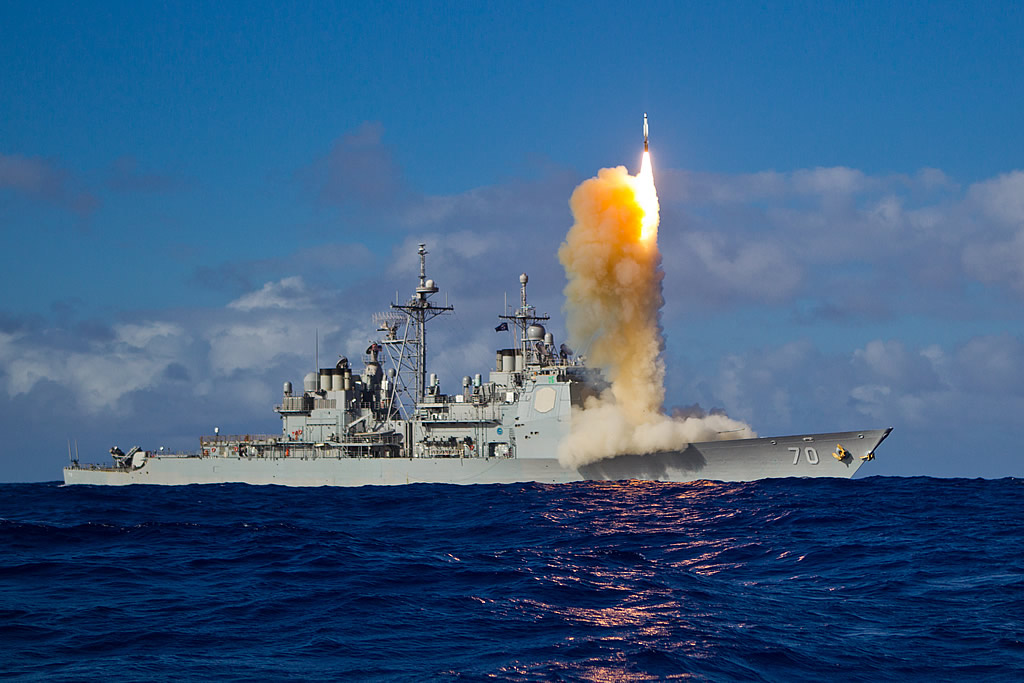
(click to view full)
Sept 27/13: SM-6. Raytheon Missile Systems, Tucson, AZ, was awarded a $243.5 million contract modification for 89 Standard Missile-6 Block I All Up Rounds, spares, containers, and engineering services. This order launches full-rate production of the missile. $236.7 million is committed immediately, and will expire on Sept 30/13.
This contract is added to the Jan 31/13 long-lead items contract for $33.3 million for a FY 2013 total of $276.8 million, or about $3.1 million per missile. That sum compares very closely to Lockheed Martin’s PATRIOT PAC-3, which plays a similar role on land.
Work will be performed in Camden, AK (34.4%); Tucson, AZ (25.5%); Wolverhampton, U.K. (14.6%); Andover, MA (7.3%); Middletown, CA (5.3%); San Jose, CA (3.1%); Dallas, TX, (2.7%); Anniston, AL (1.5%); Clarkston, GA (1.3%); Huntsville, AL (1.1%); Andover, MA (1.1%); San Diego, CA (1.1%); and Warrington, PA (1.0%) and is expected to be complete by March 2016. US Naval Sea Systems Command in Washington Navy Yard, DC manages the contract (N00024-13-C-5407). See also: Raytheon release, Sept 30/13.
FY 2013: 89 SM-6s launches Full-Rate Production
Sept 24/13: Industrial. DRS RSTA, Inc., Infrared Technologies, Huntsville, AL receives a maximum of $17.7 million cost-plus-fixed-fee contract to design, develop, and fabricate a 2-Color Focal Plane Array (FPA) for the MDA’s Advanced Technology Risk Reduction. The objective is to develop and implement a controlled dual-band, large-format, long wavelength infrared FPA manufacturing process to improve the yield for multiple lots of FPAs. If they can succeed, it would benefit a number of missile defense programs, including a very strong payoff for SM-3 Block IB and higher missiles. It would also benefit Finmeccanica’s DRS, as a premium supplier of this specialized technology.
$125,000 is committed immediately, with the rest awarded over time. Options work includes a digital FPA design, development, and fabrication effort.
All work will be performed in Dallas, TX, and Santa Barbara, CA from Sept 30/13 through Nov 30/17. This contract was competitively procured via FBO.gov, with 112 proposals received by the MDA in Redstone Arsenal, AL (HQ0147-13-C-0021).
Aug 6/13: +29 SM-3 IB. A $218.5 million sole-source, cost-plus-incentive-fee contract modification exercises an option for 29 SM-3 Block IB all-up-round missiles and containers, using FY 2013 defense-wide acquisition funds. This raises the total value of the contract from $179.4 – $398 million, which represents the FY 2013 order.
These 2 orders are good news for the SM-3 Block IB, which faces an imminent full-rate production decision.
The Pentagon says that work will be performed in Tucson, AZ, but that’s just the guidance sections. Final assembly will take place in Raytheon’s new, state-of-the-art Redstone Missile Integration Facility in Huntsville, AL, with an expected completion date of Sept 30/16. The MDA in Dahlgren, VA manages the contract (HQ0276-13-C-0001, CLIN 0002). Raytheon.
Aug 6/13: +4 SM-3 IB. A $48.9 million sole-source cost-plus-incentive-fee contract modification exercises an option for 4 SM-3 Block IB all-up round missiles and containers, using FY 2013 defense-wide acquisition funds. This is the add-back discussed in the July 9/13 entry, and raises the total value of its contract from $1.91 billion – to $1.958 billion.
Work will be performed in Tucson, AZ with an expected completion date of Sept 30/15. The MDA in Dahlgren, VA manages the contract (N00024-07-C-6119, CLIN 0026).
FY 2013: 33 SM-3-IBs
July 11/13: SM-3 IIA. A $57.2 million sole-source, cost-plus-fixed-fee contract modification for SM-3 Block IIA upgrades and engineering support, using FY 2013 RDT&E finds. The total contract value rises from $1.537 billion to $1.594 billion.
Work will be performed in Tucson, AZ through Sept 30/16. The MDA in Dahlgren, VA manages the contract (HQ0276-10-C-0005, PO 0046).
July 9/13: SM-3 IB. Raytheon in Tucson, AZ receives a somewhat confusing modification contract, so we’ll summarize in point form:
* $48.9 million cut, along with 4 SM-3 Block IB missiles. CLIN 0016 (q.v. March 29/11 entry) will now buy 20 SM-3-IB missiles.
* The 4 missiles could be added back later as an option, under new Contract Line Item Nimber 0026, for the same $48.9 million. If the option is exercised, it’s expected to happen in Q4 (Summer) 2013.
* $24 million added for “resolving technical and production transition issues,” but CLIN 0016 doesn’t change its March 2011 – December 2013 timeline.
So, the overall cut is $25 million, and the contract’s total value drops from $1.933 billion to $1.908 billion, but the new option could change that to a $24 million boost. The US MDA in Dahlgren, VA manages the contract (N00024-07-C-6119, PO 0117).
May 31/13: Support. Raytheon Missile Systems, Tucson, AZ, is being awarded a $75.9 million cost-plus-fixed-fee contract for Standard Missile engineering and technical services. These services include research and development efforts; design, systems, and production engineering; technical services; evaluation services; component improvement services; and production proofing services for missile producibility, missile production, and shipboard integration. This contract includes options that could bring its cumulative value to $316.5 million.
$33.1 million is committed immediately, using a combination of FY 2011-2013 budget lines. Of this, $1.6 million will expire at the end of FY 2013, on Sept 30/13. Work will be performed in Tucson, AZ (86.8%); Andover, MA (9.4%); Huntsville, AL (1.7%); Arlington, VA (1.1%); Camden, AK (0.7%); and White Sands, NM (0.3%), and is expected to be completed by December 2017. Since the Standard Missile family is Raytheon’s, this contract was sole sourced under 10 U.S.C. 2304(c)(1) – only one responsible source. US Naval Sea Systems Command, Washington, D.C., is the contracting activity (N00024-13-C-5403).
May 22/13: SM-6. A Pentagon Defense Acquisition Board approves full-rate production of Raytheon’s Standard Missile-6. The current configuration is the SM-6 Block I, and the team is on track to deliver the first Full-Rate Production missile in April 2015, 3 months ahead of contract. Raytheon.
SM-6 into FRP
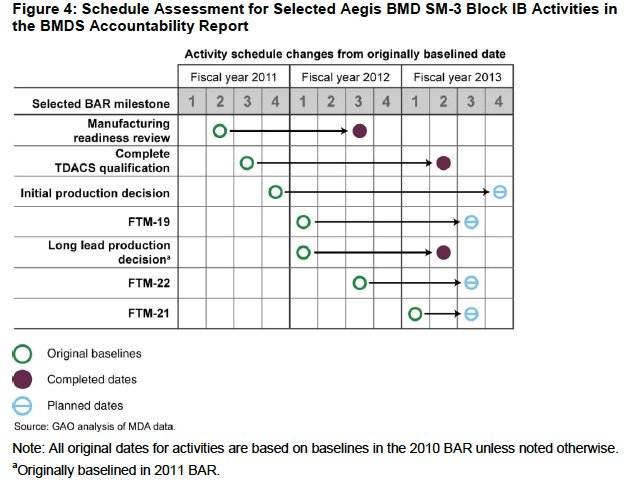
(click to view full)
April 26/13: GAO Report. The GAO looks at the MDA’s full array of programs in report #GAO-13-342, “Missile Defense: Opportunity To Refocus On Strengthening Acquisition Management.” They have a lot to say about various SM-3 programs:
SM-3 Block IB: After the Sept 1/11 failure, 2012 has been a year of fixes, while Block IB production was cut and production of the previous SM-3 Block IA was extended by 55 missiles. The May and June 2012 tests went well, but MDA experienced further difficulties completing testing of a new maneuvering component, delaying the FTM-19 flight. To keep the production line going, the FY 2013 buy of Block IB missiles was split in 2, with an initial components purchase in early 2013, and the rest to be placed after the FTM-19 test.
During 2012, the SM-3 Block IB program experienced multiple issues completing TDACS qualification tests, including a test failure in October 2012 whose root cause analysis will cost $27.5 million. Completion of qualification testing ended up slipping from late 2011 to February 2013.
SM-3 Block IIA: After the SM-3 Block IIA had its Preliminary Design Review delayed by problems with 4 components (incl. the nosecone, TDACS, and 2nd & 3rd stage rocket motors), the GAO thinks MDA did the right thing by delaying the PDR by a year and adding about $296 million to extend development. The program completed the PDR successfully in March 2012, but the TDACS thrusters that aim the kill vehicle remain an issue. Program management officials say they’re applying SM-3 Block IB program lessons learned, as DACS systems are tough problems that have often challenged SM-3 variants.
SM-3 Block IIB: The missile was effectively canceled shortly after the report, and the report explains why. See SM-3 background section, above, for more.
April 10/13: FY 2014 Budget. The President releases a proposed budget at last, the latest in modern memory. The Senate and House were already working on budgets in his absence, but the Pentagon’s submission is actually important to proceedings going forward. See ongoing DID coverage. The biggest news is the SM-3 Block IIB Next-Generation Aegis Missile’s effective termination into a technology demonstration program. Its ability to defend the USA from European bases became questionable, and its timelines were never realistic. The USA will buy the originally-planned number of land-based GBI missiles instead.
Budget totals are graphed above, and it’s also worth noting that the SM-6 missile saw multi-year production cuts. The Navy’s justification documents explain, though we suspect SM-6 production will end up stretched long beyond 2024 due to future cuts:
“SM-6 was rephased to better align with the combat systems upgrades to Destroyers and Cruisers via [Aegis] ACB-12…. Per OPNAV Direction of 11 July 2012, the Program of Record total procurement quantity for SM-6 is increased from 1200 to 1800. The estimated scheduled completion date is extended from FY19 to FY24.”
March 15/13: SM-3 IIB. Following North Korea’s 3rd nuclear test attempt, the new US Secretary of Defense announces that the USA will add 14 more ground-based interceptors at Fort Greely, AK and Vandenberg AFB, CA, boosting the total number from 30 back to the 44 planned by the previous administration. At the same time, they’re re conducting Environmental Impact Studies for a potential additional GBI site in the United States.
They’re paying for this by “restructuring” the SM-3 Block 2B Next Generation Aegis Missile program, whose 2020 deployment date was never realistic (vid. April 20/12 GAO report).
Japan will continue to collaborate with the USA on the SM-3 Block 2A program, and will get a 2nd AN/TPY-2 radar on its territory. Pentagon AFPS | Full Speech Transcript | Boeing.
SM-3-IIB/ NGAM cancelled
March 11/13: Datalink. Raytheon announces that they’ve begun advanced testing of their company-funded dual-band (S/X) datalink, linking SM-3 missiles to an X-band Thales Nederland Advanced Phased Array Radar (APAR) at a shore-based Dutch facility. Dutch LCF ships have already participated in American missile defense tests as trackers, but they’d need this datalink if they wanted the full radar communication that’s needed to launch their own interceptors.
APAR active array radars are used as fire control radars by Dutch LCF and German F124 frigates, and by the new Danish Ivar Huitfeldt Class. The datalink would also help the US Navy. Their 3 new Zumwalt Class “destroyers” will use Raytheon’s SPY-3 X-band radar, but their SM-2 and SM-3 missile inventories are designed to work with SPY-1 S-band radars.
March 5/13: SM-3 support. Raytheon’s SM-3 Block IB in-service engineering support contract jumps from $594.4 million to $656.7 million, a raise of $62.3 million. Based on subsequent documents, this appears to be an early order for components etc., with the rest to follow if the next test succeeds.
They’ll work on this sole-source, cost-plus-award-fee contract through Sept 30/15, with initial funds coming from FY 2013 Research, Development, Test and Evaluation accounts. The US MDA in Dahlgren, VA manages this contract (HQ0276-11-C-0002, PO 0032).
Feb 28/13: Industrial. Raytheon announces that their new SM-6 production facility, with modern tools that include mobile robots and ultra-precise laser positioning, has delivered its 1st SM-6 all-up-round to the US Navy. See Nov 16/12 entry for more.
Feb 11/13: Block 2B – GAO Report. GAO-13-382R: “Standard Missile-3 Block IIB Analysis of Alternatives” throws cold water on the idea that the SM-3 Block 2B can defend the USA from bases in Poland or Romania. The geometry isn’t very good, and success may require a boost-phase intercept. Those are very tricky, and have limited range, because you have to hit the enemy missile within a very short time/ distance.
Some members of the military think it’s possible, at an initial estimated budget of $130 million extra. The missile may also need to grow from 21″ diameter to 27″, which will change which launchers it can fit into. Then there are other tradeoffs. Liquid propellants can boost speed, but are unsafe on Navy ships due to the fire risks. On the other hand, the middle of the North Sea offers much better missile intercept geometries, which can work after the boost phase. Maybe Block 2B shouldn’t be land-based at all, but then how big an improvement is it over Block 2A? MDA still needs to set the future Block 2B’s missile’s performance requirements and limits. Where should the tradeoffs be made?
This brings us to the GAO’s point about the MDA developing the SM-3 Block IIB under a framework that dispenses with a good chunk of the usual paperwork, including an Analysis of Alternatives. On reflection, this is more than just a bureaucratic point driven by “records show that programs doing the paperwork usually fare better.” One of the EPAA’s key underlying assumptions is now in question, and the proposed solution must now be in question as well. Is the best solution for land-based European missile defense still SM-3 Block IIB? What are the tradeoffs vs. using a system like the enhanced US-based GMD system recommended by the September 2012 NRC report (q.v.), and making Block 2B a ship-deployed missile? Without good answers regarding capability, options, and maintainability, how does the MDA pick the right winning combination among the Block 2B competitors? A full AoA could improve those answers – and hence the odds of a smart pick.
Feb 4/13: Support. A $14.2 million cost-plus-fixed-fee contract to repair, provide depot and intermediate level maintenance for, and recertify “Standard Missiles” or associated items. The contract covers the US Navy and Foreign Military Sales from FY 2013 – 2017.
Work will be performed in Tucson, AZ (89%); Camden, AR (8%); Huntsville, AL (2%); and Andover, MA (1%), and is expected to be complete by September 2013. $5.6 million in funding from the FY 2013 “Operations & Maintenance, Navy” is committed immediately, and will expire at the end of the current fiscal year on Sept 30/13. This contract was not competitively procured in accordance with the “one responsible supplier” provision of 10 U.S.C. 2304 (c) (1), as implemented in FAR 6.302-1 (N00024-13-C-5402).
Jan 31/13: SM-6. A $33.3 million cost-only contract for FY 2013 long-lead items, to support SM-6 Block I production.
Work will be performed in Camden, AR (72.6%), Andover, MA (11.5%), Wolverhampton, United Kingdom (9.8%), Tucson, AZ (2%), San Carlos, CA (1.1%), San Diego, CA (0.9%), Anniston, AL (0.7%), Middletown, CT (0.6%), Joplin, MO (0.5%), and Milwaukie, OR (0.3%), and is expected to be complete by February 2015. All funding is committed immediately, via the FY 2012 “Operations and Maintenance, Navy” budget line. This contract was not competitively procured in accordance with the “one responsible source” exemption in 10 U.S.C. 2304 (c) (1), as implemented in FAR 6.302-1 (N00024-13-C-5407).
Jan 17/13: SM-6 DOT&E. The Pentagon releases the FY 2012 Annual Report from its Office of the Director, Operational Test & Evaluation (DOT&E). The SM-6 is included, and the overall recommendation is blunt:
“SM-6 does not meet the flight reliability criteria established by USD(AT&L) for full-rate production…. Until reliability deficiencies are resolved, the Navy should consider issuing tactics that employ multiple missiles for certain targets [DID: because you can’t depend on just 1].”
The good news is that the SM-6 has demonstrated longer downrange engagement than any SM-2. Unfortunately, current Aegis SPY-1 B/D radar and combat system can’t fully test the SM-6’s capabilities, and won’t until Aegis Baseline 9 (aka. Navy Integrated Fire Control-Counter Air) From the Sea combat system enhancements in FY 2014 – 2015. Once that back-end element is delivered, however, initial trials using multiple sensors suggest that “SM-6 battlespace will be significantly expanded.”
The bad news is that the classified deficiency noted in the 2011 report is still there, and the Navy doesn’t have a fix yet. There’s also a problem with debris and the uplink/downlink antenna, which can interfere with initial guidance. The fix hasn’t been fully flight tested, and wind tunnel testing revealed new problems with the antenna sealant material and insulation bonding. Finally, there’s an anomaly with the fuse’s Mk54 Safe-Arm Device.
Jan 17/13: SM-3 DOT&E. The Pentagon releases the FY 2012 Annual Report from its Office of the Director, Operational Test & Evaluation (DOT&E).
With respect to the SM-3’s anomaly in test FTM-15, the 3rd stage rocket motor has been redesigned, and flew successfully in test FTM-18. That stage is common to SM-3 Block IA and Block IB. The program is still trying to fully understand what went wrong in FTM-16, though, and that issue also deals with the 3rd stage motor. DOT&E wants a flight test to verify the correction for FTM-16 Event 2, which didn’t end as well as FTM-15 did.
Beyond that, they recommend that the US Navy engage a medium-range target before the SM-3 Block IB’s Full-Rate Production Decision.
Dec 14/12: Support. A $12.3 million contract modification exercises options for Standard Missile engineering and technical services, including evaluations of advanced missile configurations and advanced technology efforts.
Work will be performed in Tucson, AZ, and is expected to be complete by March 2013. All funds are committed immediately, and $2.7 million will expire at the end of the current fiscal year. US Naval Sea Systems Command, Washington DC (N00024-12-C-5400).
Nov 30/12: SM-2. A $108.8 million contract modification to previously awarded contract for SM-2 production, section level components and spares, shipping containers and associated data. It lists itself as a FY 2011 award, and Raytheon confirms that it brings the total FY 2011 contract value to more than $200 million. They also confirm that the award includes 60 SM-2 missiles, while emphasizing that well over half of the contract value is for design agent services, spare sections, and test equipment.
This contract will support foreign military sales to Australia (39.8%), Korea (19.8%), Japan (17.5%), Canada (3.2%), Germany (0.4%), Taiwan (0.2%) and the Netherlands (0.1%). That only totals 81%, so about $20.7 million/ 19.0% must be for the US military, which has committed to supporting SM-2 past 2035.
Work will be performed in Tucson, AZ (43.5%); Camden, AR (22%); Andover, MA (16.7%); Netherlands (5.3%); Anniston, AL (2.6%); San Diego, CA (2.4%); Lebanon, NH (2.1%); San Jose, CA (1.9%); Joplin, MO (1.8%); and El Segundo, CA (1.6%); and is expected to be complete by March 2014. $8.5 million will expire at the end of the current fiscal year, on Sept 30/12 (N00024-11-C-5300). See also Raytheon.
Nov 29/12: SM-3 SDACS R&D. Aerojet-General Corp. in Sacramento, CA wins a $34.9 million contract, Aerojet to develop and test Solid Divert and Attitude Control Systems (SDACS) technologies for exoatmospheric BMD kill vehicles, which are carried by systems like the SM-3, THAAD, etc. Improved SDACS is part of the SM-3’s planned evolution, and Aerojet is just one firm receiving these awards – vid. Sept 27/12 entry.
This contract was competitively procured and the work will be performed at Rancho Cordova, CA, from December 2012 through November 2014. $3.7 million in FY 2013 research, development, test and evaluation funds will be used to incrementally fund this effort. The MDA in Huntsville, AL manages the contract (HQO147-13-C-0005).
Nov 26/12: Industrial. Raytheon opens the doors of its new $75 million, 70,000 square-foot, SM-3/ SM-6 all-up-round production facility at Redstone Arsenal, AL in November 2012. Its advanced features include a fleet of 5-ton capacity laser-guided vehicles that silently move missiles around the factory, and use lasers and software to position missiles within 1/10,000 of an inch. Raytheon.
FY 2012
SM-6 production begins in earnest; SM-3 block IIA work gets big funding injection and continues with Japan; SM-6 test problems; Report examines SM-3 development.
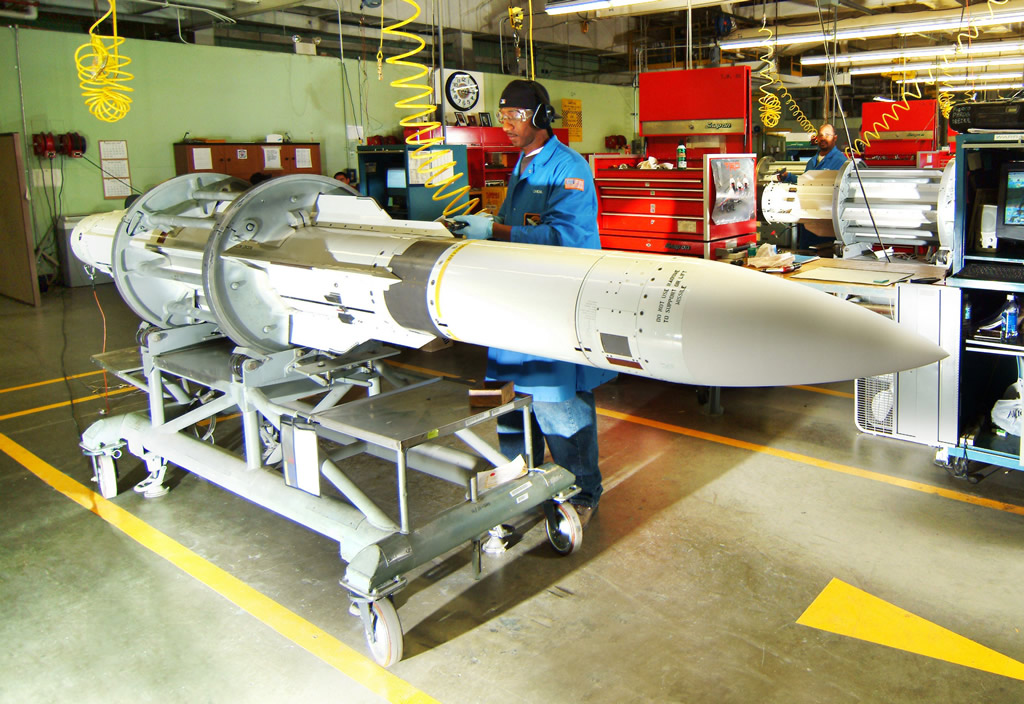
(click to view full)
Sept 27/12: SM-3-IIB MDACS R&D. Alliant Techsystems (ATK) Inc. of Minneapolis, MI receives a $52.8 million award to develop and test solid divert and attitude control systems (SDACS) technologies of interest to the MDA, “for use in final-stage kill vehicles.”
ATK has produced more than 165 earlier-generation solid DACS (SDACS) for the SM-3 program, but a Dec 3/12 release confirms that the work is aimed at the new SM-3 Block IIB (NGAM). The new Modular Divert and Attitude Control System (MDACS) is designed to improve the warhead-killer’s performance.
This contract was a competitively awarded procurement, and the work will be performed at Elkton, MD from October 2012 through September 2014. The contract begins with $200,000 in FY 2012 research, development, test and evaluation funds. The US MDA in Huntsville, AL manages the contract (HQO147-12-C-0016). See also ATK.
Sept 27/12: SM-2. Raytheon in Tucson, AZ receives a $14.2 million firm-fixed-price modification for SM-2 spares.
Work will be performed in Joplin, Mo. (31.6%); Tucson, Ariz. (23.5%); Minneapolis, Minn. (18.7%); Andover, Mass. (13.8%); Stafford Springs, Conn. (6.8%); and other sites below one% (5.6%), and is expected to be completed by March 2014. Contract funds in the amount of $11,738,119 will expire at the end of the current fiscal year. The Naval Sea System Command, Washington, D.C., is the contracting activity (N00024-11-C-5300).
Sept 21/12: SM-6 test. The high-altitude JLENS radar aerostat is part of a test involving the new SM-6 naval defense missile. During the test, JLENS’ fire-control radar acquired and tracked a target that mimicked an anti-ship cruise missile, then Cooperative Engagement Capability (CEC) was used to pass the data on to the firing ship. The missile was fired, and used JLENS’ targeting data to move into range of its own radar, before picking up the target and destroying it. Raytheon.
Aug 30/12: +19 SM-3s. A $230.3 million sole-source cost-plus-incentive-fee contract modification buys 14 SM-3 Block IA and 5 SM-3 Block IB missiles. This raises the overall contract value from $1.7 billion to $1.93 billion, and raises FY 2012 orders so far to 14 Block IA and 14 Block IB missiles.
Work will be performed in Tucson, AZ through Sept 30/14, using FY 2012 Defense-Wide Procurement funds. The MDA in Dahlgren, VA manages this contract (N00024-07-C-6119, PO 0102).
FY 2012: 14 SM-3-IAs, 5 SM-3-IBs
July 31/12: +9 SM-3-IB. A $77.1 million sole-source cost-plus-incentive-fee action exercises an option for 9 SM-3 Block IB AURs. This order increases the total contract value from $1.618 billion to $1.695 billion, and is funded by FY 2012 Defense Wide Procurement funds.
Work will be performed in Tucson, AZ from July 31/12 through July 31/13, and the MDA in Dahlgren, VA manages the contract (N00024-07-C-6119, PO 0099).
FY 2012: 9 SM-3-IBs
July 25/12: SM-3 IIA SDD Extended. Raytheon Missile Systems in Tucson, AZ receives a a sole-source $925 million cost-plus-incentive-fee contract modification, which raises the total for this FY 2010 contract from $583.4 million to $1,508.4 million. It extends and increases SM-3 Block IIA development through the Critical Design Review stage, and covers flight test support, from July 27/12 – Feb 28/17.
The SM-3 Block IIA began in 2006 as a cooperative development program with Japan, but shifts like the cancellation of the Multiple Kill Vehicle, and technical issues, have delayed the program. A restructuring plan was agreed on in September 2011, and initial flight tests won’t begin until FY 2016.
Work will be performed in Tucson, AZ, and FY 2012 Research, Development, Test and Evaluation funds will be used to begin funding. The MDA in Dahlgren, VA manages the contract (HQ0276-10-C-0005, PO 0030). Raytheon’s release adds that the missile is “on track for a 2018 deployment date,” and says that they’ve delivered “more than 130 SM-3 variants to the U.S. and Japanese navies…”
SM-3-IIA development extended
May 10/12: SM-6 LRIP-4. A $313.8 million combination fixed-price-incentive, cost-plus-fixed-fee, firm-fixed-price letter contract, for Low-Rate Initial Production of FY 2012 SM-6 Block I all-up rounds, plus special tooling and test equipment, spares, and containers. $63.4 million are committed at time of award, and the rest will be used to place orders over time.
This order is a milestone for the program. FY 2012 was intended to be the shift into SM-6 Full-Rate Production, after 3 LRIP lots. This may be LRIP Lot 4, but as the order’s size indicates, this is where the transition to SM-6 production really begins for the US Navy. Numbers aren’t given, but the figure is close enough to the FY 2012 procurement budget of $356.9 million that one can assume it orders all 89 of those missiles. To date, Australia has also committed to the missile for its Hobart Class destroyers.
Work will be performed in Tucson, AZ (46%); Camden, AR (24%); Andover, MA (6%); Wolverhampton, United Kingdom (6%); Huntsville, AL (4%); Dallas, TX (4%); Hanahan, SC (3%); Anniston, AL (3%); San Jose, CA (2%); and Middletown, OH (2%), and is expected to complete by March 2015. This contract was not competitively procured, as Raytheon is the sole qualified producer for Standard Missile (N00024-12-C-5401). The Raytheon release doesn’t add anything.
FY 2012: 89 SM-6s
May 9/12: FTM-16E2a – Block IB success. For “FTM-16, Event 2a”, the missile was fired from the guided missile cruiser Lake Erie [CG 70] using the new AEGIS BMD 4.0.1 hardware and software, and the missile used its new 2-color infrared seeker to track and intercept the target. Overall, this is the 20th successful SM-3 intercept, but the Block IB had failed the previous FTM-16 firing test (vid. Sept 1/11). Wes Kremer, vice president of Raytheon Missile Systems’ Air and Missile Defense Systems product line, offers a quick update:
“Raytheon has delivered more than 130 SM-3 Block IAs ahead of schedule and under cos… We are on track to deliver the SM-3 Block IB to the nation by 2015 for deployment at sea and ashore.”
It’s a big moment for the missile. See: US MDA | Lockheed Martin | Raytheon.
FTM-16E2a: SM-3-IB test successful
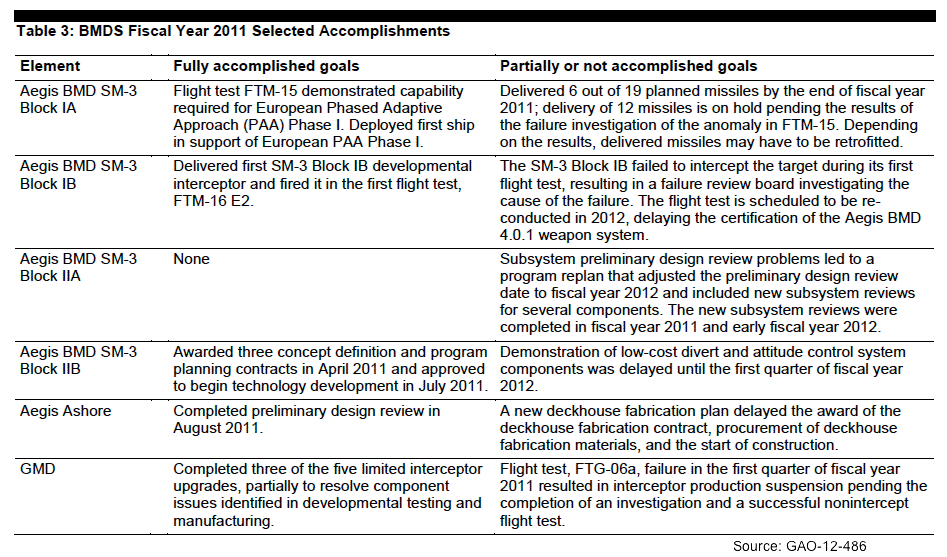
in FY 2011
(click to view full)
April 20/12: GAO report The US GAO releases “Opportunity Exists to Strengthen Acquisitions by Reducing Concurrency.” That bland-sounding title has a lot to say about the Pentagon’s SM-3 missiles, as it reviews the events of FY 2011 and looks at each variant.
SM-3 Block IA: Production was supposed to end in 2009, but Block IB failures led to 41 FY 2010-2011 orders, and may lead to more in FY 2012. The problem with further Block IA orders is an anomaly in test FTM-15. The test still succeeded, but it was serious enough that deliveries were frozen until the problem is fixed. At the time of the GAO’s report, 12 missiles were awaiting delivery (GAO says about 10% of the operational fleet), and at least 7 missiles will need modifications.
SM-3 Block IB: The 2015 political schedule for deploying a European Missile defense is forcing a lot of the program’s overlap between development, testing & production. For instance, the program began production of SM-3 IB interceptors before resolving development issues with the kill vehicle’s TDACS propulsion. TDACS failed qualification testing in early 2010 and required a redesigned propellant moisture protection system, but the version used in the failed FTM-16E2 flight test in 2011 wasn’t the same as approved production design. TDACS is expected to complete qualification testing in 2012, barring further problems, and various issues continue to delay production. After the FTM-16 E2 test failure, FY 2011 orders were cut, and most of those missiles (18/25) are now slated for testing. Those issues aren’t fully resolved, and the Block IA’s FTM-15 test anomaly is also a problem, since the affected system is shared with the Block IB. A decision must be made on the planned FY 2012 order for 46 missiles, even though testing may need until 2013. The MDA wants to buy 472 SM-3 Block IBs by 2020.
SM-3 Block IIA USA/Japan: While this is still technically an “SM-3,” the GAO correctly points out that this 21″ diameter missile will have very little in common with the Block IB. A September 2011 program rescheduling has helped, and an issue with nosecone weight seems to be settled. At the end of FY 2011, however, there were still technical difficulties with the 2nd and 3rd stage rocket motors, and the alternate propellant picked for the new “high-divert” DACS system may offer less kill vehicle performance than hoped.
SM-3 Block IIB NGAM: Being pursued as a competitive program, with 3 design vendors and multiple technology development contracts for key technologies. The GAO is also concerned about concurrency here, as the summer 2013 product development decision will occur before the March 2015 Preliminary Design Review. They add:
“Based on the experience of other SM-3 interceptors, the program must commit to produce flight test interceptors 2 years before the March 2016 first flight. However, this timeline means the commitment to a flight test vehicle would occur a year before the SM-3 Block IIB PDR [in March 2015] has confirmed that the design is feasible and more than a year and a half before CDR has confirmed that the design is stable.”
Key progress report
March 21/12: SM-3. Raytheon Missile Systems in Tucson, AZ receives a $120 million contract ceiling increase for SM-3 design and engineering, in service engineering support, production engineering and obsolescence, surveillance and flight test support, and transition to production. The change increases the contract’s maximum value from $689 million to $809 million.
Work will be performed in Tucson, AZ through Sept 30/15. FY 2012 research, development, test and evaluation funds will be used to incrementally fund this initial effort. The MDA in Dahlgren, VA manages the contract (HQ0276-11-C-0002, PO 0017, contract line item number 0003).
Jan 19/12: SDACS. Alliant Techsystems (ATK), Inc. in Minneapolis, MN receives a $13.5 million contract modification to “develop and test Solid Divert and Attitude Control Systems (SDACS) technologies of interest to the Missile Defense Agency.”
This contract represents part of the MDA’s technology development strategy to improve performance and reduce risk for BMD interceptor divert and attitude control systems, which maneuver missile kill vehicles to hit their target in space. ATK’s SDACS is associated with the SM-3 program’s LEAP(Lightweight Exo-Atomspheric Projectile) Kinetic Kill Vehicle, but similar kil vehicles are also used in the land-based THAAD (Boeing liquid DACS) and GBI/GMD (Raytheon/Aerojet EKV) programs. Depending on the technologies tested, there may be spinoff benefits.
The original contract was a competitively awarded procurement. Work will be performed at Elkton, MD, from February 2012 through December 2012, with $800,000 in FY 2012 Research, Development, Test and Evaluation funds as opening funding. The MDA, Huntsville, AL manages the contract (HQOI47-11-C-0003).
Jan 17/12: DOT&E & SM-6. The Pentagon releases the FY2011 Annual Report from its Office of the Director, Operational Test & Evaluation (DOT&E). The SM-3 and SM-6 are included.
For the SM-3, the DOT&E report has little to say. The SM-3 Block IA system is stable, and continues to show progress. There was an anomaly in the SM-3 Block IA interceptor’s flyout during test FTM-15, but it achieved intercept. FTM-16 Event 2 saw a failure by the new SM-3 Block IB. Both incidents are still under investigation.
The SM-6 completed IOT&E flight testing in July 2011, but was assessed as not operationally effective or suitable yet. On the plus side, it showed strong range, and performed well against low-level, maneuvering, and ECM(electronic countermeasure) protected targets. On the other hand, it succeeded in only 7 of 12 intercepts, and those weren’t in an “objective operational environment.” Two missions failed due to fuze-related anomalies, 2 missions were in-flight hardware failures, and 1 was a failure of the missile navigation system.
There were 2 classified performance anomalies that DOT&E believes should have been uncovered in developmental testing, and 2 more anomalies (antenna debris, MK54 safe-arm device) that were found but not fixed, with effects on the test results. The DOT&E wants corrective action on the problems, more flight tests, and an IOT&E test plan for SM-6’s full over-the-horizon capability when Aegis Capability Baseline 12 and the NIFC-CA sensors are fielded after FY 2014.
Dec 8/11: SM-3 IB. A $35 million sole-source modification to Raytheon’s cost-plus-incentive-fee SM-3 Block IB contract, to buy materials and assemblies used in those missiles from December 2011 – May 2012. This raises the contract’s total value to $1.604 billion. The period of performance for this contract action is from December 2011 through May 2012.
FY 2011 RDT&E funds will be used to fully fund this effort. The MDA in Dahlgren, VA manages the contract (N00027-07-C-6119).
Nov 15/11: SM-3 IIA. Raytheon in Tucson, AZ receives a sole-source, $241 million cost-plus-award-fee contract modification, including options, which brings the total contract to $575.6 million. In exchange, they’ll offer engineering services and material for systems engineering, design and development support, and initial hardware fabrication for the SM-3 Block IIA missile, including redesign of the divert and attitude control system (DACS, vid. Sept 17/11 entry).
Work will be performed in Tucson, AZ through March 31/12, using FY 2012 research, development, test and evaluation (RDT&E) funds. The SM-3 block IIA is a collaboration with Japan, but the Pentagon notes that this is not a Foreign Military Sales acquisition. The MDA in Dahlgren, VA manages the contract (HQ0006-10-C-0005). See also Sept 8/11 entry, Raytheon release.
FY 2011
SM-3 block IIB/NGAM, phase 1 R&D contracts; Datalink could expand SM-3 to new ship classes; SM-3 block IIA work continues with Japan; SM-3 block IA production continues after all, following FTM-16’s SM-3 block IB test failure; SM-3 IA demonstrates launch on remote track in FTM-15; Multinational SM-2 contract; SM-6 LRIP-3 contract; 1st SM-6 delivery.

(click to view full)
Sept 23/11: FY11 SM-2s. A not-to-exceed $142.6 million cost-only contract for FY 2011’s SM-2 all-up-rounds (number not mentioned), section level components and spares, shipping containers, and associated data. This contract will provide 60 SM-2 Block IIIB all-up-rounds, along with components and spares. This contract combines purchases for the U.S. Navy (17.8%); and, under the Foreign Military Sales Program, the governments of Korea (32.4%), Japan (26.5%), Australia (21.9%), Germany (0.7%), Taiwan (0.5%), and Canada (0.2%). It includes options which could bring the total to $146.2 million.
Work will be performed in Andover, MA (37%); Camden, Ark. (36%); The Netherlands (7%); Anniston, AL (5%); Joplin, Mo. (4%); San Diego, CA (3%); Middleton, CT (3%); El Segundo, CA (3%); and Reisterstown, MD (2%). Work is expected to be complete by June 2013. This contract was not competitively procured by US Naval Sea Systems Command in Washington Navy Yard, DC (N00024-11-C-5300).
FY 2011: 60 SM-2s
Sept 17/11: SM-3-IIA delays. Mianichi Daily News reports US notification to Japan that the SM-3 Block IIA will be delayed 2 years, because the kill vehicle needs additional testing. The USA will cover the additional costs.
The original development plan involved a 9-year effort ending in 2014, with Japan paying $1.0 – 1.2 billion, and the USA $1.1 – 1.5 billion. That will now extend to 2016, with the USA looking to deploy the new missile in 2018.
SM-3-IIA program delayed
Sept 16/11: SM-3 IA order. A maximum $285.8 million unfinalized sole-source, cost-plus-incentive-fee contract modification to build another 23 SM-3 Block IA missiles. The award increases the total contract value from $1.269 billion to $1.555 billion, and appears to cancel the procurement shift indicated by the March 29/11 contract, which cut and seemingly ended SM-3 Block IA production. See also the Sept 1/11 entry, in which the replacement SM-3 Block IB missile failed its 1st intercept test.
Work will be performed in Tucson, AZ through April 30/14. $60 million in FY 2011 defense-wide procurement funds will be used to incrementally fund this effort. The MDA in Dahlgren, VA manages the contract (N00024-07-C-6119, PO 0068).
FY 2011: 23 SM-3-IAs
Sept 16/11: SM-6. Another $9.1 million fixed-price incentive-fee and firm-fixed-price contract modification for low rate initial production of FY 2011 SM-6 Block I AURs. See also the $182.3 million June 21/11 entry.
Work will be performed in Tucson, AZ (50%); Camden, AR (23%); Boston, MA (5%); Dallas, TX (4%); Hanahan, SC (3%); Anniston, AL (2%); San Jose, CA (2%); and other areas (11%), each having less than 1%; and is expected to be complete by March 2014 (N00024-09-C-5305).
Sept 13/11: DB Datalink. Raytheon announces successful testing for their prototype dual-band datalink, allowing ships that use either Lockheed Martin SPY-1/ AEGIS or Thales Nederland’s SMART-L and/or APAR radars to employ the full range of Standard Missiles, including the SM-3.
The firm cites up to 20 eligible ships, including SPY-1/ AEGIS/ MK41 VLS operators in Norway (Fridtjof Nansen) and Spain (F100); as well as APAR/ SMART-L/ MK41 radar operators in Denmark (Iver Huitfeldt), Germany (F124 Sachsen), the Netherlands (De Zeven Provincien); and closely derived S1850 operators in France (Horizon), Italy (Horizon) and the United Kingdom (Type 45).
For discussion of the issues, the opportunity, and the ships Raytheon left out, read “Raytheon’s Datalink: A New Naval Standard for the Standard?” See also June 20-21/11 entry.
Sept 8/11: SM-3-IIA. Raytheon Missile Systems in Tucson, AZ receives a sole-source $48 million cost-plus-award-fee contract modification, to perform SM-3 Block IIA engineering services, design and development support, and initial hardware fabrication, including continued DACS(divert and attitude control system) development work. The award raises the total contract value from $286.5 million to $334.5 million.
Work will be performed in Tucson, AZ is through Oct 31/11. FY 2011 research, development, test and evaluation funds will be used to incrementally fund this effort, and even though the Block IIA is a joint effort with Japan, his is not a Foreign Military Sales acquisition. The MDA in Dahlgren, VA manages the contract (HQ0006-10-C-0005, PO 0017).
Sept 1/11: FTM-16E2 = SM-3-IB fail. The first ABM test of the new SM-3 Block 1B missile does not go well, as the launch from the AEGIS BMD 4.0.1-equipped USS Lake Erie [CG-70] fails to intercept the target missile during “FTM-16, Event 2”. The US MDA is now 21/26 for SM-3 missile intercept attempts, plus one successful satellite kill.
The root cause of failure turns out to be abnormal performance in the 3rd stage, during thrust pulses for final rocket maneuver. That stage is common to Block IA and Block IB missiles, so the program decides that the least disruptive approach is to change the ship’s Aegis BMD 4 software to control the timing between pulses. There are no further problems in the next 3 SM-3 Block IB tests. US MDA | Aviation Week pre-test | GAO report explains cause.
SM-3-IB test failure
Aug 31/11: TDACS. GenCorp subsidiary Aerojet announces successful SM-3 Block 1B Throttleable Divert and Attitude Control System (TDACS) ground static testing, which is short of full qualification. Aerojet is the Standard Missile’s TDACS supplier, developing the SM-3 Block IB and Block IIA systems, and doing technology research for NGAM Block IIB. Vice President of Missile Defense, Michael Bright:
“These tests confirm the readiness of the TDACS for the upcoming [Block IB] critical flight test… We look forward to a successful flight test.”
Aug 23/11: Raytheon Missile Systems Co. in Tucson, AZ receives a $9.8 million sole-source, cost-plus-award-fee contract modification. The CLIN 0008 option, “Future Upgrades and Engineering Support,” will help the MDA execute technical analysis for the Aegis BMD 5.1/SM-3 Block IIA combination, and increases the total contract value from $276.7 – $286.5 million.
Work will be performed in Tucson, AZ through Sept 30/16, and will be incrementally funded by FY 2011 research, development, test, and evaluation funds. Though the SM-3 Block IIA is a cooperative program with Japan, this is not a foreign military sales acquisition. The US MDA in Dahlgren, VA manages the contract (HQ0276-10-C-0005, PO 0015).
July 6/11: DSB controversy. In an open letter, the US Defense Science Board aims to dispel impressions that they recommended against the SM-3, which by its nature is a mid-course or terminal phase interceptor:
“The DSB concluded that the Missile Defense Agency is on the right track in developing European Phased Adapted Approach (EPAA) options, including continued evolution of the SM-3 family of missiles… The DSB also examined the potential in the EPAA context for EI [Early Intercept] in regional defense against short-range missiles before threat payloads could be deployed, and concluded that this was not a viable option because of technical constraints… The fact that this form of EI is not viable in shorter-range regional applications does not imply that either SM-3 family interceptors or the EPAA concept are flawed… MDA is on the right track in pursuing this capability for national missile defense, and examining the potential application in regional defense as a function of the range of threat missiles.”
June 23/11: CRS report. The US Congressional Research Service releases the latest update of “Navy Aegis Ballistic Missile Defense (BMD) Program: Background and Issues for Congress” [PDF]. Key excerpts:
“Some observers are concerned… that demands from U.S. regional military commanders for BMD-capable Aegis ships are growing faster than the number of BMD-capable Aegis ships. They are also concerned that demands from U.S. regional military commanders for… BMD operations could strain the Navy’s ability to provide regional military commanders with Aegis ships for performing non-BMD missions… Options for Congress include, among other things, the following: accelerating the modification of Aegis ships to BMD-capable configurations, increasing procurement of new Aegis destroyers, increasing procurement of SM-3 missiles, and providing funding for integrating the SM-2 Block IV BMD interceptor missile into the 4.0.1 version of the Aegis BMD system… MDA states that SM-3 Block IAs have a unit procurement cost of about $9 million to $10 million, that SM-3 Block IBs have an estimated unit procurement cost of about $12 million to $15 million, and that SM-3 Block IIAs have an estimated unit procurement cost of about $20 million to $24 million.”
June 21/11: SM-6 LRIP-3. Raytheon Missile Systems in Tucson, AZ receives a $182.3 million contract modification to previously awarded contract for FY 2011 low-rate initial production (LRIP Lot 3) of SM-6 Block I all up rounds (AUR), complete with storage and self-test container. The USA is buying 59 SM-6 Block I AURs, 35 instrumentation kits, spares and containers, and engineering/ design agent services.
Work will be performed in Tucson, AZ (61%); Camden, AR (23%); Boston, MA (5%); Dallas, TX (4%); Hanahan, SC (3%); Anniston, AL (2%); and San Jose, CA (2%). Work is expected to be completed by June 2013 (N00024-09-C-5305). See also July 1/10 entry.
June 3/11: SM-3 IB. A $219.5 million cost-plus-award-fee, cost-plus-incentive-fee, and cost-plus-fixed-fee contract modification, finalizing work for the FTM-16 ballistic missile defense test. This finalizes the total contract at $294.5 million, which includes the engineering, development, testing, support and material necessary to deliver an SM-3 Block 1B missile; and to provide engineering support, production engineering and obsolescence, surveillance and flight test support, and travel during the 55-month (about 4.5 year) performance period.
FTM-16 is scheduled for late summer 2011. It will demonstrate the new AEGIS BMD 4.0.1 fire control standard mounted in USS Lake Erie [CG 70], in conjunction with the 1st flight test of the SM-3 Block IB interceptor. Work will be performed in Tucson, AZ through Sept 30/15, and about $32 million in FY 2011 research, development, test and evaluation (RDT&E) funds will be used. The MDA at Dahlgren Naval Base, VA manages this contract (HQ0276-11-C-0002). See also US MDA testimony to HASC [PDF].
May 27/11: SM-3 IIB R&D. GenCorp subsidiary & rocket propulsion specialist Aerojet announces 2 contracts to develop key technologies required for the SM-3 Block IIB Next-Generation Aegis Missile.
That’s still in competition, and will be for a while, but Aerojet will work to develop improved high-performance, lightweight propulsion components for the missile’s upper stage, and also for the final Kill Vehicle’s maneuvering Divert and Attitude Controls. At this stage, however, it’s extremely preliminary stuff. They’ll identify key propulsion technologies, define and conceptualize propulsion components, and conduct limited testing to provide characterization data. Even prototyping won’t take place until the next stage.
May 26/11: SM-3 IA R&D. A $110.7 million cost-plus-award-fee modification, resulting in a new cumulative contract value of $276 million for SM-3 Block IIA engineering and development. The modification will extend contract line item number (CLIN) 0001 period of performance to from May 1/11 through Sept 30/11, the end of fiscal 2011.
FY 2011 RDT&E (research, development, test and evaluation) funds will be used for this effort with $20 million provided at time of award (HQ0276-10-C-0005, PO 0011). This announcement repeats a May 11/11 Pentagon notice.
April 26/11: SM-6 1st delivery. Raytheon announces that they’ve delivered the 1st SM-6 missile to the US Navy. Raytheon’s Air and Missile Defense Systems product line VP Frank Wyatt implies that the delivery actually took place in March, when he says that:
“Five years ago, Raytheon promised the U.S. Navy that SM-6 would be delivered in March 2011, and we delivered on that promise… and met cost expectations for system development and demonstration.”
SM-6 delivery
April 15/11: FTM-15. Flight Test Standard Missile-15 (FTM-15) fires an SM-3 Block 1A missile against an intermediate-range (officially, 1,864 – 3,418 miles) target, based on AN/TPY-2 ground-based radar data, before the USS O’Kane (DDG 77, equipped with AEGIS BMD 3.6.1) could pick the target up using its own radar. Initial indications are that all components performed as designed, and the missile recorded the 21st successful AEGIS BMD intercept in 25 tries.
The target missile was launched from the Reagan Test Site, located on Kwajalein Atoll in the Republic of the Marshall Islands, approximately 2,300 miles SW of Hawaii. The AN/TPY-2 radar, which is also used as part of the THAAD missile system, was located on Wake Island, and crewed by Soldiers from the 94th Army Air and Missile Defense Command. It detected and tracked the missile, then sent trajectory information to the 613th Air and Space Operations Center’s C2BMC (Command, Control, Battle Management, and Communications) system at Hickam Air Force Base, HI. That was relayed to USS O’Kane, sailing to the west of Hawaii, which launched the SM-3-1A missile about 11 minutes after target take-off. O’Kane’s own AN/SPY-1 radar eventually picked up the incoming missile itself, and controlled the missile until impact.
FTM-15 was less dramatic than the SM-3’s 2008 satellite kill, but it’s equally significant. Launch on remote track was supposed to wait for AEGIS BMD 5.1, and SM-3 Block IB was supposed to begin addressing IRBMs, with full capability only in SM-3 block II. Instead, the test also combined to extend the current system’s proven capabilities, while validating the difficult connections that make a missile defense system more than the sum of its parts, and proving out an important early warning element (STSS satellites) in the system. US MDA | Lockheed Martin | Raytheon | Lexington Institute.
April 12/11: SM-6. Raytheon in Tucson, AZ receives a $17.7 million fixed-price incentive-fee contract modification to get ready for SM-6 production. It includes incorporation of pre-production materials and support required for FY 2011 production of “all up rounds,” i.e. missiles and smart canisters.
Work will be performed in Tucson, AZ, and is expected to be complete by June 2013. US Naval Sea Systems Command in Washington Navy Yard, DC manages the contract (N00024-09-C-5305).
April 7/11: SM-3 IIB/ NGAM Phase 1. The MDA announces a trio of Phase 1 cost-plus-fixed-fee contracts to work with MDA on the Next Generation AEGIS Missile/ SM-3 Block IIB. The firms will perform concept definition and program planning, offer their competing visions for viable and affordable missile configurations, conduct trade studies, and define an executable development plan. This contract was competitively procured via publication on the Federal Business Opportunities website, and received 4 proposals. Based on previous releases, it would appear that Northrop Grumman is the odd firm out (vid. Nov 10/10 entry). Winners included:
Boeing in Chicago, IL wins a $41.2 million contract. Work will be performed in Huntsville, AL, through December 2013, and $1.4 million in FY 2011 research, development, test and evaluation funds will be used as incremental funding (HQ0147-11-C-0007). Boeing’s core theater missile defense offering is the Ground-Based Midcourse Defense program, run with key team members Orbital Sciences and Northrop Grumman.
Lockheed Martin Corp. in Bethesda, MD wins a $43.3 million contract. Work will be performed by Lockheed Martin Space Systems in Sunnyvale, CA, through December 2013, and $1.4 million in FY 2011 research, development, test and evaluation funds will be used as incremental funding (HQ0147-11-C-0008). Lockheed Martin’s core theater missile defense offering is the THAAD interceptor, and there has been talk of expanding it to a longer-range 21″ diameter weapon. Lockheed Martin’s release touts their lead roles in the AEGIS BMD 5.1 combat system and Mk.41 launcher, which will be used with the land and sea-based SM-3 Block IIBs. This contract was also announced on May 6/11; that announcement was a duplicate.
Current SM-3 incumbent Raytheon Co. in Waltham, MA wins a $42.7 million contract. Work will be performed by Raytheon Missile Systems in Tucson, AZ, through December 2013, and $1.4 million in FY 2011 research, development, test and evaluation funds will be used as incremental funding (HQ0147-11-C-0009). See also Raytheon’s release notes that “Raytheon has delivered more than 130 SM-3s ahead of schedule and under cost as part of its contract with the Missile Defense Agency.”
SM-3 Block IIB/ NGAM, Phase 1
March 29/11: Shift to the SM-3 Block IB. The MDA takes with one hand, and gives with the other.
Contract #N00024-07-C-6119, CLIN 0004 cuts $72.3 million in funding from the SM-3 Block IA, ordering 18 missiles for $157.6 million instead of 24 missiles for $229.9 million. Work will be performed in Tucson, AZ, and will take place from March 2011 through April 2012. This identical change was announced on March 22/11 as well. The MDA tells DID that the original plan was to go to 12 missiles, but Congress added funding for another 6 in the FY 2010 budget/supplemental rounds.
On the other hand, CLIN 0016 for the same contract pays $312.7 million to finish SM-3 Block IB development, and order 24 missiles. Work will be performed in Tucson, AZ, and will take place from March 2011 through June 2013. FY 2011 research, development, test and evaluation (RDT&E) funds will be used to incrementally fund $47.8 million of this order – but the Block IB’s days as a development project are numbered. It’s about to become the main production weapon. See also Raytheon release. The GAO-12-486 report notes that this purchase of 24 Block IB missiles was later canceled.
March 3/11: SM-3 IB. The MDA announces a $75 million sole-source cost-plus-award-fee contract to Raytheon Missile Systems in Tucson, AZ to support flight test mission 15 involving an SM-3 Block 1B missile, and deliver the SM-3 Block 1B missile for FTM-16. This undefinitized contract action will award contract lines items for in service engineering support and travel, and will also cover engineering development, testing, support and necessary materials.
Work will be performed in Tucson, AZ from February 2011 through May 2011, and $20 million in FY 2011 Research, Development, Test and Evaluation (RDT&E) funds will be used to incrementally fund this effort (HQ0276-11-C-002).
Dec 29/10: SM-3. Raytheon Missile Systems in Tucson, AZ receives a $24.4 million cost-plus-award-fee modification, exercising an option to provide continued systems engineering and development of the Standard Missile-3.
Work will be performed in Tucson, AZ from Jan 1/11 through Jan 31/11. FY 2011 research, development, test and evaluation funds will be used to obligate $5 million to provide the initial funding for this effort. The MDA manages this contract (HQ0276-08-C-0001).
Nov 29/10: The US Navy’s PEO-Integrated Warfare Systems issues a readiness and sustainment contract to BAE Systems, to establish and maintain the ship interfaces for the Standard Missile family. That includes, but is not exclusive to, the Mk41 vertical launch systems carrying the missiles. These services include systems and software engineering, systems integration, testing, and computer-aided design. The contract has a 1-year base period, with up to 4 one-year options. If all options are exercised, it will be worth $60 million. Work will be conducted at a BAE Systems Support Solutions facility in Rockville, MD, and at customer sites in Tucson, AZ and around the world.
Under the same contract, the company also works with the Navy to support Standard Missile family interfaces for Australia, Canada, Germany, the Netherlands, and Taiwan. BAE Systems.
Nov 22/10: Raytheon Missile Systems in Tucson, AZ receives a $70 million contract modification for FY 2011 Standard Missile program engineering and technical services. Work will be performed in Tucson, AZ, and the option will expire in January 2012 (N00024-09-C-5303).
Nov 10/10: NGAM/ SM-3 IIB. SM-3 Block IIB won’t be sole-sourced to Raytheon. Several firms have submitted proposals to the MDA under its “Next-Generation Aegis Missile” program, a.k.a. SM-3 Block IIB, which aims to provide early intercept capability against intermediate- and long-range (IRBM/ICBM) ballistic missile threats. The new missile will integrated with AEGIS BMD 5.1 equipped ships (4.0.1 is the most advanced version in current ships), and the MK 41 Vertical Launching System, both ashore and at sea.
Competitors beyond Raytheon include Boeing (GMD background), Lockheed Martin (THAAD), and Northrop Grumman (KEI). A 32-month concept definition and program planning phase will begin in 2011 to define design objectives, conduct trade studies, establish a technical baseline, and develop an executable program plan. A competitive product development phase will follow, but the SM-3 Block IIB missiles aren’t expected to be available before 2020. FedBizOpps Pre-Solicitation | Boeing | Lockheed Martin | Northrop Grumman | Brahmand.
Nov 5/10: A $34 million contract modification, exercising an option for R&D engineering and technical services to support the standard missile program. Work will be performed in Tucson, AZ, and is expected to be complete by December 2012. Contract funds will not expire at the end of the current fiscal year (N00024-07-C-5361).
FY 2010
SM-3 block IIA work continues with Japan; Pointed debate – is SM-3 a flawed concept?; R&D for early intercept investigation re: SM-3; New Mk.125 warhead for SM-2 and SM-6 missiles; SM-6 LRIP-2 contract; SM-6 risks, cost increases; Upgraded Australian FFG-7 frigate fires SM-2; New missile production facility at Redstone Arsenal, AL.

from USS Decatur
(click to view full)
Sept 23/10: SM-2 spares. A $5.8 million firm-fixed-price contract modification for FY 2010 SM-2 common production spares. Work will be performed in Tucson, AZ, and is expected to be complete by December 2012. All contract funds will expire at the end of the current fiscal year, on Sept 30/10 (N00024-09-C-5303).
Sept 10/10: SM-1 support. A $60.5 million contract modification to a previously awarded contract (N00024-05-C-5341) for Standard Missile-1 (SM-1) core support, missiles, spare components and parts to Taiwan (98%) and Italy (2%). This contract modification will provide for the procurement of 1 SM-1 Block VI-B inert operational missile, 407 MK 56 regrained dual thrust rocket motors (DTRMs), and 1 option to procure an additional 3 DTRMs.
Work will be performed in Camden, AR (45%); Sacramento, CA (45%); and Tucson, AZ (10%). Work is expected to be complete by August 2013.
Sept 8/10: SM-3-IIA R&D. A $165.2 million cost-plus-award-fee with technical/schedule performance incentive contract, covering SM-3 Block IIA Preliminary Design Review efforts. This may include engineering services and material for systems engineering, design and development support, and initial hardware fabrication for the Standard Missile-3 Block IIA missile.
Work will be performed in Tucson, AZ, and is expected to be complete by March 31/11. FY 2010 RDTE(Research, development, test and evaluation) funds will be used to for this effort, with initial incremental funding of $40 million (HQ0276-10-C-0005). Raytheon release.
July 19/10: Industrial. Raytheon announces plans to build an all-up-round Standard missile production facility at the US Army’s Redstone Arsenal in Huntsville, AL. The 70,000-square-foot facility will be for final assembly and testing of SM-3 and SM-6 missiles. Construction will begin in 2010.
July 1/10: SM-6 LRIP-2. A $65.3 million contract modification for low-rate initial production of FY 2010 SM-6 ERAM Block I all-up-rounds, instrumentation kits, design agent services, spares and containers.
Raytheon informs DID that there are actually several contracts involved, worth up to $368 million. They finalize FY 2009 (Low Rate initial Production Lot 1) work for 19 missiles under an existing letter contract, award FY 2010 (LRIP-2) production of 11 missiles plus spares pending Congressional clearance, and add an option for 59 LRIP Lot 3 missiles in FY 2010, as the firm moves to ramp up to full production in 2012. System and design engineering efforts are also part of these awards. See also May 20/10 contract for long-lead items.
Raytheon will deliver the first missiles in early 2011, with initial operational capability set for March 2011. Work will be performed in Tucson, AZ (50%); Camden, AR (23%); Boston, MA (5%); Dallas, TX (4%); Hanahan, SC (3%); Anniston, AL (2%); San Jose, CA (2%); and other locations (11%). Work is expected to be complete by December 2012 (N00024-09-C-5305). See also Raytheon.
FY 2010: 11-70 SM-6s
May 24/10: SM-3 R&D. A $182.6 million cost-plus-award-fee modification for Raytheon to continue systems engineering and development for new SM-3 variants.
Work will be performed in Tucson, AZ, from May 2010 through December 2010. FY 2010 Research, development, test and evaluation funding will be used to incrementally fund this effort in the amount of $56.2 million. The MDA manages this contract (HQ0276-08-C-0001).
May 20/10: SM-6 lead-in. A $7.2 million fixed-price incentive-fee modification to a previously awarded contract, buying long-lead materials for FY 2010 production of SM-6 Block I all up rounds.
Work will be performed in Tucson, AZ, and is expected to be complete by June 30/12 (N00024-09-C-5305).
May 17/10: SM-3 dispute. The New York Times runs an article critical of the Navy’s SM-3 program. “Review Cites Flaws in U.S. Antimissile Program” alleges that the MDA’s definition of “successful intercept” is essentially fraudulent, because it does not require a direct hit on the warhead, and cites instances in 1991 where a hit on the missile still resulted in a warhead landing and detonating. They also claim that the technologies used cannot reliably pick the warhead out from simple countermeasures, from “chuffing” rockets to debris fields. Instead of 84% test intercept success, the paper argues that the figure should be 10-20%. Dr. Postol, a former Pentagon science adviser who forcefully (and correctly) criticized the performance of the Patriot system in the 1991 Persian Gulf war, is categorical:
“The system is highly fragile and brittle and will intercept warheads only by accident, if ever.”
The military does not often refer to Wile E. Coyote in public responses, but it does here. The MDA adds that the NY Times chose not to publish extremely relevant information they had been given, in order to push the paper’s version of the story. Excerpts:
“…whether it’s a unitary target or a separating target – [the impact] completely obliterates the warhead and the missile and spreads a debris field along the path of the original trajectory… pieces that… we’ve seen after and intercept, some of them have only been maybe two or three inches across. Even in the case of the satellite that we had to shoot down, there was nothing larger than a football… contrary to what Doctors Postol and Lewis said, after being hit, the – well, the interceptor does not pass through the body of the – of the target missile. That’s akin to, you know, Wile E. Coyote running through a glass or plate glass and leaving the exact outline of his body after he goes through.”
The MDA adds that Postol & Lewis made their assessment without any access to the base data that showed “the complete destruction” of the target missiles, adding that even the public photos they cite cast doubt on their claims. Tests against unitary targets where the warhead does not separate did hit what they were aimed at. MDA also contends that the tests without warheads for the first 3 tests (FM-2/3/4) using prototype interceptors were a sensible move, reducing costs for tests that aimed only to prove that missiles could be intercepted – and did. They also point out that the NY Times was told all of these things, and chose not to publish them. In terms of the overall record, and lethality tests:
“Since 2002, a total of 19 SM-3 missiles have been fired in 16 different test events resulting in 16 intercepts against threat-representative full-size and more challenging subscale unitary and full-size targets with separating warheads. In addition, a modified Aegis BMD/SM-3 system successfully destroyed a malfunctioning U.S. satellite by hitting the satellite in the right spot to negate the hazardous fuel tank… From 1991 through 2010 the MDA has conducted 66 full scale hit-to-kill lethality sled tests and 138 sub-scale hit-to-kill light gas gun tests covering all MDA interceptor types against nuclear, unitary chemical, chemical submunitions, biological bomblets and high-explosive submunition threats. Eighteen of these tests were specifically devoted to the current SM-3 kinetic warhead system.”
See: Lewis & Postol’s May 2010 Arms Control today article and PDF on MIT’s site | NY Times article | DoD roundtable audio | MDA written response | DoD Buzz | WIRED Danger Room #1 | WIRED Danger Room #2.
May 10/10: A $54.3 million cost-plus-incentive-fee modification to deliver SM-3 Block IA spares common and unique material for U.S. and Foreign Military Sales (FMS) manufacturing. The purchase will use $15 million of FY 2010 Research, development, test, and evaluation (RDT&E) funding, and $7.9 million of FY 2010 Foreign Military Sales monies, to incrementally fund this effort in the amount of $22.9 million.
Work will be performed in Tucson, AZ from May 2010 through March 2011. The MDA manages this contract (N00024-07-C-6119).
May 3/10: Raytheon announces that its SM-6 ERAM missile will begin sea-launched flight testing this month. This would represent an acceleration of the program, based on the GAO’s March 30/10 report. According to Raytheon, the SM-6 is on-time and on-budget, despite the April 1/10 SAR report’s noted increases. Asked by DID about this divergence, Raytheon replied that:
“The report referenced projects costs (including government costs) to manage the program through 2019. We stand by our statement that Raytheon Missile Systems SM-6 is on schedule and on budget through five years of System Development and Demonstration.”
The firm believes that they are on track to achieve the SM-6’s Initial Operational Capability milestone in 2011, with 5 successful land-based flight tests and manufacturing now in low rate initial production.
April 9/10: A $6.5 million modification to previously awarded contract (N00024-08-C-5374) for 6 more SM-2 all-up-round (AUR) missiles; AN/DKT-71A telemetric data transmitting sets; 10 guidance section spares, 9 SCU spares, 36 shipping containers, 30 battery spares, 1638 Innovasic chips; and associated data.
Work will be performed in Tucson, AZ (74%); Andover, MA (18%); Camden, AR (5%); and Farmington, NM (3%); and is expected to be complete by December 2010.
April 1/10: The Pentagon releases its April 2010 Selected Acquisitions Report, covering major program changes up to December 2009. The SM-6 program is listed, due to cost increases:
“Program costs increased $645.6 million (+10.8%) from $5,954.4 million to $6,600.0 million, due to an increase in known missile component costs and refinement of the production cost estimate (+$563.8 million), an increase to fully fund initial spares (+$225.3 million), and a stretch-out of the procurement buy profile from fiscal 2010 to fiscal 2019 (+$30.6 million). These increases were partially offset by the application of revised escalation indices (-$174.4 million).”
SAR: SM-6 cost increases
March 30/10: GAO report. The US GAO audit office delivers its 8th annual “Defense Acquisitions: Assessments of Selected Weapon Programs report. The SM-3 and SM-6 missile programs both come in for comment:
“The Aegis BMD program is putting the SM-3 Block IB at risk for cost growth and schedule delays by planning to begin manufacturing in 2010 before its critical technologies have been demonstrated in a realistic environment. This risk has been deemed acceptable by the MDA… Prototypes of these four critical technologies – the throttleable divert and attitude control system [TDACS], all reflective optics, two-color seeker, and kinetic warhead advanced signal processor – have not completed developmental testing in a relevant environment. Aegis program officials told us that the integrated ground test would not be completed until late 2010. In addition, the first target intercept flight test will not occur until the second quarter of fiscal year 2011… Aegis BMD program officials… stated that the SM-3 Block IB full rate production decision is scheduled for 2012 – after several flight tests. The procurement that is mentioned in this report is for test rounds to conduct developmental and operational flight testing… may also be deployed if a security situation demands…
“The Aegis program completed the system design review for the Block IIA in fiscal year 2009 after a delay of over 5 months. The first operational test of the Block IIA is planned for the third quarter of fiscal year 2014.”
“Land-based [SM-6 ERAM] developmental flight tests against targets representing anti-ship cruise missiles were successful. However, during a developmental test in January 2009, the SM-6 missile failed to launch. Post-test failure investigation identified an issue with the tactical seeker batteries which caused mission computer failure. The contractor implemented corrective actions… in August 2009 it was retested successfully. The SM-6 has not yet been flight tested at sea. As of January 2010, the first operational flight test at sea is scheduled for the fourth quarter of fiscal year 2010, following a series of… tests (DT / OT) scheduled to begin in the second quarter of fiscal year 2010… The SM-6 program is pursuing a concurrent testing and production strategy that could result in costly retrofits and schedule delays if unexpected design changes are required as a result of testing… the program has not yet flight tested the SM-6 at sea or tested one key capability – receiving in-flight updates from another Aegis ship (engage-on-remote).”
Feb 16/10: A $143.9 million modification covering FY 2010 production of SM-2 all-up-round missiles, missiles serviced under the service life extension program, section-level spares, post production spares, shipping containers, and associated data.
Work will be performed in Tucson, AZ (74%); Andover, MA (18%); Camden, AR (5%); and Farmington, NM (3%). Work is expected to be complete by December 2012 (N00024-09-C-5301).
FY 2010: SM-2s
Feb 2/10: BAE Systems Technology Solutions and Services, Inc. in Rockville, MD receives a $9.1 million cost-plus-fixed fee contract for continued design agent and technical engineering support to the Standard Missile Program’s Weapons Direction Systems. This contract includes options which, if exercised, would bring the cumulative value of this contract to $12.2 million.
This contract combines purchases for the US Navy (24.7%), the government of Australia (73.6%) as a Foreign Military Sales Program and the governments of Germany (0.8%) and the Netherlands (0.9%) under Memoranda of Understanding (MOU). Work will be performed in Rockville, MD (85%) and Sydney, Australia (15%), and is expected to be complete by May 2010. Contract funds in the amount of $147,157 will expire at the end of the current fiscal year. This contract was not competitively procured (N00024-10-C-5345).
Jan 14/10: Raytheon announces success in the SM-6’s 4th guided test vehicle launch, clearing the way for at-sea testing in 2010.
Jan 4/10: Warheads. GenCorp subsidiary Aerojet announces that it has been selected to provide the MK 125 warhead for SM-2 and SM-6 missiles, with deliveries beginning in 2010. Program management and manufacturing will take place at Aerojet’s modern load assembly and pack facility in Camden, AR. Aerojet VP of Tactical Programs John Myers said that:
“The competitive selection of Aerojet to provide this critical warhead is a clear indication that our efforts to cut costs have been effective, while continuing to provide high-quality and on-schedule deliveries. The MK 125 consolidates our position as Raytheon and the U. S. Navy’s major energetic systems provider for the SM-2 and SM-6 missiles, complementing our MK 104 and MK 72 propulsion programs.”
Dec 18/09: A $71.2 million modification, exercising options for engineering and technical services to support SM-2 production. Work will be performed in Tucson, AZ, and is expected to be complete by June 2012 (N00024-09-C-5303).
Dec 8/09: SM-3-IIA extension. A $159.5 million modification under cost-plus-award-fee contract HQ0276-08-C-0001, contract line item number (CLIN) 0003, extending its performance period for an additional 10 months to Aug 31/10. Under this contract modification, Raytheon will continue the SM-3 Block IIA cooperative program’s technology development. Their work will be performed in Tucson, AZ.
At the time of award, $4.2 million is committed using the Missile Development Agency’s FY 2010 Research, Development, Test and Evaluation funds. The rest will be allocated over the contract period, as needed.
Nov 17/09: Early BMD intercept? Northrop Grumman announces a 3-month $4.7 million task order from the MDA, under an indefinite-delivery/ indefinite-quantity Joint National Integration Center Research and Development Contract. Under the Sept 29/09 task order, the firm will help the MDA integrate and demonstrate an early-intercept capability using existing SM-3 and GBI missiles.
The Early Intercept effort aims to address renewed focus by the U.S. Department of Defense on dealing with large raids and countermeasures. Early Intercept will demonstrate an integrated architecture of early warning sensors, including space, airborne, land and sea; regional fire control and battle manager systems; and secure communications. This integrated architecture will enable current systems to engage threats earlier in the battle space to improve protection against large raids and facilitate “shoot-look-shoot” opportunities.
Northrop Grumman will begin by assessing existing sensor and battle management systems’ ability to support missile interception in the difficult boost phase, including technology developed for programs like the now-canceled Kinetic Energy Interceptor and battle management projects. The firm will plan demonstration experiments, leading toward the design and development of an experimental, plug-and-play architecture for battle management, command and control.
Nov 5/09: Raytheon in Tucson, AZ receives a $47.8 million modification to a previously awarded contract (N00024-07-C-5361) for engineering and technical services to support the Standard Missile program. This contract is for Round Design Agent engineering and technical services for the design integrity, and total systems integration of the missile round and its components. Work will be performed in Tucson and is expected to be complete by October 2010.
According to the DefenseLINK release, work under this modification includes “flowdown of top level requirements, predicting and monitoring missile performance and reliability, internal/external interfaces, interfaces with ship combat systems, test and packaging, handling, storage and transportation equipment, improving missile design, and maintaining the technical data package.”
FY 2009
SM-3s will be deployed on land, too; Multiple-Kill Vehicle contract cancellation hurts SM-3 block IIA program with Japan; Multi-national SM-2 contract for FY 2009-2010; SM-6 completes final development fight test, begins initial LRIP manufacturing; SM-2 block IV and IIA successfully beat a “Midway high-low” attack.
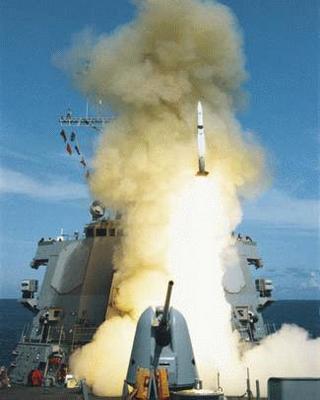
(click to view larger)
Sept 30/09: FY09/10 SM-2s. Raytheon in Tucson, AZ receives a $206.1 million modification to a previously awarded contract (N00024-09-C-5301). It covers SM-2 related American and Foreign Military Sales buys, in FY 2009 and FY 2010 (options). The order is for 402 SM-2 all-up rounds, 40 AN/DKT-71A telemetric data transmitting sets (TDTS), section level spares, post production spares, shipping containers, and associated data.
Work will be performed in Tucson, AZ (74%); Andover, MA (18%); Camden, AR (5%); and Farmington, NM (3%), and is expected to be complete by December 2011.
FY 2009: 402 SM-2s
Sept 29/09: Raytheon in Tucson, AZ receives a $7 million modification to a previously awarded contract (N00024-07-C-5361) for R&D Level of effort engineering and technical services to support the standard missile program. This ceiling increase is to permit the continuation of several ongoing efforts which include prototype design, development integration and testing. Work will be performed in Tucson, AZ and is expected to be complete by December 2009. Contract funds will not expire at the end of the current fiscal year.
While the announcement doesn’t specify, that kind of RDT&E is underway for the SM-3 Block 1B, SM-3 Block II, and SM-6 missiles.
Sept 29/09: Raytheon in Tucson, AZ receives a $6.8 million modification to a previously awarded contract (N00024-09-C-5303) for the delivery of common spares material in support of FY 2009 SM-2 program. Common spares are those items purchased or manufactured during the production of SM-2 all up rounds. Work will be performed in Tucson, AZ (72%) and Camden, AR (28%), and is expected to be complete by December 2011. All contract funds will expire at the end of the current fiscal year.
Sept 17/09: EPAA = Land-based SM-3s. The Obama administration announces revised plans for its European missile defense architecture. Instead of positioning Boeing’s Ground-Based Interceptors, which could intercept even the longest-range ballistic missiles, they choose an architecture based around the SM-3. Read “BMD, in from the Sea: SM-3 Missiles Going Ashore” for full, ongoing coverage.
EPAA – land-based SM-3s
Sept 04/09: SM-6 LRIP-1. A $93.9 million fixed price incentive fee, firm fixed price contract to begin low-rate initial production of the FY 09 Standard Missile-6 (SM-6) Block I All Up Rounds (AURs). This contract provides for the procurement of 19 SM-6 Block I AURs, 20 SM-6 Block I AUR instrumentation kits, and SM-6 Block I spares and containers.
Raytheon will perform the work in Tucson, AZ (50%); Camden, AR (23%); Boston, MA (5%); Dallas, TX (4%); Hanahan, SC (3%); Anniston, AL (2%); San Jose, CA (2%); and other locations (11%), and expects to complete it by March 2012. This contract was not competitively procured (N00024-09-C-5305). See also Raytheon release.
LRIP for SM-6
Aug 28/09: SM-6 test. Raytheon completes the SM-6’s final System Design & Development (SDD) phase flight test. By performing a series of pre-programmed maneuvers, the SM-6 missile was pushed to the limits of its performance, allowing the US Navy to gather simulation validation data. Technically, this is the 3rd SDD test. A “4th” test, which was not in the contract, was completed in May 2009: the Advanced Area Defense Interceptor (AADI) test, where an SM-6 was launched using a targeting cue from outside the “ship.”
Aug 18/09: SM-3 to land. In a presentation at the 2009 Space and Missile Defense Conference & Exhibition in Huntsville, AL, Raytheon announces that it is developing a land-based system SM-3 system that would work with THAAD’s Raytheon-made AN/TPY-2 long range radar, and could be ready as early as 2013.
The presentation states that this solution could provide Israel a near-term solution to counter ballistic missiles from Iran, given the deployment of TPY-2 radars in Israel by the US government. It is also reportedly under consideration for use in Europe as the missile component of planned deployments in Poland and the Czech Republic.
It’s no accident that this comes just as Boeing announces a “mobile GBI” proposal for Europe by 2015, and Lockheed Martin has gone farther by submitting a modified THAAD proposal to the MDA for consideration in the 2011 budget. Lockheed Martin has already invested privately funded R&D into a 21″ wide THAAD variant that would nearly double the Army interceptor missile’s range. Current SM-3s are 13.5″ in diameter, current THAADs are 14.5″, and the proposed SM-3 Block II being developed in partnership with Japan will also be 21″ in diameter. It would appear that a competition for the forward-deployed theater defense role may be brewing. Arutz Sheva | Reuters | Aviation Week re: shifts in doctrine | Aviation Week re: THAAD | Jerusalem Post re: Boeing’s “mobile GBI”.
Aug 4/09: MKV ripples. The Pentagon’s decision to cancel Lockheed Martin’s Multiple Kill Vehicle program has contributed to a big jump in the cost of Raytheon’s SM-3 IIA interceptor system now under development with Japan. The system is now expected to cost $3.1 billion by the time it is deployed in 2014, an increase of $700 million over earlier $2.4 billion estimates. Since the change lies entirely on the American side, the USA is expected to shoulder the extra costs. AIA SmartBrief | Aviation Week | NTI Global Security Newswire.
MKV program kill hits SM-3-IIA
Aug 4/09: Colin Clark of DOD Buzz publishes a short video interview with Raytheon VP of advanced missile defense and directed energy Mike Booen. The interview took place at the 2009 Paris Air Show, and the topic is the $50 million FY 2010 US military budget request to study land-based SM-3 deployment.
July 16/09: SDACS. Aerojet General Corporation of Rancho Cordova, CA received a modification for $5.6 million under cost-plus-fixed-fee contract #HQ0006-08-C-0006. They will design and test prototype solid propellant divert thruster components, a composite solid propellant gas generator, and case structure as part of the SM-3 Block IIA development program. Block IIA is the next generation “high divert” variant, which will combine a wider, longer-range missile with a larger diameter kill vehicle that’s more maneuverable and carries a better seeker.
Work will be performed in Rancho Cordova, CA from Ju1y 1/09 – March 29/10. So far, $3.9 million is committed using FY 2009 Research, Development, Test and Evaluation funds. The MDA manages this contract (HQ0006-08-C-0006).
July 13/09: SM-3 Block IB CDR. Raytheon announces that the Standard Missile-3 Block IB program has completed its critical design review, clearing the way for a 2010 flight test and deployment.
The release also includes dates for the SM-3’s 12 successful hit to kill interceptions so far.
SM-3 IB CDR
May 28/08: FY09 SM-2s. An $87.2 million cost-reimbursable-letter contract to buy long lead material in support of the FY 2009 production of SM-2 Block IIIB all up rounds (AURs). These long delivery lead-time materials will support buys of 50 American SM-2 Block IIIB AURs, 104 Block IIIB ORDALT missile rounds, and 69 SM-2 Block IIIA/B AURs for international customers.
Raytheon will perform the work in Andover, MA (37%); Camden, AR (36%); The Netherlands (14%); St Petersburg, FL (5%); Middleton, CN (3%); El Segundo, CA (3%); and Reisterstown, MD (2%), and expects to complete it by December 2011. This contract was not competitively procured (N00024-09-C-5301).
April 27/09: SM-3 – Land, ho? Japan’s Yomiuri Shimbun reports that the MDA has started studying a new missile defense system capable of launching the Standard Missile-3 from the ground. See also Land-Based SM-3s for Israel?
March 24-26/09: SM-2 high/low test. During the Stellar Daggers 2009 exercise, the USS Benfold [DDG-65] fires a pair of SM-2 surface-to-air missiles against 2 very different targets. A ballistic missile target was launched from San Nicolas Island, CA, while a sea-skimming anti-ship cruise missile target was launched from Point Mugu, CA.
An SM-2 Block IV NT-SBT missile intercepted and destroyed the ballistic missile warhead during the last phase of its descent, while an SM-2 Block IIIA intercepted and destroyed the anti-ship missile. This was the 3rd test of the modified SM-2 Block IV’s terminal defense capability against short range ballistic missiles. US Navy | Raytheon.
March 9/09: A $30 million modification to previously awarded contract for FY 2009 engineering and technical services to support SM-2 export customers.
Work will be performed in Tucson, AZ., and is expected to be complete by March 2010 (N00024-09-C-5303).
Jan 12/09: A $44.3 million modification to previously awarded contract N00024-07-C-5361 for engineering and technical services in support of Standard Missile research, development, test, and evaluation (RDT&E) programs. Work will be performed in Tucson, AZ and is expected to be complete by December 2009.
According to the DefenseLINK release, work under this modification includes “flowdown of top level requirements; predicting and monitoring missile performance and reliability; internal external interfaces; interfaces with ship combat systems; interfaces with test and packaging, handling, storage and transportation equipment; improving missile design; and maintaining the technical data package.”
Nov 20/08: A $40 million cost-plus fixed-fee contract for engineering and technical services to support Standard Missile production programs. This contract includes options which would bring the cumulative value of this contract to $334.4 million if exercised.
This contract combines purchases for the U.S. Navy (64%) and Foreign Military Sales (FMS) Program countries (36%). Work will be performed in Tucson, AZ; and is expected to be complete by November 2009 (N00024-09-C-5303).
FY 2008
SM-3 kills a satellite; SM-3 contracts & tests; Multi-national SM-2 contract; SM-6 processor replacement contract, 1st test firing; 100% Earned Value Management score for Raytheon.
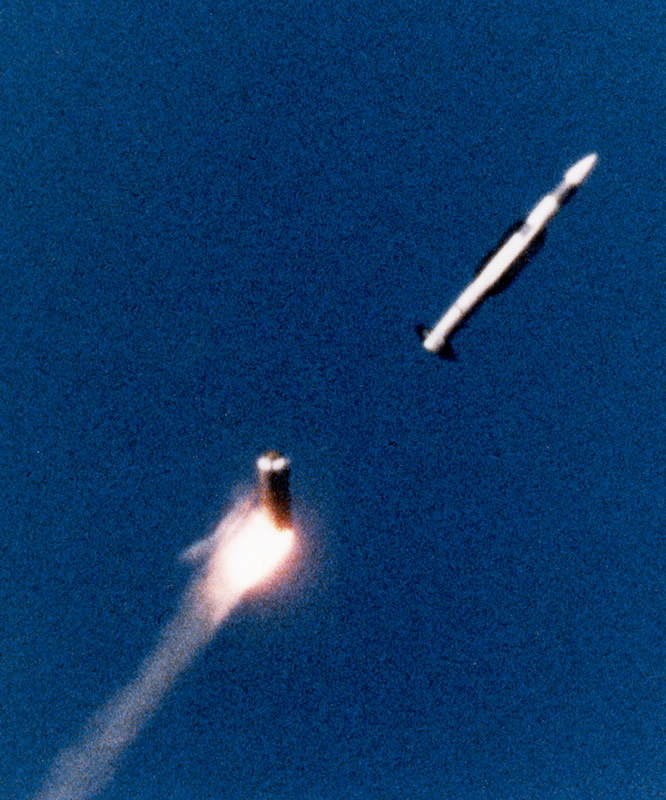
stage separation
(click to view full)
Sept 30/08: FY08 SM-2s. A $422.6 million firm-fixed-price cost plus fixed fee contract for the 419 SM-2 All-Up-Round (AUR) missiles, 96 AN/DKT-71A Telemetric Data Transmitting Sets (TDTS), section level spares, post production spares, 265 shipping containers, and associated data. This contract includes options which, if exercised, would bring the cumulative value of this contract to $428.7 million. This is an international purchase that combines purchases for the U.S. Navy (22.34%) and the governments of Japan (5.75%), South Korea (37.99%), Taiwan (33.91%) and the Netherlands, (0.01%).
Work will be performed in Tucson, AZ (74%); Andover, MA (18%); Camden, AK (5%); and Farmington, NM (3%), and is expected to be complete by December 2010. Contract funds in the amount of $9.3 million will expire at the end of the current fiscal year. This contract was not competitively procured (N00024-08-C-5347).
FY 2008: 419 SM-2s
Sept 5/08: EVM 100%. Raytheon Missile Systems announces a 100% score on an Earned Value Management (EVM) Systems compliance review by the Pentagon’s Defense Contract Management Agency. DCMA auditors found that the firm passed all 32 guidelines, which is currently a rare level of performance among major defense firms.
Earned Value Management is a key project management methodology used by America’s Department of Defense, and the SM-6 program was one of 2-3 programs that led the way for Raytheon. Firm sources tell DID that the US Navy encouraged Raytheon not to compromise of EVM, which helped by removing potential conflicts between customer demands and the need for training. Raytheon’s upper management also made a decision to make the financial and time investments required, in order to strengthen that capability within the firm for future projects. That commitment included monthly meetings that spend a full day conducting EVM reviews, in addition to other measures described in the release.
Raytheon EVM 100%
Sept 5/08: SM-6 test. The U.S. Navy conducted its 2nd firing test of the Standard Missile-6 extended range missile, which intercepted a BQM-74 aerial target drone. The active seeker, employing the U.S. Navy’s legacy command system, autonomously acquired and engaged the target.
Note that the SM-6 fills the short range SM-2’s role; its range is extended in comparison to the SM-2, not the longer-range SM-3. Raytheon release.
July 1/08: A $13.2 million modification to a cost plus fixed fee contract for the Processor Replacement Program, Phase I. This project will replace the data processor module that’s common to both the AIM-120 AMRAAM air-air missile and SM-6, which shares its independent radar homing technologies. The problem is that the AMRAAM Data Processor (ADP) and the Input-Output application specific integrated circuits (I/O ASIC) in the guidance section electronics aren’t manufactured any more. The electronics industry has much shorter life cycles than the military does, so the USAF is looking to replace these obsolete parts and do any redesign required.
This effort supports the US military, and foreign military sales to Greece and Taiwan. All funds have already been committed (FA8675-07-C-0055, P00012).
June 23/08: SM-6, 1st test. Raytheon announces the first test of its new SM-6 missile, launched from the Navy’s Desert Ship at the White Sands Missile Range, NM. The SM-6 successfully intercepted a BQM-74 aerial drone, using its active seeker to find and target the drone on its own.
FY 2008: 419 SM-2s
June 6/08: FTM-14: SM-2-IV NT-SBT. The USA’s AEGIS cruiser USS Lake Erie [CG 70] uses a modified SM-2 Block IV missile to hit a short-range ballistic missile target about 100 miles WNW of Kauai, Hawaii. FTM-14 test objectives included evaluation of: the BMDS ability to intercept and kill a short range ballistic missile target with the Aegis BMD, modified with the terminal mission capability; the modified SM-2 Blk IV missile using SPY-1 cue; and system-level integration of the BMDS. FTM-14 marks the 14th overall successful intercept in 16 attempts, for the Aegis BMD program, and the 2nd successful intercept by an SM-2 Blk IV.
The SM-2 Block IV adds a rocket booster and additional guidance technologies to the SM-2, giving it anti-ballistic missile capability at shorter ranges than the SM-3, during the last phase of a missile or warhead’s descent within the atmosphere. The program was canceled in 2001, but revived as the Near Term Sea-Based Terminal weapon (NT-SBT). This test looks to keep it going. US Navy.
SM-2 Block IV NT-SBT test success
Feb 20/08: Satellite Killer. The U.S. Navy’s Ticonderoga Class AEGIS cruiser USS Lake Erie [CG 70] has participated in a number of successful ABM tests, but today was something new. A modified SM-3 Block 1A missile fired from the cruiser destroyed a National Reconnaissance Office satellite traveling at 17,000 mph, about 247 km/ 150 miles over the Pacific Ocean. The satellite was no longer working and falling out of orbit, and contained toxic hydrazine fuel that could pose a health hazard if it hit a populated area. President George W. Bush authorized the Navy to bring down the satellite, in order to avoid that scenario, and the missile appears to have hit the fuel tank itself in a very exacting shot. Joint Chiefs of Staff Chairman Navy Adm. Mike Mullen:
“What we’ve tried to do from the beginning was be as open as possible about the intention… We are taking the shot at what we hope will be an altitude that will minimize the amount of space debris that will occur. We’ve engaged governments throughout the world to tell them what our intentions are. We have been very transparent, very open in that regard.”
Frost & Sullivan Industry Analyst Michael Stuart noted that:
“The amazing thing about using it in this scenario is that it required alterations to not only the tracking assets involved, but also the flight characteristics of the missile itself. The orbit of the satellite was nothing like that of a missile shot from earth and designed to return to earth.”
Perhaps, but after spending $30-60 million, it worked just fine. The capability was always obvious as a potential spin-off, but the wider acknowledgment that comes with a successful test makes this an important inflection point. See also Navy photo essay | Navy satellite impact Video [MPG] | US SecDef Gates comment | Slate looks at the modification effort | The Christian Science Monitor examines the factors driving the decision | India Daily looks at the China/Russian angle | Lexington Institute analysis.
SM-3 Satellite Killer
Feb 15/08: FY08 SM-3s. A $1.016 billion cost-plus-incentive-fee sole source contract modification to manufacture 75 SM-3 block IA missile for the United States, and 27 SM-3 Block IA missiles for Foreign Military Sales “in support of the Aegis Ballistic Missile Defense System” (N00024-07-C-6119). That almost certainly means sales to Japan, which has successfully tested the SM-3 from JS Kongo (see Dec 17/07 entry in exports section).
The principal place of performance is Tucson, AZ, but work will also be performed in Elkton, MD by major subcontractor Alliant Techsystems, and is expected to be complete by February 2012. FY 2007 research and development and Japanese Foreign Military Sales funds will be used for the initial funding, and will expire at the end of the fiscal year. The contract modification will be incrementally funded, committing $92.8 million at the outset – $85.9M FMS funds and $6.9M FY 2007 R&D funds.
FY 2008: 102 SM-3-IAs
Nov 16/07: Raytheon Missile Systems of Tucson, AZ received a $25.5 million cost-plus-award-fee sole source contract modification to revise the statement of work for the manufacture of 29 SM-3 Block IA missiles (20 US, 9 Foreign Military Sales) plus one set of spare sections for the AEGIS ballistic missile defense program. See the June 6/07 DSCA request in the “Foreign Military Sales” section; the 9 are destined for Japan.
The principal place of performance is Tucson, AZ. Work will also be performed in Elkton, MD by major subcontractor Alliant Techsystems and is expected to be complete by July 2008. FY 2007 research and development funds will be used, the contract will be incrementally funded, and at award it will obligate $8.5 million. Contract funds will expire at the end of the fiscal year. The Naval Sea Systems Command in Washington, DC issued the contract (N00024-03-C-6111).
Nov 8/07: Raytheon Co. in Tucson, AZ received a $37.3 million modification to previously awarded contract (N00024-07-C-5361) for engineering and technical services in support of Standard Missile research, development, test, and evaluation (RDT&E) programs. Work will be performed in Tucson, AZ, and is expected to be complete by September 2009. Contract funds in the amount of $117,743 will expire at the end of the current fiscal year.
FY 2007
SM-3 orders from USA & Japan; Multi-national SM-2 contract; 1st SM-2 SBT/Block IV+ delivery;

(click to view full)
Aug 27/07: SM-3 R&D. A $142 million cost-plus-award-fee contract modification for engineering and technical services for the continued missile design and development, fabrication, test, and flight test support for the SM-3 as part of the Navy’s AEGIS Ballistic Missile Defense System program. The contract modification will be incrementally funded, and at award will obligate $48.6 million of FY 2007 research and development funds. Work will be performed in Tucson, AZ and is expected to be complete by December 2007 (N00024-03-C-6111).
July 20/07: FY07 SM-2s. A $201 million firm-fixed-price modification to previously awarded contract for FY 2007 SM-2 production requirements of 190 missiles, 121 shipping containers, spares and associated data for the US (73.12%) and the Governments of Japan (22.17%); Germany (3.28%); Spain (1.10%); and Canada (0.33%) under the Foreign Military Sales Program.
Work will be performed in Tucson, Ariz. (83%); Andover, Mass. (14%); Camden, Ark. (2%); and Farmington, N.M. (1%), and is expected to be complete by September 2009 (N00024-06-C-5350).
FY 2007: 190 SM-2s
July 19/07: SM-2 Block IV/ SBT. Raytheon announces delivery of the first Near Term Sea-Based Terminal weapon (a modified SM-2 Block IV) to the U.S. Navy for use in defending against short-range ballistic missile threats. Raytheon, the Navy and Johns Hopkins University’s Applied Physics Lab partnered to update the Standard Missile 2 Block IV weapon. The idea is to use these missiles as a near term solution and supplement “until a more capable system can be fielded.
Unlike the SM-3, SM-2 SBT is aimed at the very last phase of a ballistic missile’s flight, just before impact. It will fulfill a naval role similar to the Patriot PAC-3 on land, therefore, acting as a second line of defense against incoming missiles. Raytheon release.
SM-2-IV NT-SBT delivered
May 14/07: SM-3 lead-in. A sole source $140.7 million cost contract for long-lead material required for the manufacture and delivery of 36 Standard Missile-3 Block IA missiles to meet U.S. and Foreign Military Sales requirements in support of the AEGIS Ballistic Missile Defense System.
Fiscal Year 2007 research and development and Foreign Military Sales funds will be used. The contract will be incrementally funded, and at award will obligate $20 million FY-07 research and development and $5 million Japan Foreign Military Sales funds. Work will be performed at Tucson, AZ and is expected to be complete by May 2008 (N00024-07-C-6119).
April 19/07: SM-2 upgrade. Raytheon Company and the U.S. Navy announce that they have successfully completed a major update to Standard Missile-2 (SM-2). The improvement, called a “Maneuverability Upgrade,” provides SM-2 with substantially increased performance against new, anti-ship weapons. See also the April 5/06 entry below.
The team included representatives from the U.S. Navy Standard Missile program office and Naval Weapons Station/ Seal Beach and a cross-section of manufacturing and engineering employees from Raytheon Missile Systems. Raytheon release.
SM-2 finishes major upgrade
Jan 30/07: An estimated $30.6 million cost-plus award-fee contract for engineering and technical services in support of Standard Missile Research, Development, Test, and Evaluation (RDT&E) programs. Work will be performed in Tucson, AZ and is expected to be complete in January 2008. This contract was not competitively procured (N00024-07-C-5361).
Dec 7/06: SM-3. A $20.6 million cost-plus-award-fee contract modification for the development and procurement of additional tooling and test equipment in support of the continued development and delivery of Standard Missile-3 (SM-3) Block IA missiles to meet U.S. and Foreign Military Sales (FMS) requirements in support of the AEGIS Ballistic Missile Defense (BMD) system. The work will be performed in Tucson, AZ and is expected to be complete by November 2007 (N00024-03-C-6111).
Nov 6/06: SM-2. An estimated $39.3 million cost-plus-award-fee modification to previously awarded contract N00024-03-C-5330, to provide additional engineering and technical services to support SM-2 production efforts for Fiscal Year 2007 U.S. requirements. Work will be performed in Tucson, AZ and is expected to be complete by February 2008.
FY 2006 and Earlier
SM-3 orders for USA, Japan; Boeing delivers 1st SM-3 block IA warhead; Multi-national SM-2 order; Upgraded SM-2 block IV tested.

note rocket booster
(click to view full)
Aug 16/06: FY06 SM-3s. A $265.9 cost-plus-award/incentive fee contract modification for 29 SM-3 Block IA missiles to be produced for the United States and Japan and for flight test support, engineering activity, system upgrades and continued cooperative research and development work with the MDA and Japan. The initial delivery order is for $168 million.
Work will be performed in Tucson, AZ and is expected to be complete by December 2009 (N00024-03-C-6111). The Japanese order may well be related to the June 5-6, 2006 item in the Foreign Sales section, below.
FY 2006: 29 SM-3-IA
Aug 4/06: Spares. An $8 million modification to previously awarded contract (N00024-06-C-5350) for FY06 SM-2 Block IIIB, post-production spares, and FY04 SM-2 common production spares to support of maintenance and repair of shipboard missiles. Work will be performed in Tucson, AZ (83%); Andover, MA (14%); Camden, AZ (2%); and Farmington, NM (1%), and is expected to be complete by December 2008.
July 27/06: TDACS. Raytheon Company and Aerojet successfully demonstrate the capability of a solid Throttling Divert and Attitude Control System (TDACS) for the SM-3 in a ground test at Aerojet’s Sacramento, CA facility. Four of the 10 proportional TDACS pintle thrusters move the kinetic warhead sideways while the 6 other thrusters maintain the seeker’s angular alignment and view of the target. On-board electronic controls and software throttle the combustion pressure up and down to alternate between high thrust and coast periods. In addition to the improved intercept capability this gives the hit-to-kill payload, TDACS is also easier to produce, thus holding the potential for significant cost savings. Raytheon release.
June 22/06: As North Korea prepares to test-launch a Taepodong-2 ballistic missile reportedly capable of hitting the US mainland, the US & Japan successfully conducted a joint missile intercept test off of Hawaii using the USS Shiloh [CG 67] guided missile cruiser and its upgraded AEGIS radar & combat system, firing an SM-3 missile. The test was the 7th successful intercept in 8 tests during the current program.
The USS Lake Erie [CG 70], USS Paul Hamilton [DDG 60], & USS Milius [DDG 69] also participated, as did the Japanese Kongo Class destroyer JS Kirishima [DDG-174], which has installed AEGIS Long Range surveillance & Tracking 3.0 but no engagement capability. Testing also included receipt of target data on USS Shiloh from a land-based radar, as well as a second CG-47 Class cruiser that used the flight test to collect data and further the development of an upgraded SPY-1B radar with a new signal processor. See Navy News article | Lockheed Martin release.
June 8/06: Boeing has delivered the first Block 1A Standard Missile-3 Kinetic Warhead (SM-3 KW) to Raytheon. Boeing has been partnered with Raytheon on the SM-3 program since 1996, and is under subcontract to integrate and test the KW hardware. They are responsible for the KW avionics, guidance and control hardware and software, as well as the ejection subsystem. In addition to SM-3 round integration, Raytheon provides the KW infrared seeker, signal and image processor, and the integrated KW software. Boeing release.
May 26/06: SM-3 R&D. An estimated $424 million cost-plus-award fee contract modification (N00024-03-C-6111). It covers the continued systems engineering, design, development, fabrication, and testing of Standard Missile-3 (SM-3) Block IA and IB Missiles for the AEGIS Ballistic Missile Defense Program being conducted by the USA, with some cooperation from Japan. Work will be performed in Tucson, AZ and is expected to be complete by May 14, 2008. Initial funding of $96 million has been issued to support engineering services, engineering studies and technology development technical instruction efforts. See June 7, 2006 corporate release.
April 5/06: SM-2 SBT test. A Raytheon Company Standard Missile-2 (SM-2) Block IV with control systems upgrades was successfully flight tested against a subsonic target at White Sands Missile Range, NM on Feb. 16, 2006. The SM-2 Block IV upgrade includes a new steering control section, new thrust vector actuator assembly for the boost rocket motor and a new primary missile battery as well as upgrades to the guidance and control software. The upgrade was completed as part of a value engineering project at Raytheon Missile Systems in Tucson, AZ, and “will result in a significant cost reduction” by making the missiles more reliable and easier to produce. Raytheon also notes that these improvements will be applied across the Standard missile family to the SM-3 and SM-6 as well.
March 27/06: SM-6. A $9 million modification to previously awarded contract N00024-04-C-5344 exercises an option for engineering and technical services to support the STANDARD missile-6 (SM-6) program. Engineering & technical services include initial performance studies, conceptual design studies, functional design, preliminary design, detailed design and development and round integration studies for potential future improvements. The Contractor shall also provide design assessments as necessary for current improvements. Work will be performed in Tucson, AZ (80%); Camden, AK (15%); and Andover, MA (5%), and is expected to be complete by December 2011.

launches SM-3
(click to view full)
Feb 27/06: Spares. A $17.8 million modification to previously awarded contract (N00024-06-C-5350) exercises the United States option for the procurement of the FY06 STANDARD Missile-2 BLOCK IIIB Spares. Work will be performed in Tucson, AZ (83%); Andover, MZ (14%); Camden, AK (2%); and Navajo Agricultural Products Industries (NAPI) in Farmington, NM (1%), and is expected to be complete by December 2008.
Feb 15/06: FY06 SM-2s. A $122.2 million modification under a previously awarded contract exercising an option for FY 2006 production of 75 Standard Missile-2 Block IIIB All-Up-Rounds (AUR), 80 SM-2 Block IIIB Service-Life Extension Program (SLEP) Retrofits, and 125 AN/DKT-71A Telemetric Data Transmitting Sets (TDTS) with installation kits. The contract modification will also provide for royalties associated with AUR and SLEP equipment. Work will be performed in Tucson, AZ (83%); Andover, MZ (14%); Camden, AK (2%); and Farmington, NM (1%), and is expected to be complete by December 2008 (N00024-06-C-5350).
See also the May 4 Raytheon release. Note that “all-up-rounds” include the missile, its launch container, and related equipment that allows for rapid installation of the naval missiles in vertical launch systems.
FY 2006: 75 SM-2s
Feb 15/06: A $7.9 million option under another previously awarded Raytheon contract (N00024-01-C-5306) to provide FY 2006 Depot Level Maintenance Facility work in support of Standard Missile 2 (SM-2), Guided Missile Program. Work will be performed in Tucson, AZ (100%), and is expected to be complete by the end of September 2006 – which is also the end of the US Defense Department’s fiscal year.
Jan 18/06: Raytheon Missile Systems in Tucson, AZ received a cost-only contract modification that covers the procurement of long lead material and is estimated at $21.7 million. It will be used to build special tooling and test equipment for Standard Missile-3 (SM-3) Block IA Missiles for the AEGIS naval Ballistic Missile Defense program. Work will be performed in Tucson, AZ and Camden, AR, and is expected to be complete by April 2006. This contract was not competitively awarded by the Naval Sea Systems Command in Washington, DC (N00024-03-C-6111).
July 20/05: FY05 SM-3s. Raytheon Missile Systems in Tucson, AZ received a $124.1 million cost-plus-award/ incentive-fee contract modification for the continued development and delivery of 12 Standard Missile-3 Block IA Missiles in support of the AEGIS Ballistic Missile Defense System. Work will be performed in Tucson, AZ and is expected to be complete by April 2007. This contract was not competitively awarded. The Naval Sea Systems Command, Washington, D.C. issued the contract (N00024-03-C-6111). DID covered this along with a number of other contracts related to ballistic missile defense.
FY 2005: 12 SM-3-IA
Sept 3/04: SM-6 SDD. Raytheon Co. in Tucson, AZ received a $440.1 million cost-reimbursable contract with cost and technical/schedule performance incentives for the Systems Development and Demonstration (SDD) of the STANDARD Missile-6 Block I/Extended Range Active Missile (SM-6 ERAM). This includes the design, development, fabrication, assembly, integration, test and delivery of flight and non-flight assets.
Work will be performed in Tucson, AZ (80%); Camden, NJ (15%), and Andover, MA (5%), and is expected to be complete by December 2011. Initial funding in the amount of $5 million will be provided at contract award. This contract was not competitively procured by the Naval Sea Systems Command in Washington, DC (N00024-04-C-5344).
SM-6 SDD
The Standard Missile Naval Defense Family: Exports & Related Key Events

(click to view full)
Unless otherwise specified, all contracts are issued to Raytheon Co. in Tucson, AZ, at the request of the US Naval Sea Systems Command. See also the above section.
With respect to Japan, the USA and Japan are working together on missile defense, continuing their efforts now that Japan has announced completion of the joint technology research stage. The plan is to have SM-3 missiles as Japan’s outer ABM layer and Patriot PAC-3s as the point defense component. Cooperating partnership contracts between the USA and Japan, and international orders with a strong American component, are listed in the American section, above.
2012 – 2014

(click to view full)
May 26/14: South Korea. South Korean official rule out any deployment of SM-3s for now. Defense Ministry spokesperson Kim Min-seok:
“We’ve never considered adopting the SM-3 missiles… Among issues under consideration is how to boost our maritime-based intercepting capabilities, but we’ve not yet reviewed any details…. Intercepting a missile in the ascending stage goes beyond what our military aims at. It is also beyond our capability…. The KAMD [land-based missile defense architecture] has been under development regardless of the U.S. system, and no changes have been made in our position.”
Planned SM-6 missiles (q.v. June 11-12/13) will give the ROKN terminal BMD intercept capabilities around 2015-2016, and that seems to be enough. The national KAMD system currently includes Israeli Green Pine long-range radars, ex-German PATRIOT PAC-2 missiles, and an AMD-Cell command and control backbone. South Korea is about to to upgrade its PATRIOT batteries to PAC-3/Config 3, and add SM-6 missiles to KDX-III destroyers. They may also field Cheolmae 4 BMD-capable missiles in future, designed in collaboration with Russia. Sources: Yonhap, “Acquiring SM-3 missiles not an option for S. Korea: defense ministry”.
July 17/13: Support. Raytheon Missile Systems in Tucson, AZ, is being awarded a $19.1 million modification to previously awarded contract, covering exported Standard Missile 2/3/6 engineering and technical services. These services include research and development efforts; design, systems, and production engineering; technical services; evaluation services; component improvement services; and production proofing services for missile producibility, missile production, and shipboard integration for fiscal years 2013-2017.
$18.5 million is committed immediately. The total percentage of foreign orders is 100%: to Japan (28%), Australia (24%), Korea (21.5%), Germany (8.3%), Netherlands (8.3%), Taiwan (7%), Canada (1.7%), and Spain (1.2%). Japan already fields SM-3s, and Australia and South Korea have both expressed plans to adopt the SM-6 on their Aegis destroyers by 2017.
Work will be performed in Tucson, AZ (86.8%); Andover, MA (9.4%); Huntsville, AL (1.7%); Arlington, VA (1.1%); Camden, AR (0.7%); and White Sands, NM (0.3%), and is expected to be complete by July 2014. The Naval Sea Systems Command, Washington, D.C., is the contracting activity (N00024-13-C-5403).
June 11-12/13: South Korea. The Yonhap news agency quotes “a senior government official” who says that KDX-III destroyers will be armed with SM-6 missiles as of 2016, as part of an overarching Korea Air and Missile Defense System (KAMD) program. If true, that date implies a 2014 order. It also implies a future system upgrade for the ships, from a standard Aegis combat system to Aegis BMD 5.0.
The SM-6 will complement the ROK’s existing SM-2s. Unlike the SM-2s, the new missiles can be used for terminal point defense against ballistic missiles, while also providing long-range air defense against enemy fighters, cruise missiles, etc. KAMD would integrate the ROK’s Green Pine radar, PATRIOT missile batteries, naval missile defense assets, and other surveillance systems into a single “kill chain”, reducing Korea’s dependence on American help. They hope to have KAMD v1.0 ready by 2020. Yonhap | Global Post.
2011
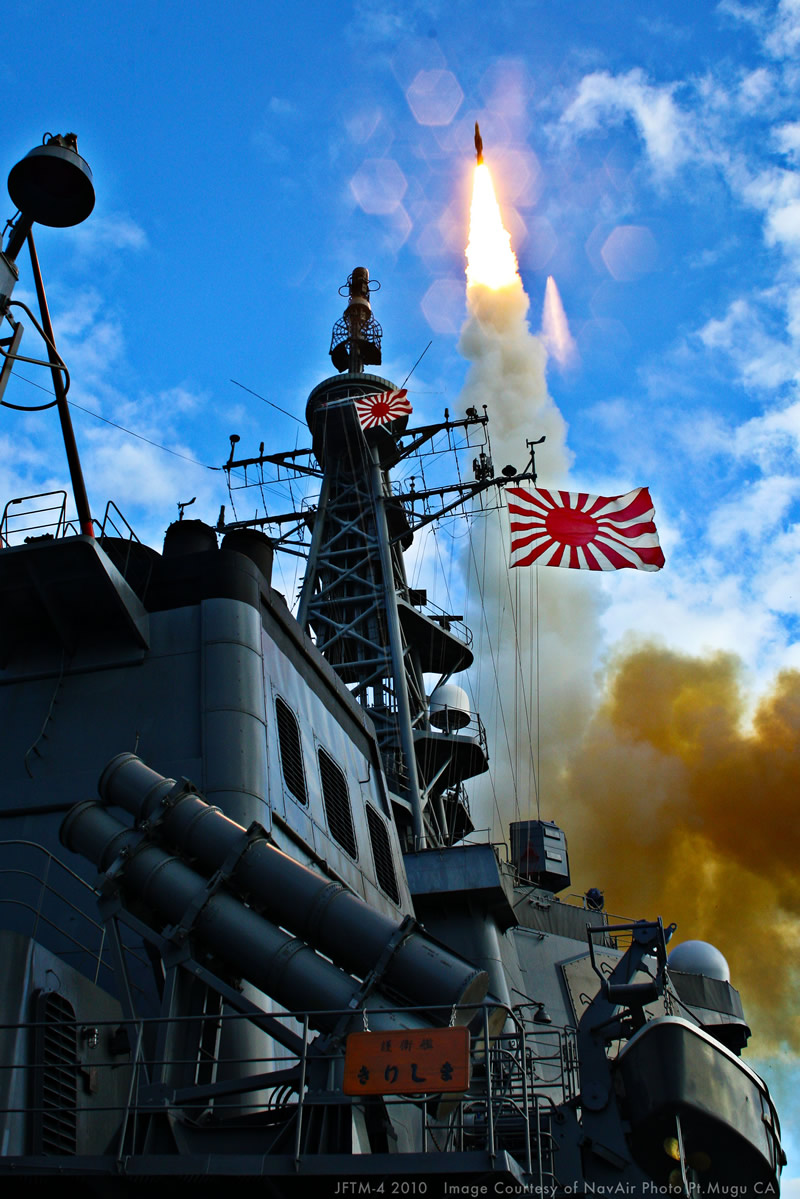
(click to view full)
Sept 17/11: SM-3-IIA delay. Mianichi Daily News reports US notification to Japan that the SM-3 Block IIA will be delayed 2 years, because the kill vehicle needs additional testing. The USA will cover the additional costs.
The original development plan involved a 9-year effort ending in 2014, with Japan paying $1.0 – 1.2 billion, and the USA $1.1 – 1.5 billion. That will now extend to 2016, with the USA looking to deploy the new missile in 2018. Japan had planned to deploy the SM-3 Block IIA in 2020 on its Kongo Class BMD destroyers, and the question is whether that deployment will also be delayed.
SM-3-IIA delayed
Sept 7/11: Japan. Mianichi Daily News reports that Japan’s Defense Ministry has begun launching about 15 mock missiles and collecting data, in a YEN 8.2 billion (currently about $106 million) bid to boost the accuracy of detecting and tracking missiles under the missile defense plan. The operation is expected to run until the end of March 2013.
Aug 30/11: Australia. Australia’s government approves 4 new defense projects, including the A$ 100 million SEA 4000 Phase 3.2. Note that this is not a contract yet; that will take place later, under the US State Department’s Foreign Military Sales protocols.
Australia’s DoD explains that their upgraded FFG-7 Adelaide Class use SM-2 missiles configured for Rail Launch operations. Under Phase 3.2, many will be converted to the Vertical Launch configuration, for use in Australia’s Hobart Class Air Warfare Destroyers and their MK41 launch systems. They’ll also be upgraded to “the latest [SM-2] version”, and DID worked to clarify further; it only involves and upgrade to the latest SM-2 Block III, rather than the BMD-capable Block IV.
The Hobart Class will eventually carry the SM-6, with active guidance and final defense capabilities against ballistic missiles, but that’s slated for the early 2020s under project SEA 1360 Phase 1.
June 20-21/11: SM-3s for the Europeans? Raytheon Missile Systems VP Ed Miyashiro is telling journalists that a number of other platforms are being looked at for NATO/European ballistic missile defense and SM-3 carriage. They include ships that already carry compatible Mk.41 vertical launch systems (VLS), like the forthcoming Danish Iver Huitfeldt Class, German-Dutch F124s, and Spanish F100 frigates; and also ships with DCNS’ rival Sylver system, like the Franco-Italian Horizon Class, and Britain’s Type 45 destroyers.
The ship types with Sylver launchers are already slated to carry MBDA’s Aster-30, which has just begun land tests against ballistic missiles. In its favor, the SM-3 can cite 3 advantages: a much longer test record, the coming SM-3 Block II’s significant performance improvements, and much cheaper BMD development costs, thanks to American and Japanese advance work. Some reports even float the possibility of SM-3 Block IIB/NGAM becoming a joint American/European project, just as the IIA is an American/Japanese project.
The fleet issue would be integration. F100 frigates are the most straightforward, with the same AN/SPY-1D radars and Mk.41 VLS as American ships. The same BMD upgrade set used in American destroyers would suffice. Dutch, German, and Danish ships also carry the MK.41 VLS, but use higher-performance Thales APAR and SMART-L radars. That requires additional integration and modification work, but all 3 classes are using a shared core system that allows a common upgrade path. The British, French, and Italian ships would be the most work. While they share a similar core air defense system, they all use different radars, while sharing key electronics and DCNS’ Sylver VLS. That means both electronics work, and physical changes to the weapons array. In the latter area, Miyashiro mentions that they’re looking into the possibility of fielding SM-3 compatible inserts in DCNS’ Sylver A70 VLS, which is the required size for the 6.6 meter SM-3. Britain’s Type 45 Daring Class uses only A50 launchers, but there is space for adding the larger A70 launchers up front. Miyashiro has reportedly said that they’re also looking at the possibility of inserting the strike-length Mk.41 VLS in that location. Aviation Week | Defense News | Later coverage: “Raytheon’s Datalink: A New Naval Standard for the Standard?”
May 25/11: Japan. Media reports indicate that Japan is preparing to approve U.S. export of their jointly developed SM-3 Block IIA missiles to 3rd countries, provided each export is discussed, no transfer can occur beyond the buyers, and North Korea, Iran, or any other country under UN sanctions is ruled out. The decision will reportedly be officially communicated to the United States at a June 2011 meeting. Japan plans to begin deploying the missiles itself, beginning in 2018.
It remains to be seen if the SM-3 Block IIB missile, whose design is being competed as the Next Generation AEGIS missile program, ends up avoiding the shared technologies that require this export approval. Japan Times | Defense News | UPI.
Jan 10/11: Japan. Japan’s Yomiuri Shimbun reports that Japan’s government will compile criteria that would allow the United States to deploy and export SM-3 Block IIA missiles in Europe and other parts of the world, without violating the nation’s “3 principles” of not exporting weapons to communist bloc countries, countries subject to U.N. arms embargoes, or countries involved in or likely to become involved in international conflicts.
Officials from Japan’s Defense Ministry, Foreign Ministry, Economy Trade and Industry Ministry and “other relevant government organizations” will soon start discussing how to draw up the criteria, which is expected to take about a year.
In 2004, the Koizumi government relaxed those 3 principles in order to allow joint development with the USA, and Chief Cabinet Secretary Hiroyuki Hosoda issued a statement in December that required those exceptions to be “strictly managed.” The question is what that term will mean in practice, but one thing is clear: Japan will have the power to block SM-3 Bock II exports, and deployments, on the same technology transfer grounds that the USA has so often used with others.
2010

(click to view full)
Oct 29/10: Japan JFTM-4 test. The recently upgraded JS Kirishima [DDG-174] successfully hits a separating “1,000 km class” ballistic missile target using an SM-3 Block 1A missile, in test JFTM-4 off the coast of Kauai in Hawaii. It’s the 3rd of 4 successful SM-3 test firings for the JMSDF. America’s USS Lake Erie [GC-70] cruiser and USS Russell destroyer [DDG-59] also participated in this test, tracking the target and simulating their own intercepts.
The firing follows another test earlier this month, in which JS Kirishima acquired a separating target passed from a U.S. destroyer with her own sensors, and performed a simulated engagement. Jeff Bantle, Lockheed Martin’s vice president of Surface-Sea Based Missile Defense Systems, said that “This [live fire] test completes the planned upgrade of the Japanese navy’s destroyers with the Aegis ballistic missile defense capability.” US MDA | Lockheed Martin | Raytheon (incl. video).
Oct 26/10: Japan request. The US DSCA announces [PDF] Japan’s formal request to buy 13 SM-2 Block IIIB missiles, 13 AN/DKT-71A Telemeters, conversion kits, containers, spare and repair parts, support equipment, and support. The estimated cost is $33 million, and these appear to be slated for use as test missiles. The prime contractors are Raytheon Missiles Systems Company in Tucson, AZ; Raytheon Company in Camden, AR; and United Defense LP in Aberdeen, SD.
Japan has already integrated the SM-2 Block IIIB missiles into its ship combat systems, and maintains two Intermediate-Level Maintenance Depots capable of maintaining and supporting the SM-2. As such, implementation of this proposed sale will not require any additional U.S. Government or contractor representatives in Japan.
DSCA: Japan SM-2-IIIB request
Oct 26/10: Australia request. The US DSCA announces [PDF] Australia’s formal request to buy 17 Warhead Compatible Telemetry missiles used in missile tests, including AN/DKT-71 Telemeters and assembly kits, spare and repair parts, technical data and publications, personnel training and training equipment, and support. The estimated cost is $46 million. The prime contractors are Raytheon Missiles Systems Company in Tucson, AZ; and Raytheon Company in Camden, AR.
The proposed sale of SM-2 Block IIIB STANDARD missiles will be used for anti-air warfare test firings during Combat Systems Ship Qualification Trials for the Royal Australian Navy’s 3 new Hobart Class Air Warfare Destroyers, currently under construction. Australia, which has already integrated the SM-2 Block IIIA, will have no difficulty absorbing these missiles into its armed forces. Implementation of this proposed sale will not require the assignment of U.S. Government or contractor representatives to Australia.
DSCA: Australia SM-2-IIIA request
July 29/10: SM-3 IIA exports. Cooperative weapons programs like the SM-3 Block II come with a catch: export permissions. Japan banned exports of weapons it develops in 1967, with the USA’s 1983 blanket exemption as the only exception to date. The Japan Times reports that Washington recently notified the Japanese government that it plans to begin shipping SM-3 Block 2A missiles in 2018, and asked Tokyo to start preparing to strike export deals with third countries. The US wants a response by the end of 2010.
The SM-3 Block 2 is expected to play a significant role in European missile defense, and is also likely to attract interest from countries like Australia and South Korea. Brahmand.
Feb 26/10: South Korea. A $67.3 million modification to a previously awarded contract (N00024-09-C-5301), exercising the FY 2010 SM-2 production option of 46 SM-2 Block IIIA and 16 SM-2 Block IIIB missiles and associated data.
This contract combines purchases for the US Navy (2.07%), and the governments of Korea (96.15%), Taiwan (1.16%), Japan (0.19%) and Canada (0.43%) under the Foreign Military Sales program. Work will be performed in Tucson, AZ (74%); Andover, MA (18%); Camden, AR (5%); and Farmington, NM (3%), and is expected to be complete by December 2012.
Korea: SM-2-IIIA/Bs
Dec 18/09: Australia SM-2 test. The frigate HMAS Melbourne fires the SM-2 Block IIIA, as an enhancement from its previous SM-1 armament. Australia’s upgraded Adelaide Class frigates are slated to add this capability, and the lessons learned may allow Raytheon to offer a more standardized upgrade package for other operators of the SM-1 missile and/or FFG-7 Oliver Hazard Perry Class Australian DoD | Raytheon.
2009
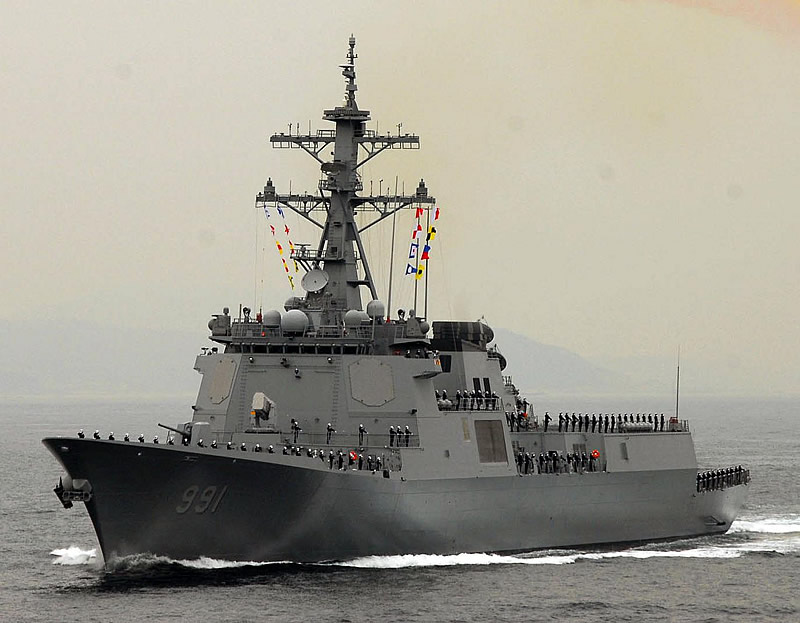
(click to view full)
May 27/09: South Korea request. The US Defense Security Cooperation Agency announces [PDF] South Korea’s official request for 46 SM-2 Block IIIA missiles, 35 SM-2 Block IIIB missiles, 3 SM-2 Block IIIB Telemetry Missiles for testing, 84 SM-2 missile containers, and associated test and support equipment, spare and repair parts, training, and other forms of support. The estimated cost is $170 million.
South Korea uses the SM-2 missiles on its KDX-II (SM-2 Block IIIA) and its KDX-III AEGIS (SM-2 Block IIIB) destroyers. Read “South Korea Beefs Up Anti-Air Defenses as North Blusters” for a look at this missile request in the context of South Korea’s overall defense modernization efforts, and increased tensions with North Korea.
DSCA: Korea SM-2-IIIA/B request
May 2/09: Australia. Australia’s new defense White Paper says that the forthcoming Hobart class Air Warfare Destroyers will be equipped with SM-6 missiles and Cooperative Engagement Capability, giving them some latent terminal-phase defense capabilities against ballistic missiles. The destroyers will not have the AEGIS BMD modifications to their electronics and radar, however – at least, not at the outset.
2008

(click to view full)
July 16/08: SM-3 on land? Aviation Week reports that the MDA is considering a land-based variant of the SM-3, and Raytheon is examining options – largely due to specific requests from Israel.
Israel already has its own successful Arrow-2 system, and fields shorter-range Patriots. So why the sudden interest? As it happens, Israel decides later on to keep its Arrow system, but the USA thinks this is a great idea. Read “BMD, in from the Sea: SM-3 Missiles Going Ashore.”
Feb 15/08: Japan order. A $1.016 billion cost-plus-incentive-fee sole source contract modification to manufacture 75 SM-3 block IA missiles for the United States, and 27 SM-3 Block IA missiles for Foreign Military Sales “in support of the Aegis Ballistic Missile Defense System” (N00024-07-C-6119). That almost certainly means sales to Japan, which has successfully tested the SM-3 from JS Kongo (see Dec 17/07 entry, below).
The principal place of performance is Tucson, AZ, but work will also be performed in Elkton, MD by major subcontractor Alliant Techsystems, and is expected to be complete by February 2012. FY 2007 research and development and Japanese Foreign Military Sales funds will be used for the initial funding, and will expire at the end of the fiscal year. The contract modification will be incrementally funded, committing $92.8 million at the outset – $85.9M FMS funds and $6.9M FY 2007 R&D funds.
US/Japan SM-3-IA order
2007

(click to view full)
Dec 17/07: Japan test. The JS Kongo AEGIS destroyer [DDG-173] becomes the first Japanese ship to destroy a ballistic missile, launching an SM-3 Block 1A missile to successfully intercept a medium-range ballistic missile target fired from the U.S. Navy’s Pacific Missile Range Facility on Kauai, Hawaii. The veteran ABM test participant USS Lake Erie [CG 70] sailed from its homeport of Pearl Harbor to participate as a secondary, using its radar to track the target.
This marks the 12th successful intercept overall for the SM-3, and the first successful ABM interception by anyone other than the US Navy. Read “Japanese Destroyer JS Kongo Intercepts Ballistic Missile” for more information, and links to news articles and reactions around the world.
Japan: 1st BMD intercept
Sept 12/07: Taiwan request. The US DSCA announces [PDF] “The Taipei Economic and Cultural Representative Office in the United States” formal request for 144 SM-2 Block IIIA STANDARD missiles, 16 Telemetry missiles, canisters, containers, spare and repair parts, supply support, personnel training and training equipment, publications and technical data, U.S. Government and contractor technical assistance and other related elements of logistics support.
The prime contractor will be Raytheon Missile Systems Corporation in Tucson, AZ, and although “the purchaser generally requires offsets, at this time, there are no known offset agreements proposed in connection with this potential sale.” The total value, if all options are exercised, could be as high as $272 million.
DSCA: Taiwan SM-2-IIIA request
Aug 24/07: Spain request. The US DSCA announces [PDF] Spain’s request for 36 SM-2 Block IIIB STANDARD missiles (36 tactical missiles with warheads), 36 MK 13 MOD 0 canisters, section-level shipping containers, spare and repair parts, support equipment, training, technical assistance, and other related elements of logistics support. The total value, if all options are exercised, could be as high as $63 million. The weapons will be carried on the Spanish Navy F-100 Alvaro de Bazan Class Frigates.
DSCA: Spain SM-2-IIIB request
June 8/07: Japan request. The US DSCA announces Japan’s request for Ballistic Missile Defense upgrades to one AEGIS Weapon System (Lockheed-Martin Maritime System and Sensors in Moorestown, NJ), AEGIS BMD Vertical Launch System ORDALTs (BAE’s Mk41 modifications, Minneapolis, MN), 9 SM-3 Block IA STANDARD missiles (Raytheon in Tucson, AZ) with MK 21 Mod 2 canisters, containers, spare and repair parts, publications, documentation, supply support, U.S. Government and contractor technical assistance and other related elements of logistics support. The total value, if all options are exercised, could be as high as $475 million.
The intended ship is believed to be the JMSDF destroyer JS Chokai [DDG-176], which is the last of the current Kongo Class destroyers; the 5th and 6th Improved Kongo Class ships currently under construction will reportedly have AEGIS BMD capability pre-installed.
DSCA: Japan AEGIS BMD + SM-3-IA request
May 25/07: Japan request. The US DSCA notifies Congress [PDF] of Japan’s request for 24 SM-2 Block IIIB Tactical STANDARD missiles with MK 13 MOD 0 canisters; 24 AN/DKT-71A telemeters and conversion kits; containers; spare and repair parts; supply support; U.S. Government and contractor technical assistance and other related elements of logistics support. The SM-2 missiles will be used on ships of the Japan Maritime Self Defense Force fleet and the total value, if all options are exercised, could be as high as $40 million.
Japan has already integrated the SM-2 Block IIIB into its ship combat systems and maintains two Intermediate-Level Maintenance Depots capable of maintaining and supporting the SM-2. The missiles’ prime contractor is Raytheon Company in Tucson, AZ and the MK 13 Mod 0 canister’s prime contractor is BAE Systems of Minneapolis, MN. There are no offset agreements proposed in connection with this potential sale, and implementation of this proposed sale will not require the assignment of any additional U.S. Government or contractor representatives to Japan.
DSCA: Japan SM-2-IIIB request
April 20/07: South Korea request. The US DSCA announces South Korea’s request for 150 SM-2 Block IIIB Tactical STANDARD missiles, 60 SM-2 Block IIIA Tactical STANDARD missiles with MK 13 Mod 0 canisters, 1 inert Block IIIB Tactical STANDARD missile, spares, intermediate-level maintenance activity section-level shipping containers, test equipment, hardware/software upgrades, test and support equipment, supply support, training and training equipment, publications and technical data, U.S. Government and contractor technical assistance and other related logistics support
South Korea already has these missiles in inventory, and the total value, if all options are exercised, could be as high as $372 million. Industrial offset agreements associated are expected as part of the contract, and will be negotiated between the South Koreans and Raytheon Systems in Tucson, AZ. See DSCA release [PDF]
DSCA: Korea SM-2-IIIA/B request
Jan 3/07: SM-1 support. A $24.9 million firm-fixed modification to previously awarded contract (N00024-05-C-5341) to procure Full Service Support (FSS) requirements in support of the STANDARD Missile-1 (SM-1) Program of U.S. Allied Nations. This SM-1 FSS FY 2007 option exercise consists of MK56 Dual Thrust Rocket Motor (DTRM) Regrain production and SM-1 Block 6B Missile assembly, testing and delivery for the Governments of Spain (89.5%, see also Oct 20/06 below) and Egypt (10.5%) under the Foreign Military Sales Program.
Work will be performed in Tucson, Ariz. (49%), Sacramento, CA (47%) and Camden, AK (4%), and is expected to be complete by September 2009. The Naval Sea Systems Command in Washington, DC issued the contract.
2006

(click to view full)
Dec 6/06: Japan. “The U.S. and Japan plan to build a joint base in the Nagasaki Prefecture for the maintenance of Standard Missile-3 interceptors, reports the UPI. According to sources in the Japanese Defense Agency, the facility would be located on a filled-in area off the coast near the U.S. Navy’s Hariojima ammunition depot in Sasebo. The U.S. and Japan would each maintain their own missiles, although the Japanese Maritime Self Defense Force (MSDF) would be able to ask the U.S. military for technical assistance if it encountered problems, allowing it to minimize costs.” Link.
Nov 13/06: SM-1 support. A $31.9 million firm-fixed-price modification under previously awarded contract (N00024-05-C-5341), exercising an option to procure Full Service Support (FSS) requirements in support of the STANDARD Missile-1 (SM-1) Program of U.S. Allied Nations. This SM-1 FSS FY 2007 option exercise consists of MK56 Dual Thrust Rocket Motor (DTRM) Regrain production and SM-1 Block VIA missile assembly, testing and delivery.
This effort combines requirements for the Governments of France (24%); Japan (16%); Turkey (16%); Bahrain (15%); Poland (12%); Italy (11%); and Chile (6%) under the Foreign Military Sales Program. Work will be performed in Camden, AK (85%) and Tucson, AZ (15%), and is expected to be complete by June 2009.
Nov 6/06: SM-2 support. An estimated $25.5 million cost-plus-award-fee modification to previously awarded contract N00024-03-C-5330, to provide additional engineering and technical services in support of the SM-2 Guided Missile Program under the Foreign Military Sales (FMS). Initial funding of $311,095 will provide services for Germany (50.3%) and Canada (49.7%). The purchase of additional services by other countries – Japan, Korea, the Netherlands, and Spain – has not been finalized. Work will be performed in Tucson, AZ and is expected to be complete by December 2007.
Oct 20/06: SM-1s for Spain. Defense Aerospace translates a release from the Spanish Council of Ministers, who have authorized the acquisition of 94 SM-1 Block 6B missiles from the US Navy for the amount of EUR 25.7 million (about $32.3 million now) to be paid from 2006-2010 inclusive. The missiles will equip Spain’s six F80 Santa Maria Class frigates, a modified variant of the USA’s Oliver Hazard Perry Class. They will be loaded into the forward section’s Mk. 13 Mod. 4 (aka. “one armed bandit”) missile launchers; each ship has a capacity of up to 32 SM-1MR Standard Missiles.
Spain: 94 SM-1-6B
June 26/06: South Korea request. The US DSCA announces South Korea’s formal request for 48 SM-2 Standard Block IIIB missiles, as well as Mk 13 Mod 0 canisters for vertical launcher systems, containers, Intermediate-Level Maintenance spares and repair parts, supply support, personnel training and training equipment, publications and technical data, U.S. Government and contractor technical assistance and other related elements of logistics support. The total value, if all options are exercised, could be as high as $111 million.
Korea already uses SM-2 missiles aboard some of its ships, and these SM-2 are slated for use as the primary defensive system aboard its new KDX-III AEGIS destroyers. Industrial offset agreements are expected but not yet defined. See DSCA release [PDF].
DSCA: Korea SM-2-IIIB request

(click to view full)
June 5-6/06: Japan requests. The US DSCA announces a pair of requests from Japan for Standard-family naval air and missile defense systems, as well as destroyer BMD upgrades. The total value, if all options are exercised, could be as high as $528 million. Raytheon, Lockheed, and BAE are the primary contractors.
The first sale for $458 million sale involves 9 longer-range SM-3 missiles plus ballistic missile defense upgrades to one AEGIS Weapon System, AEGIS BMD Vertical Launch System (VLS) alternations, and other support. The JMSDF destroyer JS Myoko [DDG-175] may be the target of the request.
The second sale is for $70 million if all options are exercised, and involves up to 44 shorter-range SM-2 Block IIIB Standard Missiles that serve as the mainstays of the Kongo Class AEGIS destroyers’ air defense, plus various forms of support. See full DID coverage.
DSCA: Japan AEGIS BMD + SM-3-IA + SM-2-IIIB request
April 6/06: SM-2 support. A $29.5 million cost-plus-award-fee modification to previously awarded contract N00024-03-C-5330. This provide for engineering and technical services in support of the Standard Missile 2 (SM-2) Guided Missile Program for foreign military sales for the countries of Taiwan (66.2%) and Korea (33.8%) under the Foreign Military Sales Program. Work will be performed in Tucson, AZ and is expected to be complete by March 2007.
2005

(click to view full)
Dec 30/05: SM-2 orders. Raytheon Co. in Tucson, AZ received a $235.7 million firm-fixed-price contract in for the production of the FY06 Standard Missile-2 Block IIIA and Block IIIB all up rounds (AURs) AN/DKT-71A telemetric data transmitting sets (TDTS), section level spares, and shipping containers for allied nations. Note that “all-up-rounds” include the missile, its launch container, and related equipment that allows for rapid installation of the naval missiles in vertical launch systems. This contract will provide for the procurement of Foreign Military Sales (FMS) and other international customers procurements of 221 SM-2 Standard Block IIIA AURs, 64 SM-2 Block IIIB AURs, 106 TDTS’ with installation kits, 69 various FMS spare sections and 393 various FMS shipping containers. Specific countries were not specified by the US DoD DefenseLINK release.
Work on this contract will be performed in Tucson, AZ (83%), Andover, MA (14%), Camden, AR (2%), and Farmington, N.M. (1%), and work is expected to be complete by December 2008. Contract funds will not expire at the end of the current fiscal year. This contract was not competitively procured by the Naval Sea Systems Command in Washington, DC is the contracting activity (N00024-06-C-5350).
285 SM-2s for Export
Nov 22/05: SM-1 support. An $8 million firm-fixed-price modification to exercise an option under previously awarded contract (N00024-05-C-5341) to procure Full Service Support (FSS) requirements in support of the STANDARD Missile-1 (SM-1) Program of U.S. Allied Nations. This modification supports the governments of Spain (77%); Poland (14%); Taiwan (4%); Italy (3%); Egypt (1%); and Japan (1%) under the Foreign Military Sales Program. Work will be performed in Sacramento, CA (85%); Camden, AR (10%); and Tucson, AZ (5%); and is expected to be complete by June 2008.
June 29/05: Japan request. The US DSCA announces a Government of Japan request for 9 SM-3 Block IA Standard missiles with MK 21 Mod 2 canisters, Ballistic Missile Defense (BMD) upgrades to one AEGIS Radar & weapon control system, AEGIS BMD Vertical Launch System ordnance alternations (ORDALTs), containers, spare and repair parts, publications, documentation, supply support, U.S. Government and contractor technical assistance and other related elements of logistics support. The total value, if all options are exercised, could be as high as $387 million.
The target of these BMD upgrades may be the destroyer JS Kongo [DDG-173], as JS Kirishima’s modifications were limited to AEGIS Long Range Scan & Track 3.0, which lacks the weapon control aspect. It is expected that the JS Kirishima will be upgraded later to include engagement as well.
These BMD modifications will provide, in concert with Japan Self Defense Forces PAC-3 Patriot missiles, the initial ballistic missile defense for mainland Japan. The principal contractors will be Lockheed-Martin Maritime System and Sensors in Moorestown, NJ (AEGIS radar) Raytheon Company Equipment Division in Andover, MA (missiles), and BAE Systems in Minneapolis, MN (canisters). DID article | DSCA release [PDF format].
DSCA: Japan AEGIS BMD + SM-3-IA request
June 6/05: Japan request. The U.S. Defense Department notified Congress of a proposed sale to Japan of Raytheon’s SM-2 Block IIIB surface-to-air missiles. The sale includes 40 SM-2 Block IIIB missiles with MK 13 MOD 0 canisters; 24 SM-2 Block IIIB Telemetry Standard missiles with MK 13 MOD 0 canisters, and associated equipment. It would be worth up to $104 million if all options are exercised, with contracts going to Raytheon and United Defense LP.
The Pentagon’s Defense Security and Cooperation Agency said Japan requested the missiles for use on ships of the Japan Maritime Self Defense Force fleet and said it would enhance Japan’s defense of critical sea-lanes. Reuters: U.S. Moves To Sell Japan SM-2 Missiles
DSCA: Japan SM-2-IIIB request
May 31/05: Australia request. The government of Australia has requested a possible sale of up to 175 SM-2 Block IIIA Standard anti-air missiles, up to 30 Telemetry missiles, up to 2 SM-2 Block IIIA inert operational missiles, canisters, containers, spare and repair parts; plus supply support, personnel training and training equipment, publications and technical data, US government and contractor technical assistance, and other related elements of logistics support. The estimated cost is $315 million, and the principal contractors will be Raytheon (Tucson, AZ) and General Dynamics (Scottsdale, AZ). There are no known offset agreements proposed in connection with this potential sale.
The Royal Australian Navy already has SM-1 Standard missiles in its inventory, and intends to use the improved SM-2 missiles on its FFG 7 Oliver Hazard Perry Class frigates for self-defense against air and cruise-missile threats. DSCA release [PDF format].
DSCA: Australia SM-2-IIIA request
May 13/05: SM-1 support. Raytheon Co. in Tucson, AZ is being awarded an $11.2 million firm-fixed-price contract to provide Full Service Support (FSS) for the Standard Missile-1 (SM-1) program of U.S. Allied Nations. This contract combines purchases for the countries of Egypt (43%), Taiwan (26%); Spain (10%); Japan (6%); Turkey (6%); France (3%); Italy (3%); Bahrain (1%); Netherlands (1%); and Poland (1%) under the Foreign Military Sales Program.
This contract was not competitively procured. Work will be performed in Sacramento, CA (67%) and Tucson, AZ (33%), and the contract will expire before the end of September 2006 (N00024-05-C-5341).
March 23/05: SM-2 orders. A $266 million firm-fixed-price modification for production of the FY 2005 SM-2 missile order to equip the U.S. Navy and the navies of Japan, the Netherlands, Germany, Taiwan, Canada, and Korea respectively. Work will be performed in Tucson, AZ (56%), Andover, MA (23%), Camden, AR (20%), and Farmington, NM (1%), and is expected to be completed by December 2007. The Naval Sea Systems Command in Washington, DC, issued the contract (N00024-04-C-5342).
U.S. Navy orders include agreed quantities of Block IIIA All-Up-Rounds (AUR), Block IIIB AUR, Block IIIB ORDALT kits, AN/DKT-71A Telemetric Data Transmitting Sets (TDTS), and section level spares.
The contract also includes procurement for other navies under the Foreign Military Sales Program: 99 SM-2 Block IIIA AUR, 64 SM-2 Block IIIB AUR, 51 AN/DKT-71A TDTS with Installation Kits, 25 various foreign military sales spare sections and 161 shipping missile containers.
FY 2005 SM-2s
March 22/05: SM-2 support. A $29.6 cost-plus-award-fee modification to a previously awarded contract (N00024-03-C-5330) to provide engineering and technical services in support of the Standard Missile-2 Guided Missile Program for Foreign Military Sales (FMS). This modification satisfies the requirements of the following FMS customers: Germany (16.5%); Japan (16.67%); Korea (16.67%); the Netherlands (16.67%); Spain (16.67%); and Canada (16.67%). Work will be performed in Tucson, AZ and is expected to be completed by December 2005.
Additional Readings
* US Navy Fact file – Standard Missile. Covers SM-2 and SM-6.
* Raytheon – Standard Missile Family
* GlobalSecurity.org – SM Standard Missile.
Associated Systems
* Lockheed Martin – AEGIS, Shield of the Fleet.
* GlobalSecurity.org – AEGIS Weapon System Mk7.
* Wikipedia – AEGIS Combat System.
* GlobalSecurity.org – AN/SPY-1 Radar. Interesting analysis of some of the systems weaknesses as well, but those may or may not be current.
* HighFrontier.org, via WayBack – Sea-Based Platforms.
* DID FOCUS – Serious Dollars for AEGIS Ballistic Missile Defense (BMD).
* DID Spotlight – Japan’s Fleet BMD Upgrades. Covers their Kongo Class AEGIS destroyers.
* DID – SM-3 BMD, in from the Sea: EPAA & Aegis Ashore.
News & Views
* US Congressional Research Service (July 2/13) – Navy Aegis Ballistic Missile Defense (BMD) Program: Background and Issues for Congress [PDF].
* MIT, via WayBack (May 3/10) – A Technically Detailed Description of Flaws in the SM-3 and GMD Missile Defense Systems Revealed by the Defense Department’s Ballistic Missile Test Data [PDF]. By George N. Lewis and Theodore A. Postol. See May 17/10 entry for MDA replies.
* StrategyPage (Aug 4/08) – Aegis Triumphant. “The U.S. Navy, capitalizing on the success of its SM3… wants to equip more ships with it… There are 18 U.S. Navy ships equipped with SM-3, and the navy would like enough money to equip all of its Aegis equipped ships (90) with the SM-3. This is expensive… to equip over 80 additional Aegis ships with SM-3 would cost over three billion dollars.”
* George C. Marshall Institute, via WayBack (Nov 28/08) – Aegis Ballistic Missile Defense System – Status and Upgrades [PDF]. By Rear Admiral Alan B. Hicks, Program Director, Aegis Ballistic Missile Defense. Includes discussion of SM-3 Block II.
* DID (Dec 18/07) – US Missile Defense Shifting Toward More Realistic Testing?
* Lexington Institute, via WayBack (Oct 12/07) – The Standard Missile: Standard Bearer Of Reliability
* Information Dissemination, via WayBack (June 21/07) – US Navy Ballistic Missile Defense. Well researched article covering the USA’s plans in this area, including ships slated to receive ABM capability.
* Navy League Seapower Magazine, via WayBack (November 2004) – Navy Pursues SM-6 as Defense Against Cruise Missile Threats.