

(click to view full)
Amateurs discuss tactics, professionals discuss logistics. A military force can have all of the flashy combat vehicles it wants, but without a solid underpinning of medium and heavy trucks to handle logistics, that combat force is either dependent or hollow. This truth has been vividly illustrated in Iraq, where the priority level placed on raising the Iraqi Army’s combat power has made it dependent on the mature American logistics force in theater. Discussions of “independent operational capability” for Iraqi units revolve primarily around this logistics gap. While some units are capable now, Iraq is just beginning to implement the logistics tail that will give most of its units this ability to operate independently.
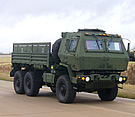
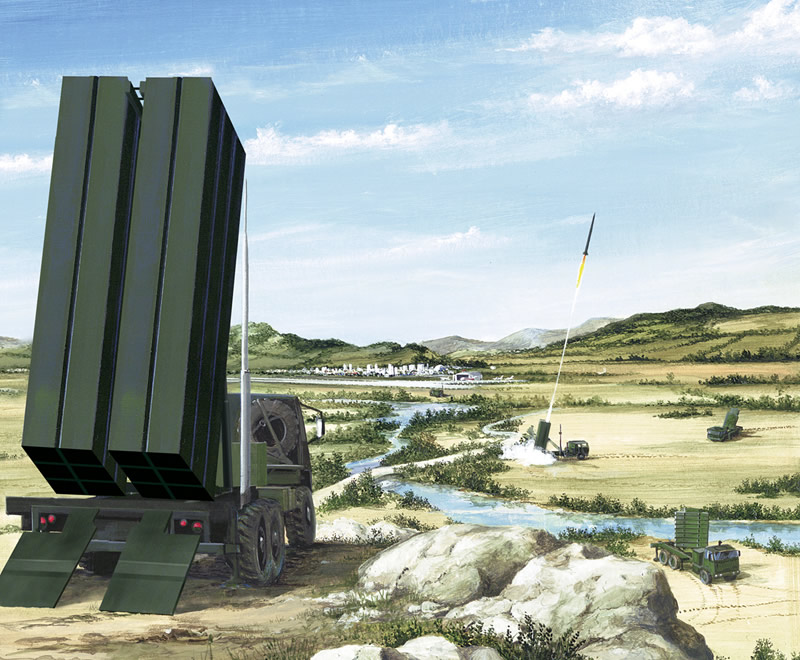
The 14 variants in the Family of Medium Tactical Vehicles (FMTV) form the core of the USA’s state-of-the-art medium military transport truck fleet, and serve as the base for key weapons systems like the future MEADS air-defense system and the new HIMARS air-portable multiple rocket launchers. They also serve as the base for BAE’s Caiman MRAP blast-resistant vehicle, which adds armor and a blast-resistant capsule for carrying troops. As of June 1/08, the US military has ordered 2,862 Caimans for use on the front lines.
There have been 3 main phases of the FMTV program, including the last “SO23” open competition in 2003. That ended in 2008, however – hence the necessity for a bridging contract to 2010. All told, over 50,000 FMTV trucks in various models have been delivered to the US Army…
* FMTV Features and Developments
* FMTV Program: Long-Term Future
* FMTV Program: Production and Sustainment
* Contracts & Key Events
* Additional Readings
FMTV Features and Developments

(click to view full)
FMTV trucks are all automatic transmission, and range from 2.5-ton cargo and van models to 5-ton cargo, tractor, van, wrecker, tanker, specialty, and dump-truck models in various 4×4 and 6×6 configurations. Some models also have attached trailers that increase their carrying capacity. Even so, the use of common engines, transmissions, drivelines, power trains, tires, cabs, etc. create over 80% parts commonality between FMTV models. Where possible, commercial components are used for added savings.
These trucks are at least as sophisticated as modern commercial vehicles. In addition to the Anti-Lock Braking System (ABS), FMTV trucks feature a Central Tire Inflation System (CTIS), exhaust retarder, extensive electronics, and other key features. A cab-over design, in which engine, fluids and hydraulics are all accessible in one place under the cab, is in place to make regular maintenance much easier and faster. After a series of accidents involving the FMTV A0 model trucks, modifications were made to reinforce the vehicles’ drivelines and u-joints. The subsequent A1 models ad their upgrades have been in production since 2000.
All FMTV trucks com with a 2 year full warranty, and a longer systemic warranty for any problems found to be the result of a systemic design or materials flaw. Beyond that, service contracts are required to see to the fleet’s ongoing health. The best place to manage these issues, however, remains the design phase.
One under-appreciated feature of the FMTV family is their array of embedded sensors and diagnostic systems, which monitor and report on various mechanical and electrical systems. These sensors all run through an ultra high speed J1939 electronic databus that makes the new Interactive Electronic Technical Manual (IETM) possible, and allows for both rapid fault diagnosis and connection to troubleshooting guides and parts ordering. This saves money by removing some unnecessary precautionary maintenance work, while preventing small problems from snowballing or creating breakdowns during a mission.
Full J1939 databus compliance across the vehicle is also appearing in other trucks like Oshkosh’s heavy HEMTT A4, but FMTV is currently unique in having this capability across the entire active fleet. The next step would involve a fully multiplexed system to increase bandwidth, and make it easier to take the next step into proactive “impending fault” diagnosis (prognostics) which learns about that particular vehicle over its lifetime and predicts problems in advance. BAE has invested private funds and some government funds in this area, but the design freeze going into the coming FMTV re-compete will forestall such discussions until a new winner has been declared.
On the materials side, some changes were made in the program’s early years, after corrosion resistance throughout such a long life cycle was shown to be an issue. A special e-coat facility at Sealy, TX is part of BAE’s purpose-built production infrastructure, and is used in conjunction with double-sided, galvanized, all-steel cabs; stainless steel exhaust systems; chip resistant coatings; and many other material and design upgrades. These efforts have helped to make FMTV is the first tactical vehicle ever to reach the 22-year mark in accelerated corrosion tests at the Aberdeen Test Center.
As a result of these measures, the current operational availability rate for FMTV trucks is an impressive 93%. That’s higher than any other vehicle in the US Army’s inventory – and likely higher than any vehicle in its history. In addition, tested data shows 20,000 miles between hardware failures, as opposed to the 3,500 miles originally expected.
The newest addition to the FMTV fleet is the FMTV A1P2 version, which is delivered ready to accept the LTAS armoring kits that form the core of the US military’s long-term plans to protect its logistics vehicles in theater.
FMTV Program: Long-Term Future
(click to see whole)
Over the longer term, the Army’s plans for its FMTV fleet move beyond acquisition, to maintenance, sustainment, and protection.
The original design requirement was a 20 year service life under heavy driving in difficult conditions, an appreciably difficult goal when one compares that requirement to expectations for one’s car.
Within that time span, mileage is actually less important in many cases than hours driven, as difficult off-road terrain can consume more hours and put on a great deal more wear in far fewer miles. While figures vary greatly for the different FMTV variants, DID has been quoted figures of around 10 hours per day as average for FMTV trucks in theater. Those trucks are not being rotated in and out, due to the transportation load it would create; instead, troops are generally rotated to the equipment in theater.
Even so, BAE representatives confirmed that the Army’s 20-year goal is still in place for its fleet. At present, there are no plans to recapitalize part or all of the FMTV fleet early. Instead, vehicles returning from combat theaters are RESET to like-new condition in partnership with the Red River Army Depot. BAE spokesmen place the current FMTV RESET rate at a very low 300-400 vehicles per year, with many of the vehicles brought in for accident or battle damage rather than high wear.
That kind of damage has become the US military’s biggest long-term issue, as it contemplates its truck fleet.
The steady employment of IED land mines in theater, coupled with a global communications net that has diffused bomb-making expertise and the concept of their use, ensures that land mines will be a major feature of future conflicts around the world. For several years now, the US military has moved to react quickly by purchasing add-on vehicle armor for its Hummer and trucks from various manufacturers, including Plasan Sasa (Marines MTVR medium trucks), and new BAE subsidiary Armor Holdings.
(click to see whole)
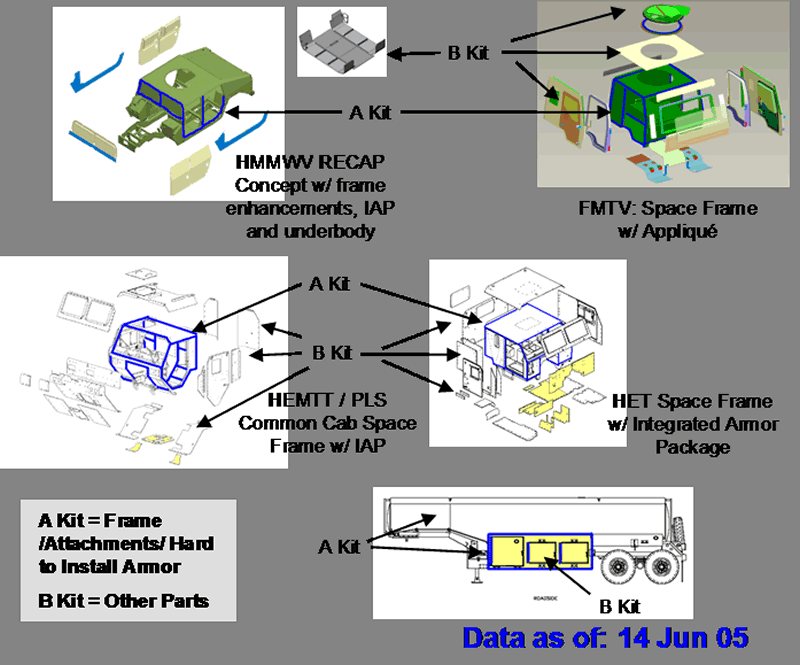
Over the longer term, a more organized approach was needed. Hence the Long-Term Armor Strategy (LTAS), which began issuing contracts in 2008 but has been in the works for several years now. The concept is that American trucks et. al. would be designed to quickly add standard configurations of removable armor: an “A-kit” for light threats, and a “B-kit” for heavier threats. Mine resistance is limited to some extent by the truck’s fundamental design, but add-on armoring does provide some protection against smaller devices, and lessons from the derivative Caiman MRAP design have informed the process.
LAS “A-kit” production is currently up to the relevant equipment suppliers for Hummers and trucks: AM General, BAE Systems, Oshkosh, and Navistar. BAE has received an initial contract for LTAS “B-kit” production, but the US Army has not made its final decision regarding how many it wants to order, especially with protection technologies evolving quickly and the current front-line situation calming down.
The FMTV A1P2 is the latest version in the family, and will be delivered in a design that’s ready to accept LTAS armoring. This seems like a minor change, until one realizes the implications of the potential extra weight. BAE Systems representatives have told DID that about 50% of the vehicle parts change in the A1P2 version, including higher capacity axles, new cab lift and cab tilt mechanisms, and a new, higher capacity air-over-hydraulic braking mechanism that replaces the previous hydraulic system.
Many FMTV trucks under the current interim contract will be sent from Sealy, TX to BAE’s facility in Cincinnati, OH to have this armor added prior to delivery. The original requirement was for armor that could be installed by soldiers in the field with few extra tools, but in practical terms the armor’s weight requires lifting equipment to mount. This means installation at production and maintenance locations, or in rare cases installation in the field with the help of engineering vehicles.
FMTV Program: Production and Sustainment

(click to view full)
FMTV trucks entered service in 1996, and production has gone through 3 phases to date. The first 2 multi-year contracts were sole-source production phases, based on Stewart & Stevenson’s contract win. The 3rd “SO23” contract was competed based on a set design blueprint, and ran from FY 2003-2008. All 15,500 trucks ordered under this phase will be delivered by November 2009, and the current inventory now stands at around 48,000 vehicles. This phase is now the responsibility of BAE Systems, following its $4.5 billion acquisition of Stewart & Stevenson’s parent Armor Holdings in May 2007.
Production has ramped up sharply over the last few years. Initial rates of production were approximately 2,400 trucks per year, but that rate has now accelerated to 7,200 (about 32/day) and is expected to reach over 8,000 per year (about 42/day) during FY 2009.
Heavy use in theater and casualties of chance or battle have contributed somewhat to this production ramp-up, but other factors also play a major role. One is the desire to grow the US Army by over 60,000 soldiers. The importance of logistics means that more soldiers will need more trucks, especially as the regular army focuses on assuming more of the sustainment role that has traditionally been assigned to the National Guard and Reserves. Meanwhile, those military reserve forces are driving 30 and even 40 year old trucks that are reaching the end of any useful life cycle, and must be replaced quickly.

(click to view full)
Armor Holdings had anticipated many of these requirements, and began preparing its Sealy, TX facility about a year in advance to handle increasing production demands. Those moves have already paid off, leading to fast fulfillment of key MRAP and FMTV orders. The facility went from contract award to full-rate Caimin production, on a weekly rather than the standard monthly delivery schedule, in 43 days.
FMTV’s next phase will begin soon.
A “build to print” RFP from the US Army was expected around July 2008. It offered the blueprint for the FMTV A1P2 series, to be competed among various manufacturers on the basis of cost, expected delivery time, evaluated contractor risk risk, etc., with an award expected around early 2009. Until then, the blueprint design is frozen.
BAE was touting the strength of its workforce and its embedded knowledge that goes beyond the blueprints, and into production processes, efficiency, and proven flexibility. The delivery record for FMTV and its derivative Caimin MRAP vehicles has been excellent; indeed, Caimin was the #1 MRAP vehicle in its ratio of on-time to promised deliveries. Then, too, there is the specialized infrastructure like BAE’s Sealy e-coat facility, and privately developed off-blueprint additions like “miles to go on this tank” indicators and other enhancements. All of this will make BAE hard to beat in the re-compete.
Nothing is impossible, however, and BAE could expect motivated competitors. It got them. Oshkosh produces the USMC’s MTVR medium trucks, and the Army’ FHTV heavy trucks; but they had fallen short of their expected success in the lighter MRAP and JLTV competitions. That makes them an experienced large-scale truck producer with strong military ties, available capacity, and something to prove.
Truck manufacturer Navistar is a large-scale producer for the US Army and other militaries, and won more MRAP prime contract orders than any other manufacturer. The new FMTV contract would kick in just as Navistar’s high-volume MRAP production line is expected to begin closing, which made it a tempting bid target.
BAE ended up facing both firms. In August 2009, the decision came down – and Oshkosh had substantially underbid them for the contract. Protests were filed, and the GAO ruled in favor of BAE and Navistar, but Oshkosh won the re-compete in February 2010. Production soon began in Wisconsin, and BAE’s Sealy, TX plant would end up laying off over 3,000 workers.
On the other hand, the Army always knew that if the winner was anyone other than BAE Systems, the demands of production ramp-up mean that they would be unable to take over the contract until the end of 2010. Hence the need for an interim deal to bridge that gap. That deal is detailed below, and this article covers contracts and options awarded under this interim arrangement.
Contracts & Key Events
Unless otherwise indicated, the US Army Tank & Automotive Command in Warren, MI issues the contracts to BAE Systems’ Tactical Vehicle Systems Limited Partnership in Sealy, TX.
May 10/10: BAE Systems in Sealy, TX receives an $11.9 million firm-fixed-price contract for the federal retail excise tax for 401 M1157A1P2 10-ton dump trucks scheduled to remain within the continental USA. That seems like a pretty high excise tax, but the USA does levy about 12%, with extra taxes on heavy vehicles in order to account for road wear. BAE Systems replied that:
“…[the figure in] the announcement is correct. As you probably know, this accounts for the excise tax, the purpose of which is to help pay for improvements to federal highways. We pay the tax as the vehicle manufacturer, and then it is refunded. As you would expect, it is purely a pass through and we do not profit on it.”
Work will be performed in Sealy, TX with an estimated completion date of Dec 31/10. One bid was solicited with one bid received (W56HZV-08-C-0460).
April 27/10: The Oshkosh award may end up complicating life for the M142 HIMARS rocket launcher program, fielded by the US Army and Marines, and by several foreign militaries. The Army has 2 more years of buying HIMARS, but there’s a 14-month lag from contract award to delivery. The Army planned to procure its last 44 BAE chassis for the HIMARS system in FY 2011, but BAE is expected to discontinue FMTV production during the period of time it would take to build the chassis.
Col. Dave Rice, program manager for precision fires, rocket and missile systems, added that BAE’s Increased Crew Protection (ICP) cab for the HIMARS is a proprietary design. The Army will “have to see if the cab changes are militarily significant,” and then decide what to do. Gannett’s Army Times.
Feb 12/10: Oshkosh keeps the next FMTV award. US Department of Defense:
“The Department of the Army announced today that it has re-evaluated the contract award decision for its Family of Medium Tactical Vehicles (FMTV) originally made on Aug. 26, 2009. This change was based on Government Accountability Office’s (GAO) recommendations. Accordingly, Oshkosh Corp. has been awarded a competitive, five-year requirements contract for production of up to 12,415 trucks, 10,926 trailers, and associated support and engineering services. The total estimated contract value at award was $3.023 billion… From Dec. 21, 2009, to Jan. 22, 2010, the Army re-evaluated the proposals in accordance with the GAO’s recommendation. Subsequently, there was an Office of the Secretary of Defense peer review affirming the Army’s reevaluation process.”
Oshkosh celebrated the award in a corporate release, while BAE Systems was forced to notify its investors:
“…the Group will include in its 2009 accounts an impairment of goodwill and other intangible assets amounting to [GBP] 592 million relating to the Armor Holdings Inc. transaction and specifically the FMTV product line.”
The news is a major blow to BAE Systems’ $4.53 billion acquisition of Armor Holdings. With its core FMTV business about to end, MRAP production finished, and the M-ATV competition lost to Oshkosh, much now rides on the JLTV competition. The Houston Chronicle reports that up to 3,000 jobs could be lost in Sealy, TX, with layoffs beginning in 2010. At the same time, BAE Systems’ UK facilities recently announced potential job losses in its submarine business, and a minor trimming of its Nimrod-related workforce.
Dec 14/09: Congress’ Government Accountability Office issues its decision, recommending that the Army reevaluate the offerors’ capability evaluation factor, and make a new selection decision. GAO managing associate general Michael Golden said that:
“Our review of the record led us to conclude that the Army’s evaluation was flawed with regard to the evaluation of Oshkosh’s proposal under the capability evaluation factor, and the evaluation of Navistar’s past performance… We also denied a number of Navistar’s and BAE’s challenges to the award to Oshkosh, including challenges to the evaluation of Oshkosh’s price.”
By statute, the Army now has 60 days to inform the GAO of its response to the GAO’s recommendations. BAE Systems welcomes the decision, while looking forward “to reviewing the full GAO report and its recommendations so we can fully consider the implications for our business and our options…” Oshkosh Corporation Chairman and CEO Robert G. Bohn said in their corporate release that challenges to the evaluation of the Oshkosh Corporation price had been denied, adding that:
“It is important to realize that today’s decision did not recommend proposal revisions nor did it recommend termination of our contract… We believe that when these narrow issues are reconsidered, the Army’s decision to award Oshkosh Corporation the FMTV contract will be maintained.”
See: Redacted GAO decision [PDF] | Navistar release | Oshkosh release | The Hill.
Nov 18/09: BAE Systems holds a teleconference to discuss their protest, and the recent GAO hearings. A GAO decision is expected by Dec 14/09, which is the 100th day, in conformance with GAO rules.
One clarification up front is that FMTV variants used as part of other weapons system, such as HIMARS rocket launchers, SLAMRAAM air defense systems, MEADS air defense systems, and the FMTV Low-Velocity Airdrop version used by airborne forces, were all removed from the re-buy competition in February 2009. Program managers for those systems will apparently make those decisions, but BAE does have some unique intellectual property in those vehicles’ current designs. If lack of production orders causes BAE to shutter their Sealy, TX facility, the firm would have to begin production of those variants elsewhere at added cost; alternatively, any competitor selected instead would have to replicate and test the vehicles’ mission-specific design features, either at its own expense or at the government’s. The derivative Caiman MRAP was never part of the FMTV re-buy, and remains BAE’s intellectual property.
In response to questions from DID regarding the applicability of Oshkosh’s rapidly fielded and produced M-ATV MRAP as a risk-evaluation precedent, BAE representatives made several points. The core of those points was that M-ATV was an internally-held design, whereas FMTV is a government-held TDP (technical documentation), which does not include all of the know-how needed to build the vehicle, and has a much longer and more involved process for changes. In conjunction with a production schedule that resembles M-ATV’s aggressiveness, and the production of only 1 FMTV prototype from Oshkosh to date, BAE believes this represents added risk.
BAE Systems also believes there’s a question around the FMTV A1 LTAS-compliant (Long Term Armoring Strategy) cab design, which is currently BAE’s design. Competitors must re-design that cab, and replicate and test the A1P2 cab’s level of protection, which is just being fielded now. An Aug 13/09 Oshkosh release says that Oshkosh has done this design work at its own expense, but the release does not mention testing; BAE’s protest includes their observation that a design which requires testing and verification adds production and design risk.
Finally, with respect to reports from sources like the Lexington Institute (vid. Nov 4/09 entry), BAE representatives confirmed that Oshkosh’s $3 billion total evaluated price bid underbid the current FMTV price in the neighborhood of 30%, but add that BAE’s re-buy bid price was lower, too. The government, “for whatever reason,” published Oshkosh’s contract bid on their web site, down to variant level pricing. BAE systems knows the trucks very well, and fully 60% of the trucks’ value is directed source, which means the winning contractor must use those suppliers. BAE representatives do not believe that Oshkosh’s prices are realistic, and display similar skepticism regarding some of the elements of Oshkosh’s insourcing claims.
Oshkosh Defense was contacted regarding BAE claims, but chose not to respond.
Nov 18/09: The Greater Houston Partnership business advocacy umbrella organization releases the results of their study, which claims that the region would lose 3,400 direct jobs and 6,766 indirect jobs if Oshkosh retains the contract, with other effect spreading beyond to the state of Texas. The Partnership is joining other Sealy FMTV Task Force members in calling on the Army to put the contract out for a re-bid – in effect, a do-over. PR Newswire release.
Nov 17/09: BAE Systems releases a redacted version of its protest to the public, following agreement from the GAO and even Oshkosh. Its core allegation is that the buy was not best value, but became a solely price-based competition that disregarded risk factors. The protest also cites other past GAO cases that it believes to be analogous. Redacted FMTV Protest [PDF, 6.5 MB].
Nov 9-10/09: The GAO holds hearings regarding the FMTV protest. GAO hearings usually held when there are conflicting factual issues, and the dispute cannot be resolved merely from submissions. This is longer than usual for such hearings, but reports indicate that an array of Army witnesses were called.
Nov 4/09: Loren Thompson of The Lexington Institute predicts that the GAO will overturn the Army’s decision:
“Let’s revisit what happened in that competition, and ask whether a protest seems warranted…[The Army] made the award after concluding that incumbent BAE Systems and Oshkosh were essentially equal in all non-cost selection criteria, but that Oshkosh offered a more attractive price… On price, the Army accepted a bid from Oshkosh that is 30% below the price BAE Systems is currently charging for the vehicle – even though Oshkosh, with no direct experience in manufacturing the product, must turn out a vehicle with the same performance specifications and features, using many of the same suppliers. When challengers to an established producer offer such huge price reductions to win a contract, it is standard procedure to conduct a rigorous analysis of how realistic the challenger’s price is. Yet there is little evidence the Army made any such effort… leveling of non-cost factors… allowed… a “best value” award solely on the basis of price. But unlike BAE, Oshkosh did not have all production facilities or tooling in place; its workforce was not experienced in building FMTV trucks; it did not have established relationships with all suppliers; and it did not have a validated design for the required armored cab in the vehicle. So to say the rivals represented equivalent risk is simply not believable – especially given the very aggressive price targets Oshkosh’s bid required it to meet. GAO will see this award for what it was, and act accordingly.”
See: Issue Brief | Subsequent elaboration.
Oct 16/09: BAE Systems files another supplemental protest to the GAO:
“…after finding additional concerns with the source selection process during the U.S. Army’s Family of Medium Tactical Vehicles (FMTV) rebuy competition… BAE Systems is increasingly convinced the service’s source selection evaluation was flawed and that the Army did not follow its own stated objective to conduct a best-value FMTV competition based on a clear-cut set of criteria… BAE Systems is requesting that a redacted version of the supplemental protest be made available publicly. In order for release of a redacted supplemental protest, all parties involved in the matter must agree to its release.”

Sept 11/09: BAE Systems files a supplemental protest.
Sept 4/09: Both BAE Systems and Navistar Defense file GAO protests (file# 401865.2, 401865.1) regarding the FMTV award to Oshkosh. BAE:
“BAE Systems has filed a protest with the U.S. Government Accountability Office (GAO), asking the agency to review the decision by the U.S. Army to award a contract to a competitor for the Family of Medium Tactical Vehicles (FMTV) rebuy program. After a detailed analysis of the information provided by the Army, before and during the formal competition debrief, the Company believes that the Army did not properly evaluate the proposals, consistent with the Government’s stated requirements, and the Army failed accurately to assess the various risks associated with the different proposals.”
The GAO protests will put the FMTV re-buy contract on hold until a decision is rendered. A decision is expected by Dec 14/09.
Aug 26/09: Oshkosh wins the FMTV production re-compete, and an initial order. FMTV bridge buys will continue from BAE over the life of the existing contracts, while Oshkosh makes preparations and ramps up production. BAE is reviewing its options, and a formal protest is certainly possible.
With MRAP production ended, MRAP-ATV going to Oshkosh, and its FMTV mainstay removed, BAE Systems’ American land vehicle strategy has taken a series of body blows that make the future JLTV competition even more important to the firm.
Aug 25/09: AAR’s Mobility Systems division announces a $40 million contract from BAE Systems to manufacture mobile shelters for use with the U.S. Army’s Family of Medium Tactical Vehicles. BAE Systems is exercising the one-year option on an October 2008 contract. Delivery of the shelters is scheduled to start in April 2010, and be complete by November 2010. AAR Corp. release.
May 27/09: BAE Systems submits its bid for the FMTV re-compete. Their corporate release touts over 17 years of experience, during which their 2,700 person facility in Sealy, TX has manufactured more that 53,000 FMTV trucks and trailers in 21 variants.
May 27/09: Oshkosh submits its bid for the FMTV A1P2 re-buy contract. As noted above, their main competitor is a Sealy, TX incumbent with a formidable performance record of its own. In that situation, Oshkosh’s required priorities are twofold: (1) Avoid anything that might tip the scales against them, even slightly. That means driving perceived performance risk as close to zero as possible, and creating a net zero for political risks; and (2) Produce a poposal that offers credible improvements in price and/or performance, against a very strong competitor.
In discussions with DID, the firm outlined the core of its case. Assuming a level playing field, the key criteria for this contract are price and past performance. Oshkosh believes they have a very credible, fact-based price derived from their own experiences building about 10,000 MTVR medium trucks for the Marines, and the fact that almost 90% of FMTV suppliers are already Oshkosh suppliers.
In terms of past performance risk, they point to the fact that their integrated production line has conducted simultaneous production of 10 models, totaling 29 variants – a record that matches well with the FMTV re-buy’s high mix/ low individual volume schedule. Oshkosh also touts its performance in the area of engineering and logistics support, which has become an integral aspect of the FMTV program. Their work with MTVR and the Army’s FHTV heavy truck family gives them a very wide field support network, and the firm cites its fast delivery and fielding of up-armored heavy trucks after the Army confirmed its LTAS armoring strategy. They’re building on that record with their FMTV related risk-reduction investments, which include an internally-financed design for an LTAS-compatible FMTV cab.
If Oshkosh wins, production would mostly take place on the firm’s existing campus in Oshkosh, WI, with some sub-contracting to current subcontractors. That kind of concentration generally improves price and efficiency numbers, but lowers political leverage. The other potential political strike is the “industry consolidation” card, which notes the risks of placing all medium and heavy truck production (FMTV, MTVR, FHTV) with one supplier and, for the most part, one campus. Oshkosh’s response is to cite the number and range of large firms involved in the MRAP and JLTV programs, and to state their belief that there has been a fundamental industry change over the past few years. Oshkosh Defense release.
April 3/09: A $64.1 million firm-fixed-price and cost reimbursement contract for 500 FMTV 10-ton capacity 6×6 dump trucks, as an unfinalized contract that commits 49.9% of the ceiling price up front. According to BAE Systems’ April 13/09 release, the total value could reach up to $128.4 million. That release adds that the trucks will be delivered in LTAS-A configuration, and will have twice the payload capacity of current FMTV dump trucks.
Work is to be performed in Sealy, TX Deliveries will begin in August 2009, and are expected to be complete by the end of December 2010. One bid solicited and one bid received (W56HZV-08-C-0460).
Feb 3/09: A $107.4 million firm-fixed-price and cost reimbursement contract to incorporate engineering changes that add additional armor B-Kits to 5,108 FMTV A1P2 cabs. Work is being performed in Sealy, TX.
BAE Systems’ follow-on release adds that the total contract value could rise to $190 million. The kits will be delivered to the U.S. Government between April 2009 and August 2010 for use on FMTV cargo trucks, wreckers, expansible vans, shop vans, and tractors (W56HZV-08-C-0460).
Feb 3/09: A $7.3 million firm-fixed-price and cost reimbursement contract for 38 HIMARS (High Mobility Artillery Rocket System) chassis for Foreign Military Sales customers. Work is to be performed at Sealy, TX, with an estimated completion date of Aug 31/10 (W56HZV-08-C-0460).
Recent DSCA requests for HIMARS systems have included Singapore (18 in 2007) and the UAE (20 in 2006), which makes 38.
Nov 12/08: BAE Systems announces a $1.6 billion contract from the U.S. Army to build another 10,000 FFMTV trucks and trailers for delivery during 2009 and 2010. This award is in addition to a finalized $2.1 billion contract for 10,000 vehicles, plus program support, engineering, integrated logistics support, configuration management and field service support. This latest contract brings the total 2008 award value for FMTVs in 2008 to $3.7 billion.
BAE Systems will manufacture all of these FMTVs in the Long Term Armor Strategy (LTAS) configuration.
Sept 29/08: BAE Systems Tactical Vehicle Systems Limited Partnership in Sealy, TX receives a $442.5 million firm-fixed-price contract modification, which finalizes the June 2008 order at about $2.1 billion for 10,000 FMTV trucks, program support and Federal Retail Excise Tax (FRET). Work will be performed in Sealy, Texas, with an estimated completion date of Dec 31/11. One bid was solicited and one bid was received by U.S. Army TACOM in Warren, MI (W56HZV-08-C-0460).
June 2/08: BAE Systems Tactical Vehicle Systems Limited Partnership in Sealy, TX received a $1.656 billion firm-fixed price and cost-reimbursement contract for 10,000 FMTV trucks, program support and federal retail excise tax. Work will be performed in Sealy, TX and is expected to be complete by Dec 31/10. One bid was solicited on Nov 5/07 by the U.S. Army TACOM in Warren, MI (W56HZV-08-C-0460).
BAE’s says that the posted figure is an initial amount, and announces a possible value of up to $2.2 billion pending negotiations to finalize the contract. The contract also contains an option year for another 10,000 trucks, whose exact cost would also be determined when this contract is finalized. BAE Systems release.
May 5/08: Stewart & Stevenson Tactical Vehicle Systems Limited Partnership, Sealy, Texas, was awarded on May 1, 2008, a $54,312,842 firm-fixed price and cost-reimbursement contract for adding 370 supplemental family of medium tactical vehicle variants to the contract. About 100 of these trucks will be equipped per the US Army’s LTAS configuration.
Work will be performed in Sealy, Texas and is expected to be complete by Nov. 15, 2008. Contract funds will not expire at the end of the current fiscal year. Two bids were solicited on Aug. 15, 2008, and two bids were received. U.S. Army TACOM, Warren, Mich., is the contracting activity (DAAE07-03-C-S023), and the current value of this 2003 contract is now about $3.6 billion. BAE Systems release.
April 2/08: Stewart & Stevenson Tactical Vehicle Systems Limited Partnership, Sealy, Texas, was awarded on March 31, 2008, a $43,579,276.55 firm-fixed price contract for adding long-term armor strategy A1P2 cabs to 730 family of medium tactical vehicles. Work will be performed in Sealy, Texas. Contract funds will not expire at the end of the current fiscal year. Work is expected to be completed by Nov. 15, 2008. Two bids were solicited on Aug. 15, 2002 and two bids were received. U.S. Army TACOM, Warren, Mich. is the contracting agency (DAAE07-03-C-S023).
April 09/07: The Pentagon’s current Selected Acquisition Report cites the FMTV program for cost changes:
“Program costs increased $3,351.9 million (+19.2 percent) from $17,450.1 million to $20,802.0 million, due primarily to the addition of Long Term Armor Strategy (LTAS) A-Cab (+$1,257.1 million) and associated LTAS installation kits (+$1,319.1 million). There were also increased recurring costs for planned model mix changes (+$672.8 million) and the application of revised escalation rates (+$64.6 million). These decreases were partially offset by an acceleration of the annual procurement buy profile (-$149.7 million).”
Additional Readings
* Global Security – Family of Medium Tactical Vehicles (FMTV). Includes more detailed information re: FMTV variants, as well.
* US Army Fact Files – Family of Medium Tactical Vehicles (FMTV).
* DID FOCUS Article – RESET of the US Army’s Vehicle Fleet Continues.
* DID (March 28/08) – Iraq’s Military Requesting $1.39B in Weapons, Vehicles, and Equipment.
* DID (May 9/07) – BAE to Acquire Armor Holdings for $4.53B.
* Army Logistician (Sept-Oct 2005) – Resetting the FMTV.