

(click to view full)
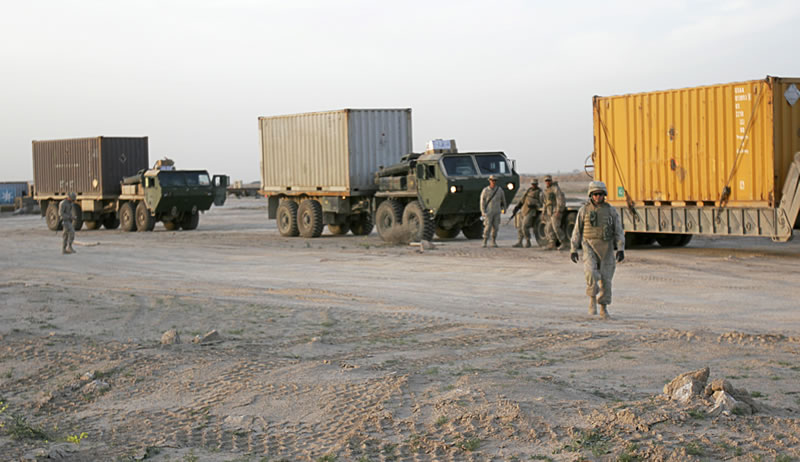
On July 25/06 Al-Anbar commander and U.S. Marine Corps Maj. Gen. Richard Zilmer submitted an MNF-W priority 1 request. It pointed to the hazards inherent in American supply lines, and noted that many of the supply convoys on Iraq’s roads (up to 70%, by some reports) were carrying fuel. Much of that fuel wasn’t even for vehicles, but for diesel generators used to generate power at US bases. That is still true, and Afghanistan has even more daunting logistics. By some estimates, shipping each gallon of fuel to Afghanistan requires 7 gallons of fuel for transport.
A number of Pentagon projects use alternative energy at various installations, but Zilmer’s request is believed to have been the first formal request from a front-line commander. Not to mention the first formal request that acknowledges the security dimension of alternative energy sources, in response to the growth of “systempunkt” terrorism and the non-linear battlefield. It has not been the last.
* The Need on the Ground
* Options and Considerations
* Contracts and Key Developments [updated]
* Additional Readings
The Need on the Ground

Maj. Gen. Zilmer 2006 request reportedly called for 183 renewable energy systems of various power capacities, for deployment to Iraq. More than anything else, however, Zilmer’s letter was about changing assumptions. Those changing assumptions remained relevant, even as events overtook the original request.
Well-known renewable energy advocate Amory Lovins, who advises a Defense Science Board panel on fuel efficiency, was quoted by Defense News as saying that the Pentagon’s fuel cost calculations have traditionally been based on wholesale prices, and have not taken into account the actual cost of delivering it to front-line units. Before the Iraq war, “fuel logistics were assumed to be free and uninterruptible.” Former CIA director and current energy adviser to the Pentagon and Congress James Woolsey adds this:
“If you’re talking about getting the gas to an M1A1 tank in Fallujah, the supply lines, the tanker vehicles and their protection could drive the cost up to $100 a gallon or more.”
Which, interestingly enough, is about the price level that Halliburton subsidiary KBR got into trouble for, when it was responsible for providing fuel to US forces in Iraq.
As it happens, the notoriously fuel-thirsty M1 Abrams tanks are not even the main problem. A study done by the US Marines in Iraq found that only 10% of their consumption was by armed vehicles. Only 2 of the Army’s top 10 fuel consumers are combat vehicles, and fuel haulers make up 75% of its “bottom 4” least-efficient vehicles. When coupled with the growing needs of bases on the ground, it can hardly be surprising that 2004-2009 saw the consumption of fuel at American forward operating bases in conflict zones rise 10-fold, from 50 million to 500 million gallons.
The US military’s research and engineering director John Young reportedly commissioned a task force on energy efficiency and renewable fuels, and says the Pentagon is trying to develop a more accurate calculation for the delivered price of fuel to forward-deployed troops. These calculations will then feed into future acquisition programs, adding much more weight to energy efficiency criteria.
As Terry Pudas of the Pentagon’s Office of Force Transformation put it: “This is the beginning of the people trying to understand that the whole notion of energy means being more effective in operations.” A March 13/08 speech by Rep. Roscoe Bartlett [R-MD], ranking Republican member of the House Armed Services Seapower & Expeditionary Forces subcommittee, said that:
“70% of the tonnage delivered to deployed forces is fuel. Fuel delivery convoys to deployed forces add costs to the logistical chain and create targets for IEDs, the single greatest source of casualties in Iraq. Additional personnel protection measures to reduce casualties from IEDs, such as air cover or air transport substitutions for ground convoys, increase costs further.”
In response, the emerging conclusion was that one of the best ways to reduce casualties on the roads would be to reduce the number of vehicles forced to use them. Defense News reported that the request said:
“If this need is not met, operating forces will remain unnecessarily exposed to IED, RPG, and [small arms fire] threats and will continue to accrue preventable Level III and IV serious and grave casualties resulting from motor vehicle accidents and… attacks. …Continued casualty accumulation exhibits potential to jeopardize mission success.”
In addition…
“As we transfer control to the Iraqis, the addition of renewable and self-sustainable energy at the outlying bases will enable the Iraqis to operate independently, lessening the need for coalition forces to provide future logistics support…”
(click to view full)
So, what actually happened in Iraq?
First, the request for local renewable power options was declined in 2007. Modern technologies were not seen as reliable and effective enough to justify the cost of buying and deploying them.
On the ground, the most significant development was that the de facto transfer to Iraqis happened a lot faster than expected, thanks to the tribal “Anbar Awakening” that broke al-Qaeda’s influence over large areas of the country. Many American vehicles were kept off the roads, but it was done by making much heavier use of fuel-expensive airlift for supplies. When they did use roads, units traveled in blast-resistant MRAP vehicles, which are much heavier and less fuel-efficient than the Humvee jeeps they replaced. Most of those MRAPs were flown into theater by C-17 transport. Over time, however, better intelligence and local tribes’ efforts would up sharply cutting the number of IED land mines encountered.
At all levels, fuel usage can be said to have intensified – but a shift in the war’s conduct made that change supportable.
This should come as no surprise. Wars are not won by having superior miles per gallon.
On the other hand, they can be lost over the longer term if circumstances and logistics make them too expensive to continue, or force poor tactical approaches that erode support at home.
The impetus behind Maj. Gen. Zilmer’s 2006 request is not going away. The question is what form future options will take.
Porta-Power: Options and Considerations
By 2006, some efforts and directives were already pushing the US military in the direction of renewable power. The Common Core Power Production (C2P2) program was a year-long demonstration & validation DoD/ USAF program to seek alternative, environmentally-sound fuel sources for troops in deployed locations. It would be deployed as part of BEAR (basic expeditionary airfield resources), or as backup power sources for stateside bases. Over at Robins AFB, GA, USA, a fuel cell system was already being demonstrated. But a system in Macon, GA is not the same thing as a battlefield option.
Maj. Gen. Zilmer’s document enclosed a list of requirements that a successful renewable energy system fielded to Iraq must be able to satisfy. They are likely to remain relevant in future conflicts.
Iraq’s and Afghanistan’s climates certainly make solar power a very strong option. As the Pentagon considers deployment in climates ranging from Afghanistan’s mountains to Iraq’s river valleys, however, the ability to operate in climates from cold to tropical to wet to dry is an obvious need. The military’s reliance on diesel fuels, mostly derivatives of JP-5 and JP-8, means that any associated generators and backups must also be able to handle these jet fuels. Power output must cover a range of devices from 100 – 240 volts, and have enough storage capacity to run continuously for a minimum of 24 hours. Finally, flexibility in getting them to global trouble spots, and then easily moving them around in-theater, are key benefits for combat commanders.
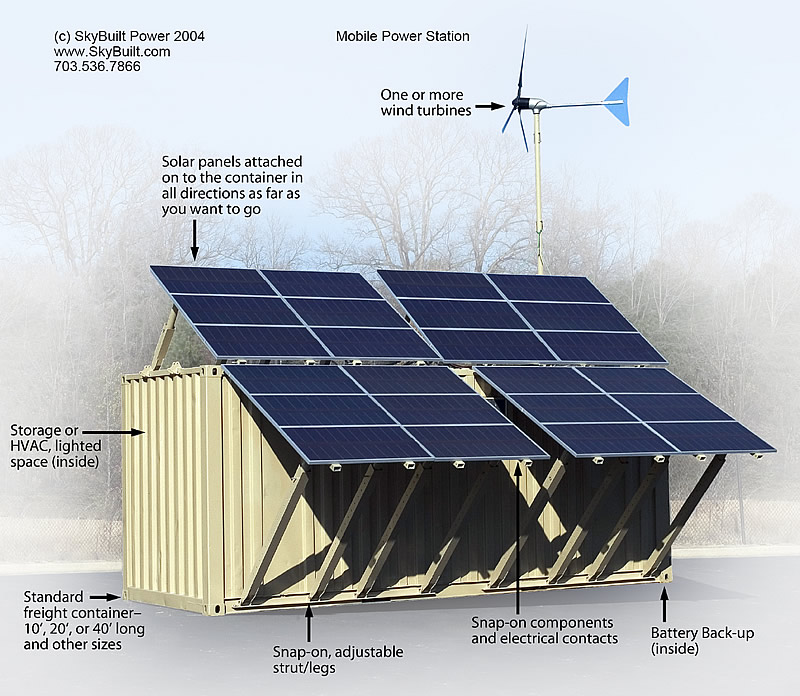
One logical approach for higher-end porta-power involves containerized modules, based on the ISO standard shipping containers that have become ubiquitous throughout the global supply chain.
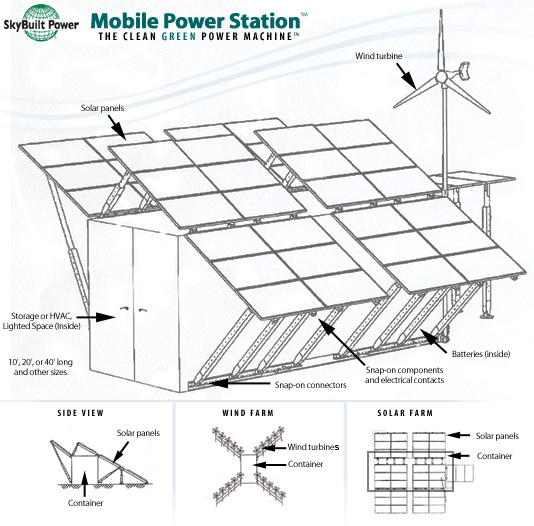
According to InsideDefense.com, Zilmer’s 2006 request singled out the Mobile Power System (MPS) (also knows as transportable hybrid electric power station, or THEPS), a containerized solution built by SkyBuilt Power. THEPS reportedly provides about 5kW of power on average, depending on weather conditions – not a huge amount, but potentially a useful amount for tactical scenarios.
SkyBuilt is an Arlington, VA firm who aims to become “the Dell of renewable energy systems.” The firm has received funding from the CIA’s In-Q-Tel, a venture arm set up to fund innovative technologies that could benefit US national security.
Inside the Pentagon reportedly added that once the system was deployed, “the [ISO standard shipping] container can be used for a myriad of other, non-energy related functions like housing a command and control center.” This kind of dual transportation/use functionality is among the factors driving the gradual global military trend toward containerized systems, from hardened troop transports to field hospitals and even temporary bases. See this article for more examples.
With respect to costs, however, there’s no doubt that conventional diesel generators are far less expensive. The 2006 MNF-W request thought there was still a business case:
“Comparison of the true costs (capital costs, maintenance, fuel, fuel logistics, etc.) of a 10 kilowatt diesel generator shows that a SkyBuilt Power MPS solar/battery system can cut those costs by at [least 75%] while improving reliability, saving manpower [and] spare parts, reducing or eliminating fuel costs, handling, and logistics, and providing a low heat signature… The up-front capital costs of a 10 kilowatt diesel generator are around [$7,500-$10,000], much less than a MPS (around $100,000 depending on the configuration), but after only [three to five] years these costs are recovered…”
Maybe so, maybe not. What’s certain is that the MNF-W request was denied in June 2007, on grounds of cost and uncertain technologies.
This has not stopped subsequent efforts, though many of them seem to have shifted toward smaller-scale systems. This is a normal pattern for new technologies, from computers to hydraulic backhoes. They are not usually competitive with standard technologies at first. Instead, they must find a more limited niche where lower performance is all that’s required, and their disadvantages are outweighed by their advantages.
InsideDefense.com later added a follow-up, noting that The US Army was moving ahead with plans to develop and test renewable energy systems in Iraq and Afghanistan in 2008, with the aid of its Rapid Equipping Force. According to Air Force Capt. Brian Smith, project officer for REF’s renewable and hybrid energy research, a broad agency announcement was expected, soliciting
“…innovative off-the-shelf products to provide integrated concepts for power generation that will reduce the amount of fuel shipped to remote operating bases and observation posts in a theater of operations”
The USMC has also continued its efforts, and the US Air Force has stepped into the game as well. The systems they’re testing tend to be smaller and more limited in scope, but that’s probably good news. The longer-term questions are twofold. One is whether niche applications can emerge, in order to create order flow and investment. The second is whether key technologies will advance fast enough to begin “moving up the food chain,” and providing more comprehensive solutions.
Contracts and Key Developments
(click to view full)
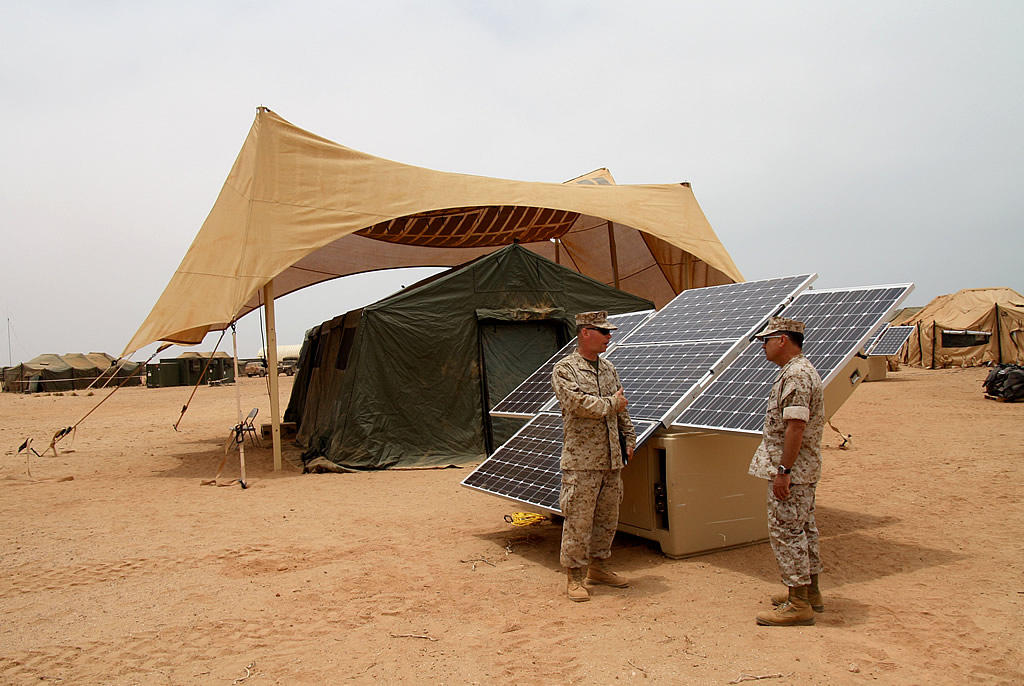
EIPG will establish a quantitative baseline for energy and fuel use in expeditionary operations, and systematically evaluate the impact of technology such as improved efficiency environmental control units, insulating thermal tent liners, tent shades, and hybrid solar-electrical power technology in changing that baseline. US Army.
March 2011: The USMC’s 3rd Battalion, 5th Marine Regiment has returned from Sangin, Afghanistan, where they tested the ExFOB systems in a combat environment. The ExFOB systems included Ground Renewable Energy Networks (GREENS), Solar Portable Alternative Communications Energy Systems (SPACES), LED lighting systems, Solar Shades, and Solar Light Trailers. It was such a success that the Marines are looking to expand it. At present, 2 patrol bases are operating on 100% renewable energy, while a 3rd base dropped fuel use from 20 gallons per day to about 2.5 gallons. If you add the fuel used to ship that fuel in, it’s actually a reduction for the Corps from about 140-150 gallons per day, to about 15 gallons per day.
An even bigger benefit of the systems used was the ability to conduct a 3-week foot patrol “without battery resupply, reducing [overall] load on Marines [in the unit] by 700 lbs.” The experiment has been explicitly cited for congratulations in Senate hearings, and led to a March 14/11 RFI #M00264-11-I-0209: “ExFOB – Concentrated Solar Harvesting Technology & Tactical Vehicle Fuel Efficiency“:
“The rapid deployment of 3/5 proved to be highly successful and has already resulted in changes to USMC’s requirements documents, acquisitions, and investment decisions… Information received in response to this RFI is intended to serve two purposes. (1) Technology descriptions will help formulate the Science , Technology and Acquisition planning necessary to mature technologies toward fieldable solutions; and (2) Technology descriptions may result in invitations for equipment manufacturers to demonstrate their technologies at the ExFOB 2011 at no cost or risk to the Government, from 11 through 20 August 2011… This ExFOB event will be conducted in conjunction with the U.S. Army through their Expedited Modernization Initiative Procedure (EMIP) process.”
They’re primarily interested in Concentrated Solar Harvesting technologies to produce power and hot water, and ways to bow to reality on the ground by helping tactical vehicle’s be more efficient when used as a power source. That usually means running the vehicle at idle, and using it to power or charge external devices. It’s not efficient, but it is ubiquitous, so making a difference here by improving efficiencies, adding useful bolt-ons, etc. would make a real difference. US Office of Naval Research | USMC ExFOB Briefing [PDF] | USMC interim release, 2011-01 | US Senate Armed Services Committee Hearings: Transcripts, etc. | Video [Flash 10] || Aviation Week.
Aug 11/10: SkyBuilt Power announces a contract from the US Army to provide rapidly deployable renewable energy power stations for Afghanistan. Other than saying that the contract provides for both products and services, SkyBuilt releases no details. SkyBuilt | Defense Daily.
May 21/10: During exercise African Lion in Morocco, Marines test a portable system called the Expeditionary Forward Operating Base program (ExFOB). The system uses portable SLMCO water purification systems and Zero Base power generation systems, in order to provide drinking water, LED lights for a medium size general purpose tent, and power outlets for small electrical devices like ruggedized laptop computers. USMC.
May 18/10: The US Army announces that it will hold its first-ever Renewable Energy Rodeo and Symposium June 8-9 at Fort Bliss, TX.
May 6/10: Lockheed Martin announces a $3.5 million contract to develop the containerized Integrated Smart-BEAR Power System (ISBPS) for the U.S. Air Force. The Basic Expeditionary Airfield Resources (BEAR) program equips U.S. forces with lightweight, air-transportable gear used to establish mobile air bases. ISBPS will integrate a variety of energy sources, including renewables, into the existing BEAR power grid, with goals to reduce fuel consumption by 25% and improve power availability. Lockheed is partnered with SkyBuilt Power.
ISBPS priority will be given to housing and airfield operation, operating in both grid-tied and grid-independent modes. The system will independently sustain critical power loads when the primary grid is unavailable, supplementing conventional diesel generation with solar and wind power.
Initial ISBPS development and demonstration using actual BEAR structures will happen at Lockheed Martin’s Dallas site, where the Lockheed Martin Microgrid Development Center is located. Lockheed Martin and SkyBuilt expect that their solution will be relevant to civil and international markets, as well as military uses.
March 12/10: USMC Commandant Conway visits a technical demonstration where more than two dozen commercial vendors showcased the first USMC Experimental Forward Operating Base. At this point, the effort is in Phase 2, evaluating existing commercial technologies to meet the Marines’ needs for small company-sized bases, similar to those used in Afghanistan. The next phase will see equipment sent to Afghanistan, to see how well it fares in a combat environment.
SkyBuilt is one of the participants, combining its 10 foot SkyTrailer with their partner ElectroChemistry’s fresh water treatment system. USMC | SkyBuilt.
Feb 23/10: The USMC issues a Marine Corps Expeditionary Energy bulletin. Key Excerpt:
“OPPORTUNITIES EXIST TO REDUCE THE DEMAND FOR SUPPLY CONVOYS; TO GENERATE POWER MORE EFFICIENTLY; AND TO MAKE BETTER USE OF ALTERNATIVE AND RENEWABLE ENERGY RESOURCES. THE EXPEDITIONARY ENERGY OFFICE WAS ACTIVATED LAST NOVEMBER AS A SEPARATE STAFF ELEMENT OF HEADQUARTERS MARINE CORPS TO ANALYZE, DEVELOP, AND DIRECT OUR ENERGY STRATEGY IN ORDER TO IMPROVE EXPEDITIONARY CAPABILITIES ACROSS ALL WARFIGHTING FUNCTIONS. NOT ALL OF THE SOLUTIONS TO THE MARINE CORPS’ CHALLENGES WILL COME FROM THE HEADQUARTERS, AND MARINES ARE ENCOURAGED TO MAKE USE OF THE UNIVERSAL NEED STATEMENT (UNS) OR URGENT UNS PROCESS FOR BATTLEFIELD IMPROVEMENTS, AS WELL AS THE BENEFICIAL SUGGESTION PROGRAM, WHICH MAY PROVIDE CASH AWARDS FOR RECOMMENDING IMPROVEMENTS THAT HELP MARINES.”
September 2009: The Commandant of the US Marine Corps directs the Marine Corps Energy Assessment Team to go to Afghanistan, and conduct an assessment of the energy used by deployed Marine units, then report back with findings. Brig. Gen. Robert Hedelund, the commanding general of the Marine Corps Warfighting Lab and vice chief of Naval Research:
“The Commandant has said, ‘Let’s not only lighten the load, but let’s reduce risk to Marines downrange by reducing our reliance…”
ExFOB (vid. May 21/10 entry) is one of the testing initiatives that comes out of this assessment. Source.
Feb 12/09: A PSN article notes that SkyBuilt systems are seeing limited deployment, providing the US Army with renewable energy power solutions for remote cellular transmission tower installations.
Subsequent SkyBuilt releases add that the firm’s units will be used by the US Department of Homeland Security, on the Canadian border.
Oct 6/08: The U.S. Army announces a Senior Energy Council to serve as a board of directors focusing on Army energy policy, programs and funding to leverage the Army’s nationwide energy-conservation efforts. The secretary also announces 5 major energy projects, all of which focus on fixed installations at major state-side bases.
May 1/08: Small scale experiments continue. Defense Life Sciences announces that 2 Tactical Garbage to Energy Refinery (TGER) bio-refineries have been deployed to Victory Base Camp, Iraq where they will be undergoing assessment and Technical Data Package Development.
Engineering support is being provided by the Army Edgewood Chemical and Biological Center, as well as the Program Manager Field Support Systems (PM-FSS).
(click to view full)
June 2007: The USA’s Joints Chiefs of Staff rejects Maj. Gen. Zilmer’s request, saying the solar and wind-powered technologies are “not mature enough” to send out the battlefield. Danger Room relays the news from Inside Defense.
May 7/07: SkyBuilt announces that it had been selected as 1 of the 3 companies chosen to perform trade studies and design renewable energy trailer mounted power stations to reduce fuel use in the field for US Marines under the Multi-National Forces in Iraq and Afghanistan. This award is for Phase 1 of a three Phase program called DREAM, Deployable & Renewable Energy Alternative Module. SkyBuilt announcement, no permalink.
April 2007: National Defense Magazine’s “Alternative power sources sought for remote bases” covers alternative energy and water options for the front lines, and mentions that the US Army’s Rapid Equipping Force is evaluating Skybuilt’s transportable hybrid electric power station (THEPS). This is part of a larger effort. The director of the Rapid Equipping Force, Col. Greg Tubbs, has asked a group of energy experts to find commercial products that can be deployable within 18 months and that will reduce fuel consumption by 40%.
WIRED Danger Room later adds that he 45-day trial involves 4 units; the US Army REF is considering shipping units to 2 Djibouti and Kuwait for assessment, and then ordering more for Iraq and Afghanistan if the verdicts are positive.
Additional Readings
* US Naval War College – Cebrowski Institute’s web site. Includes transcripts etc. from the ongoing “Energy Conversation” series, sponsored in part by the Pentagon.
* Air University, Maxwell Air Force Base – War Without Oil: A Catalyst For True Transformation [PDF]. Thesis by Michael J. Hornitschek, Lt Col, USAF. Hat tip to the Defense Tech article by Stephen Trimble, “Oil Free by 2050,” who highlighted it as a notably visionary piece. Is the vision achievable at reasonable cost? Read this Feb 17/06 thesis and decide.
* US Army, 2009 – Energy Security. See also Army Energy Security Implementation Strategy (AESIS) [PDF].
* US Army (May 10/12) – Army scientists develop deployable renewable-energy solutions
* New York Times (Oct 5/10) – U.S. Military Orders Less Dependence on Fossil Fuels
* National Defense (February 2010) – Tough to Free Troops From Oppressive Tyranny of Fuel. “The Wall Street Journal reported that the Pentagon is spending $1 million per soldier deployed in Afghanistan, and up to $350,000 of that is for the fuel needed to support that soldier.”
* USA ASC 9September 2009) – U.S. Military Seeks “Green” Energy Solutions
* Brookings Institute (August 2009) – Fueling the “Balance”: A Defense Energy Strategy Primer
* InsideDefense, via Military.com (Aug 11/06) – Renewable Energy Systems Wanted in Iraq. InsideDefense.com’s article is worth reading in full.
* DID (March 28/06) – Fuel & Energy Issues Continue to Get Spotlight in US Military. Includes recent US military fuel use & cost figures.
* DID’s (March 17/06) – Energy Conservation Moving Up Pentagon’s Agenda.