

(click to view larger)
Russia wants a “5th generation” fighter that keeps it competitive with American offerings, and builds on previous aerial and industrial success. India wants to maintain technical superiority over its rivals, and grow its aerospace industry’s capabilities. They hope to work together, and succeed. Will they? And what does “success” mean, exactly?
So far, preliminary cooperation agreements have been signed between Sukhoi/United Aircraft Corporation, for a platform based on Sukhoi’s T50/PAK-FA design. This DID FOCUS article consolidates specific releases and coverage to date, and adds analysis of the program’s current state and future hurdles.
The PAK-FA/ FGFA
Sukhoi’s “T50”
(click to view larger)
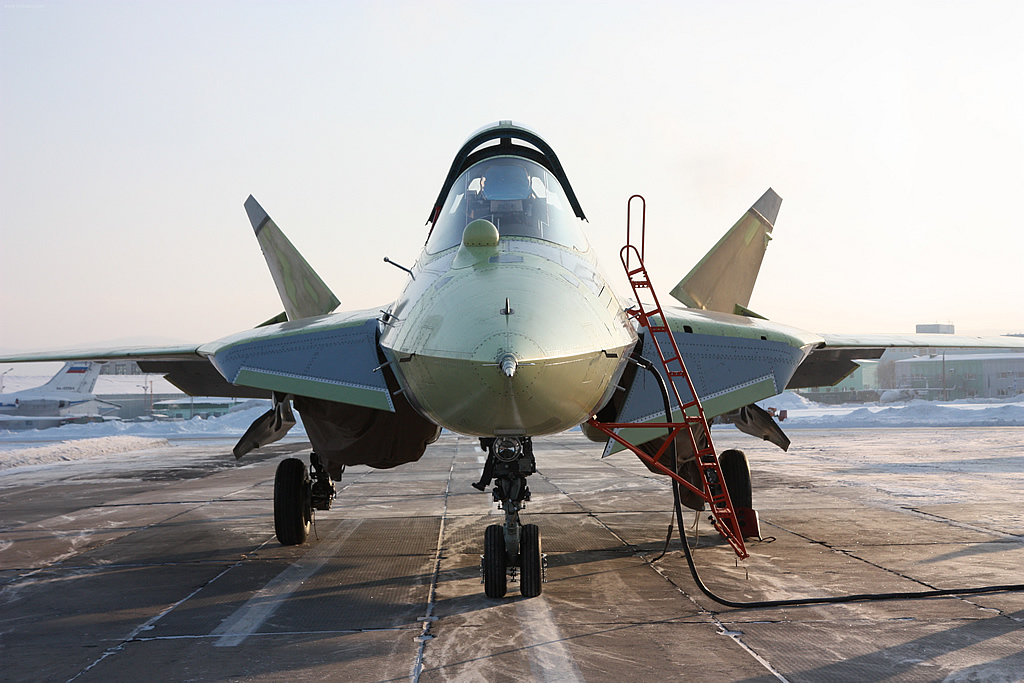
The plane behind the project has taken on several names. The T50 may eventually become the SU-50, but for now it’s referred to as PAK-FA. The aircraft project is also known as FGFA (India: Fifth Generation Fighter Aircraft), and PMF (Russia: Prospective Multirole Fighter). Key characteristics include:
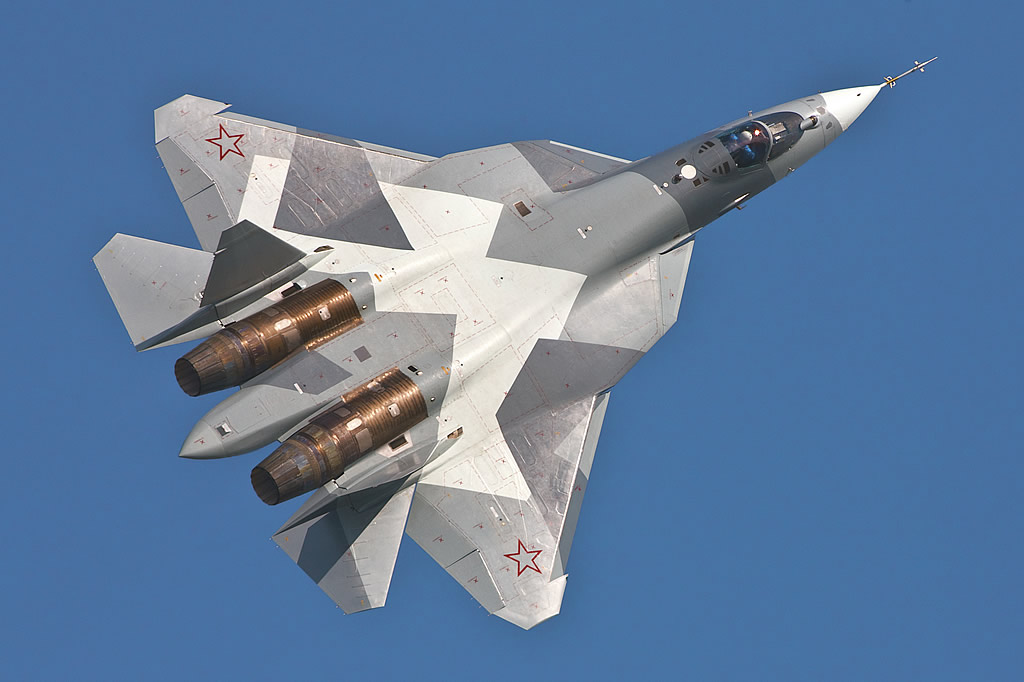
Shaping: Some observers have tried to characterize the T50 as a copy. That’s a mistake. The PAK-FA’s first flight revealed a distinctively Russian stealth-driven configuration, which borrows from previous Sukhoi designs and priorities. The prototype has some clear stealth-limiting features, from fit quality, to features like Sukhoi’s standard spherical InfraRed Scan & Track (IRST) system mounted near the cockpit. Those may change in the production aircraft; meanwhile, a smaller tail, clear stealth shaping, and internal weapons carriage all indicate a strong push toward a stealthier plane.
The PAK-FA’s air intakes are set back from the leading edge root extensions (LERX), and one interesting wrinkle involves movable LERX shapes that come forward from the wings to join the aircraft body. This “PChN/ Movable LEX” feature apparently allows some of the maneuverability bonuses normally associated with canards on planes like the SU-30SM, SU-34, etc., but in a much lower profile design.
[youtube:v=kG7KeUrcbm0]
Engines: Reports concerning the fighter’s initial engines vary. Some sources contend that the engines used in its test flight are 5th generation engines, but most of them report that it is borrowing from the SU-35 program for now, until more advanced engines designed specifically for the plane can be fielded. Both descriptions could be correct. The SU-35S reportedly uses a heavily-upgraded and more reliable version of NPO Saturn’s AL-31F, named the Saturn 117S. It is said to offer over 30,000 pounds of thrust, with full 360 degree thrust vectoring, and is believed to equip initial PAK-FA fighters. The longer-term question is whether incremental 117S upgrades will let the aircraft reach its required “5th generation” performance levels, or whether the AL-41F project, which aims to use a new and improved engine core, will be able to replace the 117S in future.
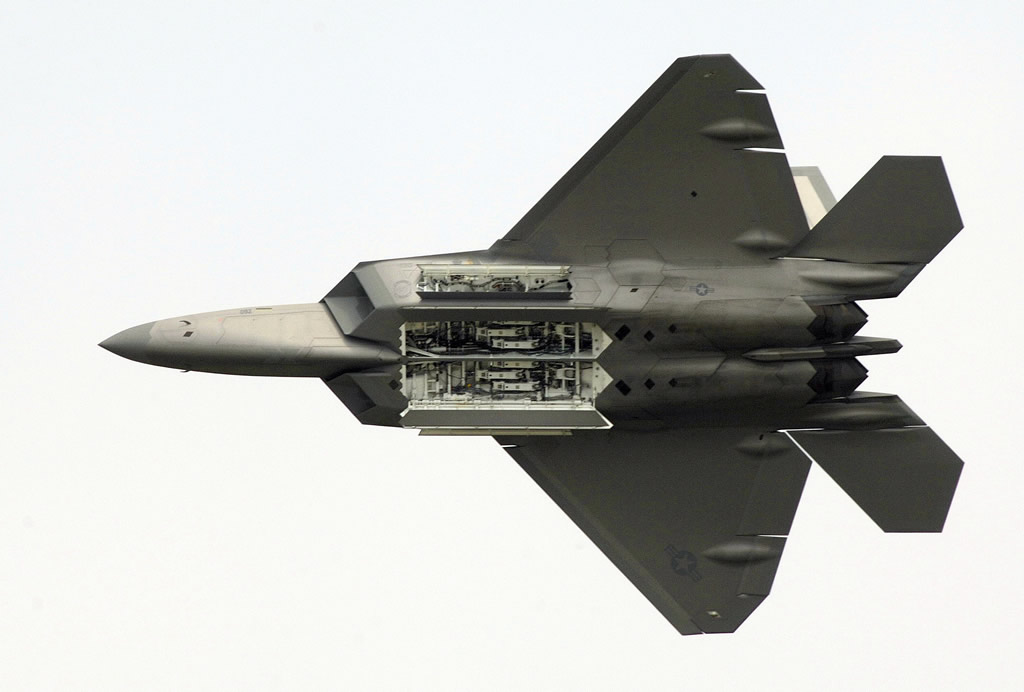
Weapons: Russian reports cite carriage of 8 missile suspension points inside the fuselage, to match the F-22. While the Raptor has 2 body bays (with space-saving AVEL launchers) and 2 smaller side bays, the Russian plane is big enough to have 4 body bays and 2 side bays. Air-to-air weapons will certainly include the improved AA-11 (RVV-MD SRAAM) and AA-12 (RVV-SD MRAAM), but RIA Novosti adds that it has the ability to carry 2 ultra long range AAMs, presumably the 200-400 km Novator K-100-1. These “AWACS killers” are also intended for use on the SU-35, and their size may force the PAK-FA to carry them externally.
To date, the T50’s ground-attack weapon capabilities remain something of a mystery.
(click to view larger)
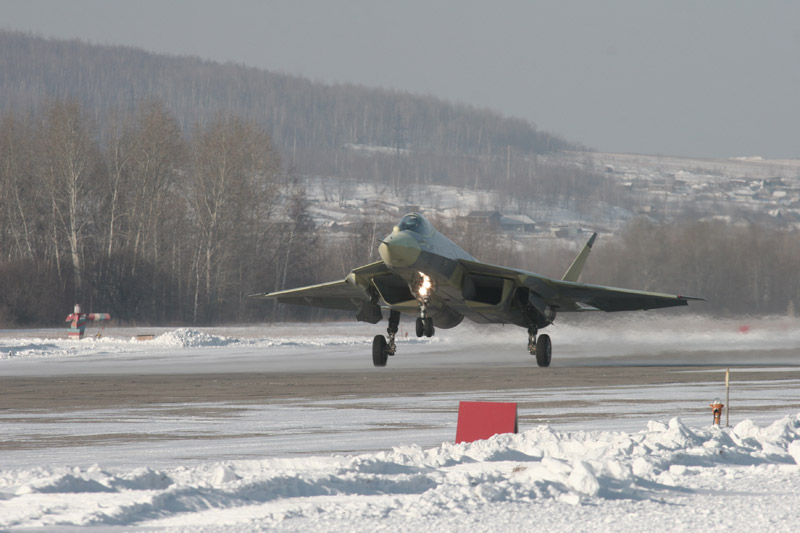
Sensors: The PAK-FA’s advanced Tikhomirov AESA radar is still undergoing testing on other platforms, and its readiness could be important to the project. As is true of all 4+ generation Russian designs, the radar will be supplemented by an IRST that looks for the heat produced by engines and air friction. This allows long-range, no warning missile attacks, and offsets enemy advantages from radar stealth.
Another approach to offset enemy radar stealth involves L-band radars in the wing’s leading edges, to help the plane find other X-band optimized stealth fighters. The plane’s SH121 radar complex will reportedly add another 3 small X-band AESA radars around the front and sides of the aircraft, in order to provide full radar coverage. Harmonizing these features with stealth, and ensuring that they don’t become a maintenance nightmare, will be another important technical challenge for the new fighter.
The fighter’s biggest technical challenge will involve harmonizing all of these sensors into a single view for the pilot. Russia and India aren’t short on programming talent, but pilot ergonomics has been a long-standing weakness in Russian fighters, as western pilots found when they began flying East German MiG-29s. Good sensor fusion is a technically challenging task, especially if the goal is a system that can accommodate upgrades without ruinous expense. The talent is there, but both Russia and India have mixed histories trying to manage those kinds of military efforts.
Other Electronics: Sukhoi’s releases emphasize an advanced datalink that allows PAK-FA aircraft to share situational awareness, much like NATO’s “Link 16” standard. As the USAF has discovered, however, having other platforms share information with stealth aircraft, while retaining “low probability of intercept” to avoid giving the stealth aircraft’s positions away, is difficult. Russia and India will need to resolve that issue, or accept the operational limitations of a unique but incompatible datalink.
[youtube:v=CeYyLNjxkHk]
click for video
All of these characteristics show a convergence of Russian design with leading-edge technologies. Russian 4+ generation fighter designs have always placed a premium on super-maneuverability, and so does the T50. Russian AESA radars are becoming service-ready, and the T50 looks set to be a key platform for their use. Engine improvements may even allow Mach 1+ supercruise if the T50’s weight can be kept down, and if Saturn can deliver on promised operational performance – but both of those “ifs” remain to be proven.
Once it becomes operational, this plane is expected to get the designation SU-50. The big question right now is how close it is to reaching that goal.
Development Timelines, Risks, & Differences of Opinion
Defined Design? A Disagreement

(click to view full)
As of February 2014, 5 PAK-FA prototypes are flying, and 2 more are in ground test roles, which is short of the 8 that were expected to be available by the end of 2013. The “T3” prototype was the first to have the full avionics and radar suite, including the AESA radar. The plane is reportedly preparing for full operational trials in 2015, and VVS fielding in 2016-2017, but the history of stealth fighters justifies some caution about those dates.
In 2009, former Hindustan Aeronautics Ltd. chairman Ashok Baweja took that caution several steps further, saying that that the current PAK-FA prototype and tests were only “proof of concept” level work. The Russians had already approved the design in 2008, so they clearly didn;t see things that way, but America’s F-22 program history made Baweja’s thesis plausible. The YF-22 prototype made quite a few modifications en route to its F-22A designation, over a period lasting several years. The Russian design has changed since 2009, including visible reinforcements to indicate a need for redesign in the wings and other areas. On the other hand, external design changes haven’t been much in evidence, and they continue to move forward with more advanced tests.
India’s low level of expertise designing advanced fighters, and the advanced nature of Russia’s project before India joined, both point toward a final FGFA design that’s much closer to the planes Russia is already flying.
Russian & Indian Timelines

(click to view full)
Differences of opinion re: the fighters’ readiness also express themselves in each side’s proposed timelines. Russia is focused on 2015-2016 production and 2017-2018 fielding, though senior officials acknowledge that full serial production won’t begin until 2020 – 2024.
Indian officials have pushed a timeline that’s up to 4-5 years longer, in order to develop many of the FGFA’s systems and make a long list of changes. As the cumulative cost and risk of their chosen course become apparent, however, they’re reducing their demands. A 2012 interview with Air Chief Marshal Browne suggests that India’s FGFAs will hew much more closely to Russia’s design, beginning with the current single-seat configuration instead of a new 2-seat layout. About 100 HAL engineers are already working on the project from a facility in Bangalore, and another contingent has moved to Russia to work in the Sukhoi design bureau.
That’s all well and good, but it’s 2014, and the joint R&D contract between Russian and India remains unsigned. Plenty of time remains for meddling, as India was expecting to receive prototypes in 2015, 2017, and 2018. India would still have to fund their own national program of FGFA (SU-50KI?) customization for the Indian air force by a joint team of Russian and Indian engineers. The difference is described as “mission hardware and software,” though it would be surprising if Indian bureaucrats’ fetish for “indigenization” was forced to stop there. Each prototype will be slightly different, creating an incentive for the military and political figures to press for additional changes and alternations.
If India’s FGFA R&D program can get underway in 2014, and if it progresses without major delays, a 2018 prototype would finalize the base configuration, and Indian development could end in 2019. Whereupon series manufacturing would begin at HAL in 2022.
Note the number of “ifs” required to meet even that target. Which will also have to contend with HAL’s known high-tech production industrial issues (vid. LCA Tejas & M-MRCA programs). They’ll need to be solved by the time FGFA production begins, because its manufacturing techniques are likely to be a step beyond anything HAL has attempted to date.
So much for the original plan of IAF service by 2017. If current dates hold true, India wouldn’t see operational serving FGFA fighters until 2025 at the earliest. At the same time, India’s planned FGFA buy is shrinking, from over 200 to around 144.
In a project of this nature, it’s par for the course for Russia and India to both end up being too optimistic in their initial schedules. There’s still more than enough room for that dynamic to happen within the revised schedules, as the project works through configuration, testing, and production issues. The history of modern fighters suggests that software could prove to be particularly troublesome.
Contracts & Key Events
2015 – 2020
Sukhoi insists it will meet new 2016 production deadlines.
[youtube:v=SF8t0zu_49g]
July 31/19: Serial Production According to local reports, Russia has started serial production of the Su-57 fifth-generation fighter jets. Sukhoi began to implement its contract for the delivery of the jets to the Russian Air Force. The deal entails delivery of 76 Su-57 fighter jets to Russia’s Aerospace Force. The first plane is scheduled to be delivered by the end of the year. The Russian Air Force was expected to receive two Su-57s prototypes by the end of 2019 and two more aircraft in 2020. The Su-57 is designed to destroy all types of air targets at long and short distances and hit enemy ground and naval targets, overcoming its air defense capabilities.
June 28/19: 76 confirmed The Russian defense ministry confirmed the purchase of 76 Su-57 multirole fighter jets under a contract with Sukhoi Company at the Army 2019 Forum. The jets will be supplied by 2028. Already in May, president Putin said that Russia planned to purchase 76 SU-57s instead of 16 by 2028 without increasing the price. The Sukhoi Su-57 is the country’s first indigenously designed and built fifth-generation stealth fighter jet. It can destroy all air, ground, and water surface targets.
May 17/19: 76 more Russian President, Vladimir Putin wants to purchase 76 Su-57 before 2028. The Sukhoi Su-57 is the country’s first indigenously designed and built fifth-generation stealth fighter jet. According to TASS, Putin said in a defense meeting: “The 2028 arms program stipulated the purchase of 16 such jets, we have agreed to purchase 76 such fighters without the increase in prices in the same period of time.” Defense Minister Sergey Shoigu reported that manufacturers reduced prices for both the aircraft and the equipment by 20%, which provided the opportunity to purchase more of these jets.
May 8/19: Turkish SU-57? Russia wants to sell its Su-57 fighter jet to Turkey in case the F-35 deal with the US falls through, reports say. The US has warned Turkey that it would expel the country from the F-35 program if it accepts the Russian-made S-400 surface-to-air missile system as the US sees the purchase incompatible with Turkey’s commitments to NATO. The S-400’s radar system could enable the Russian military to figure out how the F-35 operates. Washington has already halted deliveries of F-35 parts to Turkey. However, according to Turkish officials, the country can’t afford to leave the F-35 without replacement. Sergei Chemezov, head of Russian company Rostec now offered the Su-57 to Turkey. The Su-57 is a stealth, single-seat, twin-engine multirole fifth-generation fighter. Sukhoi completed the manufacture and delivery of a batch of Su-57 prototypes back in 2018. They are currently being tested.
February 26/19: Su-57 to India Russia is ready to discuss deliveries of Sukhoi Su-57 fifth-generation fighter jets to India. The Su-57 is stealth, single-seat, twin-engine, multirole, jet fighter designed to destroy all types of air targets at long and short distances and hit enemy ground and naval targets, overcoming its air defense capabilities. It combines the functions of an attack plane and a fighter jet. The use of composite materials and innovation technologies and the fighter’s aerodynamic configuration ensure the low level of radar and infrared signature. While India displays interest in the Su-57, Russian company Rostec wants the Indian Air Force to determine how much the plane fits into their general concept and what they want to focus on.
April 23/18: Babushka, it’s you not me! In pursuit of what it called the air force’s want for a better fighter, India has pulled out of its partnership with Russia in the Fifth Generation Fighter Aircraft (FGFA) program. In the works since 2007, the program has seen cooperation between Hindustan Aeronautics (HAL) and Russia’s Sukhoi Design Bureau (Sukhoi) in developing and manufacturing a new fighter dubbed the Perspektivny Aviatsionny Kompleks Frontovoy Aviatsii, or “Prospective Airborne Complex of Frontline Aviation” (PAK-FA). Now called the Su-57, seven prototypes are currently in flight-testing since the first took to the skies in 2010. With $8.63 earmarked for the procurement of 127 PAK-FAs that were stealthy, possessed 360-degree radar and had more powerful engines, the Indian Air Force (IAF) have now claimed that the aircraft being offered was not stealthy enough for a fifth-generation combat aircraft. India’s National Security Advisor Ajit Doval is said to have conveyed the decision to a Russian ministerial delegation in February.
March 5/18: Combat Deployment Israeli sources have expressed private reservations about Russia’s deployment of its new Su-57 stealth fighter to Syria, Flight Global reports. Satellite images captured by the Israelis confirmed earlier videos of the fighter in the region and is one of dozens of new weapons systems currently being combat tested by the Russians in Syria. While Israel has not reacted officially to the development, a senior source says there is no doubt that Moscow has sent its newest fighter to the region in order to test it against Western technologies. Israeli Air Force F-16s and unmanned assets are active in Syrian airspace, locating and targeting weapons sites that have been used by Lebanon’s Hezbollah, who are friendly to the Syrian regime and use government-held territory to transfer arms and rockets to its own territory in Lebanon. The arrival of the Su-57 comes just two weeks after a border clash during which an Iranian-operated stealth unmanned air vehicle and an IAF F-16 were shot down.
December 7/17: Russia’s newest fighter jet—the fifth-generation Su-57—has flown for the first time while being powered by the new NPO Saturn “Product 30” engine. Lasting 17 minutes, the flight was carried out by the second Su-57 aircraft prototype—T-50-2—from the Gromov flight test centre at Zhukovsky AB. The new engine is slated to become the production standard for the Su-57, after the nine flight test prototypes of the Su-57 fighter were powered by NPO Saturn Product 117 engine—itself based on the AL-41F-1S afterburning turbofans developed for the Su-35. Moscow said the Product 30 will provide more thrust and fuel efficiency, with reduced weight and maintenance requirements.
October 25/17: An Indian Air Force (IAF) official has made claims that the service is looking to end involvement with PAK-FA next-generation fighter aircraft program, urging the government to back out of the effort. The aircraft is collaborative effort between Hindustan Aeronautics Limited (HAL) and the Russian air giant, Sukhoi, but also involves work from various Russian design bureaus. The IAF source claimed that the “IAF is not keen to continue with the program,” and cited concerns such as an insufficient reduction in radar cross-section (RCS), especially in comparison to the Lockheed Martin F-35 Lightning II, and difficulties in the Russia’s ability to demonstrate that it can produce the requisite technologies for 5th-generation fighters, such as electronic subsystems. Standing behind the program,however, is HAL, who is confident that the PAK-FA will succeed, arguing that the depth of technology-transfer being offered to India under the PAK-FA is not available elsewhere.
August 14/17: Sukhoi’s T-50 PAK-FA has been designated the Su-57, according to Russia Air Force chief Col. Gen. Viktor Bondarev. The fifth-generation stealth fighter made its maiden flight in 2010 and since then has received a number of upgrades to avionics, stealth and armaments. Six aircraft are expected to be delivered to the Russian Air Force next year, with 55 expected to be in operation by 2020. The aircraft will then go into mass production.
May 9/17: After years of delay, India and Russia are close to signing an agreement  for the further development of the PAK-FA fifth-generation fighter aircraft (FGFA). An inter-governmental pact on the FGFA project was initially signed in 2007, however negotiations over workshare, technology transfer, and IPR have hampered discussions but are now said to be mostly resolved. New Delhi has insisted on a full technology transfer, saying that it must get all the required codes and access to critical technology so that it can upgrade the aircraft as per its requirements.
May 5/17: Russian media has reported that the Sukhoi T-50/PAK-FA stealth fighter will be armed with the upgraded Kh-35UE anti-ship missile. An upgrade of the Kh-35, the integration of the tactical cruise missile will give the fighter an added anti-surface mission capability, and add to the aircraft’s weapons load which includes the Kh-38 air-to-surface missile and Kh-58UShK anti-radiation missile. Nikolai Vasilyev, chief designer of the Kh-35UE at the Korolev-based Tactical Missiles Corporation, said that the missile has already demonstrated itself effectively on the carrier-based variants of the MiG-29K and MiG-29KUBR fighter planes, and on the Ka-52 attack helicopter.
April 19/17: Russia has commenced weapon testing trials on the T-50/PAK-FA fifth-generation stealth fighter cannons, with plans to have the trials completed later this year. Designed to have similar capabilities to the Eurofighter Typhoon and Lockheed Martin’s fifth-generation F-22 Raptor, Moscow, with the T-50, hopes to break the US-held monopoly on fifth-generation fighters, as Washington finalizes development on its second, the long-delayed F-35 Joint Strike Fighter. Five T-50s are expected to be operational by the end of 2017.
February 1/17: A light-weight version of the Indo-Russian designed BrahMos cruise missile is to be developed for Russia’s 5th-gen T-50 PAK FA fighter aircraft. Already available in naval, submarine, and land variants, Indian and Russian developers will now collaborate on designing smaller variants of the short-range ramjet supersonic cruise missile with the specification that it will “fit the size of a torpedo tube and be almost 1.5 times smaller by its weight.” Other potential warfighters that could have the new munition integrated include the MiG-35, recently selected to operate as Russia’s newest multi-purpose fighter.
September 14/16: Russian media reported that the upcoming T-50 PAK-FA is having a new cluster bomb developed specially for carriage on the fighter. Dubbed “Drill,” the munition relies on satellite navigation for guidance and has an effective range of 30km. Russia is one of only 16 nations left that still produces cluster munitions.
September 12/16: India and Russia have reached an agreement on the joint production of a new fifth generation fighter aircraft (FGFA). A detailed work-share agreement on the fighter has been released which includes production of over 100 fighters in India and will see New Delhi committing to invest $4 billion over the coming years to develop a tailor-made version of the fighter. The two nations are also expected to incorporate a new company by October for the production of Kamov Ka 226 light choppers, which would involve significant private sector participation.
September 9/16: Russia’s Deputy Minister for Defense Yuri Borisov has said that the Sukhoi PAK-FA is ready for mass production with Moscow planning to acquire a squadron of aircraft in 2017. Equipped with advanced avionics and all-digital flight systems, the PAK-FA is set to become the first operational stealth aircraft of the Russian Aerospace Forces. An export version is expected to be available by 2025.
June 21/16: United Aircraft Corporation (UAC) has announced that its Sukhoi T-50 PAK-FA is now ready for mass production. According to Russian newspaper Izvestia, the fifth generation fighter almost fully meets the requirements of the military’s combat capabilities. UAC is also currently preparing a proposal to be submitted to the Russian Ministry of Defense on starting serial production.
December 11/15: The Russian Deputy Defense Minister Yuri Boisov has said that testing of the PAK FA is nearly complete. The 5th generation fighter is intended to replace the Mig-29 and Su-27 currently currently in service. The fighter is part of a development partnership between Russian manufacturer Sukhoi and India’s Hindustan Aeronautics Limited. The Indian Air Force may purchase 154 of the aircraft once they come into service in 2016. The PAK FA is set to rival the US made F-35 fighter, but holds a major export advantage in that it is much more cost effective.
August 27/15: Russia’s “fifth generation” Sukhoi PAK FA stealth fighter is to get the X-58USHK missile, which will reportedly reach mach 3.5. But the critical advantage the new combo would bring was expressed in the a Tass sub-headline: “The missile will be placed inside the fighter’s fuselage.” Thus the PAK FA – also called the T-50 – will remain stealthy, where the F-35’s weapons bay has grown even smaller on the new variants and most weapons will have to be mounted externally.
Feb 2/15: Agreement on production split. The Hindu reports that the main sticking point (who produces what) is settled between the Russians and the Indians. Up to now, the Indians were producing only 13 percent of the fighter, and none of the interesting technology bits. The agreed-upon split hasn’t been made public.
Feb 2/15: On (new) schedule. Originally slated for 2015 production, the PAK-FA, now being called the T-50 in press materials, is to be produced in Komsomolsk-on-Amur in 2016, according to company officials. There is no mention of an export market. India had already cut its order from 200 fighters to 144, but bureaucrats have also pushed back certification to 2019, after which production could be authorized. Complaints by the Indian Air Force in early 2014 may indicate some buyer’s remorse.
2014
Negotiations with India turn tense, remain in limbo as Russia moves ahead; Better stealth than the F-22?
Oct 21/14: Sub-contractors. Russia’s Radio Electronic Technologies concern has provided the 1st batch of Himalayas internal electronic warfare systems for the new jet.
The Himalayas EW system was developed by RET’s Kaluga Scientific Research and Radio Technology Institute, and is manufactured at its Signal Radioplant in Stavropol. Sources: Defense World, “Russian T-50 Aircraft Gets Himalayas EW System”.
Sept 15/14: Negotiation. The Russians and Indians are saying different things to Defense News. “A “Russian diplomat in India” tells them they they “have finally sorted out all sticky issues that have been holding back an agreement,” adding that India’s workshare was eventually expected to increase from 13-18% to 40%. India’s MoD refused to confirm this, “especially those [issues] related to workshare between the two countries”.
We’ve seen enough programs involving India to be skeptics, even when Indian officials will confirm such stories. The magazine’s sources say that India and Russia will sign a final agreement on the program the end of 2014. Take that as the metric, and believe it when you see it. Sources: Defense News, “Indo-Russian Jet Program Finally Moves Forward”.
Aug 30/14: Tension. India isn’t pleased with the lack of response to its questions concerning the recent PAK-FA engine fire (q.v. June 10/14), NPO Saturn AL-41FI jet engine performance, Byelka AESA radar performance, the lack of permission for its pilots to fly the jet in Russia, and HAL’s low workshare. India’s lack of a firm development agreement is the 1-sentence argument for much of this situation, except for the engine fire question and HAL’s workshare.
HAL’s workshare has reportedly dropped from 25% to just 13%: tires, the VOR-DME basic navigation avionics, coolant for the radar, a laser designation pod and the head-up display. This list appears to justify analysis that HAL simply doesn’t yet have the capability to be a full partner in such a sophisticated aircraft, and may also be a function iof Indian dithering as Russia simply goes ahead and makes final decisions about the PAK-FA’s development..
Within HAL’s workshare, the Laser Designation pod itself is unlikely to come from India, but may be produced under license. Israel’s RAFAEL LITENING pods equip many Indian aircraft, including the SU-30MKI, but Eastern European and American pressure on Israel makes SU-50 integration tough to contemplate. Thales’ Damocles pod, which already equips Malaysia’s Su-30MKMs and would equip Indian Rafales, would be a more logical choice.
The real challenge here is twofold. One is the M-MRCA program, whose $10 billion cost growth really shrinks the overall room for PGF funding within India’s budgets. The related challenge is time, and “IAF sources told IHS Jane’s that this deadline [to begin Indian production in 2020 – 2021] would be missed by several years.” Sources: Daily Mail India, “India-Russia jet deal hits turbulence over ‘technical worries’ ” | IHS Jane’s Defence Weekly, “Indian Air Force unhappy at progress of PAK-FA fifth-gen fighter”.
Aug 4/14: Negotiations. Still no firm production agreement re: the PAK-FA/ FGFA/ PMF, following the end of the initial engineering development contract in 2013. Russian sources continue to make hopeful noises, but at this point, it means very little until there’s a firm contract in place. Sources: Itar-Tass, “Sukhoi to sign another contract with India on FGFA”.
June 10/14: Fire. A commission will be investigating:
“Today after the regular test flight of the T-50 aircraft at the airfield of the M.M.Gromov Flight Research Institute in Zhukovsky near Moscow, while the plane was landing, a smoke above the right air intake was observed, then a local fire broke out. The fire was quickly extinguished. The plane is to be repaired…. This incident will not affect the timing of the T-50 test program.”
The Moscow Times suggested that the damage might leave the plane out of action for a little while, as people reportedly: “…saw smoke and flame billow out of the front of the engine and [it] caused visible damage to the exterior of the aircraft.” Sounds like an engine issue. Maybe one day, we’ll know. Sources: Sukhoi, “Sukhoi’s message over the incident with the T-50 aircraft” | Moscow Times, “Russian Advanced Prototype Fighter Jet Erupts into Flames on Landing”.
Fire
Feb 21/14: Production version. Sukhoi announces that their production version will not be waiting until 2016, while the current set of 4 flying and 2 ground prototypes continue their work at Zhukovsky. In fact:
“Today the flight model of the prospective 5th — generation fighter aircraft (PAK-FA, T-50) arrived to the 929th Chkalov State Flight Test Centre’s airfield in Akhtubinsk for State Joint Tests…. The PAK FA tests program included aero-dynamic features evaluation, tests of stability and controllability and of dynamic strength, function check of on-board equipment and aircraft systems. Optical locator system as well as active electronically scanned array radar was tested on the aircraft with positive results obtained. Air refueling mode was tested. Supermaneuverability tests of the aircraft are under way. Aircraft systems are being tested on the test stands, ground experimental works continue.”
It’s still possible for hardware or software problems to make the delivery of 60 combat-capable aircraft an impossible goal by 2020, and Russian reports aren’t going to involve public accountability or discussion of test results. Even so, the Akhtubinsk arrival is embarrassing timing for War Is Boring’s same-day report. Sources: Sukhoi, “T-50-2 fighter aircraft made the flight to Akhtubinsk” | Russia & India Report, “Russian Air Force receives first FGFA T-50 fighter for tests”.
Feb 21/14: No mystery. “Russia’s New Air Force Is a Mystery” wonders why Russia is buying SU-30MK2s, SU-30SMs and SU-35s, in addition to the future PAK-FA. It turns out that the answer is extremely simple: industrial priorities that bought up aircraft the Chinese stopped buying, took advantage of successful advanced SU-30MKx export developments, and aim to provide the SU-35 with a home country order base for potential exports. That sort of thing happens all the time, everywhere. The article ends up stinging itself with this quote re: the PAK-FA:
“The T-50’s schedule has stretched farther and farther to the right. Originally planned for handover to the air force’s Akhtubinsk flight test center for evaluation in 2014, recent announcements suggest this might now slip until the second half of 2016. This would derail plans to declare initial operational capability, and the start of full-scale production, at the end of 2016.
The best-case scenario would have seen 60 production T-50s delivered between 2016 and 2020, but this now seems a distant hope. As a result, the air force is badly in need of supplementary equipment.”
The 1st PAK-FA arrives in Akhtubinsk for testing that same day. Sources: War Is Boring, “Russia’s New Air Force Is a Mystery”.
Feb 7/14: Timelines. Russia and India are still negotiating the FGFA R&D contract, but India’s Chief of the Air Staff and Air Chief Marshal Norman Anil Kumar (A K) Browne tells the Press Trust of India that the 1st FGFA prototype will arrive in India this year, for testing at Ojhar AB, located NE of Mumbai. One imagines that he’s speaking on the basis of a draft R&D contract that would have Indian scientists and test pilots in Russia until the R&D phase is scheduled to end in 2019.
2022 is now given as the planned in-service date, as India slip farther and farther from the original plan of having these planes in service by 2017. That 2017 date was always a pipe dream, and even present dates depend on very large financial decisions being made very soon by an unpopular government, or by its electoral successor. It’s more realistic to assume that the draft R&D agreement won’t actually become a signed contract and disbursed funds until 2015 or later, with attendant effects on India’s schedule.
Meanwhile, Russia continues to develop the plane,m but even they are several years from serious fielding. Federal Service for Military-Technical Cooperation (FSMTC) First Deputy Director Alexander Fomin is quoted as saying that testing and manufacturing ramp-ups will require: “At least… [6-10 years] before we build a sample of the fifth generation fighter plane and being its serial production.” Sources: Itar-Tass, “Russia fulfils FGFA obligations with India – Alexander Kadakin”.
Jan 21/14: India. India’s Air Force is directly criticizing the stealth fighter program, according to the minutes of a Dec 24/13 meeting chaired by secretary of defence production Gokul Chandra Pati:
“Business Standard has reviewed the minutes of that meeting. The IAF’s three top objections to the FGFA were: (a) The Russians are reluctant to share critical design information with India; (b) The fighter’s current AL-41F1 engines are inadequate, being mere upgrades of the Sukhoi-30MKI’s AL-31 engines; and (c) It is too expensive. With India paying $6 billion to co-develop the FGFA, “a large percentage of IAF’s capital budget will be locked up.”
On January 15, the IAF renewed the attack in New Delhi, at a MoD meeting to review progress on the FGFA. The IAF’s deputy chief of air staff (DCAS), its top procurement official, declared the FGFA’s engine was unreliable, its radar inadequate, its stealth features badly engineered, India’s work share too low, and that the fighter’s price would be exorbitant by the time it enters service.
Top MoD sources suspect the IAF is undermining the FGFA to free up finances for buying 126 Rafale medium multi-role combat aircraft (MMRCA) for an estimated $18 billion, an acquisition that has run into financial headwinds because of budgetary constraints….”
Perhaps if India hadn’t structured its MMRCA competition to completely ignore the costs of the competing aircraft, this wouldn’t be happening. But they did, and it is. Sources: India’s Business Standard, “Russia can’t deliver on Fifth Generation Fighter Aircraft: IAF”.
Jan 16/14: T-50 trolling. Rosoboronexport’s parent firm Rostec decides to troll the aviation world, with claims that the PAK-FA will have better stealth than the American F-22 Raptor:
“The average [radar cross section value] for the T-50 fighter is between 0.1 and 1 square meter…. the T-50 is now ahead of not only all other fighters of the Russian Army, but also foreign models. For example, the visibility of the American fifth-generation F-22 fighter is 0.3-0.4 square meters, according to PAK FA chief designer Alexander Davidenko.”
This means almost nothing. First, the Russian PAK-FA range includes values that are a closer match for the Eurofighter than the F-22. Second, Davidenko couldn’t know the F-22’s real production values without access to American flight test data, and there are rumors that it’s smaller than 0.3 m2. The third issue is production. Davidenko’s claims for the PAK-FA back existing assessments that it’s a legitimate stealth aircraft design, but production work affects final values for any plane. If it’s shoddy and alignment is poor, for instance, a design with RCS of 0.1 m2 could easily hit 1.0 m2 in reality. Russia is known for many things, including excellent and robust fighter designs, but precision work? Not so much. A real comparison would require test data from production aircraft (q.v. Nov 12/12 caveats), including different values from various angles, and their different success levels against different radar bands. That isn’t on offer for either plane.
Other points in the release are more informative, if true. Rostec says that composite materials are just 25% of the fighter’s weight, but cover 70% of its surface. A new power system design from Rostec’s Aviation Equipment provides double the amount of electrical power offered by previous Russian systems. We hope they have better luck than Boeing has, but that power will be needed by Radioelectronic Technologies’ new avionics and related systems. With respect to the plane’s biggest current deficit, UEC has an initial-model of the next-generation AL-41F1 thrust-vectoring engines installed in a prototype now, and Rostec is feeding general expectations that the AL-41 will give the new fighter supercruise capability. Sources: Rostec, “The T-50 Fighter will feature even greater stealth capabilities” | Air & Cosmos, “Le T-50 russe serait plus furtif que le F-22”.
2013
Test flights, incl. the new 5th prototype; Negotiations and tensions with India.

(click to view full)
Oct 28/13: #5. Sukhoi flies the 5th T50 prototype at its Y.A.Gagarin KnAAZ aircraft plant in Komsomolsk-on-Amur. Once it finishes local flight tests, the aircraft will join the program flight tests at Zhukovsky, near Moscow.
Sukhoi pegs the number of flights to date at “more than 450”, with another 2 planes are involved in ground tests as a complex ground stand and static testing platform, respectively. Sources: Sukhoi release, Oct 28/13.
Oct 21/13: Indian complaints. Aviation Week reports that India is dissatisfied with their development workshare, in a project they came op late and close to lockdown on their partner’s side, and for which they have only recently managed to produce anything resembling their specifications (q.v. April 10/13):
“We have a major opportunity in the FGFA program,” Indian air force (IAF) Deputy Chief Air Marshal S. Sukumar says. However, “at the moment [the 15% development share] is not very much in favor of Indian development. We are flagging it through the government. It should be much more focused towards indigenous development capability.”
The problem is that 4 Russian T50 prototypes have performed about 450 test flights since January 2010, and the VVS plans to begin inducting the fighter in 2015-2016. Even if they’re a year late, it doesn’t leave much room for development. That would have required fast decisions to begin the contract early, when the design was still in need of refinement.
India’s desires and its modus operandi are in conflict once again, and the question is whether the dichotomy will become a stumbling block in negotiations for the final $11 billion system development contract. At this point, the only way to square that circle would be to increase the number of differences between the Russian and Indian fighters, or to involve India in developing the “Block 10” next iteration of a fighter whose core technologies are already a big stretch for Indian firms. Either approach would drive up overall costs for the contract under negotiation (q.v. July 15/13), and add substantial risk to India’s plans to begin manufacturing at HAL in 2022 – itself a problematic proposition, given HAL’s record. Sources: Aviation Week, “India Concerned About Fifth-Gen Fighter Work Share With Russia”.
Oct 18/13: Aircraft issues. An article in The Aviationist looks at issues with the PAK-FA, which don’t get the same exposure as western projects with their public oversight. Piotr Butowski of the Polish Magazyn Lotnictwo notes that:
“…the plane still suffers from the strict g-limits…. The plane underwent a modernization in the Sukhoi facility on the Polikarpov Street in Moscow Dec. 2012 and May 2013. The airframe was reinforced according to the flight tests and static tests that were already carried out; many new [metal strip] overlays can be seen on the airplane’s surface.”
Problems and modifications aren’t abnormal. The 1st PAK-FA prototype has structural cracks in 2011, and the 2nd had an engine flameout cancel its public MAKES 2011 air show performance. Sources: The Aviationist, “Russia’s most advanced fighter jet’s troublesome childhood”.
July 15/13: India Delays. The FGFA project’s parameters may be set (q.v. April 10/13), but there’s a problem with the R&D deal, which was pegged at $11 billion equivalent. The Times of India:
“Defence ministry sources said the inking of the final design and R&D contract for the stealth fighter has been hit by a huge delay, with Russia also jacking up costs for the futuristic project. “It’s very unlikely the FGFA final design contract will be concluded in the 2013-2014 fiscal,” said a source. “The timeframes will now have to be revised. MoD has established a committee of specialists and finance officials to verify the rise in costs. An internal contract negotiation committee is also in progress…”
Russia isn’t going to wait, and will continue development of their version while they wait for India’s signature. Operational testing is slated to begin in 2014. If FGFA negotiations stretch into 2015, the net effect will be to severely delay India’s variant, even as the base Russian design becomes more and more firmly set.
April 25/13: VVS flight. The Russian air force’s (VVS) Chkalov Flight Test Center begins flying the PAK-FA prototypes, with a 2-hour flight from the M.M. Gromov Flight Research Institute in Zhukovsky (Moscow region).
At present, Sukhoi has 4 flying test planes, which are mostly flown by company test pilots, and 2 ground test planes. Sukhoi.
April 10/13: India. Sukhoi announces that the parameters for their joint FGFA project with India are set:
“The contract to develop a sketch and technical project of the Russian-Indian perspective multi-functional 5th-generation fighter (PMI/FGFA) was completed. The fighter design was fully developed. The both parties have agreed upon on the amount and division of work during the research and development (R&D) stage. A contract for the R&D is being prepared. It is to be signed this year.”
March 1/13: Plans & Schedule. High-level Russian and Indian sources offer a bit more clarity concerning dates, but they seem to be at odds regarding electronics.
Russian VVS commander Gen. Victor Bondarev expects weapons release trials to begin in 2013, as the number of aircraft rises from 4 – 8. If tests go well, the fighter could enter series production in late 2015 or early 2016. Based on past fighter programs, that may be a bit optimistic.
Meanwhile, IAF chief of staff Air Marshall N.A.K. Browne is expecting to sign the big design & development contract for the FGFA in 2013. They’ll receive 3 developmental prototypes in India in 2015, 2017 and then 2018, rather than the wider 2014-2019 window reported earlier. That SDD version would apparently be fully common between Russia and India, making Pogosyan (vid. Feb 7/13) correct to that point. India would then fund, as a separate project, FGFA (SU-50KI?) customization for the Indian air force by a joint team of Russian and Indian engineers. The difference is described as “mission hardware and software,” though it would be surprising if Indian bureaucrats’ fetish for “indigenization” was forced to stop there. Series manufacturing would begin at HAL in 2022.
If true, it means that India wouldn’t see operational serving FGFA fighters until 2025 at the earliest, and that’s only if HAL’s known industrial issues with high-tech production are fully solved by 2022. AIN.
Feb 7/13: Avionics. At Aero India 2013, Obedinnoe Avaitstroitel’noi Corporatsii (United Aircraft Corp.) President Mikhail Pogosyan says that the new fighter will “have a single set of on-board equipment [cockpit avionics],” as a requirement of the Indian Air Force. He adds that India’s fighters will also share the Russian single-seat configuration.
Both of those statements would represent major changes from India. India’s initial plans involved a 2-seat variant that would follow the example of programs like the SU-30MKI, and create a unique cockpit avionics set that used equipment from Indian companies and foreign vendors. If Pogosyan is correct, India has backtracked toward a standard type configuration, and joint funding of upgrades. UPI.
2012
India’s timeline keeps falling back, as it cuts plans to 144 jets; No SU-50 for ROKAF; Prototype #4 flies; AESA radar testing begins.
(click to view full)
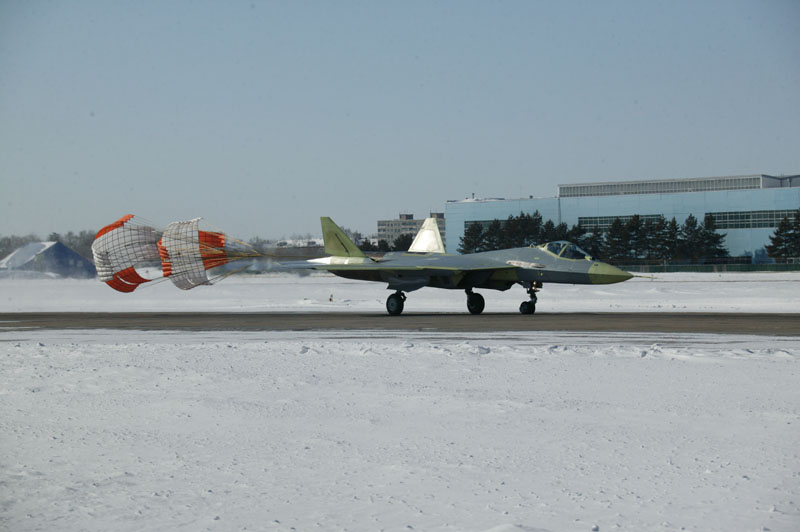
Dec 12/12: #4 flies. The 4th prototype takes flight at the snowy Komsomolsk-on-Amur Aircraft Production Association (KnAAPO). UAC.
Nov 12/12: RCS guess. Airpower Australia uses public-domain photos coupled with the Physical Optics (PO) method for predicting the Radar Cross Section of complex targets on Russia’s T50, using VisCam View software to produce a PolyChromatic Spherical Representation (PCSR). Without flight test data, it’s still a guess, but it’s a kind of guess that Moore’s Law has made available outside of large intelligence agencies.
Their guess? It won’t match the F-22, or even China’s J-20, but if they introduce a rectangular faceted design to the engine nozzles and add radar absorbent coatings, they might beat the F-35. Sources: Airpower Australia, “A Preliminary Assessment of Specular Radar Cross Section Performance in the Sukhoi T-50 Prototype” | WIRED Danger Room, “Russia’s Stealth Fighter Could Match U.S. Jets, Analyst Says”.
Oct 9/12: During an interview with India Strategic, Chief of the Air Staff Air Chief Marshal NAK Browne confirms that HAL has committed $6 billion to joint development. Plans have changed, and India’s 144 planned FGFAs will all be single seaters, now, hewing much more closely to the Russian baseline. In the same vein as India’s SU-30 MKIs, however, they’ll have some avionics and integration differences. According to the ACM Browne:
“… the first prototype is likely to be delivered to India in 2014 followed by two more in 2017 and 2019. The series production then “will only be ordered based on the final configuration and performance of the third prototype.”
See: India Strategic | IANS.
Aug 19/12: Even later to India. Reports now indicate that the 1st FGFA prototype flight tests should start in India in 2014, with deliveries to the Indian Air Force by 2022, a full ten years from now. This would be the start of a $30+ billion, 250 plane program over the next decade, at roughly $100 million each.
Closer to the present, Russia and India are reportedly finalizing the research and development phase at $11+ billion, split evenly between the two parties. Business Standard | AviationWeek.
Aug 8/12: Radar. Sukhoi announces that they’ve begun flight tests of the PAK-FA’s Tikhomirov “active phased array radar system” in both air-to-air and air-to-surface test modes. Initial trials toward flight refueling also take place this month. Sukhoi | The DEW Line | RIA Novosti.
May 14/12: Late to India. India is already backtracking on service dates for its FGFA variant of Sukhoi’s T50, bringing them closer to predictions made by outside observers years ago. M M Pallam Raju has moved the plane’s certification and production start date from 2017 back to 2019. Close examination shows that 2020 or beyond is more likely.
India’s Business Standard also highlights a number of areas that aren’t settled, where ongoing specifications changes and/or technical problems may end up delaying the fighter and send India’s costs skyrocketing. India reportedly wants 40-45 design changes to the current PAK-FA, including its own avionics and a “360 degrees” AESA radar. That last requirement is likely to involve AESA “cheek fairings” that need to maintain aircraft stealth levels, a tailcone radar, and the internal computing and software required to fuse all of those radars into a single picture. They also want at least 2,000 hours of certification flying, and possible configuration changes in light of tests. India now expects their fighters to prepare for service no earlier than 2019, and if the IAF fields a 2-seat version, it’s likely to take even longer. All of India’s changes add 3 types of risk.
One is technical risk. India’s history is littered with overly ambitious projects that India’s Ministry of Defense and associated state-run agencies approved, but could not execute. The cutting-edge nature of the FGFA project magnifies those risks, even with Sukhoi’s assistance.
The 2nd risk is cost risk. Sukhoi’s help, and the associated design, production, and testing of new FGFA equipment, won’t come for free. The more changes India makes, the more the project will cost them. Russia isn’t going to pick up the tab for changes to a design their air force has already approved, and even the “Tactical Technical Agreement” that specified Indian changes isn’t going to mean much if costs become a problem. Russia has forcibly renegotiated critical defense contracts with India several times, and won’t hesitate to do so again.
The 3rd risk is schedule risk. Since Russia is focused on fielding the current single-seat configuration in its current form, while India is focused on major configuration changes and is still debating a 2-seat variant, both of those timelines could turn out to be true. Russia could wind up fielding SU-50 squadrons several years before India even finishes development. India’s Business Standard.
Jan 29/12: Korea: No PAK-FA. The Korea Times quotes a DAPA spokesman, who confirms the potential F-X-III competitors:
“No Russian firm submitted an application to attend the program’s explanatory session, which was a prerequisite to participate, by the Friday registration deadline,” a spokesman of DAPA said. He noted that a representative from Swedish company Saab, which has been searching for additional export orders for its Gripen multirole fighters, successfully filed an application for the mandatory session along with Boeing, Lockheed Martine [sic] and EADS.”
This means that the Indo-Russian PAK-FA will not be part of the $7+ billion competition, despite reports (vid. July 20/11) that it was intending to participate, just as Russian disinterest kept the SU-35 out of F-X-2.
2011
Prototypes #2 & 3 fly; Testing flameout; South Korean opportunity?
(click to view full)
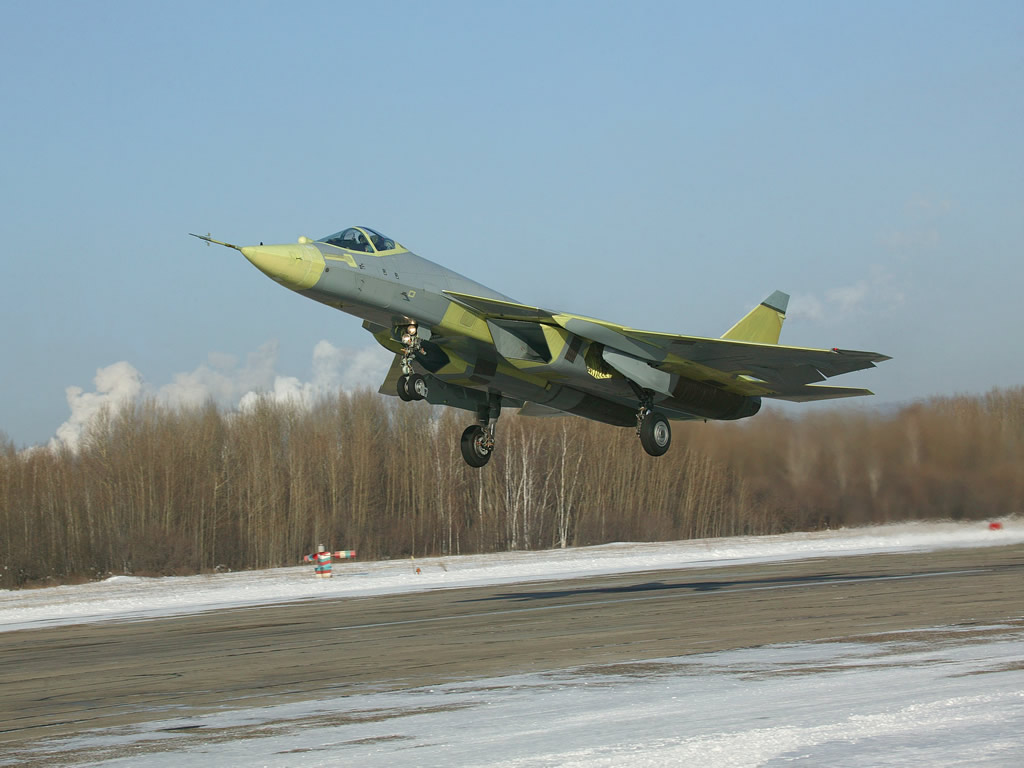
Dec 22/11: #3 flies. First flight of the 3rd PAK-FA prototype from Sukhoi’s KNAAPO aircraft plant in Komsomolsk-on-Amur. Sukhoi.
Sept 6/11: Exports? Russia & India Report highlights an analysis by Russia’s unofficial Centre for Analysis of World Arms Trade (CAWAT), which takes a look at potential buyers of the PAK-FA’s export version. They see a potential for 274-388 export units beyond India or states that spun out of the Soviet Union, like Kazakhstan et. al. Their projections for possible buyers, and their projected purchasing periods, include:
* Algeria (2025-2030)
* Argentina (2035-2040)
* Brazil (2030-2035)
* Venezuela (2027-2032)
* Vietnam (2030-2035)
* Indonesia (2028-2032)
* Iran (subject to lifting of the arms embargo, 2035-2040)
* Kazakhstan (2025-2035)
* China (“subject to certain conditions”, 2025-2035)
* Malaysia (2035-2040)
* Syria (2025-2030)
Aug 24/11: Flameout. Flight International conveys NPO Saturn general director Ilya Federo’s explanation of the MAKS 2011 failure:
“The motor did not fail – in fact, it was put by erroneous control input into a wrong mode that caused the surge. This is not an engine failure, but the wrong data input caused by a malfunctioning sensor feeding data to the flight control system. After what had happened the motor was checked [and] the malfunctioning sensor was replaced by a good one. Today, there is no issue with this engine.”
Aug 22/11: Flameout. After performing a basic fly-over with the PAK FA, Sukhoi intended to close Russia’s MAKS 2011 air show with a bang – and did, sort of. The pilot of its second prototype PAK-FA/T50-2 was forced to abort his take-off run, and the planned flying routine, after 2 bursts of flame erupted from the right engine.
The show’s organizers compounded the embarrassment by promising that the 1st prototype would fly instead – but it was not on site, and is believed to be in maintenance following its Aug 17/11 demonstration. Flameout: Flight International (incl. flame burst picture) | India’s Open magazine | China’s Xinhua || Appearance: Moscow Times | Pravda | RIA Novosti | Voice of Russia | Reuters | UPI | WSJ Emerging Europe blog | op-ed – Right-wing Heritage Foundation, USA.
July 20/11: PAK-FA for South Korea? As South Korea’s DAPA eases the criteria to try and foster more competition, DAPA’s Col. Wi Jong-seong says that “Russian aircraft manufacturer Sukhoi expressed its intent to compete in the fighter jet procurement project early this year.” The report quotes him as saying that Sukhoi’s T50 PAK-FA will be up against Boeing’s stealth-enhanced F-15SE Silent Eagle, Lockheed Martin’s F-35 Lightning II, and EADS’ Eurofighter Typhoon. Assuming we don’t have an F-X-2 repeat, where all competitors but one drop out.
At this point, FX-III is being touted as a 60 jet buy of high-end fighters, with a budget of 8.29 trillion won ($7.86 billion). Eurofighter reportedly offered a better deal than the F-15K in F-X-2, but lost. The firm recently proposed to phase in Korean assembly for Phase III, with the 1st 10 made in Europe, the next 24 using Korean components, and the last 26 assembled in Korea. Korea Times.
March 3/11: #2 flies. Russia’s 2nd PAK-FA fighter prototype successfully completes its 1st test flight in Russia’s Far East region of Komsomolsk-on-Amur. Note that China’s Xinhua cites local reports dated Feb 23/11, but Sukhoi’s release pegs the date at March 3/11.
UAC’s Mikhail Pogosyan adds that they expect to have a fleet of 3 test aircraft by year end, and says the existing jets have now made 40 flights since last January to test the model’s aero-dynamic characteristics and electronics. Beyond that, Pogosyan tells Russian media that the Indian Air Force will “acquire 50 single-seater fighters of the Russian version” before their 2-seat FGFA is developed. If true, it would go a long way toward ensuring that India meets its 2017 induction target. On the Russian end, plans are to purchase the first batch with existing engines, buying the first 10 aircraft after 2012 and then 60 after 2016. Russia’s Centre for Analysis of Strategies and Technologies director Ruslan Pukhov predicts that Vietnam will be the 2nd export customer for the fighter. Sukhoi | Russia’s Pravda | China’s Xinhua.
Feb 9/11: With Aero India 2011 underway, Sukhoi offers some additional details regarding the December 2010 agreement with India:
“This is the first of a series of documents governing the obligations of the parties at different stages of the program. The PMF project includes the design and development of a next-generation fighter, which will have such advanced features as stealth, supersonic cruise speed, high maneuverability, highly integrated set of avionics, an advanced warning system about the situation, the internal deployment of weapons and the possibility of a centralized reporting and electronic warfare system. The fighter is being developed on the basis of the Russian perspective aviation complex (PAK FA) according to stringent technical requirements of the Indian side. The further development of the program envisages design and development of a two-place version of the aircraft and integration of an advanced engine with increased thrust. The two sides are supposed to cooperate in joint marketing of the complex in other countries.”
Feb 9/11: India. Indian defence minister AK Antony reiterates their target of a 2017 induction for the FGFA. India’s defense procurement history suggests that they’re unlikely to make it. Time will tell. Sukhoi.
2010
1st flight; Russian air force plans; Contract with India.
(click to view larger)
Dec 20/10: Contract. Russian President Dmitry Medvedev reportedly signs a set of defense and nuclear agreements in India, including the FGFA development contract. Details remain sketchy. Bloomberg | BBC.
Dec 16/10: Hindustan Aeronautics Limited (HAL) Chairman Ashok Nayak tells Russia’s RIA Novosti that Russia and India have agreed on key features of the design contract for their joint fifth-generation fighter project. The cost of preliminary design is estimated at $295 million, with work expected to be complete within 18 months. The partnership will develop both a single-seat and a twin-seat version of the aircraft by 2016, focusing on the single-seat version in the initial stages of development.
Nayak said the contract could be signed by the representatives of India’s HAL and Russia’s United Aircraft Corporation (UAC) during a visit by Russian President Dmitry Medvedev to India on December 20-22. RIA Novosti.
Development contract
Nov 30/10: The right-wing American Heritage Foundation think tank releases an analysis of the Russia program and its implications: “What Russia’s Stealth Fighter Developments Mean for America“.
July 23/10: Testing. Sukhoi’s KnAAPO issues a release saying that:
“Sukhoi Company has completed the preliminary on-land and in-flight activities which involved all 3 engineering prototypes of the Frontline Aviation Advanced Airborne Complex (PAK FA)… These prototypes were used for testbed strength tests, on-land optimization of fuel systems and other work towards flight trials. The flying prototype has made 16 flights… enables execution of a complete program of flight trials… Vladimir Popovkin, the Russian Defense Minister First Deputy, in his interview to the Rossiyskaya Gazeta newspaper estimated the Russian Air Force’s demand for the 5th-generation fighters at 50 to 100 units. It is planned to complete all tests of the PAK FA airframe in 2011-2012, and to sign a contract in 2013 for a pilot lot of ten aircraft for testing the model’s entire weapons suite.”
July 13/10: Russia. RIA Novosti quotes senior Russian figures. Russian Air Force chief Col. Gen. Alexander Zelin confirms the expected delivery dates of over 60 planes, which they hope to begin in 2015-16, but equipped with older, “non-fifth” generation engines from existing SU-30 family planes.
“Deputy Defense Minister for Arms Procurement Vladimir Popovkin said the Defense Ministry would purchase the first 6 to 10 aircraft after 2012, based on the outcome of initial tests… The prime minister said 30 billion rubles (around $1 billion) had already been spent on the project and another 30 billion would be required to complete it, after which the engine, weaponry and other components would be upgraded.”
April 2010: Testing. The 1st flying prototype of the fighter, and the avionics testbed used for systems optimization before flight trials, are delivered to the flying test center of the OKB Sukhoi Experimental Design Bureau in Zhukovsky, near Moscow. On April 29/10, the flying prototype begins preliminary tests. Source.
March 29/10: Welcome to the new world of intelligence, where a pair of YouTube videos appear to provide insights into PAK-FA technologies. Veteran aviation journalist Bill Sweetman reports that:
“…the video highlights a new honeycomb core material designed for high temperatures. It also states that the T-50 will have no fewer than five radar arrays: the 1500-module forward active electronically scanned array (AESA), two side-facing X-band sub-arrays and two “decimetric” (L-band) arrays in the leading-edge root extensions. It also states that the goal is to fight the F-22 by closing within visual range. Another new video shows a novel inlet radar blocker… It uses flexible vanes with a rotating ring at the rear end: in the “stealth regime” it provides extensive blockage, but it clears the airflow when it doesn’t matter or you need full speed or power.”
Late March 2010: Testing. Acceptance trials of the flying prototype are fully completed. Source.
March 16/10: Russia. In “The future of the Russian Air Force: 10 years on“, RIA Novosti military commentator Ilya Kramnik discusses planned buys and pending recapitalization of the Russian Air Force over the next decade:
“According to various media reports, the Ministry wants to buy at least 1,500 aircraft, including 350 new warplanes, by 2020. The fleet would include 70% new equipment at that point, said Air Force Commander-in-Chief Colonel General Alexander Zelin… The Defense Ministry has now signed contracts for the purchase of 32 Su-34 Fullback advanced fighter-bombers to be delivered by 2013, 48 Su-35 Flanker-E fighters by 2015, 12 Su-27SM Flanker-B Mod. 1 fighters by 2011, 4 Su-30M2 Flanker-C planes by 2011 and 12 Su-25UBM Frogfoot combat trainers. This year, the Defense Ministry intends to sign a contract for the delivery of 26 MiG-29K Fulcrum-D fighters by 2015. Additional contracts for the delivery of at least 80 Su-34s and 24-48 Su-35s are expected to be signed. In all, the Russian Air Force is to receive 240-260 new aircraft of these types. It is hard to say much about the specifications of another 100-110 aircraft, due to be manufactured primarily after 2015. They will probably include 25-30 MiG-35 fighters, another 12-16 Su-30 combat trainers for Su-35 squadrons and 40-60 Sukhoi T-50 PAK FA (Advanced Frontline Aviation Aircraft System) fifth-generation fighters…”
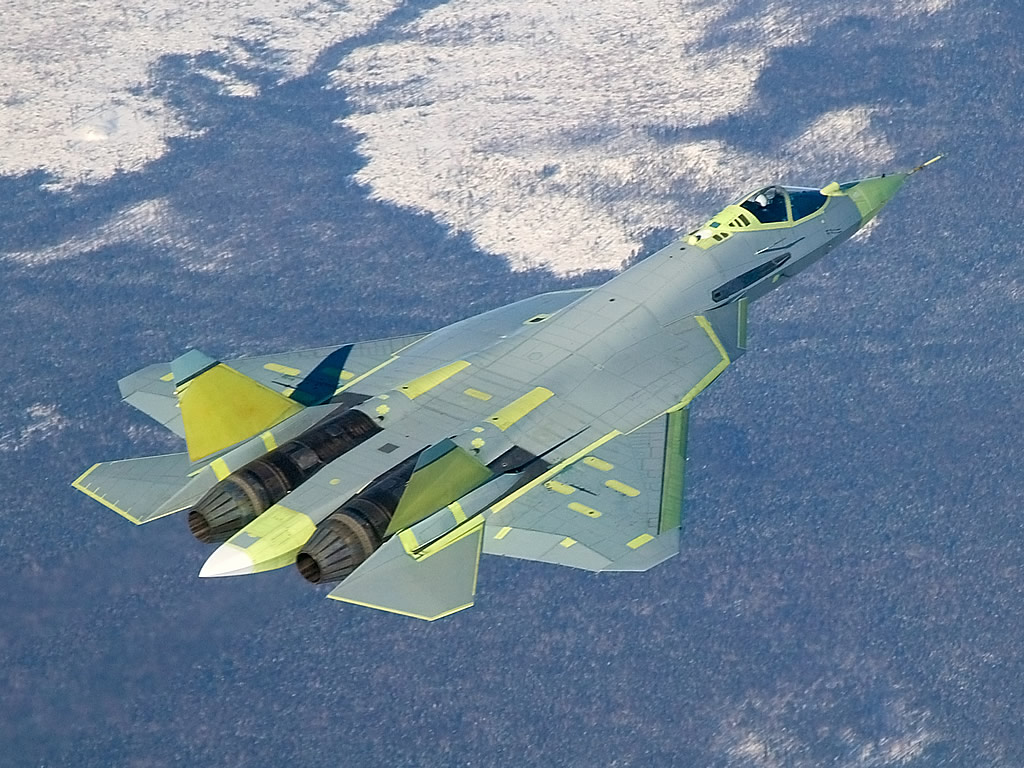
Feb 12/10: Testing. The PAK-FA prototype reportedly makes its 2nd flight at Komsomolsk-on-Amur. Times Now | RT
.
Feb 6/10: Some aviation watchers ask “How long has the PAK-FA or T50 been flying?” They believe that the first prototype may have flown before January 2010, and that there may be more than 1 prototype, based on differences in available photos.
Jan 29/10: Fly! The first prototype PAK-FA fighter lifts off from KNAAPO’s Komsomolsk-on-Amur facility for a 47 minute flight, piloted by Sukhoi test-pilot Sergey Bogdan. Sukhoi says that the plane met all expectations. Sukhoi JSC release | NPO Saturn release [in Russian] | Russia 1 TV video | Pravda | RIA Novosti | Times of India | Aviation Week | Defense News | Agence France Presse | BBC | Canadian Press | Washington Post | China’s Xinhua | Aviaiton Week’s Bill Sweetman: Preliminary Analysis.
1st PAK-FA flight
Jan 6/10: India’s Business Standard covers the workshare and capability issues that have must be addressed before production contracts and arrangements can be finalized. The project is currently expected to have development costs of $8-10 billion, and Russia and Sukhoi have already made substantial investments.
The crux of the negotiations revolves around HAL’s designated development workshare, and the areas it will be applied to. On the other side of the table, the Russian United Aircraft Corporation is wary of India’s lack of design credentials, coupled with the cutting-edge nature of this project. HAL is intent on a 25% share, to include the mission computer and critical software (building on Indian SU-30MKI work), navigation systems, cockpit displays, counter-measures dispensing (CMD) systems, composites expertise and production to complement Russia’s titanium expertise, and modifying Sukhoi’s single-seat design into a twin-seat fighter for the IAF. HAL’s Chairman Ashok Baweja seems to have a different view of the fighter’s design state, referring to existing prototypes as “proof of concept” items rather than nearly final designs.
Once the 2 sides come to a firm agreement on issues of design and funding, UAC and HAL will sign a General Contract, and set up a joint venture to design and build the aircraft. That has not happened yet, while Sukhoi has continued to push forward with general design, and has produced a prototype aircraft. Business Standard describes India’s workshare as “almost finalised,” but as we’ve seen with other Indian procurements, that doesn’t necessarily mean anything.
Jan 3/10: Rollout. Reports surface that the first prototype of Russia’s PAK-FA aircraft has rolled out on the runway at KNAAPO’s plant in Komsomolsk-on-Amur, but did not fly. The test pilot reportedly switched on the engines and made 2 runs on the airstrip, while testing the brakes.
Russia’s vice premier Sergei Ivanov had promised that tests would commence in December 2009-January 2010, and the Russian Air Force reportedly plans to induct the fighter beginning from 2015. DNA India.
2008 – 2009
Russia – India MoU signed; Russia approves their version’s design; Exports could be a challenge.

(click to view larger)
Oct 9/09: India. The Indian Ministry of Defence issues a release regarding the 9th meeting of the Russia-India Inter-Governmental Commission on Military-Technical Cooperation on Oct 14-15/09:
“Among the major new projects which will be high in priorities of the Indian agenda for bilateral defence cooperation between the two countries, will be projects for joint design and development of the Fifth Generation Fighter Aircraft (FGFA) and of the Multi-Role Transport Aircraft (MTA). The co-development and co-production of the FGFA with Sukhoi Design Bureau Russia has been progressing, with several rounds of discussion already completed to finalize the technical requirements. During discussions in the meeting of the Commission, Shri Antony would highlight New Delhi’s interest in ensuring that the development phase of the FGFA is completed by 2016, as originally anticipated and that induction of the aircraft into the IAF can start by 2017.”
See also: Times of India.
Aug 28/09: Radar. Tikhomirov’s NIIP reportedly exhibits models of the PAK-FA’s active electronically scanned array (AESA) radar. Tikhomirov reportedly says the AESA antenna entered bench testing in November 2008, and was mated with the radar’s other blocks for an initial integration test “this summer,” with a 2nd radar produced by mid-2010 for integration with the operational prototype aircraft.
The Milaz report adds that Sukhoi will complete 5 prototypes for initial testing, including 2 to be dedicated for ground test activities. Initial trials are scheduled for completion in 2011-12, with the company expecting to produce an initial batch of aircraft for operational trials by 2015.
April 16/09: Exports? Forecast International offers a cautionary market assessment of the FGFA:
“…with the PAKFA program under increasing tension and the West’s major aerospace firms seeking to shore up additional orders for soon to be closed fourth-generation aircraft production lines, Russia faces the prospect of declining presence in the world’s most high sought after arms markets… Faced with the considerable research & development costs associated with developing a new, advanced fighter platform, Russia is seeking to both distribute costs and ensure that a viable export market will exist… Sukhoi, is reported to have already invested as much as $115 million in company capital…
Several factors are working against the Rosoboronexport’s attempts replicate the international cost/production-sharing development model implemented for the F-35, which is expected to become the dominant fighter in the fifth-generation market… the unproven status of the PAKFA… its timeline for delivery its far behind its western competitors. Deliveries of the PAKFA are not anticipated to begin until 2017. Finally, as production of the Eurofighter Typhoon and Lockheed Martin F-35 ramp up, the western aerospace firms currently producing advanced variants of fourth-generation aircraft are likely to push hard to gain additional order to extend production lines.”
Aug 8/09: RIA Novosti quotes the chief of the Russian Air Force, Alexander Zelin, from the MAKS-2009 arms show. Zelin says there are problems with the PAK-FA’s proposed new engines, and:
“For the time being the aircraft will use Saturn engines. There are problems, I admit, but research is continuing.”
Dec 29/08: MoU. Hindustan Aeronautics Limited and Russia’s United Aircraft Corporation (UAC) sign the deal to jointly develop and produce a 5th generation fighter aircraft. HAL Chairman Ashok K Baweja:
“We (HAL and UAC) are moving forward as per schedule. We (have) just done the general contract yesterday. I went to Delhi and signed the general contract.”
According to reports, Russia and India will simultaneously develop 2 versions of the aircraft: a 2-seat version for India, and a single seat version for the Russian Air Force. India Defence.
India – Russia MoU
Sept 29/08: India Today magazine reports that the Russian and Indian designs for the FGFA project will differ somewhat, while efforts continue to define India’s participation in a project that has reportedly already had its design frozen by Sukhoi. HAL Chairman Ashok Baweja is quoted as saying that the Indian aircraft will be a 2-seat aircraft, which changes some aspects of design and has an especial impact on stealth unless carefully managed. Bajewa added that both stealth and supercruise capabilities were expected for the aircraft, adding that both sides were closer to a real agreement defining India’s participation, almost a year after the original cooperation memo was signed. India’s capabilities in composite materials manufacturing was mentioned as a possible basis for industrial participation.
Meanwhile, Russia’s the United Aircraft Corporation President Alexey Fedorov says that the single-seat T50 is set to fly in Russia in 2009 as planned; Bajewa adds that it will be powered by an ALF-31 FP engine.
The most interesting quote was Indian Air Vice Marshal Kak’s, who noted that the opportunity to gain from being part of the design process was gone, and added that “…if we have missed out on the design phase, we have to analyse the cost-benefits of acquiring only super cruise and stealth technology for $10 billion.”
A fair question. One likely to be asked in the political realm as well, when the time comes to finalize the agreement. Which leads to the corollary questions: How important each aspect is to the IAF? And where, if anywhere, might enough of these performance benefits be acquired at less cost?
Summer 2008: Design approval. The fighter’s initial design is approved in Russia, and the prototype blueprints are delivered to the KNAAPO aircraft building company based in Komsomolsk-on-Amur. Source.
Russia approves design
April 3/08: RIA Novosti reports that Russia plans to begin flight tests of a new fifth-generation fighter based on Sukhoi’s PAK FA project in 2009.
Feb 28/08: HAL explains some of the timelines facing the FGFA program. HAL Chairman Ashok Baweja explains the process, which is also the set of implicit points of failure where the project can become stalled or canceled:
“We have only signed an Inter-governmental Agreement which agrees to cooperate in developing the FGFA. Now from that will flow the project report, general contract, the structure of the company that will be set up, and where the funding will come from. An aircraft design, development, certification, the complete entity with its power plant, systems, weapons, trials, is a process which takes 15 years to be completed.”
2004 – 2007
India signs key agreement, but it isn’t finalized.

(click to view full)
Nov 6/07: India. Issues and rifts may be developing between India and Russia over the FGFA contract, which still lacks key signatories. Defense News reports that key difference include the design’s level of finalization (India wants more input and hasn’t finalized requirements, Russia says the design is final), India’s monetary share (HAL says $2 billion, agreement suggests $5-6 billion), and other issues. The Defense News report does claim that Sukhoi’s secret PAK-FA/ I-21/ T50 design has been selected as the foundation.
The first prototype of the aircraft is reportedly projected to be test-flown by 2015, but the number of aircraft to be built remains among the unsettled issues, and the 2 state-owned firms (Hindustan Aeronautics Ltd. & Russia’s Sukhoi Design Bureau) have not signed any agreements yet.
All of these things are solvable by negotiations, of course, but that means the partnership is still effectively in negotiations, rather than a final deal.

Oct 18/07: India and Russia sign an Intergovernmental Agreement for joint development and joint production of the Fifth Generation Fighter Aircraft (FGFA). The agreement was signed in Moscow, Russia at the conclusion of the 7th Meeting of the India- Russia Intergovernmental Commission for Military and Technical Cooperation.
India’s Defence Minister Mr. AK Antony and his Russian counterpart Mr. Anatoly Serdyukov also signed a Protocol which envisages a ‘new strategic relationship’ based on greater interaction at various operational levels. The two countries have agreed to strengthen and expand relations in all areas, especially in the areas of more frequent joint exercises and greater R&D cooperation. Talks with Russia to extend the 2000 Military Cooperation Agreement beyond 2010 have now begun, and Antony also expressed hope that the two countries would soon sign an Intergovernmental Agreement on co-development and co-production of Multi-Role Transport Aircraft (MRTA). The India MoD release adds:
“The Defence Minister described the Agreement on FGFA as a ‘major landmark’ and said that the Indo-Russian relationship is on a trajectory to reach new heights. He Mr. Antony expressed satisfaction at the outcome of discussions on other important projects e.g., supply and licensed production of T-90 tanks, SU-30 MKI aircraft and other strategic issues. He admitted that there has been a delay in the delivery of the repaired and refurbished aircraft carrier Admiral Gorshkov along with supply of deck-based fighter aircraft MiG-29K and said it was decided that some more studies by technical groups would be done to go through the details. He appreciated the efforts made by the Russian side to resolve issues relating to life cycle support of equipment of Russian origin.”
Inter-Governmental Agreement
Aug 29/07: India. India’s MoD issues a familiar release, in response to renewed questions:
“Co-development of a Fifth Generation Fighter Aircraft has been identified as an important area of cooperation between the Indian and Russian Government. Technical discussions to work out the details are in progress. Efforts are on for finalizing the draft Inter Governmental Agreement in this regard. This information was given by the Minister of State for Defence Production Rao Inderjit Singh in a written reply to Shri Gurudas Dasgupta and Shri CK Chandrappan in Lok Sabha today.”
March 1/07: India. “Advanced Combat Aircraft” release from India’s Minister of State for Defence Production Shri Rao Inderjit Singh:
“The co-development of a Fifth Generation Fighter Aircraft has been identified as an important area of cooperation between the Indian and Russian governments. Technical discussions to work out the details are in progress. Efforts are on for negotiations and finalization of the draft Inter-Governmental Agreement in this regard.”
Dec 10/04: The new fighter’s exterior design is approved. Source.
Appendix A: “Fifth Generation”?
(click to view full)
Russia’s SU-27/30 Flanker family fighters were invented in the 1980s and 1990s, and attempted to incorporate the lessons from America’s 4th generation “teen series” fighters (F-14, F-15, F-16, F/A-18) into their designs. They were successful, and India’s Air Force may now be flying the world’s second best air superiority fighter in the SU-30MKI. The MKI, and European designs like the Eurofighter, Rafale, and JAS-39 Gripen, are typically referred to as “4+ generation” aircraft.
The term “fifth generation” fighter is part marketing hype, and partly based in reality. There are no objective criteria for this designation, and very few examples, which means it’s mostly applied based on when the development of a front-line, advanced fighter begins. There are a few general constants on the American side: some level of stealth, and internal weapon carriage to maintain it; arrays of embedded sensors within the airframe’s structure, rather than as bolt-ons; and sensor fusion into single displays. On the other hand, level of application varies for each category, and key capabilities like super-maneuverability and supercruise (Mach 1+ without using fuel-guzzling afterburners) have not been constants.
(click to view full)
The USA’s “5th generation” F-22A Raptor offers full stealth, supermaneuverability, an advanced AESA radar, huge computing power that creates a single “sensor fusion” picture from the plane’s array of embedded sensors and datalinks, and the ability to “supercruise” above Mach 1 instead of just making short supersonic dashes. It is operated by the USAF, and just over 190 aircraft will constitute America’s entire fleet. America has refused to export it, despite interest from very close allies.
To a lesser extent, there’s also the cheaper F-35 Lightning II, with some stealth, a smaller AESA radar, sensor fusion, and even more computing power and sensors embedded around the aircraft. It lacks supercruise or super-maneuverability, and will be produced for domestic use and export in Air Force, Marines/STOVL, and Navy variants.
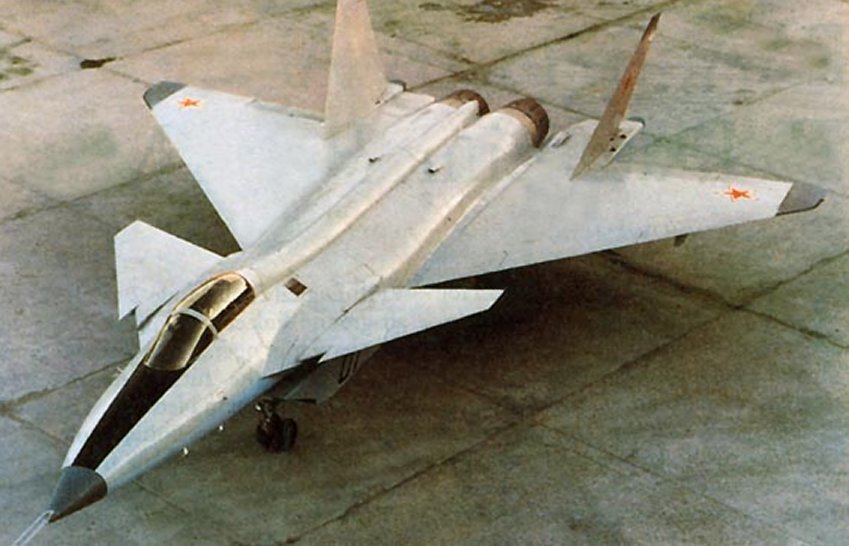
Russia’s MiG 1.44 (if indeed it was a real project?) and/or “I-21” type aircraft were early attempts to keep up with the Americans, but lack of funds suspended both efforts.
The obvious solution was a foreign partner, but Europe had limited funds, and had invested in its own 4+ generation projects: Dassault’s Rafale, EADS’ Eurofighter, and Sweden’s Gripen. India, on the other hand, has a long-standing defense relationship with Russia, and the funds to pursue advanced projects. From their point of view, a joint development agreement is one way to restrict Russian cooperation with China along similar lines. See Vijiander K Thakur’s “Understanding IAF interest in the MiG fifth generation fighter” for more background.
Until similar aspects of the Russian design became clear, however, it was impossible to know exactly what Russia and India meant by “5th generation.” Some of those ambiguities were resolved when Russia unveiled its T50 demonstrators.
Appendix B: DID Analysis – Under Pressure (2008)
(click to view full)
If there’s one watchword to use for this deal, it’s “pressure.” Russia has been putting pressure on India lately to remain a customer, by giving China export rights to jet engines that will power Pakistan’s new fighters, and by working to evict India from its base in Tajikistan. Verbiage concerning deepened strategic cooperation needs to be seen in this light.
The second kind of pressure at work here is the fiscal variety. With the Navy also demanding funds for new ships, submarines and aircraft as India’s geostrategy shifts toward securing the Indian Ocean sea lanes, any additional fighters will face an extremely tight fiscal environment over the next decade and more.
India already faces cost pressures given limited defense budget and pressing need to refurbish its existing fleet, modernize its fighters via the MRCA competition, and bring the Tejas LCA on line to replace its MiG-21s. Not to mention adding new platforms to patrol India’s vital sea lanes, fulfill naval fighter needs, upgrade its transport aircraft fleet, and extend the IAF’s reach. Meanwhile, India’s SU-30MKIs remain one of the best 4th generation aircraft in the world, with a comfortable edge over regional rivals, good growth prospects, and superiority over most current and planned US aircraft as well.
(click to view full)
Then there’s pressure in future, as the strategic agreement lays the foundations for something of a dilemma down the road. There are no real guarantees when dealing with Russia, only its interests of the moment and the logic of cash. Any fighter whose R&D is partly underwritten by India can easily be sold to China later on if relations turn sour, or if India does not buy enough aircraft to make exclusivity worthwhile from Russia’s point of view. One might think that this would be counterbalanced somewhat by Russian wariness about giving a potential rival its best technology, but past experience shows that even this will be for sale. China’s real military budget is about 4-5 times India’s according to most credible estimates, and is likely to remain so.
Given the amount of Russian equipment in India’s military, and the limitations of defense budgets in a democracy that prevent a massive “throw-out and re-equip” exercise, India’s options for retaliation would be very limited.
India faces high hurdles to retaining future exclusivity – and is handing a potent lever to Russia for future “negotiations” involving Russian armaments.
Additional Readings
Background: PAK-FA
* Global Security – PAK FA [Perspektivnyi Aviatsionnyi Kompleks Frontovoi Aviatsyi].
* Air Power Australia (Feb 15/10) – Assessing the Sukhoi PAK-FA. “While the failure to account for the imminent arrival of this design in United States TACAIR force structure planning qualifies the PAK-FA as a “known capability surprise”, the important advances in PAK-FA aerodynamic, kinematic and low observables design also qualify it as a “surprising capability surprise”.
* Wikipedia – Sukhoi PAK FA. Wikipedia is a useful source for concept aircraft, because it tends to aggregate the various sources. This article is a good example. Note that all articles concerning this aircraft must be regarded as very provisional.
* Warfare.RU, via WayBack – PAK-FA Sukhoi T-50. As of 2011. The “T-50” is an internal designation; the operational aircraft will be SU-##.
* RIA Novosti, via WayBack – FACTBOX: Russia’s fifth-generation fighter T-50 (PAK FA). As of 2012.
* NPO Saturn – 117S. The engine that equips the Su-35, and early T50 models. For its successor, see Aircraft Engines of the 5th Generation [in Russian].
News and Views
* Air Power Australia – Sukhoi Flankers: The Shifting Balance of Regional Air Power. The SU-30 family has its own growth potential. Includes program history, details, regional procurement notes, and analysis of current capabilities and likely future upgrades.
* China Air and Naval Power (Jan 29/14) – Some thoughts on 5th gen projects. Less than sanguine about Russia’s ability to pull off a good AESA radar, and suggests that software will become a bigger issue as the PAK-FA/SU-50 jets get closer to deployment.
* The Aviationist (Oct 18/13) – Russia’s most advanced fighter jet’s troublesome childhood.
* Flight Global, via WayBack (April 20/13) – Flying the Flanker. Tactical Air Support COO Gerry Gallop talks about supercruising in a clean, demilitarized SU-27. The SU-50 will be heavier and bulkier, but it will also be clean with basic weapons loaded. Can the engines provide enough thrust : weight?
* Airpower Australia (Nov 12/12) – A Preliminary Assessment of Specular Radar Cross Section Performance in the Sukhoi T-50 Prototype. Uses public-domain photos coupled with the Physical Optics (PO) method to predict the RCS of complex targets, using VisCam View software to produce a PolyChromatic Spherical Representation (PCSR). Conclusion: it could match the F-35, with some changes and coatings added. Without flight test data, it’s still a guess, but it’s a kind of guess that Moore’s Law has made available outside of large intelligence agencies.
* Heritage Foundation, via WayBack (Nov 30/10) – What Russia’s Stealth Fighter Developments Mean for America.
* Defense Technology International, via WayBack (Feb 8/10) – Major Work Ahead on Russian Stealth Fighter.
* Plane Talking (Feb 6/10) – How long has the PAK-FA or T-50 been flying?
* Flight Global (April 24/07) – Picture: Russian Sukhoi T-50 fighter images emerge. From the NPO Saturn web site. See above for the rendering, and see also this Russian page re: the engine.
* DID (Jan 26/07) – January 2007 India-Russia Cooperation Agreements.