


(click to view full)
The multi-national Eurofighter Typhoon has been described as the aerodynamic apotheosis of lessons learned from the twin engine “teen series” fighters that began with the F-14 and F-15, continued with the emergence of the F/A-18 Hornet, and extended through to the most recent F/A-18 Super Hornet variants. Aerodynamically, it’s a half generation ahead of all of these examples, and planned evolutions will place the Eurofighter near or beyond parity in electronic systems and weapons.
The 1998 production agreement among its 4 member countries involved 620 aircraft, built with progressively improved capabilities over 3 contract “tranches”. By the end of Tranche 2, however, welfare state programs and debt burdens had made it difficult to afford the 236 fighters remaining in the 4-nation Eurofighter agreement. A 2009 compromise was found in the EUR 9 billion “Tranche 3A” buy, and the program has renewed its efforts to secure serious export sales. Their success will affect the platform’s production line in the near term, and its modernization plans beyond that.
Eurofighter: Design & Evolution

(click to view full)
The Eurofighter program emerged out of a long and conflicting set of multinational efforts to design a new European fighter. By 1983, Britain, France, Germany, Italy and Spain had coalesced around the Future European Fighter Aircraft (FEFA) program. That partnership lasted only until 1985, as differences with France over carrier compatibility, weight limits, and French insistence on the lead industrial role, ended their partnership. Britain, Germany, Italy and Spain established Eurofighter Jagdflugzeug GmbH in 1986 to manage the Eurofighter project, while France went its own way and developed their Rafale fighter.
Both projects went on to develop clipped delta, canard-equipped twin-engine fighters, whose “radar shaping” designs significantly lowered their radar signature compared to earlier fighters like the Mirage F1, Tornado, or F/A-18A-D Hornet. Even so, it would be a misnomer to call these European jets stealth aircraft. The standard term is a “4+ generation” fighter, distinguishing them from “5th generation” aircraft like the American F-22A Raptor and Indo-Russian PAK-FA.
While the Rafale’s development emphasized weapon load and multi-role capabilities, squeezed budgets and ample fleets of strike aircraft led Eurofighter’s partner nations to focus on the air superiority role. An excellent aerodynamic design, very good thrust-to-weight ratio, and fast slew-and-point capability was fused with a very integrated set of electronic sensor and defensive systems, including a pilot-friendly cockpit design that offered the first use of voice commands in a fighter. This made Eurofighter’s Typhoon very capable in its chosen aerial role, able to compete with or best serving opponents short of the American F-22A.
Typhoons even proved capable of armed supercruise during 2011 Libyan operations, but this was only possible with low-drag “4 + 2” air-to-air missile configurations, at high altitudes, to Mach 1.2.

B-2, ICU
(click to view full)
For air-to-air combat, the Eurofighter currently relies on long range detection using its mechanically-scanned, phased array ECR-90 CAPTOR radar and PIRATE IRST(Infra-Red Search & Track) system, coupled with a good array of advanced air-to-air weapons. Non-British Eurofighters will also have a 27mm Mauser cannon on board, considered by many observers to be the best fighter cannon on the market.
On defense, the Typhoon’s Praetorian (formerly EuroDASS) self-protection suite is designed for 360 degree coverage, with high automation. The Defensive Aids Computer (DAC) controls a package that includes Towed Radar Decoys, a Missile Approach Warner (MAW), wingtip ECM pods, and a Countermeasures Dispensing System (CMDS). They are integrated with each other, and with the Eurofighter’s radar and IRST.
Unfortunately for the consortium, this aerial combat strength ended up being the flip side of their biggest weakness. Initial “Tranche 1” machines were severely hobbled on the export market by their poor ground attack capabilities, a serious weakness in a world of multi-role fighters. When combined with the plane’s $100+ million cost, the result has been a slew of lost export competitions. Dassault’s Rafale, which had gaps of its own, could not capitalize on that failing, and is still looking for its first export win. Embarrassingly, the Eurofighter has usually lost to modernized, multi-role versions of the very F-16s and F-15s it was meant to supplant. That, in turn, has affected both prices and the pace of upgrades.
A list of current weapons may help snap the plane’s evolution into clearer focus:

As the list above notes, the Tranche 2 fighters that began delivery to member countries in 2008 have added precision ground attack capabilities under programs like P1E, but still fall well short of the full capabilities and weapon arrays offered by competitors like the American F/A-18E/F Super Hornet and F-15E Strike Eagle. Their lack of a helmet-mounted display (HMD) compounded this issue, preventing the Typhoon from taking full advantage of its new air-to-air missiles, and detracting from their ground attack capabilities. A BAE “Striker” HMSS Helmet-Mounted Display is in low-rate production now, but it didn’t become operational until 2011.
Tranche 3 Eurofighters will reportedly be based on the Tranche 2 standard, with provisions for dorsal conformal fuel tanks (CFTs) that can extend range while creating minimal drag. The other big change involves upgraded power systems and electronics that can more easily support future growth and upgrades. The weapon bus can handle fiber optic cabling, onboard computing is upgraded, and a high speed data network improves sharing with weapons or other platforms. The most important upgrade remains a CAPTOR “E-Scan” Active Electronically Scanned Array (AESA) radar to replace the ECR-90. Industry is developing it for a 2015 delivery date, but there doesn’t seem to be a contract framework in place. The lack of an AESA radar leaves the Eurofighter a generation behind its American counterparts in radar technology, and until it catches up, it’s likely to suffer in export competitions.

(click to view full)
Even as these upgrades are being discussed, however, the Eurofighter’s export window as a leading-edge fighter choice is closing. The F-35 Joint Strike Fighter is aerodynamically inferior, but it offers a stealth fighter with a tested AESA radar, a wider array of sensors, and sensor fusion at an even higher level. By the end of this decade, 5th generation projects like the Russo-Indian PAK-FA will also become viable choices for some export targets.
Successful upgrades can keep the Eurofighter Typhoon competitive, even in that environment, if its production line lasts long enough. The key word will be “competitive.” As an example, see this comparison of the Eurofighter vs. Saab’s single-engine contemporary, the 4+ generation JAS-39 Gripen. Saab already has a development contract for an ES-05 Raven AESA radar, and is significantly ahead in weapons integration:

Eurofighter: What’s Next?
A Weak Core

(click to view full)
Tranche 3 aircraft are expected to deliver a few important new capabilities, including an AESA radar and Conformal Fuel Tanks. At present, however, only Tranche 3 Eurofighters are designed to add CFTs. The biggest question at present is whether Tranche 3A aircraft will be the only CFT-capable Typhoons. The status of core countries’ Tranche 3B orders is very unclear, but Britain and Germany have already firmly ruled out further buys, and it appears likely that Tranche 3A will be the last production order from the original member countries.
In 2011, Eurofighter’s CEO placed the end of production at 2015, barring a major export win like India or Japan, or a Tranche 3B purchase from the consortium partners. By 2014, that date had been revised to 2017/18, but 2015 still marks the point that parts of the supply chain will begin to stop.
This will leave core countries with smaller fleets, for 2 reasons. One is limited orders. The other is Typhoon fleets that won’t serve in parallel. UK Air Chief Marshal Sir Glenn Torpy has said that he expects the RAF to operate on the basis of a Typhoon fleet of 120 aircraft. By the time the last jets of the 3A tranche come into service, between 2015 and 2020, the first batch of Tranche 1 Typhoons would be approaching the end of their life. This is likely to be true in other partner countries as well. A 2009 Der Spiegel article illustrates some of the issues in Germany, for instance:
“The German air force didn’t get the first jets until July 2006. It now has 38 Eurofighters. But 14 of them have been sent back for repairs. Some of them still suffer instrument failure during flights. Of the six single-seat aircraft at the Neuburg air base only four are fit for service on average. That’s just enough to provide day and night cover for Germany’s airspace. The defense ministry recently admitted to budget committee members that the approved sum of [EUR] 14.7 billion would only be enough to pay for 143 Eurofighters. Parliament would have to approve an additional [EUR] 3 billion if the air force was to get the planned 180 aircraft…”
Upgrade Lifeline?

(click to view full)
At the same time, remaining aircraft in these existing fleets offer strong opportunities for piecemeal upgrades, from moves to give Tranche 1 planes precision ground attack capabilities, to helmet-mounted sights, AESA radar retrofits, and even thrust-vectoring engines to create super-maneuverability. Conformal fuel tanks (CFTs) could also become possible, if Eurofighter devises an appropriate upgrade process. It would be logical to make that part of a life-extension structural refit, which would help existing customers keep expensive investments in service for longer. Key export order competitors like the F/A-18E/F Super Hornet, F-15 Strike Eagle, F-35 Lightning II, JAS-39 Gripen, Rafale, and Russian SU-30MKx/SU-35 already field every one of these capabilities – but none currently field all of them.
Weapon upgrades are absolutely expected. Expansion of the Typhoon’s ground attack weapon choices is an ongoing process. MBDA’s medium-range stealthy Storm Shadow cruise missile is in testing for full integration by 2015, reportedly thanks to Saudi Arabia and Oman. Taurus’ similar KEPD 350 will undergo partial testing at the same time. Saudi Arabia also reportedly wants to add the French Damocles surveillance and targeting pod, which makes sense because the Israeli LITENING-III runs up against their boycott.

(click to view full)
In the air, 2017 is expected to mark full integration of the long-range Meteor air-to-air missile.
Over the medium term, planned weapons reportedly include Diehl’s medium-range PILUM and HOSBO glide bombs, short-range MBDA Brimstone light strike missiles, and possibly their longer-range SPEAR-3 successors. Raytheon’s AGM-88 HARM anti-radar missiles have been discussed, and they would fix a critical deficiency for an important mission. So, too, would anti-ship missiles, which all of its competitors already carry. None of these items come with a schedule, however.
National budgets will play a role in the pace of these upgrades, as they have throughout the Eurofighter’s history. The question, for current and future customers, is timing. Until integration is done, the absence of key capabilities like long-range precision strike and anti-radar missiles will continue to hobble the Typhoon’s positioning as a fully multi-role aircraft.
What has changed now is the consortium’s seriousness about winning exports, along with a dawning understanding that most of these upgrades are now basic requirements for serious players. The question is whether this understanding came too late.
Exports Required
[youtube:http://www.youtube.com/watch?v=k-2QiyzaF2o]
click for video
Export wins will be necessary in order to finance the full range of timely improvements, and keep the line open past 2017/18. An August 30/09 Financial Mail article reported that Eurofighter GmbH was hoping for sales of 300 Eurofighter Typhoon to 10 export countries by 2020, but that will be very challenging.
The Eurofighter’s cost of $100-140 million each is already creating tough sledding against F-35 stealth fighters whose production quantities will eventually create prices in the $100 million range, and F/A-18 Super Hornets or JAS-39E/F Gripens that can be sold for around $60-70 million. With existing operators interested in selling some of their aircraft, even an export win or 2 may not change the Eurofighter’s overall production numbers.
The Tranche 3A release from Eurofighter cited active export campaigns in Switzerland, India, Japan, Romania, Greece, and Turkey, while “exploring possible opportunities” in South Korea, Bulgaria, Croatia, et. al. Romania (F-16s) and Turkey (F-35A) never went ahead with a real competition. Subsequent losses in Brazil (JAS-39E/F Gripen), India (Rafale, unfinalized), Japan (F-35A), South Korea (F-35A), Switzerland (JAS-39E Gripen, canceled by referendum), and the UAE (TBD, q.v. Dec 19/13 entry) have hurt.
Greece, which canceled an order for 30-60 Eurofighters in 2005, and bought F-16s instead, still had plans for an additional next-generation fighter buy to counter Turkey’s planned purchase of 100 F-35As. With Greek finances in tatters, however, don’t hold your breath.
After that, Eurofighter’s options narrow sharply. On the bright side, the Gulf states of Bahrain, Kuwait, and Qatar all have fighter competitions in progress, and successful sales to Saudi Arabia and Oman help the Typhoon’s chances within the Gulf Cooperation Council.
With Japan and South Korea out, the once-promising Asian market has few options left for Eurofighter. A MiG-29N replacement competition in Malaysia has run into trouble due to finances, and they are exploring leasing deals. That will be a tough win for Eurofighter. In Europe, Eastern European countries like Bulgaria and Croatia would normally be problematic sales due to the Eurofighter’s costs, but Germany is pushing hard, and offering umbrella maintenance agreements and training packages. Even if they succeed, however, the end result is just a handful of sales.
Typhoon at Sea?

(click to view full)
India was pitched with very explicit offers to have their needs and investments drive the Typhoon’s future enhancements, and significant roles for Indian industry. At Aero India 2011, Eurofighter and BAE even unveiled an initial internally-funded design for a navalized Eurofighter than can operate from aircraft carriers. In a direct nod to potential Indian sales, they touted the plane as being able to take off from “ski jump” carriers without catapults – a design that describes all of India’s current and planned carriers, as well as the initial design for Britain’s own Queen Elizabeth Class. Eurofighter GmbH describes the goal as 95% commonality with land-based aircraft, and required changes as “limited… include a new, stronger landing gear, a modified arrestor hook and localised strengthening on some fuselage sections near the landing gear, as well as updates the EJ200 engines,” which could include thrust-vectoring as well as structural reinforcement.
It didn’t help. India picked the French Rafale, which already has a carrier-capable version, as their future M-MRCA medium fighter. The Indian Navy is currently flying MiG-29Ks as its naval fighters, and plans to add Indian-designed LCA Naval light jets.
Britain could have been a long-shot backup option, but they’re planning to use the F-35B from future carriers, which won’t be fitted with steam catapults and arrester wires after all.
Brazil might have been a future option, on the assumption that they will replace their aircraft carrier at some point. Unfortunately for Eurofighter, Brazil picked Saab’s JAS-39E/F Gripen as their future air force fighter, and Saab also has plans for a naval variant.
That leaves a carrier-capable Eurofighter variant without a plausible future customer.
Eurofighter: Industrial Structure & Orders

(click to view full)
Technically, the NATO Eurofighter and Tornado Management Agency (NETMA) is the customer for the Eurofighter project. Eurofighter GmbH is the contractor, with joint ownership by all of the key industrial partners: BAE Systems, EADS, and Finmeccanica. Overall, Eurofighter GmbH cites a total of 100,000 supported jobs in 400 companies across Europe.
Aircraft production work shares were designed to correspond to the number of aircraft ordered under the 1998 Umbrella Contract:
* 37.5% UK (232). BAE Systems: Front fuselage including foreplanes, canopy, dorsal spine, tail fin, inboard flaperons, rear fuselage section.
* 30.0% Germany (180) EADS Deutschland: Main center fuselage. Airbus spinout Premium AEROTEC is the main sub-contractor.
* 19.5% Italy (121). Alenia Aeronautica: Left wing, outboard flaperons, rear fuselage sections
* 13.0% Spain (87). EADS CASA: Right wing, leading edge slats
The Eurofighter’s 2 EJ200 turbofans deliver 20,000 pounds thrust each in reheat mode, and are manufactured by the EUROJET partnership of Avio (Italy), ITP (Spain), MTU Aero Engines (Germany) and Rolls-Royce (UK).
The Euroradar consortium supplies the ECR-90 CAPTOR radar, and is developing the “E-Scan” AESA successor for introduction by 2015. It is led by Finmeccanica subsidiary SELEX Sensors and Airborne Systems in Edinburgh, UK (formerly BAE Systems Avionics), and also includes EADS and Spain’s Indra.
The Eurofighter contract was designed to protect the fairness of each participants’ agreed manufacturing work shares, by making it very expensive to back out of committed orders. On the other hand, European defense spending continues to decline due to pressure from welfare state commitments and debt burdens, even as European military operational deployments and their costs have increased. Hence the fractious contract negotiations around Tranche 3, and also the investigation of foreign sell-offs by the member countries.
In June 2009, the partners took a diplomatic way out, splitting Tranche 3 into 2 parts. At the end of July 2009, the 4 partner nations placed a EUR 9 billion Tranche 3A order, which will keep production going for several more years. The table below summarizes the Eurofighter’s evolving production plans, from the original 1985 plan to the 1998 agreement, and then planned and actual orders for each production tranche.

Note that 24 of Britain’s Tranche 2 aircraft have been diverted to Saudi Arabia, in order to satisfy Saudi demands for early delivery. In response, Britain ordered 24 more Tranche 3 aircraft as replacements. In practice, this means that Britain has ordered only 16 of its originally planned 88 Tranche 3 Eurofighters – and high-level statements indicate that Tranche 3A agreement absolves Britain of the need to place any further Eurofighter orders. Other reports explain the gap by claiming that the other 48 British Tranche 3 aircraft will go to Saudi Arabia, meaning that all of Saudi Arabia’s 72 planes will have been siphoned off from British orders.
Maintenance contracts to keep the fleets in service involve a small core of multi-national contracts for key systems and general service, followed by a number of national umbrella contracts to address other areas, and then a set of national maintenance agreements that are less comprehensive. See the chart below for tracking of the main support contracts currently underway:

Contracts & Key Events

(click to view full)
DID coverage focuses on purchases related to consortium aircraft buys under Tranche 3, platform improvement efforts, international opportunities, and sales. See the “Additional Readings” section for coverage of the comprehensive support contracts for the various countries, and of the Saudi and Austrian export deals.
2014 – 2024
Germany confirms no Tranche 3B, but how much will they have to pay?; German maintenance costs an issue; Eurofighter needs new orders, soon.

July 25/24: An Italian Air Force Eurofighter Typhoon fighter jet has crashed in the Douglas Daly region, approximately halfway between Daly River Mission Airport (YDMN) and Anson Bay, south of the Daly River, during Exercise Pitch Black 2024. The information is according to a social media post by Darwin Aircraft Movements. Fortunately, the pilot successfully ejected from the aircraft and was promptly rescued by a civilian CHOP41 helicopter (VH-RQY, A139) at approximately 1:05 PM local time. The pilot was then airlifted to the Royal Darwin Hospital and is reported to be safe and in good condition.
June 27/24: European and Japanese fighter jets will engage in a series of joint training exercises over Japan scheduled for next month, as part of the larger Pacific Skies 24 initiative. These exercises aim to enhance the tactical skills of the Japan Air Self-Defense Force (JASDF) and strengthen defense cooperation between participating nations. Germany, Spain, and France will all deploy military aircraft to Japan. The German Air Force will be the most prominent participant, sending eight Eurofighter jets, alongside with four A330 MRTT tankers, three A400M transports, and one A321 aircraft. Spain will contribute four Eurofighters and two A400M transports, while France dispatches a contingent of four Rafale fighters, three refueling tankers, and three transport planes.
April 8/24: Six Royal Air Force (RAF) Eurofighter Typhoon jets have arrived at Mihail Kog?lniceanu Air Base in Romania on March 25, commencing a four-month deployment in support of NATO’s enhanced Air Policing (eAP) mission. This marks the fifth such rotation for the RAF in Romania, building upon a successful partnership established in 2014. The deployment sees the RAF Eurofighters joining forces with the Romanian Air Force to safeguard NATO airspace. This collaborative mission strengthens regional air defense capabilities and underscores the alliance’s commitment to collective security.
February 27/24: Latvia Germany is moving five Eurofighters to Latvia to protect NATO airspace over the Baltics. The fighter jets took off from Neuburg an der Donau and were to be deployed from the Lielvarde military airfield southeast of the Latvian capital Riga, an air force spokesman said on Monday. The soldiers of Tactical Air Force Squadron 74 are supposed to protect NATO airspace over the three Baltic states, including Estonia and Lithuania, from the beginning of March to the end of November.
January 9/24: Germany has dropped its opposition to a follow-on sale of Eurofighter combat aircraft to Saudi Arabia. German Federal Minister of Foreign Affairs Annalena Baerbock announced the shift in policy in comments made to journalists during a visit to Israel, Agence France-Presse (AFP), Reuters, and other news agencies reported. “We do not see the German government opposing British considerations for more Eurofighters for Saudi Arabia”, said Baerbock.
December 1/23: EW A German parliamentary budget committee has approved equipping 15 Eurofighter Typhoons for electronic warfare. Airbus will outfit the aircraft with the Saab transmitter location and self-protection system and Northrop Grumman’s Advanced Anti-Radiation Guided Missiles. The combined solution will enable the aircraft to detect, locate, and disable anti-aircraft radars and improve its self-protection.
November 23/23: Blocked Sale Italy has blocked French form Safran to buy a key Italian defense and aerospace company, with sources citing the state of conflict around the world as a reason to avoid approving such sales. Italy halted the purchase of Microtecnica, which makes components for the Eurofighter jet, by using its so-called Golden Power legislation, which grants it the right to block purchases of strategic firms by overseas buyers.
October 25/22: Bulgaria Spain has announced plans to send six Eurofighters to Bulgaria and eight Hornets to Romania starting from next month. The Eurofighters will leave for Bulgaria in the middle of next month while the F-18s will depart from December.
October 14/22: GPSE Serco has secured contracts to deliver its automatic test solution General Purpose Support Equipment (GPSE) to the UK Royal Air Force and the Spanish Air Force. The first contract will see Serco provide the latest version of the GPSE test sets to refresh the support capabilities of the UK’s Eurofighter Typhoon fleet. The second contract requires the integration of additional Pylon and High-Pressure Pure Air Generator test functionality to the existing GPSE capability at Spanish Air Force bases in Morón and Albacete.
October 3/22: Kuwait Kuwait now has six Eurofighters in the country after Leonardo delivered another two aircraft to Ali Al-Salem Al-Sabah Air Base. This is the third batch of delivery and the Kuwait News Agency said in a statement that the Eurofighters in the country have accumulated 100 flight hours.
September 23/22: Joint Training Japan has officially acknowledged that three Eurofighters from the German Air Force will be arriving at Hyakuri Air Base on September 28. The Germans will participate in joint training with F-2 fighter pilots from the Japan Air Self-Defense Force. The ASDF says the goal is to promote mutual understanding, strengthen defense cooperation and improve the ASDF’s tactical skills.
August 24/22: Qatar BAE Systems officially delivered its first Eurofighter Typhoon aircraft to the Qatar Armed Forces (QAF) during a roll-out ceremony at the company’s facility in Warton, UK. The Typhoon aircraft was delivered on schedule and will be transported from the UK to Doha later this month. BAE Systems and the UK see the delivery as a “significant milestone” under Qatar’s $5.08 billion program to acquire Eurofighter jets and Hawk advanced jet trainers.
July 25/22: Kuwait The State Department has cleared a potential $397 million purchase request from the government of Kuwait for missiles, bombs, tail kits and other equipment in support of its Eurofighter Typhoon aircraft fleet. The potential foreign military sales transaction will include 60 AIM-120 C-7/8 Advanced Medium Range Air-to-Air Missiles, several hundred MK-84/84 General Purpose 2000LB bombs, 350 KMU-556 Joint Direct Attack Munition tail kits and other munitions, the Defense Security Cooperation Agency said Thursday.
July 15/22: Air Training Britain’s Royal Air Force Typhoons have been conducting combat air training with Rafale fighter jets from the French Air and Space Force, flying from their base locations around the Eastern Mediterranean. Carrying out bilateral air-to-air combat training over the Eastern Mediterranean, the fighters were supported by air-to-air refuelling from an RAF Voyager.
June 27/22: Spain Spain has ordered another 20 Eurofighter jets to bring its fleet to 90 aircraft. The Halcón contract will see Spain getting 16 single-seat aircraft and 4 twin-seat fighters. These jets will be equipped with e-scan radars and are intended to replace Spain’s Hornets. 48 new EJ200 engines will be bought as well. Delivery is expected to begin in 2026.
May 27/22: Qatar An adviser for the British defense ministry, Air Marshal Martin Elliot Sampson, told Qatar’s state news agency (QNA) on Monday that the first delivery of typhoon jets will be delivered to Qatar in August. In 2017, BAE Systems and Qatar entered into a contract valued at around 5 billion pounds ($6.7 billion) for the country to buy 24 Typhoon combat aircraft.
April 12/22: Air Policing The UK has taken command of NATO’s air policing mission in Romania. RAF Typhoons, along with their pilots and ground crew, will lead the Enhanced Air Policing mission for the fourth time since it began in 2014 – following Russia’s annexation of Crimea. The UK is taking over from Italy at a time of massive tension across NATO’s eastern flank due to Russia’s invasion of Ukraine.
March 3/22: Kuwait Leonardo, an Italian aerospace firm, is preparing to deliver another two Eurofighters to Kuwait in the middle of this month, Reuters reports. So far, 2 out of the 28 aircraft ordered have been delivered.
January 26/22: Investigation Italy’s Leonardo said it is not subject of a judicial investigation in relation to the Kuwait Eurofighter program. The country signed a $9 billion order with Leonardo in 2016 for 28 Eurofighter Typhoon fighters. On Monday, Kuwait’s Anti-Corruption Authority said that a major general and colonel in the Army would face prosecutors in a major corruption case related to this purchase.
January 18/22: E-scan Radar Leonardo has signed over $297 million worth contracts with HENSOLDT to help in the development of the Eurofighter Typhoon Jet’s ECRS Mk1 (European Common Radar System Mk1) E-scan radar, ordered by Germany and Spain. According to a press release, Leonardo will conduct development work on new wideband capabilities and provide core parts of the new radar’s antenna, APSC (Antenna Power Supply & Control) and its processor.
December 16/21: Kuwait The first two Eurofighter Typhoons out of an order for 28 aircraft for the Air force of Kuwait landed in Kuwait City. The Eurofighter Typhoon for the Kuwait Air Force feature a wide range of operational capabilities, built by Leonardo according to the specific requirements of the Kuwaiti Air Force.
December 7/21: Fox Defender UK Royal Air Force (RAF) Typhoons from 12 Squadron arrived in Qatar for their joint Exercise Fox Defender. Pilots and engineers from both nations will fly and maintain the Typhoon throughout the exercise. The pilots will be challenged to a range of air to air and ground to air training serials to further enhance interoperability with the Qatar Emiri Air Force, RAF said in a statement.
October 19/21: Bright Star British Typhoon jets currently deployed as part of 903 Expeditionary Air Wing joined Egyptian Air Force F-16s during an exercise called Bright Star. According to the Royal Air Force that this was the first time since 2001 that the RAF have flown with the Egyptian Air Force. The Typhoons were also joined on the exercise by F-16s from the Greek Air Force and US Air Force F-15s and F-16s together with C-130 Hercules and B-52s.
September 16/21: TFST The UK Ministry of Defense awarded BAE Systems contracts valued at more than $305 million to deliver advanced synthetic training for pilots training to fly the Typhoon jet. Under the Typhoon Future Synthetic Training (TFST) contracts, BAE Systems is leading work to deliver ten simulators, together with training facilities at RAF Coningsby in Lincolnshire and RAF Lossiemouth in Moray. The new training environments will be linked together providing an integrated environment for pilots to train and carry out complex combined training exercises using real world mission software and tactics.
August 9/21: Next Steps In a bilateral contract worth close to $354 million, Eurofighter and NETMA, the NATO Eurofighter & Tornado Management Agency, have defined the next steps in the development of the Eurofighter Typhoon. Consolidation Package Step Two and Three, Phase 1 Contract’s most important features will enable Typhoon to operate the Meteor beyond-visual-range, air-to-air missile while transferring the capability from the existing M-Scan radar to the new E-Scan radar.
July 27/21: Norway Royal Air Force (RAF)-operated Eurofighter Typhoon FGR4s from RAF Lossiemouth in Moray, Scotland, have completed a proof of concept exercise in Norway, which tested tactical ground-based refuelling capabilities at a dispersed forward operating location. The multi-role fighters were supported by an RAF-operated Airbus A330-243MRTT Voyager KC2/KC3 multi-role tanker transport and A400M Atlas C1 heavy-lift tactical transport from RAF Brize Norton, Oxfordshire, for the duration of the deployment.
June 30/21: RAF In Romania A detachment of German Air Force Eurofighter fighters were in Romania to undertake combined Quick Reaction Alert training alongside the British Typhoon fast jets already deployed there, according to the RAF. This was the third time since 2020 that both air forces have joined forces on active deployments as part of the bi-lateral Eurofighter Interoperability Enhancement programme.
June 14/21: Kuwait US Air Force, Army, Navy and Marine Corps joint terminal attack controllers participated in a joint training exercise with Italian Air Force Eurofighters at Udairi Range Complex, Kuwait on May 26. Four Italian Eurofighter Typhoon jets are currently stationed in Kuwait, to support OIR (Operation Inherent Resolve), the multinational campaign against Daesh in Iraq and Syria. The F-2000A jets have deployed in April 2021, as part of “Prima Parthica”, as the Italian Armed Forces operation is dubbed at national level, and operate within the Task Group “Typhoon”.
May 19/21: Iraq Two RAF Typhoons have successfully bombed a group of Islamic State jihadis in Iraq, according to UK militarily chiefs. According to the UK Ministry of Defense, Iraqi security forces recently encountered a group of Islamic State terrorists in a strong defensive position about twenty five miles south west of Mosul. The MoD said the fighter jets used precision-guided bombs to take-out heavily armed IS militants who were dug-in at a site near to the city of Mosul.
May 14/21: Damaged Litening Pod A Litening III targeting pod on a Royal Air Force Eurofighter was damaged beyond repair after it dropped from the jet during testing. The Telegraph reported on the news, but did not mention if the accident happened in the air or on the ground. The damage was worth $847,260.
May 11/21: Bersama Lima The Royal Air Force is preparing to send its Eurofighters and Voyager aerial refueling tanker to South East Asia for Exercise Bersama Lima 2021 in October. The British government had earlier announced that the Carrier Strike Group will be participating in the same exercise as well. This marks the second time that a RAF contingent is joining a British aircraft carrier for the Five Power Defence Arrangements (FPDA) exercise, usually carried out off Peninsular Malaysia in the South China Sea. The first was back in 1988 when HMS Ark Royal came to the Far East for Exercise Lima Bersatu.
April 7/21: UK/Qatar: The UK has confirmed it is to establish a joint operating unit with Qatar for the BAE Systems Hawk advanced jet trainer (AJT) aircraft as part of a wider military co-operation agreement signed by the two countries on April 1. The unit, which will be based at Royal Air Force (RAF) Leeming in England, will operate the Mk 167 (T2 in RAF nomenclature) variant of the Hawk recently acquired by the Qatar Emiri Air Force (QEAF) in support of its Eurofighter Typhoon procurement. The updated defense agreement will also see the RAF deploy a Voyager aircraft to Qatar to periodically provide air-to-air refuelling training for the Qatari Emiri Air Force.
April 5/21: Finland The UK-led Typhoon proposal being prepared for Finland’s HX contest pledges to add the nation to the Eurofighter industry consortium, while offering in-country final assembly, engine production and sovereign control over mission data, Jane’s reports. Speaking during a 31 March media briefing outlining the campaign’s key points, UK minister for defence procurement Jeremy Quin said the four-nation Eurofighter group discussed Helsinki’s potential inclusion during a meeting earlier in the month.
March 30/21: Missiles The Italian Air Force is arming its Eurofighter Typhoon fighter jets with new GBU-48 bombs, AMRAAM 120 missiles, and IRIS-T missiles, as well as Litening pods made by Rafael Advanced Defense Systems, to locate targets and direct guided munitions. The Aviationist website reported that the GBU-48 Paveway is a new 454kg GPS and laser-guided munition. Italian Air Force commanders said that Eurofighter Typhoons were originally intended mainly for missions to maintain aerial superiority, but starting from last year the planes were equipped with new and advanced software enabling them to carry out air-to-ground attacks.
January 29/21: Spain – Romania A detachment of Spanish Air Force Eurofighter combat aircraft and support staff arrived at Mihail Koglaniceanu Air Base on January 25, marking the service’s first operational deployment to Romania in support of NATO. Six EdAE Eurofighters and 130 personnel arrived at the base on Romania’s Black Sea coast, from where they will perform NATO’s Southern Air Policing mission through to the end of March. “This is the first time that Spain has sent [its] fighters to the southeast of NATO’s territory to support the alliance’s deterrence and defense measures,” NATO’s Allied Air Command said.
December 11/20: Tornado Replacement According to Jane’s, Airbus is offering a Tranche 5 standard of the Eurofighter combat aircraft to replace Germany’s fleet of Panavia Tornados. Speaking at a virtual running of the company’s annual Trade Media Briefing (TMB), the head of combat aircraft business development, Wolfgang Gammel, said that this future standard will be offered to the Luftwaffe as the service looks to replace 90 Tornado Interdiction and Strike (IDS) and Electronic Combat Reconnaissance (ECR) aircraft with 85 new aircraft from 2030.
November 12/20: Germany’s Windfall Defense company BAE Systems will reportedly receive a €1billion ($1.2 bn) windfall from the German government’s purchase of 38 Eurofighter jets, which german officials announced last week. According to the Times, BAE, which will make parts for the aircraft at its plant in Warton in Lancashire, would secure at least €1bn from the deal. However, the firm declined to comment on the report. BAE is Britain’s largest defense group and also part of the Eurofighter consortium. The German parliament had approved a 5.4 billion euro contract to buy 38 Eurofighter jets from Airbus. The selection of the Eurofighter over the Lockheed Martin F-35 will mean that the German Air Force will not be flying the American Jet in future.
October 22/20: Spain Eurofighter formally submitted to Spain its offer to provide a further 20 Typhoon aircraft under the country’s Project ‘Halcon’ (Falcon). Delivery of the offer, which was disclosed by the consortium on 19 October, came three months after Spain announced that it was seeking to augment its existing Typhoons and to begin the process of replacing its Boeing EF-18 Hornet fleet. “Eurofighter has submitted proposals for the replacement of the Spanish Air Force’s EF-18s which are based on the Canary Islands. Spain is looking to secure 20 new Eurofighter Typhoon aircraft to boost its existing fleet under what is called Project Halcon,” the consortium said.
September 2/20: Air Policing Mission On August 31, the German Air Force Eurofighter detachment took over the augmenting role of NATO’s Baltic Air Policing mission from the French Air Force at Ämari Air Base, Estonia. The French Air Force Mirage 2000-5 detachment, deployed at Ämari since last May, handed over its augmenting role in NATO’s Baltic Air Policing to a German Air Force Eurofighter detachment during a ceremony today. The second Air Policing detachment at Ämari takes place under NATO’s assurance measures introduced in 2014 as the Alliance’s response to Russian interventions in Ukraine and is aimed at reassuring eastern Allies and demonstrating NATO’s commitment and resolve.
August 6/20: Lithuania The first ever Luftwaffe Eurofighter training detachment while embedded with a Royal Air Force (RAF) contingent that is deployed to Lithuania as part of the NATO Baltic Air Policing Mission has concluded. Pilots from RAF Lossiemouth-based 6 Sqn RAF flew with pilots from the German Tactical Fighter Wing 71 Richthofen to practice air intercepts and basic fighter maneuvers together as a pair. Both sides will reverse roles in September when the British will embed with a German detachment in Amari, Estonia.
June 22/20: Upgraded AESA in Germany The German Bundestag approved funding to develop, build, and integrate a new active electronically scanned array (AESA) radar system for the Luftwaffe’s Eurofighter combat aircraft fleet. The approval by the Bundestag’s Budget Committee will see national sensor-house Hensoldt lead the effort to equip the Luftwaffe’s 79 Tranche 2 and 31 Tranche 3A Eurofighters with an updated AESA (also known as electronically scanned [E-Scan]) radar system. The Eurofighter consortium that comprises Germany, Italy, Spain, and the UK is already developing an AESA/E-Scan radar through the Euroradar consortium. This effort, led by Leonardo UK, builds on the aircraft’s existing Captor mechanically scanned (M-Scan) radar, and is known as Captor E-Scan and/or Captor AESA (CAESAR).
June 4/20: E-SCAN Italian defense firm Leonardo announced that a flight test campaign dedicated to the configuration chosen by Kuwait is proceeding at pace. According to the company, Leonardo ISPA 6 (Instrumented Series Production Aircraft) is the most advanced Eurofighter Typhoon test aircraft with E-SCAN radar and it recently joined the other Typhoon test aircraft after the successful completion of an important lay-up in November last year. ISPA6 has completed the overall P3Eb Flight Test campaign, which represents a significant step forward to allow the delivery of the Eurofighter to the Kuwait Air Force. ISPA 6 is one of the three EF Typhoon test aircraft equipped with the Electronic Scan Radar made by the EuroRadar Consortium, led by Leonardo UK in Edinburgh, and it’s currently allocated to the EF/NETMA P3Eb (Eurofighter Consortium/NATO Eurofighter and Tornado Management Agency – Phase 3 Enhancements Package b) development programme to perform E-SCAN Entry Into Service flight tests and provide final clearance to the Kuwait customer.
May 21/20: JTAC Training Lithuanian, German and Norwegian Joint Terminal Attack Controllers (JTAC) carried out training with Royal Air Force Eurofighters and Spanish F/A-18s at Kazl? R?da training ground on May 11. The German and Norwegian JTACs are part of NATO’s enhanced Forward Presence Battlegroup in Lithuania. The British and Spanish air force contingents operate from Šiauliai Air Base and help guard the skies over the Baltic region as part of NATO’s Air Policing mission. NATO’s battlegroup in Lithuania is composed of around 1,200 personnel from Germany, Belgium, Croatia, Czech Republic, Iceland, Luxembourg, Netherlands and Norway. The battlegroup is part of the biggest reinforcement of the Alliance’s collective defense in a generation.
March 20/20: Production Plans During COVID-19 Pandemic According to Jane’s, the Eurofighter consortium has a strategy in place to ensure that work across its four national production lines continues amidst the worsening coronavirus crisis. The deliveries to the four partner nations of Germany, Italy, Spain, and the UK are all recently completed. The pan-European consortium has now introduced plans to protect the delivery of its outstanding orders for Kuwait and Qatar. The program-of-record (PoR) for the Eurofighter partner nations of 160 aircraft for the UK, 143 for Germany, 96 for Italy, and 73 for Spain was concluded in January. The export orders of 15 aircraft for Austria, 12 for Oman, and 72 for Saudi Arabia, had already been delivered, leaving an outstanding backlog of 28 aircraft for Kuwait and 24 for Qatar. To satisfy these Kuwaiti and Qatari orders, all four national production lines will manufacture parts, with final assembly to take place at Caselle and Warton respectively. The delivery of these two orders, expected from late 2020 to 2023 for Kuwait and from 2022 to an unspecified date in the mid-2020s for Qatar, will conclude the 623-aircraft PoR for the partner nations and export customers.
January 15/20: Kuwait The first Eurofighter combat aircraft configured for Kuwait made its maiden flight towards the end of 2019, the company announced. Instrumented Series Production Aircraft (ISPA 6), equipped with the Kuwait Air Force configuration, departed the Flight Test Centre of Leonardo Aircraft Division in Turin-Caselle on December 23, 2019. As written by Eurofighter, ISPA 6 is the most advanced iteration of the aircraft to date, and while other elements have previously been flight tested, this is the first time that all of the enhancements have been brought together. ISPA 6 is the first to fly the Captor E-Scan Radar with Phase Enhancement 3 b (P3Eb), for which Kuwait is to be the launch customer. Other enhancements for Kuwait include the Lockheed Martin Sniper advanced targeting pod, the introduction of the DRS-Cubic ACMI P5 combat training pod and an enhanced Very High Frequency (VHF) Omni-Directional Range navigation aid.
December 31/19: Kuwait The first Instrumented Series Production Aircraft (ISPA 6) configured for the Kuwaiti Air Force has successfully completed its first flight. The aircraft is the first to fly the Captor E-Scan Radar with Phase Enhancement P3Eb, and is a key milestone for the entry into service of Eurofighter with the State of Kuwait. ISPA 6 is the first Eurofighter in the planned export configuration for the Kuwait Air Force, with the second iteration of the Phase 3 Enhancement software (P3EB) and fitted with the new Captor E-Scan radar (known as Radar One Plus, or Captor E Mk0), an active electronically scanned array (AESA) derivative of Typhoon’s highly regarded Captor radar. The capability package for Kuwait includes the integration of Storm Shadow and Brimstone and other air-to-surface weapons.
November 15/19: UK Deploys To Iceland The United Kingdom has sent fighter aircraft to Iceland for the first time since a diplomatic spat between the two countries over the Nordic nation’s banking crisis scuppered a previous planned deployment in 2008. An undisclosed number of Royal Air Force Eurofighter Typhoon FGR4s from 1 (Fighter) Squadron and 100 personnel were deployed from their home station of RAF Lossiemouth in Scotland to Keflavik Air Base on November 13. According to the UK Ministry of Defense, the aircraft will spend the next month protecting the airspace as the UK’s contribution to NATO’s Icelandic Air Policing Mission, returning to Scotland in mid-December. The RAF deployment to Iceland was announced by the then-Defense Secretary Gavin Williamson in June 2018, at which time he said four Typhoon aircraft would be sent to the island. The announcement came a decade after the last scheduled deployment was called off after Iceland’s banking system collapsed owing billions of pounds to UK savers. In 2016, the UK Treasury announced that it had received the final compensation payment from Iceland, resetting the relationship between the two countries.
November 8/19: Germany Airbus Defence and Space disclosed a plan for a Electronic Combat Reconnaissance (ECR)/Suppression of Enemy Air Defenses (SEAD) variant of the Eurofighter for Germany. Germany plans to replace its Tornado fighter, 40 of them are the ECR variant. Airbus wants to put escort jammer pods on the underwing stations while moving the 1,000 liter tanks to another station that has to be modified to carry fuel tanks. Speaking at the company’s Manching facility in southern Germany on November 5, Kurt Rossner, head of Air Combat, provided the first insight into Airbus DS plans for an Electronic Combat Reconnaissance (ECR)/Suppression of Enemy Air Defenses (SEAD) version of the Eurofighter to replace the Luftwaffe’s Tornado ECR aircraft. This Tornado ECR replacement covers 40 aircraft as part of the wider Tornado IDR/ECR replacement program for 85 aircraft.
October 22/19: Next-Generation EW Suite The four-country EuroDASS consortium, which consists of UK’s Leonardo, Italy’s Elettronica, Germany’s Hensoldt, and Spain’s Indra, has outlined its vision of a next-generation electronic warfare (EW) suite for the Eurofighter Typhoon combat aircraft. Global Flight reports, that the industry partners launched plans for a so-called Praetorian Evolution, or “Evo” package of capabilities. Known as Praetorian Evolution, the future Defensive Aids Subsystem (DASS) builds on the Typhoon’s existing Praetorian DASS but introduces a new all-digital architecture and expands electronic warfare functionality beyond platform self-protection. EuroDASS has developed its roadmap independent of the Praetorian Long Term Evolution (LTE) study activity awarded earlier this year, although Praetorian Evolution work is expected to inform LTE outputs.
October 3/19: UK BAE Systems delivered an advanced Typhoon to the UK Royal Air Force, the company announced in a press release. The delivery of the final Tranche 3 aircraft brings a production run of 160 Typhoons for the RAF to an end that began in 2003. The RAF fields eight Typhoon units with 1 (Fighter), 2 (Army Cooperation), 6, and 9 (Bomber) squadrons based at RAF Lossiemouth in Scotland; and 3 (Fighter), 11 (Fighter), and 12 (Bomber) squadrons based at RAF Coningsby in England. There is also a permanent detachment located on the Falkland Islands. A ceremony was held at BAE Systems’ final assembly facility at Warton to mark the latest milestone delivery.
September 5/19: Headed East British Royal Air Force Typhoons based at Coningsby have left for a four-month tour of the Middle East and the Far East to participate in exercises. The first stop for the multi-role Typhoon jets will be Oman, the Royal Air Force announced in a statement. There, pilots from both nations will test their skills in a two week ‘live’ weapons exercise in the desert. The Royal Air Foce of Oman also operates the Typhoons and has a long history in training with the UK. The exercises prepare personnel performing support functions to become familiar with operating in tough conditions away from home. The jets will then be flying on to a multi-national exercise in Malaysia at the end of September. Meanwhile Typhoons, which have been deployed to Estonia under Operation Azotize have returned to the UK.
August 15/19: Spectre For UK Typhoons BAE Systems announced in a news release that their ‘revolutionary’ new mission planning software will be rolled out to the Royal Air Force by November 2020. The software, named Sceptre, will be used throughout a mission, from the initial plan, to the execution of it, to the debrief. BAE says it’ll allow users on the ground to “make better, more informed decisions” to support the flight crew. The RAF plans to initially use it primarily to support its Typhoons. BAE Systems developed and funded Spectre internally. The value of the contract with the Ministry of Defense is yet to be released.
August 13/19: RAF Tranche 3 Makes Second Flight Craig Hoyle from Flight Global reports that the final Eurofighter Tranche 3 for the UK Royal Air Force has made its second flight and will be delivered to the customer by end of the year. The Royal Air Force has an active fleet of 116 Typhoons, the oldest of which are 14 years old. Under current plans, the type should remain in UK service until 2040, operating alongside its short take-off and vertical landing Lockheed Martin F-35Bs. The same news report also said that Qatar has requested to accelerate the delivery of its own Eurofighters. The jets will start arriving in 2022 and most of the 24 jets on order will be delivered in 2023. The final aircraft will reach home in 2024.
August 7/19: EJ200 The UK and Rolls-Royce signed a contract to provide maintenance for the engines of Typhoon fighter jets. The deal is valued at $425.9 million. The contract will provide support for the Eurojet EJ200 jet engine until 2024, Reuters reports. The company will also be required to provide modules, spares and accessories to support the Typhoon fleet. “Not only will this contract help to maintain our world-class jets, it secures 175 jobs across the UK and boosts the skills base our world-leading defense industry relies upon,” junior defense minister Anne-Marie Trevelyan was quoted by the news agency.
June 26/19: Largest Export Credit Deal Qatar’s $6.4 billion deal with the UK in 2018 to supply Qatar with 24 Typhoon fighter jets was the largest UK export credit deal ever, the recent UK Export Finance report shows. In the UKEF report, it says: „As well as being its centenary, this has also been a record year for UKEF, with the largest amount of business underwritten in a single year for decades. This included support for the biggest transaction in its history, worth nearly £5 billion for the export of defence equipment to Qatar. As well as supporting BAE Systems, MBDA UK and their thousands of UK employees and suppliers, this contract will strengthen our own defence capabilities and those of an important strategic ally“. According to Jane’s the provision of credit to Qatar continues the UKEF’s trend in recent years to engage primarily with the defense materiel requirements of countries from the Middle East and Asia Pacific.
June 25/19: Crash in Germany Two German Eurofighter Typhoons collided and subsequently crashed in the northeast of Germany, reportedly killing one of the pilots. According to the German Air Force, the aircraft were taking part in an air combat exercise when they collided and crashed near Laage Air Base. The German newspaper „Die Welt“ called the incident „the worst crash in the history of the Eurofighter“. It is yet unknown, what caused the collision. The accident comes in the midst of the Luftwaffe’s plans to procure more Eurofighters. The old models of the German Eurofighters are to be replaced by modernized variants. The cost for one Eurofighter is roughly valued at $148 million.
June 18/19: Scrambling Russian Fighters British Typhoons in Estonia have yet again been busy intercepting Russian fighters. The British Ministry of Defense said that Typhoon jets launched during the evening of Friday the 14th of June to intercept a Russian SU-30 fighter aircraft that was flying to the north of Estonia. Royal Air Force crews made a second scramble on Saturday June 15 to intercept a Russian SU-30 Flanker fighter and an Ilyushin IL-76 Candid transport aircraft transiting north from Kaliningrad towards Estonian and Finnish airspace. The RAF Typhoons are deployed at Ämari Air Base in Estonia in support of NATO Baltic Air Policing. This was already the eight time the British aircraft intercepted Russian fighters since taking over the Baltic Air Policing mission on May 3, 2019. During both intercepts, pilots reportedly flew the aircraft at a safe distance and operated in a professional manner throughout.
May 27/19: RAF tests BriteCloud The British Royal Air Force started testing the latest version of the BriteCloud missile decoy on its Typhoon fighter aircraft. Leonardo will support a series of trials in which the ‘BriteCloud 55’ Expendable Active Decoy is being trialled for operations with the Royal Air Force (RAF)’s fleet of Eurofighter Typhoon Aircraft. Designed and built by Leonardo Aerospace in Luton, Bedfordshire, BriteCloud is a line of expendable anti-missile decoys. With mission programmable electronics packages, the small canisters come in a number of variants to fit different aircraft. Each canister has spring-loaded airfoils and contains a miniaturized radio-frequency jamming module. In recent tests, the RAF dispensed 33 BriteCloud rounds from Typhoon fighters against a series of simulated battlefield threats. The trials were not only to demonstrate the effectiveness of the decoy, but also that the canisters can be launched safely from the Typhoon.
May 17/19: Interception British Typhoons were launched twice in two days after taking over the NATO Baltic Air Policing mission in Estonia. On Wednesday, the aircraft intercepted two SU-27 fighters and an IL-22 and escorted the formation towards Russia. On Tuesday, British Typhoon fighters scrambled out of Ämari Air Base in Estonia in response to two Russian SU-27 fighter aircraft and one IL-22 aircraft that were flying along the Baltic coast heading towards Kaliningrad. Britain took over the NATO Baltic Air Policing mission from the German Air Force last month.
May 7/19: Air Policing Mission British Typhoons officially started their NATO Baltic Air Policing mission from Amari Air Base in Estonia on May 3. The aircraft from XI(F) Squadron normally based at RAF Coningsby in Lincolnshire already arrived on April 24 and the crew has been working with the German Luftwaffe and their Eurofighters to prepare themselves for the NATO mission of providing a Quick Reaction Alert capability off the Baltic Sea area around Estonia. The Handover Ceremony marked the replacement of the German aircraft with the British Typhoons and their crew.
April 19/19: Italian Eurofighters on a Mission to Montenegro According to local reports, NATO for the first time launched Italian Air Force Eurofighters based at Gioia del Colle Air Base on April 9. The mission was to intercept a civilian airliner that lost communications with civilian air traffic control over Croatia and was heading south towards Montenegro and Albania. It was established that the loss of communications was related to a misunderstanding between civilian air traffic control and the airliner crew. After resuming regular contact with the civilian controllers, the airliner continued to proceed to its destination to Hurghada, Egypt. On December 16, 2005, the F-2000 Typhoon reached initial operational capability with the Italian Air Force. The Italian Air Force uses the Eurofighter Typhoon as the main nation’s asset for air defense and coalition missions.
March 19/19: RAF in Estonia The British Royal Air Force (RAF) sent vehicles and supplies from Southhampton to Estonia to mark the start of a new deployment in the region. The RAF will join the already deployed British Army Battlegroup that formed part of the NATO Enhanced Forward Presence mission. The Enhanced Forward Presence is an allied, forward deployed defense and deterrence military posture in Eastern Europe to reassure the countries of their security. British Defense Minister Gavin Williamson announced the RAF Mission already last year. As part of the mission the Air Force will deploy four Coningsby based Typhoon jets to the Amari Air Base in Estonia.
March 5/19: Spain Airbus delivered the first upgraded Tranche 1 Eurofighter to Spain. The company performed the upgrade at its facilities in Getafe near Madrid, Spain. The enhancements included the introduction of hardware modifications, which support the Operational Flight Program 02 (OFP-02) developed by Spain’s Armament and Experimental Logistics Centre (CLAEX). The company also integrated Tranche 2 and Tranche 3 equipment on the aircraft, including a computer symbol generator, digital video and voice recorder, laser designator pod and maintenance data panel. CLAEX will use this first single-seat Eurofighter, to be followed by a second two-seat aircraft currently undergoing the upgrade, as a test aircraft for the qualification of these new capabilities that will be implemented on the Air Force’s fleet of 15 Tranche 1 Eurofighters. The Eurofighter Typhoon is a project with four European nations, the UK, Germany, Italy and Spain as founding members.
December 12/18: UK Typhoons armed with MBDA Meteor Jane’s reports that the Royal Air Force is arming its Eurofighter Typhoon combat aircraft with MBDA’s Meteor missile. This is the first time the French-made beyond visual range air-to-air missiles are deployed on the British Typhoons. The Meteor was conceived as a longer-range competitor to popular weapons like the American AIM-120 AMRAAM. Its ramjet propulsion is intended to offer the missile a head-on closing range of 120 km, with a 2-way datalink and full powered performance at Mach 4+ throughout its flight, instead of the standard “burn and coast” approach use by rocket-powered counterparts. The intent is to give the Meteor both longer reach, and a wider “no escape” profile. The Meteor program partners include France, Germany, Italy, Spain, Sweden, and the UK.
September 20/18: Qatari milestone Qatar is marking another milestone in its Eurofighter Typhoon acquisition program. The country made its first payment to BAE Systems on Tuesday, and thus finalises the $6 billion purchase of 24 Eurofighter jets and 9 Hawk trainers. This deal is the first major defense contract between the Emirate and the UK. In October 2017 the deal was hailed by former UK Defence Secretary Sir Michael Fallon as “an important moment in our defence relationship and the basis for even closer defence co-operation between our two countries.” The contract also provides for the training of Qatari pilots, facilitated by the British Royal Air Force’s (RAF) No. 12 squadron. This joint UK-Qatari operational squadron will also help to police the skies during he Gulf state’s hosting of World Cup 2022. Deliveries of the fighter aircraft are expected to commence in 2022.
September 13/18: Kuwait orders Kuwait’s budget for the current fiscal year suggests that the country will buy several additional Eurofighter Typhoon aircraft. The Ministry of Defense plans to spend $1.1 billion on the Typhoons and another $1.1 billion on machinery and air transport equipment. Kuwait purchased an initial 28 Eurofighter aircraft equipped with the Captor-E active electronically scanned array (AESA) radar back in 2016. First deliveries of which are expected to commence in 2019.
August 9/18: Oops! A Spanish Eurofighter accidently launched an AIM-120 AMRAAM in Estonia. The fighter aircraft was flying near defenses near Pangod in the vicinity of Otepää when the incident occurred. It is yet unclear if the AIM-120D’s built in self-destruct mechanism terminated the flight or if the missile landed at an unspecified location. The Estonian Defense Forces have sent helicopters to search for the missile. The Spanish Eurofighter is part of NATO’s Air Policing Mission that support member states that do not have the necessary air capabilities to independently protect their airspace. The Spanish air force currently deploys six Typhoons as part of this mission. An investigation has been initiated to clarify the circumstances.
July 11/18: Project Centurion upgrade Jane’s reports that, the UK Royal Air Force (RAF) can now fly the first of its Eurofighter Typhoon combat aircraft upgraded with the Project Centurion weapons fit. The multi-national Eurofighter Typhoon has been described as the aerodynamic apotheosis of lessons learned from the twin engine “teen series” fighters that began with the F-14 and F-15, continued with the emergence of the F/A-18 Hornet. The Project Centurion configuration is intended to combine the already-delivered Raytheon Paveway IV precision-guided bomb, and the Storm Shadow, Meteor beyond-visual range air-to-air missile (BVRAAM), and Brimstone on the Typhoon FGR4 in time for the retirement of the Tornado in April 2019.
May 04/18: Small parts cause big problems The magazine Der Spiegel reports that the German Luftwaffe is currently facing problems keeping the ground readiness of its Eurofighter Typhoon fleet. According to the magazine the majority of the Luftwaffe’s 128 fighter planes is currently not cleared for conducting missions. Engineers are concerned about faulty wing-pods that could seriously impede the functionality of the plane’s self-protection system. Without this system the planes are not ready for conducting missions as part of its NATO obligations. The technicians managed to fix some issues with the pods but are unable to fix an issue with leaking cooling-fluid. The component issue, centers on a so-called “grease nipple” that is part of the system that cools the wingtip pods that house elements of the self-protection system, which was designed by BAE Systems. Supplies of the component have been restricted while the primary supplier, a U.S.-based company, is recertified after a change in its ownership. “We hope to get this problem under control in several weeks or months,” the Defense Ministry spokesman Colonel Holger Neumann told a regular German government news conference. He declined to give any details about how many of Germany’s Eurofighters were affected by the spare parts logjam.
March 29/18: Leonardo targets Poland The Italian airframe manufacturer Leonardo prepares to promote the Eurofighter Typhoon to the Polish government which should launch its “Harpia” fighter tender to replace its remaining RAC MiG-29s and Sukhoi Su-22s within the next few weeks. The company is willing to negotiate the relating integration of weapons used by the Polish air force. This would involve the Eurofighter consortium clearing the type to operate with Lockheed Martin’s AGM-158 JASSM air-to-surface cruise missile. Warsaw is a strategic costumer for the company as it has previously bought Leonardo’s Aermacchi M-346 advanced jet trainers. Eurofighter Typhoons can be either assembled in Italy, Germany, Spain or the UK. The companies that took part in the analysis and market survey phase are Boeing, Leonardo, Lockheed Martin and Saab.
March 12/18: Saudi MoU The three-day visit of Saudi Arabia’s Crown Prince Mohammed Bin Salman to the UK has seen the kingdom’s heir sign a memorandum of intent for the purchase of 48 Eurofighter Typhoon fighter jets. While the accord stops short of committing to an order, manufacturer BAE Systems sees the sale as a “positive step towards agreeing a contract for our valued partner.” Before offsets are included, the sale could be worth as much as £8 billion. The visit, which included meetings with the British cabinet and the Queen, was marred by protests by human rights and anti-war campaigners critical of the kingdom’s ongoing war in Yemen, backed by British weaponry.
February 14/18: Austria Corruption Probe-Defense Ministry Statement The Austrian Defense Ministry has announced that the government has handed over its findings on suspect money flows related to its 2003 purchase of Eurofighter jets to international bodies including the US Department of Justice. “Foreign authorities were informed about the results of the defense ministry’s investigation in the context of the international fight against corruption. The Department of Justice has also been informed,” it said, adding that the documents were handed over two months ago. The sale is being investigated by Austrian prosecutors over allegations of fraud against Airbus and the Eurofighter consortium based on earlier complaints from the defense ministry. Austria is seeking up to 1.1 billion euros ($1.4 billion) in compensation, while the consortium dismiss any wrongdoing, calling the accusations politically motivated. Another investigation into the sale by German prosecutors, was closed after Airbus agreed to pay fines nearing $99 million.
February 14/18: Potential Sale-Malaysia BAE Systems has offered the Malaysian government a UK government-sanctioned financing deal, if Kuala Lumpur selects the Eurofighter Typhoon as its new fighter jet. “We have an offer on the table…It’s competitively priced and we have offered UK government financing so the Malaysian government can spread the payment over a longer period,” Alan Garwood, the Group Business Development Director for BAE Systems, said from the Malaysian capital. “We can offer training, local partnership and lots of jobs,” he added. Malaysia could buy as many as 18 fighters in a $2 billion program to replace its MiG-29 fighters, with Dassault’s Rafale also in the running for selection. However, a decision on the acquisition has been delayed until after elections, which much be held by August.
February 12/18: Austria Corruption Probe Airbus will pay $99 million in fines in order to settle one of two investigations into alleged corruption surrounding the sale of Eurofighter combat jets to Austria in 2003. The settlement was reached with German prosecutors based in Munich and includes an administrative fine of 250,000 euros and “disgorgement”—which legal experts broadly define as the recovery of ill-gotten gains—of 81 million euros. In a statement, prosecutors said they had not found evidence of bribery but that Airbus had been unable to account for over 100 million euros in payments to two shell companies. Airbus said in a statement the penalty, which it had agreed to pay, related to the “negligent breach of supervisory duties” by unidentified members of Airbus Defence and Space’s former management.
February 9/18: Project Centurion Britain’s Royal Air Force (RAF) has hailed 2018 the “Year of the Typhoon” as modernization work to the multi-role fighter’s continues to pass tests. Upgrades to systems and weapons under Project Centurion—an effort to improve the capabilities of Eurofighter Typhoons in the RAF fleet as it replaces the Tornado as the force’s main fighter—have been undergoing testing by 41(R) Squadron, a Test and Evaluation Squadron based at RAF Coningsby, Lincolnshire. The head of Project Centurion, Gp Capt John Cunningham, said that by the end of the year “no other aircraft in the world will have all of the Typhoon’s capabilities.” He added: “It will have the long-range air-to-air Meteor missile, Brimstone and Storm Shadow which can hit moving targets and underground structures, Paveway IV laser guided bombs, the Litening III targeting pod and ASRAAM air-to-air missiles. All this will come together by December 2018 making the next year the biggest game changer ever in the development of this aircraft.”
January 31/18: Fleet Retirement-Reduce To Produce The British Royal Air Force (RAF) plans to retire 16 two-seat Eurofighter Typhoons, as the service looks to trim $1.13 billion in operating costs. Following their retirement, the aircraft will then be cannibalized for spare parts under the Reduce to Produce (RTP) project, which aims to generate over $70 million worth of parts from each airframe “back into the supply chain”, according to RAF Air Command at High Wycombe, in Buckinghamshire, UK, in response to a Freedom of Information (FOI) Act request submitted by Jane’s. News of the cost-saving measures comes less than a week after chief of the general staff, General Sir Nicholas Carter, told the Royal United Services Institute (RUSI) that an increase in defense spending was required to fill a $28 billion funding shortfall to stave off cuts to key capabilities and personnel numbers.
January 22/18: Qatar-Support A joint Qatari-UK operational squadron will be formed to help police the skies during the Gulf state’s hosting of World Cup 2022. The announcement was made by Qatar’s Deputy Prime Minister and Defense Minister Dr Khalid bin Mohamed al-Attiyah during his speech at the Royal United Services Institute (RUSI) in London last week, with the agreement made last month as part of the UK’s support and training package within Qatar’s Eurofighter procurement program. Qatar’s World Cup bid and preparations have been shrouded in criticism, which have been made worse by its neighbors enforcing a blockade and cutting off ties which included earlier offers of providing hotels and training facilities—Iran is now believed to be in talks to fill this void—while some allege that governing body FIFA, received bribes from the Qataris to help bring the competition to a state with little soccer culture.
January 16/18: Settlement-Probe Germany’s Sueddeutsche Zeitung newspaper has reported that Airbus has offered to pay between €70 million and 80 million settlement ($85 million to $98 million) in order to stop an investigation by German prosecutors into its 2003 sale of 15 Eurofighter Typhoon fighters to Austria. While the firm refused to comment on the reported figure, the settlement would end one probe into the sale, while the Austrian government still investigates fraud allegations in relation to offsets attached to the agreement that never materialised. The newspaper report followed an Airbus statement on Saturday in which the company said it was talking to Munich prosecutors about “the potential termination of the investigation”.
January 3/18: Training-Qatar The British Royal Air Force’s (RAF) No. 12 squadron will stand again in order to help Qatari air and ground crews be trained to operate the Eurofighter Typhoon combat aircraft. Previously based at RAF Marham, the unit will relocate to RAF Coningsby in Lincolnshire, where Qatari Air Force personnel will be temporarily integrated with the squadron ahead of the delivery of Typhoons to the Gulf. The British Ministry of Defense (MoD) said the arrangement will provide Qatar with valuable joint frontline experience on an RAF Typhoon Squadron and speed up their preparation for when their own jets are delivered.
December 15/17: Potential second-hand sale According to a story originally reported in the Spanish-language news website, Defensa, the Colombian Air Force is currently evaluating a series of options that will boost its fighter-interceptor fleet capabilities. The main option involves procuring about a fighter wing’s worth of second-hand, Trance 2 standard Eurofighter Typhoons from Spain, equipped with the advanced Meteor missile. If the deal was to go ahead, Colombia would become the first operator of the Typhoon in the region, and the aircraft itself would be one of the most advanced fighters in South America, comparable only to the future Brazilian Saab JAS-39E/F fleet. Other (mostly second-hand) options being considered by Bogota include both Dassault Aviation’s Mirage 2000 and Rafale fighter, the American Lockheed-Martin F-16 and Boeing F/A-18, the Swedish Saab JAS-39 Gripen, and even the Russian Sukhoi Su-30.
December 15/17: Program update-Kuwait Eurofighter partner companies are on track to start Typhoon fleet deliveries to Kuwait from 2019. According to the consortium, “Production activities have begun in order to comply with the contract and the Customer expectations,” adding that “activities to establish infrastructures in Kuwait to operate the aircraft are also proceeding according to the plans.” Italy’s Leonardo is lead partner in the sale, which calls for 28 Eurofighters, including six two-seat trainers, with all aircraft equipped with the consortium’s Captor-E active electronically scanned array radar, Lockheed Martin Sniper targeting pod, plus precision-guided weapons including MBDA’s Brimstone air-to-surface missile and Storm Shadow cruise missile. Detailing of the program’s status comes during the annual Gulf Defence & Aerospace exhibition in Kuwait, which ran from December 12-14.
December 13/17: Potential FMS The German Defense Ministry has come out in favor of the Eurofighter Typhoon combat aircraft as the replacement for its fleet of 85 Panavia Tornado jets. However, the decision contradicts an announcement by the Luftwaffe last month that hailed Lockheed Martin’s F-35 Joint Strike Fighter as the best option to meet the service’s requirements of stealth and long-distance operational capabilities. News of the ministry’s preference came to light in a letter sent to a Greens lawmaker who had inquired about the deliberations, with the ministry listing the F-35, alongside Boeing’s F-15 and F-18 fighters as secondary options. Built by the Eurofighter consortium consisting of Britain’s BAE Systems, France’s Airbus, and Italy’s Leonardo, a Typhoon purchase by Berlin may come as a precursor to eventual Franco-German cooperation on a new European fighter effort, intentions on which were announced earlier this year. A decision on the Tornado’s replacement needs to be approved by parliament within the next two years and a contract signed by 2020 or 2021to ensure deliveries by 2025. However, no final decision is likely to be made before a new government is formed, which has remained undecided since elections in September left no party with a majority or workable coalition.
December 11/17: Contract Signing BAE Systems and Qatar finalized Sunday a $6.7 billion deal to deliver 24 Eurofighter Typhoon combat jets to the Gulf nation. Delivery is expected in late 2022 and the contract is subject “to financing conditions and receipt by the company of first payment” that is “expected to be fulfilled no later than mid-2018”. The deal was signed during a ceremony in Doha under the auspices of the UK Defence Secretary Gavin Williamson and Qatari Minister of State for Defence Affairs Khalid bin Mohammed al Attiyah. Williamson hailed the sale as a “massive vote of confidence, supporting thousands of British jobs and injecting billions into our economy”.
November 30/17: Foreign Sales In what may be some kind of record, a senior BAE Systems official has told the UK Parliament’s Defence Select Committee that a deal to sell Eurofighter Typhoon fighters and Hawk jet trainers to Qatar is complete—just six weeks after the signing of a statement of intent. Chris Boardman, the managing director of BAE Systems’ military air and information business, said all that is needed to be decided is an appropriate date to sign contracts, but would not speculate on what that date would be. Boardman also urged the British government to provide clarity on its vision for combat air requirements in a post-Typhoon era. Qatar’s purchase of 24 Eurofighter Typhoons is the first major arms contract to be signed between the UK and the Gulf state, and is the first Typhoon sale by the British since the Ministry of Defence took over responsibility for leading the government’s Typhoon export sales effort from the Defence and Security Organisation, the department responsible for most overseas sales in the sector.
November 06/17: BAE Systems has completed firing tests of the Brimstone precision strike missile from a Eurofighter Typhoon aircraft, paving the way for evaluation by the British Royal Air Force (RAF) in 2018. A total of nine firings and nine jettisons were conducted from the aircraft as part of the firm’s Phase 3 Enhancement (P3E) package, which aims to transfer capabilities from the Tornado GR4 onto the Eurofighter before the former is taken out of service in 2019. The flight trails, which commenced in July, covered a range of specific release scenarios, testing at various heights, speeds, levels of G-force and in different positions on the aircraft wing and in the launcher. It was also used to perform data analysis and models of the weapon’s performance, and was completed with support from the UK Ministry of Defence, MBDA, QinetiQ, Eurofighter GmbH and the Eurofighter Partner Companies, Airbus and Leonardo.
October 11/17: BAE Systems confirmed Tuesday that it is to cut nearly 2,000 jobs from its UK operations in what is being deemed a “significant blow” to the country’s manufacturing industry. Approximately 1,400 jobs are expected to go at its military aerospace business over the next three years, along with a further 375 in maritime services and 150 at its cyber-intelligence business. The brunt of the cuts will take place at BAE’s aerospace bases at Warton and Samlesbury in Lancashire, where the Eurofighter Typhoon combat jet is assembled, with 750 losses, while another 400 posts will go at its other aerospace base in Brough, east Yorkshire. 340 posts will go in Portsmouth, 245 at the RAF bases Marham in Norfolk and Leeming in North Yorkshire, and 150 in London, Guildford and at other cyber-intelligence sites. A further 30 job losses will take place at other UK locations. The firm’s new CEO, Charles Woodburn, said the “organisational changes we are announcing today accelerate our evolution to a more streamlined, de-layered organisation, with a sharper competitive edge and a renewed focus on technology.” Citing the timing of future Typhoon orders, BAE said the cuts were necessary “to ensure production continuity and competitive costs between the completion of current contracts and anticipated new orders, we now plan to reduce Typhoon final assembly and Hawk production rates.” It also blamed the British government’s decision to take the RAF Tornado fleet out of service in 2019, which will affect Marham and Leeming, although BAE will continue to work on the F-35 fighter jet at Marham. BAE employs more than 83,000 people worldwide, including 34,600 in the UK.
October 10/17: BAE Systems is expected to announce this week, redundancies that are likely to result in the loss of over 1,000 jobs. The cuts are believed to take place primarily at the firm’s Warton plant in Preston, England, but “trimming” could also take place at other locations as well. While sources said that Brexit—the UK’s exit from the European Union—was “not a factor” in BAE’s decision, the cuts are being largely attributed to the continued slowdown in production of the Eurofighter Typhoon fighter aircraft, with ongoing uncertainty about the timing of a potentially large order from Saudi Arabia. Last month, BAE announced that Qatar made its first major defense deal with the UK, ordering 24 Typhoon aircraft in a sale that was hailed by Defence Secretary Sir Michael Fallon as “an important moment in our defence relationship and the basis for even closer defence co-operation between our two countries.”
October 05/17: The Eurofighter consortium has pitched its Typhoon fighter to Poland at the recent MSPO defence exhibition. Raffael Klaschka, head of marketing at Eurofighter GmbH said that by being part of the Eurofighter program, Poland would experience “new and additional opportunities…both from a military and economic perspective, with a number of possible options in scope, from assembly and manufacturing to support and maintenance.” She added, “Poland would play a role in the definition of any future development of the aircraft, which will continue to be in service well beyond 2050.” Finishing her pitch, Klaschka told the audience that industrial collaboration was an inherent part of the Typhoon program, promising an attractive and cost-effective solution for Warsaw.
September 19/17: Airbus has refuted claims levelled at it by Austrian prosecutors that it carried out fraud and willful deception during a $2 billion Eurofighter Typhoon deal. The aerospace giant went on to threaten legal action at Austria’s Defence Minister Hans Peter Doskozil, accusing the minister of disregarding the presumption of innocence in the case and therefore violated the firm’s rights. A final report of a parliamentary inquiry into the 2003 jet purchase, how side deals were awarded and whether bribes were paid, is expected on Tuesday.
September 18/17: Qatar has signed a Statement of Intent with the British government for the purchase of 24 Eurofighter Typhoons from BAE Systems. Speaking on the deal, British Defence Secretary Sir Michael Fallon, who is on a visit to the Gulf State, said this will be the first major defence contract between both countries, and will run into the billions of dollars. Human rights and anti-war organisations are likely to protest the sale, which comes as the UK’s $16 billion defence industry is facing intense scrutiny over exports to Saudi Arabia and other states accused of major human rights violations.The UK has exported more than $6 billion in arms to authoritarian states since the summer’s general election, with a huge increase in arms exports to Saudi Arabia and exports worth $160 million to Qatar, where political opposition is banned.
August 1/31: BAE Systems, in conjunction with the British Royal Air Force (RAF), are testing a new package of advanced weapons, software and avionics enhancements for the Eurofighter Typhoon as part of its Project Centurion program. Upgrades already tested during the program—which looks to provide a seamless transition between use of the GR4 Tornado and Typhoon—have included the successful live firing of the Brimstone air-to-surface missile. The ongoing operational testing and evaluation of the upgrades, known as the Project Centurion Phase 1 capability package, includes trials of MBDA’s Meteor ‘beyond visual range’ air-to-air and Storm Shadow deep attack air-to-surface missile software systems.
July 21/17: The British Royal Air Force (RAF) is to drive funds into Eurofighter Typhoon fleet enhancement from savings made through a new in-service support model. Known as the Typhoon total availability enterprise (Tytan), the 10-year arrangement between the RAF and industry partners BAE Systems and Leonardo is expected to reduce the Typhoon’s per-hour operating cost by 30-40%, generating savings of at least $712 million over the agreement’s lifetime. These funds will then be generated back into upgrading the aircraft. UK-specific initiatives already introduced via the Tytan contract include increasing the intervals between scheduled major maintenance activities, which will increase aircraft availability and reduce repair bills. Deep maintenance initially scheduled after every 400 flight hours has previously been extended to a 500h interval, and is expected to be stretched further to 750h.
July 18/17: Following a series of flight trails earlier this year, a British Eurofighter Typhoon has test-fired a Brimstone air-to-surface missile for the first time. The missile’s integration is part of Phase 3 Enhancements developed for the jet in a wider a program known as Project Centurion, which aims to deliver a series of upgrades that will improve the strike abilities of RAF-operated Tornado GR4s and Typhoons. The missile is expected to enter service in 2018.
July 14/17: UK Defence Secretary Michael Fallon has announced that Whitehall will spend $52 million on upgrading the anti-missile defense system of its Eurofighter Typhoon fighter jets. The Eurofighter consortium member Leonardo will undertake the work on the jets’ Defensive Aids Sub System (DASS), and the government said it would help the aircraft in missions against Islamic State in Iraq and Syria. The work will sustain approximately 65 jobs at Leonardo’s site in Luton, 30 miles north of London, as well as a further 41 jobs at fellow consortium member BAE Systems’ site in Warton, northwest England.
June 26/17: Oman have received delivery of the first of 12 Typhoon fighters ordered from the Eurofighter consortium. The aircraft’s arrival to the sultanate was marked by a ceremony at Adam AFB, with Commander of the Royal Air Force Air Vice-Marshal Mattar bin Ali bin Mattar Al Obaidani in attendance. Ordered in 2012 to beef up its fighter fleet, the squadron of Typhoons along with eight Hawk aircraft will join Muscat’s current fleet of F-16 and Hawk aircraft.
June 21/17: The Eurofighter consortium has announced a record year in operations of its Typhoon fighters, with further sales on the horizon. Operators of Eurofighter fleets have exceeded a combined 400,000 flight hours, including operations by RAF aircraft in Syria and supporting Baltic Air Policing commitments for NATO. The consortium also announced that its fighter will soon commence the first live firings of missile manufacturer MBDA’s Brimstone air-to-surface missile.
June 13/17: The head of Airbus has called on the French government to join German and Spanish efforts on a proposed new fighter to succeed the Eurofighter Typhoon. “I really hope that France will be involved,” says Fernando Alonso, speaking to reporters on 9 June at the company’s media day. “We have to do this in Europe. There’s no place to do two or three different systems.” While Paris had initially stayed out of the Eurofighter program—instead favoring to work with Dassault on the Rafale—there has been much talk of further integrated European defense research and procurement among EU members, and with the UK gearing up to leave the EU, France is being seen as a potential replacement partner in such joint programs. Last year, Germany and Spain partnered to draw up requirements for the New Generation Weapon System (NGWS), a proposed new fighter that would be developed under the Future Combat Air System effort, which includes other elements of air warfare technology, including unmanned air vehicles (UAV) and space-based capabilities.
May 16/17: BAE Systems has rolled out the lead example of its Eurofighter Typhoons destined for delivery to Oman later this year. Muscat’s Typhoon order, signed in December 2012, is for nine single-seat aircraft and three two-seat examples to support training activities. A ceremony to mark the occasion was hosted at the firm’s final assembly in Lancashire, UK, with the Typhoon joined by Oman’s first new-generation Hawk advanced jet trainer, of which eight Mk 166 examples are on order by the Gulf sultanate.
April 13/17: Italian manufacturer Leonardo has handed over its 500th operational Eurofighter Typhoon to the Italian Air Force. Marking the occasion was a ceremony at the firm’s Turin facility and saw attendance from various military and security industry representatives, including leaders from Leonardo, NETMA, and Eurofighter Jagdflugzeug. Speaking at the event, Eurofighter Jagdflugzeug CEO Volker Paltzo stated that the “500-strong Eurofighter Typhoon fleet represents one of the largest and most capable fighter fleets in the western hemisphere, and will be the backbone of European airpower for decades to come.” European armed forces have been operating the Typhoon since 2003, when the first completed jet was delivered to Britain’s Royal Air Force. The service received their 100th plane in September 2006 while Germany’s air force accepted the delivery of the 400th jet in 2013.
March 15/17: The British Royal Air Forces and BAE Systems have completed a series of trials as part of the Phase 3 Enhancement package that the company is developing for the Eurofighter Typhoon aircraft under the Centurian program. RAF pilots in conjunction with support from BAE’s engineers flew over 40 flights with the aircraft which set out to test its high precision MBDA Brimstone air-to-surface weapon. Each flight carried two launchers; each containing three Brimstone missiles alongside four AMRAAM, two ASRAAM, and two Paveway IV laser-guided bombs. The Centurian program aims to upgrade the Typhoon to sufficient multi-role standards in order to effectively replace the Tornado GR4 currently in service, by 2018.
March 5/17: Opposition parties in the Austrian parliament have agreed to the setting up of an inquiry into the 2003 purchase of Eurofighter jets. The parliamentary inquiry formally announced on Friday by the Greens and far-right Freedom Party (FPO) comes just a week after Austrian prosecutors opened a criminal investigation into allegations of fraud against Airbus and the Eurofighter consortium, based on a complaint by the defense ministry. This is the second parliamentary inquiry in relation to the deal. The first, in 2006, sought to find reasons to cancel the contract but only resulted in the order being scaled back while the new investigation will examine the terms of that settlement and seek to claim back any monies it finds to have been wrongly paid out.
February 20/17: Northrop Grumman and the British RAF have successfully demonstrated communication system interoperability between an F-35 and Eurofighter Typhoon jets. The test was carried out during an MoD-funded two week trial, called Babel Fish III, and saw a Lockheed Martin F-35B communicate with a Typhoon fighter by translating its Multifunction Advanced Data Link messages into a Link 16 format. It was the first time a non-U.S. 5th- and 4th-generation aircraft shared MADL-delivered data. Northrop claimed that the test integrated its Freedom 550 technology into the F-35’s Airborne Gateway, which translates information from various sources to enhance situational awareness and interoperability.
February 17/17: After four years of investigation, Austria has filed a lawsuit against Airbus and the Eurofighter consortium over alleged deception and fraud linked to the 2003 purchase of Eurofighter jets. The investigation into the $2.1 billion deal by the Defense Ministry found that the defense groups gave misleading information on the purchase price, deliverability, and equipment of the jets, and are seeking damages that could amount to $1.17 billion. Vienna’s purchase of 15 fighters has faced scrutiny since the outset of the deal, with allegations that money was pocketed by politicians, civil servants, and others via brokers for side deals accompanying the purchase.
January 18/17: Eurofighter will provide a five-year support deal for four NATO countries operating the Typhoon fighter. Two contracts were signed between NETMA, the NATO Eurofighter & Tornado Management Organization on behalf of core Eurofighter nations, and Eurofighter Jagdflugzeug GmbH on behalf of aircraft makers Airbus Defense and Space, BAE Systems and Leonardo. The deals cover the sustainment of engineering capabilities and program management, and for logistics, repairs, and the provision of spare parts for the Eurofighter fleet.
October 24/16: Eurofighter Typhoons recently ordered by Kuwait will be fitted with Lockheed Martin’s Sniper advanced targeting pods. Under a contract with the Aircraft division of Leonardo-Finmeccanica, a member of the Eurofighter consortium, Lockheed Martin will supply 18 pods for Kuwaiti Typhoons, plus integration and logistics support. Deliveries are expected to begin in 2017.
October 10/16: Efforts to market the Eurofighter Typhoon to Belgium will be lead by BAE Systems, as Brussels shops for its aging F-16 fleet’s replacement. As part of the bid, BAE has spoken to more than 100 Belgian companies in the defense, aerospace, and space sectors. Other fighters included in the mix are Lockheed Martin’s F-35, Boeing’s F/A-18, Dassault’s Rafale, and Saab’s Gripen.
October 6/16: A lack of orders alongside a complex production process has seen production of the Eurofighter Typhoon suspended and potentially removed from the German market, at least until 2018. A joint European offering, the Typhoon receives components manufactured at four plants in Germany, Britain, Italy and Spain, which makes the production very complicated and expensive. It’s believed that Spain may soon follow in suspending production but production lines are likely to remain open in Italy and the UK. This is due to orders arranged between Italy and Kuwait as well as UK ambitions to shift Eurofighters to Saudi Arabia.
July 15/16: A UK operated Eurofighter Typhoon has commenced flight testing of the E-scan radar following successful ground trials on the aircraft. The trials are designed to ensure the radar and weapons system reach the required capability in time for first deliveries to the Kuwait Air Force, which became the aircraft’s eighth customer earlier this year. Development of the new radar underpins the Typhoon’s current and future capability evolution.
July 7/16: A Spanish Eurofighter Typhoon has dropped the GBU-48 dual-mode GPS and laser guided bomb for the first time. Testing took place in the Gulf of Cadiz in support of the Air Force´s Arms and Experimentation Logistical Centre (CLAEX) between June 20-24. According to the service, the event marks a significant increase for the C-16’s air-to-ground capabilities allowing the fighters to carry out simultaneous offensives against several ground targets.
June 23/16: Eurofighter is to target fresh export sales of the Typhoon fighter as the consortium announced deliveries of 47 of the multi-role aircraft in the 12 months running up to May. A backlog of 106 deliveries now remain, with orders from Germany, Italy, Kuwait, Oman, Saudi Arabia, Spain and the UK. Targets for the fighter include campaigns with Indonesia and Malaysia, several European nations and a watchful eye is being kept on the ongoing situation in Canada.
May 10/16: With the company currently rolling out its Leonardo re-brand, Finmeccanica has reported a strong financial first quarter thanks to its recent $9.1 billion Eurofighter deal with Kuwait. However, a drop in helicopter sales is negatively affecting the company. Helicopter orders dropped a massive €964 million in the first quarter from €1.35 billion last year to €384 million, which managers are attributing to turmoil in the oil and gas sector, resulting in companies buying fewer helicopters to access oil rigs.
April 8/16: Kuwait is to become the launch customer of the Eurofighter Typhoon’s Captor-E active electronically scanned array (AESA) radar. The country will be the first to flight test the new technology upon delivery of its long awaited order for 28 of the multi-role fighters. Finmeccanica, who has taken the lead on the Kuwait sale has said that the Typhoons that will be delivered to Kuwait will be the most advanced configuration of the type, and will include the company’s Praetorian defensive aids suite and Pirate infrared search and track system.
April 6/16: Kuwait’s delayed Eurofighter deal was eventually signed on Tuesday. The 28 jets making their way to the Gulf state will be the largest order of the jet for Italian Eurofighter partner Finmeccanica, who spearheaded the deal. The fighters will also come with a new electronically scanned radar designed by the European EuroRADAR consortium and specifically developed for the Eurofighter. Kuwait will be the first to have such radars installed on their jets as the four Eurofighter launch partners, Germany, Spain, Italy, and UK have yet to adopt the radar.
March 3/16: Finmeccanica can breath a sign of relief as Kuwait’s parliament approved a draft law to allow for a $500 million down payment on its future Eurofighter deal. The purchase of 28 jets at a total cost of $8.7 billion had been hanging in the balance since a memorandum of understanding was signed in September. A final was expected to be signed in January, but issues over final cost and training requirements had been put under scrutiny. The delay had stoked fears that the deal could be cancelled, causing a 6 percent tumble in the Italian manufacturers’ shares in early February.
February 23/16: Oman’s ordered Eurofighter Typhoon’s move one step closer to delivery according to Eurofighter partner BAE Systems. Final assembly has begun at BAE’s Warton site in Lancashire, UK with 12 to be delivered to the Royal Oman Air Force in 2017. The sale will also include eight Hawk 166 advanced jet trainers. Exports of the joint European Typhoon have been on the increase, with Italian partner Alenia Aermacchi and the Italian government leading the charge for the sale of 28 of the fighters to Kuwait.
February 15/16: Following the delays in finalizing Kuwait’s Eurofighter fighter deal, Kuwaiti Deputy Premier and Defense Minister Sheikh Khaled Jarrah Al-Sabah has said that contracts will be signed this week. Italian Defense Minister Roberta Pinotti will visit Kuwait after both ministers discussed issues surrounding the deal during wider NATO talks over tackling the Islamic State in Brussels. With the deal originally planned to be finalized by the end of January, procedural delays over cost and training had put in doubt a deal being concluded any time soon.
February 3/16: Last weekend’s expected signing of a deal for Kuwait to purchase twenty-eight Eurofighter jets has been put off. Italian Ministry of Defense officials cited “procedural” delays on Kuwait’s behalf, and that no clear date had been set. It had been expected that the deal would close quickly after some initial delays over pilot training had pushed an agreement into 2016. News of the deal came as Kuwait’s initial plan to purchase F-18 Super Hornets from Boeing was scrapped after their frustration over congressional delays in gaining approval for the sale. The loss of the sale to the Eurofighter has put into question the security of some jobs at Boeing’s St. Louis plant. The plant specializes in the manufacture of the Super Hornet, and were set to start production of the $3 billion deal before the change.
January 28/16: After delays in gaining approval from the US to buy new F-18 Super Hornets, Kuwait instead looks set to sign contracts for twenty-eight Eurofighter Typhoon jets to replace their older F-18s. An official in the Italian Ministry of Defense said minister Roberta Pinotti would visit Kuwait on Sunday to sign papers finalizing the deal estimated to be worth $8.7 billion. Talks had been ongoing since November with issues over pilot training delaying the deal, but should be completed within eighteen months. The switch in allegiance will no doubt annoy manufacturer Boeing, and may see renewed frustrations over the lengthy congressional approval process for foreign military sales.
December 14/15: Kuwait’s purchase of 28 Eurofighter jets from Finmeccanica is set to experience further delays, as contracts may not be signed until 2016. The CEO of Finmeccanica expressed concerns last week, saying that he did not expect a sale to be agreed upon before December 25. The $9 billion purchase has been delayed repeatedly since a memorandum of agreement was signed in September. Reasons for the delay have apparently arisen due to disagreements over pilot training and the dispatching of specialized personnel. On December 1, the Kuwaiti government requested parliament to release a supplementary budget of $20.4 billion to fund military weapon purchases over the next ten years.
November 30/15: A $9 billion Eurofighter sale to Kuwait has been delayed. Italian defense company Finmeccanica announced that problems with pilot training and the dispatching of specialized personnel has resulted in the deal being postponed until mid-December. An initial memorandum of agreement for 28 fighters was signed in September and it was hoped contracts would have been signed by November. Kuwait is one of several Gulf nations currently driving to acquire high-tech aircraft and weaponry to protect themselves from neighbouring Iran as well as internal threats in the region.
November 13/15: BAE Systems is slowing Eurofighter production in order to sustain production lines out past 2018, in addition to cutting jobs on the fighter’s UK production line. The decision reflects the company’s orderbook, covering production orders which conclude in 2018 and an expected uptick in production as a result of an order for 28 Eurofighters by Kuwait, following an agreement between the Italian and Kuwaiti governments earlier this year; however a finalized deal has yet to materialize.
October 19/15: In further bad news for the German Eurofighter program, a malfunction with the aircraft’s external fuel tank grounded [German] the fleet from flying with the additional fuel pod attached, reducing the ability of the fighters to operate at longer distances. One of the German contingent of Eurofighters deployed to the Baltic region saw one of its fuel tanks fall off last week, leading to the grounding. This follows news earlier this week that the German government has temporarily suspended deliveries of new Eurofighters, citing manufacturing defects. German press also reports [German] that the EUR1 billion ($1.27 billion) contract to develop the CAPTOR-E radar system for the fighter, signed in November 2014, is now delayed by five months, as well as being above budget.
October 14/15: Germany’s Defence Ministry has halted deliveries of Eurofighter Typhoon fighters following the discovery of a technical fault with the Airbus-manufactured jets. The technical problem is thought centered around the connection between the aircraft’s vertical stabiliser and the fuselage. This is the second time quality control measures for the European fighter have caused problems, with manufacturing defects in September 2014 [German] also leading to a suspension of deliveries. In both cases BAE Systems was the consortium member responsible for manufacture of the defective parts; however this latest problem is not thought to pose any immediate flight safety issues for operators of the aircraft.
September 14/15: Kuwait is buying 28 Eurofighters through the Italian government, following an order for a dozen of the aircraft in December 2012. The order is the first in three years for the multinational Eurofighter, with the Eurofighter consortium’s partner company Alenia Aermacchi reportedly having led the marketing campaign in the Gulf state. Oman similarly ordered twelve of the multi-role fighters in December 2012, with the aircraft already in operation with six national air forces.
Dec 12/14: Weapons. BAE announces that the 1st Brimstone trial onto a Typhoon was completed, following a June 19/14 award to study integration between the missile and the aircraft. The firm says that “6 Brimstone missiles were fitted to the aircraft, each wing carrying a launcher with three missiles. Training missiles were used for the purposes of the trial and demonstrated that the weapon can be fitted to the aircraft.” Of course that’s not the toughest part in such an endeavor, and full integration is not expected before 2018.
November 2014: Weapons. The 1st release of a Storm Shadow cruise missile was performed successfully by the Italian IPA2 test aircraft, following initial tests in August. Now that inert drop tests and store release trials were performed, Phase 3 will involve environmental data gathering, followed by additional flights to assess handling qualities.
BAE Systems was also able to test the installation of a Storm Shadow onto a RAF Typhoon. Source: Eurofighter.

(click to view full)
Nov 19/14: Sensors. NATO’s Eurofighter and Tornado Management Agency (NETMA) finally signs a EUR 1 billion/ GBP 800 million / $1.273 billion contract with Eurofighter Jadgflugzeug GmbH to finish and integrate Euroradar’s Captor E-Scan movable AESA radar (q.v. March 22/12, July 30/12, Nov 15/13, Oct 17/14), whose absence is currently a big disadvantage compared to every other top-tier fighter on the market. This deal was supposed to be done by the end of 2012, and the delay has been costly, but better late than never.
Captor-E is touted as having an unspecified “very large” antenna size that’s expected to be comparable to F-15s (APG-82v1) and F-22As (APG-77). That means more raw power for performance, and more T/R modules available for specialized functions; though materials, build quality, and the number of the T/R modules will all modify final performance statistics. Instead of using a fixed mounting like American fighters and the French Rafale, Eurofighter’s Captor-E will be mounted on a movable plate for an extremely Wide Field of Regard (WFoR). The current contract release appears to have expanded the touted FoR from about 120 to 200 degrees, thanks to the combination of mechanical movement and electronic beam steering. Eurofighter sees that capability as very useful for fire-and-evade dogfighting maneuvers that use the Eurofighter’s speed and maneuverability to their fullest, without breaking the launching fighter’s radar lock. The tradeoff is paid in poorer reliability and higher maintenance costs, compared to a fixed AESA array.
The contract value for Finmeccanica alone will be EUR 400 million, as the leader of the Euroradar consortium. Finmeccanica-Selex ES will produce the new radar at its facilities in Edinburgh, UK and Nerviano (Milan), Italy while Finmeccanica-Alenia Aermacchi’s Turin, Italy site will be responsible for the navigation systems during the integration phase. Airbus DS in Germany, and Spain’s Indra, round out the consortium. Sources: Eurofighter GmbH, “Eurofighter And NETMA Sign One Billion Euro Radar Contract” | UK MoD, “€1 billion contract to develop cutting-edge radar for Typhoon” | Airbus Group, “New radar ensures superiority of the Eurofighter” | Finmeccanica Selex ES, “€1 billion contract signed between the Eurofighter consortium and the inter-governmental agency NETMA” | Defense News, “Action Pending on AESA Radar for Typhoon”.
CAPTOR-E AESA Radar

(click to view full)
Oct 17/14: P1E. BAE Systems announces that deliveries of Eurofighter Typhoon Phase 1 Enhancement upgrades have created 17 P1Eb standard aircraft in service with the RAF. A further 18 are to be delivered by April 1/15, under a EUR 1.2 billion program that will eventually convert all 67 Tranche 2 Typhoons in RAF service; BAE offers a useful summary of key features.
Now that the UK has completed testing and undertaken initial fielding, the upgrade package will also become a proven installation option for other Eurofighter Tranche 2 customers, beginning in 2015. Meanwhile, future P2E and P3E upgrades are being planned, but the biggest wild card and competitive disadvantage remains:
“Eurofighter is still waiting for the partner nations to sign a production contract for the introduction of the Captor-E [AESA radar]…. A program source confirmed that the signing of the deal had slipped to the end of 2014, and “the staffing process within some partner nations is taking more time than originally planned.” “Germany is still sorting out some details,” a second source said.”
Sources: BAE Systems, “Royal Air force now flying their most advanced fighter jets ever” | Defense News, “British RAF Now Flying Improved Typhoon Aircraft”.
Sept 30/14: Defects. Germany suspends their remaining 32 Eurofighter deliveries, pending resolution of a manufacturing defect and negotiations re: what to do about it. They also sharply cut the estimated number of safe flying hours in each of their 108 delivered Eurofighters to just 1,500, and Austria and Britain are apparently taking similar measures. The timing is terrible, coming on the heels of revelations that budget cuts have forced the German armed forces into deep disrepair, with most of its key equipment unready for war.
BAE Systems and Britain’s RAF reportedly discovered that some of the rivet holes in the rear fuselage of the jet were drilled in ways that could introduce splinters and cracks into the rear fuselage, giving it less ability to resist wear and tear. That section is built by BAE, and tests are underway to get a more precise estimate of the effect on the fighter’s safe lifespan.
Meanwhile, the problem isn’t an immediate safety issue, and the Luftwaffe won’t hit even this low hours limit until 2018, so the planes aren’t grounded. Exports to Oman and Saudi Arabia are expected to continue.
Note that 1,500 flight hours is a ridiculously short life span, even for fighter jets whose forecasts in a capable military amount to just 150-300 hours per plane per year. Base figures of 5,000 – 8,000 are expected, with deep repair and refurbishment extending some airframes to around 10,000. The original official limit of 3,000 hours was itself just half of the Eurofighter Typhoon’s 6,000 hour design life, with the expectation that hard flight data would extend the official limit as experience offered greater certainty. It’s a very German approach, but the introduction of a big uncertainty is pushing estimates the other way for now. Sources: German Bundeswehr, “Eurofighter: Flugbetrieb der Luftwaffe aktuell nicht von industrieller Flugstundenreduzierung betroffen” | Der Spiegel, “Desolate Bundeswehr-Ausrustung: Hersteller warnt vor Mangeln am “Eurofighter” | Defense-Aerospace, “Eurofighter: Air Force Flight Operations Currently Not Affected By Flight Hours Reduction” | Agence France Presse, “Germany ‘erring on side of safety’ regarding Eurofighter defect” | Reuters, “UPDATE 2-Manufacturing flaw halts some Eurofighter deliveries” | Reuters, “Austria says Eurofighter has part problem” | SwissInfo, “Austria says Eurofighter has part problem, some deliveries halted” | Russia Today, “Eurofighter hull hitch: Germany halves fighter flying hours” || Der Spiegel, “Marodes Material: Bundeswehr erfullt Nato-Anforderungen derzeit nicht” (re: massive disrepair in armed forces) | Deutsche Welle, “Bundeswehr struggles with faulty defense equipment”.
Manufacturing defect could shrink fighter lifespan
Aug 5/14: Weapons. Italy’s Alenia Aermacchi has confirmed that the 1st phase of tests for Storm Shadow long-range cruise missile integration (q.v. July 26/13, Nov 20/13) is complete.
They add that the fighter will be able to carry 2 Storm Shadows and up to 8 air-to-air missiles. That’s a good load for fighting your way in and out, which is useful to customers like Saudi Arabia and Oman who are paying for the work. The ability to add drop-tanks would be another valuable load-out, extending the Storm Shadow’s reach. Countries like Britain would find that exceedingly useful, but weight and aerodynamics make this combination a more challenging load-out. Perhaps Tranche 3 upgrades and Conformal Fuel Tanks (q.v. May 13/14) can offer this capability in a more elegant way. Sources: Eurofighter GmbH, “Success For Italian Eurofighter Storm Shadow Trials”.
July 16/14: HMD. BAE unveils its Striker II Helmet-Mounted Display (HMD), which builds on the original Striker system flying with Eurofighter and Gripen fleets.
The new system removes the need for night vision goggles, integrating a center-mounted ISIE-11 sensor based on Intevac Photonics’ patented electron bombarded active pixel sensor (EBAPS) advanced imaging sensor technology. The result is brighter and lighter than standard HMD/NVG combinations. the system is fully digital, and new hybrid opto-inertial technology is designed to reduce jitter and other syncing issues as the HMD tries to stay aligned with the pilot’s head movement and display its symbology. Sources: BAE Systems, “BAE Systems Unveils Digital Striker II Helmet-Mounted Display System with Superior Tracking, Night Vision Capabilities”.
June 19/14: Weapons. BAE announces an initial GBP 5 million study contract from the British Ministry of Defence, to conduct initial integration studies for the dual-mode radar/laser guided Brimstone 2 short-range light strike missile. Brimstone is already operational on Britain’s Tornado GR4 strike fighters, and this is an expected development that will improve the Typhoon’s capabilities for close air support against land targets and swarming motorboats.
Initial wind tunnel tests are already underway at Warton, Lancashire, and the study also intends to explore a common launcher for future derivatives like the 75+ km SPEAR 3 light strike missile. The target date for Brimstone 2 integration is 2018. Sources: BAE, “UK Study Contract Awarded to integrate Brimstone 2 onto Typhoon”.
June 10/14: Crash. A Spanish Eurofighter Typhoon crashed just before landing at Moron de la Frontera AB, killing the pilot. The pilot was an experienced flyer with 600 flight hours in the type, and the cause is under investigation.
It’s the first Spanish Air Force plane to go down, though a consortium prototype and a Saudi Eurofighter have crashed in Spain within the last decade. Sources: The Local – Spain, “Eurofighter jet exploded shortly after 2pm shortly after take-off for a routine practice mission” | Reuters, “UPDATE 2-Eurofighter jet crashes at Spanish base, killing pilot” | UK Daily Mail, “Eurofighter jet crashes just short of southern Spain airbase runway killing pilot”.
Spanish crash
June 9/14: Weapons. The Eurofighter’s weak weapons array has come back to bite it again, this time in Malaysia and Qatar. In “response” to this demand for “maritime attack capabilities,” which all of its competitors already possess in full:
“Peter Maute, the head of combat aircraft sales at Airbus Defence, said the Boeing Harpoon and MBDA’s Marte and Sea Brimstone missiles were being considered as possibilities…. work on the weapons was done by Eurofighter in its development simulator but that full integration would have to await a customer. Qatar and Malaysia are known to have stipulated a maritime-strike capability for their next purchase of combat jets.”
One hears “discussion,” study” and “plan” a lot, with respect to key Typhoon capabilities. In a competitive market, that doesn’t substitute for action. If you await a customer, you’ll be watching them buy something else: F-16s with Penguin Mk3s, F-15s with SLAM-ERs, JAS-39 Gripens with RBS-15s, Rafales with Exocets, Russian jets with Kh-31/ Kh-35s, or Super Hornets with Harpoon and SLAM-ER anti-ship and land strike missiles. It’s also doubtful that most customers would consider the short-range Brimstone missiles to be a “maritime attack capability,” unless one confines potential targets to small boats. Sources: Defense News, “Eurofighter Studying Missiles To Give Typhoon Maritime Attack Capability”.
May 21/14: P1Eb. Eurofighter GmbH formally unveils the Phase 1 Enhancements B package in Berlin at the ILA 2014 airshow. It’s essentially the EP2 capabilities (q.v. Oct 30/13) of enhancements to the existing radar for Meteor missile compatibility, DASS defensive system improvements, MIDS/Link-16 interoperability updates, as well as Flight Control System (FCS) and the Utility Control System (UCS) improvements. Plus Storm Shadow cruise missiles, which weren’t announced in EP2 because payments are coming from outside the core group. Storm Shadows should be integrated by 2015, but full Meteor long-range air-to-air missile integration isn’t scheduled until 2017.
The FCS/UCS upgrades will inprove compatibility with future civil airspace requirements, and also allow the pilot to switch seamlessly between air-to-air and air-to-ground modes.
Overall, there’s less here than meets the eye. The Eurofighter’s aerial performance is very good, and they have a reputation for implementing very good pilot interfaces. With the exception of Meteor, however, comparable or better capabilities are already fielded in competitive aircraft like the F-15. This is more of a partial catch-up than a paradigm shift in anything. Sources: Eurofighter GmbH, “Eurofighter Unveils ‘Paradigm Shift’ In Capability At Berlin Air Show”.
May 13/14: CFTs. BAE Systems has begun wind tunnel tests for conformal fuel tank designs, based on a “geometrically perfect 1/12th scale model” of the Tranche 3. The CFTs are created using additive manufacturing, then attached and removed for the tests.
CFTs are one of the big changes inherent in the Tranche 3 aircraft, which will form a small portion of the core partners’ Typhoon fleets. Removing drag-creating fuel tanks from underwing hardpoints is a big plus, but a great deal depends on good design. Boeing and Northrop Grumman managed to craft CFTs that added 3,500 pounds of fuel to the F/A-18E/F Super Hornet, while creating nearly zero drag at sub-sonic speeds. Even those CFTs impose a trans-sonic penalty, which will be an issue for Super Hornets, but the Eurofighter has such a good power to weight ratio that a minor trans-sonic penalty won’t matter. Sources: BAE, “British Engineers test new configuration of fighter jets in high speed wind tunnel”.
April 30/14: Germany – Costs. Germany’s Bundesrechnunghof (Federal Court of Auditors) publishes a supplementary annex to its 2013 report, and the Eurofighter is one of their subjects. The press release goes over known ground by saying that the EUR 11.5 billion budget will buy just 140 planes, instead of 180. What’s new is an acknowledgement that Eurofighter maintenance costs continue to increase, driven by added need for support and spares, and that life-cycle costs are expected to be roughly double the 1997 estimate of EUR 30 billion.
2011 and 2012 reportedly had the Eurofighter fleet consuming about 1/3 of the air force’s maintenance budgets, even though the fleet was smaller than planned and didn’t reach its maximum flight hours. By 2020, the fleet is expected to rise from 86 to 140, and flight hours would roughly triple to 28,400 per year. A comparative graph in the full report shows the rising operating & maintenance costs from the F-4F Phantom, to the Tornado fleet, to the Eurofighter fleet. The United States has seen similar trends as it fielded each new generation of fighters, but the Tornado is known to be a maintenance problem, and the Eurofighter still graphs significantly above it.
The Bundesrechnunghof adds that even Germany’s Ministry of Defence doesn’t seem to know the full cost, and explains the Ministry’s rationalizations for not knowing. Other countries seem to manage such things, somehow. Perhaps the Germans could visit those countries and find out. Sources: German FCA, 2014 Pressemitteilung 04 – Bemerkungen 2013, weitere Prüfungsergebnisse [Press release] | “2013 Bemerkungen – Weitere Prufungsergebnisse – Nr. 09 “Kostentransparenz beim EUROFIGHTER herstellen” [Eurofighter summary, incl. link to full report] | Langfassung der Bemerkung Nr. 09 [Full report, PDF].
German costs
Feb 27/14: Pessimism, or Realism? Airbus CEO Tom Enders doesn’t sound very sunny about Eurofighter’s future:
“Enders said he’s also “not very optimistic” about securing further deals for the Eurofighter combat jet…. “We do hope we can still score one or two other successes in exports,” he said. “But we also have to prepare for a scenario — due to lack of export orders plus cancellations from others — that we’ll have to ramp down production of this otherwise very impressive aircraft sooner rather than later.”
Sooner would be an end of production in 2017, which means that preparations within the supply chain would begin sometime in 2015. Sources: Bloomberg BusinessWeek, “Airbus CEO Says Turkish Delay in Taking A400M Threatens Ramp-Up”.
Feb 25/14: Germany. The Handelsblatt business daily says that Airbus is demanding EUR 800 – 900 million in compensation for Germany’s Tranche 3B cancellation. Britain finessed its absence from Tranche 3B by substituting Saudi jets, which were bought under a direct government-to-government deal with Britain, but the other partners aren’t able to do that.
That’s a steep price. Negotiations are expected, but even if Germany ends up paying in full per their original contract, it will still be a small percentage of what they would have paid to buy 37 new Typhoons. Obvious options involve some shifting of payments into R&D or upgrade work, or a refundable “export loan” whose repayment depends on reaching a certain number of fighter exports.
The larger question for Eurofighter GmbH is whether financially fragile Italy and Spain take the same approach as Germany, or stand by their Tranche 3B orders. Sources: Sky News Australia, “Airbus ‘wants money’ for scrapped jets” | Frankfurter Allgemeine Wirtschaft, “Airbus will Entschadigung fur abbestellte Eurofighter”.
Feb 20/14: Germany. German Defense Minister Ursula von der Leyen removes 2 senior procurement officials: Stephane Beemelmans and Detlef Selhausen. Part of the issue involves Eurofighters, specifically, a EUR 55 million euro (~$75 million) settlement to Germany’s MTU in lieu of EUR 340 million for Eurofighter Tranche 3B engine work. Not bad, but Bundestag budget committee approval is required for contracts over EUR 25 million, and the payment was authorized without that. Relationships with these individuals were already tense, so that was the end of the road. Sources: Defense News, “Germany Plans Procurement Overhaul After Program Missteps” | Der Spiegel, “Rustungsprojekt “Eurofighter”: Verteidigungsministerium gab Millionensumme ohne Bundestagsvotum frei” | Frankfurter Allgemeine Zeitung, “Wie von der Leyen aufräumen will”.
Feb 19/14: Saudi Arabia. Saudi Arabia finalizes their contract for 72 fighters, agreeing on price escalation terms to upgrade the fighters bought under the Salaam program toward Tranche 3 standard (q.v. Feb 21/13, Aug 1/13, Dec 19/13). BAE was very involved in the process, but because the underlying agreement is actually with the British government, the amendment must also be negotiated between the governments involved.
BAE had continued Eurofighter deliveries during the long negotiations, which meant rising amounts of cash committed without booking any profits. Clearing this issue up frees BAE to deploy its cash reserves more freely, while also removing a source of uncertainty for potential Gulf Cooperation Council customers.
The firm describes the settlement as “broadly consistent with the Group’s prior trading outlook for 2013.” That outlook (q.v. Dec 19/13) estimated a 6-7 pence earnings per share drop without any agreement, or about GBP 250 million (~ $410 million) maximum, based on total shares revealed in a recent transaction. That’s on top of the original GBP 4.43 billion pounds/ $7.4 billion. Sources: BAE Systems, “Agreement on Salam Price Escalation” and “Feb 20/14 Transaction in Own Shares” | Reuters, “UPDATE 2-BAE Systems agrees pricing on Saudi Eurofighter deal”.
Saudi finalization
Feb 19/14: Germany. News reports are describing a German decision to cancel 37 Eurofighters, based on Deputy Defense Minister Stephane Beemelmans’ testimony before their the parliamentary defense committee. That isn’t quite true.
What it means is that Germany doesn’t intend to pay for a Tranche 3B, which would have included 37 fighters to finish their agreed purchases. A Tranche 3B offer was reportedly extended to the core countries by Eurofighter on June 9/10, but Europe’s financial woes have left the core partners uninterested. Indeed, Germany ended their plans for a Tranche 3B order back in 2011 (q.v. Oct 21/11). 2014 was supposed to be a year of decision for the core countries, but with Germany and Britain on the sidelines, Spain or Italy become that much more difficult to convince.
The wording of the July 31/09 Tranche 3A agreement, and of the broader Eurofighter partnership agreements, determine how much the decision costs Germany in cancellation fees. Britain found a way to disclaim any Tranche 3B buy the moment the Tranche 3A contract was signed, but they appear to have done so by shifting Saudi exports under their own account, which avoids any penalties.
Unless Eurofighter GmbH finds additional orders somewhere, the production line will begin shifting toward upgrades and maintenance only in 2015 (q.v. Jan 25/11). Sources: Reuters, “Germany cancels delivery of last 37 Eurofighter jets: source” | Handelsblatt, “Deutschland bestellt 37 Eurofighter wieder ab”.
Feb 9/14: Italy. The center-left Democratic Party is reportedly preparing a policy document that would cut F-35 buys from the current reduced plan for 90 F-35A/Bs to around 45 planes, while trying to make Italy invest in Eurofighter’s Tranche 3B buy.
Significant reductions in planned buys by Italy, Denmark, the Netherlands, etc. will all hit Italy’s own F-35 Final Assembly and Check-Out plant. Part of the party’s push despite this incentive is ideological, reflecting a bias that’s in favor of European defense programs and less friendly toward the USA. Part of it reflects a level of general uneasiness with F-35 costs, capabilities, and delivery dates. Sources: Defense News, “Italian Lawmakers Consider New Cuts to JSF Purchase”.
Jan 15/14: Testing. Test flights with the KEPD 350 cruise missile begin from at Manching Military Air Systems Center, north of Munich. They’re technically part of the Storm Shadow integration program, thought the KPED 350 won’t be fully integrated, and will include flutter tests, air data system large store interference assessment and aerodynamic data gathering. Sources: Eurofighter, “Eurofighter Typhoon: Flight tests with Taurus KEPD 350 missile started”.
2013
Saudis abandon local assembly; Competitions in Denmark, South Korea; Problems in Germany?; Testing begins for Storm Shadow & KEPD 350 missiles; Tranche 3 flies; 400th delivered; New CEO has a big job ahead.

(click to view full)
Dec 19/13: Low Rents of Arabia. A BAE investors release suggests that the UAE “have advised that they have elected not to proceed with [Eurofighter] proposals at this time,” and adds that negotiations with the Saudis over Tranche 3 upgrades to their Al-Yamamah buy of 72 planes may be deadlocked.
The UAE’s decision is a very big blow to the Eurofighter’s future in the Gulf. A UAE buy offered the prospect of sustaining production for several years beyond 2018 by making Eurofighter the GCC’s de facto standard fighter, just as key competitions in Bahrain, Kuwait, and Qatar were coming up. If the UAE goes back to the Rafale instead, their fellow Mirage 2000 operator Qatar becomes a much harder target for Eurofighter, and the standardization momentum that was bringing unlikely customers like Bahrain to the table evaporates.
The British government tried to use diplomacy on Eurofighter’s behalf, but they may have done more damage than good. None of the Gulf Cooperation Council were pleased with Britain’s failure to support the Syrian rebels. They were even less pleased when Britain’s government pushed hard for an Iranian nuclear deal that most of them regard as both catastrophically stupid and directly threatening. In contrast, France has played a leading role in pushing the Syrian issue, and was a very public dissenter regarding the Iranian deal. Sources: BAE, “BAE Systems – Status of prospective business in the UAE and Salam pricing discussions” | The Telegraph, “Blow for Britain and BAE Systems as UAE rules out Eurofighter deal” | The Telegraph, “David Cameron’s Typhoon debacle a sign of Britain’s declining Arabian influence”.
UAE loss
Dec 9/13: Tranche 3. British Single Seat aircraft #116 conducts the 1st Eurofighter Tranche 3 flight, with pilot Nat Makepeace at the controls. The biggest differences from earlier versions include a structure that can mount dorsal conformal fuel tanks; and a modified nose with a new internal structure, power, cooling and electronics for the future E-Scan AESA radar.
Another development aircraft has been modified to take an E-Scan development radar for testing purposes. It’s currently being prepared at Warton, UK, ahead of its coming 1st flight. Eurofighter GmbH, “Eurofighter Typhoon Tranche 3 Takes to the Skies” | BAE Systems, “Eurofighter Typhoon Tranche 3 Takes to the Skies”.
1st Tranche 3 flight
Dec 4/13: #400. The 400th Eurofighter Typhoon has been delivered. The single-seat fighter in question was handed over to the German Air Force at Cassidian’s Military Air Systems Center, located in Manching, Southern Germany. Sources: Eurofighter GmbH, “Eurofighter Typhoon Marks Delivery of 400th Aircraft”.
#400
Nov 27/13: Testing. Flight tests of the Storm Shadow missile (q.v. Nov 20/13) begin from Alenia Aermacchi’s Flight Test Centre at Decimomannu Air Base, in Sardinia, Italy. Sources: Eurofighter, “Eurofighter Typhoon: Flight tests with Storm Shadow missile started”.
Nov 22/13: Industrial. BAE and Finmeccanica’s Selex ES announce a teaming agreement to provide Electronic Warfare Operational Support (EWOS) for future Eurofighter Typhoon customers, “and the Eurofighter Typhoon core programme where appropriate.”
Electronic warfare is often a pretty “black box”, as-is affair, but its importance makes it something that customers want to be able to modify for local threats and local needs. Technology has made that ideal easier, as software-defined digital systems are fielded. The flip side is that full export customer access to key items like threat libraries and operational modes creates a greater attack surface area for the core countries’ enemies to steal secrets. Under this agreement, the partners pledge to provide willing customers with a “sovereign” EWOS capability. That word is usually associated with full ability to maintain and modify a system, but absent further details, use of the word alone isn’t something to rely on.
Selex ES SVP Electronic Warfare, Chris Bushell, adds that the partners have “agreed to also look at non-Typhoon EW support solutions where there is mutual benefit to doing so.” Sources: BAE, “Boosting Eurofighter Typhoon Electronic Warfare Support”.
Nov 20/13: Weapons. At the Dubai Air Show, Eurofighter GmbH commits to full integration of the stealthy, medium range GPS/IIR guided Storm Shadow cruise missile by 2015. Storm Shadows are already used by Eurofighter customers in Britain, Italy, and Saudi Arabia (q.v. July 26/13). Ground tests are complete, and flight tests will begin using the IPA2 test aircraft upgraded to the P1E equipment standard.
The similar KEPD 350 missile in service with Germany and Spain won’t be fully qualified, but it will be flight tested at the same time on the IPA7 test aircraft. That will cut time and costs if a customer decides to spend the money and pay for full integration. Sources: Eurofighter, “Flight tests for Storm Shadow and Taurus stand-off precision missiles announced”.
Nov 15/13: CAPTOR-E AESA. The Eurofighter’s new AESA radar has finished its 4-nation program review at Cassidian’s site in Ulm, Germany, with antenna, repositioner, and Antenna Power Supply and Control Unit results that meet the theoretical design.
Next, the antenna sub-system will go to Selex Edinburgh for integration and test with receiver and processor. Final integration of the Captor-E radar into Eurofighter test plane IPA5 is planned in springtime 2014. Source: EADS Cassidian, Nov 15/13 release.
Nov 12/13: Bahrain. Flight International quotes Col. Salah Al-Mansoor from the Royal Bahraini Air Force’s planning headquarters, who says that Bahrain will be upgrading its 21-plane F-16 fleet to roughly F-16V status from 2014-2018, under a deal whose initial outline is already agreed with Lockheed Martin. Bahrain would represent the 3rd such F-16 upgrade, after Taiwan and South Korea. Major upgrades under the Common Capability Integration Program will reportedly include an AESA radar (NGC APG-80 or SABR, or Raytheon RACR), new cockpit displays, the Link-16/MIDS datalink, software upgrades, and Lockheed’s AN/AAQ-33 Sniper surveillance and targeting pod. Al-Mansoor also mentions GPS-guided JDAMs, an upgrade to AIM-9X short range air-to-air missiles, and “the D-model version of Raytheon’s AIM-120 AMRAAM”. That last is unlikely; the AIM-120D isn’t approved for export, and is still working toward Initial Operational Capability in the USA.
Col. Al-Mansoor says that the kingdom is considering a follow-on order of new F-16s, adding that “We must analyse and determine the cost of the future force structure.” The RBAF’s 16 F-5E/F fighters need replacement, and a winner is expected to be announced in January 2014 at the Bahrain international air show. BAE’s Eurofighter remains the front-runner, but the same outlay that would buy just 12 Eurofighters would net Bahrain around 20-22 F-16E/F Block 60s or similar F-16V equivalents, with all of these upgrades already baked in.
Questions remain. Can Bahrain buy new F-16s and Eurofighters, given the need to aid countries like Egypt and pacify its own restive population? Is the F-16 CCIP + Eurofighters their best Plan B, or could they decide to operate an all-F-16 future fleet of upgraded and new fighters, offering lower short and long-term force structure costs, and commonalities with the nearby UAE? Finally, what about Gulf monarchs’ growing wariness concerning US intentions and support? How will that play into Bahrain’s decisions? Flight International, “Bahrain to launch F-16 upgrade in 2014”.
Nov 4/13: Tranche 3. The 1st Tranche 3 Typhoon (BS116), has successfully completed engine ground runs at Warton, UK, from green screen checks through Stage C checks of the engine’s integration with all onboard systems. 1st flight is expected to take place before the end of 2013 – and does, in December. Sources: Eurofighter GmbH, Nov 4/13 release.
Oct 30/13: EP2. The NATO Eurofighter and Tornado Management Agency (NETMA) signs a development contract with Eurofighter Jagdflugzeug GmbH for Evolution Package 2. It includes enhancements to the existing radar, DASS defensive system, and MIDS/Link-16 system, as well as Flight Control System (FCS) and the Utility Control System (UCS) improvements to inprove compatibility with future civil airspace requirements. MBDA’s Storm Shadow cruise missile isn’t mentioned (q.v. July 26/13).
Development is supposed to be done by the end of 2015. Earlier reports (q.v. July 30/12) suggested that the radar enhancements may involve a new AESA system, but current sources indicate that EP2 this just adds Meteor missile capability to the existing Captor-M radar (q.v. June 18/13). Sources: Eurofighter GmbH, Oct 30/13 | AIN, “Eurofighter Signs New Contract, Describes AESA Radar Status”.
EP2 development
Oct 28/13: P1E. The Eurofighter Typhoon Phase 1 Enhancements (P1E) program has finished flight testing in Manching, Germany and Getafe, Spain, and will be ready for installation and retrofit on existing Tranche 2 aircraft by the end of 2013.
P1E implements full Air-to-Surface capability, with full integration of a Laser Designator Pod (RAFAEL LITENING III), full smart bomb integration (Paveway laser-guided, and dual-mode Paveway IV/ EGBU-16 GPS and laser), Helmet Mounted Sight System upgrades for ground attack use, Mode 5 Identification Friend or Foe, improved Radios and Direct Voice Input, Digital integration of Short Range Air-to-Air Missiles (full IRIS-T integration with HMSS for high off-boresight shots, and allowing future AIM-9X integration), and an updated MIDS/Link-16 Datalink for wider interoperability. All of these enhancements will come factory-installed in Tranche 3 aircraft. Sources: Eurofighter GmbH, Oct 28/13 | Aviation Week, “Partners Chart Course For Eurofighter Typhoon Enhancements”.
Tranche 2 P1E upgrades approved
Aug 19-20/13: South Korea. Conflicting messaging from DAPA and contractors give a somewhat muddled picture, but the upshot is that Eurofighter was disqualified on a questionable technicality, and the F-35 for budgetary reasons, apparently leaving the F-15SE as the de facto winner. That was reversed in late September, when South Korea’s government decided to cancel the competition and start over. In effect, they’ve signaled that it isn’t really a competition, they want the F-35. Which is confirmed in November, when the F-35 is picked as a sole-source winner. Read “South Korea’s Reboots F-X Multi-Role Fighter Buy, Wants 5th Gen” for full coverage.
Loss in Korea
Aug 7/13: Bahrain. BAE Systems says that Bahrain “has expressed an interest in Typhoon and the British government are leading very early discussions”. That’s new, and the motivation is interesting.
Bahrain’s King Hamad al-Khalifa reportedly told British Prime Minister David Cameron that they were interested in buying Eurofighter jets to “create a cohesive defence system between the Gulf Cooperation Council (GCC)” nations. Saudi Arabia is the linchpin of the GCC, and Oman is a respected member. This is a clear dividend from their purchases, and the king’s comment may also be good news for prospective sales in the UAE (40-60 jets), Kuwait, and Qatar. At the same time, every one of these sales is expected to be hotly contested, with competition in place or expected from Boeing’s F/A-18E/F Super Hornet, Dassault’s Rafale, Lockheed Martin’s F-16E/F, and Saab’s JAS-39E/F Gripen. Reuters.
Aug 1/13: Saudi Arabia. BAE’s 2013 Half-Year Results says that deliveries have resumed, with the Saudi fleet up to 28 fighters, construction beginning on new facilities, and pilot training in-country progressing:
“Four Typhoon aircraft were delivered in the first half, adding to the initial phase of 24 Typhoon aircraft deliveries between 2009 and the end of 2011…. A [GBP] 0.3bn contract was signed in March for the construction of airfield facilities at King Fahd Air Base in Saudi Arabia. Discussions on the provision of maintenance and upgrade facilities in-Kingdom, and further capability enhancement of the Typhoon aircraft remain ongoing. Under an order received at the end of 2012 to deliver training to the RSAF, the first graduation ceremony of cadets from the King Faisal Air Academy was held in May [2013].”
With respect to finalizing terms for Tranche 3 upgrades, BAE’s accompanying presentation cites “good progress,” and says “Significant trading bias to second half anticipated.” Translation: we expect a deal before the end of the year. That will need to be taken care of before BAE can talk about further sales, though they do cite a “KSA B2” opportunity as one of their top prospects. Half-Year Results statement [PDF] and presentation [PDF] | Daily Mail.
July 26/13: Storm Shadow. AIN reports that key Tornado upgrades may end up being funded by Saudi Arabia and Oman. RAF assistant chief of the air staff AVM Ed Stringer says that “Storm Shadow will be on the Typhoon sooner than you think.” From “Middle East Customers Funding Eurofighter Upgrades”:
“…further indication that some key upgrades to the combat jet are being funded by Saudi Arabia and possibly Oman. The four original partner nations have proved reluctant to collectively fund in the near term enhancements… such as integration of the MBDA Storm Shadow cruise missile. The four partners have also so far failed to approve full development of the Captor-E AESA radar by the Euroradar consortium…. “Other Typhoon customers are involved [in providing] funding profile,” [RAF Air Vice Marshal Ed Stringer] added…. During a briefing at the IDEX show in Abu Dhabi earlier this year, a BAE Systems official said that the Storm Shadow would enter flight-test on the Typhoon this year because this is a requirement of the Royal Saudi Air Force.”
The RSAF already uses Storm Shadow missiles on their Tornado strike fighters.
July 7/13: Germany. Der Spiegel takes a strafing run at the Eurofighter program in Germany, pointing out both its budget overruns, and citing recent documents that discuss safety and quality issues with the planes. Germany and the other Eurofighter partners are expected to make their Tranche 3B decisions sometime in 2014, so the articles feed into a live political debate as an election approaches.
On the budgetary front, the Bundestag approved EUR 14.7 billion for 180 fighters, but Der Spiegel says that EUR 14.5 billion has already been spent on just 108 machines. The current Bundeswehr estimate is reportedly EUR 16.8 billion for 143 fighters (Tranche 1 through 3A) by 2018. That would average out to EUR 117.5 million/ $157 million per plane.
The 2nd issue involves quality control problems. On Oct 1/08, the military did not extend the Manching, Bavaria plant’s license to remain a Bundeswehr aviation site. Aircraft were still accepted after more detailed inspections, but that could leave the government liable in the event of a crash on German soil. Later, on April 18/13, an auditor from the Bundesamt fur Ausrustung, Informationstechnik und Nutzung der Bundeswehr (BAAINBw) in Koblenz cited the ejection seats as a fleet-wide problem area. Der Spiegel alleges that German quality control and inspections have suffered as a result of austerity measures and military “reforms,” but it isn’t the first time this has been publicly cited as an issue. In August 2010, an RSAF Lt. Col. and member of the Saudi Royal family was killed in a 2-seat Typhoon crash near Moron, Spain, when his parachute separated from the harness. His Spanish counterpart ejected safely. The accident led the RAF to modify its fleet’s ejection seat harnesses. Der Spiegel re: budgets [in German] | Der Spiegel re: reliability [in German] | Reuters.
Program problems
July 5/13: South Korea. DAPA suspends bidding on its fighter competition, after none of the entries (Eurofighter, F-15SE, F-35A) could meet South Korea’s industrial demands, and performance specifications, and budget limits. Something clearly has to be rethought, if South Korea wants those fighters. If they don’t drop the number bought, then either the budget must be increased, or cost-adding elements like industrial offsets need to be revised, or the performance specifications need to be relaxed and new competitors contemplated. Yonhap | Yonhap follow-on.
July 2/13: P1E Weapons. BAE announces that they have finished initial Paveway IV GPS/laser guided bomb trials with a Eurofighter, as part of the Phase 1 Enhancement Programme that will give Eurofighter Typhoon Tranche 2 planes independent precision strike capabilities. Other elements of the program include the LITENING laser designation & surveillance pod, and EGBU-16 Enhanced Paveway laser/GPS guided bomb. BAE Systems.
June 20/13: Qatar. AFP says that the Middle Eastern Emirate intends to launch its RFP for 24-36 fighters “soon.” They own a fleet of Mirage 2000-5s, which recently flew to enforce the no-fly zone over Libya.
French President Hollande will visit Doha for high-level economic talks on June 22, and France has close ties with the Emirate, but the Qataris aren’t waiting around. They reportedly spent time in May 2013 evaluating the Eurofighter Tornado with the RAF, and will soon host a Eurofighter team in-country for flight trials. Boeing also remains in the mix. Agence France Presse.
June 19/13: Industrial. New Eurofighter GmbH CEO and former Airbus Military head Alberto Gutierrez seems to understand what his firm needs to do. Now, can he do it? He tells Reuters:
“In this market, where we are, there is competition and we have to keep on going, finding out whatever improvement is available to catch up, to make the product cheaper and a way of getting into decisions leaner and faster…”
All true. The problem is, he has just admitted that his plane is behind competitors in key areas, too expensive, and hobbled by an industrial structure that doesn’t foster either lean costs or fast action. Fixing even 1 of those problems is a serious challenge. Fixing all 3 in time to land new orders, before the plane goes out of production, while keeping governments from derailing improvement plans, starts edging toward “Mission: Impossible” territory.
June 18/13: Weapons. Eurofighter Jagdflugzeug GmbH signs a full weapon system integration contract with the NATO Eurofighter and Tornado Management Agency (NETMA) for MBDA’s Meteor long-range air-to-air missile. This will reportedly include 2-way datalink integration, which will offer parity with the JAS-39 Gripen and an advantage over the Dassault Rafale.
Germany became the last of the 6 core Meteor partners (Britain, France, Germany, Italy, Spain, Sweden) to sign a contract for missile stocks, on May 31/13. The NETMA contract completes the other coverage loop, and means that MBDA now has contracts to integrate its missile onto all 3 originally-envisaged platforms: the Dassault Rafale, Eurofighter Typhoon, and Saab’s JAS-39 Gripen.
BAE had done some preliminary work (q.v. June 20/11, July 11/12) in Britain, which led to an unguided test firing (Dec 6/12). That was an excellent set of 1st steps to cut integration time for everyone, but that isn’t the same as full integration. Further design and test work on the missile system will continue at Alenia Aermacchi, BAE Systems, and EADS Cassidian… which doesn’t seem like a very efficient way to conduct things.
What the releases don’t say is when integration will be complete. Eurofighter GmbH has now confirmed the date as 2017. That’s about 3 years later than Saab’s JAS-39 Gripen (2014), and later than original Eurofighter forecasts of mid-2015, and but a year earlier than the French Rafale (2018). Eurofighter | MBDA | UK MoD | Aviation Week.
Full Meteor air-air missile integration contract
June 7/13: Engine. EUROJET Turbo GmbH celebrates the delivery of its 1000th EJ200 production engine, of over 1,500 orders places so far. This one was assembled at ITP for Spain, and the firm touts 789 engines in service so far on operational Eurofighter Typhoons. To date, the engines have accumulated over 390,000 flying hours. Eurojet [MS Word] | Eurofighter.
1,000th EJ200
May 23/13: South Korea. EADS Cassidian reportedly announces that they would invest $2 billion in the K-FX fighter development project, and help market the plane internationally, if the Eurofighter is chosen for F-X-3. Investments would include a maintenance repair and overhaul (MRO) facility that could extend to the KF-X, and an aerospace software center.
It isn’t a bad idea for EADS. Barring multiple orders from new sources, it’s very unlikely that the Eurofighter will still be in production by 2022. Upgrades and maintenance will continue for some time, but the C-203 KF-X design could offer EADS a new option to sell, with a fundamental design that can improve toward stealth fighter status. The question is whether South Korea wants to go forward. Yonhap News.
April 5/13: South Korea. An un-named military official tells the government’s Yonhap News Agency that after 2 years of discussions and negotiations with DAPA, EADS has changed its industrial offer. Instead of having the first 10 made in Europe, the next 24 made using Korean components, and the last 26 assembled in Korea, EADS has offered to build just 12 in Europe, with the other 48 Tranche 3 planes at KAI in South Korea.
The news report is imprecise, leaving the question of structural manufacturing vs. kit assembly unaddressed. It also fails to address how EADS can promote the idea of 20,000 South Korean aerospace jobs for a 5-year period, when the company also says that building the Typhoon for the much larger orders of the core country participants created just 10,000 jobs in Europe. On its face, the statement seems less than plausible, but it does point to the likelihood of significant structural manufacturing in Korea. Yonhap.
April 4/13: South Korea. The ROKAF has picked Taurus’ KEPD 350 long range cruise missile for their future fighter force. They’ll have to pay extra to integrate it with their F-16s and F-15Ks. The proposed F-15SE Silent Eagle is different enough that it will probably require added testing, so Eurofighter may garner a slight advantage from German & Spanish plans to add the KEPD 350 to Eurofighter by 2015. Read “Korea’s F-X Multi-Role Fighter Buys: Phases 2 & 3” for full coverage.
March 26/13: Tranche 3. The Tranche 3 Instrumented Production Aircraft 8 test plane has joined all major structural pieces, and moves on to the next production station on the final assembly line in Manching. Work is now focused on hydraulics, defensive aids, test flight instrumentation, and electrical systems with over 110 km of complex special cabling.
IPA8 will play an important role testing and integrating new features like the AESA radar, new weapons, etc. EADS Cassidian.
March 13/13: Denmark. The Danes pick up their fighter competition as promised, following their announced hiatus in April 2010. Invited bidders include the same set of Lockheed Martin (F-35A), Boeing (Super Hornet), and Saab (JAS-39E/F) – plus EADS (Eurofighter), who had withdrawn from the Danish competition in 2007. The goal of a 2014 F-16 replacement decision has been moved a bit farther back, and now involves a recommendation by the end of 2014, and a selection by June 2015.
The Flyvevabnet are reported to have 30 operational F-16s, with 15 more in reserve, out of an original order of 58. Past statements indicate that they’re looking to buy around 25 fighters as replacements, but there are reports of a range from 24-32, depending on price. Danish Forsvarsministeriet [in Danish] | Eurofighter GmbH | Saab | JSF Nieuws.
Feb 21/13: Saudi Arabia. BAE’s end of year investor presentation [PDF] discusses changes in Saudi Arabia, including a contract amendment that formally abandons Saudi plans for a final assembly line in-country. That insistence had been holding up deliveries, and the remaining 48 aircraft will begin arriving in 2013. Meanwhile, work to “expand the multi-role capabilities” of Saudi Typhoons continues, as do negotiations to continue expanding those capabilities toward Tranche 3 levels.
Pricing remains an issue several years after the contract, and the next stage of support contracts is also in long negotiations:
“Under the Saudi British Defence Co-operation Programme (SBDCP), orders totalling £3.4bn were awarded for support through to 2016, including the provision of manpower, logistics and training to the RSAF…. The initial three-year Typhoon support contract finished at the end of June and two subsequent six-month extensions have been secured. Discussions continue with the customer on the next five years of support. Discussions on Typhoon price escalation with the Saudi Arabian government remain ongoing. Negotiations are also ongoing for the provision of maintenance and upgrade facilities in-Kingdom, and further capability enhancement of the aircraft.”
Feb 11/13: DACT distilled. A veteran Eurofighter test pilot doesn’t see the logic behind Lockheed Martin test pilot Bill Flynn’s recent claim that an F-35 will beat any 4+ generation aircraft, including the Eurofighter Typhoon:
“The F-35 thrust to weight ratio is way lower [than Eurofighter] and its energy-manoeuvrability diagrams match those of the F/A-18…. starting from medium altitude and above, there is no story with a similarly loaded Typhoon…. [F-35] Transonic acceleration is… better than in an F/A-18 or F-16, but mainly due to its low drag characteristics than to its powerplant. That means that immediately after the transonic regime, the F-35 would stop accelerating and struggle forever to reach a non operationally suitable Mach 1.6…. The Typhoon will continue to accelerate supersonic with an impressive steady pull, giving more range to its BVR (Beyond Visual Range) armament…. Angle-of-attack is remarkably high in the F-35, as it is for all the twin tailed aircraft, but of course it can not be exploited in the supersonic regime, where the limiting load factor is achieved at low values…. Excessive energy bleeding rates would operationally limit the F-35 well before its ultimate AoA is reached.”
Both Britain and Italy will eventually find out for sure, as they will soon have both types in service. Italy will be the best test, as its F-35As are more capable dogfighters than Britain’s F-35Bs. About 2 months earlier, the Aviationist had canvassed Italian pilots, who fly both the F-16 and the Eurofighter, for their opinion concerning those 2 platforms:
“During more or less a decade of service with the Italian Air Force, the F-16 has been extensively used to train Typhoon pilots in WVR engagements. According to the Italian pilots, the F-16 matches the F-2000 under 10,000 feet. But above FL100 the Typhoon becomes quite difficult to beat since its superior aerodynamics give the Eurofighter can out maneuver the Viper at every engagement.”
Sources: The Aviationist, “No way an F-35 will ever match a Typhoon fighter jet in aerial combat” Eurofighter test pilot says” | and “How does the F-16 perform against its adversaries in dogfight?”
vs. F-35 & F-16
2012
EUR 2 billion support deal; Oman buys 12; India loss.

(click to view full)
Dec 21/12: Oman. It isn’t Christmas over there, but the RAFO is getting a present anyway. The Sultanate signs a GBP 2.5 billion (about $4.057 billion) deal with Britain for 12 Eurofighters, and 8 Hawk LIFT advanced trainers. This makes them the Eurofighter Typhoon’s 3rd export customer, a status they share with their neighbor Saudi Arabia. The deal includes in-service support, and deliveries are expected to begin in 2017.
See “Oman’s Air Force Upgrades: From Jaguars to F-16s & Eurofighters” for full coverage.
Oman buys 12
Dec 6/12: Weapons. 1st firing of MBDA’s Meteor long range air-air missile from a Eurofighter Typhoon. It’s part of Britain’s Future Enhancements Flight Test Programme, and builds on BAE’s unpowered trials to verify safe separation. The flight trials were conducted with integrated support from QinetiQ and MBDA. BAE | Eurofighter.
Nov 29/12: UK Updates. BAE Systems has finished upgrading 43 RAF Eurofighters under the Retrofit 2 program, which began as its own effort but was subsumed into the wider Typhoon Availability Service (TAS) contract. Their Tranche 1 Block 5 standard installs the PIRATE forward looking infra-red (FLIR) system, improves air-to-air capability; and adds precision strike by using a combination of Paveway II family laser-guided bombs, and RAFAEL’s LITENING-III surveillance and laser designator pod. Eurofighter GmbH.
Nov 6/12: UAE. British Prime Minister David Cameron issues a joint communique with the UAE. The 2 countries will improve their defense ties, with specific commitments that include:
“Deepen our defence ties by; continuing the development of our joint plans for the security of the UAE and wider Gulf region; increasing our joint exercises and training; and by investing in the British military presence in the UAE.
Establish a defence industrial partnership that involves close collaboration around Typhoon and a number of new technologies.”
The Eurofighter is competing with France’s Rafale for a 60-plane buy, and these sorts of agreements are normal under the circumstances. It’s also normal for specific defense deals to depend on the customer’s final choice, though the joint communique includes economic relations beyond defense. UK PM | Reuters.
Nov 6/12: Flight costs. From Britain’s House of Commons:
Mr Ellwood: To ask the Secretary of State for Defence what the average hourly cost was of flying the Typhoon fighter (a) with and (b) without fuel costs. [126215]
Mr Dunne [holding answer 1 November 2012]: The standard marginal flying hour cost for a Typhoon is £3,875, including the cost of fuel. Excluding fuel costs the figure reduces to approximately £2,670.”
Even GBP 3,875 (about $6,200) is considerably cheaper than published American fighter costs per flight hour. The comparable F-15 Eagle family is generally quoted as being in the $17,000 – $30,500 range. The difference has less to do with the respective machines, and more to do with differing approaches to calculating those costs, especially in one’s choice of what to include. A standard calculation method would be informative, but it doesn’t exist.
RAF flight costs
[youtube:v=Xos8ljrvkK4]
click for video
Oct 16/12: HMD. Eurofighter GmbH touts the new “Head Equipment Assembly (HEA), developed by BAE Systems’ Electronic Systems, [which] comprises the aircrew helmet and all the sub-system elements needed to display a real world overlaid picture on the helmet visor.” The accompanying video has a Typhoon pilot explaining why this is so powerful, and expressing his belief that it’s impossible to beat an enemy if they have a system like this and you don’t. “Once you’ve had this helmet on, you don’t ever want to be without it.”
All well and good, but American fighters have had these capabilities for almost a decade now. A fact that they have used to their advantage in international competitions against the Typhoon, and against other fighters like the French Rafale that lack an accompanying HMD.
Why HMDs matter
July 2012: Japan. The Japanese Ministry of Defense releases its “Defense of Japan 2012” White Paper. Among other things, it explains exactly why the F-35 won. All 3 contenders fulfilled all mandatory requirements, but the F-35 was rated as the overall winner based on the 2nd stage evaluation of capability, industrial participation, cost, and support.
Part of the problem is that Japan simply accepted Lockheed Martin’s paper performance and cost promises at face value, in the absence of data. Even then, the Typhoon was seen as the most fuel-efficient plane, and its bid had the best industrial benefits for Japan. On the other hand, EADS and BAE had trouble meeting Japan’s purchase cost targets while giving Japanese firms all of that work, and picking EADS/BAE would have meant deviating from Japan’s strongly American industrial links and equipment infrastructure. The Eurofighter Typhoon also had a compatibility problem with the JASDF’s KC-767 aerial tankers, who don’t carry hose-and-drogue refueling pods. KC-767 retrofits would have been required, driving up the program’s expense. Read “Japan’s Next Fighters, From F-X Competition to F-35 Buys” for full coverage.

(click to view full)
July 30/12: Eurofighter vs. F-22. Combat Aircraft leaks some results from the 2012 Red Flag exercises. WIRED Danger Room:
“In mid-June… [8] Typhoons arrived at Eielson Air Force Base in Alaska for an American-led Red Flag exercise involving more than 100 aircraft from Germany, the U.S. Air Force and Army, NATO, Japan, Australia and Poland. Eight times during the two-week war game, individual German Typhoons flew against single F-22s… The results were a surprise to the Germans and presumably the Americans, too. “We were evenly matched,” Maj. Marc Gruene told Combat Aircraft’s Jamie Hunter. The key, Gruene said, is to get as close as possible to the F-22 … and stay there. “As soon as you get to the [close-in] merge … the Typhoon doesn’t necessarily have to fear the F-22,” Gruene said.”
That’s interesting, and an impressive testament to the Eurofighter’s design and ergonomics. On the other hand, let’s acknowledge that it isn’t exactly easy to “get to the merge” against an opponent who is invisible to your radar at range, moving up to 50% faster than you are, and able to see you just fine on their own radar.
vs. F-22
July 30/12: AESA. NETMA(NATO Eurofighter and Tornado Management Agency) has reportedly issued an RFP to Eurofighter GmbH for the development of an E-Scan Active Electronically Scanned Array Radar. Eurofighter CEO, Enzo Casolini says the 2015 target remains, per announcements in June 2011:
“The timescale is to answer the RFP by October this year and to have an agreement with the nations by the end of the year. The target is to have a contract by the middle of next year and to have an E-Scan entering into service by 2015.”
See: Arabian Aerospace.
July 11/12: Weapons. BAE describes cockpit assessment trials for the long-range Meteor air-to-air missile. They took pilots from “each of the Eurofighter nations,” and put them through a range of scenarios in a modified simulator. That led to a series of recommendations for the final cockpit design.
On the one hand, getting the user interface really right pays big dividends in combat. On the other hand, the fact they’re doing these exercises a good indication of how early they are in the process. It also points to how much more is involved in this sort of thing, beyond just hanging a new missile on a pylon. BAE Systems.
July 10/12: Gulf opportunities. Reports from Farnborough shed some light on potential Eurofighter Typhoon sales to Oman, Qatar, and the UAE.
Dassault has been sounding quite confident about the Rafale’s ultimate prospects in the UAE, but BAE Systems’ business development director Alan Garwood told Reuters that he believed the UAE’s interest is “real and genuine,” adding that they “could tell by the questions they were asking us that they were serious.” BAE is still working with the British government to put together a package for 60 planes. With the loss in India, and the near-certain demise of Tranche 3B, the UAE represents the fighter’s largest near-term opportunity. Oman is a higher-odds opportunity, and Garwood said that:
“We’ll start formal negotiations [for 12 jets] with Oman towards the end of August [2012] I would imagine. The two governments have targeted it for completion this year and we want it done this year as well… I see no reason why we shouldn’t be able to do that.”
With respect to Qatar, he would say only that: “We are talking to the Qataris quite a bit.” That’s normal in a competition like this, which is reported to include Boeing’s F/A-18E/F Super Hornet, Dassault’s Rafale, Lockheed’s F-35A Lightning II, and Saab’s JAS-39E/F Gripen. Reuters | WSJ’s The Source blog.
July 9/12: Upgrades at last? At the opening of the Farnborough defense exhibition, British Prime Minister David Cameron discusses the Eurofighter’s future:
“Typhoon’s growth potential is huge and the four partner nations, Italy, Germany, Spain and the UK have agreed the next steps required to further exploit this. The integration of the METEOR missile, an Electronically Scanned Radar, enhancements of the Defensive Aids System, further development of the air-to-air and air-to-ground capabilities and integration of new weapons.”
With Tranche 3B fading away, and India out as a big export win, upgrades like these are the only way to keep part of the manufacturing base going for much longer, and are also its best hope for landing significant export orders. The question is when some of these upgrade “agreements” will become signed contracts with actual dollars behind them. Read “Eurofighter’s Upgrades: Enough? In Time?” for more.
March 30/12: “Contract 1”. Eurofighter Jagdflugzeug GmbH signs a major 5-year contract with NATO’s Eurofighter and Tornado Management Agency (NETMA), to support the fleet of Typhoon jets across the 4 Eurofighter core nations: Germany, Italy, Spain and the UK. The overall contract total is not disclosed, but is estimated to be around EUR 2 billion (currently $2.66 billion).
BAE estimates its share of the total at GBP 446 million (about EUR 533 million). Finmeccanica estimates its share of the total at “more than EUR 500 million.” EADS declined to give figures.
“Contract 1” replaces previous Integrated Logistics Support (PC1-11) contracts and a number of sustainment contracts, covering items like day-to-day support, studies, and customer queries and investigations. It also includes continued development, testing, and upgrade work on the fighters’ systems. Replaced contracts will morph into Contract 1 over a period of time, but they will not include any of the major support contracts announced by various member countries in 2009. Eurofighter GmbH | BAE | Finmeccanica | Defense News.
“Contract 1” for support
March 30/12: #321. A Finmeccanica release notes that so far, the consortium has delivered 321 Eurofighter Typhoons to customer nations.
March 22/12: AESA – just a sim. EADS Cassidian touts the benefits of an “E-Scan” AESA radar for the Eurofighter, and touts its operation of the largest assembly line in Europe for the individual transmit/ receive modules that make up those radars.
The German BWB’s 2-year study, using IABG GmbH’s MILSIM (man-in-the-loop simulator), is nice enough. What it isn’t, is a development and production contract. American F-15 Strike Eagles, F-16s, and F/A-18E/F Super Hornets are offered with AESA radars right now. France’s Dassault just received the 1st RBE2-AA AESA radar for its Rafale production line. Saab is well underway developing its own ES-05 Raven AESA radar for the JAS-39E/F Gripen NG, which will join the Eurofighter’s notional AESA design in using a pivoting plate approach. They’re doing so in conjunction with Finmeccanica’s SELEX Galileo, the current leader of the Euroradar consortium. Unless the Eurofighter consortium and its governments get moving soon, their fighter will begin to find itself at a severe disadvantage in international competitions.
Jan 31/12: India loss. Dassault’s Rafale is picked as the “L-1” lowest bidder for India’s 126-aircraft M-MRCA deal, even after the complex life-cycle cost and industrial calculations are thrown in. Some reports place its cost as $5 million lower per plane. Next steps include the negotiation of a contract, in parallel with parliamentary approval and budgeting.
Until a contract is actually signed, however, India’s procurement history reminds us that even a “close” deal is just 1 step above a vague intention. The contract may take a while. Even the French government sees a deal as only an 80% probability within 6-9 months. The budgeting is likely to be even trickier. The IAF’s exclusion of cost considerations in picking its finalists means that the only question now is: how far over the stated budget will a full Rafale buy go? Some reports place the deal’s cost at around $15 billion – an increase of up to 50% from previous estimates. If economic downturns or squeezed defense budgets make those outlays a big enough issue, early enough in the process, it could have the effect of re-opening the competition. British PM David Cameron has expressed an intent to change India’s mind, and both Saab and Boeing are still positioned within India, in order to be ready for a renewed opportunity.
Eurofighter’s problem is that it’s hard to see how it might succeed in a competition that was re-opened for financial reasons. Dassault | President Sarkozy [in French] | Economic Times of India, see also their timeline | Indian Express | Rediff (thanks for using our descriptions, sans attribution) | Times of India || Aviation Week | BBC | UK’s The Guardian | Reuters report and expert roundup.
India loss
2011
HMD at last; Tranche 3 sub-system contracts; German cuts to 3B plans; Competitions in Bulgaria, India, Japan (loss), South Korea, UAE; Opportunities in Indonesia & Turkey?; AESA by 2015?; Paveway IV and EGBU-16 bomb tests; PILUM glide bomb; Naval Eurofighter; Negative British NAO report; 100,000 flying hours.
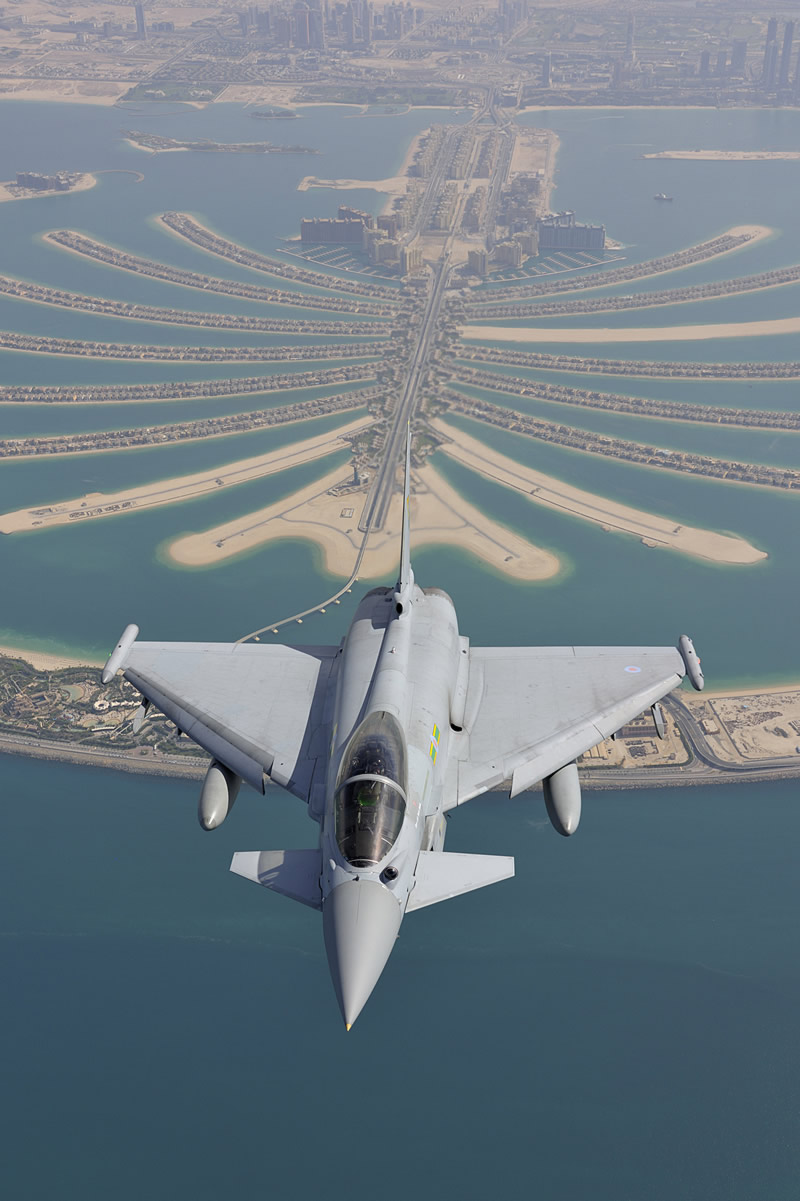
(click to view full)
Dec 20/11: Japan loss. Japan’s Ministry of Defense announces that Lockheed Martin’s F-35 Lightning II has won the F-X competitive bid process for 42 planes, beating the Eurofighter and Boeing’s F/A-18 Super Hornet International. As F-4 replacements, the F-35As will have an air defense role, but Japan does have a large cadre of dedicated F-15Js to perform that mission. Conclusion? Their undeclared role is as strike fighters.
Note that there’s still an F-XX program in the future, aimed at replacing Japan’s F-15Js. Numbers as high as 100+ planes have been floated, but that will depend on both economic straits, and local geopolitical threats. Read “Japan’s Next Fighters, From F-X Competition to F-35 Buys” for full coverage.
Japan loss
Nov 16/11: UAE. The UAE is either engaged in the mother of all hardball negotiations, or the potential Rafale sale is crashing. Critical comments at the highest levels are accompanying the invite to Eurofighter, strengthening the belief that the Typhoon is more than just a stalking horse to lower the French bid.
The question is, how big is the opportunity? Reports have surfaced that the UAE may be about to cut its planned new jet order, regardless of its choice, and buy more of its unique F-16E/F Block 60s. Read “Derailed Denouement in Dubai: What’s Up With the UAE’s Fighter Deal?” for a snapshot.
Nov 13/11: UAE. Flight International reports that the UAE must have liked their October briefings re: Eurofighter’s capabilities, because they’ve asked Eurofighter GmbH for an RFP bid to replace their current fleet of Mirage 2000-9s. The UAE has been in negotiations to buy Rafale planes for several years now, but hasn’t been able to clinch a deal.
It’s hard to tell if the UAE is just looking to add pressure and get a better price from Dassault, or if their interest is serious. One sign that they might be serious is the fact that they’ve also received classified technical briefings regarding the F-15E Strike Eagle and F/A-18 Super Hornet, but haven’t asked for RFP bids from the Americans. Flight International believes that this may be a prelude to consideration of the stealth-enhanced F-15SE Silent Eagle or F/A-18 Super Hornet International for the UAE’s planned 2018-2025 fighter modernization. The obvious 3rd contender there is Lockheed Martin’s F-35.
Nov 12/11: Eurofighter GmbH touts their Dubai flying display, complete with a graphic showing their impressive flight plan.
They also tout a range of technologies that they hadn’t advertised much before, including thrust-vectoring engine nozzles, an AESA radar, and MBDA’s Marte anti-ship missile. The release appears to blur the line between concepts/plans, and field-ready equipment.
Oct 21/11: Germany & Tranche 3B. Germany announces further defense cuts, which include a proviso that their Eurofighter orders will end at Tranche 3A, instead of adding another 37 planes in a Tranche 3B.
With Britain also saying that Tranche 3Ais the end, and the governments of Spain and Italy under severe financial strain, it appears less and less likely that there will be a Tranche 3B. The question is how to escape termination costs. Negotiations can be expected, but one option is to count future exports as re-sales of scheduled orders from existing partner countries. Aviation Week.
Aug 18/11: Sub-contractors. Finmeccanica’s SELEX Galileo contracts with BAE Systems Manufacturing at Hillend in Fife, in GBP 20+ million procurement and electronic manufacturing services contract related to Tranche 3A’s Captor radars. Work at the Hillend facility will run from 2011-2013.
BAE’s release adds that the facility has won over GBP 165 million in Captor and Typhoon DASS orders, over the last 12 years.
July 20/11: South Korea. As South Korea’s DAPA eases the criteria to try and foster more competition, DAPA’s Col. Wi Jong-seong says that “Russian aircraft manufacturer Sukhoi expressed its intent to compete in the fighter jet procurement project early this year.” The report quotes him as saying that Sukhoi’s T-50 PAK-FA will be up against Boeing’s stealth-enhanced F-15SE Silent Eagle, Lockheed Martin’s F-35 Lightning II, and the Eurofighter Typhoon. Assuming we don’t have an FX-II competition repeat, where all competitors but one drop out.
At this point, FX-III is being touted as a 60 jet buy of high-end fighters, with a budget of 8.29 trillion won ($7.86 billion). Eurofighter reportedly offered a better deal than the F-15K in F-X-2, but lost. The firm recently proposed to phase in Korean assembly for Phase III, with the 1st 10 made in Europe, the next 24 using Korean components, and the last 26 assembled in Korea. Korea Times.
June 27/11: Weapons. Diehl BGT and Israel’s RAFAEL unveil a new weapon for Eurofighter at the 2011 Paris Air Show. The PILUM long-range glide bomb concept has a range variously reported as 100-160 km/ 62 – 99.5 miles, but it’s a developmental weapon, so exact figures remain to be proven. PILUM uses RAFAEL Spice’s combination of GPS/INS and imaging infrared guidance, within Diehl’s HOSBO modular glide bomb system. HOSBO is a steamlined glide bomb that can carry a modular payload, including warheads of various sizes and types, even warheads designed to disrupt electronics. This JSOW Block III competitor will be able to attack defended targets, vehicles, ships, or even smaller targets. It will be integrated on Germany’s Tornado and Eurofighter aircraft. Will the Saudis, who fly both types, want any? Diehl BGT release | Jerusalem Post.
June 24/11: HMD. A Reuters report offers an update on progress with the Eurofighter’s BAE “Striker”/ HMSS helmet-mounted displays. HMDs are now considered a standard feature for fighter jets, as they’re required in order to take full advantage of new short range air-to-air missiles, and boost ground attack capabilities.
British RAF pilots tested the first helmets in summer 2010. So far, about 50 total helmets have been delivered to Italy, Germany, Spain and UK, at a delivery rate of about 8 per month, but none are being used over Libya. They’re expected to become operational in the RAF by the end of 2011.
June 22/11: AESA. After a year of preliminary industry funding, Eurofighter GmbH and Euroradar agree to continue development, and announce 2015 as the target date for entry into service of a Typhoon with the new “E-Scan” AESA radar. A later date wasn’t really feasible, given the delivery schedules involved in critical competitions like India’s M-MRCA. Indeed, even a 2015 date could be a disadvantage as the Eurofighter competes with France’s Rafale, which has begun testing its own RBE2-AA. The firm does say that:
“The new AESA array, larger than the ones available to our competitors thanks to the Typhoon’s voluminous radome, will be fitted on a repositioner that will provide a wider field of regard when compared to those installed or scheduled for introduction on other fighters. The new radar will offer customers the freedom to retrofit their existing Typhoons when required.”
E-Scan AESA date announced
June 20/11: Weapons. Eurofighter IPA1 has completed the first of a series of Meteor missile trials, beginning with safe separation across the flight envelope on the Aberporth range in Britain. Eurofighter GmbH.
May 17/11: Leadership. EADS Cassidian Spain has appointed 56 year old Luis Hernández Vozmediano as their new Head of the Eurofighter program. He has spent virtually his entire professional career at EADS, and has been heavily involved in Britain’s A330 Future Strategic Tanker Aircraft (FSTA), and the related American KC-X pursuit. Eurofighter GmbH.
May 11/11: Turkey. Eurofighter has courted Turkey for a long time, despite Turkey’s political & industrial commitment to the F-35 program. Hurriyet reports growing interest in a fighter split-buy, to reduce dependence on the USA.
Naturally, Italy’s government is pushing Turkey to solve that problem by joining the Eurofighter consortium. Turkey might also pick a hi-low approach, and join South Korea and Indonesia in KF-X instead. The real wild card? Turkey’s current account deficit is hitting levels that worry some observers. High levels have been predictors of Turkish economic crises in the past.
April 27/11: India. Fulfilling long-standing rumors that it had gained a leading position in India’s M-MRCA future fighter competition, Eurofighter is confirmed as one of 2 finalists, alongside Dassault’s Rafale. Read “India’s M-MRCA Fighter Competition” for full coverage.
April 2011: Weapons. EADS Cassidian Spain achieves the first 1,000 pound EGBU-16 Enhanced Paveway II precision guided munition release. The EGBU-16 is the selected dual mode bomb for Germany, Spain and Italy, whereas the locally-developed Paveway IV is the dual mode choice for the UK. Eurofighter GmbH.
March 7/11: Weapons. The first ever Eurofighter release of a Paveway IV dual guidance bomb takes place from development aircraft IPA6, in an hour long test flight over the Aberporth Range in Wales. BAE Systems | Eurofighter GmbH, incl photo.
March 10/11: Indonesia? The Times reports that more of Britain’s fighters could be leaving the force, if Indonesia’s interest in up to 24 Typhoons pans out. That could be politically challenging, though. Britain has led the way into attacks on Libya for bombing its civilians, but Indonesia has used its BAE Hawk light attack jets against its own insurgencies, and in East Timor. That triggered a defense export ban 12 years ago. Indonesia continues to operate a large fleet of Hawk jets, but it has since filled its high end air superiority slot with a handful of Sukhoi’s SU-27/30 Flanker family fighters – a cheaper choice with similar capabilities.
The UK MoD says it has “no current plans” to export Typhoons to Indonesia, but that means little to nothing when the statement is carefully parsed. If Indonesia really is interested in adding Typhoons, one option might be to re-export 24 RAF Tranche 1 aircraft that haven’t been given precision ground attack modifications. The Times [subscription-only] | Agence France Presse | The Guardian | UPI.
March 2/11: Britain’s reluctance to invest in additional Typhoon fighters is partly explained by the findings of an NAO report, which notes that:
“The cost of the Typhoon project has risen substantially. Despite the MOD’s now buying 72 fewer aircraft (down from 232 to 160, a reduction of 30 per cent), the forecast development and production cost has risen by 20 per cent to [GBP] 20.2 billion. This is a 75 per cent increase in the unit cost of each aircraft. The cost of supporting each aircraft has also risen by a third above that originally expected. The MOD now estimates that, by the time the aircraft leaves service, some [GBP] 37 billion will have been spent.”
There are concerns that the report might affect the jet’s chances in India. Meanwhile, a report in The Register highlights the importance of paying attention to Tranche buy totals, in an atmosphere of declining budgets. Note that the retirement of the RAF’s Tranche 1 jets will happen long before they reach their service life design limits, raising the possibility of resale:
“Probably the most dismal figure we are given is that the RAF will actually put into service just 107 Typhoons. At the moment it has received 70: the last of the 160 planes ordered by the UK will be delivered in 2015. But, we are told, “by 2019” all the Tranche 1 jets (which were still being delivered to the RAF at the start of 2008) will be “retired” – that is, thrown away. We’ll pay for 160 jets (actually we’ll pay for 232), but we’ll only ever get a fleet of 107.”
UK NAO report
March 2/11: During high level visits, British officials continue to press the case for the Eurofighter as Japan’s future F-X fighter, over offerings from Boeing (F/A-18E/F Super Hornet or F-15SE Silent Eagle) or Lockheed Martin (F-35A/B/C). One interesting wrinkle is that reconnaissance capabilities could become an important requirement, a move that would give the F-35 family an edge. BAE et. al. are fighting an uphill fight, but they’re not alone: in January 2011, the European Business Council in Japan launched a defense and security committee to promote defense-related business cooperation. Asahi Shimbun | Japan Times | L.A. Times.

(click to view full)
Feb 21/11: Aero India 2011 sees Eurofighter and BAE unveil an interesting wrinkle: an initial design for a navalized Eurofighter than can operate from aircraft carriers, based on an internally-funded set of studies and simulations. In a direct nod to potential Indian sales, they tout the plane as being able to take off from “ski jump” carriers without catapults – a design that describes all of India’s current and planned carriers, as well as the initial design for Britain’s own Queen Elizabeth Class.
Eurofighter GmbH describes the goal as 95% commonality with land-based aircraft, and required changes as “limited… include a new, stronger landing gear, a modified arrestor hook and localised strengthening on some fuselage sections near the landing gear, as well as updates the EJ200 engines,” which could include thrust-vectoring in flight.
India is currently planning to use MiG-29Ks as its naval fighters, but it’s currently the type’s only customer, and the Typhoon is seen as a leading contender in its M-MRCA competition for land based aircraft. Britain is planning to use the F-35C from its future carrier, but further cost increases or delays for the multinational program could open an opportunity for a jet type that the RAF already flies. Eurofighter GmbH.
Naval concept unveiled
Feb 4/11: Bulgaria RFI. Bulgaria issues another fighter replacement RFI, soliciting information from Boeing (F/A-18E/F), Dassault (Rafale, Mirage 2000), EADS (Eurofighter), Lockheed Martin (F-16), and Saab (JAS-39 Gripen) re: 8 new and/or second-hand fighter jets, to replace its existing fleet of 12 MiG-21s.
Bulgaria issued a similar RFI in 2006, for 20 jets, but the global economic crash, and Bulgaria’s own issues in trying to pay for past defense purchases, forced a hold. The Defense Ministry has taken pains to emphasize that this is just an exploratory request, and is not the start of a purchase tender. Nevertheless, November 2010 saw the formation of a National Steering Committee and an Integrated Project Team, to draft preliminary fighter replacement operational, technical, and tactical requirements. That followed October 2010 remarks by Bulgaria’s Defense Minister Anyu Angelov, who discussed spending BGN 1 billion (around $725 million) for the purchase of an uncertain number of new fighter jets to replace its MiG-21s, while modernizing its fleet of 16 MiG-29A air superiority jets. Sofia News Agency.
Feb 3/11: Upgrades. The first Spanish single-seat instrumented production aircraft version 4 (IPA4) completes 500 hours of flight at the EADS Cassidian Spain facility at Getafe, near Madrid. After a functional upgrade from its original Tranche 1 air superiority standard to Tranche 2, this aircraft is testing new technology including a Link-16 MIDS system, as well as integration trials and the launching of precision air-to-ground weapons.
The UK has already upgraded a number of its Eurofighters along similar lines, and added advanced LITENING targeting pods. Eurofighter GmbH believes that this Spanish IPA4 platform may serve as a model for the possible upgrade of the Tranche 1 fleets currently in service with Eurofighter customer nations. That’s the good news. The bad news is that an upgrade program of this type may also be seen as an alternative to ordering the final Tranche 3B set of Eurofighters. Eurofighter GmbH.
Jan 28/11: Sub-contractors. Premium AEROTEC’s Varel, Germany plant has successfully started assembling structural components for the Eurofighter. EADS Cassidian announces that Varel’s first 3/2b Eurofighter fuselage section, a 3m section that mates with the wings, has been delivered to the Augsburg plant, where the entire fuselage center section will be assembled.
Premium AEROTEC is a spin-off of the former Airbus sites in Nordenham and Varel and the former EADS site in Augsburg. It began operations on Jan 1/09, and in addition to various Airbus passenger aircraft components, it manufactures the fuselage center section for all Eurofighter aircraft, including the 4 program partners (United Kingdom, Spain, Italy and Germany) and export customers Austria and Saudi Arabia. This makes Premium AEROTEC GmbH, with over 6,000 employees and 2009 revenues of EUR 1.1 billion, the largest supplier of structures for the Eurofighter. The company has production plants in Augsburg, Bremen, Nordenham and Varel in Germany; and in Ghimbav, Brasov County, Romania. Premium AEROTEC | EADS Cassidian.
Jan 25/11: Eurofighter GmbH’s CEO sees 2011 as a pivotal year, in order to avoid the end of production in 2015. India’s M-MRCA competition, and hopes of a Tranche 3B from its consortium countries, are the key underpinnings.
Britain has been very clear that there will be no Tranche 3B buy there, and the austerity programs underway (voluntarily or otherwise) in Germany, Italy, and Spain make a Tranche 3B buy extremely unlikely.

(click to view full)
Jan 25/11: Eurofighter GmbH announces that the multinational operational fleet of Eurofighter Typhoons in service since the second half of 2003 achieved 100,000 flying hours in January 2011.
As aircraft are delivered and air forces declared their Typhoons to be operational, usage has accelerated. The first 5,000 flying hours was achieved by November 2005, and 10,000 hours was reached in August 2006. May 2007 included the 20,000 hour milestone, and by August 2008 the Typhoon had surpassed 50,000 hours. According to the firm, global operational fleets currently have more than 260 aircraft in service, with 6 squadrons in the UK (4 in Coningsby, 1 in Leuchars and 1 in Mount Pleasant, Falkland Islands); 4 squadrons in Italy (2 in Grosseto and 2 in Gioia del Colle); 3 squadrons in Germany (Laage, Neuburg and Nörvenich), as well as 1 each in Spain, Austria and in the Kingdom of Saudi Arabia.
At present, all 148 Tranche 1 aircraft have been delivered, and Tranche 2 production is in full swing.
100,000 fleet flight hours
Jan 4/11: HMD. BAE announces that its “Helmet Mounted Symbology System” (HMSS) is scheduled to enter service with the RAF in 2011, giving Britain’s Eurofighters the same helmet mounted sighting capability already enjoyed by pilots of competing aircraft, via systems like the Israeli/American JHMCS.
The HMSS does add some advanced wrinkles. A Eurofighter pilot can now look at multiple targets, lock-on to them, and prioritize them by voice-command. This will work even for targets over the shoulder, or targets picked up by the radar but located underneath the aircraft.
HMD at last
2009 – 2010
EUR 9 billion Tranche 3A deal; Tranche 3A sub-system contracts; Tranche 3B offer on table; Private work toward a “CAPTOR-E” AESA radar.

(click to view full)
Oct 5/10: Sub-contractors. Finmeccanica subsidiary SELEX Galileo announces a EUR 242 million (about $333.5 million) contract for 88 Captor-M mechanically scanned phased array radars, as part of the Eurofighter Typhoon Tranche 3A buy. Deliveries would begin in 2012.
The CAPTOR-M is the Eurofighter’ standard radar. Contracts are in progress to develop and field new CAPTOR-E Active Electronically Scanned Array radars for future buys or retrofits, vid. the July 20/10 entry. SELEX Galileo [PDF] | Defense News.
Sept 7/10: Sub-contractors. Finmeccanica subsidiary SELEX Galileo announces [PDF] a EUR 400 million sub-contract from BAE Systems, to supply Tranche 3A fighters with the Praetorian Defensive Aids Sub System (DASS), delivered to the same standard as the Tranche 2 fighters. SELEX Galileo leads the EuroDASS Consortium of Elettronica, Indra Sistemas, EADS and SELEX Galileo, which shares the production of more than 20 major Line Replaceable Items (LRIs) that make up the system. First deliveries are expected in mid-2012.
The Praetorian DASS includes Electronic Support Measures (ESM) to find hostile radars, active Electronic Counter Measures (ECM) to confuse them, and Missile Approach Warning (MAW) systems, tied into an array of defensive subsystems that include chaff, flares, and towed decoy options.
Aug 19/10: Sub-contractors. Northrop Grumman announces a contract from EADS Military Air Systems business unit to deliver 88 inertial measurement units (IMU) for Tranche 3A of the Eurofighter Typhoon. The IMU system is the sole sensor which measures the motion of the aircraft and continuously provides motion data to the flight control computer. In a secondary function, the IMU provides backup navigation data.
The IMUs, which provide motion data for the aircraft, will be built by the company’s German navigation systems subsidiary, Northrop Grumman LITEF, which also provided IMUs for Tranche 1 and Tranche 2 of the aircraft. More than 400 Northrop Grumman LITEF IMUs have been delivered and are already in service on Eurofighters in Germany, Spain, Italy, United Kingdom, Austria and Saudi Arabia
July 20/10: AESA. Eurofighter GmbH and Euroradar announce that they have begun full scale development of an Active Electronically Scanned Array (AESA) radar to serve in the Eurofighter, with a target in-service date of 2015. The Eurofighter/Euroradar groups have been conducting preliminary AESA development and flight testing since 2007, and Selex Galileo is already working towards integrating an AESA array with the UK’s Eurofighter (vid. Feb 19/10 entry).
Full-scale development of a CAPTOR AESA successor is a new step that could become a factor in Tranche 3B discussions, or later 3A upgrades. Still, SELEX Galileo CEO Steve Mogford says move represents a standalone offer, and is not linked to the proposed Tranche 3B production phase. The Euroradar consortium has reportedly proposed retaining as much “back-end” CAPTOR equipment as possible, as part of delivering the proposed E-Captor AESA system. The consortium also plans to make CAPTOR-E a mechanically scanned AESA radar, rather than mounting it in a fixed position as American fighters have done. This will expand the AESA radar’s slightly narrower cone, and also make it easier for the aircraft to use “launch and break away” tactics against aerial opponents that are beyond visual range. Eurofighter GmbH | Flight International | Microwave Journal.
June 9/10: Tranche 3B offer. At the ILA Air Show in Berlin, Germany, Reuters relays word from a Eurofighter GmbH spokesman that it has submitted a Tranche 3B offer to the partner nations for 124 more Eurofighters, finishing the planned Tranche 3. Defense industry sources at the Berlin Air Show said the offer was around EUR 10 billion.
To date, Britain, Germany, Italy and Spain have so far taken delivery of a combined 222 Eurofighter Typhoons, out of 473 ordered. Eurofighter says a production decision is needed within a year, in order to avoid the beginning of a supplier shutdown and a production gap. The member countries will face a choice between declining defense budgets, versus the likely need to pay some cancellation costs if there is no Tranche 3B.
Feb 19/10: Finmeccanica subsidiary SELEX Galileo announces [PDF] a GBP 19 million contract from Britain’s defense ministry to install a first of type, multi-function, wide field of regard AESA radar on a British Eurofighter as a technology demonstration program.
The AESA TDP will focus on Day/Night All Weather targeting, high resolution Synthetic Aperture Radar (SAR), air to air targeting, and communications. It’s designed to raise the technology readiness levels of the enabling hardware, de-risk the capability and demonstrate maturity of concept. Following ground and antenna range testing, the radar is planned to fly on a Royal Air Force Typhoon around 2013.

(click to view full)
July 31/09: NETMA (NATO Eurofighter and Tornado Management Agency), Eurofighter Jagdflugzeug GmbH and EUROJET Turbo GmbH signed the Tranche 3A contract, a EUR 9 billion (about $12.96 billion) order for 112 aircraft and 241 EJ200 engines (224 engines to equip 112 planes, plus 17 spares). This new contract also sets the baseline for subsequent support contracts.
BAE cites a work value of GBP 2 billion (EUR 2.35 billion), Finmeccanica cites EUR 3 billion worth of work from Tranche 3A, divided between subsidiaries in Italy (EUR 1.6 billion) and the UK (EUR 1.4 billion). Rolls Royce values its 37% share in the EUROJET order at GBP 300 million (EUR 352 million). The EJ200 includes advanced integrated Health Monitoring, and is already supported by availability-based contracting terms. Eurofighter GmbH | UK MoD | BAE Systems | EADS | Finmeccanica | Rolls Royce | BBC | Deutsche Welle | Financial Times | Hamburg Local | Reuters says last buy for Britain | London Telegraph | Times Online | UPI Asia.
Tranche 3A
Additional Readings
Readers with corrections or information to contribute are encouraged to contact editor Joe Katzman. We understand the industry – you will only be publicly recognized if you tell us that it’s OK to do so.
* Eurofighter GmbH. Official site.
* SELEX Galileo – CAPTOR-M radar [PDF].
* Eurofighter GmbH – Eurofighter Typhoon Helmet. Includes Quicktime video.
Official Reports
* German Bundesrechnunghof (April 30/14) – Press release [in German] | Eurofighter summary, incl. link to full report: 2013 Bemerkungen – Weitere Prufungsergebnisse – Nr. 09 “Kostentransparenz beim EUROFIGHTER herstellen [in German] | Full Report: Langfassung der Bemerkung Nr. 09 [PDF, in German].
* UK National Audit Office (March 2/11) – Management of the Typhoon Project. See also The Register.
News & Views
* The Aviationist (Feb 11/13) – No way an F-35 will ever match a Typhoon fighter jet in aerial combat.
* The Aviationist (Dec 10/12) – How does the F-16 perform against its adversaries in dogfight? “….above FL100 the Typhoon becomes quite difficult to beat since its superior aerodynamics give the Eurofighter can out maneuver the Viper at every engagement.”
* Smithsonian Air & Space (May 21/12) – Under the Eurofighter’s Hood: Europe’s frontline fighter is a marvel of technology.
* Aviation Week Ares (March 1/10) – JSF – Mid Year Check. Includes a detailed anecdote covering serious aerodynamic issues with the Typhoon, which delayed its entry into service until 2005, when its automatic low-speed recovery system was qualified.
* Defense et Securite Internationale (May 2006) – Rafale et Typhoon: Les Europeens auraient-ils tort d’avoir… raison? [PDF, in French].
Other Eurofighter Contracts
* DID – The 2006 Saudi Shopping Spree: Eurofighter Flies Off With Saudi Contract.
* DID – Eurofighter’s Rough Ride in Austria.
* DID – UK’s Eurofighters Fly To Availability-Based Contracting .
* DID – Spain’s Moron Maintenance: EUR 150M to EADS for Typhoons.
* DID – Eurofighter GmbH Signs EUR 600M+, 5-year Support Contract for Italy.
* DID – BAE Wins Big PBL Support Contracts for European & Saudi Eurofighters.
* DID (July 5/05) – $1.5B for Eurofighter Electronic Warfare Suite. Part of Tranche 2 production.
tag: typhoonfocus, eurofighterfocus