

(click to view full)
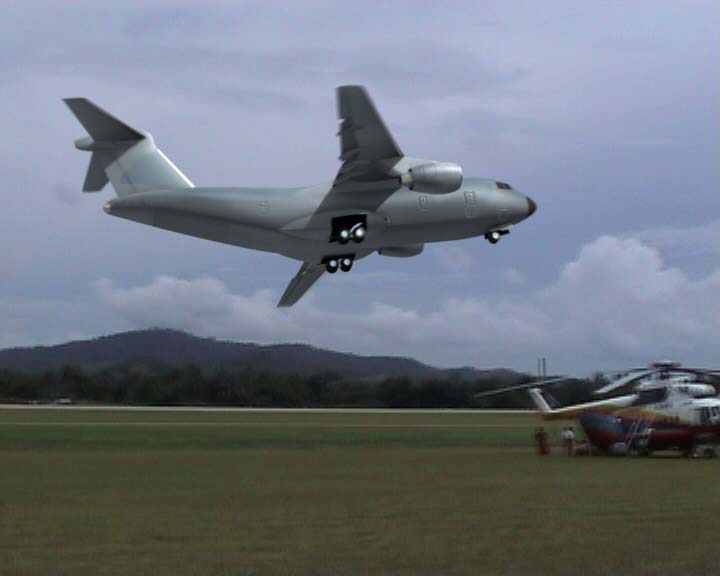
In late December 2006, Hindustan Aeronautics (HAL) announced a $700-million joint venture (JV) agreement with Irkut Corporation of Russia for manufacturing 60-tonne multi-role transport aircraft (MRTA). Under this 50/50 arrangement with HAL, Ilyushin Design Bureau of Russia would design the MRTA (now MTA) and Irkut corporation of Russia will develop the aircraft, while series production would be taken up by the transport aircraft division of HAL at Kanpur. Irkut is a major investor (40% of project expenses), and will be the coordinator of the Russian side. For HAL, the move is part of an effort to forge new partnerships with global aviation majors for military and civil projects, with an eye on trebling their annual turnover to $3 billion by 2011.
The project has moved very slowly, even as competitors like the C-130J gained traction around the world, including in India, and future rivals like the KC-390 began picking up international partners. Now, a joint venture is supposed to get underway to build 145 aircraft for its initial customers in Russia and India.
MRTA/ MTA and the Per-Ton Price Constant

(click to view full)
Early illustrations showed a jet aircraft whose requirements produce a design somewhat reminiscent of the canceled 1970s US AMST Program that eventually led to the much larger C-17. It remains to be seen whether the design that is finalized several years from now maintains that similarity.
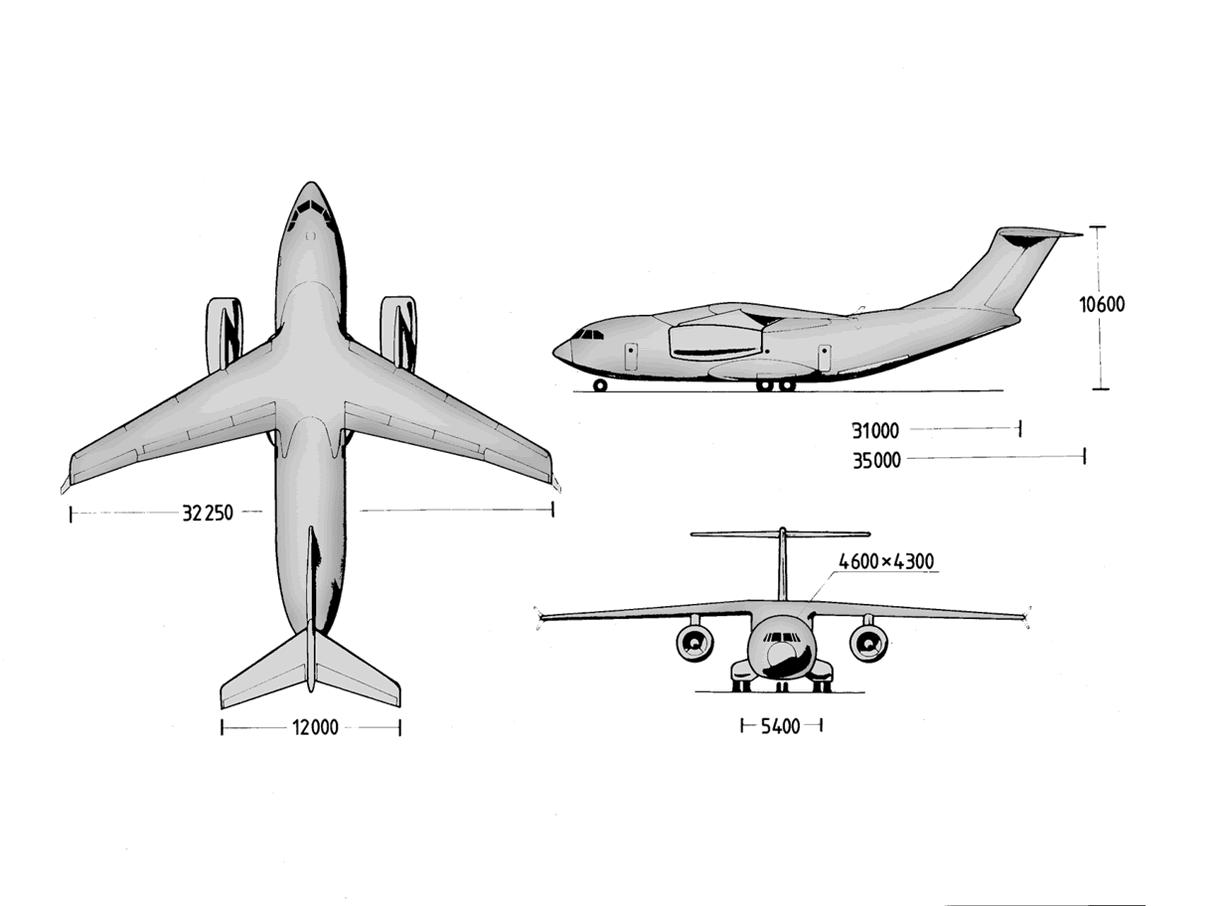
UAC gives the plane’s wingspan as 39.4m, slightly shorter than its 39.7m length. The T-Tail will reach a height of 12.51m. A pair of Russian PD-14M 2-shaft turboshaft engines will generate 34,400 pounds of thrust each, giving the maximum 68t plane a 0.46 thrust:weight ratio at maximum load. That’s supposed to help the design take off from paved or unpaved airfields at 3,300m / 10,800 feet above sea level. Cruise speed is projected to be faster than turboprop competitors at 800 km/h, or about 497 mph.
Maximum load is expected to be 18-20t, and range at maximum load is published as 2,000 km/ 1,242 miles. At more normal load-outs of around 12t, range is expected to be 4,700 km/ 2,920 miles. It’s designed for an in-flight refueling probe and system, but that’s considered an optional item for customers.
(click to view full)
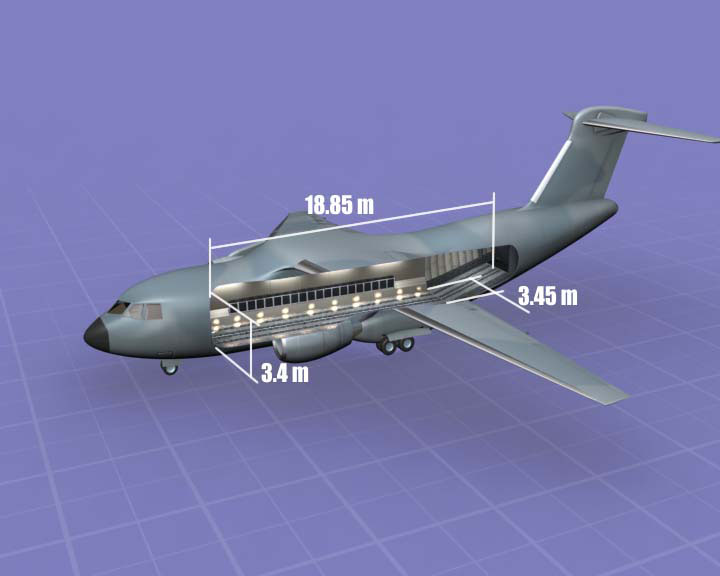
MTA cargo dimensions are listed as 14m long x 3.45m high x 3.4m wide, giving the pressurized cargo compartment a cross-section that’s the same as the larger 4-engine IL-76MD. The cargo hold is being sized to carry up to 140 troops in ferry mode, 90 paratroops for combat deployment, or 70 (crowded) medical evacuation patients. For cargo loads, a wire system of compulsory parachute opening, delimiters and spoilers is used to assist airdrops, and a 12-degree cargo ramp angle allows roll-off cargo deployment.
UAC expects to include open architecture avionics in the glass (digital) cockpit, which will include 6 LCD displays and Head Up Displays for the pilot and co-pilot. A pilot-navigator will round out the crew, though many modern aircraft cargo have eliminated that position.
UAC hopes to eventually develop a number of variants, but that will depend on the aircraft’s final performance, and on enough sales to generate either surplus cash or government patronage. The AN-12 it’s designed to replace was modified for other roles, and UAC hopes to one day field MTA aerial tankers, AWACS, Maritime patrol, Search And Rescue, Airborne communication relay, and Electronic jamming aircraft based on this airframe.
The first flight of the MTA was planned for 2016, but waiting for 2012 to begin serious design has pushed that back to 2017, with serial production is expected to begin in 2019.
MRTA/ MTA and the Per-Ton Price Constant

(click to view full)
Ultimately, however, the plane’s fate may well rest on whether it can break the per-ton price constant in the military market. Consider:
The Alenia/CMAS C-27J Spartan has a 12-ton capacity and costs about $35-40 million per plane. Lockheed’s C-130J Hercules carries 20 tons and costs about $65 million. the Airbus A400M is projected to carry 35-37 tons and cost about $120-150 million. At the high end, the 80-85 ton capacity C-17 Globemaster III sells for about $200-240 million. That appears to give us something approaching a per-ton constant for Western fixed-wing military transports that can carry tactical vehicles: around $3 million per ton.
Beyond the 20-ton target market of AN-12 and C-130 owners, Irkut also envisions this new plane as an attractive option for customers of the much smaller An-26. If they wish to realize that ambition, and some of their broader goals as well, the first question boils down to this:
Can Irkut and HAL offer an ICAO-certifiable military transport with modern avionics near a C-27J’s price range, with a C-130J’s performance and some short field ability?
If so, they may have a winner with good global prospects. If not, India and Russia will have a new transport, and both countries’ aviation industries will still derive some benefits from the program. Irkut claims that the Indian Air Force plans to acquire 45 of these aircraft, and they also see market demand in Russia’s military and civil sectors for another 100 transport aircraft within 12 years of introduction.

(click to view full)
The plane’s next big question is whether it can be delivered in time.
The first production planes were expected to enter service between 2015-2020, but it took almost 6 years from the initial 2006 announcement just to sign the first design contract. Between the end of 2006 through 2012, Brazil turned its jet-powered KC-390 into an international project, with participation and strong interest from Argentina, Chile, Colombia, the Czech Republic, Portugal, South Africa, and even France. Lockheed Martin has also been busy, signing C-130J contracts with Canada, Iraq, Israel, Kuwait, Mexico, Norway, Oman, Qatar, South Korea, Tunisia – and India.
At the other end of the market, China brought its modernized Y-9 turboprop into service around the same time that India and Russia finally signed the MTA’s 1st development contract, and can still offer low-cost AN-12/Y-8s to the global market.
If MTA development continues to be governed by India’s slow pace and lack of urgency, large segments of the global market will be locked up before the MTA is ever fielded.
MTA: Contracts and Key Events
Multirole Transport Aircraft Ltd (MTAL) is a 50/50 joint venture between Hindustan Aeronautics Ltd. and Russia’s United Aircraft Corporation — Transport Aircraft (UAC-TA), with Rosoboronexport as the intermediary.
HAL’s Aircraft R&D Centre (ARDC) at Bangalore will serve as a design resource, while its Transport Aircraft Division (TAD) at Kanpur will manufacture the prototypes and eventually build production aircraft. HAL’s other R&D Centres and manufacturing Divisions will share development of systems and electronic LRUs, and manufacture some components, sub-assemblies and composite structures.
2010 – 2012
(click to view full)
Dec 4/12: Welcome to winter, tovarisch. HAL’s 31 engineers began work today in Moscow, at the JSC “UAC-Transport Aircraft” facility. Most of the Russian engineers are Ilyushin experts, and HAL’s crew is expected to stay in Moscow for 10 months.
UAC’s release seems to put a conservative spin on desired performance, with a capacity of just 15-20 tonnes alongside its 800 km/h cruising speed, and 2,500 – 2,700 km range. The formal product page lists a firm 20t target, but it will be a few years before the answer is clear. The MTA is expected to perform its maiden flight in 2017, and serial production is expected to begin in 2019.
Oct 12/12: Contract. The MTA’s principals finally sign its Preliminary Design Phase (PDP) contract. It gives HAL and UAC-TA the go-ahead to start 10 months of preliminary design work in Moscow, including a team of 30 HAL designers who will co-locate with UAC-TA.
Note that completing the PDP phase won’t finalize the design. That will require another Detail Design Phase (DDP) contract, and if it’s held up by negotiations, the MTA will slip even farther from its market window.
The Hindu reported that Defence Minister A.K. Antony had expressed concerns over project delays, and other media reports alleged that India might back out unless an agreement was reached soon. During the 6 years wasted by this partnership before beginning serious MTA development, Embraer’s KC-390 has racked up a number of customers, and C-130J adoption has continued apace. Unless design & development shows much more urgency, the MTA may already be too far behind to achieve much market penetration by the time it’s available to the global market. HAL | UAC | The Hindu | India’s PTI | Russia’s RIA Novosti | Flight International | Russia & India Report (op-ed).
Preliminary Design contract
Feb 27/11: LiveFist’s Shiv Aroor offers concept pictures of the MRTA, including planned interior and exterior dimensions.
Sept 9/10: A shareholders agreement is signed to set up the MRTA’s joint venture company, between India’s Hindustan Aeronautics Limited (HAL), Russia’s United Aircraft Corporation (UAC), & Russia’s Rosoboronexport arms export agency.
India’s defense ministry pegs the total development cost at around US $ 600.7 million (approx. Rs. 2900 crore), to be equally shared by both the sides. The joint venture will be based in Bangalore, India, and aims to produce 205 aircraft (45 India, 100 Russia, 60 hoped-for exports), with 50:50 work share between HAL and the Russian partners. India MoD | India’s Business Standard | India’s Economic Times | India’s financial Express | Times of India | UAE’s Emirates News Agency.
Joint Venture set up
2006 – 2009

(click to view full)
Oct 9/09: The Indian Ministry of Defence issues a release regarding the 9th meeting of the Russia-India Inter-Governmental Commission on Military-Technical Cooperation on Oct 14-15/09:
“Both sides will also review the progress on the MTA, on which the Inter-Governmental Agreement had been signed during the visit of Dr Manmohan Singh’s to Moscow in November 2007. Both sides have been discussing the formation of the Joint Venture company which would execute the project involving design, development and production of the Medium Transport Aircraft in the 15-20 tonne class to meet the requirements of the Russian and Indian Armed Forces. Both sides are likely to conclude the Agreement to form the JVC shortly. “
Aug 21/09: The Indian government’s DDI News reports that India and Russia are expected to sign the MRTA contract deal during Defence Minister A K Antony’s September 2009 Moscow visit [DID: later moved to October]. HAL General Manager V. Balakrishnan told DDI that the Russian government has cleared the formalities for the creation of 50-50 JV, and Prime Minister Vladimir Putin has allocated funds for financing Russia’s share.
Balakrishnan is also quoted as saying that the IAF is interested in buying about 40 aircraft, while the Russian air force has confirmed its readiness to buy 100 planes. DDI News | Daily India.
Aug 3/09: In an official reply to a Parliamentary question, India’s Ministry of Defense states:
“An Inter Government Agreement (IGA) between Government of India and Government of Russian Federation was signed for formation of Joint Venture (JV) in November 2007 to develop a new Multirole Transport Aircraft (MTA) for Defence Sector with Hindustan Aeronautics Limited (HAL) as the Indian Partner. A preliminary project report prepared in 2006 envisaging a development cost of USD 600 million for a transport aircraft of weight class 20 tons. It is expected that commencement of production of the aircraft will take seven to eight years from ‘Go Ahead’ sanction.”
While the government agreement exists, the formal contract and go ahead have yet to be announced. If 7-8 years is the timeline thereafter, the program launch date is already past 2015. Meanwhile, Brazil’s Embraer intends to have its KC-390 competitor available by 2015, and Lockheed Martin is gaining traction with its C-130J around the world – including India.
Feb 12/09: The Times of India quotes Russian UAC President and Chairman Alexey I. Fedorov during his Aero India 2009 visit. Federov says that that India and Russia will establish the MRTA joint venture “in the next few months.”
The cost is now listed at $600 million, and Russia will reportedly identify its participants in the next few weeks. Consolidation has brought most of Russia’s aerospace firms under the United Aircraft Corporation banner.
April 23/08: In an official release, India’s Ministry of Defence says:
“Government proposes to relax the Foreign Direct Investment cap of 26 per cent in defence sector to facilitate co-development of multi-role transport aircraft by Hindustan Aeronautics. The matter is under process to get approval of the competent authority.”
It is unclear whether this foreign investment ceiling is being relaxed more generally, or just for this specific project; the latter interpretation appears to be more likely.
November 2007: IGA formally signed. Inter Government Agreement (IGA) signed between Russia and India to develop a new Multirole Transport Aircraft (MTA). Source.
December 2006: Hindustan Aeronautics (HAL) announces a $700-million joint venture (JV) agreement with Irkut Corporation of Russia for manufacturing 60-tonne multi-role transport aircraft (MRTA). Under this 50/50 arrangement with HAL, Ilyushin Design Bureau of Russia will design the MRTA and Irkut corporation of Russia will develop the aircraft, while series production would be taken up by the transport aircraft division of HAL at Kanpur.
Irkut is a major investor (40% of project expenses), and will be the coordinator of the Russian side. For HAL, the move is part of an effort to forge new partnerships with global aviation majors for military and civil projects, with an eye on trebling their annual turnover to $3 billion by 2011. Economic Times of India report | The Hindu report
Initial agreement
Additional Readings
* UAC – Multirole Transport Aircraft (MTA), Medium Cargo Capacity. Also known as MTS in Russia. Supersedes Irkut’s previous profile.
* DID – C-17s for India. Provides heavy airlift of up to 84 tons, far above the C-130J-30 or MRTA.
* DID – India Buys 6-12 C-130J-30 Hercules for Special Forces. That contract could also expand. The C-130J has carved out a strong special forces niche, and is available immediately.
* DID – India Refurbishing its AN-32 Transport Fleet. Light tactical transports, one level below the C-130J-30s and MRTA.
* DID Spotlight – A400M Delays Creating Contract Controversies. 2015 would appear to be crunch time for the global market, as several entries plan to debut. The A400M is likely to debut in 2013, but clearing its order backlog will take several years.
* DID – Embraer Launches KC-390 Tactical Air Transport Program. Now a multinational effort. This 21t capacity twin-jet airlifter will compete in the replacement C-130 market too, along with the Lockheed Martin C-130J, China’s Yunshun AN-12 derivative, the MRTA, and of course the Airbus A400M as a higher capacity option.
* Forecast International (Feb 3/11) – A400M, KC-390 Will Reshape Transport Market
* DID – The C-130J: New Hercules & Old Bottlenecks. Lockheed Martin’s C-130 will remain a strong competitor as well.
* SinoDefense – Yun-9 Multipurpose Transport Aircraft
* Chinese Military Review Blog (October 2012) – Chinese Yun-9 (Y-9) Military Transport Aircraft Operational With PLAAF