

(click to view full)
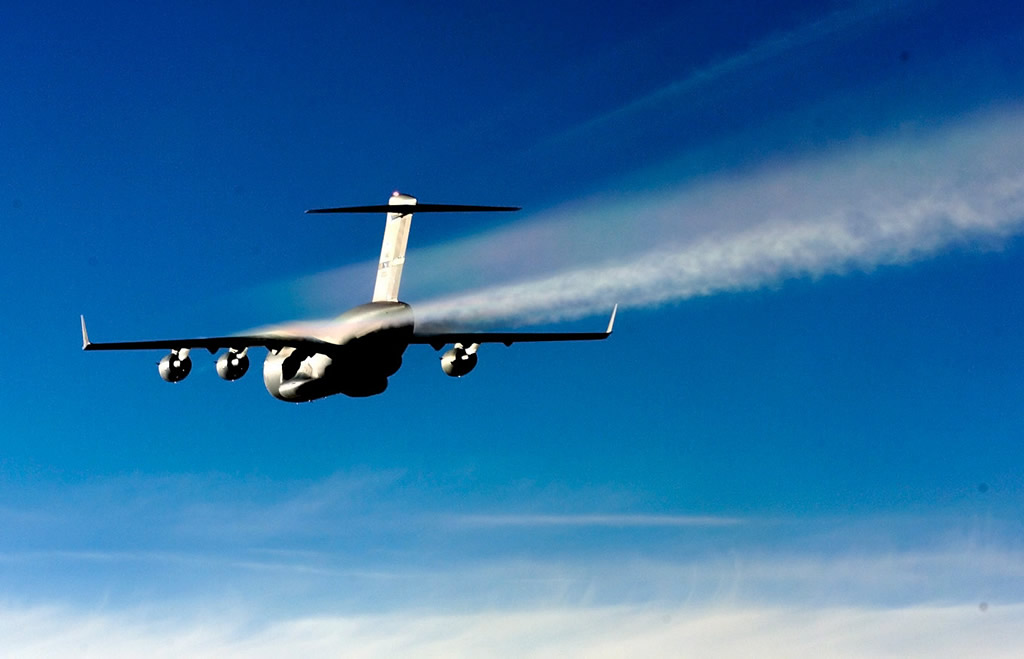
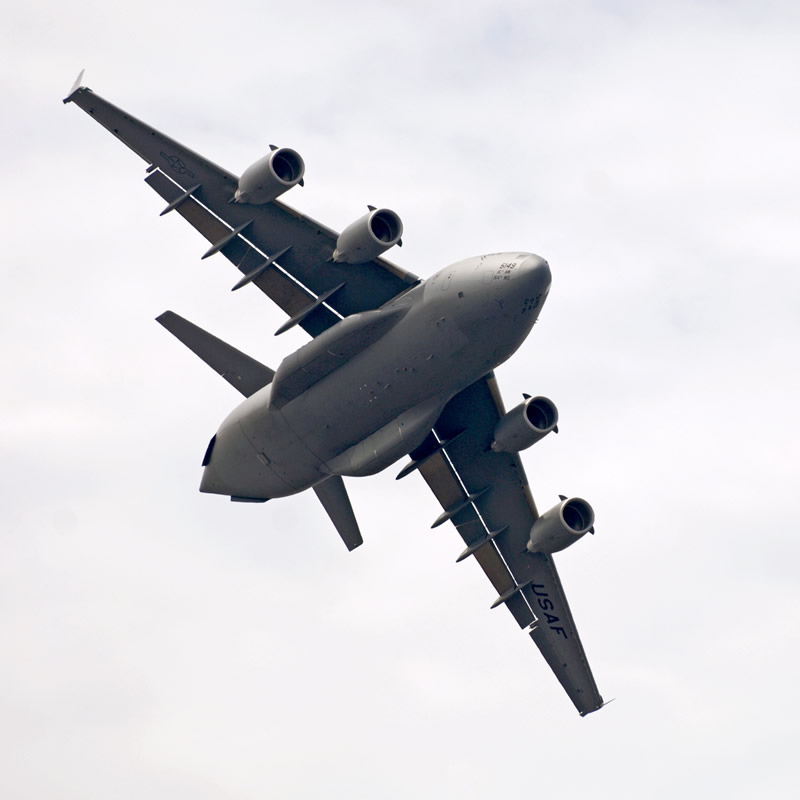
The C-17 has had more money-driven last hurrahs than The Who. Even so, FY 2010 featured the USAF’s last planned orders of C-17 Globemaster III short field, heavy-lift transport jets.
The Pentagon had been trying to end the program for years, but 3 factors led Congress to keep adding new C-17s to the budget, year after year: (1) deep doubts about the premises, pre-9/11 vintage, and quality of the Pentagon’s mobility studies; (2) uncertainty concerning the C-5 Galaxy super-heavy transport’s upgrade programs; and (3) a fleet wear tempo much higher than originally forecast, driven by constant requests from theater for C-17s.
All things end, and there were no new C-17s bought in the FY 2011 or FY 2012 budgets. That would leave the USA with a total ordered fleet of 223, once they’re all under contract. At long last, they are.
Contracts & Key Events, 2009 – Present
(click to view full)
Final USAF C-17 purchases, by year, are 15 in FY 2008, 8 in FY 2009, and 10 in FY 2010. Foreign orders have kept the production line alive, and in 2012, a single C-17 was ordered to replace an aircraft that had been destroyed. Order placement may not conform exactly, depending on the progress and timing of negotiations. Those numbers, coupled with greater certainty in the cut-down C-5 upgrade program, and a looming budget crises in the USA, make it likely that the end has finally come. Enhancements and maintenance will continue to attract significant budgets, but USAF production will end. In response, Boeing is throttling back annual C-17 production. In order to keep the C-17 production line and sales cycle alive, they’ll have to depend on foreign orders from export customers like the UAE, India, etc., orders for a civilian transport version to provide outsize cargo and/or remote equipment delivery, or some other contingency.
The expected total of 223 USAF C-17s sits just above the program’s original goal of 210 planes, which may be a fortunate thing. The Global War on Terror created very heavy demand for C-17s, resulting in increased flying hours that are wearing out the fleet early. Adding additional aircraft will help the fleet as a whole last longer, by distributing flight hours across more planes. At the same time, US vehicle programs continue to exceed the weight limit of lesser transports, ensuring robust future demand.
Unless otherwise noted, Boeing Defense, Space and Security’s Global Mobility Systems unit in Long Beach, CA executes the contracts, which are issued by by the 516th AESG/PK at Wright-Patterson Air Force Base, OH. Note that separate contracts exist for F117 engines, and for other “government furnished equipment” that is part of the final, operational aircraft.

(click to view full)
October 14/24: Boeing won a $24.5 million contract for C-17 Globemaster III Global Enhancements. This contract provides for studies and quick reaction tasks, integrated software and hardware upgrades, and other required services. Work will be performed at Edwards Air Force Base, California, and is expected to be completed by December 1, 2031. This contract was a sole source acquisition.
February 7/24: The 3rd Airlift Squadron (AS) of the 436th Airlift Wing has successfully concluded trials of a novel C-17 Globemaster III combat offload procedure dubbed “Method C,” marking a potential leap forward in cargo delivery efficiency and safety. This innovative technique eliminates the need for traditional forklifts or other ground vehicles, utilizing a system of rollers and conveyor belts to safely transfer palletized cargo from the aircraft directly to the ground. Prioritizing safety, Method C significantly reduces the drop height of cargo pallets compared to the standard offload method. This minimizes the risk of damage to sensitive equipment or supplies, a crucial concern for military operations. Additionally, the system enhances safety for ground personnel by eliminating the need for them to operate near the aft ramp during offload, a potential hazard zone.
December 27/23: NATO The US State Department has made a determination approving a possible Foreign Military Sale to the NATO Support and Procurement Agency of C-17 Maintenance and related equipment for an estimated cost of $150 million. NATO Support and Procurement Agency as Lead Nation has requested to buy contractor logistics support for the C-17 Strategic Airlift Capability program; US Government and contractor engineering, technical, and logistics support services; and other related elements of logistics and program support. The estimated total cost is $150 million.
July 21/22: UAE The US State Department approved a possible Foreign Military Sale to the Government of the United Arab Emirates of C-17 Aircraft Sustainment and related equipment for an estimated cost of $980.4 million. The Government of the United Arab Emirates (UAE) has requested to buy follow-on sustainment and support of C-17 fleet to include aircraft hardware and software modifications and support; Joint Mission Planning System (JMPS) software; classified software support for Electronic Warfare (EW) self-protection; aircraft and engine support equipment, components, consumables, spare parts and repair/return; publications and technical documentation; heavy maintenance support; participation in the C-17 Virtual Fleet for Total System Sustainment (TSS) contractor logistics support and Material Improvement Program (MIP); other U.S. Government and contractor engineering, technical, and logistical support services; and other related elements of program support.
September 29/21: Sustainment Boeing won a $3.5 billion deal for the C-17 Globemaster III Sustainment Program. The contract will provide support and sustainment services to the government product support manager/product support integrator for the C-17 weapon system. The contract involves Foreign Military Sales (FMS) to the United Kingdom, Australia, Canada, NATO Airlift Management Program Office, India, Kuwait, United Arab Emirates and Qatar. Support includes: program management; sustaining logistics; material and equipment management; sustaining engineering; quality assurance; depot level aircraft maintenance and modifications; F117 propulsion system management; long-term sustainment planning; field services, unique foreign military customer services and Air Logistics Center partnering support for the worldwide fleet of the C-17 aircraft. Estimated completion date is May 30, 2031.
July 12/21: Plugin This summer, the C-17 scheduling tool, called Puckboard, is getting an AI plugin that will help to optimize crew resources and automate the scheduling process. Develop by a team from the air force, the MIT Department of Aeronautics and Astronautics, and MIT Lincoln Laboratory, the software can quickly adapt to schedule changes and plan up to six months ahead.
December 3/20: Canada Canada will receive new equipment for its Royal Canadian Air Force C-17 transport planes, the US government announced. The DoS approved the upcoming sale that is estimated to cost $275 million and the US Congress has been notified of the proposed deal. The Canadian government “has requested to buy C-17 sustainment support to include aircraft hardware and software modification and support; software delivery and support; ground handling equipment; component, parts and accessories; GPS receivers; alternative mission equipment; publications and technical documentation; contractor logistics support and Globemaster III Sustainment Program participation”, according to the US announcement. The deal will also include US government and contractor engineering, technical, and logistical support services; and related elements of program and logistical support.
October 26/20: Emergency Landing A US Air Force C-17 had to make an emergency landing with its nose gear up on October 18 in Afghanistan. US Forces in Afghanistan spokesman Army Col. Sonny Leggett confirmed the incident. A video, taken from a car driving by the runway, shows the C-17 landing on its rear landing gear and then easing its nose down as it slows to a stop, with sparks streaking from its fuselage. Pictures of the C-17 on the ground after the emergency landing show the markings of the 62nd and 446th airlift wings at Joint Base Lewis-McChord in Washington.
September 28/20: UK The US State Department has approved a potential $401.3 million deal with the UK for C-17 aircraft logistics support. The request includes “aircraft component spare and repair parts; accessories; publications and technical documentation; software and software support; US Government and contractor engineering, technical and logistical support services; and other related elements of logistical and program support” for its C-17s. Boeing will be the prime contractor.
September 15/20: ADS-B Out A C-17 assigned to Altus Air Force Base, which is the final aircraft of its type in service with the US Air Force, received the ADS-B Out equipment. All fifty-five C-17s received the modifications at Robins Air Force Base during their scheduled Program Depot Maintenance. “The ADS-B Out is a newer type of broadcast system that provides precise position and location information of an aircraft in real time to air traffic control,” said Anthony Scott, Avionics supervisor in the 562nd Aircraft Maintenance Squadron.
August 11/20: Lebanon A US Air Force C-17 delivered pallets of food and water to Beirut, Lebanon after the explosions at a local warehouse that lead to at least 220 deaths and 7,000 injuries. Personnel from the 379th Air Expeditionary Win, Air Mobility Command’s 8th Expeditionary Air Mobility Squadron and 816th Expeditionary Airlift Squadron on Al Udeid Air Base, and the Area Support Group Qatar from Camp As Sayliyah worked to palletize food, water and medical supplies delivered to Beirut later that day.
March 17/20: UK Aid To Syria The UK Government has sent aid to the Turkey-Syria border, which it says will provide much-needed relief and protection for Syrians amid the worsening humanitarian crisis in Idlib. A Royal Air Force C-17 Globemaster III strategic airlifter carrying 37 tonnes of UK aid landed in Hayat on March 11. The supplies on board include tents to provide life-saving shelter, hygiene kits, blankets, water purification tablets, cooking equipment and lanterns for around 300 families who have been forced to flee their homes and seek safety in harsh conditions. The aid supplies are being distributed in the worst affected areas including Idlib in north west Syria, with the cooperation of the Turkish Red Crescent. The UK is one of the largest bilateral donors to the Syria crisis, providing more than £3.1 billion to trusted partners in Syria and the region since 2011.
December 31/19: Simulator Training Boeing won a $9.5 million for C-17 simulator training supporting North Atlantic Treaty Organization (NATO) partners. This modification increases the ceiling of the indefinite-delivery/indefinite-quantity contract from the previously awarded amount of $9,500,000 to $18,000,000. The C-17 Globemaster III is a premier transport aircraft. The massive, sturdy, long-haul aircraft can carry large combat equipment, troops and humanitarian aid across long distances in all weather conditions. Work will take place in the UK and is expected to be finished by December 31, 2021.
July 29/19: India The US approved an FMS worth $670 million to support India’s C-17 military transport aircraft. The decision in this regard comes after a recent Indian request to buy equipment for C-17 follow-on support, to include spares and repair parts, support equipment, and personnel training and training equipment among others. The C-17 Globemaster III is a high-wing, 4-engine, T-tailed military-transport aircraft, the multi-service C-17 can carry large equipment, supplies and troops directly to small airfields in harsh terrain anywhere in the world day or night.
June 3/19: Aircraft Engine Ground Handling Trailer The US Air Force awarded D&D Machinery a $8.9 million contract for the C-17 Globemaster program. The deal is for the Aircraft Engine Ground Handling Trailer, which is required to incorporate I-beam rails to interface with the rollers on the engine cradle. The C-17 is a high-wing, four-engine, T-tailed transport aircraft, that can carry large equipment, supplies and troops directly to small airfields in harsh terrain. The US Air Force ordered its last C-17 in 2010. In 2012, a single C-17 was ordered to replace an aircraft that had been destroyed. The estimated total cost over the lifetime of the aircraft’s program is $328 million to $368 million. Work under the contract will take place in San Antonio, Texas and has a scheduled completion date of September 18, 2023.
November 1/18: Refueling Upgrade The Air Force is upgrading the refuelling system for its C-17 Globemaster III short field, heavy-lift transport jets. Bodell Construction will construct the refueling hydrants and ramp expansion at a cost of $20.3 million. A hydrant system is a loop of pipeline located under the aircraft parking ramp that delivers fuel straight from the hydrant fuel tanks to the aircraft. A mobile pantograph allows for continuous fuel delivery to aircraft within 135 feet of a hydrant pit. With the hydrant system about 420 gallons a minute can be transferred to the C-17, which reduces the overall refueling time by half, compared to the current truck refueling method. Work will be performed in Charlotte, North Carolina and is expected to be completed by December 2020.
April 03/18: A long time coming! Boeing has been awarded a contract for the provision of one C-17 aircraft in support of the Indian government. The contract is valued at $262 million. India almost lost out on the deal in November 2017 due to New Delhi’s agonisingly long procurement process. In 2015, the Indian Air Force (IAF) approved the purchase of three C-17s to add to its current fleet of 10. Currently the C-17 production line and sales cycle is heavily depended on foreign orders from export customers like the UAE, India and others. Work will be performed in San Antonio, Texas and is scheduled for completion by August 2019.
March 13/18 New HUD A three week test period of a Replacement Head-Up Display (RHUD) for the C-17 Globemaster III has just wrapped up at Edwards Air Force Base. During the testing, the 418th Flight Test Squadron’s C-17 Integrated Test Team partnered with pilots from Air Mobility Command Test and Evaluation Squadron Detachment 3 and operational pilots from Travis Air Force Base to collect test data from the ground and in the air. Designed by Elbit Systems of America, the new HUD is larger and has more clarity of symbology than the obsolete Legacy HUD and is designed to be installed and removed easier for maintenance and includes other enhancements.
November 14/17: India is in danger of losing out on purchasing the last available C-17 Globemaster heavy transport aircraft as New Delhi’s agonisingly long procurement process may see manufacturer Boeing offer the aircraft to someone else. In 2015, the Indian Air Force (IAF) approved the purchase of three C-17s to add to its current fleet of ten, but with the Globemaster’s production line already shut down, Boeing only had one remaining to sell. But New Delhi has so far failed to send the formal Letter of Acceptance (LoA) required as part of the Foreign Military Sales (FMS) process and instead are looking to request an extension of the deadline to next year, thus pushing the completion of the procurement process further down the line. As a result, Washington could rescind the offer and instead look at other interested parties.
June 28/17: The US State Department has cleared the possible sale of one C-17 transport aircraft to India. Valued at an estimated $366 million, the package also includes 4 Turbofan F-117-PW-100 engines, a missile warning system, a countermeasures dispensing system and an identification friend or foe transponder. Offsets usually requested by New Delhi’s ‘Make in India’ initiative will be negotiated between both India and lead contractor Boeing.
April 23/17: Canada is to receive a C-17 Globemaster III sustainment package after the US State Department approved the potential foreign military sale. Valued at a possible $195 million, the deal will support five C-17s operated by Canada including tasks such as in-country field services, maintenance and technical support, spares and additional equipment. Boeing will act as lead contractor with support to be provided by Lockheed Martin.
March 13/17: The USAF has announced that it has used a quadcopter to conduct a maintenance inspection of the exterior of a C-17 aircraft. Conducted at Edwards Air Force Base, the 412th Test Wing’s Emerging Technologies Combined Test Force (CTF) conducted three sorties with the mini-UAV and it worked so well it allowed the ground crew to sign off on their preflight external inspection of the aircraft. It’s expected that use of such drones will help cut the inspection time from 45-60 minutes to just minutes. The test comes under the CTF’s task to provide agile, innovative flight test capabilities for emerging technologies and to explore the USAF’s future warfighting capabilities.
January 25/17: Besides Trident, the UK has been unsurprisingly cleared to receive continued C-17 logistics support services, and equipment from the US. Valued at an estimated cost of $400 million, provisions in the contract include continued support for eight RAF C-17 Globemaster transport aircraft once the previous deal expires in September.
February 25/16: C-17 transport aircraft used by the UAE military are to be fitted with infrared countermeasure systems in a program that could cost up to $225 million. The provision of AN/AAQ-24(V)N Large Aircraft Infrared Countermeasures (LAIRCM) equipment, and logistics support was approved by the US State Department as a Foreign Military Sale. Eight C-17s will receive a LAIRCM system which includes three Guardian Laser Transmitter Assemblies (GLTA), six Ultra-Violet Missile Warning System (UVMWS) Sensors AN/AAR-54, and one LAIRCM System Processor Replacement (LSPR).
December 1/15: Boeing has finished production of the final C-17 Globemaster III aircraft and it will make its way to Qatar next year. The completion of the plane will see the Long Beach plant close at a loss of 400 jobs. Since its inception in 1991, 279 Globemasters have been produced at the California facility, but lack of international demand for the plane has rendered keeping the plant open financially unfeasible. C-17 fleets are currently operational in UK, Canada, Qatar and Australia.
April 27/15: Boeing took a flyer and privately financed the production of 10 C-17A Globemasters. With a series of Commonwealth countries expressing interest, five are still left unsold.
Sept 12/13: Era ending. Boeing delivers the USAF’s 223rd and last C-17A Globemaster III, which flies off to its assignment at Joint Base Charleston, SC. It marks the end of an era that began with the C-17’s 1st flight, on Sept 15/91.
In a follow-on release, Boeing says that C-17 production for all customers will end in 2015, with the closure of the Long Beach, CA assembly line after the last 22 C-17s are delivered. It’s possible that a couple of additional orders might materialize, but that’s not enough. As Boeing Defense, Space & Security President Dennis Muilenburg put it:
“Our customers around the world face very tough budget environments. While the desire for the C-17’s capabilities is high, budgets cannot support additional purchases in the timing required to keep the production line open…”
Boeing will take a charge of < $100 million this quarter, and expects to begin the layoff process in 2014 for nearly 3,000 employees in Long Beach, CA; Macon, GA; Mesa, AZ; and St. Louis, MO. They had throttled back production to try and keep the line open for foreign sales, but the number of customers with the budget to buy them was always limited, and so was the amount of extra time those orders could give the production line. Sources: Boeing video feature | Boeing releases, Sept 12 and Sept 15/13.
Final USAF delivery, Plant shutdown announcement
June 19/12: One more. Boeing receives a $169.8 million firm-fixed-price contract for 1 USAF C-17A replacement aircraft. Boeing has confirmed that this contract is for the USAF.
It is needed to replace the C-17 lost in the 2010 accident, but the contract doesn’t include important “government-furnished” items like engines (another $35-38 million), military communications and defensive systems, etc. See the February 2011 entry for average C-17 costs.
Work will be performed in Long Beach, CA, and will be complete by May 23/13. The ASC/WLMK at Wright-Patterson AFB, OH manages the contract (FA8614-06-D-2006, DO 0010).
+1 C-17
Jan 23/12: Finis. Boeing in Long Beach, CA receives a $693.4 million firm-fixed-price contract modification to delivery order (DO) 0006, for 5 more USAF C-17s. DO 0006 is noted on May 16/11, and bought the 1st 5 aircraft of the USAF’s FY 2010 order. This agreement and contract is confirmed as closing the books on USAF C-17 production, by bringing the order to its expected 10.
+5 C-17s
Work will be performed in Long Beach, CA, and is expected to be complete by March 20/13. The ASC/WLMK at Wright-Patterson AFB, OH manages the contract (FA8614-06-D-2006, DO 000603).
May 16/11: A $962.5 million firm-fixed-price delivery order against the basic C-17 production contract, for 5 of the FY 2010 C-17A aircraft. At this time, $471.6 million has been committed.
Boeing representatives said that a contract for the other 5 is expected later in 2011 (FA8614-06-D-2006, DO 0006).
+5 C-17s
February 2011: According to the USAF’s FY 2012 budget documents [PDF], flyaway costs for the last set of FY 2010 C-17s is around $193 million each, rising to a full operational cost per aircraft of about $256 million once spares, site support, training, etc. are also factored in.
All planned USAF orders (incl. FY 2010) and existing export orders would see the C-17 production line end at the end of November 2012, with the USAF taking the final delivery. [Addendum: A subsequent order from Australia pushes this to the end of December 2012.]
Jan 20/11: Boeing announces the 2nd phase of C-17 Program Production Rate and Work Force Reductions. 1,100 employees cut, 900 in Long Beach, CA, as production drops from its high-water mark of 15 C-17s per year down to 10 per year.
Boeing hopes to keep the line open longer this way. The tradeoff is added fixed costs from running the line for more years, vs. the potential for new orders each extra year the line is still running. Recent experience with export orders shows latent demand around the globe, and once the C-17 line stops, strategic airlift options will shrink to rented Russian/Ukrainian AN-124s, or the medium-heavy lift Airbus A400M.
[youtube:v=VBwMJUOFmlM]
…people aren’t
(click for video)
July 28/10: Crash. A USAF C-17A (tail number 00-0173) crashes at Elmendorf AFB, Alaska, killing all 4 crew aboard. The crew were preparing for Elmendorf’s Arctic Thunder Air Show, which went ahead on July 31/10. The crash is attributed to pilot error.
Crash
June 22/10: A $1.5 billion contract modification to buy 8 more C-17 aircraft for the USAF. At this time, $734.4 million has already been committed (FA8614-06-D-2006).
February 2010: Budgets. The USAF’s FY 2011 budget submission [PDF] gives an average C-17 flyaway cost to date of around $201 million over the entire program, rising to a full “weapon system cost” of $267.5 million once required spares and support are also factored in. Despite this, it also notes that:
“The FY2010 appropriation of $2.5B “for the procurement of ten C-17 aircraft, associated spares, support equipment and training equipment as required” is not sufficient for this requirement. Shortfall estimated at $530M.”
These 10 aircraft would push total USAF buys to 223. That’s 13 more than the original program goal of 210, and far more than the 180 plane fleet the USAF would have had without Congressional intervention. On the other hand, the 223 were built over a longer manufacturing time frame than originally planned, and in the face of a fleet whose first C-17s are going to be retiring early due to heavy usage.
Feb 6/09: FY 2009. A firm-fixed-price contract to McDonnell Douglas Corporation of Long Beach, CA for an amount not to exceed $2.95 billion. This is an unfinalized contract to buy 15 more C-17A Globemaster III strategic transport aircraft in FY 2009, and separate contracts can be expected for engines and government furnished equipment that is part of the final, operational plane. At this time, $114.6 million has been committed. Wright-Patterson Air Force Base, OH will manage the contract (FA8614-06-D-2006).
Budgets to the end of FY 2008 would bring the American fleet to 205 aircraft, and the FY 2009 budget calls for 8 more.
+15 C-17s
Additional Readings
* DID – The Global C-17 Sustainment Partnership. After they’re produced, a maintenance partnership with Boeing takes over. That work will continue.
* DID – C-17 Post-Production: The Long Goodbye. Close-out funding to store the production equipment, data, etc. when the line shuts.
* DID – C-17 Production Line Out of Time?
* OC180 News (Aug 10/09) – Round 7 in the Fight for the Boeing C-17 Production Line and Its 5,000 Long Beach Jobs–a Continuing Monday Morning series
* Reuters (Jan 20/09) – Obama renews pledge to invest in military. There are rumors that the C-17 will be green-lighted again, but they prove to be untrue. The administration continues to fight new C-17 appropriations, using a series of escalating threats.
* DID (May 8/08) – C-17A, F-22A May Get Reprieves from Congress
* DID – Interactive: C-5s vs. C-17s in Washington
* DID – Airbus A400M Aerial Transport: Delays and Development
* DID – NATO’s AN-124s: A Russian Solution to the Airlift Problem… And More?