


(click to view full)
The rising cost of maintenance has made it a greater concern to the world’s militaries, and new contract vehicles are reflecting that. Under the C-17 GSP/GISP, Boeing has total system support responsibility for the big transport aircraft, including materiel management and depot maintenance, to support customer fleets around the world. The goal is total aircraft sustainment support under a single contract, in order to achieve improvements in mission readiness, while reducing operating and support costs.
While the C-17 may have limited production time in its future, the C-17 GSP is likely to continue for many years. The initial C-17 GSP contract has grown and broadened, even as Boeing’s customer base grew in the USAF (now 223), Australia (6), Britain (8), Canada (4), India (10-16), Qatar (4), NATO (3), the UAE (6) – and possibly Kuwait (1).
This in-depth, public-access DII Spotlight Article offers key statistics for the C-17A, explains the Globemaster III Sustainment Partnership’s (GSP) components, and details its contracts.
The C-17 Globemaster III

(click to view full)
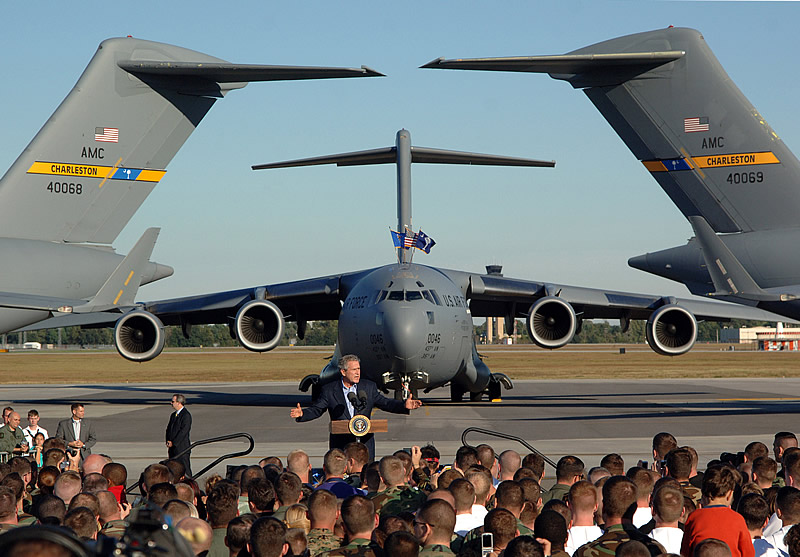
The C-17 Globemaster III remains the backbone of US Air Mobility Command inter-theater transport efforts around the world, and its ability to operate from shorter and rougher runways has made it especially useful during the Global War on Terror. Various fleet upgrades (including LAIRCM defensive systems) continue – along with heavy usage that is accumulating fatigue hours far faster than originally planned. The USA is trying to cap production at 205 planes (though the House has inserted 3 more, and the Senate 10 more, in the FY 2010 bill), but a fierce fight has now preserved the program for several years beyond the Pentagon’s planned phase-out.
Boeing’s C-17 replaced the USA’s C-141 Starlifter fleet, which was worn out early by the flying hours demanded of it. It has more payload capacity than the C-141, but less than the super-giant C-5 Galaxy. Fortunately, the C-17 has far more modern systems than the C-5, giving it a much higher base mission readiness rate. In order to keep things that way, the C-17 Sustainment Partnership involves Boeing in a partnership arrangement based on set availability and performance metrics. The C-17 GSP is part of Boeing’s Integrated Logistics Services.
The C-17 made its maiden flight on 15 September 1991, and the first production model was delivered to Charleston AFB, South Carolina, 14 June 1993. Officials sent the first squadron of C-17s, the 17th Airlift Squadron, declaring the 17th operationally ready on 17 January 1995. Robins Air Force Base notes that:
“The C-17 measures 174 feet long (53 meters) with a wingspan of 169 feet, 10 inches (51.75 meters). The aircraft powered by four, fully reversible, Federal Aviation Administration-certified F117-PW-100 engines (the military designation for the commercial Pratt & Whitney PW2040), currently used on the Boeing 757. Each engine is rated at 40,440 pounds of thrust. The thrust reversers direct the flow of air upward and forward to avoid ingestion of dust and debris. Maximum use has been made of commercial off-the-shelf (COTS) and commercial equipment including Air Force-standardized avionics. The aircraft is operated by a crew of three (pilot, copilot and loadmaster), reducing manpower requirements, risk exposure and long-term operating costs. Cargo is loaded onto the C-17 through a large aft door that accommodates military vehicles and palletized cargo. The C-17 can carry virtually all of the Army’s air-transportable equipment.

Maximum payload capacity of the C-17 is 170,900 pounds (77,519 kilograms), and its maximum gross takeoff weight is 585,000 pounds (265,352 kilograms). With a payload of 160,000 pounds (80 tons, or 72,575 kilograms) and an initial cruise altitude of 28,000 feet (8,534 meters), the C-17 has an un-refueled range of approximately 2,400 nautical miles.”
The C-17 can also airdrop 102 paratroopers and equipment, and its design allows it to operate through small, austere airfields. The C-17 can take off and land on runways as short as 3,000 feet (914 meters) and only 90 feet wide (27.4 meters). Even on such narrow runways, the C-17 can turn around using a three-point star turn and its backing capability. Its cruise speed is approximately 450 knots (0.74 Mach). Given the C-130 Hercules’ 20-ton limit, and the need for heavier vehicles in order to achieve survivability on the battlefield, the C-17s have been pressed into more extensive flying duties that include forward airfields as well as hubs. The result is a level of flight hours that remain above USAF projections, and are likely to continue doing so. Some estimates say the effect on the USA’s C-17 fleet will be to shorten the planes’ expected lifespan by 5 years.
The C-17 Globemaster III Sustainment Partnership
(click for story)
The original GSP made Boeing responsible for providing consistent sustainment support at continuously raised benchmarked levels. Product support was managed through a long term performance-based partnership between Boeing and its C-17 customers.
Boeing provides more than spares and repairs on the C-17 through the GSP program. Around the globe, Boeing employees oversee the supply chain and provide technical and engineering support in the field to Air Force maintainers. Boeing teammates work to keep C-17s available for warfighters and humanitarian relief missions. The company cemented its GSP role by establishing direct-sales partnership agreements with each of the three Air Logistics Centers (ALCs) at Robins Air Force Base, GA; Hill AFB, UT; and Tinker AFB, OK, to perform a variety of C-17 airframe and individual component repair actions. The arrangement allows Boeing to request an ALC to perform specific workloads as part of the public-private partnership arrangement. Personnel are also based at key locations like Ramstein, Germany, which will be the maintenance center for the new NATO fleet of C-17s.
In 2011, the C-17 Globemaster III Integrated Sustainment Program (GISP) began, with the USAF’s Air Logistics Center at Warner Robins AFB, GA replacing Boeing as the C-17 Product Support Integrator lead. Boeing still maintains a very significant role, however, in an expanded service partnership that includes the ALCs. Like the GSP, the GISP is also in effect for almost all of the C-17’s international operators. India, a GSP customer, is the lone exception.

The related Material Improvement Project (MIP) program is part of the Global Sustainment Partnership, and is based on estimated performance requirements for additional one-off engineering and retrofit requirements for the US fleet. This estimated annual program does not identify specific projects to be performed, just estimated aggregate requirements. The retrofit and upgrades are generally referred to by Block number.
For instance, GlobalSecurity.org notes that Block 13-14 has software modifications and improved station-keeping equipment used in flying formation with testing scheduled to be complete in 2004. Block 15 is planned to contain the upgraded on-board inert gas generating system along with navigation and safety modifications. Block 16 contains an avionics modernization package and a weather radar modification with testing to be complete in 2006. Additional enhancements, modifications, and corrections to existing deficiencies are concurrent and include a fuel system retrofit, main landing gear deficiency corrections, and a wheel brake and tire cost saving initiative.
In fiscal year 2005, the C-17 saw a sustained mission capability rate of 83.2%, while the worldwide launch departure reliability for 2005 was 95%. In FY 2006, the program resulted in a fleet-wide mission capable rate of 85.4%. That compares to figures for the USAF’s larger C-5 Galaxy strategic transports that have consistently hovered around 50%.
The C-17 PE/PI Program

(click to view full)
While the C-17’s exterior hasn’t really changed since they first began rolling off the production lines, a block upgrades to the fleet have added a host of improvements. As of the beginning of 2008, C-17 Block 17 aircraft are the current standard for new production and upgrades.
PE/PI (“peppy”) began in 1995, and stands for Producibility Enhancement/ Performance Improvement, and is a collaborative effort between Boeing and the U.S. Air Force. The USAF explains what they need, or would like to see, and Boeing responds with upgrade proposals. Over the years, the C-17 PE/PI program has developed enhanced combat survivability (e.g. LAIRCM IR missile jammers, armor shielding to protect flight crews from small arms fire, OBIGGS), navigation and communication upgrades, and special operations features (e.g. combat lighting to support nighttime and infra-red operations). Approximately $2 billion of PE/PI contracts have been issued to date.
The C-17 program has a 3 contract structure including production, PE/PI, and the GSP. There is a clear distinction between monies for the 3 contracts, but in practice they’re all connected. Once an improvement project completes its PE/PI cycle, it is incorporated into block upgrades for scheduled deployment to the fleet: as a GSP/ Material Improvement Program (MIP) retrofit, or as a new-plane install on the production line.
Contracts and Key Events, FY 2004-Present

(click to view full)
The related Material Improvement Project (MIP) program, described above, was established under contract FA8614-04-C-2004, order PO 0037.
Unless otherwise specified, all contracts are issued by the Headquarters Aeronautical Systems Center at Wright-Patterson Air Force Base, OH, to Boeing subsidiary McDonnell Douglas in Long Beach, CA. Note that this list of contracts, while extensive, is not certified to be 100% complete. 2006 onward is likely complete; 2005 and earlier may not be.
FY 2014
(click to view full)
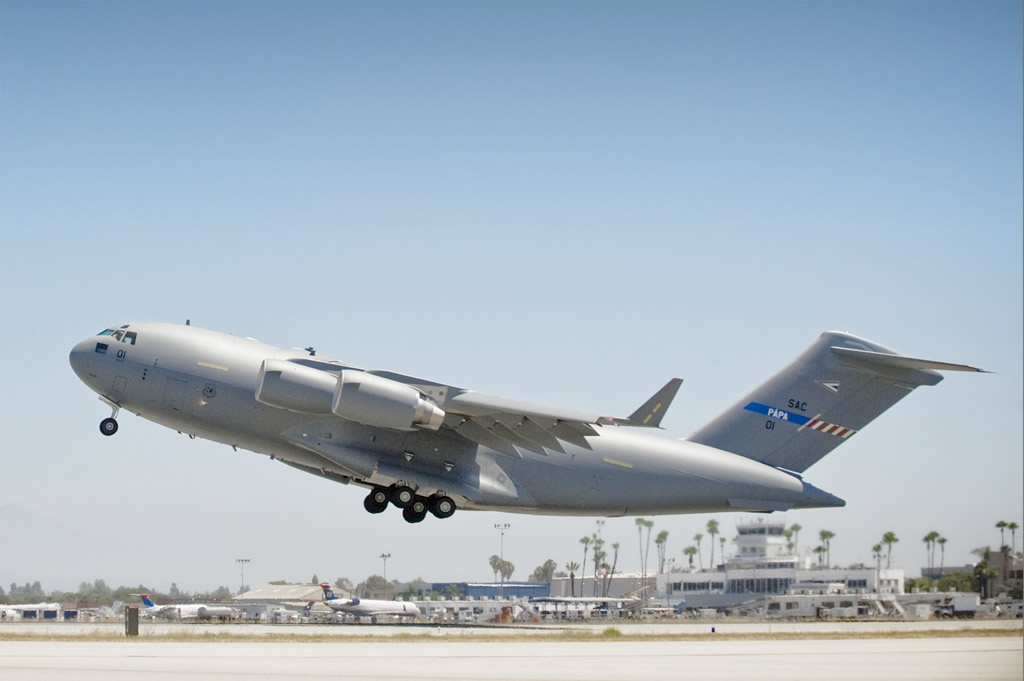
July 3/14: UK. The US DSCA announces Britain’s official export request for continued participation in the USAF/Boeing Globemaster III Sustainment Partnership. The estimated cost is $250 million for the UK’s fleet of 8, but the release doesn’t explain the time frame. Based on past contracts of this type, it’s likely to be a 3-year contract.
Boeing in Long Beach, CA remains the principal contractor, and implementation won’t require any additional US government or contractor representatives in Britain. Sources: DSCA #14-29, “United Kingdom – Globemaster III Sustainment Partnership”.
DSCA: UK request
FY 2012 – 2013

(click to view full)
Dec 28/12: Upgrades. An $895 million cost-plus-incentive-fee, cost-plus-fixed-fee, firm-fixed-price, fixed-price incentive-fee and cost-reimbursement contract for upgrades to the C-17 Globemaster III fleet. Over the next 9 years or so, these upgrades will include integrated software, hardware upgrades and development efforts.
Work will be performed in Long Beach, CA, and is expected to be complete by Dec 27/22 (FA8614-13-D-2002, 0001).
9-year upgrades contract
Dec 18/12: Bagram bang-up Boeing has confirmed this effort as part of the GISP:
“When a massive C-17 Globemaster III skidded off of a snowy runway in Afghanistan earlier this year, no one was certain the airplane could be saved. Not only did the accident severely damage the underbelly and landing gear, but it left the runway unusable. Nine months later, through extreme weather and constant concern for safety, a Boeing crew flew the temporarily repaired C-17 back to Boeing’s Long Beach Depot Center in California for permanent repairs… Boeing will begin extensive, permanent repairs to the C-17 that are expected to be completed in 22 months.”
Nov 29/12: Infrastructure. Pratt and Whitney in East Hartford, CT receives a $9 million firm-fixed-price contract for hardware and services related to increasing the repair capacity of the F117-PW-100 Heavy Maintenance Center at Tinker AFB, OK. Work is expected to be complete by March 29/14. The AFSC/PZIMA at Tinker AFB, OK manages the contract (FA8100-13-C-0004).
Oct 10/12: GISP, 2013-2017. Boeing announces a $2 billion contract from the U.S. Department of Defense, under the GISP umbrella, covering American use from FY 2013 through 2017. Boeing.
GISP 2013-2017
Oct 10/12: Vortex surfing. USAF Air Mobility Command announces “vortex surfing” flight tests with C-17s flying in formation. It’s found in nature, and the V-shaped migration flights of geese show its drag reducing, energy-saving effect at work. So does many a NASCAR race. The test continues work started last decade by NASA and Boeing on Autonomous Formation Flight, and would make for a very interesting MIP if things get that far. Airframe stress, ride quality, and safety will be the big concerns.
Researchers from Stanford pitched a similar idea to Airbus 3 years ago. So far, it seems to have translated into a CGI concept… with a 2050 horizon. USAF AMC | MIT lecture [PDF] re: Autonomous Formation Flight.
Nov 30/11: Reward. Boeing And the USAF Warner Robins Air Logistics Center’s Globemaster division receive the Best Logistics Strategy award at the annual Defense Logistics Awards ceremony in Arlington, TX. Boeing.
Nov 10/11: A $17.8 million fixed-price-award-fee contract modification for total system support responsibility for the C-17. As the contract number indicates, this one is settling the business of a past contract, rather than being part of the new GISP.
The Aerospace Sustainment Directorate (WR-ALC/GR) of Robins AFB, GA manages the contract (FA8614-04-C-2004, PO 0555).

(click to view full)
Oct 3/11: New GISP. Boeing in Huntington Beach, CA receive a maximum $11.75 billion indefinite-delivery/ indefinite-quantity contract for the C-17 Globemaster III Integrated Sustainment Program (GISP). Discussions with Boeing explain the major shift underway. In January 2010, the USAF approved a 10-year Justification and Approval (J&A) request for Boeing to provide continued, sole source lifecycle support to the C-17 fleet from FY 2012 through 2021. This is that contract. It switches from GSP to GISP because it’s a partnership with the USAF, one that brings their depots into the arrangement.
About $1.175 billion of this contract will be managed by the USAF as a Foreign Military Sales agent for Australia, Britain, Canada (“CC-177”), NATO Strategic Airlift Capability, Qatar, and the United Arab Emirates. The missing C-17 customer is India, who signed their own long-term deal for their initial fleet of 10 planes (vid. Sept 27/11).
The Product Support Integrator lead role will actually transition to the Warner Robins Air Logistics Center (ALC), GA, but Boeing will maintain a significant role for both domestic and international customers. Support shall include, but not be limited to: program management; sustaining logistics; material and equipment management; sustaining engineering; quality assurance; depot level aircraft maintenance and modifications; F117 jet engine management (the engines are bought separately from the planes); long-term sustainment (LTS) planning; field services, unique foreign military customer services, and Air Logistics Center Partnering Support. The level of support required will be outlined in individual task orders, which will spend from this pool of funds, up to the maximum. The Aerospace Sustainment Directorate Contracting Section at Robins AFB, GA manages this contract, and acts as the FMS agent (FA8526-12-D-0001).
Shift to GISP contract
FY 2011

(click to view full)
Sept 27/11: A not-to-exceed $469 million firm-fixed-price, cost-plus-fixed-fee contract modification, covering India’s initial entry into the C-17 Globemaster III Sustainment Partnership Program’s “virtual fleet” (FA8614-04-C-2004, PO 0436).
Sept 26/11: Landing gear. A $39.9 million firm-fixed-price contract modification for 17 landing gear overhauls for C-17 aircraft. Work will be performed in Long Beach, CA (FA8614-04-C-2004, PO 0401).
Sept 22/11: A $52.5 million fixed-price-award-fee, cost-plus-incentive-fee modification to the C-17 GSP contract, adjusting the amount as outlined in the annual flying hour/engine cycle clause of the contract. Work will be performed at Long Beach, CA. The Oklahoma City Air Logistics Center/GKSKH at Tinker FB, OK, manages the contract (FA8106-05-C-0001, PO 0194).
Sept 22/11: OBIGGS. A $20.1 million cost-plus-fixed-fee, firm-fixed-price contract for labor-only installation of 2 C-17 Globemaster III On-Board Inert Gas Generating Systems (OBIGGS) II kits, and 2 C-17 Globemaster III Extended Range OBIGGS kits. Work will be performed at San Antonio, TX, and Warner-Robins Air Logistics Center, GA (FA8614-04-C-2004, PO 0378).
Aug 4/11: A 10.4 million firm-fixed-price contract for the C-17 Globemaster III Sustainment Partnership. Work will be performed at Long Beach, CA (FA8614-04-C-2004, PO 0428).
July 26/11: An $11.1 million contract modification provides funding for FY 2011 C-17 MIPs (see above). The ASC/WLMK’s C-17 Division at Wright-Patterson AFB, OH manages the contract (FA8614-04-C-2004, PO 0425).
June 24/11: A $258.3 million fixed-price award fee contract modification, exercising FY 2011, Q4 options for the basic C-17 Globemaster III sustainment partnership contract. The Aerospace Sustainment Directorate Contracting Section at Robins Air Force Base, GA manages this contract (FA8614-04-C-2004, PO 0548).
June 15/11: India. Boeing and India sign the deal for 10 C-17s, to be delivered during 2013-2014. India will also join the Globemaster Sustainment Partnership. Read full coverage at “C-17s for India“.
May 12/11: Boeing in Long Beach, CA receives a $54.7 million cost plus incentive fee, fixed price contract for the C-17 GSP. At this point, all funds have been committed by the ASC/WLMK at Wright-Patterson Air Force Base, OH (FA8614-04-C-2004, PO 0376)
April 28/11: UAE. A $7.3 million fixed-price contract modification to provide FY 2011 GSP support for the United Arab Emirate’s Air Force and Air Defense fleet of 6 C-17 aircraft. The planes were bought as a direct commercial sale contract, and will be delivered in FY 2011 and FY 2012.
At this point, all funds are committed. Work will be performed in Long Beach, CA, and the United Arab Emirates (FA8614-04-C-2004, PO 0407).
March 31/11: A $258.3 million fixed-price-award-fee, cost-plus-award-fee contract exercises the Q3 FY 2011 modification for the basic C-17 Globemaster III sustainment partnership. Work will be performed at Long Beach, CA
In a shift from past announcements, the Aircraft Sustainment Directorate at Robins AFB, GA now manages the contract (FA8614-04-C-2004, PO 0543).
Jan 31/11: A $17.2 million contract modification which will incorporate the “landing gear overhaul long lead scrap replacement material” into the C-17 GSP contract. At this time, the entire amount has been committed by the ASC/WLMK at Wright-Patterson AFB, OH (FA8614-04-C-2004 PO 0385).
Dec 15/10: A $258.3 million contract modification, exercising the Q2 FY 2011 option for the basic C-17 Globemaster III sustainment partnership contract. At this time, the entire amount has been committed by the WRALC/GRGKA at Robins Air Force Base, GA (FA8614-04-C-2004; PO 0537).
Dec 10/10: The USAF’s “Moose 75” lifts off from Bagram Airfield, Afghanistan to airdrop 74,000 pounds of aviation fuel to coalition troops south of Kabul, and then return to base. It breaks the 2 million flight hour milestone for Boeing’s global C-17 fleet, which equates to 1.13 billion nautical miles.
“Moose 75” is the USAF’s 190th delivered C-17, assigned to Joint Base Charleston, SC since its 2009 delivery. Boeing feature, incl. video.
2 million fleet miles
Dec 10/10: Crash investigation. Headquarters Pacific Air Forces releases the results of their investigation into a fatal 2010 C-17 crash (q.v. July 28/10). The Board of Inquiry was led by command pilot Brig. Gen. Carlton D. Everhart II, with 4,400 hours flight experience that includes C-17s. The crash doesn’t seem to involve technical issues or modifications to the fleet:
“The investigation revealed the pilot placed the aircraft outside established flight parameters and capabilities. During the mishap sortie, the pilot aggressively flew the aircraft in a manner inconsistent with established flight procedures, resulting in a stall. The pilot failed to take required stall recovery actions. Furthermore, the board concluded the co-pilot and safety observer failed to recognize or address the developing dangerous situation. As a result, the C-17 stalled at an attitude and altitude from which recovery to controlled flight was impossible.”
See: USAF release | Accident Report & Video.
Nov 9/10: A $19.8 million contract modification to fund the FY 2010 Period II award fee, for meeting or exceeding performance metrics under the C-17 GSP. At this time, all finds have been committed (FA8614-04-C-2004, PO 0535).
Oct 22/10: NATO SAC. A $64.6 million contract modification, covering continued performance of the C-17 GSP for NAMA (NATO) and Qatar. At this time, $32.5 million has been obligated (FA8614-04-C-2004).
Oct 18/10: General Dynamics Armament and Technical Products announces a $17 million contract from Boeing to produce C-17A composite components and spares. They’ve been working with Boeing on a variety of C-17 composite technologies for over 20 years, providing winglets, leading and trailing edge flaps, landing gear/nose gear doors and radomes.
Production and program management will be performed at General Dynamics’ advanced materials facility in Marion, VA, continuing a long relationship with Boeing at the 500-person plant. Work will begin in December 2011, with first deliveries in February 2012.
FY 2010
(click to view full)
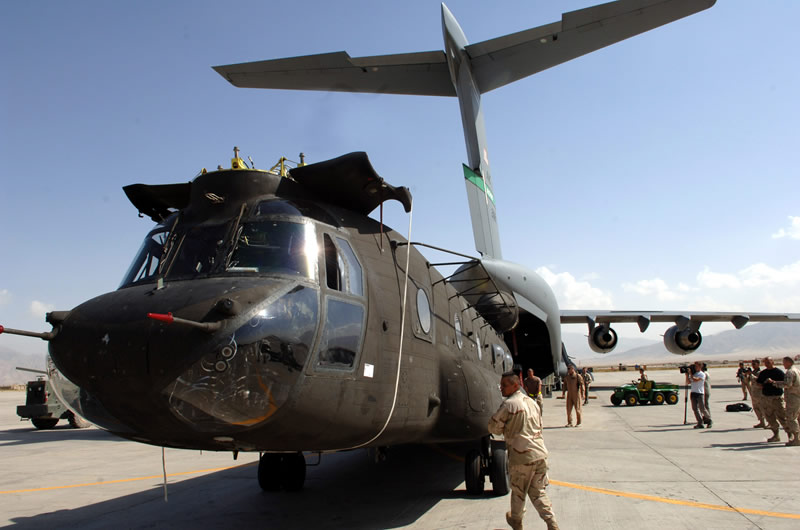
Sept 30/10: LAIRCM. A $15.7 million contract modification to retrofit aircraft with large aircraft infrared countermeasures (LAIRCM) countermeasures system, which protects the aircraft against heat seeking missiles by using laser pulses to confuse their guidance systems. “At this time, $30,805,888 has been obligated” by the 516th AESG/SYK at Wright-Patterson Air Force Base, OH (FA8614-04-C-2004, PO 0257).
Sept 23/10: An $86.5 million contract modification which will add the GSP’s FY 2010 flying hour/engine cycle adjustment, in accordance with the terms and conditions set forth in clause H012 of the basic contract. At this time, all funds have been committed by the 730th ACSG/GFKAA at Robins Air Force Base, GA (FA8614-04-C-2004, PO 0531).
July 28/10: Crash. No fixing this one, sadly. A USAF C-17 crashed on the evening of July 28 at Joint Base Elmendorf-Richardson, Alaska, with all 4 crew reported killed. Boeing says:
“Our thoughts and prayers are with the families and friends of the four crewmembers who were lost aboard the Pacific Air Forces C-17 that crashed at Joint Base Elmendorf-Richardson, Alaska, last night. Boeing stands ready to provide technical assistance to the U.S. Air Force with the investigation into this tragedy.”
The plane was preparing for the popular Arctic Thunder air show, which will continue as planned. See also: Alaska Dispatch | CBS video segment | Fox News.
Alaska crash
July 21/10: A $37 million contract modification adds extra funds, and raises the cost ceiling for USAF FY 2008 C-17 GSP MIPs. At this time, all funds have been committed by the MSW/ASC/WLMK at Wright Patterson Air Force Base, OH (FA8614-04-C-2004, PO 00371).
July 2/10: The US Defense Security Cooperation Agency officially announces Britain’s request to continue participation in the USAF/Boeing Globemaster III Sustainment Partnership, supporting Britain’s fleet of 7 C-17As. The estimated cost is $390 million, and implementation of this proposed sale will not require the assignment of any additional U.S. Government personnel or contractor representatives to the United Kingdom.
Britain request
June 30/10: Boeing wins a $263.6 million contract modification, exercising Q4 2010 options in the C-17 Globemaster III sustainment partnership contract. At this time, the entire amount has been committed by the 702nd ACSG/GFKAA at Robins Air Force Base, GA (FA8614-04-C-2004, PO 0530).
June 2/10: An $11.6 million contract will provide more funds for FY 2008 USAF material improvement projects, as part of the C-17 GSP contract. FY 2008 is long past, of course, but installs throughout the fleet take time. At this time, the entire amount has been committed (FA8614-04-C-2004).
March 28/10: UAE. A BBC report shines some light on the somewhat cryptic DSCA references to UAE aircraft and Afghanistan:
“The BBC’s security correspondent, Frank Gardner, can reveal that Arab soldiers have been taking part in dangerous missions alongside US troops in Afghanistan.
Troops from the United Arab Emirates (UAE) have been delivering humanitarian aid to their fellow Muslims and, on occasion, fighting their way out of Taleban ambushes. Though Jordanian forces have been carrying out some base security duties, the UAE’s troops are the only Arab soldiers undertaking full-scale operations in the country. Until now, their deployment has been kept so secret that not even their own countrymen knew they were here.”
May 26/10: The US DSCA announces [PDF] the UAE’s formal request to buy support and training for another 2 C-17’s being procured through a Direct Commercial Sale, plus 2 AN/AAR-47 Missile Warning Systems, 4 AN/ARC-210 (RT-1794C) HAVE QUICK II Single Channel Ground and Airborne Radio Systems, 2 AN/ALE-47 Countermeasure Dispensing Sets, and other military-related support including communication and navigation equipment, spare and repair parts, support and test equipment, publications and technical documentation, maintenance, personnel training and training equipment, preparation of aircraft for shipment, ferry support, and other U.S. Government and contractor engineering and logistics support services.
The estimated cost is up to $250 million, with exact costs to be determined once a contract is negotiated. Implementation of this proposed sale will require the assignment of additional U.S. Government and contractor representatives to the UAE, with exact numbers to be determined.
See also the Dec 18/09 entry, which covers a similar support request for the UAE’s first 4 C-17s. With this request, it appears that all 6 C-17s would now be covered.
UAE request
March 18/10: A $272.6 million contract, exercising the Q3 FY 2010 option for the C-17 GSP. At this time, the entire amount has been committed by the 330th ASW at Robins Air Force Base, GA (FA8614-04-C-2004, PO 0525).
As noted below, the Q2 payment was $263.6 million, and the Q1 payment was $270.9 million. That brings the USA FY 2010 GSP total so far to $807.1 million for announced contracts, plus $72.6 million for international GSP buys (Qatar and NATO).
Jan 22/10: New arrangement? The USAF announces a 10-year Justification and Approval (J&A) request for Boeing to provide continued, sole source life cycle support to the C-17 from FY 2012 through 2021. The USAF believes that this combination of internal depots and contractor support can save $9-12 billion over 30 years; time will tell.
Boeing’s spokespeople say the firm’s role will evolve during this next phase, as the Product Support Integrator (PSI) lead role transitions to the new C-17 Globemaster III Program Office at Warner Robins Air Logistics Center (ALC), Robins AFB, GA. Specialists at the Oklahoma ALC at Tinker AFB, OK, will manage the C-17 engine, with support from Pratt and Whitney.
The new C-17 sustainment strategy will begin in FY 2012 and be phased in over a variable timeline. The USAF approved justification and approval anticipates that Boeing will maintain a significant role in supporting the C-17 for both domestic and international customers, and that Boeing will assist the USAF to ensure an effective PSI transition. USAF release | Thanks to Boeing for their assistance and answers.
Jan 6/09: UAE. Boeing announces a contract with the UAE for 6 C-17A heavy airlifters, a 50% increase over earlier reports. Under the agreement, the UAE will take delivery of 4 C-17s in 2011, and 2 more in 2012, and will join the C-17 Globemaster Sustainment Partnership. Financial terms are not being disclosed, but a combination of stated foreign military sale requests, known C-17 costs, and earlier estimates places the value of their purchase in the $1.8 – $2.5 billion range.
The UAE contract pushes the total number of C-17s added since September 2009 to 17 (10 USA FY 2010, 1 UK, 6 UAE), and raises FY 2010 C-17 production to the full production rate of 15 planes. Total lifetime C-17 orders now stand at 249 (223 USA, 7 UK, 6 UAE, 4 Australia, 4 Canada, 3 NATO, 2 Qatar with 2 more options), with a current backlog of 37 planes. Boeing | Arabian Business | Middle East North Africa Financial Network | Long Beach [California] Press Telegram | UPI | Agence France Presse | Aviation Week | Flight International.
Dec 31/09: A $263.6 million modification, covering the basic C-17 Globemaster III Sustainment Partnership contract, including program management; sustaining logistics; material and equipment management; sustainment engineering; depot level aircraft maintenance; engine management; long term sustainment planning; air logistics center partnering support; depot activation; and support of Air Force and Foreign Military Sales operator of the C-17. At this time, the entire amount has been committed by the 730th ACSG/GFKAA at Robins Air Force Base, GA (FA8614-04-C-2004)
Boeing confirms that this announcement is the same as the Dec 22/09 DefenseLINK announcement, with minor corrections, and pays for the Q2 FY 2010 GSP program.
Dec 18/09: The US DSCA announces [PDF] the UAE’s formal request to join the C-17 Globemaster III Sustainment Partnership, which provides depth maintenance services for all global C-17 operators under an incentive-laden contract. It also included language that was found in the UAE’s recent request for CH-47F Chinook heavy-lift helicopters, saying that:
“The proposed sale will provide the United Arab Emirates (UAE) the capability to transport equipment and troops in the region, as well as, to support U.S. and NATO airlift requirements in Afghanistan.”
The UAE’s exact request includes support, training and related systems for 4 C-17 Globemaster III aircraft being procured through a Direct Commercial Sale (as opposed to a Foreign Military Sale), plus ancillary military equipment to include 5 AN/AAR-47 Missile Warning Systems, 5 AN/ALE-47 Countermeasure Dispensing Sets, 10 AN/ARC-210 (RT-1794C) HAVE QUICK II Single Channel Ground and Airborne Radio Systems (SINCGARS), plus ferry support, communication and navigation equipment, spare and repair parts, support and test equipment, publications and technical documentation, maintenance, personnel training and training equipment, preparation of aircraft for shipment, and other related elements of US government and contractor support.
While DSCA requests are not contracts, they are required before contracts can be issued. This official request, and its clearance, may indicate that a formal contract is close. The estimated cost is $501 million, the prime contractor will be the Boeing Company of Chicago, IL, and implementation of this proposed sale will require the assignment of additional U.S. Government and contractor representatives to the UAE. The number of representatives required, and exact cost, will be determined in joint negotiations.
UAE request
Oct 6/09: NATO SAC. A $61.1 million contract to exercise the FY 2010 option for the continued performance of the C-17 Globemaster III sustainment partnership for North Atlantic Treaty Organization Airlift Management Agency aircraft. This is NATO’s 3-plane SAC pool, operating from Pap AB in Hungary on behalf of consortium nations. At this time, $28.8 million has been obligated (FA8614-04-C-2004, PO 0337).
Oct 6/09: Qatar. An $11.5 million contract to exercise the FY 2010 option for the continued performance of the C-17 Globemaster III sustainment partnership for Qatar Emiri Air Force aircraft. At this time, the entire amount has been obligated (FA8614-04-C-2004).
Oct 1/09: A $270.9 million contract to provide for the basic C-17 Globemaster III sustainment partnership contract. At this time, the entire amount has been obligated. The 730th ACSG/GFKAA at Robins Air Force Base, GA issued the contract (FA8614-04-C-2004, PO 0TBD). Note that Oct 1/09 is the first day of FY 2010.
FY 2009
(click to view full)
Sept 28/09: Engines. Pratt and Whitney of East Hartford, CT received a $15.7 million contract to help the Oklahoma City Air Logistics Center with maintenance, repair, and overhaul capability for the F117 jet engine, which powers the C-17 aircraft. At this time, $4 million has been committed. The OC-ALC/PKEA at Tinker Air Force Base, OK manages this contract (FA8100-09-C-0004).
Sept 29/09: A $52.7 million C-17 Globemaster III Sustainment Partnership contract modification to procure large aircraft spare parts such as aircraft tails and cargo ramps. At this time, the entire amount has been obligated (FA8614-04-C-2004, PO 0323).
Sept 28/09: A $26.2 million modification to the C-17 Globemaster III sustainment partnership contract, to procure large aircraft spare parts. At this time, the entire amount has been committed (FA8614-04-C-2004, no order number given).
Sept 18/09: A $72.5 million C-17 Globemaster III Sustainment Partnership contract modification that will incorporate a flying hour engine cycle adjustment based on terms set forth in the basic contract. The 730 ACSG/GFKAA at Robins Air Force Base, GA manages this contract (FA8614-04-C-2004, PO 0516).
Sept 18/09: MIP. A $20 million contract which provides for “integrated software and hardware upgrades to the C-17 aircraft via multiple projects.” At this time, no money has been obligated; finds will be issued as specific upgrades are slated for testing & deployment (F33657-01-D2000, PO 0022).
Aug 24/09: The Pentagon announces a “$1.155 billion” (actually, $37.9 million) modified contract for the FY 2009 C-17 GSP program, noting that at this time, $1.148 billion has been committed by the USAF’s 330th Aircraft Sustainment Wing contracting flight (FA8614-04-C-2004, PO 0514)
That seemed like a lot of money when added to the Jan 12/09 entry covering $1.119 billion for FY 2009 GSP support, all within a 3-year, $3 billion contract announced on Oct 6/08. Subsequent discussions with Boeing reveal that the Pentagon announcement uncharacteristically included all previous FY 2009 expenditures. The only real change was $37.9 million for additional spare parts and repairs.
July 31/09: A $64.4 million modification to the C-17 Globemaster III Sustainment Partnership contract to incorporate sustainment support for the Qatar Emiri Air Force’s C-17 aircraft for FY 2009-2011. At this time, $6.7 million has been committed by the MSWE/516 AESG/PK at Wright-Patterson Air Force Base, OH (FA8614-04-V-2004).
July 22/09: The US DSCA announces [PDF] Australia’s formal request to continue participation in the USAF/Boeing GSP, which supports their fleet of 4 Boeing C-17As. The estimated cost is $300 million, but the time period is not discussed.
Implementation of this proposed sale will require the assignment of 10 U.S. Government and contractor representatives to participate in program management and technical reviews for 2-week intervals annually. Additionally, up to 10 contractor representatives will be required to provide in-country services throughout the life of this case.
Australia request
July 1/09: MIP. A $46.1 million C-17 Globemaster III Sustainment Partnership contract modification, to increase funding for FY 2007 USAF Material Improvement Projects. At this time, the entire amount has been obligated (FA8614-04-C-2004).
May 1/09: MIP. Another $16 million added to the C-17 Globemaster III Sustainment Partnership contract, to increase funding for FY 2009 USAF material improvement projects (MIP). At this time, the entire amount has been committed (FA8814-04-C-2004).
Feb 9/09: A not to exceed $114.4 million contract modification for an unspecified foreign military sales customer to buy a spare engine, night vision devices, ground handling equipment, spares, alternate mission equipment, support equipment, publications, repair and return, contractor logistics support, participation in the Globemaster III Sustainment Partnership, and services. At this time, $56.1 million has been obligated (FA8614-04-C-2004, PO 0278).
Qatar has not been featured in past contracts, and initial set-up of a support infrastructure can be rather expensive even if the ordered C-17 fleet is just 2 aircraft. NATO also ordered 2 C-17s in November 2008, with a 3rd due from US stocks.
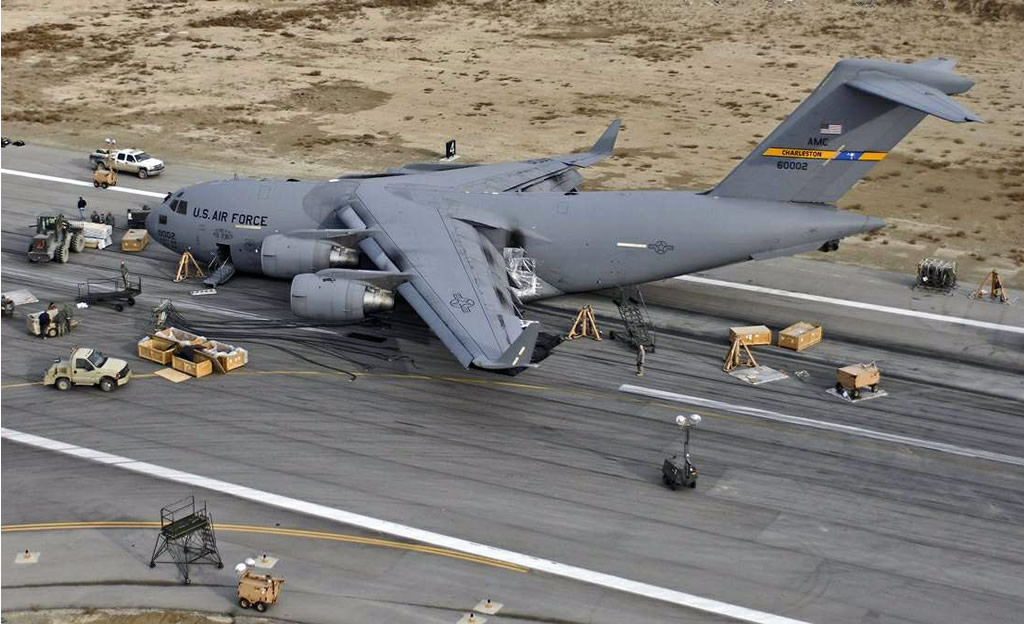
Feb 02/09: A C-17 is forced to make a no-wheels belly landing at Bagram Air Base in Afghanistan, the first time this has happened in the C-17 fleet’s 16-year USAF career. Nobody was hurt, but the task of clearing the runway wasn’t easy – and the manual was deficient. Tech. Sgt. Joseph Mixson, the lead team chief for crash recovery at Bagram AB:
“We used a 120-ton crane assisted by six 26-ton airbags to finally lift the aircraft from the runway [so we could lower the landing gear]. The major lesson learned was that the technical data for C-17 recovery did not list any alternate methods. We were not able to place the airbags in the positions they needed to be because the entire fuselage section was laying on the runway. Using the crane allowed us to get the airbags into position.”
The process took 2 days to complete, owing to exceptional teamwork. An USAF safety board has been convened to investigate the incident, and the recovered plane must now be repaired. USAF release.
Bagram accident
Jan 12/09: An unfinalized contract for $1.119 billion, to provide Total System Support for the C-17. At this time, $548.2 million has been committed. The 730 ACSG/GFKAA at Robins Air Force Base, GA manages this contract (FA8614-04-C-2004, PO 0507).
Boeing’s release clarifies, noting that this award includes a previous award of $514 million for the first 6 months of FY 2009 (See Oct 6/08 entry), and extends the GSP’s period to the end of the fiscal year on Sept 30/09. It adds that the C-17 GSP will be extended to additional bases over the coming 6 months, as the fleet continues to expand.
Oct 16/08: Sub-contractors. UTC subsidiary Pratt & Whitney announces a 1-3 year contract from Boeing to support the C-17 aircraft fleet’s F117 engines. The maintenance agreement includes a one year base period, plus the option to extend for 2 additional years through 2011.
This F117 contract covers fleet management support, configuration control, thrust reversers and closed-loop EcoPower(R) engine wash services for the entire F117 fleet of 800 engines. The F117-PW-100 is a derivative of Pratt & Whitney’s PW2037 commercial engine powering the Boeing 757, and each C-17 has 4 of them.
Oct 10/08: UK. A not to exceed $7.2 million modification by Britain’s Royal Air Force, under the C-17 GSP. This contract buys Block 17 spares, and aeromedical litter station augmentation sets that can quickly convert C-17s into airlift for wounded or even critical-care patients. At this time $2.32 million has been committed (FA8614-04-C-2004, PO 0271).
Oct 6/08: Boeing announces a new C-17 GSP contract that takes effect on Oct 1/08 (the first day of FY 2009), replacing the previous arrangement with a new 3-year Globemaster III Sustainment Partnership contract estimated to be worth $3 billion. The initial award is for $514 million, covering the beginning of FY 2009.
Boeing adds that their new proposal included a significant decrease in dollars per flight hour that will save the Air Force more than $200 million over 3 years compared with the previous GSP contract. The USA, Australia, Britain, Canada, Qatar and the NATO SAC consortium are all mentioned as co-participants in this contract. Boeing release.
Oct 1/08: A not-to-exceed $523.4 million contract for “total system support for the C-17 to include program management, sustaining logistics, material and equipment management, sustaining engineering, depot level aircraft maintenance, engine management, long term sustainment planning, Air Logistics Center partnering support, depot activation, and support of USAF and FMS operators of the C-17.”
At this time $256.5 million has been committed. The 330th Aircraft Sustainment Wing’s Contracting Flight at Robins AFB, GA is managing this contract (FA8614-04-C-2004, PO 0500).
Oct 1/08: NATO SAC. NATO signs an MoU with Boeing to finally get the SAC pooled airlift program underway. NATO’s Airlift Management Agency (NAMA) will buy 2 of the C-17s as a Foreign Military Sale, while the USAF will provide the 3rd. NAMA will then join the Globemaster Sustainment Partnership, to provide for maintenance of these aircraft. See “SALIS’ Sibling: NATO’s C-17 Pool Inaugurates In-House Heavy Lift” for full details.
FY 2008

(click to view full)
Aug 4/08: Reward. The USAF is increasing a fixed priced award fee contract with McDonnell Douglas Corporation by $10.1 million. The award is the 1st Half of the FY 2008 Earned Award Fee Payment for meeting or exceeding contract objectives. It covers the period from the beginning of FY 2008 on Oct 1/07, through March 31/08 (FA8614-04-C-2004, PO 00259).
June 30/08: Australia. A cost plus incentive fee/fixed price award fee contract with a $6.125 million limit incorporates the FY 2008 Quarter IV Option Exercise for site activation and material for Australian RAAF aircraft (FA8614094-C-2004, PO 0254).
June 26/08: A modified contract for $273.3 million, exercising the FY 2008 4th quarter option for the C-17 Globemaster III Sustainment Partnership. In addition, the contractor logistics support (CLS) for the palletized seat system (PSS) for Air Material Command (AMC) and the Air National Guard (ANG) will be exercised and funded. At this time, all finds have been committed (FA8614-04-C-2004, PO 0250).
June 13/08: MIP. The Air Force is modifying a cost plus fixed fee contract for $16.3 million for Wing Pylons and Fairings, per CCP 0586. At this time $8 million has been committed (FA8614-04-C-2004, PO 0185).
June 12/08: MIP. The Air Force is modifying a firm fixed price contract to retrofit existing C-17A Block 13 aircraft configurations to a more advanced Block 17 configuration, by increasing its limit to $114 million. The amount already committed has also increased, to $51.3 million (FA8614-04-C-2004, PO 0240).
April 16/08: The US Defense Security Cooperation Agency announces [PDF] the UK’s formal request for continued participation in the USAF/Boeing Globemaster III Sustainment Partnership for the UK’s 6 Boeing C-17A Globemaster IIIs. The estimated cost is $225 million. The principal contractor will be: The Boeing Company, of Long Beach, CA. There are no known offset agreements proposed, and the effort will not require the assignment of any additional U.S. Government personnel or contractor representatives to the United Kingdom.
Note that DSCA requests like this are required by law, and that this does not constitute a contract. Future announcements will detail the exact orders placed, but this can be read as a commitment by the UK government, since it involves continued participation within a pre-agreed framework.
Britain’s request
March 28/08: A modified contract for $273.3 million, exercising the FY 2008 3rd quarter option for the C-17 Globemaster III Sustainment Partnership. In addition, the contractor logistics support (CLS) for the palletized seat system (PSS) for Air Material Command (AMC) and the Air National Guard (ANG) will be exercised and funded. At this time, all finds have been committed (FA8614-04-C-2004, PO 0238).
March 17/08: A modified contract for $9.4 million to buy Combat Lighting Phase I Spares. At this time, all funds been obligated (FA8614-04-C-2004, PO 0229).
March 11/08: Reward. A contract modification for $10.3 million, covering the FY 2007 Performance Award Fee bonus payment on the Globemaster III Sustainment Partnership (GSP) Program for the period April 1/07 through Sept 30/07. At this time all funds are committed (FA8614-04-C-2004, PO 0230).
Feb 22/08: LAIRCM. An undefinitized contract modification for $77 million covers CCP 0575, for 37 kits and installs of Large Aircraft Infrared Countermeasure (LAIRCM) kits and additional Guardian Laser Tracker Assemblies (GLTA), plus spares, and proposal prep. At this time, $34.7 million has been obligated (FA8614-04-C-2004, PO 0196).
Jan 30/08: MIP. A GSP contract modification for $11.4 million to increase funding for FY 2007 and FY 2008 Material Improvement Projects (MIPs) for the USAF. This estimated annual program does not identify specific MIPs to be performed, just general requirements. At this time $25 million has been obligated (FA8614-04-C-2004, PO 00227).
Dec 31/07: PEPI. An indefinite delivery/indefinite quantity PE/PI contract (see above) with a 5-year ordering period, and a $1.3 billion ceiling.
This is a follow-on contract to the PE/PI-II contract awarded in January 2001, and covers ongoing efforts associated with the analysis, study, planning, design, development, qualification/test, and kit prototype of C-17 improvements. Funding will be committed via individual delivery orders (FA8614-08-D-2080).
An initial $13.6 million delivery order was awarded with the basic contract and supports Air Mobility Command requirements to participate in planning, provisioning, conducting, analyzing, and documenting an integrated Follow-On Flight Test program (FA8614-08-D-2080, #0001).
Nov 2/07: Australia. A 12.3 million contract modification for the Royal Australian Air Force (RAAF) C-17 Globemaster III Sustainment Partnership (GSP) program. This action incorporates the FY 2008 UCA for RAAF aircraft sustainment and for RAAF Contractor-Intermediate Level Logistics Support for the C-17 ‘virtual fleet.” At this time no funds have been obligated (FA8614-04-C-2004, PO 0211).
Oct 30/07: C-17 vs. C-5. As debates rage in Washington that pit the C-5M Galaxy modernization programs against the C-17, DID’s “Interactive: C-5s vs. C-17s in Washington” uses Congressional Research Service data and other sources to compile a downloadable Excel sheet with relevant cost data and key variables. Readers can try it themselves, and examine different assumptions and their effects.
Oct 15/07: The US Air Force Association Daily Report offers a window into the C-17 fleet’s usage patterns:
“The Air Force relies heavily on its newest strategic airlifter to fly much of the tactical airlift in the US Central Command area of responsibility, evidenced by the numbers wracked up last month by the 816th Expeditionary Airlift Squadron. Capt. Michael Andrews reports that the 816th EAS’s C-17s flew 44,945 passengers out of some 52,000 total throughout Afghanistan, Iraq, and the Horn of Africa. And, the unit delivered more than 36 million pounds of cargo.”
FY 2007

(click to view full)
Sept 27/07: A contract modification for $291.9 million. This action exercises the FY 2008 options for the continued performance of the Globemaster III Sustainment Partnership, which will be funded by separate funding actions as the FY 2008 funds are received. At this time no funds have been obligated (FA8614-04-C-2004, PO 0203).
Sept 27/07: Canada. A Foreign Military Sale contract modification for $8 million for the Canadian Forces C-17 Globemaster III Sustainment Partnership (GSP) program, which incorporates the CF aircraft into the C-17 “virtual fleet” including aircraft maintenance, upgrades, and sustainment for FY 2008 Q1. See also the June 6/07 and June 22/07 entries.
This action also incorporates “over and above” efforts and material improvement project efforts for FY 2008. At this time $4 million has been obligated (FA8614-04-C-2004, PO 0206).
Sept 21/07: A contract modification for $36.2 million, covering the FY 2007 flying hours/engines cycle adjustment in accordance with special contract requirement H-012 “flying hour profile” (Sept. 2003). At this time, all funds have been obligated. Wright-Patterson Air Force Base, OH manages the contract (FA8614-04-C-2004, PO 0202).
Sept 12/07: MIP. A $35.3 million increase, issued as a contract modification to the C-17 Globemaster III Sustainment Partnership (GSP) contract for FY 2005 and FY 2007 Material Improvement Projects (MIPs) for the USAF. The MIP program was established on P00037 based on estimated performance requirements for non-recurring engineering and retrofit. This estimated annual program does not identify specific MIPs to be performed, just general requirements. At this time $43.3 million has been obligated. For more information please call (937) 656-9310. MSW/516 AESG/PK, Building 558, Room 118B, 2590 Loop Road West, Wright-Patterson AFB, OH. (FA8614-04-C-2004, PO 00195).
Aug 23/07: Reward. A fixed-price award fee contract for $9.1 million for FY07 award fee payment for the period of Oct 1/06 – March 31/07. The award fee is a bonus under the terms of the contract for successfully meeting or exceeding benchmarked C-17 GSP performance levels, and all funds have been obligated (FA8614-04-C-2004, PO 0199).
August 2/07: A firm-fixed-price contract modification for $45 million, covering 13 Quick Engine Change kits for the C-17 aircraft. This contract action is an undefinitized contract, and only $20.2 million has been obligated at this time (FA8614-04-C-2004, PO 0188).
August 2/07: A firm-fixed-price, and cost-plus-incentive-fee contract modification for $20.2 million. This contract is an implementation of the Landing Gear Fleet Management Program Phase II for the removal, replacement and refurbishment of the C-17 aircraft landing gear every 8 years – those short-field landings can be kind of hard on the machinery.
Oddly, the DefenseLINK release says that a total of $37,455,110 has been obligated (FA8614-04-C-2004, PO 0172).
June 29/07: A firm-fixed-price and cost-plus-incentive-fee contract modification for $248.4 million to the Q4 FY 2007 option for the C-17 sustainment-labor/engine CLS (Contractor Logistics Services) and material. This effort also supports foreign military sales to the Royal Australian Air Force (RAAF) and the Canadian Forces. All funds have been obligated (FA8614-04-C-2004, PO 0191).
June 22/07: Canada. A cost-plus-incentive-fee/ fixed-price-award-fee contract modification for $31.1 million covering aircraft maintenance, upgrades, and sustainment of Canada’s C-17s for FY 2007 Quarter IV. This is probably training, as Canada hasn’t received any planes yet. Work will be complete by March 2008, and $15.1 million has been obligated to date. The Headquarters Aeronautical Systems Center at Wright-Patterson Air Force Base, OH issued the contract (FA8614-04-C-2004, PO 0193).
June 6/07: Canada. A $51.8 million cost-plus-incentive fee, firm-fixed-price and time and materials contract modification to incorporate Canada’s C-17 aircraft into the global C-17 “virtual fleet.”
GSP membership includes aircraft maintenance, upgrades, and sustainment; deliveries have not begin yet, but training is currently underway. At this time, $25.8 million have been obligated (FA8614-04-C-2004, PO 0180).
March 29/07: A $248.3 million firm-fixed and cost-plus incentive-fee price contract modification. It funds the FY 2007 third quarter option for the continued performance of the Globemaster III Sustainment Partnership. This option continues the support for the C-17 sustainment-labor/ engines CLS and material, and total funds have been obligated (FA8614-04-C2004, PO 0177).
Feb 21/07: MIP. A $10 million time and material contract modification to increase ceiling and funding for FY 2005 Material Improvement Projects (MIPs) for the USAF. The MIP program was established on P00037 based on estimated performance requirements for non-recurring engineering and retrofit. The estimated annual program does not identify specific MIPs to be performed, just general requirements.
At this time, total funds have been obligated; work will be complete September 2011 (FA8614-04-C-2004, PO 0174).
Feb 9/07: A $113.7 million cost-plus-fixed fee and firm-fixed-price contract modification to the C-17 Globemaster III Sustainment Partnership (GSP). They will incorporate the CY 2007 Global Reach Improvement Program (GRIP) Follow-On Retrofit Projects. At this time, $56.9 million have been obligated; work will be complete July 2009 (FA8614-04-C-2004, PO 0126).
See this DID article for a listing of the CY 2007 GRIP Non-Block, Block 14-16 and Block 17 Follow-On Retrofit Projects incorporated into this contract.
(click to view full)
Dec 28/06: A $248.3 million firm-fixed-price and cost plus incentive fee contract modification that funds the FY 2007 second quarter option for the C-17 sustainment-labor/engines contract logistics support and material. At this time, total funds have been obligated (FA8614-04-C-2004, PO 0139).
Dec 28/06: A $5 million firm-fixed-price and cost-plus-incentive fee contract modification that funds the FY 2007 second quarter option for the C-17 sustainment-labor/engine contract logistic support and material. At this time, $2.5 million has been obligated (FA8614-04-C-2004, PO 0139).
Oct 5/06: Australia. An $8.55 million cost-plus-incentive fee, fixed-price-award fee and time and materials contract modification. This is an undefinitized contract action for the FY 2007 portion of the Royal Australian Air Force C-17 Globemaster III sustainment partnership program. The RAAF has procured four C-17 aircraft (via a separate contracting action). This action will provide the sustainment of these aircraft over the course of FY 2007 to include aircraft maintenance, upgrade, and sustainment. At this time, $3.8 million has been obligated (FA8614-04-C-2004, PO 0129). See also July 28/06 entry.
FY 2006

(click to view full)
Sept 26/06: A $26.9 million firm-fixed-price and cost-plus-incentive fee contract modification exercises the USAF’s FY 2007 options for the continued performance of the Globemaster III sustainment partnership. These options will be funded by separate funding actions as the FY07 funds are received. Work will be complete September 2007 (FA8614-04-C-2004, PO 0127)
Sept 14/06: Canada. Canada Begins C-17 Buy With $1.3B for Equipment and Support. Part of this DSCA request will involve the GSP.
July 28/06: Australia. Boeing Co. in Long Beach, CA was awarded an $80.7 million cost-plus-incentive-fee/ fixed-price award-fee/ time-and-materials contract modification. This contract modification is a foreign military sales requirement for Royal Australian Air Force (RAAF) C-17 Globemaster IIIs to join the international C-17 Sustainment Partnership Program. This action incorporates the RAAF’s 4 aircraft into the C-17 “virtual fleet” which includes aircraft maintenance, upgrade, and sustainment. The Headquarters Aeronautical Systems Center, Wright Patterson Air Force Base, OH is the contracting activity (FA8614-04-C-2004, PO 0110).
The proposed plan will also require 7 each U.S. Government and Australian representatives at the facility, plus the assignment of up to ten each U.S. Government and contractor representatives to travel to Australia for annual participation in training, program management, and technical review. Additional subcontractors may be needed depending on the exact nature of the contracting arrangements established. As part of its role, Boeing will establish a facility at RAAF Base Amberley to provide logistics support for the C-17. See DID’s FOCUS Article coverage of the Austrlian C-17 sale.
July 22/06: LAIRCM. A $54.8 million firm-fixed-price contract modification to the C-17 Globemaster III sustainment partnership (GSP) contract. It incorporates an undefinitized contract action for large aircraft infrared countermeasures (LAIRCM) small laser turret assembly installs and difference engineering. Work will be complete by March 2008 (FA8614-04-C-2004, PO 0095).
July 22/06: MIP. A $49.7 million time and material contract modification to the C-17 GSP to increase funding for FY04 material improvement projects (MIPs) for non-recurring engineering and retrofit. This estimated annual program does not identify specific MIPs to be performed, just general requirements; but the FY04 time & materials ceiling amount for contract line item 0014AA is increased by $49.7 million for a total ceiling amount of $152 million. This work will be complete in December 2007 (FA8614-04-C-2004, PO 0105).
July 11/06: OBIGGS. A $12 million cost-plus-fixed-fee contract modification for on-board inert gas generation long lead line replaceable unit (OBIGGS) spares for C-17 aircraft P1-P137. At this time, $6 million has been obligated (FA8614-04-C-2004, PO 0118).
OBIGGS systems use various technologies to draw in air and concentrate nitrogen, which is then released into the fuel tank, displacing the explosive air/fuel mixture inside. Since nitrogen is quite inert, his makes the plane much less subject to explosions as a result of enemy ground fire, static discharge, faulty wiring, etc.
June 29/06: Landing gear. A $34.5 million firm-fixed-price-contract modification will implement the landing gear fleet management program phase II for the removal, replacement and refurbishment of C-17 aircraft landing gear every eight years. At this time, $17.25 million has been obligated (FA8614-04-C-2004, PO 0116).
June 1/06: GRIP. A $19 million cost-plus fixed-fee contract modification to incorporate the CY06 Block 14-16 Global Reach Improvement Program (GRIP) retrofit projects. Global Reach Improvement Program (GRIP) retrofit projects for the C-17 fleet. This includes: (1) Mobility 2000 (M2K) airline operational capability and printer, (2) secure enroute communications package-improved (3) communication open systems architecture, (4) weather radar replacement, (5) stabilizer struts system redesign. (FA8614-04-C-2004, PO 0115). See DID coverage.
April 28/06: MIP. A $49.7 million time-and-material (T&M) modification to the C-17 GSP contract to increase funding for FY04 material improvement projects (MIPs) for the Air Force. The MIP program was established on P00037 based on estimated performance requirements for non-recurring engineering and retrofit. This estimated annual program does not identify specific MIPs to be performed, just general requirements. The FY 2004 T&M ceiling amount for contract line item 0014AA is increased by $49.7 million for a total ceiling amount of $152 million. This work will be complete December 2007 (FA8614-04-C-2004, PO 0105).
April 28/06: LAIRCM. A $54.8 million firm fixed price contract modification to the C-17 Globemaster III sustainment partnership (GSP) contract to incorporate and undefinitized contract action for large aircraft infrared countermeasures (LAIRCM) small laser turret assembly installs and difference engineering. At this time, $27.4 million has been obligated, and work will be complete by March 2008 (FA8614-04-C-2004, PO 0095).
April 7/06: A $5 million firm fixed price award fee contract modification. The Boeing Co. earns an annual award fee that is based on the Globemaster III Sustainment Partnership (GSP). This effort provides for FY 2005 award fee payment pursuant to special contract requirement H-028 (FA8614-04-C-2004, PO 0089).
March 30/06: GRIP. A $26.8 million cost-plus fixed-fee, firm-fixed-price contract modification to provide for CY07 Global Reach Improvement Program nonrecurring engineering and technical support that shall define and integrate retrofit work package to facilitate retrofit of C-17 aircraft to a homogeneous configuration with the incorporation of Block 14 – 17 projects (FA8614-04-C-2004, PO 0102). See DID coverage for more details.
March 28/06: A $9.4 million cost-plus, fixed-fee, firm-fixed-price contract modification to provide for “C-17 Interim Contractor Support for activating Main Operating Base Peculiar Support Equipment” (FA8614-04-C-2004, PO 0092).
March 22/06: A $6.7 million firm fixed price contract modification to provide for “C-17 Product Improvement Program Multiple quantity buy for Peculiar Support Equipment for activating main operating bases” (FA8614-04-C-2004, PO 0091).
March 17/06: OBIGGS. A $14.6 million firm-fixed price contract modification to incorporate the on-board inert gas generating system II (OBIGGS II) retrofit into C-17 aircraft P71-P137. OBIGGS systems use various technologies to draw in air and concentrate nitrogen, which is then released into the fuel tank, displacing the explosive air/fuel mixture inside. Since nitrogen is quite inert, his makes the plane much less subject to explosions as a result of enemy ground fire, static discharge, faulty wiring, etc. This work will be complete December 2007 (FA8614-04-C-2004, PO 0099).
There was also a March 13/05 DefenseLINK announcement RE: the OBIGGS retrofit to P71-P137, for the same amount. DID is treating them as identical.
March 13/06: GRIP. A $53.2 million cost-plus fixed-fee contract modification to incorporate the CY06 Block 14-16 Global Reach Improvement Program (GRIP) retrofit projects for the C-17 fleet. This includes: (1) Mobility 2000 (M2K) airline operational capability and printer, (2) secure enroute communications package-improved (3) communication open systems architecture, (4) weather radar replacement, (5) stabilizer struts system redesign. Work will be complete March 2008. (FA8614-04-C-2004, PO 0097).
Dec 2/05: GRIP. A $5.6 million firm-fixed-price contract modification to provide for CY06 Global Reach Improvement Program (GRIP) follow-on projects. Projects include Troop Seats, Station Keeping, Defensive Systems and Terrain. Negotiations were completed October 2005 (FA8614-04-C-2004, PO 0084).
Oct 31/05: MIP. A $22 million time-and-material contract modification to the C-17 Globemaster III sustainment partnership contract, to increase funding for FY04 and FY05 material improvement projects for the Air Force. The Material Improvement Project program was established on P00037 based on estimated performance requirements for non-recurring engineering and retrofit. This estimated annual program does not identify specific MIPs to be performed, just general requirements. Work will be complete by December 2007 (FA8614-04-C-2004, PO 0077). A separate $16.4 million contract adds combat lighting to 28 aircraft (F33657-02-C-2001, PO 0041). See DID coverage.
FY 2003 – 2005

(click to view full)
Sept 28/05: A $273.7 million firm-fixed price contract modification to exercise the FY 2006 options for the C-17 Globemaster III Sustainment Partnership. These options will be funded by separate funding actions, as fiscal 2006 funds are received. This effort supports foreign military sales to the United Kingdom.
Work will be performed at McDonnell Douglas in Long Beach, CA and Pratt and Whitney in Cheshire, CT. Solicitations began in January 2003, negotiations were complete November 2003, and the option period will be complete by September 2006 (FA8614-04-C-2004, PO 0078)
July 7/05: LAIRCM. A $31.2 million firm-fixed-price contract modification definitizes P00042, an undefinitized contractual action (UCA) for the incorporation of the Large Aircraft Infrared Counter Measures (LAIRCM) on 15 C-17 Globemaster transport aircraft. The contract also included additional changes. Negotiations on this contract were completed June 2005, and work will be complete by January 2007 (FA8614-04-C-2004, PO 0066).
Negotiations added 3 additional LAIRCM units, which were identified in the UCA as unpriced not-to-exceed options. Another 22 LAIRCM units were also negotiated as a part of this contract change resulting from additional LAIRCM funding from the President’s fiscal 2005 supplemental defense budget. The total number of LAIRCM units procured under this change is thus 40 (15+3+22). The commodity procured in this change is the aircraft installation hardware such as wiring harnesses and support structure, and the installation labor.
Dec 3/04: LAIRCM. A $40 million firm fixed price contract to provide for C-17A Large Aircraft Infrared Counter Measure (LAIRCM) Follow-on Retrofit that include procurement of installation kits and the actual installation effort for 15 Aircraft.
In addition, the effort includes procurement of tooling necessary to operate 4 total lines to support the retrofit effort. Finally, the action also includes kits and installs for 3 independent single Aircraft options. Work will be performed at McDonnell Douglas Corp. in Long Beach, CA, and the Boeing Aerospace Support Center in San Antonio, TX. At this time, $30 million of the funds has been obligated, and work will be complete by January 2005 (FA8614-04-C-2004, PO 0042).
Sept 23/04: Wheels retrofit. A $13.7 million cost-plus fixed-fee contract to provide for C-17 sustainment effort to acquire and install 53 updated landing gear kits, which include the following hardware: nose landing gear Wheels, main landing gear wheels, brakes and temperature sensors. This action completes the fleet retrofit program for the new wheels and brakes. Negotiations were completed August 2004, and work will be complete by July 2007 (FA8614-04-C-2004).
Sept 02/04: Boeing announces that the U.S. Air Force has awarded them an $891.6 million contract modification to provide sustainment services for the C-17 airlifter fleet. This is the first of four option periods under a contract awarded in July 2004, with a total potential value of $4.9 billion if all remaining options are exercised.
Dec 22/03: A $166.7 million firm fixed price contract modification to provide for sustainment of the fleet of C-17 aircraft from January through February 2004. Approximately 3% of this effort supports foreign military sales to the United Kingdom. The locations of performance are: McDonnell Douglas Corp. in Long Beach, CA (43%); Pratt & Whitney in Cheshire, CT (32%), and other locations. At this time, $126 million of the funds has been obligated, and further funds will be obligated as individual delivery orders are issued. Solicitation began January 2003, Negotiations were completed November 2003, and work will be complete by October 2008 (FA8614-04-C-2004, PO 0005).
Oct 1/03: A $259 million letter contract for the C-17 sustainment program. The locations of performance are: McDonnell Douglas Corp., Long Beach, CA (43%); Pratt & Whitney, Cheshire, CT (32%), and other locations (35%). At this time, $129.5 million of the funds has been obligated, and further funds will be obligated as individual delivery orders are issued. Solicitation began January 2003, and work will be complete by December 2003 (FA8614-04-C-2004).
Additional Readings & Sources
* DID Spotlight article – Interactive: C-5s vs. C-17s in Washington. Includes a downloadable Excel sheet with relevant cost data and key variables, allowing reading to examine different assumptions and their effects.
* Boeing – C-17 Globemaster III.
* Boeing Photo Release (Jan 30/07) – Gives readiness statistics for 2006.
* Boeing Frontiers (May 2006) – Globemaster III Sustainment Partnership keeps C-17s flying.
* Boeing Backgrounder – C-17 Globemaster III Sustainment Partnership (GSP) [PDF]. Published May 2006.
* USAF (Aug 3/09) – Air Force Aeromedical Evacuation Teams Give British Soldier Fighting Chance. The elimination of dedicated aeromedical aircraft often leaves C-17s to play that role, complete with roll-on medical equipment – one reason the average C-17 cargo load is lower than you might expect. In this case, the effort required 4 sorties involving 2 C-17s and a C-130.
* Boeing Frontiers (February 2006) – The Big Fix: Boeing, Air Force rescue C-17 in Afghanistan. The partnership includes emergency calls: “At Bagram Air Base, Afghanistan, a severely damaged C-17 Globemaster III rests in the sand. Its massive left wing blocks the runway, preventing the landing of other aircraft conducting essential military operations. One thing is for sure: The airplane, the most extensively damaged C-17 to date, has to be moved quickly. But can it be saved?…Using a crane and a flatbed trailer, military [and Boeing] personnel at Bagram lifted and towed the aircraft, reopening the runway less than two days after the mishap.”
* Boeing Frontiers (September 2005) – Sweet 16. Describes Block 16 and earlier upgrades under the GSP-MIP.
* Military Aerospace Technology (April 18/03) – Protecting the Big Birds. Explains the multi-layered defenses being installed on US transport aircraft, and places LAIRCM in context as part of a suite of countermeasures.
* WARNER ROBINS AIR LOGISTICS CENTER OFFICE OF HISTORY – FY 2002, Chapter V: Aircraft Management.
Tag: c-17gsp