


(click to view full)
Japan already produces F-15J Eagle aircraft under license from Boeing, and in 1987 they selected Lockheed Martin F-16 fighter jet as the basis for a “local” design that would replace its 1970s era F-1s. The aim was to produce a less expensive fighter that would complement its F-15s, provide a bridge for key aerospace technology transfers, and give Japan’s aerospace industry experience with cutting-edge manufacturing and component technologies.
The F-2’s increased range is very useful to Japan, given their need to cover large land and maritime areas. Nevertheless, a combination of design decisions and meddling from Washington ensured that these fighters ended up costing almost as much as a twin-engine F-15J Eagle, without delivering the same performance. As a result, production ended early, and the 2011 tsunami made Japan’s fleet even smaller. The remaining fleet will continue to receive upgrades, in order to keep them combat capable for many years to come.
Japan’s F-2 Program
F-2: The Aircraft
(click to view full)
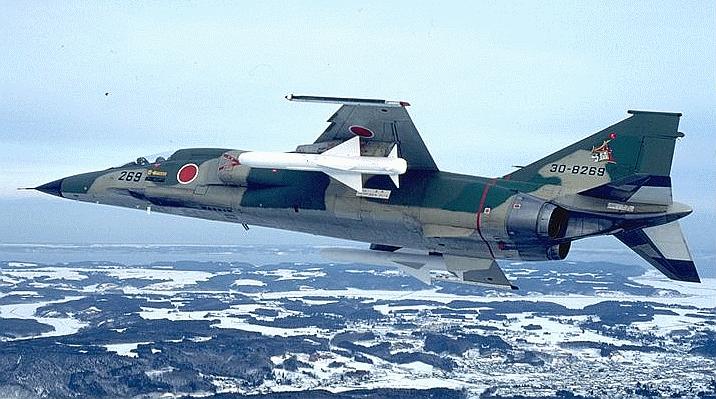
Japan’s Mitsubishi F-1 heralded the revival of Japanese fighter design, but it was never really a front-line air combat fighter. Rather, it was derived from a trainer, and given secondary strike capabilities.
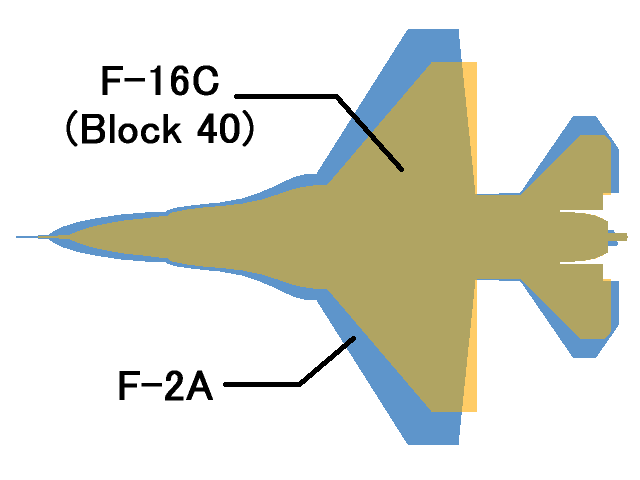
Japan’s F-2 aimed to take the next step, and become a full front-line fighter. While it looks like the F-16 from which it was derived, it’s noticeably bigger. Changes include a 17″ longer fuselage, larger horizontal tails, 25% more wing area, more internal fuel storage, and 2 more weapon store stations than the F-16.
(click to view full)
The aircraft is powered by GE’s uprated F110-129 engine generating 17,000 pounds of thrust, or 29,600 pounds with afterburners on. The centerline and inner-wing hardpoints are “wet,” and can carry drop tanks with up to 4,400kg of fuel for long range combat air patrols.
Mitsubishi Electric supplies a locally-designed X-band J/APG-1 AESA fire control radar, and a J/ARG-1 AESA datalink transmitter. Weapons carried include the AIM-9L Sidewinder and MHI AAM-3 short range air-air missiles, license-built AIM-7F/M Sparrow medium range air-air missiles (built until 2010), MHI’s Type 89 ASM-1 and ASM-2 anti-ship missiles, rocket launchers, and bombs that can include GPS-guided JDAM weapons.
Upgrades are underway.
Mitsubishi’s AAM-4B active-seeker medium range air-to-air missile is being added, along with a radar upgrade to APG-2 status. Together, they’ll give the F-2 the ability to attack multiple aerial opponents from medium range. They’ll also allow the fighters to fire and leave, if desired, instead of having to close into visual range while providing a radar lock for the AIM-7 Sparrow.
F-2: The Program
(click to view full)
As noted above, the point of the F-2 program was to produce a cheaper fighter to complement its F-15s, provide a bridge for key aerospace technology transfers, and give Japan’s aerospace industry experience with cutting-edge manufacturing and component technologies. Unfortunately, the US Congress proved to be a significant program obstacle, raising many questions about technology transfer issues. That delayed the program by at least 2 years, and the resulting changes led to a better but more expensive design.
In the end, the F-2 delivered on its techno-industrial promises. Mitsubishi’s heavy use of graphite epoxy and co-cured composite technology for the wings encountered some teething problems, but proved to be a leading-edge use of a technology that provides weight savings, improved range, and some stealth benefits. This technology was then transferred back to America, as part of the program’s industrial partnership.
[youtube:v=ckryKdCvUA8]
(click for video)
On the flip side, the ambitious goal of developing a fighter that used so many new technologies exacted a price. At a reported $108 million per plane in 2004 dollars, the F-2 is as expensive as the F-15s it seeks to supplement. Unfortunately, its overall performance, smaller radar size, and single engine make it a less capable aircraft. As a result, a program originally intended to field 130 fighters ceased production at 94.
At least 18 F-2s were damaged in the 2011 tsunami, leaving a reduced fleet. That fleet will continue to receive upgrades, including upgrades to their Japanese radars, improved missiles, avionics improvements, and other required upgrades over time. Japan is also moving to try and rehabilitate and upgrade up to 13 of the 18 damaged planes.
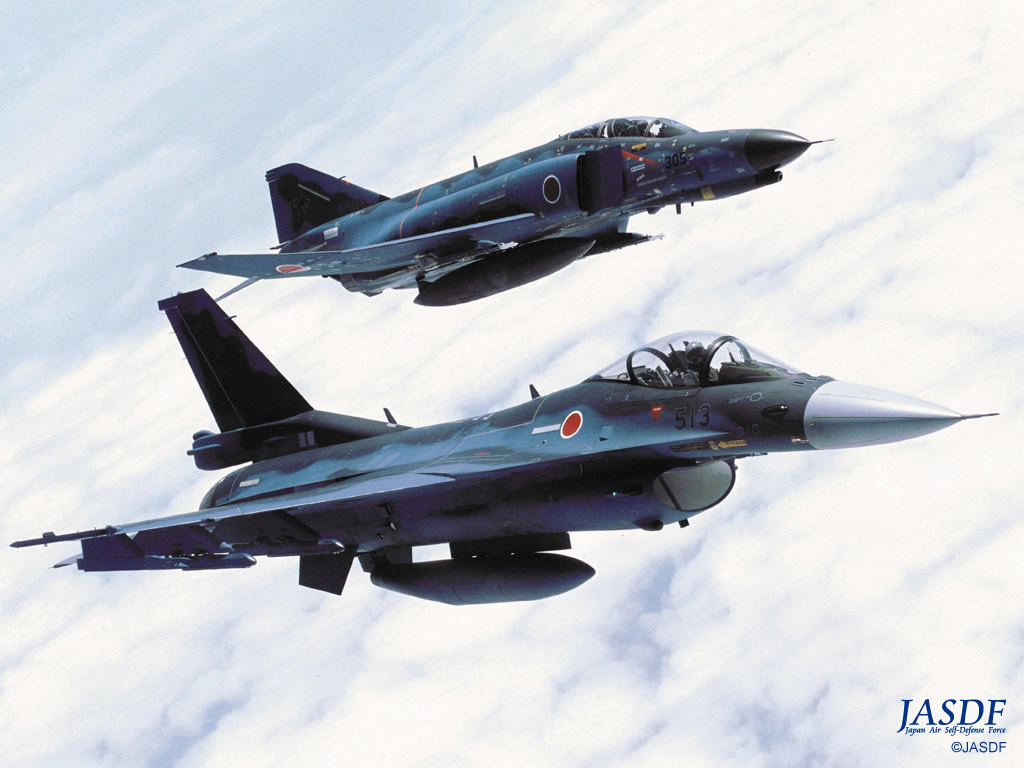
Upgraded F-2s will continue flying alongside Japan’s F-15Js, and Japan’s next-generation F-35A fighters. With the JASDF’s F-4J and RF-4J Kai(zen) Phantom IIs slated for retirement, and China bent on aggressive moves in and around Japan, every fighter will count.
F-2: Industrial Partnerships
The government of Japan has overall F-2 program responsibility, and funds the program. Under the agreement, Japan is responsible for producing approximately 60% of the aircraft and the other 40% is produced in the USA. The Japanese defense ministry’s Technical Research and Development Institute is also involved in designing ongoing upgrades, in collaboration with program partner firms.
Mitsubishi Heavy Industries (MHI) is the prime contractor and has design responsibility for portions of the airframe and avionics, the digital flight controls, the active phased array radar, and certain support equipment. MHI is also responsible for overall systems integration, and all components are assembled by at their Komaki South Plant near Nagoya, Japan. MHI delivered the first production aircraft to the Ministry of Defense in September 2000.
(click to view full)
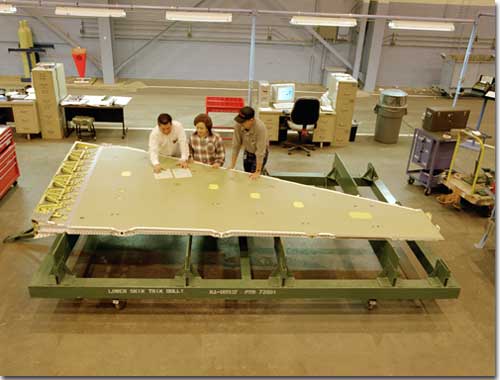
Key Japanese subcontractors include Fuji Heavy Industries (FHI) and Kawasaki Heavy Industries (KHI). FHI is responsible for developing the aircraft nose cone, the composite upper skin for the wing, and the horizontal and vertical tail assemblies. KHI is responsible for the center fuselage. The aircraft’s fly by wire system is a co-development with Japan Aviation Electric and Honeywell. Ishikawajima Harima Heavy Industries (IHI), another Japanese participant, produces the F110-GE-129 engines under license to General Electric of the United States.
Lockheed Martin provides about 40% of the overall fighter: all the aft fuselages, wing leading-edge flaps and stores management systems; 80% of all left-hand wing boxes; and other avionics and avionics support equipment. They also support MHI and the JASDF as they incorporate new weapons like Boeing’s Joint Direct Attack Munition (JDAM), and aid in other support activities. Lockheed Martin components are shipped to MHI’s Komaki-South facility, where they are assembled with other components by MHI to form the F-2.
Contracts & Key Events
2011 – 2019
Tsunami destroys 18 F-2s; Upgrade plan & budgets; Some damaged F-2s to be restored.
(click to view full)
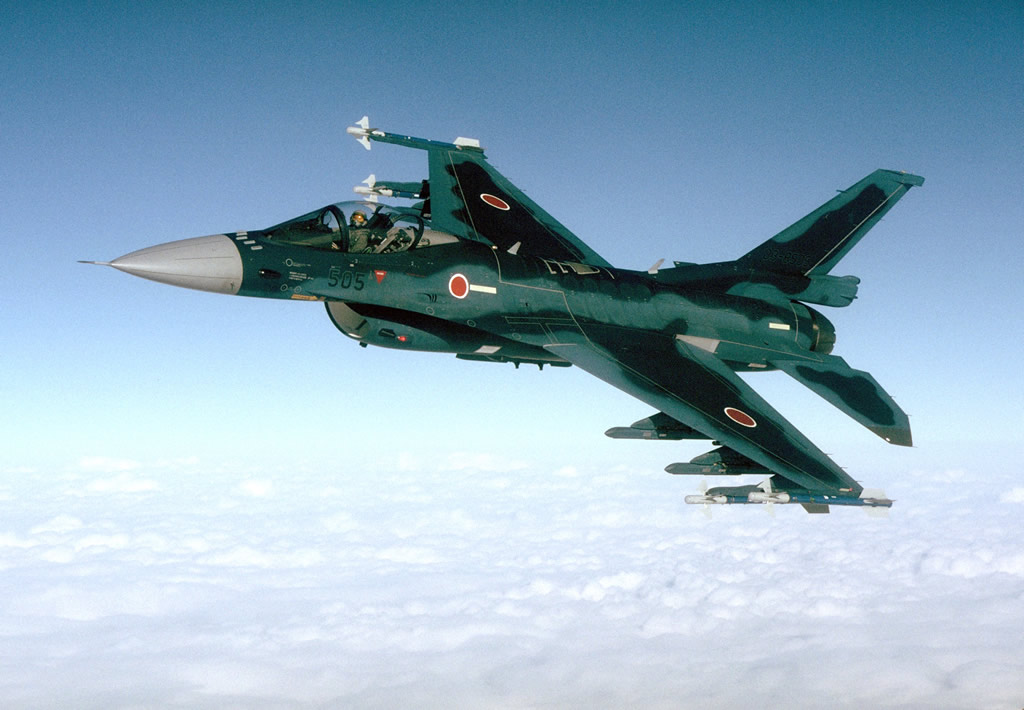
Mitsubishi Heavy Industries (MHI) is the prime contractor for the F-2. Lockheed Martin is the major subcontractor under the terms of their partnership.
October 22/19: Japan Japan’s Board of Audit has found that the US has been behind schedule in delivering military equipment ordered by the Japan Self-Defense Force, the Japan Times reports. It found that only 40 percent of the flight computers ordered for the F-2 fighter have been delivered and some computers ordered nine years ago have yet been shipped. Delays also forced Maritime Self-Defense Force to hold back repairs for its Harpoon anti-ship missiles. The board on Friday urged the Defense Ministry to negotiate with the US side so that such delays will be resolved as soon as possible. In its survey, the audit board looked at Japan’s defense equipment procurement from the United States in four fiscal years through the end of March 2018. The F-2 support fighter aircraft is a multi role single engine fighter aircraft principally designed for the Japan Air Self Defence Force, the result of a joint Japan and USA development program.
May 10/19: Talking to the USA The US government together with the Japanese Ministry of Defense are deepening their talks about Japan’s program to develop a platform in order to replace Japan’s Mitsubishi F-2 fighter, Jane’s reports. The F-2 support fighter aircraft is a multi role single engine fighter aircraft, which also resulted from a joint Japan and USA development program. But with the Air Self-Defense Force’s F-2 aircraft due to be retired in the mid-2030s, Japan has begun to examine potential replacement fighter jets. Costs may be reduced through joint development with other nations and industry giants from countries such as the US and the UK have proposed development plans based on existing aircraft. Discussions between the US and Japan are currently focused on the fighter aircraft technologies that the US would transfer to Japan to support the next-generation fighter program, which Japan wants to make a decision on in the near future.
March 22/19: New missile Japan is planning to extend the range of it ASM-3 air-launched anti-ship missile, Jane’s reports. The country wants to develop long-range air-to-surface cruise missiles to bolster defense capabilities. The ASM-3 is a supersonic anti-ship missile that was jointly developed by Mitsubishi Heavy Industries and the Japanese Ministry of Defense to replace Japan’s 93 series of missiles. The missile is expected to be carried by Japan’s F-2 multirole fighters. However, a new advanced mission computer for the F-2 is yet to be made and the missile cannot yet be integrated with the aircraft. The Mitsubishi F-2 is a multirole fighter that entered service in 2008. On October 2018, it was reported, that Japan wants to replace its F-2 fighter with a indigenously made aircraft after rejecting proposals from Lockheed Martin, Boeing and BAE Systems. The domestic cruise missiles are also intended for use on the new fighters that will replace the F-2 after its retirement in 2030.
October 8/18: What will it be? Japan’s ATD-X (X-2) program is taking a new turn. The Japanese Ministry of Defense is determined to develop a new fighter jet, that will eventually replace its fleet of F-2s. Proposals from three American and British companies failed to meet Japan’s costs and capability requirements, hence the decision to indigenously develop a new fighter jet. The companies made offers to upgrade their existing models, Lockheed for the F-22, Boeing for the F-15 and BAE for the Typhoon. Development of the new aircraft could cost trillions of yen and could be a major financial burden on Japan’s defense budget. To mitigate the overall cost the ministry has an eye on a joint development with foreign companies. The government is looking towards British or German-French partners as they are also looking into developing next-generation jets. Japan’s Air Self-Defense Force currently operates 92 F-2s which will begin to reach the end of their service life in the 2030s.
July 18/18: Too expensive? The government of Japan is in dire need to replace its ageing fleet of F-2 fighters. The country is currently searching for a Japan-led international collaborative development for a new fighter jet. Lockheed Martin already issued a development proposal that is a big favorite. The company would build a high-performance stealth machine integrating F-35 electronics onto a F-22 platform. However, the plane will be more expensive than initially thought thus raising concerns to the program’s cost effectiveness. Lockheed estimates the initial price tag to be around $177 million per plane, essentially making it more expensive than the F-35. Japan will start retiring its fleet of 90 F-2s by 2030. Development of a new plane takes about 10-years therefore the Ministry of Defense intends to specify any concrete development policy by the end of the year.
April 25/18: Japan mulls its options In addition to Lockheed Martin’s rumored offer to build them a fifth-generation hybrid stealth fighter, the Japanese government may restart the flight test program of the X-2—its stealth technology demonstrator aircraft. The possibility was mentioned by an anonymous official speaking to Flight Global, who said that while nothing was certain about the future of the X-2, “We may do more testing.” Originally designed ATD-X, the X-2 formed part of Tokyo’s efforts to jump start its industrial base and explore technologies necessary for stealthy fifth- or sixth-generation aircraft. An technology demonstrator aircraft is currently based at Gifu Airbase after completing a run of 34 test flights. 50 had been originally planned. While the official declined to comment on an earlier story from Reuters that Lockheed Martin wants to offer a hybrid of its F-22 and F-35 for the long-term Japanese requirement, they did say that a number of proposals are being weighed, noting that Japan and Great Britain also have a joint study to look at “potential opportunities for the future fighter program.”
April 23/18: Lockheed offer 5th gen hybrid Reuters reports that Japan is to be offered a fifth-generation fighter platform by Lockheed Martin that will fuse the export-banned F-22 Raptor and F-35 Joint Strike Fighter. The hybrid platform is the US defense giant’s entry into Japan’s competition to build its own stealth fighter—the F-3. In March, the Japanese government issued a third Request for Information (RFI) for the F-3 to foreign defense companies and sent a separate document outlining its requirements in more detail to the British and United States governments. In addition to Lockheed, Tokyo expects designs from Boeing and BAE Systems. Japan’s last indigenous fighter effort was the F-2, which entered service in 2000, was built jointly by Mitsubishi Heavy and Lockheed Martin. Mitsubishi has also participated as a partner manufacturer for Lockheed Martin’s F-35, controlling airframe assembly of Japanese F-35s at its Final Assembly and Check-Out (FACO) facility in Nagoya.
March 6/18: International Partners Wanted Japan will seek an international partner to help develop and build a successor for its F-2 fighter fleet, abandoning plans on a solo development of a next-generation fighter. The Ministry of Defense is expected to send out a request for information (RFI) over such a collaboration to US aerospace firms later this week, however, there are also plans inplace to simply acquire additional F-35 Joint Strike Fighters. Derived from the F-16 Fighting Falcon, the F-2 has been in operation with the Japan Air Self-Defense Force since 2000, Tokyo plans to retire the F-2 from the 2030s.
November 29/17: Despite announcing a multi-year pause on developing its own next-generation stealth fighter—or possibly pitching in with a new European fighter project—a Japanese defense official has told Aviation Week that its X-2 stealth demonstrator has collected more data than required during 34 flights since its first flight in April 2016. 50 flights had been planned but were not needed. While further details on the testing remains scant, the official mentioned that radar signature was one area of outperformance, while its IHI XF5 engines also did better than expected under the adverse conditions of high angles of attack.
November 15/17: Delays Japan is likely to delay plans to develop its next advanced stealth jet, the F-3, despite having tested its $350 million ATD-X demonstrator aircraft—a forerunner for the F-3—in 2016. Funding for a F-3 program, which is expected to reach $40 billion over its lifetime, is likely to be diverted instead into to purchasing additional F-35 Joint Strike Fighters, V-22 Osprey tiltrotor aircraft, as well as new ballistic missile interceptors for its Patriot and planned Aegis Ashore systems. Also stalling the F-3 program is bureaucratic indecision on whether to pursue a solely indigenous development or to seek international collaboration. A decision is expected in 2018, meaning that the program is unlikely to feature in 2019’s five-year defense equipment plan.
October 25/16: For the first time since WW2, UK and Japanese fighters will duke it out in aerial combat drills at Japan’s northern Misawa Air Base. Four RAF Eurofighter Typhoons and a C-17 support plane touched down on Saturday and will face off against and fly with Japanese F-15s and domestically built Mitsubishi F-2s in an exercise dubbed Guardian North 16. The exercise is also being seen as an opportunity by Tokyo to see the Typhoon in action as it ponders the replacement of the F-2 and the choice of using a cheaper non-stealth superiority fighter based on an existing design or a much more expensive program to develop their own indigenous stealth fighter.
October 17/16: Lockheed Martin has offered to collaborate with Mitsubishi Heavy Industries (MHI) on jointly developing a new fighter for Japan. LM President Marillyn Hewson made the disclosure saying the company will participate in a second round of Request For Information by Japan’s Ministry of Defense next year. Set to be the replacement for Tokyo’s current fleet of F-2s, other potential collaborators who have responded to the initial RFI include Boeing.
July 29/16: Plans for October? Mitsubishi’s X-2 stealth demonstrator is to go on public display at Gifu Air Base, Japan, on October 30. This will be one of the first times regular punters can get up close and personal with the new jet following its maiden flight in April. For those rushing to check those dates, authorities have advised to leave the cars at home and come via rail.
July 21/16: Industry partners already lining up for the Japanese F-3 program include US giants Lockheed Martin and Boeing. The new program is set to replace the existing F-2 fighter with a next generation stealth fighter based on the X-2 Shinshin experimental aircraft. With the F-3 planned for 2027, any partners taken into the development program stand to earn from a $20 billion project.
April 28/16: After numerous delays in its maiden flight which occurred last week amid much excitement from manufacturer Mitsubishi Heavy Industries (MHI), the X-2 stealth demonstrator will have a year long test campaign involving around 50 flights. With the maiden flight described as “ordinary” by Hirofumi Doi, manager of Japan’s Future Fighter Program at the defence ministry’s Acquisition, Technology & Logistics Agency (ATLA), future testing will help ATLA gather data on advanced fighter technologies such as stealth, thrust vectoring, data links, and other areas. Depending on this data, flight testing of the X-2 could easily be extended, leading the way for a potentially busy period for the demonstrator.
April 25/16: Mitsubishi Heavy Industries (MHI) has announced the successful maiden flight of its X-2 stealth demonstrator. The test flight now makes Japan the world’s fourth nation to test-fly a stealth aircraft. After performing a number of basic maneuvers, the X-2 left Nagoya Airport and landed at the Japan Air Self-Defense Force’s Gifu Air Base. In development since 2009, the X-2 program has seen MHI cooperate with 220 domestic companies alongside Japan’s Acquisition, Technology & Logistics Agency (ATLA) to develop the necessary technologies.
April 14/16: Mitsubishi’s X-2 stealth demonstrator has moved one step closer to its first flight after a series of taxi and runway tests since January. The aircraft has now moved into the Vr stage whereby the aircraft accelerated to rotation speed, and the pilot pulled the nose wheel off the ground. Testing took place at the Nagoya Airfield on April 9, and precedes the plane’s maiden flight, expected by the end of the month.
April 13/16: The first flight of Mitsubishi’s X-2 (formally ATD-X) stealth demonstrator is expected to take place toward the end of this month. Initially scheduled for February, the maiden flight was pushed back by the developers out of caution, but the jet has been spotted undertaking runway and taxiing tests over the last number of weeks. The X-2 is being developed to lay the basis for a Japanese made replacement of Mitsubishi’s F-2, due to be retired in 2028.
March 24/16: The Japanese government has opened talks with western fighter manufacturers such as Boeing and Lockheed Martin, over their participation in helping to build the country’s next F-3 series of fighter jets. Talks come as the Mitsubishi developed ATD-X experimental stealth aircraft prepares for its first test flights within the next few days. The indigenous ATD-X would be part of any attempt by Japan to develop their own F-3 fighter, with analysts expecting such a program to cost at least $40 billion. While this may prove too costly, Japan is anxious to continue developing its stealth technologies as it tries not to fall behind regional rival China.
March 8/16: Mitsubishi’s X-2 has been performing well in taxi tests according to Japan’s Acquisition Technology and Logistics Agency (ATLA). The agency was happy with the progress it was making, saying they were “proceeding with tests, performing very careful maintenance, and making some minor adjustments.” However, the agency hasn’t commented on the jet’s future flying schedule, or how many test flights will take place in 2016. The maiden flight had been originally planned for February.
February 12/16: The Mitsubishi X-2 Shinshin was recently photographed while out for its first taxi test at Nagoya airport. After its unveiling to the public just last month, a maiden flight for the stealth demonstrator, formally known as the ATD-X, is just weeks away, bar any upcoming technical problems. The Shinshin, which means “spirit of the heart,” is Japan’s first foray into developing experimental stealth technologies and will form the basis for its fifth generation F-3 fighters planned for 2027.
January 29/16: Mitsubishi Heavy Industries has unveiled to the press their latest ATD-X stealth fighter prototype at their plant in Komaki. The fifth generation stealth fighter was developed alongside Defense Ministry’s Technical Research and Development Institute (TRDI) with the aim of seeing if an indigenously produced stealth fighter could be developed in Japan along with researching the technologies required. With its first test flight due this year, full scale production could be under way as early as 2018. The new jet will replace the aging Mitsubishi F-2 and F-15, while complementing its F-35 acquisition as Japan looks to take more responsibility over defending it’s territory and population.
December 29/15: Mitsubishi’s ATD-X stealth fighter is to make its maiden flight in February 2016 according to the Japanese Ministry of Defense. The indigenous fighter is set to complete taxiing and ground trials in late January prior to the voyage. The demonstrator model is Japan’s first attempt at developing an entirely domestically produced stealth fighter, but has been suffering from delays. It is hoped that the ATD-X program will eventually lead to their own F-3 fighter to be produced by 2027.
December 7/15: Japan has made plans to test its very own fifth generation stealth jet, making it only the fourth country in the world to do so. The maiden flight of the ATD-X will take place in the first quarter of 2016 and aims to replace the current F-2 fighters in service. The development program is the most expensive in Japan’s history, costing $324 million. Japan’s announcement comes at a time when President Abe is modernizing the Japanese Self-Defence Force and new laws to send Japanese troops abroad. The re-militarization has received much chagrin from neighbours China and South Korea as well as domestic protests against Japan’s resurgent ultra-nationalism.
Dec 19/13: Lockheed Martin announces that they’ve delivered the first F-2 aft and leading edge flaps as part of a “restoration plan to replenish Japan’s F-2 fleet,” in cooperation with Mitsubishi Heavy Industries (MHI).
Discussions with Lockheed Martin confirmed that Japan will try to repair and refurbish up to 13 of the 18 fighters damaged in the 2011 tsunami. With initial F-35 price soaring over $120 million per plane, this is a much cheaper way to try and increase the JASDF fleet. If it works, of course. Sources: Lockheed Martin, “Lockheed Martin Supports Japanese F-2 Restoration Program”.
Dec 12/13: Budget. Japan’s 5-year military budget features a slight increase, with political cover provided by an aggressive new Chinese “Air Defense Identification Zone” that includes Japanese territory. Japanese moves will include shifting a 2nd squadron of F-15Js to Naha Air Base in Okinawa, but they’ll need to cover the territory that the shifted F-15s are leaving.
They’re also moving to begin some F-15 and F-2 upgrades, beginning with trials for some features. F-15 improvements top out at YEN 17.58 billion, while F-2 upgrades could total up to YEN 24.3 billion (about $240 million). That includes 30 sets of APG-2 radars (YEN 9.4 billion), 12 “fuselage upgrades” (YEN 3.8 billion), adding JDAM capability to 4 planes as an initial step (YEN 4.4 billion), and an integration & testing trial with an unspecified targeting pod, which could become a mass upgrade (YEN 6.7 billion). Sources: Japan MoD, “Defense Programs and Budget of Japan: Overview of FY2014 Budget Request” and “Defense of Japan 2013” annual white paper in Additional Readings | Asahi Shimbun, “A lot of new equipment purchases in latest 5-year defense plan” | Taiwan’s Want China Times, “Japan increases defense budget in wake of ADIZ controversy”.
Feb 25/12: Radar & Missile upgrades. Aviation Week reports that Japan is planning to spend YEN 36 billion (about $468 million) to upgrade about 60 F-2 fighters with the Mitsubishi Electric Corp. AAM-4B missile, and improve their J/APG-1 fire control radar to a new APG-2 standard.
The AAM-4B will be the same size as the AIM-7 Sparrow missile, but it will have an AESA radar seeker head, in order to allow active homing and lock-on after launch. These abilities allow the launching fighter to leave the area or shift attention to other targets, instead of having to remain vulnerable while homing in on the target until impact. A reported 20% range improvement over the AIM-7M Sparrow, and a 40% improvement in autonomous guidance distance over the AIM-120B AMRAAM, would really improve the F-2’s overall air-to-air performance. Japan might get similar improvements from buying the latest AIM-120C7 AMRAAM, though it’s hard to tell. What’s certain is that they wouldn’t get the same design and production experience.
The J/APG-2 involves J/APG-1 upgrades. Despite AESA technology’s natural advantages, Aviation Week points out that the APG-1 is not seen as a top of the line radar. It was an early AESA example, and many features were limited to “best we could do at the time” technologies. Upgrades seem to revolve around improvements to radiated power and signal processing. All the JASDF will say, is that the APG-2 and AAM-4B will give F-2As a new ability to engage multiple targets from medium range.
The new systems were developed by the Japanese defense ministry’s Technical Research and Development Institute with considerable help from Mitsubishi Heavy Industries (missile integration) and Mitsubishi Electric (radar upgrades). Sources: Aviation Week, “Japan’s Air-to-Air Upgrades”
Fleet upgrades
April 20/11: Tsunami aftermath. Japan seems willing to try and repair some of the 18 Matsushima F-2s damaged in the tsunami, though they’re concerned that with the final F-2 delivery scheduled for this autumn, a parts shortage is a real possibility.
Repairs and parts production could keep the production line busy longer than expected. Still, as Kyle Mizokami points out, inundation with seawater can’t be good for the planes’ electronics and structures. New Pacific Institute | Sankei Shimbun [in Japanese].
[youtube:v=XBGFwu9G4UA]
(click for video)
March 12/11: Tsunami! With nuclear plants in danger of full meltdown, and thousands dead in the wake of a 1-2 punch from an 8.9 earthquake and its tsunami, losing 18 F-2 fighters is a minor cost in the overall scheme of things. Still, Japan’s low military spending levels, and its need to finance reconstruction, mean that the JASDF has taken a significant hit. IAF News:
“The Sendai airport authority in Miyagi Prefecture said the airport’s runways were submerged by tidal waves. The Air Self-Defense Force’s Matsushima Air Base in Miyagi was inundated with seawater, damaging 18 F-2 fighters and a number of other aircraft possibly permanently, the Defense Ministry said.”
Strategy Page points out that the 21st Fighter Training Squadron at Matsushima was also the site of most F-2 pilot training. Flight International (incl. photos/ video) | Liveleak video | IAF News | Strategy Page.
Tsunami takes out 18 F-2s
2002 – 2010
Confirmed contracts for 49, as total F-2 orders rise to 94.

(click to view full)
April 8/08: +8. Lockheed Martin announces the 12th and final contract from Mitsubishi Heavy Industries (MHI), valued at approximately $250 million. Lockheed Martin will manufacture all of the aft fuselages, wing leading-edge flaps and stores management systems; 80% of all left-hand wing boxes; and other avionics and avionics support equipment, for 8 additional F-2 production aircraft.
This award brings the total aircraft under contract to 94, which is the total that the Japan Government has authorized for production. Lockheed Martin is also working with MHI to define appropriate post-production support arrangements. Lockheed Martin release.
March 31/07: +5. Lockheed Martin receives a $150 million contract from MHI to manufacture components for 5 additional F-2 production aircraft. Lockheed Martin release.
March 31/06: +5. Lockheed Martin receives a contract from Mitsubishi Heavy Industries (MHI) valued at over $145 million to manufacture components for 5 additional F-2 production aircraft. This is the 10th annual contract for F2 production, bringing the total aircraft under contract to 81. At this point, more than 60 F-2 fighters are in service in Japan. Lockheed Martin release.
March 31/05: +5. Lockheed Martin receives a contract from Mitsubishi Heavy Industries (MHI) valued at over $125 million to manufacture components for 5 additional F-2 production aircraft. This new award brings the total aircraft under contract to 76. Lockheed Martin release.
March 31/04: +6. Lockheed Martin receives a contract from Mitsubishi Heavy Industries (MHI) valued at over $130 million to manufacture components for 6 additional F-2 production aircraft. This new award brings the total aircraft under contract to 71. Lockheed Martin release.
April 27/03: Industrial. Lockheed Martin announces a new 3-year labor agreement with District Lodge 776 of the International Association of Machinists and Aerospace Workers (IAM), the largest union at its Fort Worth, TX aircraft manufacturing facility. The new contract will allow the union members to report to work as usual on Monday, April 28/03, and resume their production of the F-16 Fighting Falcon, major portions of the F/A-22 Raptor, and components for Japan’s F-2 fighter, among other projects.
March 31/03: +8. Lockheed Martin receives a contract from Mitsubishi Heavy Industries (MHI) valued at $160 million to manufacture components for 8 additional F-2 production aircraft. This new award brings the total aircraft under contract to 65, with 36 total F-2s delivered by the end of the month. Lockheed Martin release.
March 29/02: +12. Lockheed Martin receives a contract from Mitsubishi Heavy Industries (MHI) valued at over $200 million to manufacture components for 12 additional F-2 production aircraft. This new award is the 6th annual contract under the MHI-LMCO partnership, and brings the total aircraft under contract to 57; by the end this month, 28 F-2s had been delivered to the JDA. Lockheed Martin release.
1995 – 2001
From prototype delivery to 1st deployment.
October 2001: Deployment. The Japan Air Self-Defense Force deploys the first F-2 to Misawa AB in northern Japan. Source.
Deployed
April 20/2000: Industrial. Lockheed Martin Aeronautics Company’s military aircraft design and production facility in Fort Worth, TX is awarded the coveted Shingo Prize for Excellence in Manufacturing. Named after internationally acclaimed industrialist Shigeo Shingo of Japan, the Shingo is sometimes referred to as the Nobel Prize of manufacturing.
Lockheed Martin ‘s release says that they are the largest single company, and the first aerospace prime contractor, ever to receive the award. It adds that they earned the award for several outstanding achievements, including substantial progress in implementing lean manufacturing principles in the production of the F-16, F-22 and Japan F-2 fighter aircraft. Other award criteria included the company’s successful partnering with customers and suppliers, application of innovative product development, et. al. Lockheed Martin release.
February 24/98: Industrial. Lockheed Martin Tactical Aircraft Systems has implemented an automated control process to streamline its procedures for documenting non-conforming material in the factory that produces the F-16 and major components for the F-22 and F-2 fighters. The change is one aspect of a lean manufacturing and quality improvement initiative that began in 1992.
Under the new process, 7 steps are streamlined into 4. The Quality Assurance Inspector enters the Quality Assurance Report (QAR) QAR directly into the PAAC data management system via computer. It is then reviewed by personnel who enter the QAR disposition into the system, which automatically performs transactions and creates rework or repair orders based on disposition. A laser printed paper QAR copy is routed with parts and then sent to the Quality Assurance Inspector who closes the QAR.
The old process took between 20 to 30 days to complete. With the automated system, up to 10 days can be cut from the cycle. By 2001, by 2001, Lockheed projects project net cumulative savings of over $1 million from this system, plus significant cycle time improvements and lower QAR rates. The automated process has already been successfully implemented in the F-22 program, and is scheduled to be implemented in the F-2 program by the end of February 1998. It will be fully implemented in the F-16 program by the end of 1998, and will be applied to future programs such as the Joint Strike Fighter. Lockheed Martin release.
October 1995: 1st flight. First flight of F-2 prototype aircraft.
March 1995: Delivery. Delivery of the first prototype F-2 aircraft.
Additional Readings
Background: F-2 Fighter & Program
* Lockheed Martin – F-2 Defense Fighter
* Mitsubishi Heavy Industries – F-2
* Aerospace Web – Mitsubishi F-2 Multirole Fighter
* Air Force Technology – F-2 Attack Fighter, Japan
* Military Today – Mitsubishi F2
* Japan MoD – Defense Programs and Budget of Japan: Overview of FY2014 Budget Request [PDF]
* US GAO (1997, #NSIAD-97-76) – U.S.-Japan Fighter Aircraft: Agreement on F-2 Production. Includes issues with technology transfer.
News & Views
* Japan MoD – Defense of Japan 2013. Annual white paper.
* Aviation Week (Feb 24/12) – Japan’s Air-to-Air Upgrade. J/APG-2 radar and AAM-4B missile.
* Lockheed Martin Code One magazine (Q1 2001) – Full Production, Full Deployment For The F-2
* Lockheed Martin (Nov 8/99) – 3-D Woven Composites for the Joint Strike Fighter.
* MRO Today (1999) – Lean manufacturing of F-2 wing boxes cuts waste, raises quality