

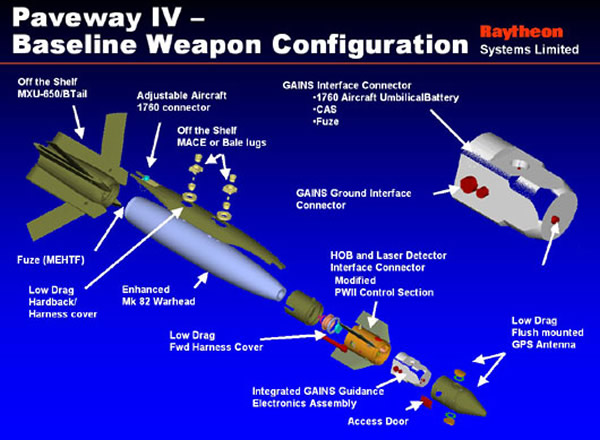
(click to view larger)
In 2003, Raytheon UK operation won the GBP 120 million pound contract to develop and produce Paveway IV, beating Boeing’s INS/GPS guided JDAM. The GPS/INS and laser-guided 500-pound bombs are a British project, and will add a number of other enhancements, including longer range than previous Paveway versions.
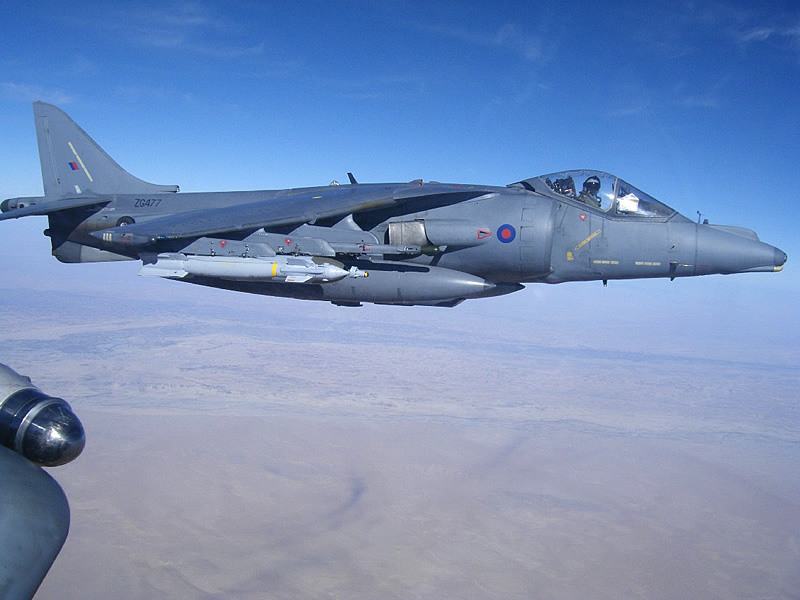
The British military had wanted to deploy Raytheon’s latest Paveway IV bombs in Afghanistan by September 2007, on board its newly-upgraded Harrier GR9 aircraft. Unfortunately, testing problems with Thales UK’s Aurora fuze removed that option. The MoD found a way to deploy the smart bombs with lesser capabilities by December 2007, and eventually deployed full Paveway IVs on its Harriers in Afghanistan. The weapon is now ready for use with its Tornado GR4 strike aircraft, which are replacing the Harriers, and has been qualified on the RAF’s Eurofighters.
Paveway IV: Capabilities and Challenges
Paveway IV is a 500 pound guided bomb, with limited glide capabilities using its tail fins. When integration work on the different aircraft types is added, the National Audit Office’s 2006 Major Projects Report forecast overall development costs of GBP 341 million. Raytheon UK has contracts to integrate Paveway IV on the F-35B (July 2007 contract, GBP 24 million), Tornado GR4 (agreement in principle, contract February 2008, in service by 2010, used in Libya 2011), and Eurofighter Typhoon F2 (issued from BAE, in service). It’s also scheduled to enter service with Britain’s F-35Bs as an internally-carried weapon, once the Block 3F software is fielded (scheduled 2018, but software delays make 2019 or later likely).
The Paveway IV brings 2 significant new capabilities to the table for the RAF, and for any future export customers.
One is joint laser/GPS guidance. GPS/INS guidance allows pilots to bomb from safe altitudes through clouds, into duststorms, and in other conditions that would make laser guidance impossible. When it can work, laser guidance offers more accuracy due to last minute corrections, and can even be used to hit moving targets under certain conditions.
(click to view larger)
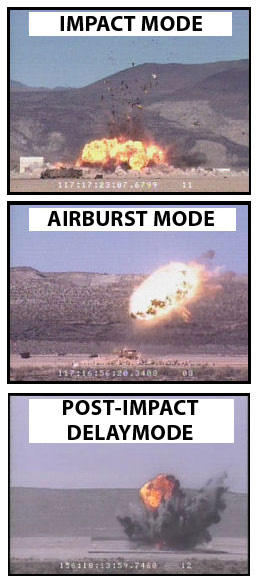
The other key capabilities Paveway IV brings reside in its programmable attack modes, which can be set from the cockpit during a mission.
One set of modes involves attack style. Within its range, which depends upon variables like speed and altitude of launch, the pilot can select a desired direction of approach and angle of impact. This improves the likelihood of the weapon’s arrival on target, and lowers the possibility of collateral damage in crowded urban areas.
The other programmable pilot option involves weapon fuzing. A UK-developed fail-safe fuse mechanism means that the bomb will only detonate once it has reached its intended target. When it does, the bomb has 3 fuzing modes. Airburst detonates at a set height above ground, to maximize the effect on soft targets out in the open. Detonate on impact is the standard mode. Delayed detonation after impact maximizes the bomb’s effect on hardened targets, by ensuring that more of the blast takes place inside.
The UK MoD’s SPEAR (Selective Precision Effects at Range) CAP 1 program will enhance the bomb with low collateral damage and penetrator warhead options, enhanced moving target capability thanks to laser seeker improvements, and enhanced range.
Challenge, and Response

(click to view full)
Unfortunately, those Thales “Aurora” variable fuzes turned out to be a problem. UK MoD, 2007:
“As a result of poor system reliability during operational evaluation trials, the Paveway IV in-service date is likely to slip. Mitigation action is being investigated and we cannot, as yet, confirm the new date.”
While other aspects of the system performed well, fuze difficulties mean bombs that don’t go off.
Fortunately for the Ministry, the Paveway IV contract was firm-priced, so the contractors bore the burden of any cost overruns caused by testing failures, re-work, extended schedules, etc. That work began quickly, even as production of other Paveway IV components continued. Once the fuzing issue was sorted out, deliveries would be able to ramp up as quickly as possible.
In the meantime, a clever swap gave British forces the front-line solution they needed. Since production of other components was underway, the RAF could join the Paveway-IV’s Enhanced Computer Control Group to an existing Paveway-II bomb. That gave them a usable weapon with all-weather capability, while waiting for the fuze fix.
Defense News’ August 20/07 report quoted Raytheon UK Paveway IV program manager John Michel, who believed that qualification of the complete Paveway-IV would be delayed at least until November 2007, with an estimated sign-off on the weapon’s final design certification coming at the end of 2007, and a new set of capability trials during “the first half of 2008.” He was reasonably close; front line usage began in November 2008.
Paveway IV: Contracts & Key Events
2015
Development of Penetrating Warhead ordered;
September 17/15: The United Kingdom has awarded a contract to Raytheon’s UK subsidiary for the development of a penetrating warhead for the Paveway IV guided bomb. Intended to equip the Royal Air Force’s fleet of Eurofighters, the new munition is scheduled to enter service in 2019 and replace the current penetration capability provided by the RAF’s Tornado GR4s and Paveway III bombs. The new warheads will fit existing stockpiles, with BAE Systems handling the integration work. Raytheon UK has stated that the new warhead will likely equip the RAF’s F-35Bs and could do the same with Reaper UAVs.
2013 – 2014
Saudi export sale; Eurofighter qualification; SPEAR upgrades.
Nov 27/14: UK F-35s. BAE Systems announces that initial aircraft handling trials were successfully conducted by a UK test team at the Patuxent River Naval Air Station, MD. 9 flights were performed by 2 F-35Bs carrying dummy Paveway IVs and ASRAAMs. The next series of tests will take place early next year with weapon separation then guided releases. This comes right after the Ministry of Defence signed a contract for the 1st production batch of 4 F-35Bs.
Nov 25/14: UK Typhoons. Trials continue to test air-to-surface capability onto the Typhoon Tranche 2 aircraft. Following last year’s P1E upgrades (q.v. Oct 28/13), the latest P1Eb program includes the successful release of 2 Paveway IV munitions to multiple targets, out of a possible 6 guided bombs RAF Typhoons will be able to carry. The test was executed by No 1(Fighter) Squadron at Cape Wrath Training Area.
P1Eb is focused on air to ground capabilities with enhancements to the Litening III Laser Designator Pod (LDP) and Helmet Equipment Assembly (HEA) (helmet mounted sight) integration. As of mid-October 2014 the RAF had 17 aircraft upgraded to that configuration. Source: Royal Air Force.
Nov 18/14: Penetrator variant. Defense News reports that according to the MoD, work is still underway on requirements and preliminary design of a bunker busting capability. This follows a July 11/12 announcement that at the time laid out 25 months of tests, under the SPEAR enhancement program. So this project has stretched by a few months beyond its original schedule but the MoD still sounds rather tentative, describing it as “potential future compact penetrator capability” [emphasis DID]. Source: Defense News, RAF To Be Equipped With Bunker Busting Version of Paveway IV.
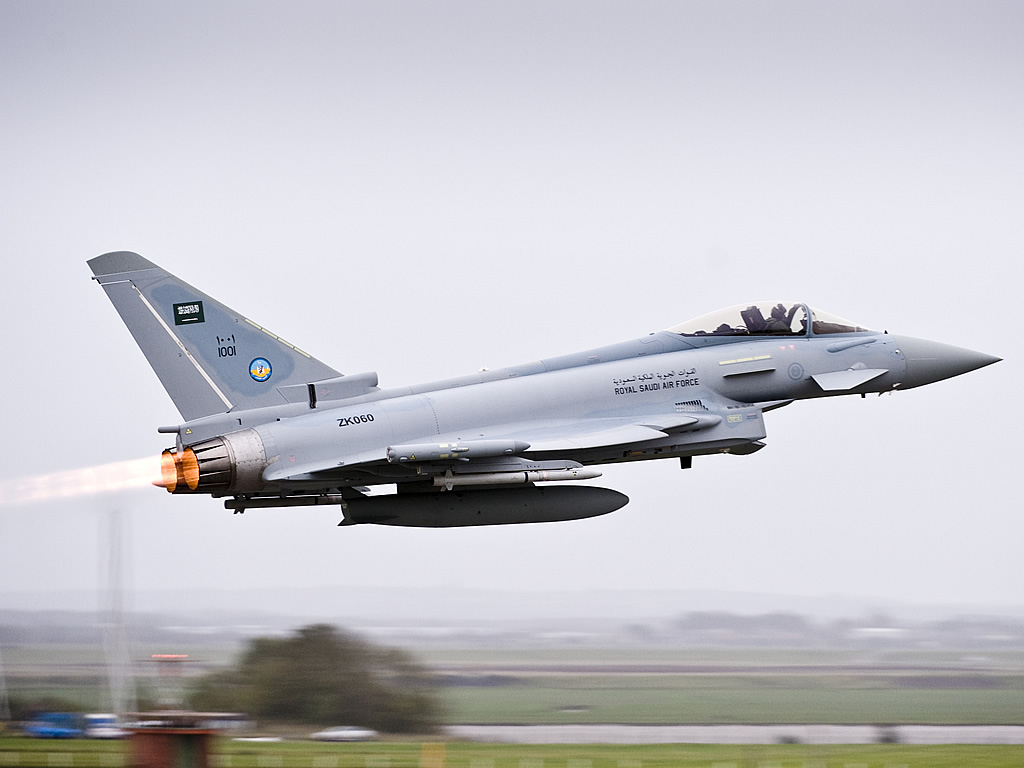
March 25/14: Exports. The Paveway IV has its 1st export customer. It will equip an “unidentified” nation, after long delays created by American attempts to use its ITAR weapons export procedures for protectionist purposes (q.v. July 16/13). The 2010 request was reportedly cleared in February 2014. One is surprised that Britain didn’t simply design the American technologies out.
The deal is generally believed to be worth around GBP 150 million, to equip the Saudi Arabian Air Force’s Tornado and Typhoon fighters. Deliveries are expected between 2015 – 2017.
It’s a timely order, as Britain’s replenishment buy (q.v. Dec 4/12) is finishing up to create about 4,000 total deliveries so far. Elsewhere in the Gulf, Oman should begin receiving their Eurofighters soon, creating another potential export customer now that there’s a precedent for ITAR clearance. Sources: Defense News, “Raytheon Secures First Export for Paveway IV” | Raytheon April 11/14, “Raytheon Awarded First International Contract for Paveway IV”.
Saudi export order
Oct 28/13: Eurofighter. The Eurofighter Typhoon Phase 1 Enhancements (P1E) program has finished flight testing in Manching, Germany and Getafe, Spain. the upgrades will be ready for installation and retrofit on existing Tranche 2 and new Tranche 3 aircraft by the end of 2013.
P1E implements full Air-to-Surface capability, with full integration of a Laser Designator Pod (RAFAEL LITENING III), full smart bomb integration (Paveway laser-guided, and dual-mode Paveway IV/ EGBU-16 with GPS and laser), Helmet Mounted Sight System upgrades for ground attack use, Mode 5 Identification Friend or Foe, improved Radios and Direct Voice Input, Digital integration of Short Range Air-to-Air Missiles (full IRIS-T integration with HMSS for high off-boresight shots, and allowing future AIM-9X integration), and an updated MIDS/Link-16 Datalink for wider interoperability. All of these enhancements will come factory-installed in Tranche 3 aircraft. Sources: Eurofighter GmbH, Oct 28/13 | Aviation Week, “Partners Chart Course For Eurofighter Typhoon Enhancements”.
July 26/13: Upgrades. AIN interviews Raytheon UK’s chief engineer of weapons systems, T.J. Marsden. Over 1,000 Paveway IVs have been dropped by the RAF so far, and Raytheon is preparing a number of upgrades under Britain’s Selected Precision Effects At Range (SPEAR) Capability 1 program.
One is a low collateral-damage warhead, which has undergone hydrocode modeling with help from QinetiQ and Cranfield University, and is moving to the prototype stage. A second project with QinetiQ involved a penetrator warhead (q.v. July 11/12), using a new discarding shroud design. The 3rd set of changes involves guidance: SASSM GPS anti-jam technology, proportional navigation for laser guidance, and a digitized laser seeker with a wider field of view for fast, maneuvering targets. Sources: AIN, “Raytheon UK Describes Paveway IV Upgrades”.
July 16/13: Saudi Arabia. IHS Jane’s reports that a Paveway IV export deal with Saudi Arabia is close.
“A long-awaited sale to Saudi Arabia of Raytheon’s Paveway IV precision-guided bomb is close to being signed…. will equip Eurofighter Typhoons with the Royal Saudi Air Force (RSAF)…. A senior programme source has told IHS Jane’s that “there is an imminent first export customer for the Paveway IV and we expect to have that signed and secured before the end of the year.” The source noted that the deal had been delayed by US technology transfer concerns and, specifically, a “reluctance by [the US] State [Department] to release that kind of capability into the region”.”
That last bit, of course, is pure bunk. Yes, the US State Department has placed itself in the way of British Paveway IV sales (q.v. March 19/12, June 2012). Somehow, the same State Department approved and released a Saudi DSCA export request on Oct 20/10, which included up to 1,000 Lockheed Martin DMLGB bombs. They match the Paveway IV very closely: 500 pound bombs with dual GPS/laser guidance. Sources: IHS Jane’s Defence Weekly, “Saudi Paveway IV deal gets the green light”.
2011 – 2012
Britain buys more, but USA stalls export sales; Eurofighter integration.

(click to view full)
Dec 4/12: UK. Raytheon UK announces a GBP 25 million contract to supply the RAF with more Paveway IVs. This latest contract will adhere to the accelerated delivery timeframe of the 2 previous orders, placed over the last year. This order would bring the total for all 3 to about GBP 99 million (about $160 million at this point). UK MoD | Raytheon.
UK buy
July 11/12: UK Buy, Penetrator variant. Raytheon UK announces a GBP 14 million British order for Paveway-IV bombs.
The release also announces progress on a “bunker busting” penetrator warhead, in collaboration with QinetiQ and Thales. The new variant has the same outer shape and mass, and has just finished sled trials at the Pendine test range. Next steps in the 25 month initiative will include transportation, handling and air carriage tests. Raytheon UK and QinetiQ have been working closely with Thales on this aspect of the SPEAR CAP 1 program, under the UK’s Weapon Technology Centre Compact Penetrator program.
UK buy
June 2012: Saudi Arabia. Combat Aircraft reports that Saudi Arabia is considering France’s AASM Hammer GPS-guided bombs for its Eurofighter Typhoons, given problems securing American export approval for Raytheon UK’s dual-mode Paveway IV. The SBU-38 GPS-guided and SBU-54 dual-mode GPS/IIR variants are deployed on French aircraft, and a dual-mode SBU-64 AASM laser/GPS variant is in testing.
The bad news is that the Saudis would have to pay full freight for integration of the AASM onto the Eurofighter, then find a way to get it squeezed into existing P1E development priorities. Sources: Combat Aircraft, “Saudi Typhoon Advances.”
April 3/12: UK. The UK gives Raytheon UK a GBP 60 million (currently about $95 million) replenishment contract, to restore the national stockpile in the wake of the Libya conflict. Raytheon had already begun long lead-time procurement and worked with its supply chain, shortening the delivery schedule from 18 months to 7 months. The UK MoD is certainly enthusiastic about the weapon, vid. Wing Commander Clive Roads, IGMR FreeFall IPT Leader:
“The MOD is extremely pleased to work with a company which understands the operational imperative, placing this first in their support to our Forces. Raytheon UK have been able to react very quickly to the need to replenish our stocks of… Paveway IV… to maintain our ability to react at short notice to emerging threats. The weapon has now been extensively used in all types of employment roles and has proven to exceed all expectations for reliability, accuracy and its ability to limit collateral damage through its sophisticated and integrated guidance, and fuzing systems.”
Raytheon adds that it will pursue a number of export opportunities for Paveway IV, “particularly where Typhoon and Tornado are deployed and the weapon is already integrated.” The export customer prospect list for Tornado & Eurofighter comprises Austria, Germany, Italy, Spain, and Saudi Arabia. Germany, Italy & Spain aim to equip their Typhoons with the dual-mode EGBU-16 Paveway-III, which suggests that Raytheon UK may have its best opportunity with the Saudis. UK MoD | Raytheon.
UK buy & Export prospects
March 19/12: Saudi Arabia. Defense News reports that the USA is blocking efforts to sell Paveway IVs to Saudi Arabia:
“The deal to sell Paveway IV weapons developed by Raytheon’s U.K. arm has been on the table since mid-2010, but the U.S. State Department has rebuffed British efforts to secure ITAR approval despite high-level intervention by the government…”
Which is odd, because they allowed a request for DMLGB weapons with the same capabilities to become part of Saudi Arabia’s OCT20/10 DSCA export request. Sources: Defense News, “U.K., U.S. at Odds Over Saudi Deal”.
Dec 5/11: Eurofighter. Raytheon announces that the Paveway-IV has been successfully released from (vid. March 5/11) and integrated with the Eurofighter Typhoon multirole fighter. The release says that “Initial operational capability is planned for 2011,” but it’s the end of 2011 already. The original schedule was 2013.
July 5/11: Support. Raytheon announces a 4-year, GBP 10 million (about $16 million) contract to continue in-service support for Britain’s full set of Paveway weapons, including the new Paveway IVs. Raytheon UK will be responsible for configuration management, design support, obsolescence, safety management, spares provision and quality assurance. Flt. Lt. Chris Wright, 31Sqn QWI, was quoted re: Paveway IV use in Afghanistan and Libya:
“Paveway IV has brought us to a new level in weaponeering capability. Simple to employ with generous launch envelopes, the ability to alter the flight, impact and fusing of the weapon in-cockpit all the way until release, gives aircrew huge flexibility in achieving the exact effect desired. This has resulted in it being our weapon of choice for a wide range of targets and is hugely popular with Forward Air Controllers who love the range of effects available in one weapon from airburst to delay fusing, and hybrid laser and GPS guidance.”
This agreement builds on the 2005 RaPID agreement.
March 7/11: Eurofighter. The first ever Eurofighter release of a Paveway IV dual guidance bomb takes place from development aircraft IPA6, in an hour long test flight over the Aberporth Range in Wales. BAE Systems | Eurofighter GmbH, incl photo.
Jan 20/11: Raytheon announces a $475 million contract with the Kingdom of Saudi Arabia for Paveway II and Paveway III kits, including dual-mode Enhanced Paveway weapons with laser and GPS guidance. Read “Saudi Smart Bombs: Paveways from Raytheon“.
2007 – 2010
Initial problems overcome; Harriers qualified; Tornado GR4s qualified; Paveway IV operational.
(click to view full)
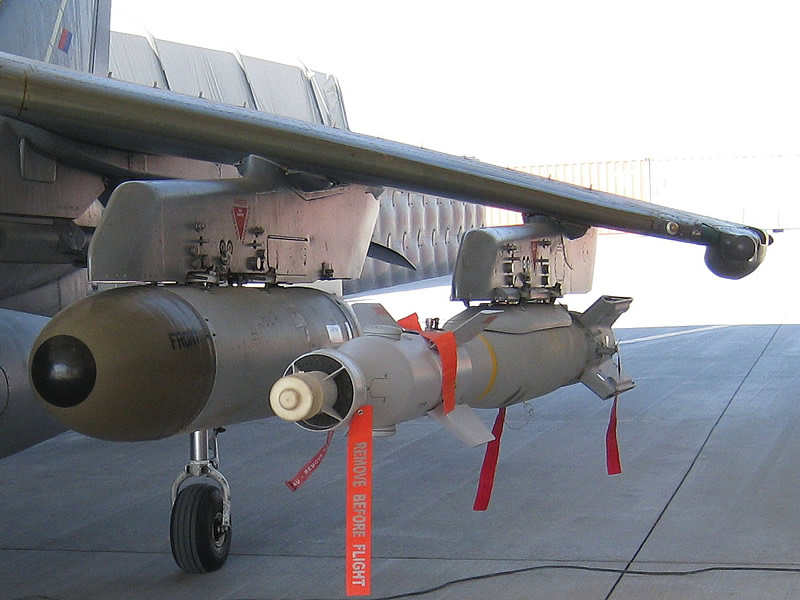
July 16/09: Tornado. A UK Ministry of Defence article announces that Paveway IV is ready for operational use on Britain’s Tornado GR4 strike aircraft, which are replacing the Harriers at Kandahar airfield in Afghanistan.
Tornado ready
Dec 10/08: Operational. The UK Ministry of Defence officially declares that the Paveway IV has entered operational service. At the moment, its sole platform is the Harrier GR9. A Defense News article contends that the weapon deployed to Afghanistan in November, and has been used in combat. UK MoD | Defense News.
Into service
Aug 1/08: Testing. The Royal Air Force reports that the Paveway IV has completed its combined Demonstration of Capability and Operational Evaluation Trials, which were conducted in the USA at the Naval Air Warfare Centre in China Lake, CA. The trials demonstrated the full range of Paveway IV’s capabilities, including all of the weapon’s fuzing modes. The RAF added that:
“Whilst the formal AWC trials reporting process is ongoing, there were no issues identified which would prevent the weapon’s progression into Service.”
The tests were conducted using Harrier GR9 aircraft. As noted above, further integration of Paveway IV onto Britain’s Tornado GR4 strike fighters and Eurofighter Typhoons is underway, and weapon integration will also be extended to the future F-35B Lightning II.
Feb 20/07: Tornado. Raytheon’s UK subsidiary adds the RAF’s Tornado GR4/4A strike aircraft to its strike contracts, moving from agreement in principle to a GBP 8.5 million (about $16.6 million) contract to integrate the weapon with that fighter fleet in 2010.
The program will focus on providing weapon system performance documentation, advice to the development of the aircraft stores management systems, and flight clearance of the weapon onto the aircraft. In support of the flight trials and certification program, Raytheon will provide BAE Systems with the required trials hardware and weapon system simulators. Raytheon Missile Systems in Tucson, AZ, will supply the enhanced computer control group, telemetry sub-systems, instrumentation, test equipment and associated support. Raytheon release.
(click to view full)
Dec 6/07: Redesign. When there’s a will, there’s a way. In response to an Urgent Operational Requirement (UOR) for better aerial support in Afghanistan, representatives from BAE Systems and the MOD met key suppliers in the United Kingdom and America (Raytheon Missile Systems, Portsmouth Aviation Limited, and EDO-MBM). Contracts were exchanged in just 10 days, and 4 months later, weapons are headed into theater.
How to get around the problems with Paveway-IV? By joining the Enhanced Computer Control Group from a Paveway-IV to an existing Paveway-II bomb. Integration of the new weapon, rig test, flight trials, weapon performance analysis and certification are all complete, and the hybrid weapon provides the UK’s GR9A Harriers with an integrated precision bombing capability that will still work through clouds, dust storms, and other obscurants. UK MoD release.
Interim solution
Additional Readings
* UK MoD’s DSTL – Precision guided Paveway IV.
* Raytheon UK – Paveway IV brochure [PDF, 2007 snapshot]. It’s de-emphasized on the corporate site, mentioned under Raytheon UK Missile Systems.
* RAF – Paveway IV
* UK Defence Suppliers Directory (not MoD) – Precision Guided Bomb (PGB) Weapons System (Paveway IV)