


(click to view full)
Thermal sights on weapons see heat. This has advantages in complete darkness, or in the presence of obscurants like dust storms, normal smoke, etc. because they can still pick out human and vehicle targets. Using deep infrared viewers also avoids “blooms” or whiteouts if someone flashes a bright light source like a flashlight at you. On the other hand, unless the lines on your map or lettering on that street sign have different heat values, thermal/ “deep infrared” sights aren’t going to help very much. This is why most 3rd and 4th generation night vision goggles use a combination of thermal and light intensifier technologies.
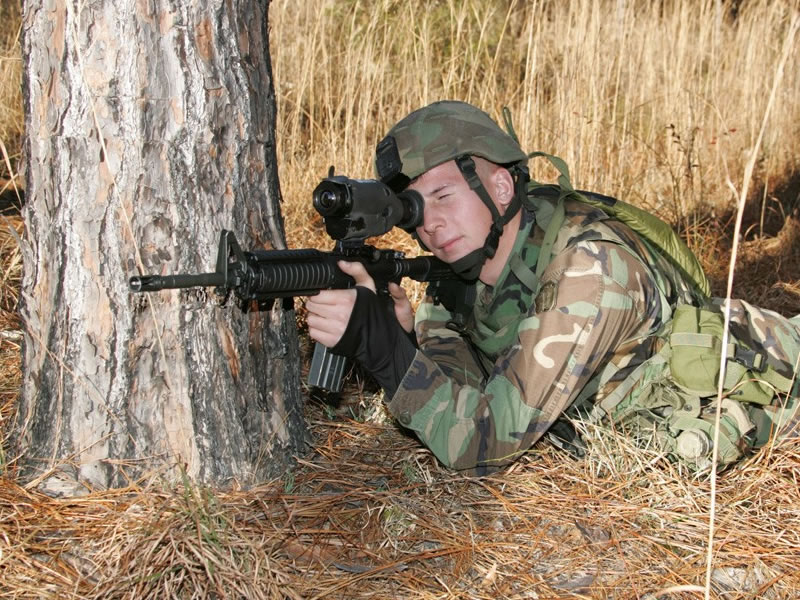
The AN/PAS-13 thermal weapons sights are used in more limited capacities, either as weapons sights or without a weapon as a sort of hand-held “night telescope.” The second generation of these sights is now being fielded, and are the subject of additional multi-billion orders from the US military.
AN/PAS-13 thermal weapon sights
(click to view full)
The new sights use microbolometer thermal imaging technology, which increases their surveillance and target acquisition range in all weather conditions, while shrinking the sights’ size and weight. Bolometers measure electric resistance changes with temperature, and their compatibility with standard CMOS silicon circuits allows for uncooled thermal sights with low cost of production, plus VLSI (Very Large Scale Integration) ‘active pixel’ architectures that place all camera functions on a single chip. Because it’s all solid-state electronics, the number of moving parts and hence breakage risks are also lower than previous generation technologies like “chopper” assemblies.
TWS-II sights also offer a dual field of view via E-Zoom, video output, and electronically programmable reticles with alphanumeric system information overlaid on the eyepiece display. This family of thermal weapons sights come in 3 versions. All statistics given are for the TWS-II variants:
AN/PAS-13 (V)1 Light Thermal Weapon Sights (LTWS) for 5.56mm M-16/M4 assault rifles and M136/AT-4 anti-tank rockets. These sights include features like a 15 degree horizontal field-of-view lens designed for urban warfare and other wide-view, close-in focus situations.
Target Recognition Range: 550 meters
Weight LWTS: 1.8 pounds
Operational Time: 5 – 25 hours (4 Lithium AAs)
Field of View: 15 degrees
Magnification: 1.55x
AN/PAS-13 (V)2 Medium Thermal Weapon Sights (MTWS) that mount to M249 “Minimi” 5.56mm Squad Automatic Weapons and M240 family 7.62mm machine guns.
Target Recognition Range: 1100 meters
Weight: 2.8 pounds
Operational Time: 6.5 – 18 hours (6 Lithium AAs)
Field of View: 6 degrees/18 degrees (narrow/wide)
Magnification: 5x/1.66x (narrow/wide)
AN/PAS-13 (V)3 Heavy Thermal Weapon Sights (HTWS) mount to M2 .50 cal heavy machine guns, 40mm grenade machine guns like the Mk19 and Striker40; and on sniper weapon systems like modified M4/M16s, the 7.62mm M24 sniper rifle, and the .50 cal M107 long range sniper rifle.
Target Recognition Range: 2200 meters
Weight: 3.9 pounds
Operational Time: 6.5 – 18 hours (6 Lithium AAs)
Field of View: 3 degrees/9 degrees (narrow/wide)
Magnification: 10x/3.3x (narrow/wide)
The use of AA batteries, instead of the TWS-I sights’ proprietary military batteries, is a very large and important change. Even in war zones, AA batteries are often available in local shops, giving units in the field more options to keep their gear going.
The medium and heavy sights interface with a variety of 26mm, 52mm, 62mm, 103mm, 150mm and 156mm telescopes. Menu-based, push-button controls are used for operating reticle selection and adjustment, polarity, and brightness, while drop-in upgrades are meant to help ‘future proof’ the sights by making upgrades simpler.
New TWS: Contracts & Key Events
Raytheon in Dallas, TX wins a $68.7 million contract for 9,001 thermal weapon systems, an average of $7,630 per. Work will be performed in Dallas, TX, with an estimated completion date of June 30/12 (W91CRB-07-D-0029).
BAE Systems in Belcamp, MD wins a $58 million contract for 6,000 thermal weapon systems, an average of $9,670 per. Work will be performed in Belcamp, MD, with an estimated completion date of June 30/12 (W91CRB-07-D-0030). See also BAE release.
Finmeccanica subsidiary DRS in Palm Bay, FL wins a $68.2 million contract for 6,876 thermal weapon systems, an average of $9,922 per. Work will be performed in Palm Bay, FL, with an estimated completion date of June 30/12 (W91CRB-07-D-0031).
These are not multiple-award contracts, so totals are cumulative: about $194.9 million for 21,877 sights. That’s an average of about $8,910 per sight when exact figures are used. On the other hand, the individual firm averages suggest that they may be supplying different size mixes, so comparisons and averages are of limited value without those exact breakdowns.
Sept 1/10: BAE Systems announces a $123 million order under its 5 year, indefinite-delivery/ indefinite-quantity TWS contract. This order increases the total contract value to more than $1 billion since 2004.
BAE Systems’ release adds that they’ve also received a $14 million multi-year contract to provide these sights to the Canadian Army, using the same MicroIR uncooled infrared sensor technology. Some of those sights will end up on Canada’s new HK 40mm Grenade Machine Guns. See also Defence Watch.
June 7/10: Finmeccanica subsidiary DRS announces $140 million in thermal weapon sight orders, via U.S. Army PEO Soldier, Project Manager Soldier Sensors and Lasers (PM SSL). The units will be manufactured by DRS Reconnaissance, Surveillance & Target Acquisition (RSTA) business group in Melbourne, FL and Dallas, TX.
The orders are part of a $387 million contract, presumably W91CRB-07-D-0031. They include $68 million in Light, Medium and Heavy Weapon (V1-V3) Thermal Sights for the U.S. Army, to be delivered from January through December 2011. Another $72 million in Medium and Heavy (V2-V3) Weapon Thermal Sights are for the US Marine Corps, to be delivered from October 2010 through July 2011.
March 27/09: Raytheon Systems in McKinney, TX receives a $94.5 million indefinite-delivery/ indefinite-quantity contract with firm-fixed-priced delivery orders for 12,105 thermal weapons sights and the start of 17-micron technology insertion.
Work is to be performed at McKinney, TX (65%) and Goleta, CA (35%) with an estimated completion date of Nov 30/10. Bids were solicited on the World Wide Web, with 3 bids received by the U.S. Army Research, Development and Engineering Command Contracting Center in Aberdeen Proving Ground, MD (W91CRB-07-D-0029).
March 27/09: BAE Systems in Lexington, MA received a $137.6 million indefinite-delivery/ indefinite-quantity contract with firm-fixed-priced delivery orders for 16,155 thermal weapon sights. BAE’s May release adds that:
“This award increases the value of the current contract to more than $563 million [for BAE, so far]. To date, BAE Systems has delivered more than 42,000 sights to meet Army fielding requirements…”
Work is to be performed at Lexington, MA, with an estimated completion date of Nov 30/10. Bids were solicited on the World Wide Web, with 3 bids received by the U.S. Army Research, Development and Engineering Command Contracting Center in Aberdeen Proving Ground, MD (W91CRB-07-D-0030).
March 27/09: DRS Sensors and Targeting Systems, Inc. in Palm Bay, FL received a $120 million indefinite-delivery/ indefinite-quantity contract with firm-fixed-priced delivery orders for 13,123 thermal weapon sights. The order is a follow-on to an existing 5-year, $2.3-billion Indefinite Delivery Indefinite Quantity (IDIQ) TWS II Bridge contract awarded in 2007; orders against that contract now exceed $230 million, and additional bridge orders are expected as funding becomes available.
DRS is currently delivering TWS II Bridge systems on schedule, at rates growing beyond 2,000 systems per month. Work is to be performed at Melbourne, FL (65%) and Dallas, TX (35%) with an estimated completion date of Nov 30/10. Bids were solicited on the World Wide Web, with 3 bids received by the U.S. Army Research, Development and Engineering Command Contracting Center in Aberdeen Proving Ground, MD (W91CRB-07-D-0031). See also DRS release.
March 10/08: BAE Systems announces a $130 million U.S. Army order for production of thermal weapon sights, from The Army’s Program Executive Office Soldier at Fort Belvoir, VA. This is the 2nd award under a 5-year indefinite-delivery/ indefinite-quantity contract (vid. July 2/07 entry), and increases the total contract value to more than $313 million. It also increases BAE Systems’ monthly deliveries to 3,000 units per month, beginning in 2009. Discussion with BAE confirms that this is an order under W91CRB-07-D-0030.
BAE’s release adds that they have delivered more than 20,000 thermal weapon sights to date under a separate 5-year, $295 million contract administered by the Army’s Communications-Electronics Command at Fort Monmouth, New Jersey. Final deliveries will be complete in 2008, more than 15 months ahead of the original contract schedule.
July 2/07: Raytheon Systems in McKinney, TX received, a delivery order amount of $63.4 million as part of a $2.61 billion firm-fixed-price contract for thermal weapons sights with associated testing. Work will be performed in McKinney, TX (65%), and Goleta, CA (35%), and other north Texas locarions, and is expected to be complete by June 30, 2012. Bids were solicited via the World Wide Web on March 9, 2007, and 3 bids were received by the U.S. Army Research, Development, and Engineering Command at Aberdeen Proving Ground, MD (W91CRB-07-D-0029).
Raytheon will begin supplying improved AN/PAS-13 thermal weapon sights in December 2007, beginning with this delivery order for approximately 5,000 systems. The entire indefinite delivery-indefinite quantity program is potentially worth $2.6 billion and could result in the delivery of up to 150,000 during the 5-year, firm-fixed-price contract. The latest sights will feature technology improvements that result in lower power requirements, reduced size and weight, and improved commonality, making Mission Support more efficient and economical during the life of the equipment. Raytheon was the first government-qualified supplier of AN/PAS-13 light, medium, and heavy thermal weapon sights, and has delivered in excess of 28,000 to the Army. Raytheon release.
July 2/07: BAE Systems in Lexington, MA received a delivery order amount of $183.25 million as part of a $2.19 billion firm-fixed-price contract for thermal weapons sights with associated testing. The order is their first award under a new 5-year indefinite delivery/indefinite quantity contract managed by the Army’s Program Executive Office Soldier at Fort Belvoir, VA. Work will be performed in Lexington, MA (70%), and Manassas, VA (30%), and is expected to be complete by June 30, 2012. Bids were solicited via the World Wide Web on March 9, 2007, and 3 bids were received by the U.S. Army Research, Development, and Engineering Command at Aberdeen Proving Ground, MD (W91CRB-07-D-0030).
BAE Systems is already under contract to produce and deliver more than 29,600 sights under the 5-year, $295 million Thermal Weapon Sights II (TWS-II) contract administered by the Communications-Electronics Command at Fort Monmouth, NJ. To date, BAE has delivered more than 11,000 TWS-II sights to meet critical Army fielding requirements in support of ongoing operations in Iraq and Afghanistan. This award will increase their production rates to 3,000 per month. BAE Release.
July 2/07: DRS Sensors and Targeting Systems Inc. in Palm Bay, FL received a delivery order amount of $14.4 million as part of a new $2.28 billion firm-fixed-price contract for thermal weapons sights with associated testing. Work will be performed in Melbourne, FL (65%), and Dallas, TX (35%), and is expected to be complete by June 30, 2012. Bids were solicited via the World Wide Web on March 9, 2007, and 3 bids were received by the U.S. Army Research, Development, and Engineering Command at Aberdeen Proving Ground, MD (W91CRB-07-D-0031).
Nov 6/06: DRS Technologies, Inc. announces approximately $76 million in new orders to produce next-generation advanced uncooled Thermal Weapon Sights II (TWS II) for U.S. Army soldiers: Up to 1,600 light, 3,900 medium, and 2,000 heavy versions. The award is part of a competitively secured 5-year contract awarded in March 2004, with a total potential value of $375 million if all options are exercised.
Work will be performed by the company’s DRS Sensors & Targeting Systems – Optronics Division in Palm Bay and Melbourne, FlL; and by DRS’ Infrared Technologies Division in Dallas, TX and Irvine, CA. The firm has recently expanded production facilities and operations in Florida and Dallas to meet the continuing and growing demand, and expects to be producing and delivering in excess of 1,000 systems per month by the end of the year.
Additional Readings
* DID – Night Vision Tech Used by American Troops
* US Army PEO Soldier – AN/PAS-13 Thermal Weapon Sight Fact Sheet [PDF]
* Raytheon – AN/PAS-13B Thermal Weapon Sight. Includes PDF fact sheet.
* Armada International (2005) – Uncooled IR is the new cool
* Military & Aerospace Electronics (January 2005) – Optoelectronics help Special Forces shoot farther and more accurately
* Wikipedia – Microbolometer