

The Raytheon Co. in Waltham, MA received an indefinite delivery/indefinite quantity contract to provide logistics support services to operate and maintain up to four forward based X-Band transportable radars to support the Ballistic Missile Defense System. The maximum potential value of the contract is $260.9 million. Most work will take place at Raytheon Integrated Defense Systems in Woburn, MA from 26 May 2005 through 25 May 2010. The Missile Defense Agency issued the contract (HQ0006-05-C-0016).
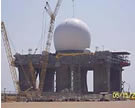
Meanwhile, the final touches are being put on the 280-foot (85-metre) tall sea-based X-band radar system that’s expected to ship out on a 20,000-mile (32,000-km) trip from Ingleside/Corpus Christi, TX to Adak, AK in the Aleutian Islands. The $815 million Raytheon radar, a distant relative of the X-band radar used by police to detect speeding drivers, is designed to detect incoming missiles instead.
The radome alone weighs 18,000 pounds, stands over 103 feet high, and is 120 feet in diameter. Made entirely of a high-tech synthetic fabric, it’s supported by air pressure alone and is designed to withstand 130+ mph winds and a “100-year storm” at sea. This makes it far more durable than any air-supported radome of remotely comparable size, and the radome’s design and fabrication required development of several new processes, materials, and technologies. The radar has been fitted to a huge mobile oil platform built by a Russian firm, that normally would steam out to offshore waters and be used as a base to drill oil and gas wells. Instead, it will steam at a top speed of about 7mph and add a mobile element to the USA’s missile defense network.
The platform is expected to arrive in Adak on schedule by late December 2005, and may get a full test when it nears Hawaii and a nearby missile range on its voyage north. Integration, testing and certification will evaluation will continue throughout its voyage.
The X-band radar, also known as the SBX, was originally planned as a land-based system but a sea-based system became possible when the Bush administration withdrew from the 1972 Anti-Ballistic Missile Treaty. The radar’s position in the northern Pacific will allow it to keep an eye on North Korea, which is viewed as the greatest missile threat to the United States at present. Although homeported in Adak, it will be capable of moving throughout the Pacific Ocean to support both missile defense advanced testing and defensive operations.
Initially, the SDX will provide the Ground-based Midcourse Defense (GMD) element of the Ballistic Missile Defense System with an advanced training and decoy discrimination capability that will help interceptor missiles located in Alaska and California provide a defense against a limited long-range missile attack.
The radar is by far the largest of its kind, which will allow it to scan a horizon of about 2,500 miles (4,000 km) at a sensitivity so great it could detect the movement of a baseball at the opposite end of the United States. Information from the radar would go to the missile system nerve center in Colorado Springs, Colorado, which could then deploy defensive missiles from sites in Alaska and California.
Boeing Co. is the prime contractor on the Ground-based Midcourse Defense system, which would be tasked with the response. Tests of intercept missiles thus far have literally been hit-or-miss, with close to half of the interceptors either not getting off the ground or missing the target. System development on the GMD element will continue.
Additional Readings and Sources:
* U.S. DoD DefenseLink Release
* Reuters (June 7/05) – Missile defense radar nearing completion in Texas
* SpaceWar.com (May 23/05) – Radome Successfully Intsalled on Sea-Based X-Band Radar
* Claremont Institute, MissileThreat.com – Sea-Based X-Band Radar (SBX)
* HowStuffworks.com – How Missile Defense Systems Will Work