

(click to view full)
The 250 pound GBU-39 Small Diameter Bomb gives American fighters the ability to carry more high-precision GPS-guided glide bombs, without sacrificing punching power against fortified targets. The initial award to Boeing was controversial, and the Darlene Druyun corruption scandal ultimately forced a re-compete of the Increment II development program. Whereas the initial GBU-39 SDB-I offered GPS-guided accuracy in a small and streamlined package, the goal of the GBU-53 SDB-II competition was a bomb that could hit moving targets in any weather, using a combination of guidance modes.
For the SDB-II competition, Boeing found itself allied with Lockheed Martin, its key opponent for the initial SDB-I contract. Its main competitor this time was Raytheon, whose SDB-II bid team found itself sharing its tri-mode seeker technology with a separate Boeing team, as they compete together for the tri-service JAGM missile award against… Lockheed Martin. So, is Raytheon’s win of the SDB-II competition also good news for its main competitor? It’s certainly good news for Raytheon, who wins a program that could be worth over $5 billion.
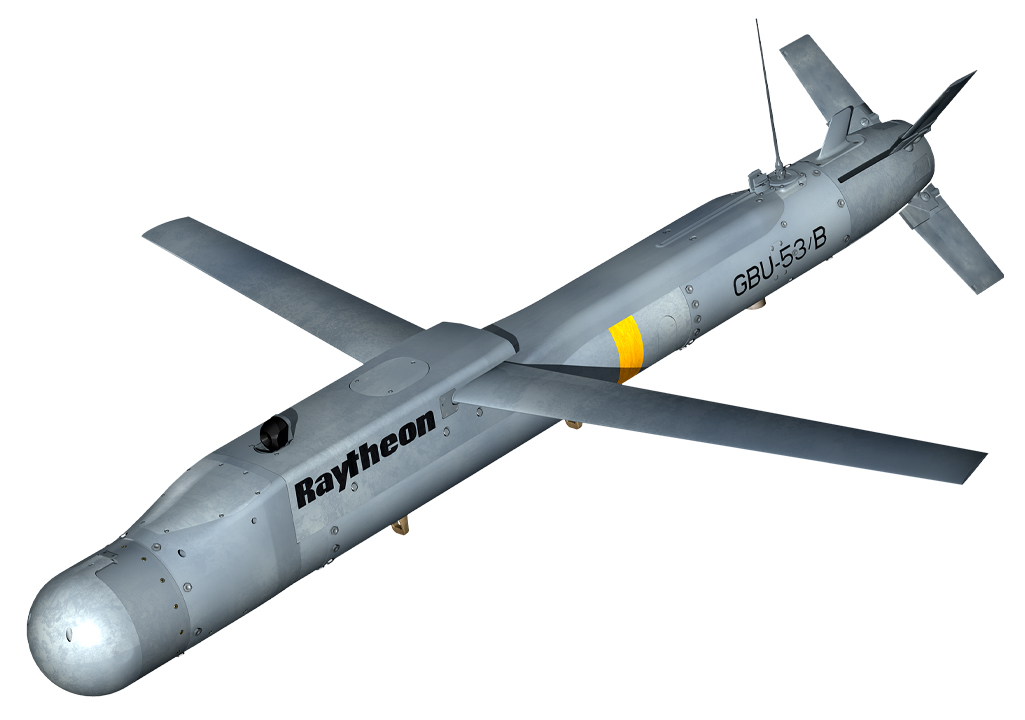
Raytheon’s GBU-53 Small Diameter Bomb
(click to view full)
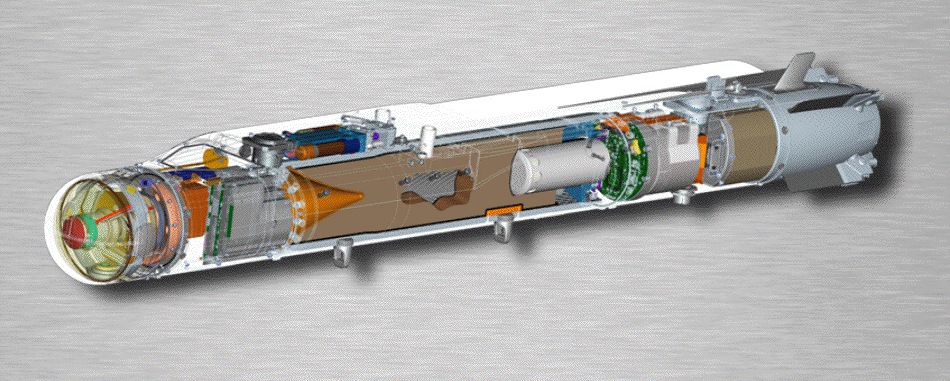
Raytheon’s GBU-53/B SDB-II is 7″ in diameter around the tri-mode (laser, IIR, radar) seeker, with a clamshell protective door that comes off when the bomb is dropped. A GPS receiver adds a 4th targeting mode. The bomb tapers to about 6″ diameter beyond the pop-out wings, and is about 69.5″ long. The wings remain swept back when deployed, and are about 66″ across with a 5 degree anhedral slope. The bomb weighs about 200 pounds, and all of these dimensions are important when trying to ensure that the US Marines’ F-35B, with its cut-down internal weapon bays, can still carry 4 of them per bay.
The US Navy is developing a Joint Miniature Munitions BRU to address internal F-35 carriage, and SDB-II also fits on BRU-61 external bomb racks. No word yet on whether the JMM BRU will also fit in the USAF’s F-22A, which is also slated to deploy this weapon.
Range is expected to be up to 40 nautical miles when launched at altitude, thanks to a high lift-to-drag ratio in the design. Since SDB-II is an unpowered glide bomb, its actual range will always depend on launching altitude and circumstances. An F-22A would be able to extend that range significantly by launching at supercruise speeds of Mach 1.5, for instance, as long as the bomb proves safe and stable at those launch speeds.
SDB-II’s Attack Modes: Seekers & Sequences
(click to view larger)
Once a target is picked by the pilot, initial communication and GPS coordinates are transmitted between the aircraft and the SDB-II bomb using the Universal Armament Interface (UAI) messaging protocol, which was designed to make integration of new weapons easier. The post-launch datalink will be Rockwell Collins’ TacNet, a 2-way, dual band link that enters the network quickly using encrypted UHF radio frequencies from the ground or secure Link-16 from the launching aircraft, and provides both weapon and target status to the shooter. TacNet’s datalink software is programmable if other frequencies/waveforms need to added in future, and Raytheon cites a message speed of 38 messages per minute as further evidence of the system’s ability to keep pace with future needs. Link-16 makes the weapon part of a much larger system, and gives SDB-II the ability to be dropped by one platform and then targeted or re-targeted by another. The bomb can also be sent an abort command, if necessary. If the link is lost, the bomb will continue with its mission, using its own on-board seekers.
Raytheon’s SDB-II contender uses a close precursor of the tri-mode seeker technology featured in the joint Raytheon/Boeing bid for the JAGM missile, which adds some refinements. The SDB-II uses jam-resistant GPS/INS targeting like Boeing’s GBU-39 SDB-I, but its added seeker features 3 modes of operation: semi-active laser, millimeter-wave radar, and uncooled imaging infrared. By combining these 3 modes, the GBU-53 can have excellent performance against a variety of target types, under any weather conditions, while making it much more difficult to use countermeasures or decoys successfully:
[youtube:v=yhlqr9pYhig]
click for video
Semi-active laser guidance. This is standard for a wide range of missiles and rockets, and offers the best on-target accuracy and assurance, especially in urban environments. Its flip side is problematic performance through heavy fog, sandstorms, etc. That’s where GPS/INS guidance to a specified coordinate, and the next 2 fire-and-forget modes, come in.
Millimeter wave radar will operate through any weather. It’s especially good at distinguishing metal targets and noting movement, and is used in weapons like AGM-114 Hellfire Longbow missiles to give them “fire and forget” capability. These days, most people probably hear the term and think of airport scanners.
Imaging infrared (IIR) This was adapted from the much larger AGM-154 JSOW glide bomb, and uses high-resolution thermal scans to create a target picture. It also helps with target identification, and offers better performance against some kinds of targets like humans. By using an uncooled IIR seeker, the bomb lowers both its cost and its maintenance requirements. The uncooled seeker also allows snap-attacks against targets that present themselves quickly, since the it doesn’t need any time to cool down before it begins to work.
[youtube:v=C8LoRO5UHoQ]
click for video
Once launched, the SDB-II relies on a sophisticated package of internal computing and algorithms that are designed to get the most out of its tri-mode sensors, and make the process of launch and targeting as simple and flexible as possible for the pilot. The GPS/INS system or datalink messages guide the bomb toward the target during the initial search phase, while the tri-mode seeker gathers initial data. A revisit phase combines information from all of its sensor modes to classify targets. That’s especially useful because the SDB-II can be told to prioritize certain types of targets, for example by distinguishing between tracked and wheeled vehicles, or by giving laser “painted” targets priority.
(click to view full)
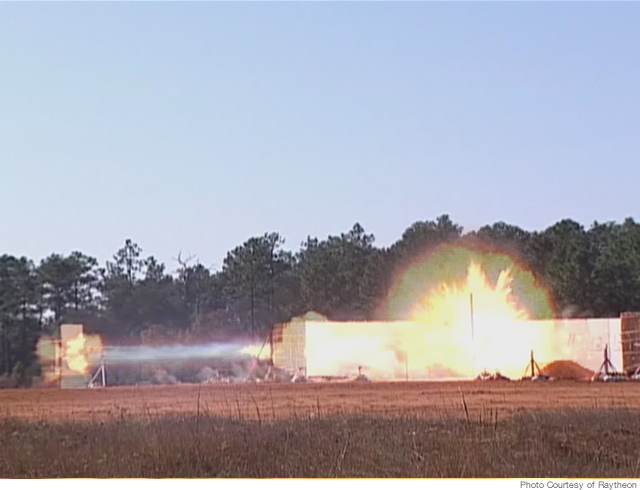
Different targets require different warhead types, which is why the GBU-53 contains a warhead from General Dynamics Ordnance & Tactical Systems that delivers shaped charge, blast and fragmentation effects all at once. A scored blast and fragmentation warhead makes it deadly against buildings and people as well.
This warhead was actually redesigned mid-way through the development phase, as the USAF added a requirement to destroy main battle tanks. That initial hardship became a positive experience, as the redesign actually ended up shrinking Team Raytheon’s bomb’s size, and improving its manufacturing costs.
SDB-II: The Program
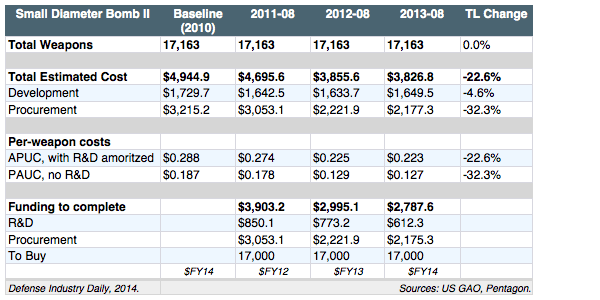
As of 2013, the Boeing SDB-I/ GBU-39 Small Diameter Bob program was finished production at 12,300 weapons, and 2,000 BRU-61 bomb racks. Another 350 specialized Focused Lethality Munitions use carbon fiber bodies to deliver more near-field blast and less collateral damage; their last order was in FY 2012. Going forward, SDB-II is expected to be the default buy.
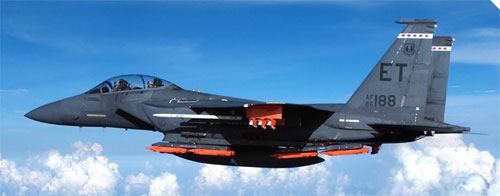
The overall program target for SDB-II is about 17,000 weapons over about 11 years: 12,000 bombs for the USAF, and 5,000 for the US Navy. Initial fielding will take place on USAF F-15E Strike Eagles, and F/A-18 E/F Super Hornets, even though the USMC and US Navy’s F-35B/C Block 4s are technically the program’s 2nd “threshold aircraft. Software development issues are likely to push F-35 fielding to 2022 or later in practice. Planned candidates for future fielding include F-16, F-22A, and F-35A multi-role fighters; B-52, B-1B, and stealth B-2A bombers; and MQ-9 Reaper drones.
Special Operations Command is even considering it for their AC-130 gunships, though they aren’t an official “objective” platform just yet. SDB-II was also supposed to equip the USAF’s A-10C close support planes, but the Pentagon is battling Congress to cancel the program.
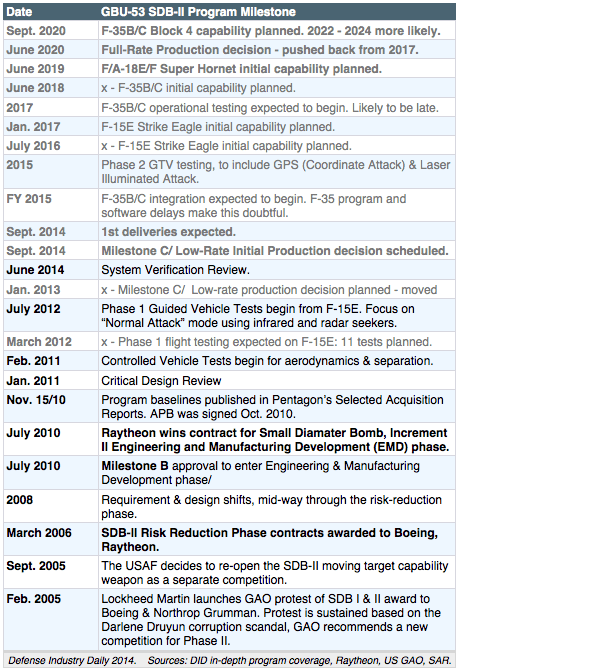
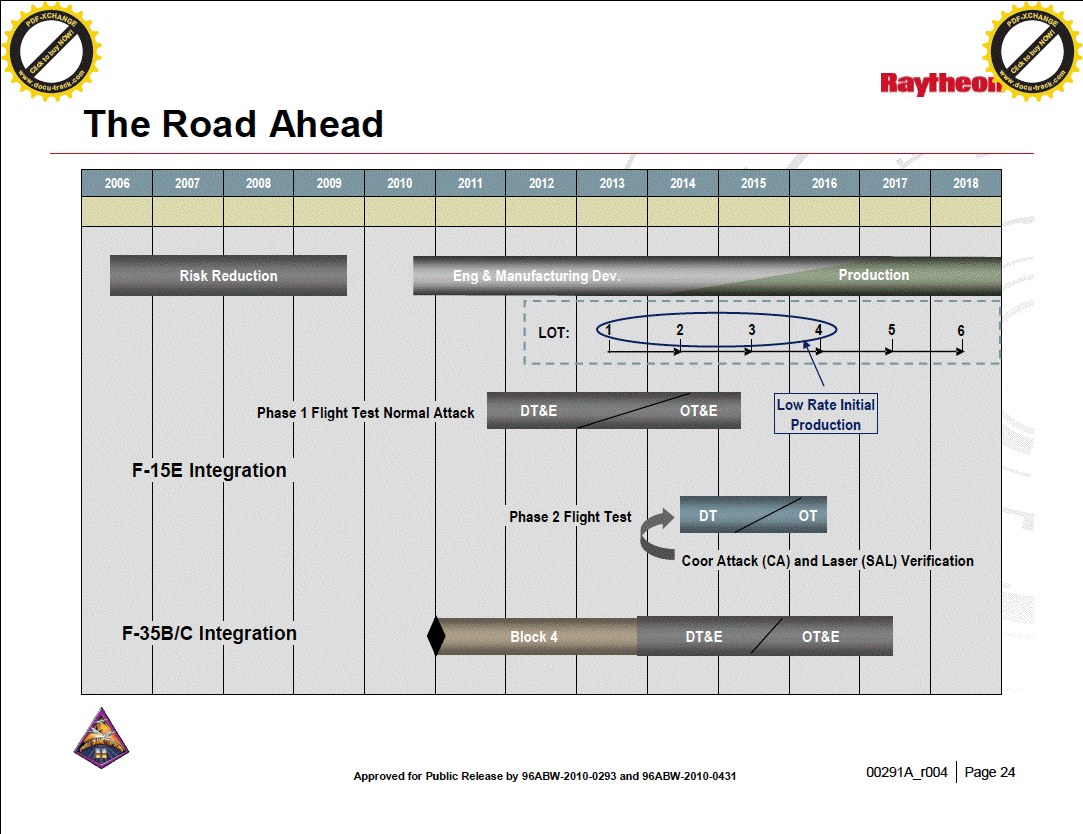
The GBU-53 may also feature integration with other fighters, if the bombs are sold abroad. Raytheon isn’t in discussions with any foreign buyers yet, and doesn’t foresee the US government releasing the weapon for export discussions and sales before Low-Rate Initial Production begins in late 2014.
(click to view full)
The SDB II Program is currently a $450.8 million Fixed Price Incentive Firm-type Engineering and Manufacturing Development contract. F-15E integration is being accomplished by Boeing in St. Louis, MO through the F-15 Development Systems Program Office using Air Force SDB II funding. The F-35B and F-35C aircraft integration contract will be awarded to Lockheed Martin in Fort Worth, TX by the F-35 Joint Strike Fighter JPO using Department of the Navy SDB II funding.
Elements of the SDB-II design have been tested, but putting the entire weapon together with its carrying aircraft and declaring the combination ready for fielding is still a development effort. Although many military development efforts are “cost-plus” (contractor’s costs plus an agreed percentage), the US military issued the SDB-II EMD Phase development contract as a fixed-price contract with incentives. The targeted flyaway cost per unit during Full Rate Production was $FY05 62-81k, but that doesn’t include amortized development costs; just the bomb, container, and shipping. Current Pentagon documents indicate that $FY19 100-125k per unit is likely.
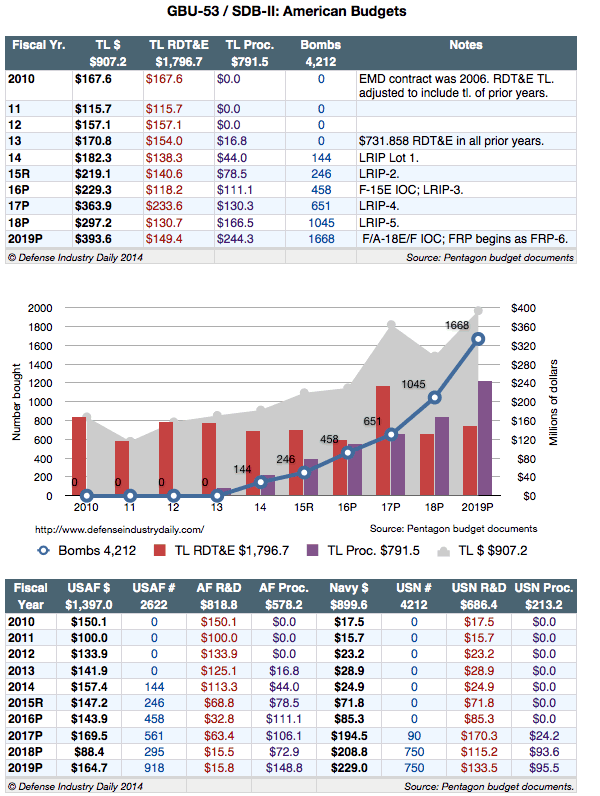
Right now, the key challenge is making it through the development process successfully. The program is progressing well, but in FY 2011 it hit a funding shortfall from Congress that has crimped its progress. Past and projected budgets include:
Raytheon’s Industrial Approach

Before it won the SDB-II development contract in 2010, Raytheon had secured firm-fixed price quotes in for 90% of required materials from its suppliers, and conducted detailed planning for whole program that includes reservations for setbacks and project margins. These are necessary steps for any fixed-price development program, but this is a good illustration of the fact that it’s often the work done before contracts are signed that determines a program’s fate.
In terms of the industrial team, Raytheon Missile Systems in Tucson, AZ will be the final assembly center, with key items and assemblies coming in from several supply-chain partners:
* General Dynamics OTS: Fuze and dual-mode shaped charge blast/fragmentation warhead.
* Klune Industries: Overbody.
* Rockwell Collins: TacNet dual-band (Link-16, UHF), 2-way datalink.
* Raytheon Dene at NAPI, NM: Aft section.
* Raytheon Missile Systems in Tucson, AZ: Tri-mode seeker.
* The program also uses Goodrich and Cobham to make the bomb’s deployment mechanisms, and Celestica will be manufacturing circuit cards.
Raytheon executives said that they took a somewhat different supply-chain approach to the SDB-II, picking suppliers early and then working directly with them to improve productivity at every step. While Raytheon prototyped their final assembly line, and began using lean production techniques to reduce the amount of “touch labor” and improve productivity, they brought in suppliers to do the same thing. For instance, Celestica engineers were embedded with the team, in order to run their own producibility tools on circuit card designs and refine them to improve yield and costs. Rockwell Collins, who makes the datalink, did the same thing. This is not uncommon in general manufacturing, but defense manufacturing has traditionally been more stovepiped.
Within Raytheon itself, another key industrial choice involved the uncooled infrared seeker. As noted above, uncooled infrared has lower performance than cooled infrared designs, in exchange for snap-attack capability, better reliability, and lower production and maintenance costs. If Raytheon wanted to use this aproach, they would have to begin early, and take a risk. Their engineers worked to adapt the IIR seeker in their 2,000 pound AGM-154 JSOW as a starting point, and they did eventually produce a version that fit SDB-II, was cheaper to manufacture, and more than met government requirements.
Raytheon’s initial team during development will be about 300, but this is expected to drop below 50 for production phase – in part because Raytheon has already used lean techniques, and focused from the beginning on creating a design that was simpler to manufacture.
Minimum Sustaining Rate for production is just 30 weapons/ month, with normal production at 117 and maximum surge production rising to 250/ month. Projected American buys through FY 2019 never top 140/month, which should leave plenty of room for export orders.
Contracts and Key Events
FY 2017-2024
Cheaper than expected – but F-35 lateness could endanger that; F-35 is biggest risk; Phase 1 testing done; GAO Report.

(click to view full)
July 29/24: Raytheon won a $325 million ceiling increase modification for the StormBreaker® Small Diameter Bomb Increment II (SDB II, GBU-53/B). The modification brings the total cumulative face value of the contract from $275,000,000 to $600,000,000. Work will be performed in Tucson, Arizona, and is expected to be completed by Dec. 31, 2026. No funds are being obligated at the time of award. The Air Force Life Cycle Management Center, Eglin Air Force Base, Florida, is the contracting activity.
May 18/22: Life Cycle Support Raytheon Missiles won a $75 million ceiling increase to previously awarded indefinite-delivery/indefinite-quantity contract FA8672-19-D-0001 for StormBreaker Small Diameter Bomb II (SDB II, GBU-53/B), Small Diameter Bomb II Life Cycle Support III. StormBreaker bomb (formerly Small Diameter Bomb Increment II (SDB II)) is an air-launched precision strike weapon. Work will take place in Arizona. Estimated completion date is September 30, 2024.
January 26/22: Production Raytheon Missiles and Defense won a $92 million contract modification for StormBreaker (SDBII, GBU-53/B) production all up rounds and containers. The StormBreaker bomb is an air-launched precision strike weapon manufactured by Raytheon Missile Systems for the US Air Force (USAF) and the US Navy. It is planned for integration on the F-15E Strike Eagle twin-engine aircraft. Raytheon Missile Systems is the prime contractor for the joint USAF and Navy SDB II programme. Work will take place in Arizona. Estimated completion date ist February 28, 2026.
April 6/21: SDB II Raytheon won a $79.4 million deal for Small Diameter Bomb Increment II (SDB II) lot integration and test. This contract effort will deliver all-up round (AUR) test vehicles, perform AUR-level assembly, checkout, testing and systems integration testing; and prepare for production cut-in and fielding for the multiple engineering changes needed, including National Security Agency (NSA) cryptographic modernization, Global Positioning System (GPS) military code, mitigation of part obsolescence, and design changes evolving from production and/or operations. SDB II’s capabilities include the ability for the weapon to be employed in three primary attack modes, each with a subset mode, for a total of six engagement modes. A dual band, two-way weapon data link for in-flight target updates and status reporting allows post-launch control of the weapon by the launching aircraft, a Joint Terminal Attack Controller (JTAC), or a third party. Work will take place in Arizona. Estimated completion is April 1, 2023.
October 19/20: Lot 6 Raytheon Missiles Won a $239.1 million contract modification for StormBreaker (SDBII, GBU-53/B) production Lot 6. Designed to address critical troop needs, the StormBreaker can detect, track, and destroy stationary or moving targets with high-precision and stand-off range during the day and at night in all-weather conditions. The GBU-53/B, originally known as the Small Diameter Bomb II (SDB II), has a tri-mode guidance system able to find targets using imaging infrared or millimeter-wave radar, or using semi-active laser homing to hit a designated aimpoint. Depending on the altitude of the launching aircraft, the weapon can also glide up to 69 miles on its own using a GPS-assisted inertial navigation system, after which could strike a specific coordinate or begin searching for a target. Just recently it was announced that the Air Force approved the bomb for use on the F-15. This means that the service will now be able to send the weapons downrange for use by F-15E squadrons Work under the modification will take place in Tucson, Arizona. Estimated completion date is November 28, 2023.
October 15/20: F-15E Operational Flights The US Air Force’s Air Combat Command has approved the GBU-53/B Small Diameter Bomb II for F-15E operational flights. The press release from Eglin Air Force Base says the weapon is expected to be field on the F/A-18E/F later this year. The GBU-53B StormBreaker, which entered operational testing in 2018, is a small diameter bomb that features a multimode seeker to guide the weapon with infrared, millimeter-wave radar and semi-active lasers in addition to or with GPS and inertial system guide. The Air Force’s fielding decision means F-15E squadrons can now be equipped with the weapon. The Navy and Marines intend to use it on their versions of the F-35 Joint Strike Fighter.
February 28/20: Technical Support Raytheon won a $15 million deal for Small Diameter Bomb II (SDB II) technical support. The total value of the IDIQ contract will increase from $100,000,000 to $115,000,000. This contract provides for lifecycle technical support throughout engineering and manufacturing development (EMD), production, and sustainment phases. The Small Diameter Bomb II, or SDB II, is designed to destroy moving targets in all kinds of weather, such as small groups of ISIS or terrorist fighters on-the-move in pick-up trucks. The US Air Force Air Armament Center, Eglin Air Force Base, Florida, awarded a $144m contract to Raytheon in April 2006 for risk reduction work of the SDB II bomb, also known as GBU-53 / B. The work was completed in August 2009. Work will take place in Arizona and estimated completion date is July 25, 2024.
July 2/18: F/18 integration The Air Force is contracting Raytheon in support of weapons integration on its fleet of F/A-18E/F fighter aircraft. The indefinite-delivery/indefinite-quantity contract is valued at $93 million and provides for the integration of the Small Diameter Bomb II (SDB II) onto the fighter jet. Raytheon’s GBU-53/B SDB-II is 7? in diameter around the tri-mode (laser, IIR, radar) seeker, with a clamshell protective door that comes off when the bomb is dropped. Range is expected to be up to 40 nautical miles when launched at altitude, thanks to a high lift-to-drag ratio in the design. Since SDB-II is an unpowered glide bomb, its actual range will always depend on launching altitude and circumstances. This contract provides for the testing, analysis, support and sustainment of SDB II weapon onto the F/A-18E/F platform with developmental and operational testing. Work will be performed in Tucson, Arizona, and is expected to be completed by July 1, 2023.
March 1/18: Lot 4 Productions Raytheon will produce additional Small Diameter Bomb (SBD) IIs for the US Air Force, under a $77.3 million contract option exercised by the service on Tuesday, February 27. Under the terms of the deal, the firm will provide low rate initial production for 570 SDB II Lot 4 munitions, 398 SDB II Lot 4 single weapon containers, 126 SDB II Lot 4 dual weapon containers, 20 Production Reliability Incentive Demonstration Effort captive vehicles, 24 SDB II Lot 3 weapon load crew trainers /conventional munitions maintenance trainers, and other data. Work will be performed in Tucson, Arizona, and is expected to be complete by July 31, 2020.
December 15/17: Milestone Lot 1 production of the Small Diameter Bomb-II, an update to Boeing’s SDB-I, has been completed by Raytheon. The firm said it is producing SDB-II bombs at its facilities in Tucson, Ariz., and that the program is nearing completion of developmental testing. The US Air Force has also contracted Raytheon to produce Lots 2 and 3, and the munition is scheduled to be integrated on the F-35 and F/A-18E/F by the USAF and Navy, and Raytheon is expected to have it prepared for integration with the F-15E by the end of the year.
October 04/17: Australia has been cleared by the US State Department for the possible purchase of GBU-53/B Small Diameter Bomb Increment II weapons. Valued at an estimated $815 million, the foreign military sale will see 3,900 GBU-53/B Small Diameter Bombs and related equipment and services delivered to Canberra by manufacturer Raytheon. Extras include weapon load crew trainers, practical explosive ordinance disposal trainers, bomb containers, support, and ground crew test equipment. Transportation, warranties, repair and return, maintenance, publications, and technical documentation round out the package. The awarding agency, the US Defense Security Cooperation Agency (DSCA), said the sale will compliment the ongoing sale of F-35A Joint Strike Fighter aircraft to the Royal Australian Air Force.
October 02/17: Raytheon received a $450 million US Air Force contract for engineering changes and development of the Small Diameter Bomb II. Under the terms of the deal, the firm will conduct design, development, integration, test and production engineering for changes to the SDB. The munition is currently being integrated for use on the F-35 and F/A-18E/F by the USAF and Navy, and Raytheon is expected to have it prepared for integration with the F-15E by the end of the year. Work will be performed in Tucson, Ariz., with an expected completion time set for Aug. 31, 2024.
July 26/17: The United States Air Force has awarded a $75 million contract to Raytheon to conduct technical work on the GBU-53 Small Diameter Bomb (SBD) II guided air-dropped weapon system. Work will be conducted at Tuscon, Ariz., and covers engineering, manufacturing development and production work for the SDB II. Completion time is expected by July 25, 2024. The all-weather munition is carried on USAF-operated F-15E, F/A-18E/F, and F-35B/C aircraft.
February 1/17: Raytheon has been contracted to deliver Small Diameter Bombs (SDB) to the USAF. While the exact value of the contract modification was undisclosed, the company received $62 million at the time of the award. The contract calls for the delivery of low-rate initial production for 312 SDB II Lot 3 munitions for the branch, and also includes 413 SBD Lot 3 single weapon containers, 20 weapon conversions for guided test vehicles, 20 production reliability incentive demonstration effort captive vehicles and training and maintenance services. SBDs are being integrated on a number of USAF and US Navy aircraft, and provide warfighters with the ability to engage their targets when faced with poor weather and other adverse conditions.
FY 2012 – 2014
Cheaper than expected – but F-35 lateness could endanger that; F-35 is biggest risk; Phase 1 testing done; GAO Report.
Oct 28/14: JMM. Raytheon Technical Services LLC in Indianapolis, IN a sole-source $35 million indefinite-delivery/ indefinite-quantity contract for F-35 integration of the Joint Miniature Munitions Bomb Rack Unit (JMM BRU), including integration and life cycle technical support throughout the technology development and engineering, manufacturing and development (EMD); and EMD F-15 flight test and production phases.
Work will be performed at Indianapolis, IN and is expected to be complete by Aug 31/21. USAF Life Cycle Management Center at Eglin AFB, FL manages the contract (FA8672-15-D-0054).
June 26/14: Testing. Raytheon and the USAF have concluded a series of SDB-II GTV flight tests using the IIR/MMW seeker, culminating in direct hits on stationary land targets. Those can be harder to hit than moving targets, which naturally stand out more against fixed object ground clutter.
The GTVs are full GBU-53 rounds, but with telemetery in place of the warhead. Raytheon says that there have been other Guided Test Vehicle shots between October 2013 and this announcement, including moving target shots, as part of the testing program. Live-fire shots with full warheads are expected in August or September 2014. Sources: Raytheon, “Small Diameter Bomb II nears end of development phase”.
April 16/14: Exports. The Pentagon releases is next set of Selected Acquisition Reports, which includes a reference to exports:
“SDB II is a Defense Exportability Features (DEF) pilot program and meetings were held on January 15, 2014 with the DEF Program Office, the Office of the Under Secretary of Defense (Acquisition, Technology, and Logistics), Office of the Director, International Cooperation and Raytheon Missile Systems (RMS). The Program Office is working with RMS to incorporate a Phase II approach for implementing design changes to support exportability requirements. The Program Office briefed the Tri-Service Committee on January 16, 2014 and a favorable decision memorandum was received on February 4, 2014.”
March 31/14: GAO Report. The US GAO tables its “Assessments of Selected Weapon Programs“. Which is actually a review for 2013, plus time to compile and publish. Our program dashboard has been updated accordingly. SDB-II still has good looking cost figures and a stable design, with 11/12 sub-system (all but the seeker) passing qualification testing. Bad news? There are a couple of flaws that need to be fixed, and its schedule is out of margin.
The System Verification Review has slipped 7 months to August 2014, due in part to 2 test failures (cover stuck on seeker, navigation error). They’ve also found a leak in the warhead case, and seeker encoders that died under vibration testing. The seeker encoders have a fix ready by the time the GAO report closed, but not the case leak. Meanwhile, the program resumed testing again in October 2013, and the 3 tests since went well. They need 11 total successful flight tests to pass Milestone C into low-rate production, including 2 live fire events. It amounts to 7 successful flight tests remaining over 5 months.
March 4-11/14: FY15 Budget/ R&D. The US military slowly files its budget documents, detailing planned spending from FY 2014 – 2019. The “flyaway” cost per SDB-II is expected to hover around $242,000 in FY 2014, but costs are expected to drop to around $125,000 by FY 2018. Totals are reflected in the chart above. The reports also call attention to the development of an new internal bomb rack for the Navy, which is considered to be part of the program’s overall R&D:
“The Joint Miniature Munitions Bomb Rack Unit (JMM BRU) is an Air Force (AF) led ACAT III program. It is required for the Department of the Navy’s (DoN) carriage of the SDB II weapon in the internal bay of the F-35B and F-35C…. The BRU-61/A, currently in production in the AF, does not meet the needs to operate with SDB II within the F-35 internal bay in the DoN environment. The JMM BRU, designated BRU-61A/A, fills the capability gap….”
No US Navy buy totals are given in the detailed budget justifications, but the Budget Briefing contains the expected figures for FY 2017 – 2019; which indicates that the USN will be buying SDB-II at the USAF’s flyaway cost. This USAF budget justification excerpt is also relevant:
“As a result of the Joint Strike Fighter (JSF) (F-35) programs restructure, SDB II integration was moved from the JSF Operational Flight Plan (OFP) Block 3 to Block 4. IOC is FY2020.”
The program office hasn’t officially changed the date, in other words. F-35 OFP Block 3F operating software might be ready by 2020, but the Norwegians have been told to plan for 2022 – 2024 as the window for actual fielding of F-35s with operational Block 4 software, and hence Kongsberg’s new JSM anti-ship missile.
Jan 28/14: DOT&E Testing Report. The Pentagon releases the FY 2013 Annual Report from its Office of the Director, Operational Test & Evaluation (DOT&E). The SDB-II is included in passing:
“This project addresses the inaccuracies in engineering models to predict sympathetic detonation of solid rocket propellant when subjected to non?reactive fragments and shaped charge threats. The Air Force 780th Test Squadron tested the ability of the small diameter bomb [DID: SDB-II in the labeled picture] warhead to detonate 122 mm rocket motors. The test results were compared with predictions from Sandia National Laboratories’ Combined Hydro and Radiation Transport Diffusion Hydrocode by Applied Research Associates. Analysis is ongoing, and is expected to enable further development of concepts and methodologies for enhanced vulnerability, lethality, and survivability in the area of insensitive munitions and non-reactive materials.”
Oct 29/13: Testing resumes. Raytheon announces that the USAF has concluded its series of test flights with the SDB-II GTV, using the bomb’s Imaging Infrared and Milimeter-Wave Radar guidance and culminating in “direct hits on targets moving at operationally representative speeds.” Next? System Verification Review and a Milestone C decision, which is behind schedule.
This is actually the 1st set of tests following a 6-month testing moratorium, which was prompted by seeker cover and navigation failures in previous tests. The firm says that the USAF has invested over $700 million in the program so far. Sources: Raytheon, Oct 29/13 release.
March 28/13: GAO Report. The US GAO tables its “Assessments of Selected Weapon Programs“. Which is actually a review for 2012, plus time to compile and publish. Overall, SDB-II is a stable design with maturing technologies. It successfully completed a test in its most difficult Immediate Attack sub-mode, but another test failed when the front sensor’s protective dome cover refused to come off.
They’re working on that urgently, as more delays to the Milestone C/ LRIP (Low-Rate Initial Production) decision risk re-negotiation of the Pentagon’s LRIP-1 through LRIP-5 production contract years. If so, it would raise costs that had come in substantially under budget. Meanwhile, Raytheon will build 50 GTV bombs for testing and live fire before beginning Low-Rate Initial Production, which is expected to involve a whopping 40% of planned GBU-53 lifetime orders (math says about 6,800 bombs).
Unfortunately, SDB-II/ GBU-53 has been affected by the F-35’s lateness, which has forced postponement of SDB-II’s Full Rate Production decision by another 2 years, to 2020. The GPS-only SDB-I will now integrated with the F-35 2 years ahead of the SDB-II, and so will other weapons with more sensitive thermal and vibration requirements. That will help the Pentagon discover whether the F-35s conform to their design documents, or whether weapon changes will be required in several weapon types including the GBU-53. Meanwhile, SDB-II will deploy aboard the F-15E.
Jan 22/13: Testing. Raytheon touts a successful fit check of the GBU-53/B Small Diameter Bomb II in the F-35A, with 4 GBU-53s loaded alongside an AIM-120 AMRAAM missile. Essentially, the 4 SDB-IIs replace one 2,000 pound JDAM.
The weapons seemed to have adequate space, though flight testing will be needed to be sure. The F-35B will be a more challenging test, because its internal bay is smaller.
July 17/12: Testing. An F-15E Strike Eagle flying over White Sands Missile Range, NM launches a GBU-53/B, which successfully engages and hits a moving target using its tri-mode seeker’s IIR and radar sensors. Raytheon.
March 30/12: GAO Report. The US GAO tables its “Assessments of Selected Weapon Programs” for 2012, which include the GBU-53. Overall, the GAO sees good progress, with 97% of design drawings releasable by the 2011 Critical Design Review, and serious efforts to achieve manufacturing maturity before production. As with any early stage EMD program, however, risks remain. The biggest may be Congressional management of weapons procurement:
“A postdesign review identified several risks related to weapon effectiveness verification, target classification, seeker reliability, and JSF [F-35B/C Block 4] integration. The program office is working to address each of these risks… However, the program’s biggest risk – integration with the JSF – will not be resolved until after [low-rate initial] production begins… The SDB II program office is managing a $53 million funding shortfall in fiscal year 2011, which could have programmatic and contractual implications. The SDB II contract is an incrementally funded, fixed-price incentive contract, and program officials stated that the funding shortfall could mean that the next part of the work will have to be deferred or the contract will need to be renegotiated or terminated.”
March 30/12: SAR shows success. The Pentagon’s Selected Acquisitions Report ending Dec 31/11 includes the SDB-II, and validates many of Raytheon’s releases:
“Small Diameter Bomb Increment II (SDB II) – Program costs decreased $994.1 million (-19.1%) from $5,206.6 million to $4,212.5 million, due primarily to a decrease in the estimate to reflect actual contract pricing (-$994.3 million).”
That’s 23.6% less than the baseline estimate, a very impressive achievement for any weapons program.
Good contract
Nov 16/11: Testing. Raytheon says that things are going very well for the SDB-II’s warhead, and the entire program is on cost and ahead of schedule:
“After building the test warheads on the production line, engineers put the warheads through an accelerated conditioning regime equivalent to 500 flight hours and 20 years of aging in a bunker, followed by live detonation testing… [It] performed at twice what was required…”
Nov 8/11: Industrial. Raytheon announces that its engineers have used design changes and other improvement approaches to cut the time for building SDB-II uncooled tri-mode seekers almost in half, from more than 75 hours to 40 hours. This is part of Raytheon’s efforts to meet their promised prices.
FY 2010 – 2011
Raytheon wins; Program baseline set; Early industrial work & tests.
(click to view larger)
Aug 16/11: Industrial. Raytheon announces that they’ve built their 5th GBU-53 tri-mode seeker in its new automated factory, which is dedicated to tri-mode seekers. That specialization may be helpful to other programs as well. Tom White, Raytheon’s SDB II program director, says that:
“Building integrated tri-mode seekers is much more complicated than just putting together three unrelated sensors, and our fifth build proves Raytheon is the only company with the technical expertise to manufacture [them]… We’re meeting predicted component build times, and as we continue to mature the program, we will find other efficiencies and cost savings we will pass on to the customer.”
Aug 8/11: Testing. Raytheon says that a series of laboratory tests on the SDB-II’s tri-mode seeker “demonstrated that it exceeds anticipated performance parameters.” Good job.
July 28/11: Support. Raytheon Missile Systems in Tucson, AZ receives a maximum $70 million firm-fixed-price contract to provide Small Diameter Bomb II technical support. The AAC/EBMK at Eglin Air Force Base, FL manages the contracts (FA8672-11-D-0107).
April 4/11: CDR. Raytheon announces that the SDB II program completed a USAF critical design review (CDR), clearing the way for the weapon to begin captive flight testing later in 2011.
CDR
Nov 15/10: SAR Baseline. The Pentagon releases its Selected Acquisition Report for the September 2010 reporting period. With respect to SDB-II, the total expected program cost is listed as $5.21 billion, if it continues through planned production:
“This was the initial SAR following Milestone B approval authorizing the program to enter the engineering manufacturing and development (EMD) phase in August 2010. The EMD phase contract was awarded to Raytheon Missile Systems for $450.8 million. [The gating decision for] Low Rate Initial Production (Milestone C) is planned for August 2013.”
Program baseline
Nov 2/10: Sub-contractors. Rockwell Collins announces what Raytheon had already confirmed: its TacNet datalink will be part of the GBU-53.
Rockwell Collins’ TacNet data link system is a small form factor, dual-channel, 2 waveform terminal that enables in-flight target updates, retargeting, weapon handover coordination, bomb hit assessments and better cooperation with other networked platforms.
Aug 9/10: Contract. Raytheon Missile Systems in Tucson, AZ receives a $450.8 million contract to cover the GBU-53/B Small Diameter Bomb Increment II program’s engineering and manufacturing development phase. Delivery is expected to begin in 2013, with a required availability date in late 2014.
At first, the SDB-II will be integrated on the USAF’s F-15E Strike Eagles, the US Marines’ F-35B, and the US Navy’s F-35C aircraft. The F-35Bs should just be entering service by 2013, but the F-35Cs aren’t expected to enter service until after SDB-II deliveries begin. Raytheon Missile Systems president says that their design “fully meets the load-out requirements for all versions of the fifth generation F-35 Joint Strike Fighter’s internal weapon bays.” SDB-II integration is also expected to extend to other USAF and US Navy aircraft and UAVs over time. At this time, $23.5 million has been committed by the Miniature Munitions AAC/EBMK at Eglin AFB, FL (FA8672-10-C-0002).
During the fly-off’s technical demonstration program, Raytheon had to prove that its compact tri-mode seeker could seamlessly transition between guidance modes, and demonstrate claimed performance and reliability. Raytheon says that their GBU/53-B seeker flew 26 missions in 21 days, without a single hardware failure. Raytheon.
Raytheon wins EMD Phase
FY 2009 and Earlier
Protest derails; New early-phase awards; Big design changes.

(click to view full)
2008: Design shifts. Mid way through the 38-month risk reduction program, Team Raytheon is faced with challenges on 2 fronts. One challenge was the need to carry 8 SDB-II bombs in the cut-down internal bomb bay of the F-35B STOVL (Short Take-Off, Vertical Landing) fighter. That meant the weapon had to become shorter, always a challenge when space is at a premium. The second challenge came from the USAF, which wanted a weapon that could disable main battle tanks. That meant the blast & fragmentation warhead the team had begun with wasn’t going to work.
In response, GD OTS started work on an innovative ‘multi-effects’ warhead. It would use a shaped charge plasma jet to kill tanks, and a scored case design improved fragmentation effects to the point that USAF engineers reportedly dubbed it “the shredder.” Meanwhile, seeker electronics had to be repackaged in a way that provided a clear path for the plasma jet. As it happens, the warhead and seeker changes allowed the bomb to become shorter, and the seeker changes made it easier and cheaper to manufacture. Raytheon would go on to win the competition. Aviation Week.
April 17/06: Contracts. The Headquarters Air-To-Ground Munitions Systems Wing at Eglin Air Force Base, FL awards 2 cost-plus fixed-fee R&D contracts under the Small Diameter Bomb (SDB) Increment II, 42-month Risk Reduction Phase. The purpose of the Risk Reduction phase is to define and validate a system concept that meets the performance requirements outlined in the SDB II System Performance Specification. Successful tests with modified JDAM recently, and weapons like Israel’s Spice GPS/INS/EO “scene-matching” bombs, strongly indicate that success is possible. Solicitations began December 2005, negotiations were complete in March 2006, and work will be complete in October 2009. The 2 winners will be competing for selection in 42 months as the prime contractor for the SDB II program, which has a potential value of $1.3-1.7 billion.
Boeing subsidiary McDonnell Douglas in St. Louis, MO receives a $145.8 million contract (FA8681-06-C-0151). This is actually a Boeing/Lockheed venture as of October 2005; prime contractor Boeing will supply the weapon and data link system, while principal supplier Lockheed Martin provides the multi-mode seeker that lets it hit moving targets. That leaves Boeing’s original Small Diameter Bomb partner, Northrop-Grumman, out in the cold.
Raytheon Co. in Tucson, AZ received its own $145.8 million contract (FA8681-06-C-0152), and is competing on its own.
Risk Reduction Phase
Feb 18/05: GAO protest. The Congressional Government Accountability Office (GAO) sustains Lockheed Martin’s protest. It finds that Darlene Druyun had played a role in the bid process that led to changes in the bomb’s technical requirements, and the deletion of related evaluation criteria. The GAO recommends a re-opened competitive procurement for the program’s $1.7 billion second phase, which had previously been awarded to Boeing and Northrop-Grumman along with SDB-I.
In September 2005, the USAF decided to re-open the Small Diameter Bomb Increment II competition. Increment II was originally awarded to Boeing and Northrop-Grumman as part of the overall SDB award.
Protest sustained
Additional Readings
DID thanks Raytheon Missile Systems, including SDB-II Deputy Program Director Murali Krishnan and Jeff White of Air Warfare Systems, for their assistance. Any errors are our own damn fault.
* Raytheon – Raytheon GBU-53/B Small Diameter Bomb II (SDB II). Mini-site, including CONOPS videos.
* Stars and Stripes, via WayBack (Dec 6/11) – Some weapons too important to lose in DOD cuts.
* Raytheon (Aug 24/10) – Raytheon presentation and press conference [dead link, see event release]. Contained extensive discussion of their SDB-II design.
* Aviation Week, via WayBack (Aug 24/10) – Winning SDB II: Innovation in Action. By Raytheon’s Harry Schulte.