

(click to view full)
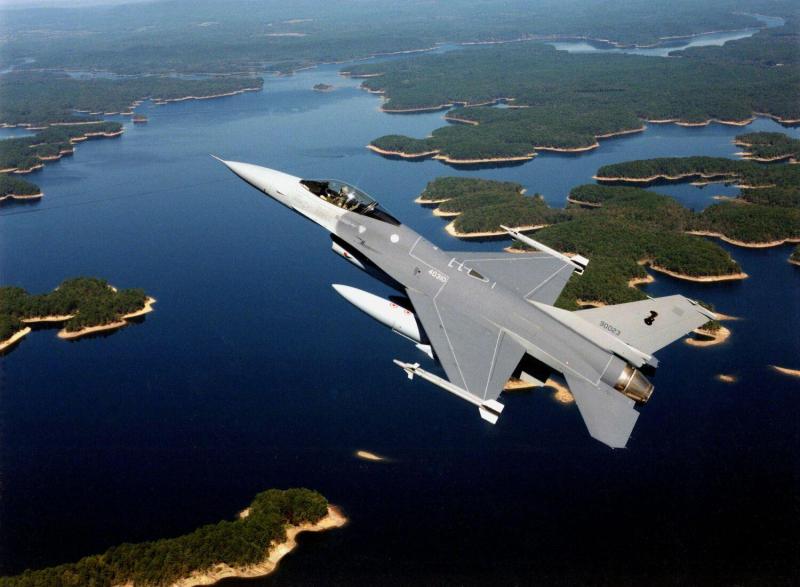
It’s a small, agile fighter that can take off and land on highways, while carrying the latest technologies and weapons. It does very well against NATO’s best aircraft in exercises, comes with a reasonable price tag, and is built for low lifetime operating costs. Unfortunately, in a world where people often buy your weapons because they want you to be their friend, the cachet of having Sweden in your corner isn’t quite what it used to be when their sailors wore those cool horned helmets. As a result, the JAS-39 Gripen is an excellent, reasonably-priced fighter yet it has been struggling for traction in the global marketplace.
A recent sale to Thailand has expanded Saab’s horizons somewhat, as the Gripen beat out the SU-30s favored by the previous Thai government. Lockheed Martin’s F-16 had been considered the leading contender to replace the RTAF’s 15-25 aging F-5B/Es, given Thailand’s extensive history with that aircraft. Other candidates included Russia’s MiG-29, and France’s Rafale. Saab had a very competitive offering on cost and performance, but in order to win, they had to throw in a very significant “something extra”: their Saab 340-AEW AWACS aircraft.
The Thai AF and the Program
(click to view full)
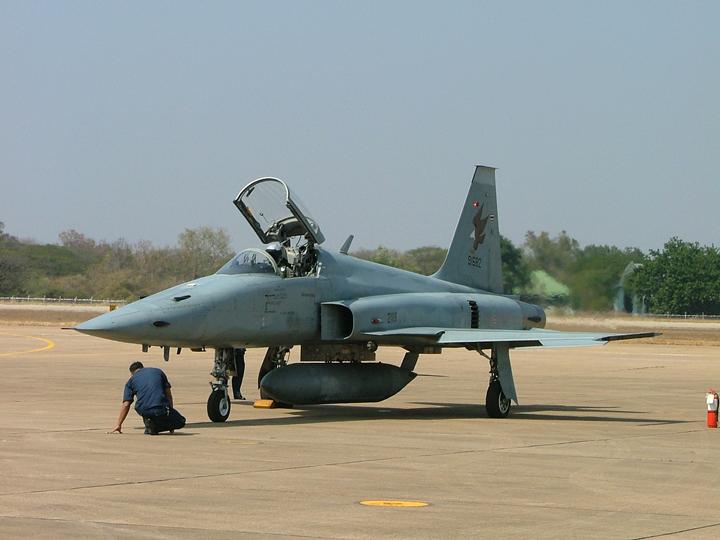
At present, the Royal Thai Air Force’s fighter fleet consists of old 1960s-70 era upgraded F-5E/F Tiger IIs, plus AV-8S Harrier IIs and F-16A/B fighters. A number of its neighbors are currently flying longer-range and more advanced SU-27/30 Flanker fighters, however, including India (SU-30MK & SU-30MKI), Indonesia (SU-27SK & SU-30MK), Malaysia (SU-30MKM), Vietnam (SU-27SK), and China (SU-27SK/J-11 & SU-30MKK).
In mid-October 2007 The Thai Cabinet approved a budget of 34.4 billion baht (about $1.1 billion) for the Royal Thai Air Force (RTAF) to purchase 12 JAS-39 Gripen multi-role fighters to replace its aging fleet of F-5 B/E Tiger II aircraft (the Israeli-upgraded F-5Ts with DASH helmet displays and Python missiles will remain in service). The RTAF would also buy 2 Saab S-1000/ S340 Erieye Airborne Early Warning aircraft, together with associated equipment and services.
The Saab Erieye AWACS was recently sold to Pakistan, and uses a fixed active-array S-band antenna with 200 solid state modules. The look angle on each side is about 160 degrees, with a maximum range of about 450 km (279 miles) from 20,000 feet, and effective range against fighter-size or seaborne targets of about 300-330 km (180-205 miles). The electronically scanned antenna can scan sectors of interest frequently while others are monitored, and a single sector can be scanned in different modes at the same time.
Thai Air force chief Chalit Phukphasuk Chavalit reportedly met with Prime Minister Surayud Chulanont on Sept 29/07 and convinced him to support the purchase, citing the need for new combat aircraft to match neighboring Malaysia’s new SU-30MKMs. Prime Minister Thaksin Shinawatra reportedly ordered then air force chief ACM Kongsak Wantana to switch to the SU-30s for Thailand’s own purchase, but ACM Chalit rejected the Russian plane as unsuited to Thailand’s needs when he became the new air force chief.
Negotiations between Thai and Swedish government officials followed, in order to conclude a formal agreement. Delivery of the Gripens into operational service of the Royal Thai Air Force is now planned for 2011, and the buy is divided into 2 phases:
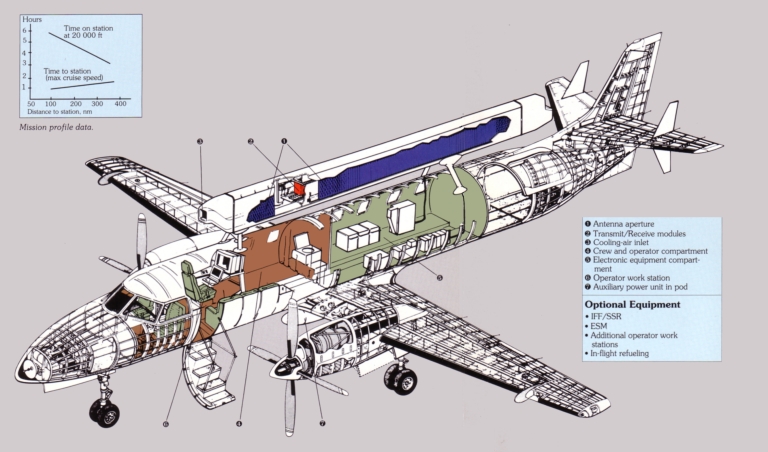
Phase 1 covers 6 JAS-39 Gripen fighters (2x JAS-39C single-seat, 4x JAS-39D 2-seat), including spare parts and training; and 2 Saab 340 turboprop aircraft. One Saab 340 will be outfitted as an S-1000 airborne early warning system with Saab’s Erieye radar, while the other will be a training and transport aircraft. The cost would be about 19 billion baht/ SEK 3.8 billion/ $600 million[1], spread within a 5-year budgetary commitment from 2008-2012. The Swedish fighters will be stationed at the air force base in Surat Thani, where Wing 7 covers the Gulf of Thailand, the Andaman Sea and the southern region of the country.
Thailand’s Phase 1 system was originally supposed to become fully operational around September 2011, but it reached that milestone 2 months early, in July 2011. A lot of activity goes into an achievement like that, and the timeline was as follows:
2009: 4 Thai pilots and 20 technicians enter training by the Swedish Armed forces.
June 2010: A 2nd set of 10 more techbnicians head to Sweden for training.
Dec. 2010: 1 S340 ERIEYE AEW and 1 Saab 340 rtransport are delivered, on time.
Feb. 2011: All 6 JAS-39 C/D fighters arrive in Thailand. 6 RTAF F-16 pilots go to Sweden for a 4-month conversion course.
Mar. 2011: One Command and Control C2 system, including equipment for 3 ground based Radio sites is delivered.
June 2011: 10 technicians return from a year of training in Sweden. 6 pilots return from conversion course.
July 2011: Phase 1 system declared operational.
In Phase 2, the RTAF intends to procure an additional 6 Gripen fighters together with associated equipment, spare parts and training, and a 2nd Saab S340 Erieye AEW system aircraft, for about $500 million over a 5-year budgetary commitment from 2013-2017. A budget squeeze ended up delaying this option, but it’s moving forward with a contract. All Phase 2 aircraft deliveries are scheduled to finish in 2013.
Sweden has offered the Gripen fighters with a 2-year maintenance and spare parts support package. As is frequently the case, Saab’s deal includes industrial offsets and benefits involving Saab investment, and Thai-Swedish industrial, science & technology co-operation, technology transfer, and investment co-operation.
Contracts & Key Events

(click to view full)
Feb 12/14: 6 more? Flight Global says they’re a happy customer, and may want to boost their fleet to 18:
“Saab is in discussions with Thailand for six additional Gripen C/D fighters, the Swedish company says. In a press briefing, Saab Asia-Pacific president and chief executive Dan Endstedt said talks are ongoing. He did not give a timeframe for the possible acquisition, but says that he hopes the deal “happens soon”.”
Sources: Flight Global, “SINGAPORE: Saab looks for additional Thai Gripen sale”.
April 5/13: Delivery. Sweden’s FMV announces that it has begun delivering Thailand’s 2nd set of fighters, after conveying the 2nd order’s S340 AEW&C plane and RBS-15F missiles. Fighters # 6 – 8 have now been delivered to the Royal Thai Air Force, with stopovers along the way in Hungary, Greece, Jordan, Saudi Arabia, United Arab Emirates, Oman and India.
June 9/12: American interference. The 2nd set of Gripen fighters and their accompanying S340 SEW plane are delayed by American games. According to the Bangkok Post, delivery:
“…has now been put off because an American parts supplier has refused to sell some key products to the Swedish manufacturer for reasons that are unclear, said the source… “Certain key items of the jet parts and the radar system produced by the US firm have not been granted permission to be sold to other countries,” said the source. “And that has resulted in a delay in [the Swedish company’s] assembling of the aircraft which I really have no idea when will be completed. “I’m not sure if this is a game or not because the Royal Thai Air Force chose the Gripen from Sweden over the F series aircraft from the United States…” Air force commander Itthaporn Subha-wong travelled to Sweden late last month to discuss the delivery with Saab but to no avail, said the source.”
April 26/12: Carrier compatibility. Thailand gives Saab a contract to upgrade Thailand’s lone carrier, the 11,500 ton HTMS Chakri Naruebet, with the Saab 9LV Mk.4 combat system, and with datalinks for communication with Thailand’s new JAS-39C/D Gripens and S340 AEW aircraft.
HTMS Chakri Naruebet is the smallest operational carrier in the world, and is based on Navantia’s Principe de Asturias design. She was launched in 1996, and can operate AV-8 Harrier jump-jets, but doesn’t have serviceable Harriers to fly any more, so in practice she is a helicopter carrier. The ship doesn’t spend a lot of time at sea, but she was heavily involved in disaster relief efforts during the 2010 Thai floods. Saab.
July 8/11: In a ceremony at Wing 7’s air base in Surat Thani, The Royal Thai Air Force (RTAF) officially declares its new air defence system operational. That includes the 6 initial Gripens, the S340 AEW Erieye plane, and the ground command and control systems.
The system was originally intended to reach this milestone in September, but they managed to be 2 months early. Saab.
Feb 22/11: The initial batch of 6 Gripen fighters arrives in Thailand. Bangkok Post | MCOT Thai News Agency.
Nov 23/10: Saab receives a SEK 2.2 billion (currently $316.6 million) order from Sweden’s FMV to provide Thailand’s 2nd tranche of fighters (6 JAS-39C Gripens) and equip the 2nd S340 AEW&C aircraft being sold to Thailand.
There’s also a 3rd component to the overall deal – Saab’s RBS-15F air-launched anti-ship missiles. Precise designations matter here. The FMV specified RBS-15Fs, which are radar-guided Mk.I missiles, without the land attack capabilities of the longer-range, GPS/radar guided Mk.III variants. The RBS-15Fs can be carried on the Gripens to hit ships over 70 km away, using a 200 kg warhead delivered by a stealthy, wave-hugging approach that includes programming for indirect attack vectors, and evasive maneuvers.
The agreement is reportedly signed by RTAF commander in chief Air Chief Marshal Itthaporn Subhawong and FMV Director General Gunnar Holmgren, and FMV’s announcement wpuld not disclose the full value of the governmet-to-government contract. Swedish FMV | Gripen International | Saab Group | Bloomberg | Engineering News, South Africa | Flight International | ScandAsia | China’s Xinhua.
Aug 26/10: Thailand’s House of Representatives approves a THB 170 billion (about $5.4 billion) FY 2011 defense budget, about 1.7% of GDP. The budget includes initial funding for the second set of JAS-39s, as well as mid-life upgrades for some RTAF F-16s. PakPasban | ScandAsia.
Aug 16-22/10: RTAF Commander in Chief Ithiporn Supawong leads a Thai Government delegation to Stockholm, Sweden for the 2nd meeting of the Thai-Swedish Joint Steering Committee for the Gripen aircraft purchasing project. The discussions at the three levels will be observed by parliamentary representatives and members of related Thai government units. During this period, Saab formally unveils its “Thai Integrated Air Defense System,” and clarifies delivery timelines for Phase 1. Gripen International | ScandAsia.
July 26/10: The RTAF has picked 10 pilots for Gripen training in Sweden. The first group of 4 pilots are training in Sweden from March 2010 – December 2010, following a 9-month curriculum for instructor pilots, while the second group of 6 are expected soon for approximately 5 months training in Sweden, followed by further training in Thailand after all 10 pilots return home in January 2011, together with the 3 first Gripen fighters.
The instructor course begins with RTAF F-16 pilots who have a minimum of 600-700 flight hours and group leader experience. All RTAF instructor pilots in Sweden undergo a 6 week theory segment that covers the aircraft and its technologies, followed by 20 hours of simulator training, 4 flights with a Swedish instructor, and their 1st solo flight. Training then continues with operation air to air, operation air to ground, reconnaissance, continued operational training, and instructor pilot training. Swedish pilot instructors and technicians will be posted to surat Thani for the first 2 years, to assist and advise the Thais. Gripen International.
April 22/10: All 4 Thai pilots training at Satenas undertake their first solo flights in the JAS-39 C/D. Source.
March 23/10: Saab Group announces that Swedish Air Force Wing F 7, based at Satenas, is upgrading from JAS-39 A/B to JAS-39 C/D aircraft and simulators. The Multi Mission Trainer is already converted, and will soon be followed by the Full Mission Simulator.
What’s driving the conversion is the Thai order. The Gripen instructors at 1st OCTU are now preparing to train the first batch of Thai Gripen pilots, who recently arrived to Sweden.
Jan 26/10: The RTAF asks for cabinet approval in principle to buy 6 more JAS-39 Gripens (15.4 billion baht/ $467 million), and upgrade 6 existing F-16 fighters (6.9 billion baht/ $209 million).
Royal Thai Air Force deputy spokesman Gp Capt Monthon Satchukorn said the RTAF wanted the cabinet to approve the 2 projects in principle first so it had enough time to prepare its FY 2011 budget, which will be considered in May 2010. Bangkok Post.

(click to view full)
Dec 3/09: Saab announces a joint venture partnership with Thailand’s Avia Satcom Co. Ltd., to developing high technology products within the aviation and defense sectors. Avia Saab Technologies’ first project will develop a National Tactical Datalink for use in the country’s JAS-39 C/D Gripen fighters.
The company will be based in Bangkok, and plans to offer products including Command & Control Systems, Simulators, Training, Mission Support Systems, Electronic Warfare Systems, Upgrade Programs and Logistic Support.
Nov 13/09: The first Saab 340 Erieye AEW aircraft for Thailand completes its maiden flight, accompanied by the first Royal Thai Air Force Gripen aircraft, in Linkoping, Sweden. Flights will continue into spring 2010, and interoperability trials will be carried out along with the other elements of the Thailand order. Saab release.
Sept 17/09: The first RTAF Gripen completes its 80-minute maiden flight in Linköping, Sweden. The Royal Thai Air Force will start their training on Gripen in Sweden in 2010, and the fighters will be delivered to Thailand in 2011. Swedish FMV | Gripen International.
May 29/09: Thailand’s follow-on Gripen purchase may end up being delayed, rather than canceled. Defence Minister Prawit Wongsuwan says that the ministry would push for the 15.4 billion bhat follow-on buy, saying that:
“As and when the economy improves and the country is in a position to earmark the budget for security-related procurement, the fighter jets will be bought and deployed.”
Thailand’s 5 billion bhat buy of search and rescue helicopters is also on hold, and the plan reportedly involves spreading the Gripen purchase over the next 5 years, beginning next fiscal year. Prawit reportedly added that the delayed purchase plan has been forwarded to the Cabinet for approval in principle, but with no set-aside of funds. While the support would be welcome, any purchase program that does not have funds allocated must be considered high political risk. Thailand’s The Nation.
May 9/09: Thai Government cancels follow-on option. The Thai Democrat Party government is faced with a drop in government revenues, and moves to spend government funds in an attempt at economic stimulus during the downturn. As a consequence, it has slashed the coming defense budget from 171 billion to 151 billion baht. The biggest casualty is the follow-on order for 6 more JAS-39 Gripen jets, which accounted for 15 billion baht.
The Bangkok Post quotes RTAF chief ACM Itthaporn Subhawong as saying that with only 6 Gripen jets, the RTAF is not confident of protecting Thailand’s national security.
(click to view full)
Feb 11/08: Swedish FMV Director General Gunnar Holmgren, and Commander in Chief of the Royal Thai Air Force (RTAF) Air Chief Marshal Chalit Pukbhasuk, sign a contract in Stockholm, Sweden for Phase 1 of the deal as outlined above. The contract’s value is SEK 2 billion (about $310 million). This is a lot less than the full Phase 1 contract, but Sweden’s FMV informs DID that:
“The total value of the deal signed on 11 February is 19 billion baht. The figure 2 billion SEK refers to the contract between FMV and Saab is a part of the total value.”
Saab release | Gripen International release.
Jan 24/08: The Swedish Government authorizes the FMV (Defence Materiel Administration) to enter into a sales agreement with the Royal Thai Air Force. While Saab makes the aircraft, this will a government to government deal structure, with Saab as the contractor. The reported SEK 3.8 billion order covers 6 JAS-39 Gripen aircraft, Saab’s Erieye surveillance aircraft, and accompanying datalinks that let these aircraft all share a common picture of the battlespace.
The agreement will still be conditional upon the Swedish Inspectorate of Strategic Products (ISP) issuing export licences after a review, per customary procedure. Swedish MoD | Saab release.
Jan 8/08: The Thai News Agency reports that the cabinet has approved the Bt 19 billion ($637 million) budget for the first 6 Gripen fighters.
Nov 6/07: A DID reader in Sweden writes to dispute the Defense News report:
“The claim “Prime Minister Frederik Reinfeldt has welcomed the sale, although he did concede that the country’s strict arms export laws prohibit the sale of arms equipment to “non-democracies.”… is just 100% fabrication, without quotation and factually wrong. They even misspelled his name. The PM said no such thing and it’s not even proper for him to comment as its a parliamentary committee that judge on this without ministerial influence.
The quick relevant facts relating to Thailand is that Sweden has NO democracy-requirement in the regulations, there’s no UN/EU embargo and Sweden has exported military products both this year and last year to the Thai junta. When (if) Thailand sign a contract they need to then apply for a export permit by the Swedish Inspectorate of Strategic Products (ISP). And it’s regulations not laws.. depending on how you read them we’re not even supposed to export to the USA or Britain because they are now in armed conflicts. But yet we do because other rules override weaker ones. Anyway.. the point is, we have no democracy requirement for exports as our exports to Pakistan and Saudi Arabia clearly show.”
Oct 29/07: Defense News reports that the sale may face political problems at home. Sweden’s Arms Export Control Regulations (AECM) ban military exports to “undemocratic states” or countries engaged in civil unrest. Mona Sahlin, the leader of the Social Democrats party says “The question, ‘Is Thailand a democratic state?’ may need clarification before this sale is approved.”
Thailand is currently classified as a “country moving towards a democratic rule” under the AECM, as the military leaders have said that they plan to step down and hold free and fair elections. There is a strong school of thought in Europe that “constructive engagement,” with incentives built in for pledges of reform and for better behavior, is the best option when dealing with unfree states, up to and including the world’s worst regimes. If that doctrine prevails in Thailand’s case, its status as a mildly authoritarian regime that has pledged to restore democracy should remove obstacles to the sale. Time will tell.
Oct 25/07: Jane’s Defense Weekly reports that the US State Department told them it “has no restrictions on military sales to the government of Thailand.” This is important, because the GE F404 engine that powers the Gripen needs US permission for exports. It’s also an enlightening statement, as it suggests that the F-16 option was a possibility when the Gripen was selected.
Oct 17/07: Announcement made that Thailand has selected the JAS-39 Gripen in a 2-phase deal.
Footnotes:
fn1. Figures vary. The Bangkok Post specifies the deal as $34.4 billion baht overall. Gripen international referred to the deal’s components as “19,000 billions baht (US$ 600 million)” and “15,400 billions baht (US$ 500 million).” We think they may have meant 19,000 million (i.e. 19 billion) and 15.4 billion baht. To put that 10-year budgeted cost in perspective, Thai military spending was 29 billion baht the year before the coup. The 2008 military budget is 140 billion.
Appendix A: Wild Card – Thailand’s Political Situation (October 2007)
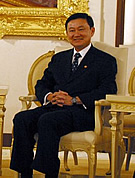
The Thai government of Prime Minister Thaksin Shinawatra was ousted in a Sept 19/06 coup that was widely believed to have been masterminded by Thailand’s king, with the cooperation of its military. That may have provided Saab with its opportunity, as an Australian newspaper reported a Thai officer as saying that “…we preferred F-16 C/D over Gripen, [but] the Americans are not allowed by their laws to sell weapons to countries whose governments have been ousted in coups.” On the other hand, the US State Department has told Jane’s that there are no restrictions on weapons sales to Thailand.
Whatever the case may be, Sweden’s fighter won. In response, its government appears to have opted for a policy of constructive engagement. While the opposition party has voiced misgivings, Swedish Minister for Foreign Affairs Carl Bildt said:
“I welcome the decision from the Royal Thai government to start negotiations with the Swedish government, to purchase Gripen fighter aircraft and the Saab Erieye Airborne Early Warning (AEW) system. This decision once again confirms that Gripen is a world class and cost effective system. The selection of Gripen was made in fierce competition with advanced US and Russian systems. We must now wait for the result of the formal negotiations that will now commence between the Swedish and Thai authorities. When a formal agreement is in place, this will be managed in accordance with the appropriate export legislation, rules and regulations.”
The current situation created that opportunity for Saab, by sidelining the previous choice, and opening the doors to a significant budget increase for Thailand’s military. It could also serve to torpedo the deal later on, of course, if the government that follows decides to undo what its military predecessor has done. Thaksin Shinawatra has stated that he has no intention of returning to politics, but he remains popular in many parts of Thailand, and his supporters could come looking for payback once elections begin again. Fighter jets are high-profile military deals with a lot of symbolism behind them, which makes them attractive targets in such situations. The Gripen’s planned acquisition period is also rather long, and much of that period will follow planned elections. This is a significant risk factor.
Until Thailand actually accepts jets into operational service, therefore, we’re hesitant to count this deal as truly done. The Gripen will also have to demonstrate exceptional performance against RTAF F-16s to make a strong case for Phase 2 and build a strong cadre of support within the Thai military. The Gripen is certainly capable of performing at that level – but much of the turbulence ahead of it will be of a type that its avionics aren’t programmed to handle.
Appendix B: Additional Readings
* Royal Thai Air Force – Official Site [Thai]. See also the JAS-39 news release [in Thai]
* RTAF – F-5 Replacement White Book [PDF, in Thai]
* DID FOCUS Article – The JAS-39 Gripen: Sweden’s 4th Generation Wild Card
* Saab – Argus/Erieye Surveillance System
* Ericsson – PS-890 Erieye radar
* Swedish Inspectorate of Strategic Products special re: Thailand [PDF, in Swedish]
* Reuters (March 4/11) – Weapons and the Art of Diplomacy. Discusses American efforts to secure the Thai deal, and why it unraveled.
* DID (Oct 7/10) – Thailand Moving to Upgrade its F-16 Fleet. It’s a 3-phase program, lasting up to 7 years.
* Gripen International (Oct 17/07) – Thailand selects Gripen and Erieye
* Bangkok Post (Oct 17/07) – ACM Chalit: Gripen jets ‘suitable’ for tasks
* Yahoo News Singapore – Thailand to buy six Swedish Gripen fighters
* Defense Aerospace (Oct 17/07) – Carries Radio Sweden report and a longer Bangkok Post article.
* Agence France Press via Defense News (Oct 17/07) – Thailand Picks Sweden’s Gripen for $1B Fighter Deal
* News.com.AU (Oct 17/07) – Thais may pick Swedish fighters over F-16s
* DID (Dec 28/06) – Thailand to Buy 12 Sukhoi Fighters?
* F-16.net – KongTup Arkard Thai (Royal Thai Air Force – RTAF). Details that air force’s history with the F-16.