


(click to view full)
In January 2006 the Pentagon attempted to remove FY 2007 funding from the F-35 Lightning II’s second engine option, the GE/ Rolls Royce F136. As predicted, protests from fellow Tier 1 partner Britain followed at the highest levels of government. Many in the US Congress, meanwhile, were openly skeptical of handing Pratt & Whitney’s F135 engine the keys to the entire F-35 fleet. In the end, the Pentagon’s argument that low program risk made R&D spending on F136 development a waste, failed. Congress re-inserted funding, and F136 development has continued on schedule.
Fast forward to the FY 2008 budget. For the second year in a row, the USAF removed funding for the GE/RR F136, arguing that killing the F136 would free up $1.8 billion. Politicians disagreed, and the USA’s GAO auditors backed them up. Funding was reinstated. Again. That process was repeated every year until December 2011, when Pratt & Whitney was finally handed its engine monopoly over the US military’s core fighter jet of the future.
The F136 Program
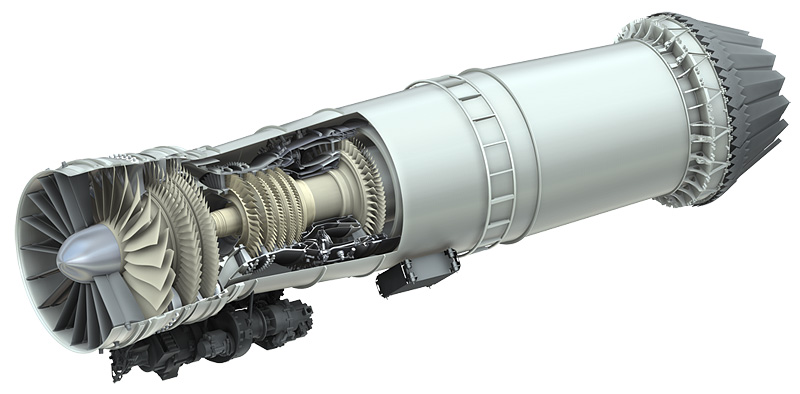
(click to view larger)
The JSF dual engine program had always envisaged a leader-follower strategy for development – it was never a competition during the development phase. When Boeing’s X-32 and Lockheed Martin’s X-35 competed to become the Joint Strike Fighter, Pratt & Whitney’s F119 was deemed to be the only production engine suitable for use as a base for an engine to power both aircraft. As the winning F-35 fighter’s SDD phase began, both engine types were already receiving funding, but the F135 engine had started much earlier, had begun development from an in-production base engine, and had already flown on the demonstrator aircraft.
Pratt & Whitney’s F135 received a 4-year head start on development thanks to a $4.8 billion System Development and Demonstration (SDD) contract on Oct 26/01, and that was set to grow to a total of $7.5 billion in funding over the F-35’s development period. It powered F-35 test aircraft, and equips initial F-35 production models. It was about 24 months behind the 2001 schedule, however; even as Pratt & Whitney was lobbying to be the F-35 engine’s sole-source supplier and maintainer, estimates placed them over budget by a reported $2.4 – 3.4 billion.
GE and Rolls Royce’s F136 was at an earlier stage of development. It was derived from the F120 engine that had powered the YF-23 Black Widow prototype, and follow-on F136 development was launched in earnest by a $2.47 billion SDD contract in August 2005, after almost $600 million in pre-SDD funding.
The idea was to replicate the very successful experience of the P&W F100 and GE F110 engines that power F-15 and F-16 models. The F110 had an even longer lag of 4 years behind the F100, but its arrival made a big difference to the F-16, which was suffering from the F100’s problems. Ongoing competition straightened that out fast, and created what were in effect free upgrades, as well as cost and reliability benefits (q.v. “F100 and F110: The 1st Engine War,” below). Fleet reliability was also improved, by creating a mixed fleet of F100 powered and F110 powered F-16s.
These characteristics become even more important when a single fighter type is expected to be the future backbone of all 3 military services. See “Engine War II: The American Debate,” below, for a fuller treatment.
F136: Industrial
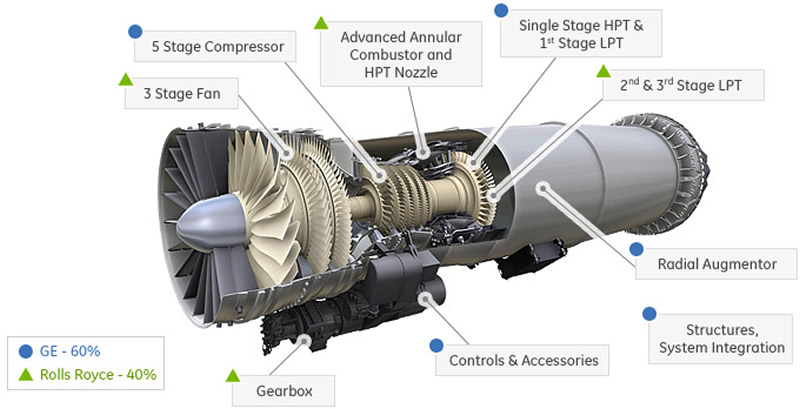
(click to view larger)
F136 engine development was led by GE Aviation in Evendale, OH near Cincinnati suburb; and by Rolls-Royce in Indianapolis, IN. GE Aviation was responsible for 60% of the F136 program: developing the core compressor, coupled high-pressure/low-pressure turbine system components, controls and accessories, and the augmentor. Rolls-Royce was responsible for 40% including the front fan, combustor, stages 2 and 3 of the low-pressure turbine, and gearboxes.
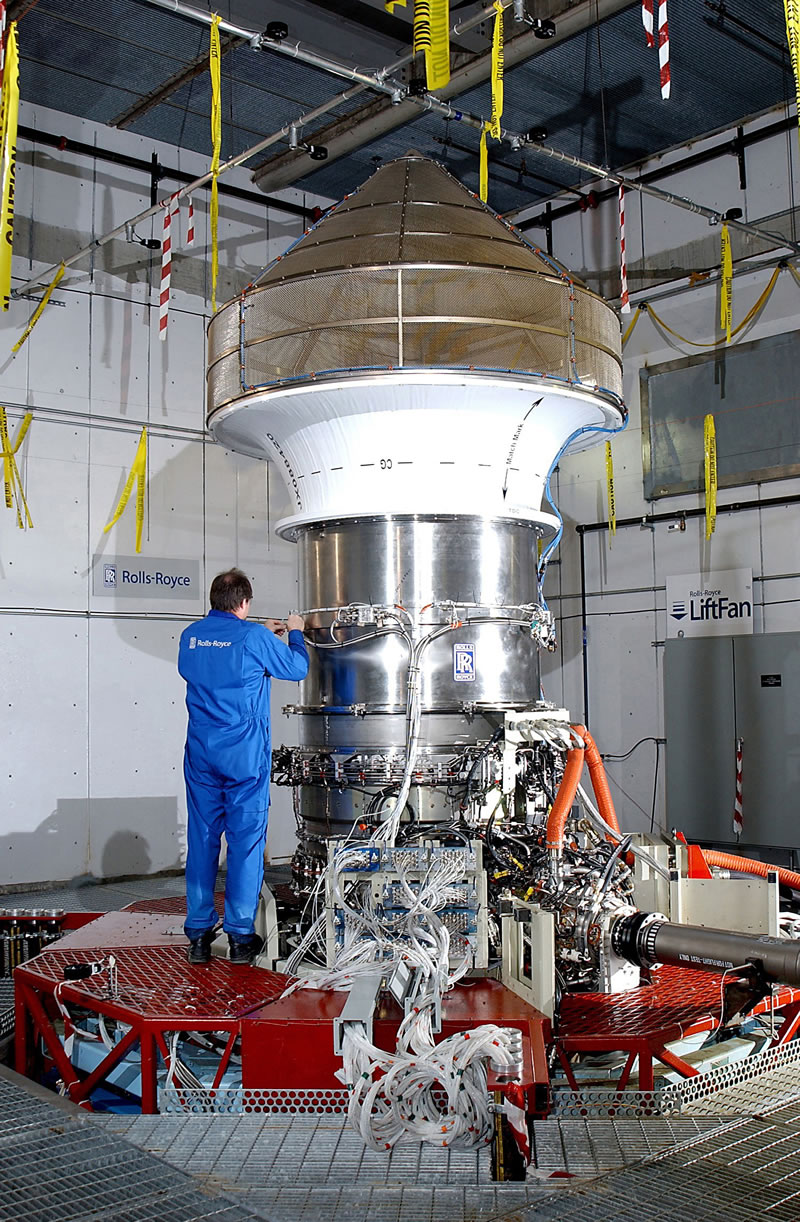
Rolls Royce’s LiftSystem fan for the F-35B STOVL was to be common to both the F135 and the F136 engines.
International participant countries like the Netherlands were also contributing to the F136, through involvement in engine development and component manufacturing. Nedtech and DutchAero (formerly Philips Aerospace), for example, had contracts with Rolls Royce for F136 backup motors and blisks. Stork-Rheinmetall had testing contracts, and was leveraging its strong expertise in fan blades. Had the F136 entered service, this international roster would have expanded.
Sitrep at the End

The first complete new-build F136 engine began testing early in 2009, and expected to see flight testing by 2011-2012. If all went well, the first production F136s could be available in 2012. The F136 program was 2-3 months behind the original 2005 schedule, and on budget, but with less testing under their belt. That’s a bit of a caution flag. Additional engine costs and rework are always a risk once stress testing begins in earnest, and Congress created issues by not providing the full amount of budgeted funding during development.
These lags seemed stressful at the time. They were more than stressful – they were dangerous. Just not for the reasons GE thought.
GE thought the problem was the F-35 program’s schedule. F-35 fighter production was scheduled to step up considerably in 2010, but the planes’ SDD phase and associated testing wasn’t expected to be complete before 2014, well after production deliveries had begun. That originally created schedule pressures for the F136 team, who wanted to be ready before the fighter’s SDD phase finished, and before Britain fielded its new HMS Queen Elizabeth aircraft carrier in 2015.
As it turned out, that wasn’t the problem.
By 2011, when GE and Rolls Royce canceled the F136, 2016 looked (and was) too optimistic as the projected end of the Joint Strike Fighter’s development phase. Production clearly wouldn’t reach full rates for several more years, and Britain’s plans had changed so much that they wouldn’t be flying any planes off of a carrier again before 2020. Testing issues had even changed the order of fielding and full-rate production for the F-35’s 3 variants.
The problem was the political schedule. The Pentagon began trying to kill the F136 in 2007, but their premises and justifications were found to be flawed, or even completely missing. They were not helped by the fact that key analysts like Congress’ GAO auditors had consistently expressed support for the alternative engine program as a good use of funds. So the problem became whether the engine could survive politically, in order to become a viable competitive alternative for customers like US Navy, Britain (who was expected to pick it), et. al.
Congressional and international support remained solid for 3 years. Then the 2010 mid-term elections ushered in a wave of new representatives in the House, many of whom were part of a “Tea Party” protest wave that pushed to retrain US government overspending before its economic backlash could seriously damage the country. The F136 got caught in that sentiment by a freshman caucus looking for a victory. A co-belligerence of right-wing Republicans with a preponderance of Democrats saw the F136’s political defenses fail in 2011, before the engine could make it into service.
The F136: Detractors and Defenders
F100 and F110: The 1st Engine War

(click to view full)
The Pentagon’s argument for canceling the F136 boiled down to 2 main pillars. One is that the F135’s derivation from the F-22A Raptor’s extensively-tested F119 engine reduces its development risks. The second contention is that The F135 is working well, which means any funds given to the F136 subtract from the total number of fighters in the F-35 program.
The Lockheed F-16, which currently flies with either P&W’s F100 or GE’s F110 engines, is an illustrative example of how a dual-source engine program can work. In program terms the F110 was introduced even later, fully 4 years after F-16s with P&W’s F100 began front-line operations in USAF units. Nevertheless, the strategy was a success. It created more competition, solved a slew of problems with the early F100 engines that were in service, and sustained the American industrial base by leveraging a popular fighter program in 2 ways. It also led to a raft of free technology improvements, from higher thrust engines to maintenance improvements, that continue to this day. With 2 competitors available for American and foreign buys, each knows that complacency will lead to rapid replacement as the F-16’s engine of choice. This is true with respect to support costs, as well as for purchase costs.
The GAO consistently reported that these benefits more than paid for the cost of developing the F110 engine. The marketplace will also tell you that, without a report.
Although the P&W F100 was the F-16’s original engine, and is still chosen by some foreign customers, GE’s F110 currently powers over 80% of the USAF’s F-16 fleet. A number of other global customers also have mixed-engine F-16 fleets, which serves as a hedge against technical risk for their primary fighter force. You can tell by an F-16’s designation: Block x0 F-16s (i.e. F-16C Block 50) have GE’s F110 engines; Block x2 F-16s (i.e. F-16C Block 52) have P&W’s F100 engines.
Competition is even bleeding into the F-15 program, which had always been far more uniform. F-15s almost all carry variants of the F100, though some of Saudi Arabia’s F-15S and Korea’s F-15Ks, and all of Singapore’s F-15SGs, are breaking that mold by selecting GE’s F110. Note that you can’t tell the F-15’s engine by a block number or by any other designation, unless the type is a single-engine fleet like the F-15SG.
Engine War II: The American Debate
(click to view full)
Given the positive maintenance and performance results from dual-sourcing the P&W F100 and GE F110 engines for the global F-16 and F-15 fleets, and the appeal of district jobs, the Pentagon had an uphill battle on its hands in Congress. They remained willing to try, however, which meant that the F136 engine kept requiring resurrection.
Revival efforts were boosted by support from the US Congress’ Government Accountability Office, whose auditors have consistently supported the long term financial and operational benefits of a dual-engines program. In 2007, they estimated that sole-source lifecycle cost for the entire F-35 engine program at $53.4 billion, while the alternate engine program would require another $3.6 – $4.5 billion. They believe that actual experience from past engine competitions suggests that it is reasonable to assume savings of at least that much, while improving contractor and engine performance, and acting as a hedge against fleet-wide risk.
The F136 has also enjoyed bipartisan support from Armed Services committee members.
Cost risk: One obvious consequence of a single-engine program would be a major win for United Technologies, as it would be the engine supplier for the backbone of the US tactical fighter fleet and a potential export star. They would also inherit a very lucrative aftermarket of spare parts and support lasting until 2050 at least, and possibly beyond. Back on Feb 5/07, Senate Armed Services Committee chair Sen. John Warner (R-VA) grilled Defense Secretary Robert Gates and Pentagon Comptroller Tina Jonas over concerned that eliminating the F136 would be the equivalent of handing Pratt & Whitney sole engine development right:
“If we have but a single engine, then we’re in effect giving a sole-source contract to one contractor, which could amount to $100 billion… I’ve calculated that out. It’s extraordinary.”
Verdict as of 2014: F135 purchase costs remain high, which is a bad omen for long-term support costs because the program needs lower per-plane costs right now. Absent an alternative, that hasn’t been enough to make a difference. The larger the F-35 fleet grows, the less leverage customers will have with Pratt & Whitney as a sole support supplier.
Operational risk: In 2009, House Armed Service Air-Land Subcommittee chair Neil Abercrombie [then D-HI] stressed the fleet reliability issue, stating that it simply was not prudent to have 80-90% of the USAF, Navy and Marine Corps’ fighter fleet dependent on one engine type, from one manufacturer, which can ground all of those fleets if mechanical flaws or difficulties surface. The conservative Heritage Foundation stressed the same issue, so those 2 have agreed on at least 1 thing over the years.
Verdict as of 2014: This has been a problem, and the entire F-35 family has been grounded a couple of times already over engine issues.
(click to view larger)
Other long term issues arose as politicians debated the merits of a dual-sourcing program.
Industrial: The Lexington Institute believed that GE would probably exit the tactical engine business, in line with its famous “#1, #2, or gone” approach. While GE would still have the contract for the F414 engine in the Navy’s F/A-18 Super Hornets and Saab’s JAS-39NG, it would have no toehold in the future fighter market. Under those circumstances, a spin-off and sale of its fighter engine assets to focus on helicopter and commercial engines would not be unthinkable.
Verdict as of 2014: Hasn’t happened yet. GE continues to service its existing engines, and is successfully marketing the F404 and F414 for foreign fighter programs like South Korea’s T-50 family and India’s Tejas LCA. GE could still exit the fighter engine business, but it won’t happen soon. They continue to do some R&D around F414 variants with better power or better efficiency, participate in advanced US government engine research programs, and have high dual-use hopes for their 7,500 shp class T708 turboshaft/ turboprop. Still, it remains true that most of their cutting-edge R&D efforts these days are firmly on the civilian side.
International. Then there were the potential consequences for the JSF program as a whole. Britain has invested $2 billion in the F-35 as the only other Tier One partner, and the participation of Rolls Royce with GE in the aircraft’s F136 engine is an important industrial spinoff. The UK’s F-35 participation has been questioned and technology transfer issues. Budget issues remain a threat to the program as a whole, and the question of related industrial spin-offs remains part of Parliament’s concerns.
The Dutch are also involved in F136 production, even as that Tier 2 partner considers alternative platforms like the JAS-39NG. Nedtech and DutchAero (formerly Philips Aerospace) have contracts with Rolls Royce for F136 backup motors and blisks, while Stork-Rheinmetall had testing contracts, and was leveraging its strong expertise in fan blades.
Dealing a serious blow to the program’s industrial spin-off potential for the UK would create risks for the program as a whole, especially with Britain facing a serious budget crisis in the wake of 2009’s Great Recession. Dutch involvement in the F136 was far smaller, but until production orders are placed, anything that might tip the balance against the F-35 was worth sober second thought.
Verdict as of 2014: Absent an alternative engine, F135 engine costs and reliability are a sales negative for the plane as a whole, but there aren’t any clear signs that it’s costing the program any near-term sales. Britain’s F-35 order has been cut by an uncertain amount, but a cut of half or more remains a possibility. The Dutch came close, but didn’t cancel; still, they their buy from 85 to 33-35 fighters, as a result of overall aircraft costs. Canada may end up doing something similar. It isn’t clear that keeping the F136 in play would have made enough difference to change these outcomes, and the F-35 hasn’t yet lost any of the few fighter competitions it’s known to have entered.
Updates and Key Events
FY 2012 – 2014
GE & Rolls Royce give up; Subsequent F135 problems push Senate SAC to recommend a reassessment of the sole-source engine approach.

(click to view full)
July 17/14: Politics. The Senate Appropriations Committee approves a $489.6 billion base FY 2015 budget, plus $59.7 billion in supplemental funding. It includes a section covering the F135 engine, and it’s clear that the members aren’t happy:
“F135 Engine. When the Department of Defense made the decision to terminate the alternate engine for the F–35 Joint Strike Fighter [JSF] in May of 2011, it reassured the Committee that a second engine was no longer necessary as a hedge against the failure of the main JSF engine program. The Department also stated that the financial benefits, such as savings from competition, were small if they existed at all. Since that time, the F135 engine has experienced numerous problems, including the failure of an oil flow management valve and a pre-take-off fire in the past few weeks, both of which grounded the entire fleet of over 100 aircraft. Further, the F135 engine unit cost has not declined as projected. However, the Committee believes that had the alternate engine program continued, competition would have incentivized the F135 engine manufacturer to find creative methods to drive down prices and ensure timely delivery of a high quality product, which is consistent with current Department preference for competition in acquisitions. Therefore, the Committee recommends the Secretary of Defense reassess the value of an alternate engine program creating competition to improve price, quality, and operational availability.”
American budgets still have to be reconciled in conference with the House of Representatives, then signed by the President, so there’s no guarantee that this remains in the FY 2015 defense budget as passed.
American budgets still have to be reconciled in conference with the House of Representatives, then signed by the President, so there’s no guarantee that this remains in the FY 2015 defense budget as passed.
The USAF is saying that the recent F135 engine fire is probably a one-off event, based on examination of the other 98 planes. Still, the point about fleet availability has been made. The meltdown also appears to have destroyed a $120 million jet, and killed the F-35’s much-hyped attendance at the world’s top military air expo in Farnborough. Nevertheless, Pentagon acquisition Chief Frank Kendall is saying that “We’re not interested in this point in going back several years and opening up to another competitor.” That has worked before with the F110, but it’s also worth asking if GE and Rolls Royce are still interested after their own cancellation (q.v. Dec 2/11). Sources: DID: FY15 US Defense Budget | Defense News, “Senate Panel to Pentagon: ‘Reassess’ Value of Alternate F-35 Engine” | Foxtrot Alpha, “Axing The F-35’s Alternative Engine Was An Incredibly Stupid Move.”
Dec 2/11: F136 Ended. Joint GE/ Rolls Royce press release:
“The GE Rolls-Royce Fighter Engine Team (FET) has reached the decision to discontinue self-funded development of the F136 engine for the Joint Strike Fighter (JSF) beyond 2011… recognizes the continued uncertainty in the development and production schedules for the JSF Program… difficult circumstances are converging that impact the potential benefit of a self-funded development effort… [The team] will continue to fulfill its termination responsibilities with the federal government…numerous patented technologies from both companies… six F136 development engines had accumulated more than 1,200 hours of testing since early 2009. The [engine] consistently delivered on cost and on schedule, and was rewarded with high marks by the Department of Defense…”
Outside reports indicate that a key blow was an Oct. 31 meeting between GE Aviation leadership and Deputy Defense Secretary Ashton Carter in which “it became clear that the [Defense Department] would not support the FET self-funding effort,” which depended on some level of cooperation with respect to the use of test facilities, access to delivered engines, etc. They also indicate that even if the 2012 budget approves self-funded development and forced the Pentagon to support it, the project is dead.
It’s that last position that prompts a certain amount of speculation. The ultimate reason for ending development, beyond complete Pentagon non-cooperation, could be a business case. Schedule difficulties were explicitly cited, as sliding production expectations make it hard to plan when to have manufacturing investments ready. Then, too, funding 20% of a $3+ billion program is a significant outlay, and the engine partners may see budgetary train wrecks in the USA and Europe imperiling planned F-35 purchases. If the plane’s trajectory follows the F-22’s, exports stall, and real production totals end up closer to 2,000 than 6,000, the lure of an up-front investment shrinks accordingly. Especially if the Pentagon makes a political decision not to buy it, no matter what, leaving the F136 competing for a small pool of small export orders. Revelations may come in time, but for now, the reasoning is not as clear as the outcome.
The only consequential questions left now are GE’s long-term future in the fighter engine business, and the size of the monopoly gift handed to Pratt & Whitney. The latter has been estimated at up to $100 billion over the F-35’s lifetime for both engine buys and the real kicker – support costs. See also Aviation Week | Bloomberg | Cincinatti.com.
GE/RR cancels F136
May 9/11: Politics. The Full House Armed Services committee releases its mark-up of the FY 2012 defense budget. The mark up includes Section 252, which blocks the Pentagon from spending any money for “activities related to destroying or disposing” any “property owned by the federal government that was acquired under the F136 propulsion system development contract.” The proposed budget also reinstates the F136 program, without funding, allowing the GE/RR team to use existing engines, test facilities, etc. HASC | Bloomberg.
FY 2011
Pentagon issues stop work order, but GE/RR will self-fund as it touts fixed-price early production offer; New GOP representatives from the “2010 wave” kill the F136; Did the Pentagon lobby Congress illegally?; F-35B and hence LiftFan placed on probation; F135/136 engines undeliverable at sea?; GE runs complete propulsion system for the 1st time.

(click to view full)
May 5/11: F136 self-funded. The GE/RR team announces that they will self-fund the F136 through FY 2011 and 2012, completing the remaining 20% of development. In return, they will retain the hardware, assemblies and testing capacity funded by the government. That would keep the alternative engine “viable” for both the F-35 and for a future U.S. Air Force long-range bomber, which gets initial funding in FY 2012.
According to a September 2009 cable from the U.S. Embassy in the Netherlands, published by Wikileaks, “prospects for winning continued Dutch support for the JSF are dim without continuation of the F136 program.” Aviation International News.
April 25/11: Contract termination. The DoD announces that it is canceling the contract to build an alternate engine for the F-35 JSF fighter jet. It informed the General Electric/Rolls Royce team and Congress that the F136 JSF engine contract has been terminated. In the FY 2011 continuing resolution funding the federal government for the rest of the fiscal year, Congress failed to fund the F136 engine, DoD said.
GE and Rolls-Royce said they would press for funding to be restored in FY 2012. They estimate taxpayers have spent roughly $3 billion on the project so far. “I can assure you we are not giving up,” GE Chief Executive Jeff Immelt said in a letter to employees, according to a Reuters report. “We continue to be encouraged by the bi-partisan support for the engine on the merits of its performance and value,” the companies added in a statement after the termination announcement, the report added.
March 24/11: Stop work order. The Pentagon issues a stop-work order on the F136:
“The Department of Defense (DoD) today issued a stop work order in connection with the Joint Strike Fighter extra engine program… The House of Representatives has recently expressed its own opposition to the extra engine in its passage of H.R. 1 including the adoption of the Rooney Amendment which removed all fiscal 2011 funding for this program. In addition, funding for the extra engine was not authorized in the National Defense Authorization Act for fiscal 2011, enacted in January. In light of these recent events, Congressional prerogatives, and the administration’s view of the program, we have concluded that a stop work order is now the correct course. The stop work order will remain in place pending final resolution of the program’s future, for a period not to exceed 90 days, unless extended by agreement of the government and the contractor.”
The bit about 2011 continuing resolutions is technically true, insofar as no specific funding directives are offered at all for any part of the F-35 program. The decision pulls $460 million in funding from the program, and House Armed Services Committee chair Buck McKeon [R-CA-24] said that:
“The views of the president and Secretary Gates are well known on this topic, but those opinions – however strong – are not the law. The Joint Strike Fighter F136 engine program is funded under the current continuing resolution. The secretary should follow current law and not pre-empt the congressional deliberation process by yanking funding after a single amendment vote… canceling the engine competition and awarding a sole-source, never-competed contract constitutes the largest earmark in the history of the Department of Defense… The Department’s decision is especially troubling when you consider their preferred engine has experienced development delays and a cost to complete increase of 445 percent over the last three years.”
Sen. John Kerry [D-MA] expressed similar concerns about the process, but restoring funding in the Senate, which struck it from the budget in 2010, and then persuading the House to go along in reconciliation, will be difficult. The Senate didn’t include the engine in its bill either, but senators voted down both versions, leaving the program in limbo. GE and Rolls Royce say they will now self-fund F136 development through the 90-day period, while continuing to make their case for the original dual-engine program. US DoD | Rep. McKeon | Australian Aviation | Aviation Week | Bloomberg | Boston Herald | Flight International | DoD Buzz | Gannett’s Air Force Times | Lancanshire Telegraph | Reuters.
Pentagon stop-work order on F136
his strategy
(click to view larger)
Feb 15/11: House votes to kill. Rep. Thomas Rooney [R-FL-16] offers an amendment to H.R. 1, which is the new Congress’ 1st bill because its predecessor failed to pass a FY 2011 budget. H.Amdt.16 proposes to strip $450 million in funding for the F136 engine out of the budget, and passes 233-198-1. The margin of difference from last year is largely among the Republican freshman class, who were the focus of strong lobbying – though on balance, Republicans voted against the amendment 130-110. With Democrats voting 123-68-2 in favor, however, the vote was carried.
A GE statement said that “While we are disappointed at the outcome, the debate to preserve competition will continue… Last fall, the Senate defense appropriations subcommittee called the F136 engine a ‘near model program.’ ”
The House isn’t done with H.R. 1, and could reverse the amendment before it finishes. Reconciliation with the Senate must also happen before this is final, but last year, it was House pressure that kept the dual-engine program alive. One proponent is Sen. Patrick Leahy [D-VT], who tweets:
“House vote is pound foolish & not even penny wise. Ending the alternate engine: A blunder that would yoke taxpayers for a generation.”
Agree or disagree, it’s pretty clear that the fight isn’t over. For the 1st time in the program’s history, however, GE is not working from a position of strength. GovTrack on H.Amdt.16 | THOMAS covers the floor debate that begins with the amendment | Rep. Rooney statement | Bloomberg | libertarian Cato Institute | DoD Buzz | The Hill | Fort Worth Star Telegram’s Sky Talk | Washington Post || Sen. Sherrod Brown [D-OH] reaction.
Feb 16/11: Deception? Rep. Roscoe Bartlett [R-MD-6], chair of the House Armed Services Tactical Air and Land Forces subcommittee, has some pointed questions for SecDef Gates about a memo circulating on Capitol Hill, which says it was prepared by the Department of Defense, containing statements that seem to be untrue, which was not sent to House Armed Services committee members, and which could conflict with statutes that the Pentagon may not lobby members of Congress. Those are not trivial issues, so here’s the document [PDF], and the full transcript of the exchange:
“Bartlett: For the past two days two papers have been circulated by the Congress here. One on Monday, one on Tuesday. They are unsigned and undated. It simply says prepared by the Department of Defense. The Office of the Secretary of Defense for legislative affairs has refused to respond over the last three days to why these papers are not dated, why they were not provided to the [House] Armed Services Committee.
Sir, when I was a little boy, my mother impressed on me that an intent to deceive is the same thing as a lie. In each of these papers there is a statement, “The F136 alternate engine is currently three to four years behind in development compared to the current engine program,” and yesterday’s paper said the F136 engine is already three to four years behind in the development phase.
Sir, as you know the first engine is now about 24 months behind in its development and I understand that the second engine is just two to three months behind in its development cycle. So, in reality, had they both been started at the same time, the second engine would now be well ahead of the first engine.
Sir, are you comfortable that these two [issue papers[ that have gone through the Congress for the last couple of days do not constitute a violation of the statute that prohibits the Pentagon from Lobbying the Congress?
Gates: I am not in the slightest aware of either one of those documents…
Bartlett: Sir, these two papers are circulating. They are both unsigned and undated. And the Office of the Secretary of Defense Legislative Affairs refuses to respond over the last three days as to why these papers are not signed… they were provided to everyone else in the Congress except the Armed Services Committee, is my understanding.
Are you comfortable sir, that this does not violate the statute that says, the Pentagon cannot lobby Congress?
Gates: Let me see the papers and find out the background before I make a judgement on them.”
Feb 15/11: Politics. DoD Buzz offers an initial report on the F136’s prospects in H.R. 1, and sees both House and Senate prospects as positive, while noting the challenge from new Republicans led by Rep. Toomey. See the video re: his “keep it simple” advocacy strategy.
Feb 14/11: Politics & Costs. US Secretary of Defense Robert Gates implies that if the new Congress doesn’t specifically require F136 engine funding, he’ll make the call himself. The program’s status under the continuing resolution has been a question (vid. Dec 22/10 entry), and Gates reportedly said:
“The Congress has not spoken with one voice on this matter and the department has been operating this fiscal year under ambiguous guidance at best… I decided to continue funding the JSF extra engine on a month to month basis [at abut $28 million per month] “for an excessive and a unjustified program that is slated for termination… when the current continuing resolution expires, I will look at all available legal options to close down this program.”
GE takes the unusual step of responding directly, and more or less accuses the Secretary of dishonesty. Whether it’s a fair cop based on this and other statements is for readers to decide. Rick Kennedy, GE spokesman, in an email to DoD Buzz:
“He claimed the F136 engine program would cost $3 billion to complete – a figure already discredited by the Government Accountability Office (GAO). GE and Rolls-Royce believe the number is closer to $1.8 billion. He failed to discuss the continuing cost overruns for the lead Pratt & Whitney engine for JSF, which last week grew an additional $1 billion in 2010 and now totals $3.5 billion in just the development phase alone… He failed to discuss a four-year, struggling JSF flight test program in which the lead P&W engine has failed to operate throughout the full flight envelope – and how the P&W engine still needs untold hundreds of millions of dollars… We couldn’t agree more – there needs to be a debate on whether to hand a $100 billion monopoly of a single engine supplier whose costs are out of control.”
Feb 10/10: F135 costs. Aviation Week reports on a Pratt & Whitney media roundtable, as part of budget lobbying. The company announced a “handshake” with the JSF program office on an LRIP Production Lot 4 fixed-price contract for F135 engines, at a unit cost 16% below the LRIP 3 cost-plus contract. On the other hand, as part of the F-35 development replan (vid. Jan 6/11 entry), Pratt & Whitney will receive about $1 billion more.
About $600 million will pay for extra engines and other resources to support extended flight testing of the F-35 from October 2013 to October 2016. The remaining $400 million or so will pay to improve the performance and durability of the F135, increasing the design margins and robustness of the engine, and addressing interstate damper, clutch, and roll post issues with the STOVL lift system – which is common to both engines. The $400 million is being presented as normal post-qualification improvement initiatives, and P&W military engines VP Boley sums up their case with respect to cost overruns so far:
“GE says we took a $5 billion development contract and turned it into $7.5 billion,” Boley said, answering a question about cost overruns on Pratt’S SDD contract. Two-thirds of the overrun – $1.6 billion – was a result of requirements changes “for which we got new money”, he said. The other $800 million was down to Pratt’s performance – “That’s 10% on execution, not a 50% gross overrun,” he argued.”
Actually, math suggests 16.7% on execution, based on an original $4.8 billion SDD contract.
Jan 24/11: F136. Forecast International summarizes F136 progress in 2010: 4 engines added to the ground test fleet, an a total of 6 engines measuring engine performance and endurance. GE says that they have met expectations of thrust, temperature margins and fuel consumption, demonstrating consistent light-offs and operability of the augmentor, successful completion of CTOL common exhaust system clearance testing, significant thrust margins at sea-level test conditions, and reaching maximum augmented thrust.
In early December 2010, GE ran a complete propulsion system for the first time with the common hardware for F-35B STOVL operatio, including the Rolls-Royce LiftFan. Production also began on test engine #41, which will be the first F136 to fly on the F-35. Final assembly began in early 2011 with acceptance testing expected to occur mid-2011. Flight testing is scheduled to begin late in 2012. defpro | q.v. also related GE release.
Jan 6/11: F-35 program changes. As part of a plan detailing $150 billion in service cuts and cost savings over the next 5 years, Defense Secretary Robert Gates states that he is placing the Marine Corps’ F-35B on the equivalent of a 2-year probation:
“By comparison, the Marine Corps’ short take-off and vertical landing variant is experiencing significant testing problems. These issues may lead to a redesign of the aircraft’s structure and propulsion – changes that could add yet more weight and more cost to an aircraft that has little capacity to absorb more of either. As a result, I am placing the STOVL variant on the equivalent of a two-year probation. If we cannot fix this variant during this time frame and get it back on track in terms of performance, cost and schedule, then I believe it should be cancelled. We will also move the development of the Marine variant to the back of the overall JSF production sequence.”
F-35 program SDD is extended again to early 2016, versus mid-2015 as planned in the 2010 restructuring, a move that’s likely to push initial operational capability (IOC) into 2017 and cost the program $4.6 billion. Individual services are assessing their model’s specific dates.
FY 2011/ LRIP-4 will be cut from 42 to 32 planes by amending the contract, and eliminating 10 F-35Bs. FY 2012 will see production held at 32, with just 6 F-35Bs bought to maintain the supplier base for the type. F-35 production is already behind, so this may not matter as much in reality. FY 2013 will see the production process speed up. It will still fall short of the previous plan for 549 LRIP orders by FY 2016/ LRIP-9, however, with only 415 ordered by that time.
To fill the gap created from the slip in the JSF production schedule, the Department of the Navy will buy 41 more Navy Super Hornet family planes in 2012-2014, and extend another 150 F/A-18 A-D Hornets for longer service via center barrel replacements and other refurbishments. Pentagon release re: overall plan | Full Gates speech and Gates/Mullen Q&A transcript | F-35 briefing hand-out [PDF] || Atlanta Journal Constitution | The Atlantic | Aviation Week | the libertarian Cato Institute | Defense Update | Flight International | Fort Worth Star-Telegram’s Sky Talk blog | The Hill | NY Times | Politico | Stars and Stripes || Agence France Presse | BBC | Reuters | UK’s Telegraph | China’s Xinhua.nce Presse | BBC | Reuters | UK’s Telegraph | China’s Xinhua.
Major F-35 program shifts: cuts, F-35B probation, Super Hornets
Dec 22/10: FY 2011 “Budget”. The US Senate passes H.R. 6523, the House’s Ike Skelton National Defense Authorization Act for Fiscal Year 2011. This is actually a “continuing resolution,” not a budget. After passing in identical form in both the House and Senate, it was introduced to the President to be signed on Dec 29/10, and became Public Law No: 111-383 on Jan 7/11. The funding will only extend to March 4/11, however, giving the incoming House and Senate full opportunity to pass their own budget.
See also May 13/10, July 28/10, and Sept 15/10 entries, which describe the provisions in the House and Senate bills. As passed, however, H.R. 6523 does not include program-level detail, so there is no amount specified for the F136 engine – or even the F-35 itself. In lieu of a defense appropriations bill, the Congress simply approved a resolution continuing FY 2010 spending levels. Sen. Sherrod [D-OH] specifically asked [PDF] the Office of Management and Budget about this, and got an answer [PDF] stating that:
“As my office indicated in the correspondence your letter references, Section 8006 of the FY 2010 Defense Appropriation Act required the Department of Defense (DoD), as a statutory matter, to fund the Joint Strike Fighter Alternate Engine program during FY 2010. As currently drafted, H.R. 3082 [DID: link added] would continue FY 2010 funding, terms, and conditions for the entire Federal government through March 4, 2011… In the case of continued FY 2010 provisions… DoD would be expected to continue funding activities on a pro-rata basis during the period covered by the CR, so as not to impinge on Congress’ full-year funding prerogatives for FY 2011.”
Dec 1/10: No at-sea engine deliveries? Gannet’s Navy Times raises a huge potential issue for the F-35’s naval variants: the engine and its packing are too large and too heavy for carrier aerial delivery platforms, and even too heavy for ship-to-ship replenishment stations. This will make sustained operations very difficult, as on-board space for spares is limited:
“…the F-35C’s Pratt & Whitney F135 engine, contained in its Engine Shipping System, is too large for the cargo door on a standard carrier onboard delivery plane and for the V-22 tilt-rotor aircraft, the program office acknowledged in a response to a follow-on query from Navy Times. The engine can be broken down into five component parts, but just its power module and packaging alone won’t fit into the [C-2 Greyhound] COD or the V-22. The JSF Program Office says the V-22 Osprey, like the MH-53E helicopter, can externally carry the F135 engine module, the heaviest of the five components, at least 288 miles “in good weather.” One outside analyst, Jan van Tol of the Center for Strategic and Budgetary Assessments, wondered how the Osprey, in hover mode, could safely lower the module to the flight deck or pick up an out-of-service engine in higher sea states… Moreover, the Navy has no fleet V-22s and has no plans to acquire them.
The 9,400-pound engine module and transport container also cannot not be transferred from a supply ship to a carrier during underway replenishments [UNREPs] – when two ships are sailing side-by-side and connected by supply lines – because, [Capt. Chris Kennedy of the JSF Program Office] said, “It’s too heavy for the unrep station [on Nimitz class carriers].”
No word on whether the F136 has similar problems. It’s likely.
Nov 28-29/10: Not a competition. A Viewpoint op-ed in Aviation Week by former deputy defense secretary Gordon England prompts a reply with AvWeek’s Bill Sweetman. The crux of the matter is that claiming there was any sort of competition for the F-35’s engine, or that Pratt & Whitney won, is dishonest. The engine program has unfolded as envisioned, a leader – follower dual engine program established before source selection, with the leader being a sole-source project based on the F119 (P&W’s F135), as it was considered to be the only suitable in-production engine to begin from. Gordon England Viewpoint | Bill Sweetman reply.
Oct 15/10: F136. The failure of F136 engine 008 in late September 2010 has been diagnosed, and it’s unique to that individual engine. A seal clearance in a fan that was set too tight, causing friction. Engines 05 and 07 continue to run well in tests, and will not need any modifications. DoD Buzz.
Oct 14/10: Politics. GE holds a local rally, with bipartisan political attendance, in support of its F136 engine. The firm is also adding about 500 jobs in the area, but they’re related to its new systems business, and developing the next-generation version of its best-selling CFM56 engines that power many passenger planes. GE says that about 1,200 jobs in its Evendale facility are tied to the F-136 engine.
After the November 2010 mid-term elections, its going to be political primary season in Ohio. In practical terms, that means the F136 project probably has to fully end in 2010, or its continuation is likely to become a political platform for Presidential hopefuls courting Ohio voters. ABC News | Cinicinnati Enquirer | WLVT.
Oct 12/10: Same same. USAF Gen. Norton Schwartz, speaking at the National Press Club, admitted there may be savings to be had through engine competition, but said “The question is, can we afford it in the short term.” That’s a step back, but GE was having none of it. GE spokesman Rick Kennedy said to DoD Buzz:
“GE and Rolls-Royce have already invested a considerable amount of their own money into the program. It’s very difficult to internally fund the engine if the F136 is not a JSF program of record. The SAC-D report called the F136 a “near model program,” and we have offered a unique fixed-price offer for early production engines which shifts the risk for early production to the contractors.”
FY 2010
US GAO, British government weigh in to keep F136; Congress prevents cancellation, again, in the face of a veto threat; Expected F135 development costs reach $7.28 billion; F136 has a test engine problem; F-35 program criticism grows in Congress; Are senior Pentagon officials giving misleading testimony, and touting a non-existent business case?; What happened during the last (F100 vs. F110) engine war?

(click to view larger)
Sept 28/10: F136. GE emails reporters to say that:
“Approximately three hours into a mechanical check-out on September 23 at the GE Aviation facility in Evendale, Ohio, an F136 development engine experienced an anomaly at near maximum fan speed. Engine #008 was shut down in a controlled manner. Initial inspection revealed damage to airfoils in the front fan and compressor area. The engine is currently being disassembled for a thorough investigation.”
That investigation later reveals that the problem was specific to engine #008, and is not shared by other F136 engines. DoD Buzz.
Sept 23/10: UK. US Sen. Carl Levin [D-MI, Senate Armed Services chair] releases a letter he received from British Defense Minister Liam Fox, supporting the F136:
“As you know, the United Kingdom (UK) was the first international partner in the F35 programme in 2001, providing not only the largest international financial contribution of $2 billion but also key elements of technology… Furthermore, we have been the first partner to commit to aircraft purchases. I thought you would therefore wish to know our views on the alternate engine strategy so that your Committee can take them into consideration.
The UK – and we believe other international partners on the programme are worried that a decision now to cancel the second engine may save money in the short term but end up costing the US and her partners much more in the long term. A second engine provides competitive discipline during the procurement of the production engines. The alternative, of course, is the creation of a permanent monopoly with all the disadvantages that would flow from that… [and] all the risks and vulnerabilities that this brings…”
Britain is currently in the middle of big decisions about budget cuts, a state that’s expected to last for several years. The Hon. Liam Fox’s letter [PDF] | DoD Buzz.
Sept 15/10: Politics. The US Senate Committee on Appropriations’ Defense subcommittee votes to cut the FY 2011 F-35 request by 10 planes, to 32 aircraft. Comments by key committee members reveal a growing skepticism bordering on hostility, noting that the USAF hasn’t contracted for the 30 fighters approved last year, calling the program’s progress “disturbing,” and even going so far as to say that the committee considered cutting off funds altogether. The subcommittee does not insert funding for the F136 engine – though it criticizes the Pentagon for abandoning the dual engine strategy:
“The incongruence of the insistence on canceling the second engine program which has been a near model program and which most analysts expect would curtail long term costs of the entire JSF program with the equal insistence on the need to fully fund the JSF program is hard to rationalize.”
With the House subcommittee voting 11-5 to continue the F136 engine, it seems likely that the House bill will contain those funds. If the full Senate Appropriations Committee adds an amendment, the Senate bill could add them as well. After that, there will be votes and amendments on the House and Senate floor, followed by the budget bill reconciliation process between the House and Senate. See: Senate Appropriations Committee release and webcast | The Hill magazine | DoD Buzz | Military & Aerospace Electronics.
Sept 15/10: GAO Report. The US GAO auditors release report #GAO-10-1020R: “Joint Strike Fighter: Assessment of DOD’s Funding Projection for the F136 Alternate Engine,” to Senate Armed Services Committee chair Carl Levin [D-MI]. In a significant departure from their normal conclusions, they think the Pentagon’s $2.914 billion estimate might be too high.
The Pentagon’s projection for remaining development funding in FY 2011-2016 is $1.533 billion. That breaks down as $1.188 billion for development & testing, and $345 million for engine component improvement work. It would be followed by $1.381 billion in procurement funing, which breaks down as $133 million in production tooling funding, $747 million in non-competitive engine and spares buys, and $500 million in support costs.
The Pentagon’s own belief is that their estimate has an even chance of being either too high or too low, but GAO says their 2 biggest assumptions push their estimate toward overestimating costs. The GAO believes that with F-35 schedule slippage and F136 progress, competitive buys could begin within 2 years, instead of in 4, cutting non-competitive buys. Competition could also save the Pentagon most of its “Engine Component Improvement Program” funds, as the competitors follow their behaviour with the last F100/F110 engine competition, and invest in their own efforts.
July 28/10: Politics. The House Defense Appropriations subcommittee approves its version of the FY 2011 defense budget, and votes 11-5 to spend $450 million on the F136 fighter engine. House Appropriations Committee | AFA | Aviation Week | Terre Haute, IN Tribune-Star | Australian Aviation.
July 27/10: Politics. In a letter to colleagues, the chairman (Rep. Robert Andrews, D-NJ) and and ranking member (Rep. Michael Conaway R-TX) of the House Armed Services Committee’s defense acquisition reform panel urge their fellow members of the House Appropriations Committee to fund the F136 engine. AFA | Letter [PDF].
July 13/10: F-16 History. Over at Military.com’s DoD Buzz, Former F-16 fighter pilot and test pilot Robert Newton, CEO of Newton Consulting & Engineering Inc., writes:
“There are volumes of information, metrics, reports, and books like The Air Force and the Great Engine War that describe the history, detail the lessons and highlight the value of a second jet engine source… We were all impressed by the F100’s high thrust; however, in-flight we had performance shortfalls and throttle restriction that to some degree forced us to baby the motor in order to avoid engine problems: stalls and/or afterburner blow-outs. We often felt as if we were flying the engine as opposed to employing the aircraft. Unfortunately the situation on the ground was even worse… reliability was a fraction of the requirement… our maintainers made herculean efforts to keep our F-16s in the air. They would routinely remove and replace engines and the engine back shop would all too often tear them down completely. In a short time, engine shop operating budgets and manpower to perform all the unplanned maintenance snowballed and drove our maintenance squadrons to the brink of operational bankruptcy.
Then our world changed. The Pentagon saw the wisdom of introducing a second engine in the form of GE’s F-110 and we discovered an engine with unrestricted throttle movements, higher thrust, and the potential to actually meet all the reliability requirements… That initial spark of competition generated a new energy level that was unmistakable, impossible to quantify, of immeasurable benefit, and enduring… When we had problems or new technical opportunities, the creative minds of each team made it theirs and in turn set new standards of excellence for both engines.”
June 17/10: The battle between Secretary of Defense Gates and GE becomes a direct exchange, as a result of the Secretary’s tendency to say things about the F-35 program that skirt the edge of strict truth.
In this case, Gates’ quote to a Senate hearing was that “We think that the engine does not meet, probably does not meet, the performance standards that are required…” The clear implication is that the engine is faulty, which drew the unusual step of a direct rebuttal from GE vice chairman John Rice. Rice noted that since 2005, Pentagon evaluations have rated F136 performance “exceptional” 7 times and “very good” 3 times, with positive reports from the F-35 project office as recently as May 2010. He also contested Gates’ repeated statements that the F136 would take another $2.9 billion to develop (vid. fixed price offer Sept 14/09, April 27/10), giving figures of $1 billion more for development and $800 million to jumpstart early production. GE spokesman Rick Kennedy also offered a direct rebuttal, saying that “The engine is not falling short of requirements – it’s meeting and exceeding requirements.”
Pentagon Press Secretary Geoff Morrell would later retreat from some of Gates’ statements, saying that the Pentagon believes the engine would meet Pentagon requirements at the end of development, and that all Gates meant was that the engine couldn’t meet final requirements while only part-way through its development. Readers can judge for themselves whether that was really what Gates wanted his audience to believe. The Hill.
May 28/10: Politics. In the face of Presidential veto threats, the US House of Representatives passes H.R. 5136 by a vote of 229-186, with 17 non-votes. It also votes 231-193 against an amendment that would have diverted F136 engine funds elsewhere.
While the margin appears to fall short of being veto-proof, many of these “no” votes against represent declared and publicly-stated opposition to the bill’s repeal of the US military’s ban on openly gay members, before the US military has delivered its own report on the issue. The corresponding Senate Armed Services Committee (SASC) chair Sen. Carl Levin [D-MI] also goes on record supporting the F136, and pronounces himself “very encouraged” by the House vote. The SASC will play an important role in reconciling the House and Senate bills into one document. See also GE release.
May 28/10: Politics. Before the House vote is taken, President Obama releases a statement that explicitly threatens to veto any budget that includes funding for an alternate engine for the F-35 joint strike fighter or more C-17 cargo jets. On the other hand, the bill includes repeal of the military’s ban on openly gay members, and a veto must include the entire bill.
If a veto is given, both the House and Senate must field a 2/3 majority vote to override. If one house fails, the other will not even vote on the matter. According the Congressional Research service, from 1789 through 2004, only 106 of 1,484 regular presidential vetoes were overridden by Congress. A budget stalemate has deeper consequences as well, of course, and presents grave political risks to all sides. White House statement | US Army | US Senate on veto procedures.
May 19/10: Politics. The full US House Armed Service Committee approves its subcommittee’s markups with respect to the F136 engine, which will become part of its H.R. 5136 budget submission to the full House of Representatives. Excerpt:
“Multiple studies, ranging from GAO reports to the Department’s own internal study, have consistently shown that there is no additional cost to fund the competitive engine, and that the second engine will generate additional savings… The Joint Strike Fighter is expected to represent 95 percent of our nation’s fighter fleet. The engine will be required to meet demands that have been asked of no other engine. The Committee believes it is unwarranted to risk grounding our entire fleet and incurring billions of dollars in unnecessary costs by cutting the second engine… a critical insurance policy for more than one trillion taxpayer dollars and for our national security. The bill authorizes $485 million for the alternate engine program and requires the Secretary of Defense to submit to the President a budget that includes a plan for the funding, development, and procurement of the competitive engine for the F-35.”
In response, Secretary of Defense Gates has pledged to “strongly recommend” a veto if F136 engine funding is included. His problem is that the President’s position has weakened significantly in the last year, with a number of members of his own party running for election against his administration – not least former Murtha aide John Crtiz [now D-PA-12]. The political questions in play are whether Obama can risk a veto threat over this issue, and whether Congress will back down if he does. House Armed Services Committee | GE.
May 13/10: Politics. The U.S. House Armed Services Seapower subcommittee and Air-Land Forces subcommittees each mark up the House of Representatives’ National Defense Authorization Bill for Fiscal Year 2011 (H.R. 5136) – and both of them vote to authorize $485 million in continued funding of the GE/Rolls-Royce F136 engine. Air-Land subcommittee chair Adam Smith [D-WA-9]:
“Today, the competitive environment created by having dual-sourced engines for the Joint Strike Fighter is estimated to save $1 billion during the next five years, and $20 billion over the life of the program. The committee has believed that competition in the F-35 engine program helps ensure against the operational risk of up to 95 percent of the entire U.S. tactical fighter fleet being grounded due to an engine problem. Competition has been demonstrated to help limit cost growth in acquisition programs, including as the first alternate engine program did for the F-15, F-16 and F-14. And competition has also been demonstrated to motivate contractor responsiveness, technical innovation, and improve engine maintainability, reliability, and durability.”
That markup has teeth, too. Until the Pentagon’s Under Secretary of Defense for Acquisition, Technology and Logistics certifies that all F136 funds have been committed, the last 25% of all F-35 program funds for FY 2011 will be withheld. These proposals survive to the full HASC committee markup session, on May 19/10. House Armed Services Air-Land subcommittee and Seapower subcommittee opening statements.
May 3/10: Politics. US Secretary of Defense Robert Gates speaks to the Navy League Sea-Air-Space Exposition in National Harbor, MD. He reiterates his strong opposition to the F136, and signals that he will continue to make it a political and budgetary issue. Excerpt from the transcript:
“In this year’s budget submission, the Department has asked to end funding for an extra engine for the Joint Strike Fighter as well as to cease production of the C-17 cargo aircraft – two decisions supported by the services and by reams of analysis. As we speak, a fight is on to keep the Congress from putting the extra engine and more C-17s back into the budget – at an unnecessary potential cost to the taxpayers of billions of dollars over the next few years.”
See Feb 25/10 and Feb 16/10 entries, below, for the debate about that analysis. In a follow-on speech, Gates reiterates that he will “strongly recommend” Presidential veto of the FY 2011 defense bill, if the F136 engine is included in the budget.
April 27/10: F136 fixed-price offer. GE and Rolls Royce reiterate, and extend the period for, their fixed-price offer for the F-35’s F136 engine. Unlike last year’s offer, this one includes lower fixed prices in 2013 and 2014 as well, and assumes the entire risk of cost overruns rather than sharing overages under a set formula as is common.
The offer amounts to a commercial-type contract, where the manufacturer absorbs the cost of the early production engines, and recovers it through later sales and service. The fact that this is seen as attractive by the GE/RR team speaks to the opportunity presented by the F-35 – and implicitly, to the value of a sole-source approach to Pratt & Whitney. GE Aviation President and CEO David Joyce says that accepting this competitive approach would save the government $1 billion over the next 5 years, and $20 billion over the life of the JSF program. Sources: Reliable Plant magazine | Reuters.
March 22/10: F136. The GE/ Rolls-Royce Fighter Engine Team announces that their 3rd production-model F136 engine has successfully hit full afterburner in an advanced testing facility at GE, and reached “all major objectives” during this testing phase for thrust, temperature margins, and fuel consumption. Note that the engine nozzle is common to both the F135 and F136 engines, as part of their designed interchangeability. Another 6 F136 engines are scheduled for testing in 2010, to measure engine performance and endurance. Rolls Royce release.
March 19/10: GAO Report. The US Congress’ GAO releases a report re: the F-35 program, and offers testimony. See: “Joint Strike Fighter: Additional Costs and Delays Risk Not Meeting Warfighter Requirements on Time” | “Joint Strike Fighter: Significant Challenges Remain as DOD Restructures Program” (testimony). Excerpts:
“The F135 primary engine development effort – a separate contract from the airframe development effort – is now estimated to cost about $7.3 billion, a 50 percent increase over the original contract award. This includes an $800 million contract cost overrun in 2008. Engine development cost increases primarily resulted from higher costs for labor and materials, supplier problems, and the rework needed to correct deficiencies with an engine blade during redesign. Engine test problems have also slowed development.
The alternate engine program to develop a second engine source – the F136 – is also encountering cost and schedule challenges… The JET estimates about $1.6 billion would be needed to complete F136 development in 2016. Contractor officials told us that funding stability, engine affordability, and testing issues are key concerns… [But GAO reiterates its past findings that the alternate engine program makes financial sense overall].
March 10/10: F135 The total cost to complete the Pratt F135 engine is now estimated to be $7.28 billion – $2.5 billion more than the $4.8 billion initially projected for the engine, and an increase of $600 million from the $1.9 billion cost overrun that was reported in 2009 by the House Armed Services Committee. Pratt & Whitney also disputes the reports, saying that its “war on costs” was working. Spokeswoman Erin Dick:
“I can unequivocally say that our costs are coming down; that there are currently no additional overruns associated with the development of the F135 engine and the government has expressed confidence in our cost reduction strategy going forward.”
An unnamed source tells Reuters that the F-35 program’s 13-month delay, and Pratt’s need for additional flight tests that add personnel costs and other overhead, are the reasons for the increases, saying that there is no “$600 million surprise.” Aviation Week | Reuters | Reuters follow-on.
F135 projected development costs
Feb 25/10: Rep. Ike Skelton [D-MO], Chairman of the House Armed Services Committee, issues a statement about the US DoD’s business case for the F136:
“Yesterday, I was finally provided with a copy of the ‘business case’ upon which Secretary Gates based his decision to oppose the development of the competitive engine for the F-35. While the committee is still reviewing the analysis, it appears that the Department’s approach focuses on near-term costs to the exclusion of what the committee sees as the long-term benefits of this program. The costs of the second engine in the next few years must be balanced against the fact that life-cycle costs of having two engines are comparable to having only one. The Department’s analysis does not consider the risk that a single engine would present not only to our fighter force, but to our national security, given that the F-35 will account for 95 percent of our nation’s fighter fleet. With this program, as with all others, we cannot use near-sighted vision when long-term security is at stake. I look forward to continuing the dialogue on this program with my colleagues and the Department of Defense. But I remain unconvinced that terminating the alternate engine program makes sense.”
Feb 24/10: Politics. DoD Buzz identifies some supporters and skeptics from watching committee hearings. On the supportive side: Norm Dicks [D-WA], the expected chair of the House Appropriations subcommittee on defense, and Jim Moran [D-VA]. Not supportive: Rep. Kay Granger [R-TX].
Feb 16/10: Politics. DoD Buzz reports that the current chairs and ranking Republican members of the House Armed Service Committee, its Seapower subcommittee, and its Air and Land Forces subcommittee, have all signed a letter to Secretary of Defense Robert M. Gates regarding the F136 engine program. They ask the Secretary for the full business case behind his recommendation to terminate the F136 engine, stating that:
“We will not detail here the accumulated testing failures, required redesigns, major cost growth and repeated delays experienced this far with the baseline engine. We simply note that, in our view, these problems bolster the case for a competing alternative engine…
In an August 2009 speech in Fort Worth, you mentioned that the “business case” did not support the alternate engine program. The committee requested a copy of that “business case,” and was told by your legislative affairs staff that there was no formal analysis, beyond the Department’s 2007 study. Yet you again referenced the “business case” during the February 3rd hearing and in your February 1st meeting with chairmen and ranking members of the congressional defense committees. Therefore, we respectfully request that you immediately provide the committee with the “business case” analysis you referenced in testimony that supports discontinuing the alternate engine program for the F-35.”
See: DoD Buzz | Scanned copy of the letter [PDF].
Feb 1/10: FY 2011 budget. The Pentagon unveils its FY 2011 budget request. Once again, Secretary of Defense Gates says he will advise President Obama to veto any defense budget that includes funds for the F136 engine. DoD briefing transcript.
Dec 10/09: F136 delay & funding. Military.com reports that the F136 program will be delayed by about 4 months due to the diffuser redesign, and quotes an unnamed congressional aide:
“It doesn’t help that, with at least a $30 million a month burn rate, [Office of the Secretary of Defense, who opposes the F136] is not giving them the money they need. Having no appropriations bill doesn’t help, but the CR lets them spend at the burn rate needed. Also, they have been shorted about $175 million over the 2007-2009 period by Congress from what the program office said was required to execute the planned program. Last I heard it was half, $15 million, so far, for what GE needs in December (as of last week). It is not good when the program manager is having to spend the kind of time he is having to spend on managing pennies instead of focusing on engine issues.”
Nov 2/09: F136. GE and Rolls Royce announce that they will redesign a diffuser that directs air into the combustor for the engine, after a nut came loose during testing.
Rick Kennedy, a GE spokesman, tells Reuters the companies expects to have the reworked F136 engine “up and running before the end of the year.” He also disputes a comparison of the F135 and F136 engines at similar life-cycle stages, published by Loren Thompson of the Lexington Institute. Reuters.
Oct 28/09: FY 2010 budget. President Obama signs the FY 2010 defense budget into law. That budget provides full funding for 30 F-35 aircraft (16 USMC F-35Bs, 12 USAF F-35As, and 4 Navy F-35Cs), and continues the F136 alternate engine program. White House | Cincinnati Business Courier.
Oct 6/09: Politics. House and Senate conferees rejected the approach taken by US Secretary of Defense Gates and the Obama administration, and fully funded the F136 in the reconciled FY 2010 defense budget. Military.com reports that:
“The authorization conferees agreed to fund the F-35 Joint Strike Fighter F136 alternate engine at $560 million, with no restriction or certification requirements – House and Senate related provisions (H 218 & 242; S 211) dropped. The conferees also agreed to fully fund the $6 billion requested for procurement of 30 F-35 aircraft, which includes 16 F-35Bs for the Marine Corps and 4 F-35Cs for the Navy and 10 F-35As for the Air Force. The conference report is expected to be taken up in the House [on Oct 7/09].”
Looks like Senate Appropriations defense subcommittee chair Sen. Inouye [D-HI] knew what he was doing (q.v. Sept 9/09 entry). See also Aviation Week’s article: “Levin Happy to Lose on Alternate JSF Engine.”
FY 2006 – 2009
Congress blocks Pentagon attempts to defund the engine; GE/RR submit unsolicited fixed-price offer for early engine production; P&W offer to match with a fixed-price F135 offer “if requested”; Gates makes case for F135 cancellation, amidst controversy over engine costs; F-35 director told not to discuss F135 issues?; F136 with “double-digit” performance growth potential vs. F136?

(click to view full)
Sept 15/09: LRIP-4 offer. Pratt & Whitney responds with an offer of its own:
“Pratt & Whitney has offered to provide the F-35 Joint Program Office with a firm fixed price proposal for the F135 engine if requested… [Meanwhile,] The company’s F135 engine Low Rate Initial Production (LRIP) Lot 4 contract proposal reflects confidence in the aggressive cost reductions actions underway by providing the Joint Program Office special protections against cost growth and incentives for significant cost reduction…
Pratt & Whitney’s LRIP 4 contract proposal covers production, sustainment, spare parts and engineering support for 37 F135 engines, consisting of 20 conventional take-off and landing (CTOL)/carrier variant (CV) and 17 short-takeoff/vertical-landing (STOVL) engines for F-35 aircraft. The same methodology that Pratt & Whitney and the U.S. Government used to achieve a 30 percent cost reduction on the F119 engine is being employed on the F135 engine.”
There are 2 likely reactions to this announcement. One will say that the fixed-price offer makes sole-sourcing the F135 much less risky, and argue that sole sourcing should proceed. The other will note that the proposal was prompted by a competitive offer, and say that rather than being an argument against the dual-engine program, the F135 fixed-price offer serves as an excellent illustration of dual-sourcing’s benefits and importance.
Sept 14/09: Fixed price? GE and Rolls Royce put out a release, offering a fixed price F136 engine, fleshing out Rep Driehaus’ [D-OH-1] statement in the April 23/09 entry:
“In response to cost overruns and schedule delays in major weapon programs, The Weapon Systems Acquisition Reform Act of 2009 was signed into law to mandate competition through the entire life of major defense programs – including funding competing sources. To drive head-to-head engine competition and predictable costs, the GE Rolls-Royce Fighter Engine Team has submitted an unsolicited fixed-price contracting approach [emphasis DID’s] for the JSF program office – a unique approach for the early production years of the JSF F136 engines.
The approach covers initial F136 engine production, beginning with the F136 second production lot, shifting significant cost risk from taxpayers to the Fighter Engine Team until head-to-head competition begins between the F136 and the Pratt & Whitney F135 engine in 2013… The financial risk for early production engine lots would be shared between the government (which manages the engine configuration) and the GE Rolls-Royce Fighter Engine Team (which is responsible for the engine program execution). “
The release also reminds readers that Pratt & Whitney’s F135 contract is reimbursed as “cost plus” an agreed percentage, while citing House Armed Service Committee figures that place F135 development $1.9 billion over plan since 2002, with a 47% rise in per-engine costs.
GE/RR: fixed-price early production offer
Sept 13/09: Aviation Week Ares reports that an F135 engine had been damaged and shut down about 2,455 cycles into a 2,600-cycle durability ground test. The precise cause remains under investigation, and there is a possibility of loose objects in the damaged engine. Damaged components included the integrally bladed rotors of the 1st and 2nd fan stages, and the compressor. A subsequent Sept 18/09 report from Military.com questions subsequent characterizations of the problems as minor:
“The investigation found that a worn bushing is the “potential cause, which tells us this issue can be addressed with little or no impact on cost or schedule.” But a congressional aide, told of Pratt’s comments, dismissed them, saying that… a Sept. 14 Pentagon fact sheet about the incident says that the engine damage was “significant.”… [The] aide also noted that this is the third failure the F135 has experienced, adding that caution is warranted given that significant problems with the F100 engine that powers most F-15s and F-16s “didn’t really show themselves until two years after initial operational capability.” The OSD document says that “an approximately 1 inch by 1.5 inch piece separated from a blade on Rotor 1 of the fan. At the time the separation occurred, High Cycle Fatigue sweep tests were being conducted, but high loads at this location on the fan blade were not expected.”
This was a new F135 IBR design, intended to succeed the already-tested first-generation design that currently flies on the F-35 test fleet.
Sept 13/09: An Aviation Week report says that a high-level, independent Joint Assessment Team (JAT) has been formed by the Pentagon’s chief procurement executive to investigate concerns about a surge in the projected cost of Pratt & Whitney’s F135 engine.
Sept 9/09: Military.com reports that the Senate Appropriations defense subcommittee’s markup of the FY 2010 defense spending bill contained no F136 money, which is surprising because its chair Sen. Inouye [D-HI] has always been a supporter:
“After the subcommittee’s brief markup of the bill Wednesday morning, Inouye had quite a twinkle in his eye when he told several reporters that the engine was now a matter for conference and acknowledged that he worried about a fight on the Senate floor over the engine’s funding if the money had been n the defense appropriations bill. Making it a matter for conference may well ensure that the engine funding has a smoother sail than it would have if Inouye had included it in his bill.
General Electric and Rolls Royce made it very clear that they are not worried about the engine’s fate. “There is strong and broad support for an engine competition for the Joint Strike Fighter. In fact, both Inouye and (Senate Appropriations defense subcommittee) Ranking Member Cochran, along with a number of the members of the Defense Appropriations Subcommittee, are longtime supporters of the F136 engine. In addition, the competitive engine received strong endorsement in the House on an overwhelming 400-30 vote,” said GE spokesman Rick Kennedy in an email headed “Joint GE/RR statement.”
Aug 31/09: At a press conference, Secretary of Defense Gates explains his case for the F135 as the global F-35 fleet’s sole engine:
“First of all, we have looked at the business case a number of times in terms of an alternative engine to the F135. The general conclusion is that it would cost several billion dollars in addition; that it would, just by the nature of things, be three or four or more years behind the F135 engine. And there’s no reason to believe that it would not encounter the same kinds of development challenges that other new engines have encountered along the way.
And so at this point, where we’re trying to count every dollar and where a dollar from one program – added to one program takes away from another program that we think is more important, we feel strongly about the fact that there is not a need for a second engine…The final decision [on a veto], obviously, is up to the president… every dollar additional to the budget that we have to put into the F-35 is a dollar taken from something else that the troops may need. So it’s as important to watch the costs here as it is on everything else.”
Readers may note that while Gates’ rationale revolves around immediate costs, it does not address the issues of long-term costs, fleet readiness, and allied participation that have been raised elsewhere. Full transcript | Pentagon AFPS article.
Gates’ case
Aug 28/09: Not a competition. Aviation Week Ares hosts a guest article by USMC Lt. Gen. Michael A Hough (Retired):
“As the former Director/ Deputy Director of the Joint Strike Fighter Program (1997-2001) and Deputy Commandant of Aviation (2002-2006), I have watched with disappointment over the last few months as those advocates of sole-sourcing the F-35 with only the Pratt & Whitney engine have attempted to spin a tale of myth and innuendo to deliberately muddy the waters around the issue of the competition of the engine for the F-35. Let me set the record straight.
First, there was no JSF engine competition as part of the overall air frame competition. We didn’t compete the JSF engine … it never happened! In 1995, the three primes in the competition selected the core of F-22 engine (119) to power the JSF demonstrators during the Program Definition & Risk Reduction Phase (1996-2001). This was done to leverage the maturity of the F-22’s 119 engine core to not only save money, but also to save time by reducing the cycle time of the phase to meet the milestones in the aggressive demonstration schedule. Although it was simple as that, it was “not” a competition!”
Aug 24/09: Silenced. Military.com reports that the JSF program manager has been ordered not to discuss issues with Pratt & Whitney’s F135 engine:
“…source with access to Joint Strike Fighter officials says that Marine Maj. Gen. David Heinz, PEO for the program, was recently called onto the carpet by Defense Secretary Gates. The message: stop talking about problems with the Pratt & Whitney engine and how second engine programs have proved themselves in the past. “They have hammered Heinz to say nothing more about this,” our source says.”
Aug 24/09: Politics. The right-wing Heritage Foundation maintains its support for the F136 project in “Why Congress Cares About Engine Competition for the Joint Strike Fighter“:
“Should Congress fail to fund the alternate engine, there will be only one type of engine available for a plane – the JSF – that will constitute 90 percent of all U.S. fighters in 2035. Because it is a single-engine plane as opposed to dual-engine, if something goes wrong with the engine, it could lead to a system-wide grounding of every aircraft until the problem is identified and fixed–unless there is an alternative available. Such a scenario constitutes an unacceptably high risk. Further, Congress just passed a new acquisition reform law that demands competition for all major subsystems – including fighter engines. Consequently, Congress must keep JSF alternate engine funds intact when the final defense bills are signed into law later this year.”
Aug 12/09: Congressional Quarterly reports that Senate Appropriations Committee chair Daniel Inouye [D-HI] is holding firm on support for the F136, even against a veto threat. He’ll be joined by House Appropriation Committee chair Jack Murtha [D-PA], whose amendment stripped F-22 funding from the final House defense bill:
“Inouye’s refusal to back down from his support of a two-engine program is noteworthy, given that he relented in his support of the F-22 fighter jet under circumstances similar to those at play on the F-35 engines.”
Aug 3/09: Aviation Week DTI reports that the F-35’s Joint Project Office raised its estimate total program costs, because Pratt & Whitney is not achieving the projected learning curve for F135 engine production. Tolerance and yield issues with manufacturing parts have raised the estimated average cost from $ 6.7 – $8.3 million (24%).
July 30/09: Politics. The US House passes its “H.R. 3326: Department of Defense Appropriations Act, 2010” by a crushing 400-30 vote. The bill contains a number of provisions that challenge official Pentagon decisions, including $560 million of continued funding for the F136 alternate engine program.
As House members prepare for negotiations with the Senate on a single, final bill to send to the President, the contrast between the overwhelming recorded House vote, and the Senate voice vote, leaves the F136 in a very strong position. See also: GE/Rolls Royce release | Cincinnati.com | Cincinnati Business Courier | Flight International.
July 28/09: F135. Military.com’s DoD Buzz reports that:
“In other JSF news, the program’s top officer, Marine Brig. Gen. David Heinz, took Pratt and Whitney to task for quality control problems with its F-135 engine that have resulted in up to 50 percent of parts being thrown away because they do not meet the high standards required by the JSF program. “I am pushing very hard on Pratt to do better,” Heinz told me when I asked him about cost increases in the engine program. He said he expects Heinz to improve to the point where 80 percent of parts meet his standards… Heinz would not be drawn on whether he supported a second engine program.”
July 23/09: Politics. The Senate adopts, by non-identifying voice vote, an amendment to S.1390, the Senate’s version of the FY 2010 defense budget. Sen. Joseph Lieberman’s [I/D-CT] amendment removes program funds for the F136, and requires certifications from the Pentagon in order to continue the program. The amendment’s stated criteria are that the F136 must reduce the total life-cycle costs of the F-35 program, and improve fleet operational readiness, while not disrupting the F-35 program during any phase, or resulting in fewer fighters over the program’s life cycle.
Since the Pentagon has been trying to kill the F136 for several years, however, the content of those certifications is irrelevant because they would never happen. Sen. Lieberman represents rival engine maker Pratt & Whitney’s home state.
The amendments must eventually be reconciled with H.R. 2647, the House of Representatives’ FY 2010 bill, which funds the F136. Preserving the Lieberman Amendment through reconciliation could be a difficult hurdle, given the lack of “political skin” involved in a voice vote. Senatus blog has the amendment.
July 16/09: Aviation Week reports that political gamesmanship is leading the Obama administration to issue veto threats if the F136 alternate engine program is canceled. The threats are weaker than the ones issued over the F-22, and are being issued as “the President’s advisers will recommend a veto” rather than a direct Presidential threat.
A defense bill veto is a major step, and both GE and congressional backers would be able to marshal strong resistance in creating a backlash. United Technologies, who makes the F135 and currently holds an engine monopoly for the JSF, is trying to head that backlash off, and strengthen its hand, by paying for ads advocating F136 termination.
June 26/09: Politics. The House votes 389-22 to reauthorize the Joint Strike Fighter Competitive Engine Program as part of H.R. 2647, the FY 2010 National Defense Authorization Act, with $603 million in funding. Rep. Steve Driehaus [D-OH] release | Cincinnati Business Courier.
June 2009: History. As part of an article about the KC-X aerial tanker program, National Defense magazine addresses the history of fighter engine competition:
“There are several high profile examples that demonstrate the dramatic improvements that are possible with production competition. The so-called “Great Engine War” to supply the F-16 and F-15 aircraft demonstrated that the introduction of a second production source cut the pre-competition shop-visit rate, per 1,000 engine flight hours, in half. The scheduled-depot-return-rate went from every 900 cycles to every 4,000 cycles, all while reducing the warranty costs from an initial bid of $53 million for warranty coverage, on roughly $130 million worth of engines, to a mere 5 percent premium. All this resulted in a dramatic improvement in engine reliability, higher performance and lower unit costs from both suppliers.”
June 12/09: Operational Risk. House Armed Service committee Air & Land subcommittee Chairman Neil Abercrombie [D-HI] issues his statement regarding the committee’s changes to H.R. 2647, the proposed FY 2010 budget. He is quite emphatic concerning the F136 program:
“This issue is not about contractor ‘A’ or contractor ‘B.’ The issue is that we do not believe that it is prudent for up to 80 to 90 percent of the fighter fleet to be dependent on a single engine type, provided by one manufacturer.
Being tied to one engine is too high an operational risk to take. This is what happened to the F-15 and 16 fleets in the ’70s when those aircraft were dependent on one engine type. This also happened to the AV-8 ‘Harrier’ fleet when it was grounded for 11 months due to engine problems. In the cases of the F-15, F-16, and AV-8, none represented a large fraction of the existing fighter force.
With all services depending on one aircraft and one engine type for the vast majority of its capability, the potential is for the entire F-35 fleet to be grounded, if there is similar problem, as has been experienced in the past.
Therefore the mark includes an increase of $603 million for the competitive engine, reduces the JSF procurement request by one Marine Corps and one Air Force aircraft and the overall U.S. fiscal year 2010 procurement from 30 to 28 aircraft. “
May 20/09: GAO Report. The GAO issues report #GAO-09-711T: “Joint Strike Fighter: Strong Risk Management Essential as Program Enters Most Challenging Phase.” With respect to the F136 engine, the GAO adds that:
“To date, the two contractors have spent over $8 billion on engine development – over $6 billion with the main engine contractor and over $2 billion with the second source contractor… In each of the past 2 years we have testified before this committee on the merits of a competitive engine program for the Joint Strike Fighter. As we reported last year, a competitive strategy has the potential for savings equal to or exceeding that amount across the life cycle of the engine. Prior experience indicates that it is reasonable to assume that competition on the JSF engine program could yield savings of at least that much… Results from past competitions provide evidence of potential financial and nonfinancial savings that can be derived from [dual] engine programs.”
April 23/09: Politics. In reponse to renewed Pentagon efforts to cancel the F136, Rep. Steve Driehaus [D-OH-1] sends a bipartisan letter with 24 House signatures, including House Minority Leader Rep. John Boenher’s [R-OH-8], to President Obama. The letter goes beyond simple support for the F136, and proposes a new agreement for both engines – while revealing that GE/RR is willing to offer a fixed price deal for remaining F136 development and production:
“The shortsightedness of the budgetary requests by the DOD fail to recognize the long-term benefits and cost savings that are widely projected with the development of a competitive propulsion system… It would be prudent for the DOD to revisit the current contract for the JSF propulsion system to address questions of operational risk, cost savings, responsible government action, and relations with key allies… Unlike other recent attempts to renegotiate defense contracts, it is proposed that a new agreement be settled to develop and then fund engines for the JSF by both Pratt and Whitney and the General Electric/Rolls-Royce team…”
Feb 5/09: Politics. Aviation Week reports that the forthcoming Pentagon budget will try, for the 3rd year in a row, to kill funding for the GE/Rolls-Royce F136 engine.
Feb 13/08: CDR. GE and Rolls Royce announce – “GE/RR F136 Jet Engine Passes Critical Design Review.”
F136 passes CDR
July 9/07: Heat & Thrust. Aviation Week quotes Jean Lydon-Rogers, president of the General Electric/Rolls-Royce F136 engine team, as saying that “Heat dissipation is a huge problem” for JSF. The team is reportedly still brainstorming approaches, in order to manage internal heat without using air-cooling external vents that create detectable thermal hot spots. The idea is to cycle heat from the engine, electronics and power systems into the fuel.
The team also tells Aviation Week that because their F136 engine was designed after the F-35 had its weight growth issues and subsequent modifications, their design takes advantage of the aircraft’s larger inlet. The team claims that single-digit thrust percentage increases could be accomplished with a software change, and claims that even “double-digit increases are feasible without a major redesign.”
March 22/07: GAO Report. The US Government Accountability Office releases report #GAO-07-656T: “Analysis of Costs for the Joint Strike Fighter Engine Program” An excerpt:
“Continuing the alternate engine program for the Joint Strike Fighter would cost significantly more than a sole-source program but could, in the long run, reduce costs and bring other benefits. The current estimated life cycle cost for the JSF engine program under a sole-source scenario is $53.4 billion. To ensure competition by continuing to implement the JSF alternate engine program, an additional investment of $3.6 billion to $4.5 billion may be required. However, the associated competitive pressures from this strategy could result in savings equal to or exceeding that amount. The cost analysis we performed suggests that a savings of 10.3 to 12.3 percent would recoup that investment, and actual experience from past engine competitions suggests that it is reasonable to assume that competition on the JSF engine program could yield savings of at least that much. In addition, DOD-commissioned reports and other officials have said that nonfinancial benefits in terms of better engine performance and reliability, improved industrial base stability, and more responsive contractors are more likely outcomes under a competitive environment than under a sole-source strategy. DOD experience with other aircraft engine programs, including the F-16 fighter in the 1980s, has shown competitive pressures can generate financial benefits of up to 20 percent during the life cycle of an engine program and/or improved quality and other benefits. The potential for cost savings and performance improvements, along with the impact the engine program could have on the industrial base, underscores the importance and long-term implications of DOD decision making with regard to the final acquisition strategy solution.”
The USAF’s hill just became a bit steeper.
May 22/06: GAO Report. Read “GAO Slams F-35 Dual-Engine Program Cancellation.”
In fairness, the British Financial Times notes that the US Department of Defense criticized the GAO report as “misleading in a number of respects,” while contending that the F135’s derivation from the F-22A Raptor’s F119 engine reduces its development risks, and makes reliance on it acceptable. Sources: GAO-06-716R: [HTML abstract | full PDF version].
Additional Readings
* GE Rolls Royce Fighter Engine Team – Fighter Engine Team: the Official F136 advocacy site; 2011 snapshot.
* GE – Model F136. 2011 snapshot.
* Rolls Royce – F136. 2012 snapshot.
* Pratt & Whitney – F135 Engine advocacy site.
* Pratt & Whitney – F135.
* Rolls Royce – Rolls Royce LiftSystem. Common to both engines.
* The Engineer (March 28/11) – Rolls-Royce develops LiftSystem for the F35-B Joint Strike Fighter.
Official Reports
* US GAO (Sept 15/10, GAO-10-1020R): Joint Strike Fighter: Assessment of DOD’s Funding Projection for the F136 Alternate Engine.
* US GAO (May 20/09, GAO-09-711T) – Joint Strike Fighter: Strong Risk Management Essential as Program Enters Most Challenging Phase.
* US GAO (March 22/07, GAO-07-656T) – Analysis of Costs for the Joint Strike Fighter Engine Program.
* US GAO (May 22/06, GAO-06-717R) – Tactical Aircraft: DOD’s Cancellation of the Joint Strike Fighter Alternate Engine Program Was Not Based on a Comprehensive Analysis.
Other Background Materials
* DID – Lightning Rod: F-35 Fighter Family Capabilities and Controversies.
* DID Spotlight – F-35: I am Fighter, Hear Me Roar. Thus far, the F135 is a very noisy engine, which creates problems with local residents around military airfields. Could noise levels become a future focus for engine competition?
* Foxtrot Alpha (July 8/14) – Axing The F-35’s Alternative Engine Was An Incredibly Stupid Move. A good and concise summary of the argument for the F136.
* R&D Magazine (March 2/11) – JSF Vote Risks an Engine Today; an Industrial Base Tomorrow. By General Electric – and the base they refer to is their firm’s long-term involvement in fighter engines.
* Aviation Week (June 1/10) – The Great Engine Misinformation War [dead link].
* Aviation Week (March 10/10) – JSF Engine “Competition” Story Rises From The Grave [dead link]. The article’s main point? There never was one, as Sweetman works to set the record straight.
* Aviation Week (Oct 13/09) – 56,000 lb. thrust F136? [dead link]. Discusses a 2002 revelation from Rolls Royce, which may turn out to have been specific to the Boeing X-32 JSF design.
* Aviation Week (July 17/09) – War of Words Erupts Over F-35 Engines [dead link]. Excerpt.
* Heritage Foundation (Aug 24/09) – Why Congress Cares About Engine Competition for the Joint Strike Fighter
* DID (Feb 27/06) – P&W, Rolls Royce Define Cooperation on F135 Jet Engine. That’s a necessity, since Rolls Royce will produce all F-35B lift fan modules. P&W also hopes to take some of the sting out of the F136’s possible cancellation.
* DID (Aug 24/05) – $3.43B for F-35 JSF Engine Development. The contracts cover both engines.