

(click to view full)
The USA has moved very slowly to give its forces mine-protected vehicles, but when it finally did move, the move has been dramatic. The $8.4 billion, 7,774 vehicle, 5-service (Army, Navy, USAF, Marines, SOCOM) MRAP Program has seen FY 2007 funding rise to $4.9 billion, and as of July 31/07, 5,621 orders have already been issued for MRAP CAT-I MRUV patrol vehicles and the larger CAT-II JERRV squad vehicles. With over 70% of orders already placed, an additional Army request in the works, and Explosively-Formed Penetrator (EFP) land mines upping the ante in Iraq, a next step was needed.
That next step appears to be underway. A July 4/07 Federal Business Opportunities notice was the first step, and had this to say:

(click to view full)
“Marine Corps Systems Command intends to issue a competitive solicitation for the purpose of selecting additional qualified producers of Mine Resistant and Ambush Protection (MRAP) vehicles for the Marine Corps and other Joint Forces. The actual end quantity is subject to change based on ongoing discussions regarding quantities required by various Joint Forces Organizations, however total estimated vehicle requirements are in excess of 20,000 vehicles… The solicitation (MRAP II) will be based on an enhanced performance specification and statement of work… performance requirements have evolved; therefore, candidates under the initial round of MRAP contracts that did not pass Government testing must have enhanced the performance of their candidate vehicles sufficient to meet or exceed the enhanced performance requirements of the MRAP II solicitation.
The proposed contract will be an Indefinite Delivery Indefinite Quantity (IDIQ) Firm Fixed Price (FFP) contract. The notional schedule for proposed RFP release is July 2007 with the anticipation of production orders being placed for vehicles in January 2008. Prospective Offerors are advised that Offerors that are successful in Phase 1 of the Government review will be required to deliver a production-representative vehicle ready for test approximately sixty (60) days after solicitation issuance…”
That RFP was made public on August 2/07. The full RFP page for solicitation #M67854-07-R-5082, with all documents available for download, can be found on the US Navy’s NECO opportunities site – quotes to be Received By Sept 17/07.
MRAP-II is set up as a 5-year contract that runs from FY 2008 – FY 2013. Contracts will include vehicles, manuals and documentation, US training of various kinds, warranties, field service representatives, 25-vehicle “workshop blocks” of consumable, repair parts and major assemblies/subassemblies for 12 months of operational use, and engineering/technical support services on a time-and-materials basis. Key excerpts from the Aug 3/07 release and solicitation:
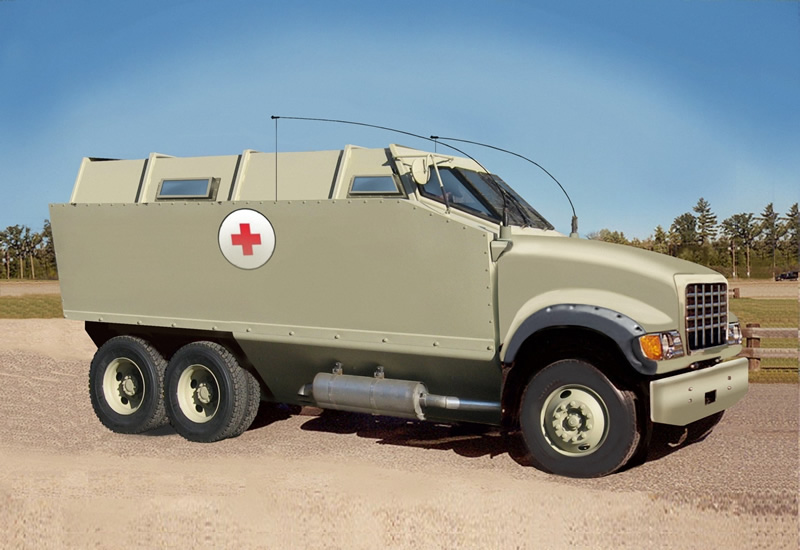
“The MRAP II solicitation queries industry on capability to produce Category I and Category II MRAP vehicles. Category I vehicles are designed for urban combat operations and can transport six people. Category II vehicles have multi-mission capabilities including convoy lead, troop transport, ambulance, explosive ordnance disposal and combat engineering. The Category II vehicle can transport up to 10 personnel… The MRAP II solicitation, however, is designed to provide the Joint Program Management Office with flexibility increasing production capability and providing vehicles with enhance protection and performance to meet future near-term requirements.”

(click to view full)
The solicitation adds that MRAP-II qualifiers should be:
“Armored vehicle with a blast resistant underbody designed to protect crews against known threats such as small arms fire, rocket propelled grenades, improvised explosive devices, and explosively formed penetrators…
Any contract awarded as a result of this solicitation will be a DX rated order[1] certified for national defense use under the Defense Priorities and Allocations System (DPAS) (15 CFR 700), and the Contractor will be required to follow all of the requirements of this regulation…
2) The Buy American Act, 41 USC 10a, states that “This section shall not apply with respect to articles, materials, or supplies for use outside the United States . . .”. Given that these MRAP vehicles are being procured for use overseas in support of Operation Iraqi Freedom and Operation Enduring Freedom, the Buy American Act does not restrict the use of foreign components in the manufacture of these vehicles.
3) In regard to the Berry Amendment as it relates to specialty metals (10 USC 2533b), the Department of the Navy has determined that the exception at DFARS 225.7002-2(f)(1) is applicable since these vehicles
are being utilized in support of a contingency operation. While the Marine Corps has requested information from the MRAP contractors relative to the use of foreign specialty metals, there is no regulation or statute preventing MRAP contractors from utilizing foreign specialty metals. Even without the contingency operation exception, DFARS 225.7002-2(n) authorizes the use of foreign specialty metals from qualifying countries.”
MRAP-II: Updates and Key Developments
(click to view full)
Note that the MRAP-II is still run by the Marine Corps Systems Command in Quantico, VA, and is considered a subsidiary effort within the MRAP program generally.
The initial testing at Aberdeen served to disqualify vehicles that didn’t meet the standard. Competitors who did not receive MRAP-II orders include Force Dynamics (reinforced Cougar), GDLS Canada (upgraded BAE OMC RG-31), Navistar subsidiary IMG (upgraded MaxxPro), and Protected Vehicles, Inc. (upgraded Golan vehicle, with improved side doors and different armor; arrived on last day). More copies of the winning test vehicles will now be delivered to Aberdeen Test Center for comprehensive testing, and the 2 MRAP-II contracts also contain ordering options for production quantities.
March 31/08 The US military’s JROC (Joint Requirements Oversight Council) approved adjustments to the original MRAP program. Some services reduce their numbers, while the Army and Special Forces add vehicles. The net result raises the total to 15,771 vehicles overall: 12,000 Army, 2,225 Marines, 558 USAF, 544 Navy, 344 SOCOM, and 100 for testing purposes.
Dec 18/07: BAE Systems Land and Armaments LP Ground Systems in Santa Clara, CA receives a $5.8 million firm-fixed-price delivery order under a previously awarded contract (M67854-08-D-5001, #0001). More copies of the winning test vehicles will now be delivered to Aberdeen Test Center for comprehensive testing, and the 2 MRAP-II contracts issued today also contain ordering options for production quantities under a $12.5 billion indefinite-delivery/ indefinite-quantity multiple vendor contract. Work will be performed in Sealy, TX; York, PA; and Fairfield, OH, and is expected to be complete July 2008. This contract was competitively procured.
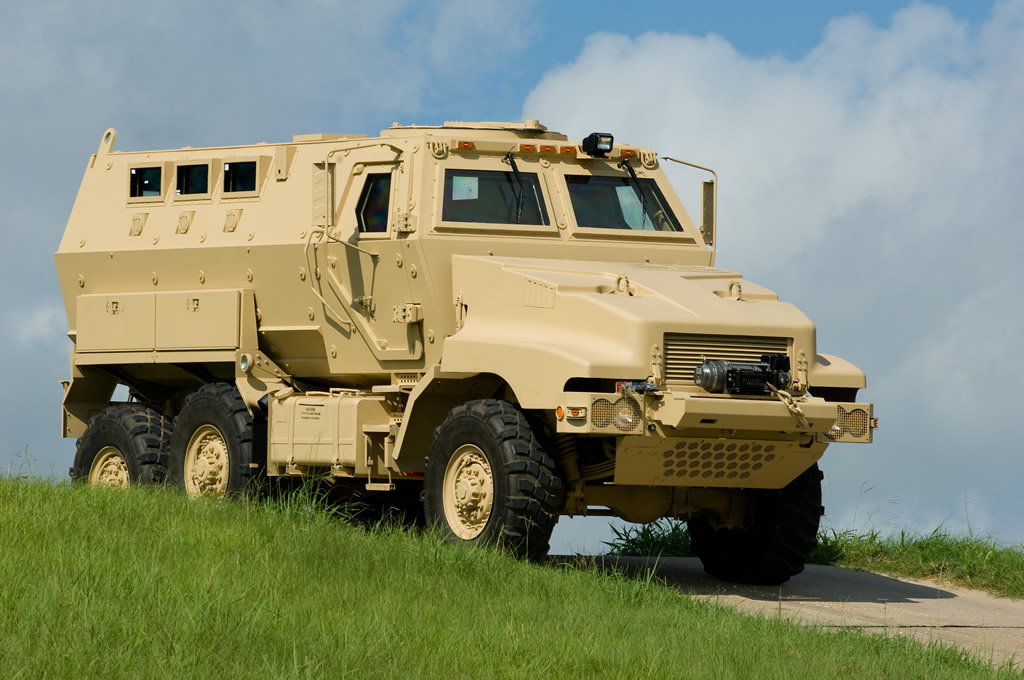
While the winning location suggested that BAE’s MRAP-II design was based on its RG-33 family, BAE personnel have confirmed to DID that its winning MRAP-II design is actually based on the Caiman, which is derived from their FMTV medium trucks.
(click to view full)
Dec 18/07: This should end speculation re: passing the tests. Ideal Innovations, Inc. in Arlington, VA received an $18.1 million firm-fixed-priced, delivery order under previously awarded contract (M67854-08-D-5000, #0001) for 6 MRAP-II test vehicles, with ordering options for production quantities under a $12.5 billion indefinite-delivery/ indefinite-quantity multiple vendor contract. The submitted vehicles will be the smaller 6-soldier MRAP Category I variant. Work will be performed in Wixom, MI; Costa Mesa, CA; and Oshkosh, WI, and is expected to be complete by July 2008. This contract was competitively procured.
Dec 12/07: DID has been hearing rumors et. al. from folks on Wall Street that The Bull had failed MRAP-II testing at Aberdeen. After waiting for a little while to see if a counter-release was forthcoming, DID asked. The question was addressed during the Nov 27 investors’ call, but we keep hearing it, so we’ll point out the implications more directly. DID asked Ceradyne VP Marc King for a response. He said:
“The vehicles have been returned to us since the government has concluded all scheduled testing for source selection and the government never paid for the vehicles so we own them and it is proper that they be returned to us. On the record: The Bull is still in source selection and an announcement by the Program Office is expected before Jan 31, 2008.”
That’s all he can say, within the bounds of what’s allowed. But if the vehicles have been returned because testing is complete, and the vehicle is still in source selection, the clear implication is that it passed the testing. Otherwise, standard practice is either to keep testing, allowing the manufacturer to re-submit with fixes – or to fully disqualify that product and take it out of source selection (vid. Textron’s M1117 ASV, PVI’s Alpha).
Oct 2/07: Ideal Innovations, Inc. (I-3), Oshkosh Truck Corporation, and Ceradyne, Inc. announce that they have delivered both 6-person and a 10-person version of The Bull to the U.S. Army Aberdeen Test Center, for further service evaluation under the MRAP-II (Mine Resistant Ambush Protected) contract. Joint release.
Oct 1/07: Defense News’ “MRAP II Deadline Passes” reports that close of business day Oct 1/07 was the deadline for MRAP-II bid submissions, and its article identifies some of the firms competing:
* Force Dynamics (reinforced Cougar vehicle equipped with EFP-stopping armor)
* GDLS Canada (upgraded RG-31)
* Navistar subsidiary IMG (upgraded MaxxPro, currently the MRAP order leader)
* Oshkosh, i3, and Ceradyne (The Bull)
* Protected Vehicles, Inc. (upgraded Golan vehicle, with improved side doors and different armor; arrived on last day)
Sept 5/07: The ceiling for the original MRAP program rises to 15,374 vehicles: 10,000 Army, 3,700 Marines, 697 USAF, 544 Navy, 333 for SOCOM, and 100 for testing purposes.
Footnotes:
fn1. A DX rating is the highest possible, and has generally been used for items like ballistic missile submarines. It means that the program has first priority for all raw materials and sub-assemblies it requires. For instance, high-grade steel is a key MRAP input. If steel production is limited, it is likely that another program (for instance, a shipbuilding program with a lower priority) would have to wait, possibly delaying delivery of that program’s equipment.