

no Chavis turrets?
(click to view full)
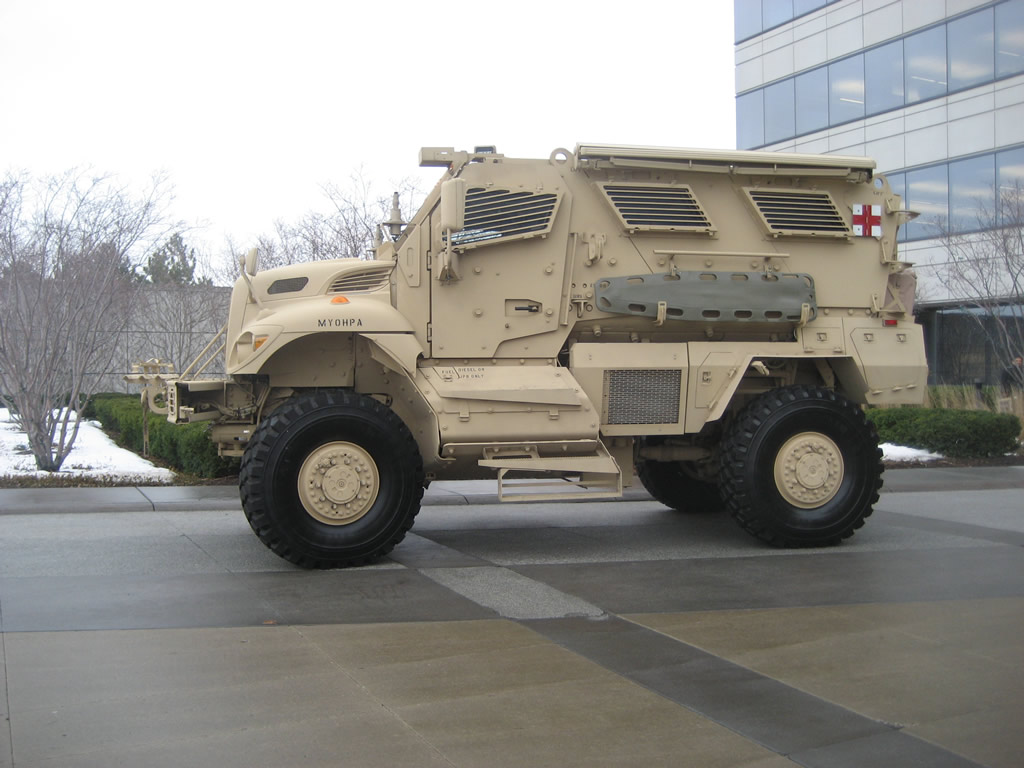
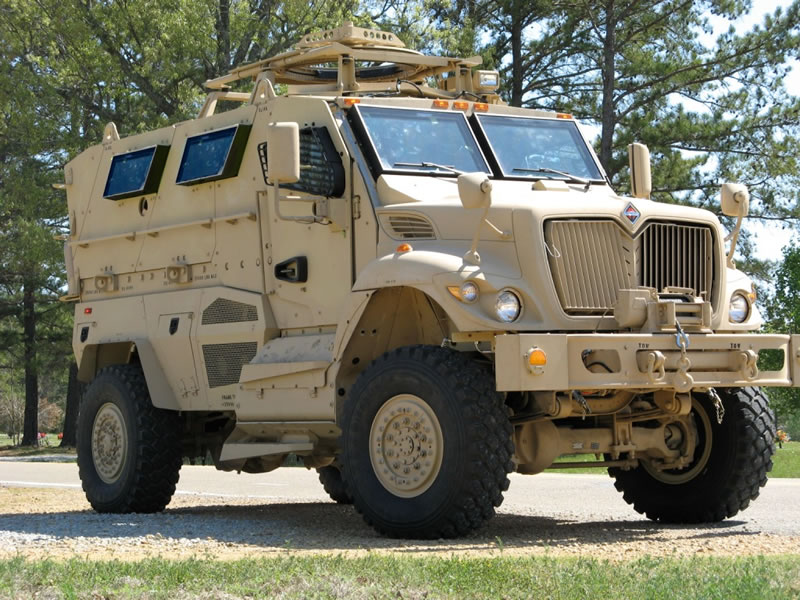
Navistar subsidiary International Military and Government LLC (IMG) in, Warrenville, IL has won billions of dollars in MRAP program contracts, to produce several variants of its blast-resistant vehicles. The Category I MRUV vehicle’s role is similar to a Hummer’s, albeit with more carrying capacity and much more protection. That has become a staple for IMG’s entry, dubbed the “MaxxPro” by its manufacturer. Their collaboration with an Israeli firm who provides up-armored vehicles for the Marines successfully overcame lukewarm initial interest, but even successful survivors of Aberdeen’s tests where challenged to offer enough protection against the ERP class of land mines that began to appear in Iraq.
Nevertheless, the MRAP program became a production race – and Navistar did very well under those competitive terms. In the end the military’s desire for standardization of its fleets exerted something of a gravitation pull on the competition. A July 2007 order vaulted Navistar into 1st place for initial MRAP Program vehicles ordered, but the US Army is divesting many of its vehicles – creating opportunities for foreign buyers…
MRAP Competitors, Navistar Totals
(click to view full)
Navistar ended up leading the initial MRAP competition, with the highest share of any competitor at 38.3%. Additional orders for Afghan-adapted vehicles ensure that this total has crept higher vis-a-vis their original competitors, but They’re still just one competitor among many, and beyond the MRAP competition, trucking rival Oshkosh’s M-ATV has now achieved very close production figures in the follow-on, single-award M-ATV program.
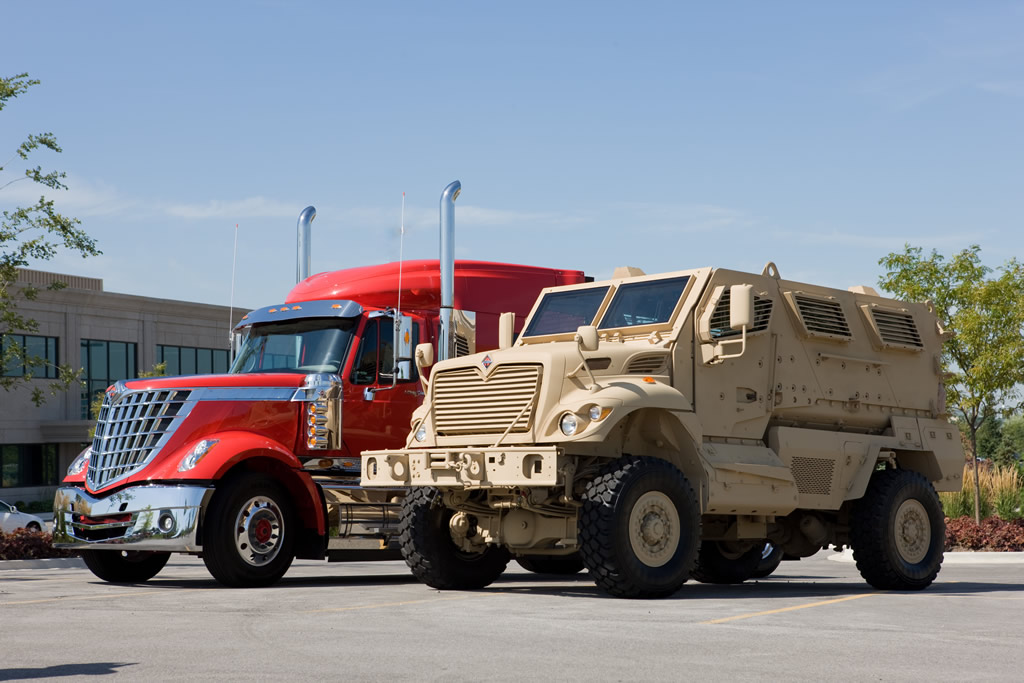
To date, Navistar has produced 7 MaxxPro variants under contract: the original MaxxPro, MaxxPro Air Force, the MaxxPro Plus with improved protection, MaxxPro ambulance (production orders were for the Dash variant), MaxxPro MEAP, the MaxxPro Dash for Afghan operations, and the MaxxPro Recovery Vehicle (MRV), for towing out stuck vehicles. The firm has also developed Cargo flatbed and Tractor (18-wheeler truck’s front end, but mine-protected) variants.
A number of these MaxxPro vehicles have also received independent suspension upgrades, in order to improve their off-road performance. The MaxxPro DXM upgrade kits are delivered through Boler’s Hendrickson subsidiary, and marry Hendrickson’s advanced engineered sub-frames, sway-bars, coil springs and shocks with GD AxleTech’s 5000 Series Independent Suspension Axle System.
Participants in the MRAP and related programs, and their vehicles, have included:
| Manufacturer | CAT I | CAT II | Notes |
| Navistar | MaxxPro MaxxPro AF MaxxPro Dash/ DXM MaxxPro Plus MaxxPro ambulance (Dash) |
MaxxPro MaxxPro MRV recovery |
Top finisher in number of MRAP orders. |
| BAE Systems | RG-33 RG-33 SOCOM Caiman Caiman MTV |
RG-33L RG-33 HAGA (ambulance) Caiman Caiman MTV-ambulance |
Won MMPV with RG-33L derivative. |
| General Dynamics | RG-31 Mk.5/ RG-31A2 | RG-31 Mk.5E | Partnered with BAE OMC, Canadian government CCC. Also received orders before MRAP began. |
| Force Protection (now GDLS) | Cougar 4×4 Cougar ISS |
Cougar 6×6 | Also received orders before MRAP began. Its Buffalo MRAP CAT-III is unique, and sole-source. |
| Oskkosh | Alpha (w. PVI) |
Bushmaster (w. Thales) |
No MRAP orders, but sole winner of related M-ATV program with its own design. |
| PVI | Alpha serve w. US Border Patrol |
Golan (w. RAFAEL) |
Alpha failed MRAP testing; 2008 firm bankruptcy & fire-sale acquisition |
| Textron | M1117 ICV | M1117 ICV | Failed MRAP testing; no MRAP orders, but ASV variant widely ordered by Military Police and fire targeting units. |
Based on awarded contracts, MaxxPro’s price per base vehicle is around $520,000 – $550,000. The vehicles must then be fitted with electronics, IED jammers, and other equipment. That can add hundreds of thousands of dollars to that base price, before they’re sent to the front lines. Announced production orders to date include:
* #001: 4 initial testing vehicles
* #002: 1,200 MRAP CAT I vehicles
* #003: 16 larger MRAP CAT II vehicles
* #004: 754 CAT I
* #005: 1,000 CAT I
* #006: 1,500 CAT I
* #007: 743 CAT I
* #008: 4 CAT I – not publicly announced
* #009: 822 CAT I MaxxPro Dash
* #010: 400 CAT I MaxxPro Dash
* #014: 1,050 CAT I MaxxPro Dash DXM with improved suspensions. Modification added 1,222 DXM retrofits.
* #015: 250 MaxxPro MRV recovery/tow variants
* #016: 175 CAT I MaxxPro Dash DXM with ECP I/II
* #018: 250 MaxxPro Dash Ambulance with DXM and ECP IV
* #019?: 471 MaxxPro Dash DXM with ECPs
* #020: ISS retrofit kits: 650 DXM Plus
* #021: 140 MaxxPro MRV recovery/tow variants
* #023: Full “rolling chassis” retrofits: 2,717
Total production is currently 8,779 vehicles. Beyond American buys, Navistar informs DID that their production totals include a 2009 order from Singapore for 15 MaxxPro Dash vehicles, and they have also announced a May 2010 order for a pool of 80 MaxxPro Dash vehicles to support “coalition forces” in Afghanistan, which has reportedly included Albania, Croatia, Estonia, Greece, Hungary, Poland, Romania, Solvakia, and South Korea.
As the USA withdrew from Iraq and Afghanistan, they decided not to keep many of their MRAP vehicles. Quite a few Oshkosh M-ATVs and Navistar MaxxPros will still remain in the force, but many MRAPs of all types won’t remain. The question is where they end up. Some have been destroyed outright, in order to avoid paying to ship them home. A number of MRAPs, including MaxxPros, have been diverted to local government organizations in the USA. Giving mine-protected, heavily armored vehicles to entities like school districts and non-violent towns of under 10,000 people has caused no small amount of controversy, and citizen protests have even forced a small handful of local governments to cancel these “1033 program” giveaways, which are not centrally tracked or accounted for. Other MRAPs have been given or sold to foreign operators, reportedly including:
* Croatia: 40
* Hungary: 42
* Jordan: 100
* Pakistan: 22 deployed, 160 requested
* Slovakia: ??
* UAE: 3,375 requested
A Note on MRAPs
DID refers to the MaxxPro as the top finisher in the MRAP competition, despite greater sales by Oshkosh’s M-ATV (MRAP All-Terrain Vehicle).
That’s because the M-ATV wasn’t part of the initial MRAP program; instead, it’s a follow-on competition that aimed to bridge the gap to the future JLTV winner. Navistar’s MaxxPro competed, but Oshkosh won, and their M-ATV was also very popular. In June 2010, its order totals narrowly surpassed the Navistar MaxxPro’s. DID defines “MRAP orders” as orders placed under the original MRAP multi-vendor contracts, however, and considers the single-vendor M-ATV competition to be a separate but related effort.
MaxxPro Contracts & Key Events

(click to view full)
Unless otherwise specified, all contracts are issued to Navistar subsidiary International Military and Government LLC (now Navistar Defense LLC) in Warrenville, IL. Unless otherwise noted, the Marine Corps Systems Command in Quantico, VA buys MRAP vehicles on behalf of 2008 requests from the US Army (12,000 by 2008), USMC (2,225), Air Force (558), Navy (544), SOCOM (344), and production verification testing (100). Those numbers rose further, via additional awards in 2010 and 2011, but the US military
2018
October 22/18: Tech services Navistar Defense is being contracted by the US Army to provide technical support to its MRAP fleet. The contract modification is priced at $19.7 million and provides for technical support for the in-production and out-of-production MaxxPro family of vehicles. MRAP vehicles are designed from the outset for blast-resistance against land mines and even car bombs. These vehicles normally serve a variety of roles including as armored personnel or weapons carrier, convoy protection platform, key leader vehicle and command post and armored ambulance. This contract combines a number of orders that will run through March 2020.
August 8/18: More protection needed The US Army is procuring protective netting kits in support of its MRAP vehicles. Navistar Defense will provide an unspecified amount of rocket propelled grenade netting kits as part of the awarded firm-fixed-price, indefinite-delivery/indefinite-quantity contract. The three-year contract with no option periods is valued at $29.58 million. The PG Net provides a lightweight solution used as an add-on protection on top of existing armor. It can be used to protect the entire vehicle or apply on specific locations where other types of armor are less effective. The mesh structure is not designed to stop the incoming RPG but to disable it by trapping it in-flight and thus preventing it from detonation. Navistar’s netting kit is similar to the Q-Net offered by QinetiQ. Work will be performed in Illinois and is scheduled for completion by August 4th, 2021.
2015 – 2017
Afghan National Security Forces Contract
March 12/17: Navistar has been contracted more than $475 million by the US Contracting Command in order to produce and support 40 armored vehicles for Pakistan and to upgrade 1,085 armored vehicles for the United Arab Emirates. The vehicles destined for Pakistan later this year are the company’s MaxxPro Dash DXM Mine Resistant Ambush Protected (MRAP) vehicle which features an armored wheeled vehicle with a V-shaped hull to deflect mine blasts. For the UAE, Navistar will provide the long wheel base MaxxPro MRAPs which are being acquired by the UAE under the US Excess Articles program and will be delivered in 2018.
February 19/17: Navistar Defense has been contracted $35 million by the US DoD to provide 40 Mine Resistant Ambush Protected MaxxPro Dash DXM vehicles. The deal supports foreign military sales for the government of Pakistan and work is expected to be complete by the end of October 2018. MaxxPro Dash DXM vehicles feature a V-shaped hull to deflect IED explosions away from the vehicle and are built to withstand ballistic arms fire and mine blasts. Pakistan will use the vehicles to protect troops against attacks from jihadist militants and other insurgents operating between Pakistan and Afghanistan.
September 11/15: US firm Navistar Defense has been contracted to supply the Afghan National Security Forces with nearly 2,300 mine resistant, ambush protected (MRAP) vehicles, based on the company’s 7000-MV platform, according to a company press release. The US Army Contracting Command handed the company a $369 million contract for the vehicles, which will bring the total number of Navistar vehicles sent to the Afghan government to nearly 9,000. The company has also exported the 7000-MV platform to Iraq. The new MRAPs will reportedly serve in a variety of roles, including ammunition, fuel and troop transport.
FY 2013 – 2014
Export requests: UAE (3,375), Pakistan (160); Support and upgrade contracts.
(click to view full)
Sept 26/14: UAE. The US DSCA announces the United Arab Emirates’ official export request for the refurbishment and modification of 4,569 used Mine Resistant Ambush Protected (MRAP) Vehicles:
* 729 Navistar MaxxPro Base
* 283 MaxxPro MRAP Expedient Armor Program (MEAP) without armor
* 264 MaxxPro Base/MEAP capsules without armor
* 29 MaxxPro Long Wheel Base (LWB)
* 1,085 MaxxPro LWB chassis
* 970 MaxxPro Plus
* 15 MaxxPro MRVs (MRAP Recovery Vehicles)
* 1,150 BAE Caiman Multi-Terrain Vehicles “without armor,” which are based on the FMTV truck chassis. Note that the V-hull is not “armor,” it’s an intrinsic part of the vehicle.
* 44 Oshkosh M-ATVs; they would be added to the UAE’s existing order for 750.
* Plus Underbody Improvement Kits, spare and repair parts, support equipment, personnel training and training equipment, publications and technical documentation, Field Service Representatives’ support, and other US Government and contractor support.
They’re being sold as Excess Defense Articles (EDA) from US Army stock, pursuant to section 21 of the Arms Export Control Act, as amended. Notification for the sale from stock of the MRAP vehicles referenced above has been provided separately, pursuant to the requirements of section 7016 of the 2014 Consolidated Appropriations Act, and section 516 of the 1961 Foreign Assistance Act. The estimated cost is up to $2.5 billion, which isn’t all that far from the cost of buying new.
To date, the UAE’s biggest patrol vehicle fleets have been its own Nimr design (1,700 total), which has also been exported within the region. Its Oshkosh M-ATV fleet (750) was second. This request would completely change the force’s configuration by adding 3,375 MaxxPros and 1,150 Caimans, giving the UAE a patrol vehicle fleet that is overwhelmingly protected against mines as well as weapons of urban unrest.
The principal contractors will be Navistar Defense in Lisle, IL (MaxxPro); BAE Systems in Sealy, TX (Caiman); and Oshkosh Defense in Oshkosh, WI (M-ATV). If the sales are concluded, implementation will require multiple trips to the UAE involving “many” US Government and contractor representatives for 3+ years to provide program support and training. Sources: US DSCA #14-26, “UAE – Mine Resistant Ambush Protected (MRAP) Vehicles”.
DSCA request: UAE (3,375 MaxxPros of 4,569 MRAP vehicles)
Sept 19/14: Pakistan. The US DSCA announces Pakistan’s official export request for 160 Navistar Mine Resistant Ambush Protected (MRAP) vehicles. That would certainly be an easy delivery from Afghanistan, for Excess Defense Article vehicles that the US Army was prepared to blow up rather than paying to ship them home:
* 30 MaxxPro Base DXM
* 110 MaxxPro Dash DXM
* 10 MaxxPro Dash DXM Ambulances
* 10 MaxxPro Recovery Vehicles with protection kits
* spare and repair parts, support and test equipment, publications and technical documentation, personnel training and equipment training, U.S. Government and contractor engineering, technical and logistics support services, and other related elements of logistical and program support.
The estimated cost is $198 million. These vehicles would be added to 22 MaxxPros (incl. 2 MRV recovery vehicles) that were already transferred under the Pakistan Counterinsurgency Capability Fund. The country’s years-long civil war involving the Pakistani Taliban will certainly provide Pakistan with opportunities to use these vehicles.
The principal contractor will be Navistar Defense Corporation in Madison Heights, MI. The proposed sale will require about 2 US Government and 24 Navistar contractor representatives in Pakistan for a period of approximately 18 months. They’ll perform inspections and deprocessing of vehicles upon delivery; provide assistance in installation of vehicle accessory kits; provide fault diagnosis and repairs; perform corrective maintenance, to include accident and battle damage assessment and repairs; conduct operator and maintainer training; and conduct inventories and maintain accountability of USG provided material. Sources: US DSCA #14-32, “Pakistan – Mine Resistant Ambush Protected (MRAP) Vehicles” | Gannet Military Times, “Source: Pakistan already has U.S.-made MRAPs, new deal in works” (April 2014).
DSCA request: Pakistan (160 MaxxPros)
Sept 12/14: Ambulance upgrades. Navistar Defense LLC in Lisle, IL receives a $44 million contract modification to buy MaxxPro Long Wheeled Base Ambulance Medical Equipment Set A-Kits, MaxxPro Survivability Upgrade Kits, and Spring Suspension System Kits. All funds are committed immediately, using FY 2012 and FY 2014 US Army budgets.
Work is expected to finish by Aug 31/15, and will be performed in Lisle, IL. The US Army Contracting Command in Warren, MI manages the contract (W56HZV-12-G-0006, PO 0002).
July 25/14: Survivability upgrades. Navistar Defense LLC in Lisle, IL receives a $27.6 million contract modification for kits to upgrade MaxxPro Dash and long-wheel base ambulances to their final configuration. $21.7 million in FY 2012 and FY 2014 US Army budgets are committed immediately.
Work is expected to finish by May 30/15, and will be performed in Lisle, IL. The US Army Contracting Command in Warren, MI manages the contract (W56HZV-12-G-0006, PO 001).
Dec 23/13: Support. Navistar Defense LLC in Lisle, IL receives a $6.9 million contract modification for MaxxPro field service support in the continental United States and overseas. All funds are committed immediately, using FY 2014 US Army O&M budgets.
Work is expected to finish by Dec 31/14, and will be performed in Lisle, IL and Afghanistan. Bids were solicited via the Internet, with 1 received by US Army Contracting Command in Warren, MI (W56HZV-10-C-0011, PO 0086).
Nov 4/13: Support. Navistar Defense LLC in Lisle, IL receives a $7.3 million cost-plus-fixed-fee contract, covering MaxxPro M1235A3 Dash MSU (MaxxPro Survivability Upgrade) engineering, logistic and travel support for the acquisition of the contract data requirements list, and program and logistics support. The contractor shall include MSU content as well as variation in vehicle content for both the objective gunner protection kit manned turret and M153 CROWS remote-controlled weapon turret. All funds are committed immediately, using FY 2013 US Army budgets.
Work will be performed in Lisle, IL, with an expected completion date of December 2014. One bid was solicited, with 1 received by the US Army TACOM in Warren, MI (W56HZV-10-C-0011). Note that the exact same award was announced on Oct 31/13.
October 24/13: AUSA. At AUSA, DRS and Navistar are showing off their privately-funded MaxxPro MCOTM (Mission Command on The Move) conversion for unit commanders and staff, which was built in partnership with DRS and Allison. That partnership’s OBVP Transmission Integral Generator has given the vehicle tremendous electrical generation capability from its Allison 3000 series transmission, with 60kW+ available to power carefully arranged command stations and screens within. That kind of on-board power removes the need for an additional generator vehicle, and drastically cuts set-up time.
A similar MaxxPro MICP is also built for communications, but it’s more of a rolling server closet. It would replace the current semi-mobile command post that’s deployed in a HMMWV shelter, plus a trailer with generator when taken outside the wire. Putting that into 1 MaxxPro that looks totally “normal” from the outside, and needs no trailer, makes the target a lot less obvious to enemies. In places like Afghanistan, where 7 gallons of fuel are needed to deliver 1 gallon for front-line use, eliminating vehicles also cuts fuel costs substantially. Beyond MCOTM and MICP:
“The Navistar Defense team is already exploring uses for the MaxxPro as a maintenance truck to weld and fix vehicles in the field; adding mortars to the back of the vehicle to produce an Offensive Weapon System; providing the vehicle architecture to support an Intelligence Surveillance and Reconnaissance control; and adding a water reservoir body for use as a Non-Lethal Water Cannon for controlling large thermal incidents, like forest fires.”
Obviously, the goal of these efforts is to promote both exports, and possible upgrade/ conversion contracts from the US military. An “MRAP 3 study” done in fall/winter 2012 has reportedly left M-ATV and MaxxPro blast-resistant vehicles in the enduring fleet, with about 2,633 MaxxPro Dash DXM troop carriers and 301 MaxxPro DXM ambulances kept. Adding MICP and MCOTM vehicles to appropriate units would provide both short-term conversion contracts, and more vehicles in service as targets for ongoing support contracts. Sources: AUSA interviews; NAvistar, “Navistar Defense Encourages Customers to Think Beyond the Standard Vehicle at AUSA” | DRS “U.S. Army to Test DRS Technologies’ On-Board Vehicle Power System for Consistent Equipment Power on the Battlefield”.
AUSA 2013: MCOTM, MICP, and other interesting variant ideas
June 18/13: Survivability upgrades. Navistar Defense LLC in Lisle, IL receives an $18.2 million firm-fixed-price contract modification, increasing the funds available for the MaxxPro Survivability Upgrade to $152.3 million. FY 2011 & 2012 Procurement funds are being used by Army Contracting Command in Warren, MI (W56HZV-12-C-0404, PO 0013).
June 3/13: Report. Navistar Defense LLC in Lisle, IL receives an $8.9 million cost-plus-fixed-fee, multi-year contract modification, for MaxxPro field services representatives. The cumulative total face value of this contract is now $49.8 million. Army Contracting Command in Warren, MI manages the contract (W56HZV-10-C-0011, PO 0071).
Jan 7/13: Survivability upgrades. Navistar Defense LLC in Lisle, IL receives a $10.6 million cost-plus-fixed-fee contract modification for MaxxPro maintenance services.
Work will be performed in Lisle, IL; Yuma, AZ; Aberdeen, MD; and Afghanistan; with an estimated completion date of March 25/13. One bid was solicited, with one bid received by US Army Contracting Command in Warren, MI (W56HZV-10-C-0011).
FY 2012
MRV problems. Survavibility upgrades.
(click to view full)
Sept 24/12: Survivability upgrades. Navistar Defense LLC in Lisle, IL receives a $138.2 million firm-fixed-price contract modification to buy MaxxPro Survivability Upgrade Kits, Vehicle Emergency Egress Windows, and MaxxPro support services.
Work will be performed in Lisle and Springfield, OH, with an estimated completion date of Sept 13/13. One bid was solicited, with one bid received by US Army Contracting Command in Warren, MI (W56HZV-12-C-0404).
Sept 19/12: Survivability upgrades. Navistar Defense, LLC announces a maximum $282 million delivery order to provide more than 2,300 survivability upgrade retrofit kits for their MaxxPro Dash MRAP vehicles, plus parts and service. Work for the survivability upgrade will be done in Afghanistan beginning in December 2012, and is scheduled to be complete by July 2013.
Navistar says they have now delivered nearly 9,000 MaxxPro units in 9 major variants to all customers.
July 30/12: Spares. Navistar Defense in Lisle, IL receives a maximum $8.6 million fixed-price with economic price adjustment contract from the US Army for MaxxPro spares. Work will be performed in Illinois and Kentucky, using FY 2012 Army Working Capital Funds. There was 1 proposal with 3 responses. The date of performance completion is July 29/13. The Defense Logistics Agency Land and Maritime in Columbus, OH (SPM7LX-12-D-9007).
July 13/12: RPG nets. Navistar Defense in Lisle, IL receives a $59.4 million firm-fixed-price contract for 1,357 rocket propelled grenade net kits, which means QinetiQ’s Q-Net. Work will be performed in Springfield, OH, with an estimated completion date of Oct 31/12. One bid was solicited, with 1 bid received by US Army Contracting Command in Warren, MI (W56HZV-12-C-0201).
March 13/12: A $21.3 million firm-fixed-price contract for “the long wheel rolling chassis upgrade with independent suspension on the MaxxPro [MRAP] and transportation fixtures.” Vid. Jan 9/12 entry for the full explanation; this the installation work associated with its January order to upgrade 2,717 vehicles.
Work will be performed in West Point, MS, with an estimated completion date of May 20/12. One bid was solicited, with one bid received, by US Army Contracting Command in Warren, MI (W56HZV-12-C-0130).
Feb 20/12: Sub-contract. Boler subsidiary Hendrickson in Kendallville, IN and GD subsidiary AxleTech International in Oshkosh, WI get a sub-contract from Navistar Defense, LLC, to equip 2,717 MaxxPro Long Wheel Base (LWB) MRAP vehicles with independent suspension systems, per the $900 million Jan 9/12 contract.
Deliveries began in January 2012, and will be completed in October 2013. GD release.
Jan 24/12: A $109.5 million firm-fixed-priced delivery order for 650 MaxxPro DXM Plus kits. Orders #002-008 add up to 5,217 vehicles. These kits, plus the “rolling chassis” order, add up to 3,367 retrofits.
Work will be performed at the MRAP Sustainment Facility in Kuwait, and is expected to be complete by the end of October 2012. All contract funds will expire at the end of the current fiscal year, on Sept 30/12 (M67854-07-D-5032, #0020).
Jan 17/12: DOT&E – MRV issues. The Pentagon releases the FY2011 Annual Report from its Office of the Director, Operational Test & Evaluation (DOT&E). The MaxxPro Dash ISS and MaxxPro MRV are both included, but get very different grades. While the MRV towing and recovery vehicle passed blast and live fire testing:
“…the Navistar MRV is not operationally effective and not operationally suitable for recovery operations on cross-country terrain. The Navistar MRV has poor mobility and poor combat towing to recover damaged MRAP vehicles in Afghanistan. The vehicle could not maneuver in soft sandy soil and had difficulty accelerating on hilly terrain. The Navistar MRV demonstrated 271 MMBOMF [Mean Miles Between Operational Mission Failure] versus its operational requirement of 600 MMBOMF. These problems should have been resolved… prior to the [Limited User Test]. The Navistar MRV is [only] capable of recovering and towing damaged MRAP vehicles on flat improved roads.”
The MaxxPro Dash ISS, on the other hand, is declared to be both operationally effective and reliable. Its figure of 1,259 MMBOMF was way above its operational requirement of 600.
Jan 9/12: An $879.9 million firm-fixed-priced delivery order for the procurement of 2,717 MaxxPro “rolling chassis”; 10 engineering change proposals; and 25 contract data requirements lists, for MaxxPro MRAPs.
This is the 3rd step in commonizing the MaxxPro fleet. The first step was the addition of DXM independent suspension in February 2009, which has appeared on all orders after #0014. It was followed in March 2010 by 1,222 DXM retrofit kits. Now, the rolling chassis is the 3rd step, which upgrades most of the earlier MaxxPros with the latest vehicle capabilities. We asked Navistar, who explained that “rolling chassis” replaces the chassis base, adding the DXM independent suspension, a new MaxxForce 9.3 engine, and a 570 amp alternator and driveline. The crew cab is essentially lifted off the old chassis, and bolted on to a new one.
Work will be performed in West Point, MS, and is expected to be complete by the end of October 2013. All funds will expire at the end of the current fiscal year, on Sept 30/12 (M67854-07-D-5032, DO #0023).
Jan 9/11: Oshkosh control fight. Icahn’s proxy skirmish at Oshkosh turns into a war, with hard-hitting submissions to shareholders from both Icahn’s group and Board slate, and from Oshkosh’s existing management and Board. If Icahn gets his Board slate elected, spinoffs and a merger of Oshkosh Defense with Navistar become far more likely.
In that scenario, it’s likely that the Maxxpro would take a back seat to the M-ATV in the future firm’s lineup. Oshkosh 8-K | Oshkosh management’s SEC DEFA14A filing (see esp. pp. 38-44) | Icahn Group DFAN14A arguments.
Dec 20/11: A $133.7 million firm-fixed-priced delivery order under a previously awarded contract for 514 field service representatives to support Navistar’s MRAPs. Queries to Navistar confirmed the contract’s size, and their response noted that it included supplies as well as personnel.
Work will be performed in Afghanistan and Kuwait (94%) and the United States (6%), and is expected to be complete by Dec 31/12. FY 2012 operations and maintenance appropriation funds will expire at the end of the current fiscal year, on Sept 30/11 (M67854-07-D-5032, #0022).
Dec 19/11: $9.6 million firm-fixed-priced delivery order for MaxxPro MRV recovery vehicle contractor support, esp. re: the contract data requirements list (CDRLs).
Work will be performed in Warrenville, IL, and is expected to be complete by the end of February 2014, but all funds will expire at the end of the current fiscal year, on Sept 30/12. The original contract was competitively procured (M67854-07-D-5032, Delivery Order 0015 under Modification 16).
Dec 6/11: Navistar/Oshkosh merger? Billionaire Carl Icahn owns 10% of Navistar, and 9.51% of Oshkosh, so his comments that the 2 companies should merge draws a lot of attention. He tells CNBC:
“I definitely think it would be a good merger. I think there would be a lot of synergy. I own stock in both and I think shareholders of both companies would benefit.”
Both Boards of Directors are maneuvering defensively around Icahn. Navistar agreed to put its Board up for election each year, but agreed not to propose his own slate of directors at the annual meeting. Things are a bit more open at Oshkosh, where Icahn is proposing Board slates, and has been increasingly critical of existing management.
FY 2011
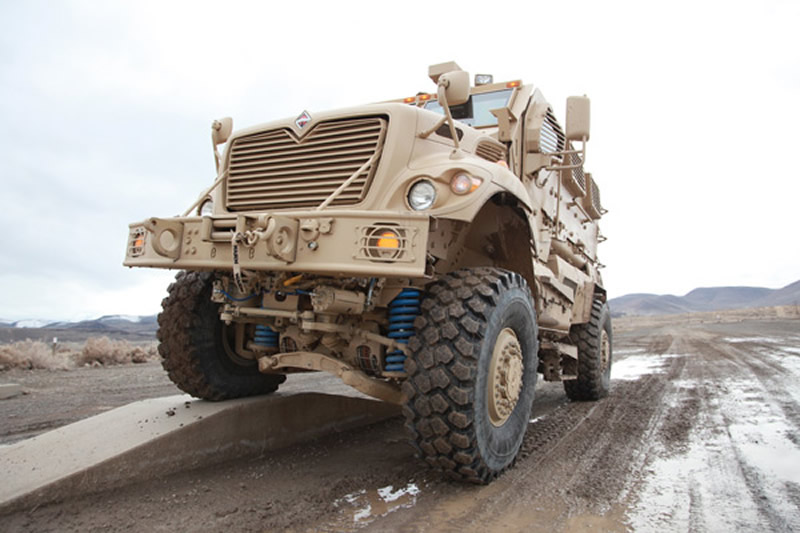
Independent suspension systems.
(click to view full)
July 15/11: A $142 million firm-fixed-priced delivery order for 140 MaxxPro Recovery Vehicles (MRVs), plus sustainment, spares and support. That brings total MRV orders to 315. Work will be performed in West Point, MS, and is expected to be complete by the end of November 2011 (M67854-07-D-5032, #0021). See also Navistar release.
July 14/11: Boler subsidiary Hendrickson, and General Dynamics’ AxleTech International, announce 2 contracts from Navistar Defense, LLC to equip 471 MaxxPro blast-resistant vehicles (vid. June 13/11 entry), and 250 MaxxPro Dash ambulances (vid. May 4/11 entry), with independent suspension systems. Their DXM solution uses AxleTech’s 5000 Series Independent Suspension Axle System, and Hendrickson’s engineered sub-frame.
Production work began in June 2011 at Hendrickson in Kendallville, IN, and AxleTech in Oshkosh, WI. Deliveries will be complete in September 2011. GD-ATP.
June 13/11: Navistar Defense:
“Navistar Defense, LLC today announced that it received a $357 million delivery order for an additional 471 International MaxxPro Dash vehicles with DXM independent suspension. The order from the U.S. Marine Corps Systems Command follows last month’s delivery order for 250 MaxxPro Dash Mine Resistant Ambush Protected (MRAP) ambulances.”
Subsequent events indicate that this is probably delivery order #0019.
May 16/11: An $18.6 million delivery order modification for installation of ambulance engineering change proposals (ECP) and Dash Phase IV ECPs on the recent order of 250 ambulances. Work will be performed in Afghanistan, and is expected to be complete by the end of September 2011 (M67854-07-D-5032, #0018, mod #0001).
May 4/11: A $183.3 million firm-fixed-priced delivery order for 250 MaxxPro Dash Ambulance vehicles, with improved DXM independent suspensions. Work will be performed in West Point, MS, and is expected to be complete by the end of September 2011. All contract funds will expire at the end of the current fiscal year, on Sept 30/11 (M67854-07-D-5032, #0018).
This is the 1st order for the ambulance variant, which was unveiled in October 2010 at AUSA (vid. Oct 25/10 entry). These Maxxpros will serve alongside the similar Oshkosh M-ATV ambulances in theater, and will be supplemented by BAE’s heavier 6×6 RG-33 HAGA MRAP. These vehicles are a component in the Pentagon’s broad ‘Golden Hour’ initiative, which aims to begin providing life-saving care within the critical 1st hour of major trauma. See also Navistar Defense release.
April 28/11: Navistar Defense, LLC in Warrenville, IL received a $13.2 million firm-fixed-priced delivery order for field service representatives (FSR) in Kuwait, to sustain operation of the MaxxPro Dash MRAPs in Afghanistan.
Work is expected to be completed by the end of November 2011, but all contracted funds will expire at the end of the current fiscal year, on Sept 30/11 (M67854-07-D-5032, #0017).
March 4/11: Navistar Defense, LLC in Warrenville, IL receives a $32.5 million firm-fixed-priced delivery order to buy MRAP Recovery Vehicle contractor logistics support for spare parts, basic initial issue tool kits and training support. Work will be performed in Louisville, KY (96%), and Warrenville, IL (4%), and is expected to be complete by the end of September 2011 (M67854-07-D-5032, #0015 Mod 005).
Dec 9/10: A $123.4 million firm-fixed-priced delivery order for 175 CAT I MaxxPro Dash vehicles with improved DXM suspensions, plus MaxxPro Dash Engineer Change Proposal (ECP) Phase I & II kits; and support items including associated unique base issue items for the fleet; and independent suspension system deprocessing parts kits. The order raises Navistar’s total orders for the MaxxPro family to 8,014.
Work will be performed in West Point, MS, and is expected to be complete by the end of June 2011. All contract funds will expire at the end of the current fiscal year, on Sept 31/10 (M67854-07-D-5032, #0016). See also Navistar release.
Nov 19/10: A $252.8 million firm-fixed-price delivery order for 250 Mine Resistant Ambush Protected recovery vehicles (MRV) and contractor logistics support (CLS). Work will be performed in West Point, MS, and is expected to be complete by the end of September 2011. All contract funds will expire at the end of the fiscal year on Sept 30/11 (M67854-07-D-5032, #0015).
A blast-protected recovery vehicle makes a great deal of sense, in an environment where a leading cause of disabled vehicles is IED land mine explosions. Navistar originally unveiled the MRV/ wrecker variant in February 2009, and had competition in this area from BAE’s RG-33 MRRMV. See also Navistar release.
Oct 25/10: Navistar Defense, LLC announces 2 new variants at the Association of the United States Army (AUSA) Annual Meeting and Exposition: the MaxxPro ambulance kit, and the MaxxPro Tractor variant.
The ambulance kit will fit into any MaxxPro variant, and include a litter assist system that helps load stretchers. The MaxxPro tractor, meanwhile, is not a farm implement. It’s the truck half of a blast resistant tractor-trailer rig.
Oct 7/10: The Romanian Ministry of National Defence announces that the first 8 MRAPs have just been supplied to the 811th “Dragonii Transilvani” Maneuver Battalion and the 812th “Soimii Carpatilor” Maneuver Battalion, deployed in Zabul Province, Afghanistan.
These are the first of 60 vehicles provided by the USA, and the lot reportedly consists of 20 new and 40 refurbished MaxxPro Dash vehicles, with improved DXM suspensions. Romanian MND | defpro | Jane’s.
FY 2010
Too many MRAP options? IP issues among contractors.

(click to view full)
Sept 23/10: A $9.9 million firm-fixed-priced delivery order modification (M67854-07-D-5032, #0011) for field service representatives (FSRs)/instructors/mechanic services outside the continental United States (OCONUS) to sustain operation of the Dash vehicles in Afghanistan, and FSR/instructors inside the continental United States for replacement center training in Fort Benning, GA.
Work is expected to be complete by the end of September 2011, and all contract funds will expire at the end of the current fiscal year, on Sept 30/10.
Sept 23/10: A $13 million firm-fixed-priced delivery order modification (M67854-07-D-5032, #0014) that pays federal retail excise tax on 148 MaxxPro Dash vehicles being used in the continental United States for training purposes. Work will be performed in Warrenville, IL, and is expected to be complete by the end of September 2011. All contract funds will expire at the end of the current fiscal year, on Sept 30/10.
Sept 17/10: A $25.2 million firm-fixed-priced delivery order modification for instructor and field service representative (FSR) support in the United States (CONUS), outside the continental United States (OCONUS); The objective of the FSRs/instructors is to sustain operation of the Dash vehicles in support of Operation Enduring Freedom in Afghanistan. Navistar will also send more FSRs and instructors to Mine Resistant Ambush Protected University and CONUS Replacement Center Training.
Work will be performed in West Point, MS, and is expected to be complete by the end of September 2011 (M67854-07-D-5032, #0011).
Aug 24/10: The US Congressional Research Service releases the latest version [PDF] of its report “Mine-Resistant, Ambush-Protected (MRAP) Vehicles: Background and Issues for Congress. Excerpts:
“As of June 28, 2010, more than 8,500 MRAPs had reportedly been shipped to Afghanistan, with over 3,500 of those being the newer M-ATVs. The Army has recently said that it will begin development of yet another MRAP version – the “Ultra-Lite MRAP” – which raises questions about possible vehicle redundancies. The Marines, although voicing support for the M-ATV program, have retrofitted a number of MRAPs with new suspension systems and reportedly are satisfied with the results. This apparent success calls into question not only if the Marines need all of the M-ATVs allocated to them by DOD but also if the Marines’ retrofitted suspension system might be a more cost-effective alternative for the other services… Among potential issues for congressional consideration are the status of almost 5,000 MRAPS in Afghanistan that are reportedly not being used because of their size and weight.”
In terms of overall budgets:
“Through FY2010, Congress appropriated $34.95 billion for all versions of the MRAP. In March 2010, DOD reprogrammed an additional $3.9 billion from the Overseas Contingency Operations fund to MRAP procurement. Congress approved an additional $1.2 billion for MRAP procurement, included in the FY2010 Supplemental Appropriations Act (P.L. 111-212). The full FY2011 DOD budget request of $3.4 billion for the MRAP Vehicle Fund has been authorized by the House (H.R. 5136).”
June 29/10: A $13.4 million firm-fixed-priced delivery order, modification #03 under a previously awarded contract (M67854-07-D-5032, #0014) to buy spare parts related to the order for 1,050 improved suspension MaxxPros. These include suspension system authorized stockage list parts, prescribed load list parts, battle damage assessment repair, and deprocessing; the DASH engineering change proposal (ECP) Phase III upgrade; the remote weapon station system upgrade; and unique collateral material/BII. Work will be performed in West Point, MS, and is expected to be complete by the end of January 2011.
June 14/10: A $60 million firm-fixed-priced delivery order for spare parts to maintain the DXM off-road independent suspension system that is being retrofitted to the entire fleet of 1,222 MaxxPro DASH vehicles. The new DXM systems are provided by Hendrickson Truck Suspension Systems and AxleTech International.
Work will be performed in Warrenville, IL, and is expected to be complete by the end of March 2011. All contract funds will expire at the end of the current fiscal year, on Sept 30/10 (M67854-07-D-5032, #0013).
June 14/10: A $17.2 million firm-fixed-priced delivery order for Navistar field service representatives in the Central Command area of responsibility. Work will be performed in Kuwait, Afghanistan and Iraq, and is expected to be complete by the end of June 2011.
May 28/10: Stolen IP? ATS litigation controversy. Armor Technologies, Inc. of South Africa launches the “MRAP Ripoff” web site, and issues a statement, after 3 years of litigation with Navistar. The ancillary web site details the company’s claims, which are summed up via these chosen excerpts from its statement:
“ATS believes it was tricked into transferring unique knowledge, technology and IP about mine-protected vehicles (MPVs) to Chicago-based Navistar Defense, during their relationship from March 2005 to January 2007… At issue is ATS’ belief that it has been hoodwinked into providing critical knowledge and technology on MPVs to Navistar, which before the start of its relationship with ATS in March 2005 had no such expertise… Navistar later claimed in the International Court of Arbitration that Plasan Sasa was the origin of the MaxxPro vehicle, but its own staff admitted to the court that the same team that worked with ATS on the ATS Oryx design, had secretly worked on MaxxPro simultaneously. Navistar can’t have it both ways: either the company illegally shared ATS’ knowledge with Plasan Sasa, which also had no previous MPV expertise, or it acted in exceedingly bad faith in terms of its agreements with ATS – which it then [summarily] broke once it had what it needed: the wherewithal to build a world-class mine-resistant troop carrier… In the meantime, Navistar has won U.S. Government tenders and funding… awarded tens of millions of dollars in U.S. Taxpayers’ money, and it is receiving lucrative foreign orders… none of which would have happened had the U.S. Government heeded its own policy not to do business with defense companies involved in related litigation… ATS’ matter has been taken up by the South African government, which in March [2010] formally requested an explanation from the U.S. Government on the matter.”
May 3/10: A $102.3 million firm-fixed- priced delivery order modification under a previously contract will buy various MaxxPro kits and parts to support operations in Afghanistan. Work will be performed in West Point, MS, and is expected to be complete by the end of October 2010. All contract funds will expire at the end of the current fiscal year, on Sept 30/10 (M67854-07-D-5032, #0013). Parts include:
* 937 gunner restraints
* 3,251 120V wiring harnesses
* 5,722 rear ramp hydraulics, rear ramp hydraulic – non-reoccurring equipment (NRE)
* 3,251 rear ramp storage
* 2,630 fire support systems kits, fire support systems kits – NRE
* 5,716 air conditioning circulation switches
* 822 heating, ventilation, and air conditioning kits
March 15/10: A $178.3 million modification to delivery order #0013 under previously awarded firm-fixed priced contract (M67854-07-D-5032) for 1,222 independent suspension system kits and aluminum catcher plates for MaxxPro vehicles. MaxxPros use the DXM independent suspension solution provided by Hendrickson Truck Suspension Systems and AxleTech International.
Work will be performed in West Point, MS, and is expected to be complete by the end of March 2011. Navistar release
Feb 16/10: Looks like the new suspension system worked. Navistar Defense, LLC in Warrenville, IL receives a $751.5 million firm-fixed-priced delivery order #0014. This order will also be used to buy 1,050 MaxxPro Dash vehicles for Afghanistan, with the new DXM independent suspension solution provided by Hendrickson Truck Suspension Systems and AxleTech International.
Other improvements reportedly include door and insulation upgrades, as well as the addition of an inclinometer to act as a level and measures side slope during vehicle operation. The higher center of gravity involved with V-hull vehicles can make them tippy, so that’s definitely something for the driver to watch.
Work will be performed in WestPoint, MS and the contract is expected to be complete by the end of August 2010. The work is expected to add back 400 jobs at the company’s West Point, MS facility, following multiple layoffs in 2009 that had cut staffing to 120. All procurement funds will expire on Sept 30/12. This contract was competitively procured (M67854-07-D-5032 / D.O.0009). Since May 2007, Navistar says it has received orders for a total of 7,494 MaxxPro MRAPs. Navistar release | Daily Times Leader | Aviation Week Ares.
Dec 29/09: A $7 million firm-fixed-priced contract for “CAT III technical labor hour” work to support for the design and development of “the Maxxpro Dash vehicle independent suspension system,” later revelaed to be the Hendrickson/Axletech DXM. Work will be performed in Warrenville, IL, and is expected to be completed by the April 30/10 (M67854-07-D-5032).
The MaxxPro isn’t alone here. Oshkosh’s TAK-4 off-road independent suspension system has recently been used to retrofit MRAP vehicles from BAE Systems and Force Protection, in order to improve their mobility in Afghanistan’s rough terrain.
Nov 9/09: Navistar announces a 4-year System Technical Support (STS) contract worth up to $78 million to provide engineering support for its MaxxPro MRAP. Navistar’s STS award includes work to improve vehicle reliability, support combat issues encountered in theater, add new kits and hardware, as well as provide new vehicle enhancements. The STS award includes up to 143,000 annual labor hours, as well as parts, to be used within 12 months, with the option to renew the contract for 3 additional years.
FY 2009
MaxxPro variants. M-ATV loss.

(click to view full)
Sept 09/09: A $48 million firm-fixed-priced modification to a previous delivery order (M67854-07-D-5032, #0004) for procurement of MRAP OCONUS field service representatives (FSRs), OCONUS senior instructors, FSR instructor/mechanics, and various contract data requirements lists.
Work will be performed in the United States and Iraq and will be completed in September 2010. Contract funds in the amount of $48 million will expire at the end of the current fiscal year. The base contract was competitively awarded, and the new requirements are sole source additions to the contract.
Aug 10/09: A $7 million firm-fixed-priced modification under contract (M67854-07-D-5032, #0010) for the procurement of engineering change proposals and tire chains in support of MRAP MaxxPro Dash vehicles. Work will be performed in West Point, MS and is expected to be complete by the end of December 2009. The base contract was competitively awarded, and the new requirements are sole source additions to the contract.
Aug 7/09: A $7.8 million firm-fixed-priced modification to a previous delivery order (M67854-07-D-5032, #0006). It adds vehicle modifications (engineering change proposals), ambulance sustainment parts, and ambulance head clearance retrofit kits for Category I MRAP vehicles.
Work will be performed in West Point, MS and is expected to be complete by the end of December 2009. The base contract was competitively awarded, and the new requirements are sole source additions to the contract.
Aug 6/09: An $8.6 million firm-fixed-priced modification to a previous delivery order (M67854-07-D-5032, #0004) for MRAP OCONUS (Outside the CONtinental US) field service representatives (FSRs), new equipment training instructors, CONUS FSR instructors, and senior FSRs.
Work will be performed in the United States and Iraq, and will end at the end of September 2010. All contract funds will expire at the end of the current fiscal year, at the end of September 2009. The base contract was competitively awarded, and the new requirements are sole source additions to the contract.
July 16/09: A $21 million firm fixed priced delivery order under a previously awarded contract (M67854-07-D-5032, #009) for additional initial sustainment items in support of 882 MaxxPro Dash vehicles.
Work will be performed at the Red River Army Depot in Texarkana, TX, and deliveries are expected to be complete by Nov 30/09. Contract funds in the amount of $687,470 will expire at the end of the current fiscal year.
July 10/09: A $71.1 million firm-fixed- priced delivery order modification under previously awarded contract (M67854-07-D-5032, #006) for the procurement of battle damage assessment and repair (BDAR) kits for its MaxxPro Base and MaxxPro Plus vehicle variants.
Work will be performed at the Red River Army Depot in Texarkana, TX and deliveries are expected to be completed by Aug 1/09. All contract funds will expire at the end of the current fiscal year. The new requirements are sole source additions to the original contract.
June 30/09: Navistar announces its disappointment at their M-ATV loss, while reiterating their firms’ strong points for investors. The firm did not enter a MaxxPro variant, choosing a derivative of the MXT Husky instead.
June 19/09: A $6.4 million modification to a previous delivery order (M67854-07-D-5032, #004) for the procurement of MRAP field service representative mechanics, back ramp retrofit kits, and several contract data requirement lists outside the USA. Despite the order’s size, the Pentagon release states that: “Contract funds in the amount of $7,291,171 will expire at the end of the current fiscal year.”
Work will be performed in West Point, MS and in Iraq, and work is expected to be complete in August 2010. The base contract was competitively awarded, and the new requirements are sole source additions to the contract.
June 18/09: A maximum $42.9 million firm-fixed-price, sole-source contract for sustainment spare parts in support of Army MRAP vehicles. Contract funds will expire at the end of the current fiscal year, on Sept 30/09, but the contract will run until Nov 9/09. The Defense Logistics Agency Warren (DSCC-ZG) in Warren, MI manages this contract (SPRDL1-09-C-0088).
June 1/09: A $44.7 million firm-fixed-priced modification to a previously awarded delivery order (M67854-07-D-5032, #0004) for the renewal of Field Service Representative services in the Iraqi and Afghan theaters of war.
Work will be performed in Iraq and Afghanistan, and the final deliveries associated with this delivery order are expected to be completed by Sept 30/10. The Basic contract was competitively awarded and the new requirements were sole source additions to the contract.
April 27/09: A $16.5 million firm-fixed-priced modification to a previously awarded contract (M67854-07-D-5032, #004), for field service representatives for the Mine Resistance Ambush Protected vehicles in theater, Contract Data Requirement Lists (CDRLs), and ECP vehicle modifications.
Work will be performed in Iraq and Afghanistan, and the final deliveries associated with this delivery order are expected to be complete by Aug 16/10.
Feb 25/09: Navistar Defense, LLC unveils 3 new MaxxPro variants at the Association of the United States Army (AUSA) Winter Symposium and Exposition. The MaxxPro Wrecker MRAP vehicle is designed to retrieve damaged or mission-disabled MRAPs, winching them out of trouble and towing them away. Since breakdowns usually involve mined areas, a high level of blast protection is very important.
Navistar also added the MaxxPro Cargo, and the MaxxPro Tractor for towing trailers under full protection. All 3 utility vehicles are built on the company’s International WorkStar platform, with a MaxxPro Dash cab and MaxxForce D 9.3L I6 engine.
Dec 17/08: Navistar Defense LLC in Warrenville, IL received an $8.9 million modification under a previously awarded contract (M67854-07-D-5032, #009) Engineering Change Proposal (ECP) upgrades for Enhanced Maneuverability and associated Non-Recurring Engineering (NRE) costs.
In English, it buys initial spare parts support packages for MaxxPro Dash vehicles, which have been modified for use in Afghanistan. Work will be performed in West Point, MS and is expected to be complete by the end of May 2009.
Dec 10/08: Navistar continues to pull away from its MRAP competitors, via a $362.3 million firm-fixed-priced delivery order for 400 more MaxxPro Dash vehicles, which have been modified for service in Afghanistan. Manufacturing under this previously awarded indefinite-delivery/ indefinite-quantity contract (M67854-07-D-5032, #0010) will be performed in WestPoint, MS and work is expected to be complete by the end of May 2009. Navistar will complete delivery of all 400 units while the testing and evaluation of vehicles for the MRAP All-Terrain Vehicle (M-ATV) program is underway.
Navistar’s release adds that delivery of the September 2008 order for 822 MaxxPro Dash vehicles is set to finish at the end of January 2009, a full month ahead of schedule.
Dec 4/08: A $53.6 million firm fixed priced modification to delivery order under a previously awarded contract (M67854-07-D-5032, #0004: 754 CAT I MRAPS for $413.9 million) for spares and equipment items needed to support Category I MRAP vehicles in theater. This order will also be used to support the renewal of Field Service Representative contracts within the CENTCOM area of responsibility. Work will be managed in WestPoint, MS, and is expected to be complete in November 2009.
Nov 14/08: The US government issues a pre-solicitation notice for a subsidiary competition called M-ATV, essentially an “MRAP Lite” bridge buy to the JLTV. FBO pre-solicitation #W56HZV-09-R-0115. The MaxxPro Dash is likely to be a prime contender for the buy(s), which begins an expected order of just over 2,000 vehicles but could reach up to 10,000.
A subsequent Defense News article places M-ATV’s top weight at 12.5 tons empty, adding that the RFP still demands significant protection against conventional and EFP land mines. That’s likely to help the heavier MaxxPro Dash, while putting competitors like Force Protection’s 7-8 ton Cheetah at a disadvantage.
The RFP was issued in December 2008. A draft issued on Nov 25/08 stated that M-ATV would receive the same top-priority DX production rating employed by the original MRAP program, adding that the first vehicles are expected to be fielded in the fall of 2009.
UPDATE: By Q2 2009, Navistar had submitted its choice – but it wasn’t their Dash, it was a variant of their MXT light truck.
Nov 7/08: Another $24.8 million for 2 firm-fixed-priced delivery order modifications under previously awarded contract (M67854-07-D-5032) The modifications would add gunner restraints, and cover funding costs associated with accelerated MRAP Category I production. Work will be performed in WestPoint, MS.
See Sept 4/08 entry for the $752 million order for 822 of Navistar’s lighter MaxxPro Dash vehicles, whose design has been lightened and modified for the Afghan front. On Nov 6/08, Navistar announced that by working around the clock, they were able to meet the military’s request to deliver all vehicles one month ahead of schedule. Originally scheduled to be completed by the end of February 2009, the company has leveraged its extensive relationships with its supply base to provide deliver all units by the end of January 2009. The firm delivered 70 vehicles on Nov 4/08 – 2 weeks in advance of its already aggressive delivery schedule.
That extra commitment isn’t free; the MRAP contract is structured to compensate manufacturers for their extra costs if the government needs vehicles faster.
Oct 29/08: Navistar Defense LLC (ND) in Warrenville, IL received a $56.4 million firm fixed priced delivery order under a previously awarded contract (M67854-07-D-5032, #0007) for engineering changes and spares to support MRAP Category I vehicles currently in theater. Delivery order #0007 covered 743 MRAP CAT I vehicles.
Work will be performed in WestPoint, MS, and is expected to be complete by the end of November 2008. This contract was competitively procured.
Oct 29/08: Navistar Defense LLC (ND) in Warrenville, IL received $8.3 million for a firm-fixed-priced delivery order under a previously awarded contract (M67854-07-D-5032, #0006) to fund additional Maintenance Workshop Blocks to support MRAP Category I vehicles currently in theater. Work will be performed in WestPoint, MS and is expected to be complete by the end of February 2009. This contract was competitively procured.
See also Dec 18/07, June 19/08, and Oct 7/08 entries re: delivery order #0006, which was for 1,500 vehicles.
Oct 24/08: Defense News reports that more mine-resistant vehicles could be in the order pipeline. The U.S. Army and Marine Corps reportedly plan to rapidly develop and buy a fleet of lighter 7-10 ton vehicles that offer better mine resistance than Hummers, but better off-road mobility than MRAPs. Afghanistan is seen as an especial focus for these vehicles.
Oshkosh’s Sandcat and Force Protection’s Cheetah vehicle are mentioned as potential candidates for that bridge buy. Other competitors are likely, and Navistar’s MaxxPro Dash must also be placed in this category given recent the MRAP orders for deployment of this lightened variant to Afghanistan (vid. Sept 4/08 entry).
Defense News places potential military demand at 2,000- 5,000 bridge buy vehicles – assuming that issues with JLTV issues don’t lead to the bridge becoming the road. Navistar may be covered either way, however; its partnership with BAE won one of the 3 JLTV development contracts.
Oct 7/08: A $35.9 million firm-fixed-priced modification to delivery order #0006 under a previously awarded contract (M67854-07-D-5032) for sustainment items needed to support Category I MRAP vehicles in theater. This order will also be used to support several engineering change proposals to increase the vehicles’ capabilities. Work will be performed in West Point, MS and is expected to be complete in April 2009.
See also Dec 18/07 and June 19/08 entries re: delivery order #0006, which was for 1,500 vehicles.
FY 2008
DynCorp support. MaxxPro Dash.

(click to view full)
Sept 4/08: A $752 million firm-fixed-priced delivery order for 822 MaxxPro Dash MRAP CAT I vehicles, under a previously awarded contract (M67854-07-D-5032, #0009). Work will be performed in WestPoint, MS and is expected to be complete in February 2009.
Pentagon references to “production vehicles with engineering change proposal upgrades for enhanced maneuverability” refer to the MaxxPro Dash, a new variant which is optimized for Afghan operations. The Dash variant is 16” shorter and has an 8″ smaller wheel base, giving it a smaller turning radius of 54 feet. It’s also up to 5,000 pounds lighter, but can accept add-on armoring that will increase its weight. These changes, and the use of Navistar’s MaxxForce D engine, also give it a higher torque to weight ratio for better off-road operations. See also Navistar release.
Navistar already had a strong presence in Afghanistan, as the main truck supplier to the Afghan National Army. Despite earlier Pentagon comments that tagged the BAE OMC/ General Dynamics RG-31 as the favorite for Afghanistan, all vehicles in this MaxxPro order are tagged for Operation Enduring Freedom, and as yet there are no corresponding orders for other MRAPs. DID’s spreadsheet also shows that the 15,771 vehicle program ceiling is now maxed out.
July 4/08: An $84.8 million firm-fixed-priced modification to a delivery order under a previously awarded contract (M67854-07-D-5032, #0004) for sustainment items needed to support Category I MRAP vehicles in theater. This order will also be used to support several Engineering Change Proposals to increase the vehicles’ capabilities. Work will be performed in West Point, MS and is expected to be complete in April 2009.
Aug 1/08: A $29.3 million firm-fixed-priced modification to a delivery order under a previously awarded contract (M67854-07-D-5032, #0007) for sustainment items needed to support Category I MRAP vehicles in theater. This order will also be used to support several Engineering Change Proposals to increase the vehicles’ capabilities. Work will be performed in West Point, MS and is expected to be complete in April 2009. Deliver order #0007 involved 743 MaxxPros.
Aug 1/08: A $27.4 million firm-fixed-priced modification to a delivery order under a previously awarded contract (M67854-07-D-5032, #0002) for sustainment items needed to support Category I MRAP vehicles in theater. This order will also be used to support several Engineering Change Proposals to increase the vehicles’ capabilities. Work will be performed in West Point, MS and is expected to be complete in April 2009.
July 8/08: A $27.7 million firm-fixed price contract for MRAP spare parts. Work will be performed primarily in Springfield, OH and Springfield, MO as well as locations across the USA, and is expected to be complete by Jan 29/10. One bid was solicited on June 26/08 from the manufacturer (W56HZV-08-C-0522). Read Navistar’s “Army Awards Navistar Defense Seven Contracts For Parts And Support:
Contracts Total $125 Million for MRAP Support,” which adds:
“Navistar has shipped more than 185,000 parts pieces to the military for use in Iraq and Afghanistan and has more than 100 field service representatives in theater.”
July 7/08: A $56.9 million firm-fixed price contract for an assortment of automotive parts, including wheels, axles, air conditioners, engines, compressors, generators, and transmissions. Work will be performed primarily in Springfield, OH, with limited production in various cities across the nation, and is expected to be complete by May 4/09. One bid was solicited on April 2/08 (W56HZV-08-C-0494).
July 7/08: A $21.4 million firm-fixed price contract for wheels and pneumatic tires. Work will be performed in Trenton, NJ and is expected to be complete by Jan 30/09. One bid was solicited on June 25/08 (W56HZV-08-C-0520).
(click to view full)
June 27/08: A $15.1 million firm fixed price contract for 1,426 air conditioner compressors [NSN 4120-01-555-5459] option priced at $556.11 each; 1,500 condensers for refrigeration [NSN 4130-01-562-3925] option priced at $1,653 each; and air conditioner blowers [NSN 6105-01-562-3922] option priced at $4,378 each. Riding in an enclosed vehicle through 100/40 degree plus heat, while wearing layers of heavy equipment, requires air conditioning as a matter of necessity. At present, 59% of the total condenser and blower options are being exercised, and are considered part of the base award when calculating the contract totals above.
Work will be performed at Dallastown, PA with an expected completion date of Aug 29/08. One bid was solicited with one bid received by the U.S. Army Tank & Automotive Command (TACOM) Life Cycle Management Command in Warren, MI (W56HZV-08-C-0483).
June 27/08: Navistar Defence, LLC in Warrenville, IL received a $6.8 million firm fixed price contract for 2,000 pneumatic tire wheels [NSN 2530-01-555-5456, PN 2596798C91L]; 18 electric engine starters [NSN 2920-01-555-5458, PN 3610516C92[]; and 16 AC generators [NSN 6115-01-555-5460, PN 3819829C91].
Work will be performed in Trenton, NJ, and Belvidere, IL with an expected completion date of Aug 29/08. One bid was solicited with one bid received by the U.S. Army Tank & Automotive Command (TACOM) Life Cycle Management Command (W56HZV-08-C-0500).
June 19/08: International Military and Government LLC in Warrenville, IL is awarded a series of contracts amounting to about $707 million.
The modifications cover both MaxxPro Category I MRAP support and spares, and also “engineering change proposals to increase the vehicles’ capabilities.” Work will be performed in WestPoint, MS under contract M67854-07-D-5032, and are expected to be complete August 2008. The contract modifications include:
* To delivery order #0002 (1,200 for $632.1 M), adds $29.5 million
* To delivery order #0004 (754 for $413.9 M), adds $84.8 million
* To delivery order #0005 (1,000 for $537.2 M), adds $146.8 million
* To delivery order #0006 (1,500 for $1.18 B), adds $211.6 million
* To delivery order #0007 (743 for $405.9 M), adds $234.3 million
June 10/08: A $28 million firm-fixed-priced modification to delivery order #0005 under previously awarded contract (M67854-07-D-5032) for the accelerated production of 1,000 MRAP Low Rate Initial Production vehicles.
Delivery order #0005 was for $509.2 million (now $537.2 million), and ordered 1,000 vehicles in October 2007. This is an infusion of funds to speed up production by covering added expenses like overtime et. al., rather than an order for another 1,000 vehicles. Work will be performed in WestPoint, MS and “work is expected to be completed by the end of April 2008.”
May 29/08: The Aug 14/07 entry notes that DynCorp had become Navistar’s in-theater MRAP support network. Now, a DynCorp International release confirms the figures involved:
“Navistar Defense LLC, a division of Navistar International, Inc., awarded DynCorp International (NYSE:DCP) a five year indefinite delivery/indefinite quantity Logistics Support Contract to provide field service support and training for its recently awarded Mine Resistant Ambush Protected (MRAP) vehicle production contracts. DynCorp International’s Logistics Support Contract has a potential value of up to $500 million over five years with an initial award of $60 million to support deployments to Iraq.”
April 16/08: A $261.3 million for firm-fixed-priced contract modification under previously awarded contract (M67854-07-D-5032) for engineering change proposals to upgrade its MRAP low rate initial production vehicles. The government will procure several engineering changes to provide additional armor protection to increase the survivability of the MRAP Category I (CAT I) vehicles. The order also includes ambulance kits for the vehicles.
Work will be performed in WestPoint, MS and is expected to be complete in November 2008. Contract funds will not expire at the end of the current fiscal year. This contract was competitively procured. The Marine Corps Systems Command, Quantico, Va., is the contracting activity.
March 14/08: A $405.9 million firm-fixed-priced delivery order (M67854-07-D-5032, #0007) for 743 Category I vehicles. Work will be performed in WestPoint, MS and is expected to be complete November 2008. To date, they have received 5,214 orders under the MRAP program (5,198 CAT-I, 16 CAT-2), 36.9% of the vehicles ordered.
N.B. Amount corrected by DefenseLINK on March 18/08.
Jan 19/08: The NY Times reports that “a gunner was killed and three crew members were wounded” on this day in an IED land mine attack. The soldiers were riding in a MaxxPro MRAP. Read “Hopes for NY Times Reporting Questioned After MRAP Story” for more details.
Jan 10/08: Israeli firm Plasan Sasa announces a $200+ million order to supply Navistar’s International Military and Government, LLC with armoring systems for an additional 1,500 armored MRAP blast-resistant vehicles, to be delivered by the end of July 2008. The Plasan Sasa release says that this armor contract continues and builds on the US military’s June 2007 order for 1,200 MaxxPro vehicles, and notes their investment in US manufacturing facilities.

(click to view full)
Dec 18/07: IMG had submitted a variant of its MaxxPro for the MRAP-II competition. It aims to field vehicles that can protect against EFP(Explosively formed Penetrator) land mines, which are more akin to instant tank shells being fired into your vehicle than they are to a conventional explosion. After initial tests, however, only 2 vendors received contracts for additional testing at Aberdeen: BAE Systems (RG-33) and the team of Ideal Innovations, Ceradyne, and Oshkosh (The Bull).
Dec 18/07: A $1.18 billion firm-fixed-priced delivery order under a previously awarded contract (M67854-07-D-5032, #0006) to purchase an additional 1,500 MaxxPro CAT-I MRAP Low Rate Initial Production (LRIP) vehicles. This order also includes sustainment items needed to support the vehicles in theater, as well as several Engineering Change Proposals to increase the vehicles’ capabilities. Work will be performed in WestPoint, MS and is expected to be complete by the end of July 2008. This contract was competitively procured. Navistar release.
As this accompanying DoD release notes, the Marine Corps issued a number of MRAP orders on this day. Navistar’s IMG remains on top, and even widened its lead slightly. To date, they have received 4,471 orders under the MRAP program (4,455 CAT-I, 16 CAT-2), for 37.6% of 11,862 vehicles ordered.
Dec 7/07: The Rakkasans of the 3rd BCT, 101st Airborne Division in Iraq received 18 MaxxPro CATR-I vehicles. Sgt. Rian Terry, a welder in Co. B, 626th BSB, from Clarksville, TN:
“I like it. It feels safe with all the additional armor. It’s much roomier and easier to access equipment, especially with all your gear on.”
Pfc. Cedric Miller, a grenadier in Co. A, 1-187th Inf., from Blakely, GA, was more direct: “It’s an all-around good truck. We need more.”
American units preparing to receive MRAP vehicles send their maintenance Soldiers attend a 5-day, 40-hour course. During the course, drivers and vehicle commanders participate in both day and night, on- and off-road driving exercises, and obstacle course-like exercises where they maneuver through jersey barriers. Soldiers who complete the 40-hour training are operationally familiar with the equipment. It is up to the unit to make them tactically familiar.
Meanwhile, each battalion is assigned a field support representative and a team of mechanics to continue training the Soldiers. Having civilian representatives and mechanics at the battalion level gives the Soldiers subject-matter experts who are available during maintenance, but will allow the Soldiers to do the hands-on work. US Army
Dec 7/07: A $152 million firm-fixed-priced modification under previously awarded contract (M67854-07-D-5032) for Maxxpro “sustainment items” (spares) under the MRAP program. Work will be performed in WestPoint, MS and is expected to be complete in February 2008.
Nov 28/07: A $24 million firm-fixed-priced modification to delivery order #0004 under previously awarded contract (M67854-07-D-5032) for procure field service representatives to provide support for the Mine Resistant Ambush Protected (MRAP) vehicles in theater. Work will be performed in Iraq, and work is expected to be completed November 2008. Note our Aug 14/07 entry – this work will be done by Dyncorp.
Oct 30/07: $68.8 million attached to firm-fixed-priced delivery order #0005 under previously contract (M67854-07-D-5032) for Mine Resistant and Ambush Protected (MRAP) Vehicle sustainment items. The Government shall purchase MRAP University requirements including field service representative-instructors, instructional material, course outlines, and special tooling, and additional sustainment items. Work will be performed at Red River Army Depot in Texarkana, TX, and is expected to be complete by the end of October 2008.
Oct 18/07: $509.2 million for firm-fixed-priced delivery order #0005 under previously awarded contract (M67854-07-D-5032) for 1,000 MaxxPro MRAP CAT I Low Rate Initial Production vehicles. Work will be performed in West Point, MS, and is expected to be complete April 2008. This contract was competitively procured.
Navistar remains in the lead for MRAP orders to date, with 2,971 vehicles (2,955 CAT-I, 16 CAT-II) contracted to date, or 33.8% of the 8,746 MRAP CAT I/II vehicles ordered so far. Force Protection is currently in 2nd place with 30.9%, and BAE/Armor Holdings come in 3rd with 26.3%.
FY 2007
LRIP.

(click to view full)
Sept 21/07: International Military and Government LLC in Warrenville, Ill. received $7.2 million firm-fixed-priced modification to delivery order #0002 under previously awarded contract (M67854-07-D-5032) for field service representatives (FSRs) to serve in theater. The FSRs will provide support for MRAP Category I MaxxPro vehicles in Iraq. Work will be performed in Camp Liberty, Iraq, and is expected to be complete in September 2008.
Sept 13/07: International Military and Government LLC in Warrenville, Ill. received a $71.5 million firm-fixed-priced modification to Delivery Order #0002 under previously awarded contract (M67854-07-D-5032) for sustainment items and data requirements for the Mine Resistant Ambush Protected (MRAP) vehicles in theater.
The US government is buying 1-Year Forward Deployment Blocks, 1-Year Maintenance Work Blocks, training, training materials, and several contract data requirement lists for International’s MaxxPro MRAP CAT I vehicles. Work will be performed in West Point, Miss., and the deliveries are expected to be complete in October 2007.
Aug 14/07: DynCorp International LLC announces that they have been selected by International Military and Government LLC to provide field-service support and training for its MRAP vehicles. This effectively makes them Navistar’s in-theater support network.
July 20/07: $413.9 million for firm-fixed-priced, delivery order #0004 under previously awarded contract (M67854-07-D-5032), covering an additional 755 Category I (CAT I) Mine Resistance Ambush Protected (MRAP) Low Rate Initial Production (LRIP) patrol vehicles. Work will be performed in WestPoint, Miss., and is expected to be complete by February 2008. Navistar release.
This contract places Navistar in the lead for MRAP orders to date, with 1,971 vehicles (1,955 CAT-I, 16 CAT-II) contracted to date, or 34.8% of the 5,621 vehicles ordered so far under the 7,774 vehicle MRAP program. Force Protection is currently in 2nd place with 31.7%, and BAE/Armor Holdings come in 3rd with 30.3%
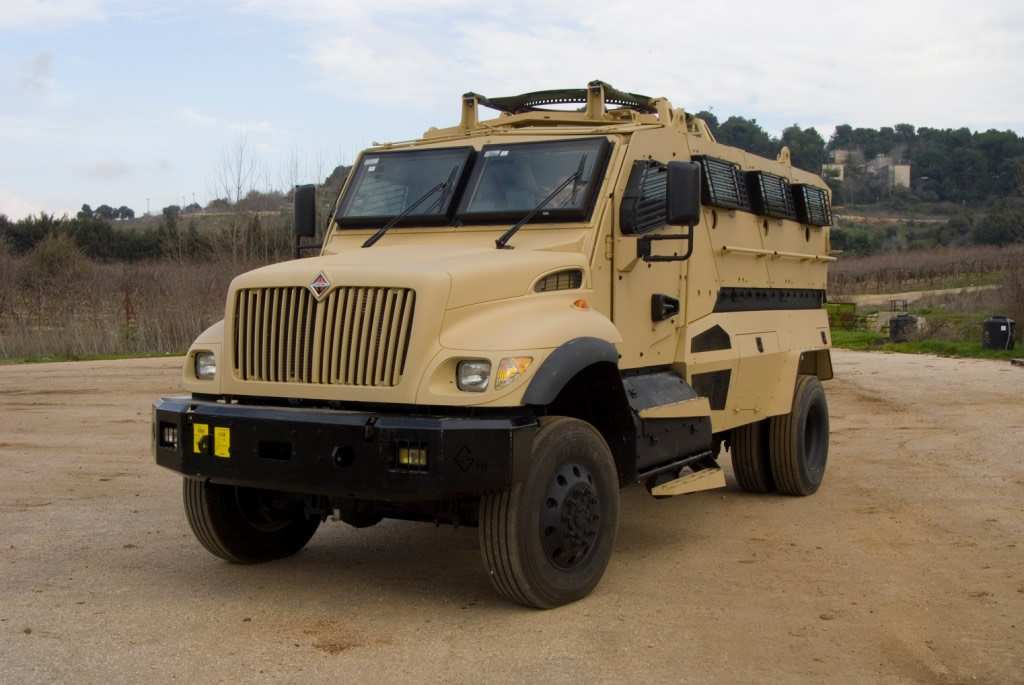
earlier version
(click to view full)
June 18/07: An $8.5 million firm-fixed-priced delivery order #0003 under previously awarded contract (M67854-07-D-5032) for an additional 16 of the larger Category II MRAP JERRV squad vehicles. Note that this works out to about $530,000 per vehicle. Work will be performed in WestPoint, Miss., and work is expected to be complete by February 2008. The DoD release adds, mysteriously, that “Contract funds in the amount of $9,547,248 will expire at the end of the current fiscal year.”
May 31/07: A $623.1 million indefinite-delivery/ indefinite-quantity contract (M67854-07-D-5032, #002) for 1,200 additional Category I (CAT I) Mine Resistance Ambush Protected (MRAP) Low Rate Initial Production vehicles. Work on the MaxxPro MPV contract will be performed in West Point, MS, and is expected to be complete by February 2008. All contract funds will expire at the end of the current fiscal year.
Which leads us to the next question… will existing MRAP vehicles be enough? They may not, and ironically, International may have declined to submit an offering of its own that could have survived in the new environment.
Footnotes
fn1. A shaped charge ‘squishes’ and detonates when it hits, focusing the blast into a cone with a point that’s like a plasma torch – with a wallop behind it. The immense focused energy converges right on the armor, cutting through the steel and/or blowing chunks off the back in a spray of molten metal of fragments, killing the occupants and/or damaging machinery.
Cage armor can prevent some types of warheads from detonating, especially those with a piezo-electric ‘crush’ fuze. Those of you thinking that metal screens are not 100% certain to prevent warhead detonation, depending on the angle at which the piezo-electric crush fuze hit, and other warhead characteristics, are correct. In general, one can expect cage armor of any sort to turn only about 50-60% of rounds into duds.
The other option “cage armor” provides is to start that process away from the armor, so the shaped charge cone’s focal point is moved out in front of the armor it’s designed to penetrate. Instead of a precisely focused cutting/blasting point, you get an less focused blast. Depending on how big the warhead is, how far away the detonation is, and how strong the vehicle’s armor protection is, its occupants may or may not be saved.
Additional Readings & Sources
* Thanks to Navistar for working with DID to help verify vehicle totals.
* Navistar – MaxxPro Dash DXM.
* DID (Dec 16/13) – High Afghan Exit Costs Force US Military to Contemplate End of Era. Which includes getting rid of many MRAPs.
* DID (Oct 23/13) – Choices, Changes & Opportunities: Corporate Lessons from the Afghan R4D Exit. Understanding the difficulty helps to explain some aspects of subsequent decisions about the MRAP fleet.
* US Army (May 5/11) – ‘Golden hour’ initiative pays off in Afghanistan. Aeromedical units play a big role – but so does having nearby vehicles that can travel in dangerous areas, and carry initial medical facilities with them.
* Plasan Sasa (June 3/07) – Plasan Sasa Will Supply International Military and Government, LLC with Critical MRAP Vehicle Protection for the US Marines [PDF format]
* Navistar (May 31/07) – U.S. Marine Corps Awards $623 Million Contract for Mine-Resistant Ambush Protected (MRAP) Vehicles to International Military and Government, LLC
* Reuters (June 21/07) – U.S. Gen.: Iranian Weapons Still Flowing into Iraq. Maj. Gen. Rick Lynch: “What I try to do is stick to the facts. And I know that inside of my battle space, there are munitions clearly marked with Iranian markings, and I am losing many of my soldiers to EFPs… It is clear that the EFP technology and munitions is coming from Iran. We have to stop that.”
* USA Today (May 31/07) – MRAPs can’t stop newest weapon
* DID (Oct 6/06) – Dispatches from Afghanistan: Armored vs. Blast Resistant
* DID (July 21/06) – GD-RAFAEL’s Reactive Armor Equips US Military (updated)
Appendix A: The MRAP Story, and the MaxxPro Story
In 2005, military manufacturers began to plan for the end of the US military’s Hummer orders, and the associated battle to replace it with a new vehicle. By this time, land mines had already been the #1 killer in Iraq for some time, and a few manufacturers were also looking to break into the American market with solutions to this problem. The technology was not new; indeed, it had been in use for over 40 years. The US military had just been very slow to adopt it, aside from some limited orders the 101st Airborne had placed for South African RG-31 vehicles, limited purchases of Force Protection’s Cougar and Buffalo vehicles for Explosive Ordnance Disposal teams, and M1117 Guardian ASV armored cars for US military police units. Worse, the ASVs were produced in New Orleans. Hurricane Katrina interrupted production just as it was ramping up.
By 2006, 3 years into the war in Iraq, realization began to dawn that the Hummers and their blast-catching flat bottoms needed a supplement in theater now, rather than waiting for the Humvee’s successor. The US Army and Marines began taking a closer look at mine-resistant vehicles on the market, and key manufacturers began maneuvering for position.
The new Mine Resistant, Ambush Protected (MRAP) program would include a smaller Category I MRUV patrol vehicles that seated at least 6 people in total, including the driver and front seat. Category II JERRV vehicles would seat at least 10, and would be large enough to hold bomb-disposal robots and other useful gear.
The expected MRAP requirement quickly began to mushroom in size, as IED land mine attacks intensified on the front lines. A large July 2007 order came hot on the heels of US Secretary of Defense Gates’ request to Congress for an extra $1.2 billion in FY 2007 to fund an additional 2,650 MRAP vehicles, on the grounds that manufacturers were ramping up production more quickly than original forecasts. Meanwhile, key inputs such as steel and tires which might have become production bottlenecks were expedited under a DX rating that give the MRAP program priority over almost all other military programs. Sen. and VP-elect Biden [D-DE], who often heard responses re: lack of industrial capacity when he began asking why more MRAP vehicles weren’t in theater, found that his “put the money together, issue the contracts, and let’s find out” speech [MS Word], embodied in Amendment #739 to the FY 2007 military budget, became the US military’s go-forward plan.

(click to view full)
By the time the competition began Force Protection, whose v-hulled Cougar vehicles had catalyzed this realization with their performance in Iraq, was set with their Cougars for MRAP CAT I/II.
General Dynamics was already partnered with BAE OMC of South Africa and the Canadian government to offer the RG-31, which was already in service with airborne and SOCOM customers. Then they signed another deal with Force Protection to share production of Cougar vehicles.
BAE Systems was busy developing their RG-33 family, an update of their proven RG-31s that incorporated new technologies and lessons learned. Meanwhile, Armor Holdings, who supplied the US military’s FMTV medium trucks and up-armoring for its Hummers, worked on an up-armored design based on the FMTV. They would eventually be acquired by BAE in a multi-billion dollar deal, after establishing an MRAP order foothold for their “Caiman” vehicles.
Lacking ready designs or American plants, others chose partnerships as their path to market. Navistar’s truck-building competitor Oshkosh entered the fray with a pair of Partnerships, signing a deal with PVI for their new Alpha MRUV vehicle, and Thales Australia for the larger Bushmaster vehicle that was already serving with Australian forces in Iraq and Afghanistan.
Protected Vehicles, Inc. (PVI) also submitted the Golan, designed in partnership with RAFAEL and the Israeli military.
German firm KMW’s Dingo had also demonstrated front-line performance with German forces in Afghanistan, but their American partner Textron elected to offer their own M1117 instead, eliminating KMW before the competition had even started.
That left Navistar considering what to do.

(click to view full)
Navistar subsidiary International Military and Government LLC (IMG, now Navistar Defense) didn’t have expertise in armored vehicles, but they did know trucks. The firm is used to substantial production numbers, and has a field maintenance network on the front lines. In addition to to being one of North America’s largest producers of civilian commercial trucks and mid-range diesel engines (161,000 vehicles in 2006), it is producing and supporting 2,781 vehicles for the Afghan National Army, and claims 9 additional contracts with the U.S. government for more than 1,000 units each. These contracts encompass include service trucks and buses that have been used in the Iraq reconstruction effort. Production facilities include Garland, TX; Springfield, OH; West Point, MS; Melrose Park, IL (diesel engines); and Tulsa, OK (buses).
The key for Navistar would be finding the right partner, with the aim of developing an armored MRAP-candidate vehicle based around IMG’s WorkStar 7000 truck chassis. In 2005, the firm contracted with South Africa’s Armour Technology Systems (ATS), which has design rights to several mine-resistant vehicles used in South Africa, and had also developed blast-resistant SAMIL armored cab solutions for South Africa’s trucks.

(click to view full)
During the course of that relationship with ATS, Navistar also opened relations with the Israeli firm Plasan Sasa, who had been designing and manufacturing up-armoring kits for the Marine Corps’ MTVR trucks for several years. That gave them a solid relationship with the MRAP competition’s key client. The Kibbutz Sasa firm also had experience developing full vehicles; its own light protected vehicle called the Caracal was under review by the US Marines for a different role. Navistar decided that they had found their partner – and in January 2007, they summarily canceled their agreement with South Africa’s ATS.
The question of what ATS knowledge may have been transferred or used by Navistar remains in the hands of lawyers, and also a PR campaign by ATS that publicizes its specific allegations of bad faith and unethical dealings.
The key characteristics of Navistar’s final vehicle contender are clearer. Unlike the HMMWV‘s auto-derived frame, IMG’s heavy-duty truck chassis would have the load capacity required to handle the weight of additional armor etc., without wearing out early. The final design positions a v-shaped crew compartment on top of that truck chassis, allowing maximum production commonality while using the compartment’s armoring and shape to channel blasts around the crew area. Extensive use of components from IMG’s trucks, including predictive maintenance features, would ensure that their entry was both producible in large numbers and maintainable in the field.
In return for this positioning, Navistar’s IMG received a test vehicle production contract for their vehicle – and nothing more. IMG/Plasan Sasa’s MPV was not featured among the early-stage orders [1st set | 2nd set] from the US military for low-risk designs, which went to rivals Force Protection (Cougar), BAE (RG-33, RG-33L), General Dynamics (RG-31), Oshkosh/PVI (Alpha CAT I), and PVI (Golan CAT II).

(click to view full)
Yet Navistar went on to become the winner in the initial MRAP competition, with the highest share of any competitor. So why was Navistar initially shut out?
One logical conclusion is doubts about its performance. The biggest downside to capsule-mounting a blast-resistant hull on top of a frame is the danger that a mine blast will separate the capsule from the frame, or (more likely) destroy the chassis and immobilize the vehicle in an ambush zone. Moving a v-shaped blast pan beneath the chassis reduces that danger, but that solution creates issues with ground clearance; and – since it offers less of a gap from the blast – with crew survivability.
What changed? Two things.
One was the Biden Amendment in the Senate, which accelerated funding for MRAPs, even as the desired number of vehicles for the FY 2007-2008 program rose again from 4,100 to 7,774 vehicles. At that volume, existing vehicle manufacturers would be very hard-pressed to deliver the required quantity in time. Which in turn lent a higher value to producibility, as long as the vehicles offered substantially better protection than a Humvee. Especially with the US Army reportedly looking for 17,000 blast-resistant vehicles of its own by 2010 – a number that would be borne out, and more, by subsequent events.
The second thing that happened was the testing at Aberdeen Proving Ground, which appears to have quieted doubts concerning IMG/Plasan Sasa’s design. Navistar received just the 2nd post-testing order to emerge from Marine Corps Systems Command, behind Force Protection’s early 1,000 vehicle order in April 2007. A May 31, 2007 report from Defense News claims that Navistar officials heard about their win from the offices of minority leader Sen. Trent Lott [R-MS] and Rep. Roger Wicker [R-MS], and Navistar spokesman Roy Wiley added at the time that “We did extremely well during the tests [at Aberdeen], and we are extremely pleased.”
Plasan Sasa does make composite armors for vehicles, and whatever it used apparently survived the trials at Aberdeen. Navistar would go on to produce its MaxxPro for MRAP orders, as well as the MaxxPro Air Force, the MaxxPro Plus with improved protection, a MaxxPro ambulance (production orders were for the Dash variant), the MaxxPro MEAP, the MaxxPro Dash for Afghan operations, and the MaxxPro Recovery Vehicle (MRV) for towing other vehicles out of danger zones.
In contrast, Navistar’s trucking competitor Oshkosh failed with both of its purpose-designed vehicles. The firm received 100 advance low-risk orders for the Alpha vehicle, which then failed testing and was removed from the competition. Despite its successful service on the front lines, the v-hulled Australian Bushmaster design never saw a single production order during the MRAP program. It would join Textron’s M1117 on the sidelines, until Oshkosh’s big win in the subsequent MRAP All Terrain Vehicle (M-ATV) competition.
Appendix B: MPV or APC to Face EFPs? (June 2007)

(click to view full)
A May 31/07 USA Today article titled “MRAPs can’t stop newest weapon” explains the dilemma:
“The military plans to spend as much as $25 billion for up to 22,000 Mine Resistant Ambush Protected (MRAP) vehicles by 2009. Last month, Defense Secretary Robert Gates declared that buying the new vehicles should be the Pentagon’s top procurement priority.
But the armor on those vehicles cannot stop the newest bomb to emerge, known as an explosively formed penetrator (EFP).”

Anti-RPG Slat Armor
(click to view full)
An EFP is just another type of land mine, where the explosives are arranged to shape a metal disk into a kind of instant high-caliber tank round as they detonate, launching it at nearby objects. This is not a new approach; the USA’s Sensor-Fuzed Weapon, a.k.a. “cans of whup-ass,” uses this exact approach but is dropped from an airplane so it can attack through the top, where armor is usually weakest. An EFP’s mode of operation when used as a land mine is a ballistic side attack rather than a conventional land mine’s explosion, which means a v-hull won’t necessarily offer much protection.
These weapons have also been among the land mines causing problems for heavier Stryker/LAV-III wheeled armored personnel carriers in Diyala Province. The Strykers lack the level of underbelly protection found in MRAP vehicles, and their “steel cage” armor designed to defeat [1] the shaped-charge warheads on anti-tank rockets will not stop large-caliber shells – or a reasonable imitation created by an EFP land-mine.
Iran has been heavily involved in shipping these weapons into Iraq for some time now, and training both Shi’ites and Sunnis to make them. A January 13, 2007 document from the USMC says that as the USA fields vehicles with MRAP-class protection against buried mines, Iraqi insurgents’ use of EFPs “can be expected to increase significantly.”
While the US has been testing new armor compositions designed to break up EFP slugs, there is a commonly-available solution on the market. It’s called “reactive armor,” and already equips American Bradley fighting vehicles, M1 tanks, and other armored platforms.
In a sense, it’s the reverse of the EFP concept – instead of using an explosion to create a killing weapon, it reacts with an outward explosion when hit. This either blows the rocket/ tank round/ or EFP projectile completely off-course, or tips it into an easily-absorbed ‘slap hit’ rather than the precise, focused strike required to penetrate steel.
The armor is manufactured in a cooperative venture between Israel’s RAFAEL and General Dynamics, and already has a strong production base. The only counter to it would be a anti-tank missiles that use a dual-warhead charge, like Russia’s AT-13 Metis or AT-14 Kornet. Some of these weapons even have remote-firing capability. That kind of equipment can only come from a state sponsor, however – a fact that sharply ups the ante on its use as a definitive act of war in theaters like Iraq or Afghanistan.

(click to view full)
There is already an MRAP contender designed from the outset to use this kind of armor to its maximum effectiveness. Protected Vehicles Inc. MRAP CAT II Golan vehicle was designed in conjunction with RAFAEL and the Israeli MoD’s Merkava tank project office. Unsurprisingly, it was also designed from the outset to carry reactive armor as an option, without changing its outward appearance. The result of this design feature is that the enemy can’t tell if reactive armor is present or not, and must therefore assume “yes” for all vehicles of its type.
The US military ordered 60 Golan vehicles for immediate deployment to the front lines back in March 2007, in addition to its order for test vehicles.
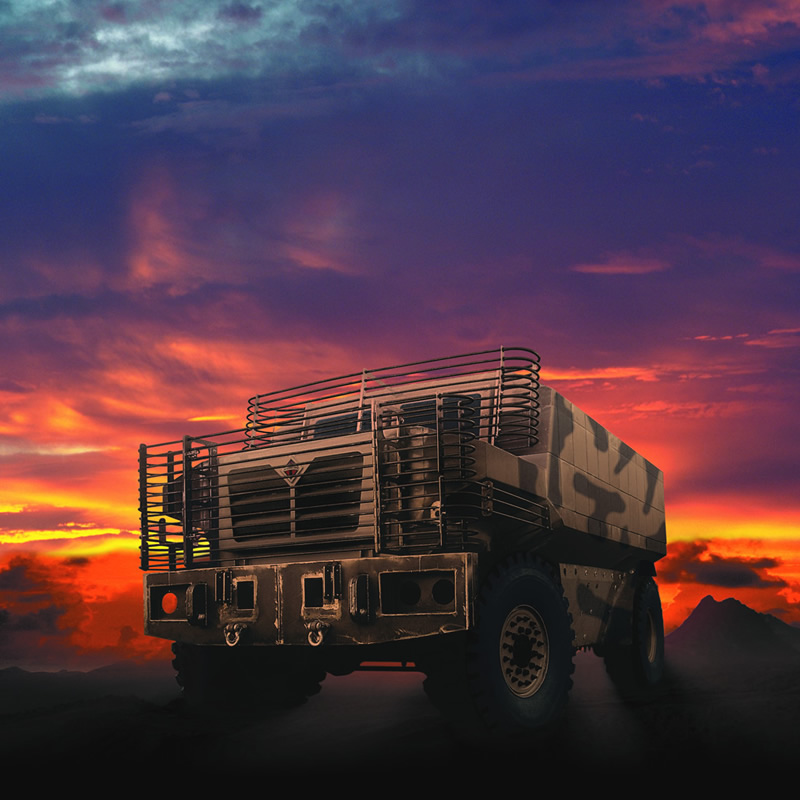
(click to view full)
The interesting thing is, IMG had its own vehicle designed from the outset to use reactive armor. The “International APC” was a definite CAT II sized vehicle at 30,000 pounds curb weight. Based on an International MV-7000 heavy truck cab, the APC promised a vehicle equipped with explosive reactive armor from the get-go.
For whatever reason, IMG chose not to enter this vehicle in the MRAP competition. Their APC could never have won a CAT I MRUV order, of course, as the MaxxPro just did. What it might have offered is an additional purchase option for the US military, when EFP land mines begin taking their toll on MRAP vehicles fielded in theater.
Postscript: DID predicted that a number of MRAP vehicle manufacturers were about to start showing much more interest in reactive armor solutions for their vehicles. It’s always more difficult to integrate later, of course, rather than as a design-in option. Still, it was immediately available – and better than nothing. That prediction proved false, as the Army began development of anti-EFP metal armor/add-on kits instead.