

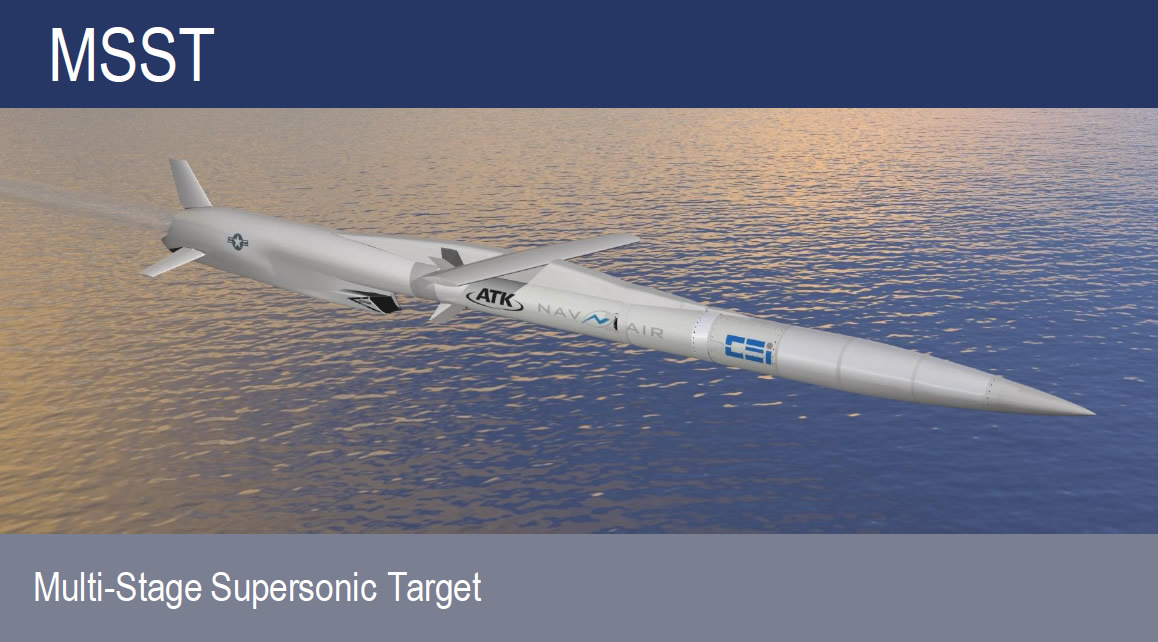
(click to view full)
In order to defend against a threat, you have to be able to simulate it for realistic training and evaluation. Navy ships are increasingly threatened by supersonic anti-ship missiles, which can leave defenders as little as 45 seconds from the moment they break the horizon to impact with the ship. The USA’s GQM-163 Coyote target was developed to simulate those, but the Russians also sell an interesting hybrid threat. The 3M54E “SS-N-27 Sizzler” variant of the Klub missile uses the usual sub-sonic, sea-skimming approach in order to extend its range, until it gets within 60 km/ 36 miles of its target. Then it boosts to supersonic speed, and performs evasive maneuvers to confuse defenses.
It’s a deadly threat. Which is why the USA has been funding the Multi-Stage Supersonic Target Program since 2008, in order to develop a target that can bring the same kind of sizzle to defensive exercises.
Contracts & Key Events
US Naval Air Systems Command in Patuxent River, MD manages the MSST program, and in 2008 they picked Alliant Tech Systems (ATK) in Woodland Hills, CA.
May 1/12: An $8.8 million cost-plus-incentive-fee contract modification for services and supplies in support of the MSST Program, including procurement of 16 rocket motors for safety and confidence testing, the material characterization program of R7340 graphite material, and a long-lead buy of armed firing devices and rocket motor cases for future low rate initial production.
Work will be performed in Woodland Hills, CA, and is expected to be complete in April 2014 (N00019-08-C-0058).
Aug 22/08: US NAVAIR picks ATK over 2 other vendors, and awards them a $96.8 million cost-plus-incentive-fee contract to design, develop, integrate, and test a Multi-Stage Supersonic Target (MSST) to represent a 2-stage anti-ship cruise missile. ATK will create a 2-stage unmanned aerial target, a launcher, and associated support equipment, delivering 2 engineering evaluation units and 7 engineering development models.
ATK will work with Composite Engineering Inc. of Sacramento, CA on this project. CEi is an important producer of training targets for the US military, including the BQM-177A/i that serves as the US Navy’s main simulator of subsonic, sea-skimming cruise missiles.
Work will be performed in Sacramento, CA, (38.9%); Woodland Hills, CA (32%); Plymouth, MN (19.2%); Elkton, MD (5.1%); and Wichita, KS, (4.8%), and is expected to be complete in September 2012. $10 million will expire at the end of the current fiscal year, on Sept 30/08. This contract was competitively procured via electronic request for proposal, and 3 offers were received (N00019-08-C-0058). See also ATK release.