

(click to view full)
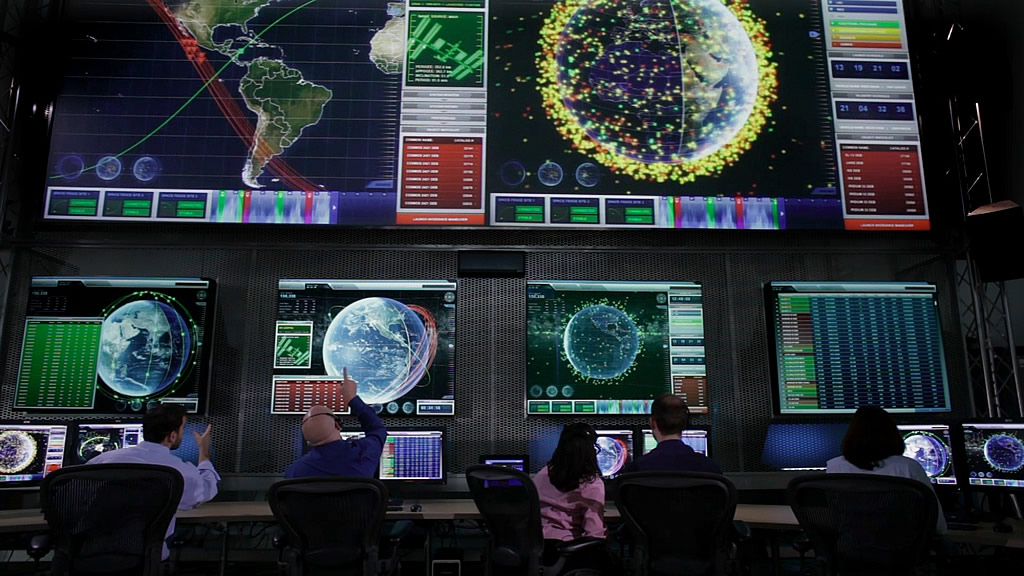
Space is big. Objects in space are very dangerous to each other. Countries that intend to launch objects into space need to know what’s out there, in order to avoid disasters like the 2009 collision of 2 orbital satellites. All they need to do is track many thousands of man-made space objects, traveling at about 9 times the speed of a bullet, and residing in a search area that’s 220,000 times the volume of Earth’s oceans.
The US Air Force Materiel Command’s Electronic Systems Center at Hanscom Air Force Base in Massachusetts leads the USA’s Space Fence project. It’s intended to improve space situational awareness by tracking more and smaller objects, while replacing legacy systems in the Space Surveillance Network (SSN) as they retire. With a total anticipated value of around $6.1 billion over its lifetime, Space Fence will deliver a system of 2-3 geographically dispersed ground-based radars to provide timely assessment of space objects, events, and debris. International cooperation will supplement it, as part of overall Space Situational Awareness efforts. Failure is not an option. Or is it?
Space Fence
Background
 LEO clutter concept
(click to view full)
(click to view full)
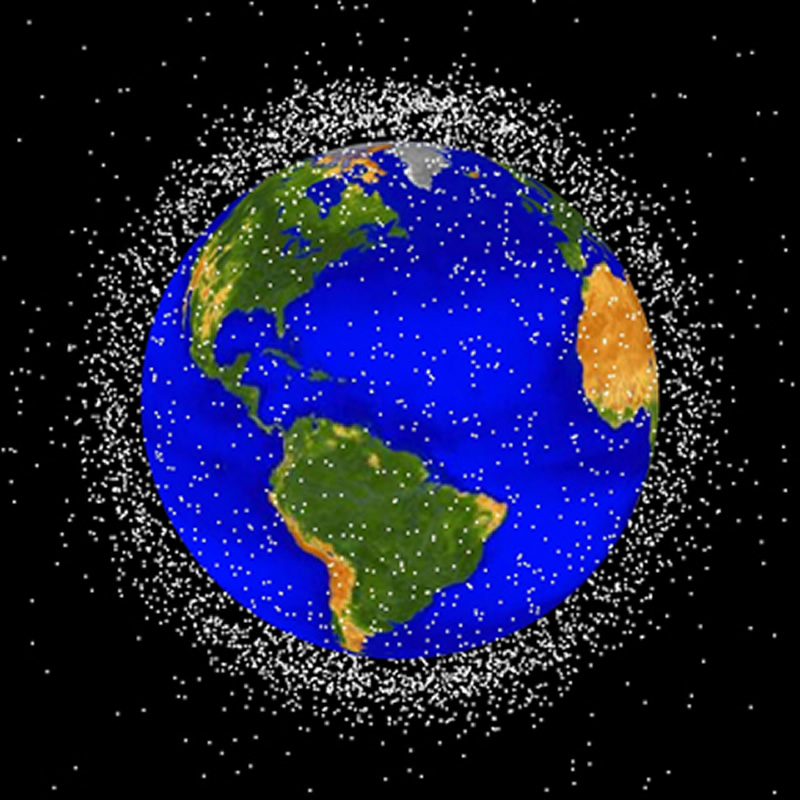
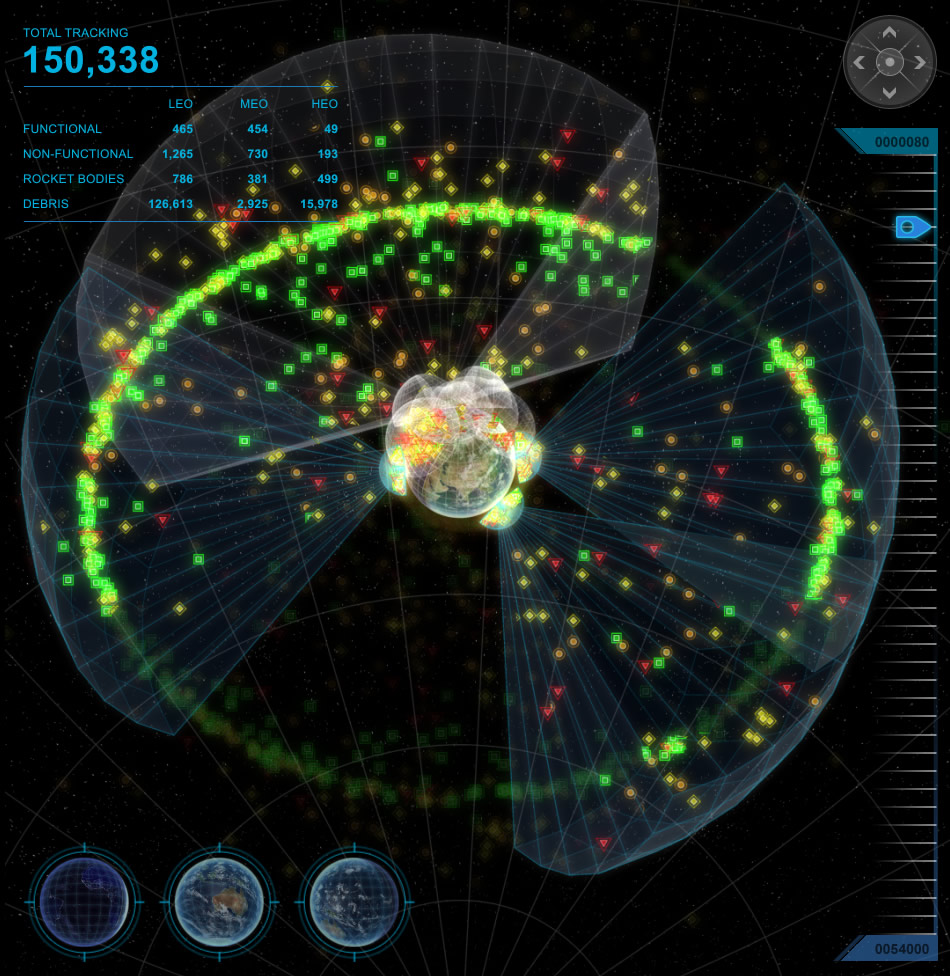
The current space fence was operational from 1961 – 2013, and Secure World Foundation technical advisor Brian Weeden charts at least 9 known collisions involving non-secret satellites over that period. Meanwhile, the number of potential hazards is rising. In 1980, there were 5,396 total objects to track. In 2010, there were 15,639. Space Fence is expected to grow that set even further, because the higher wave frequency of the new Space Fence radars will let it detect much smaller microsatellites and debris than current systems. At the same time, global political and technology trends are accelerating the absolute number of these objects in space.
The Space Fence program will provide a radar system operating in the S-band frequency range to replace the Air Force Space Surveillance System (AFSSS) VHF “Fence” radar that currently performs detection of orbiting space objects. The Space Fence will have a modern, net-centric architecture that is capable of detecting and effectively tracking much smaller objects in low/medium Earth orbit (LEO/MEO). It was slated to go live by 2015, but subsequent development have pushed it to December 2018 at the earliest.
To fit this program into its larger context, the US GAO characterized 4 facets of space situational awareness (SSA), an umbrella term that includes but it not limited to tracking space debris:
1. Detect, Track, and Identify. The ability to discover, track, and differentiate among space objects. Space Fence will anchor this facet, but it won’t be the only asset used for this purpose.
2. Threat warning and Assessment. The ability to predict and differentiate among potential or actual attacks, space weather environment effects, and space system anomalies. Space Fence may be able to help with this task, but in a secondary way.
3. Intelligence characterization. The ability to determine performance and characteristics of current and future foreign space and counterspace system capabilities, as well as foreign adversary intentions. Better monitoring of space may help with intelligence collection, but in a tertiary way.
4. Data integration. The ability to correlate and integrate multisource data into a single common operational picture and enable dynamic decision making. Out of scope for Space Fence. The USA’s pending Joint Space Operations Center Mission System (JMS) will play a large role here, and must be ready, or the amount of data generated by the new radars will exceed the existing system’s capacity.
The Space Fence Program: Old and New
Out With the Old – In Advance
(click for video)
The in-place AFSSS was also known as a “fence” because several transmitters and receivers create a narrow, continent-wide planar energy field in space. There were once 9 AFSSS sites (3 transmitter, 6 receiver), located on a path across the southern United States from Georgia to California, along the 33rd parallel. Energy emitted from the transmitter sites formed a fixed, very narrow, fan shaped beam in the north-south direction, extending across the continental United States in the east-west direction. One or more of the receiver sites receives energy reflected from objects penetrating the beam. The 3 transmitter sites were located at Jordan Lake, AL; Lake Kickapoo, TX; and Gila River, AZ. The 6 receivers were located at Tattnall, GA; Hawkinsville, GA; Silver Lake, MS; Red River, AR; Elephant Butte, NM; and San Diego, CA.
In 2013, every one of these locations was shut down. In exchange, the Perimeter Acquisition Radar Characterization System at Cavalier AFS, ND was slated for modification, and the space surveillance radar at Eglin AFB, FL became the sole space radar.
It’s estimated that this closure will remove about 40% of the current surveillance network’s observation capability, and all of its long distance capability out to about 24,000 km/ 14,900 miles. Note that the Geosynchronous Orbit (GEO) used by most military satellites is up at 22,000+ miles, where Space Fence doesn’t really reach. On the other hand, launches and subsequent satellite raisings have to make it through the debris clouds to get there. Meanwhile, important global systems like Iridium, and a number of intelligence satellites, sit in lower orbits.
In With the New, Eventually
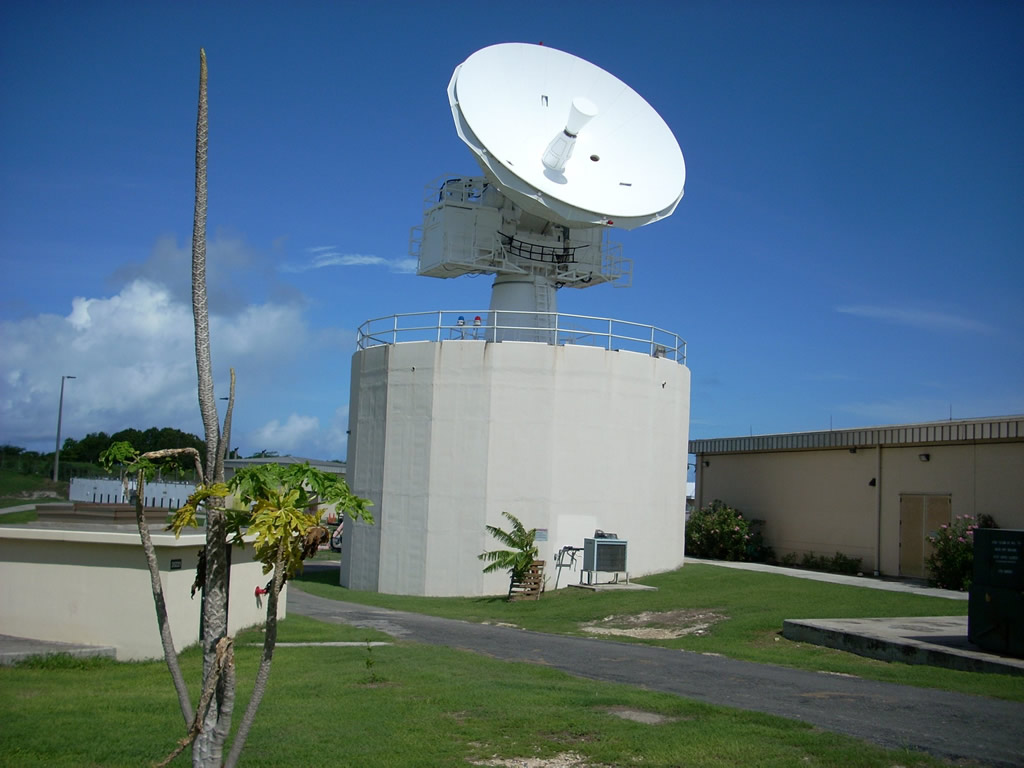
The new Space Fence system would begin to fix this problem, but the number of sites has dropped from 2-3 to just 1 large S-band radar at Kwajalein Atoll in the Marshall Islands, with an option for a 2nd.
The Space Fence procurement is broken down into the following phases: Phase A, Preliminary Design Review, System Development, Deployment and Follow-on support. System development of the large S-band radar was scheduled to begin in June 2012, but the contract wasn’t even awarded until mid-2014. Initial Operational Capability has slipped from FY 2017 to Q1 FY 2019, and full capability has shifted to Q1 2022.
Space Fence data will be fed to the Joint Space Operations Center (JSpOC) at Vandenberg AFB, CA, which is scheduled to become operational by December 2016. Data from the Space Fence radar will be integrated with other SSN data to provide a more comprehensive and integrated space picture.
At an estimated program cost of $6.1 billion over its lifetime, Space Fence was slated to be the USAF’s largest single investment in SSA sensors. Over the 2011-2015 period, the Pentagon expected about 66% of their $3.3 billion SSA investment to buy new sensors, about 21% on JMS for data integration, and the other 13% on extending the lives of current sensors, and other SSA-related programs.
Declining budgets have forced the USAF to change its plans more than once already, and plans as of October 2013 involve just $1.6685 billion for the Space Fence radar. Once the chosen system is deployed, it will serve alongside new systems like the SSBS satellite, the pending ground-based RAIDRS electromagnetic interference detection system, and DARPA’s pending ground-based Space Surveillance Telescope. They’re designed to boost the existing Space Surveillance Network, which includes 29 ground-based Department of Defense (DOD) and privately/foreign owned radar and optical sensors, at 17 worldwide locations; plus a communications network, and primary and alternate operations centers for data processing. Most of the sensors are mechanical tracking, phased-array, and continuous-wave radars; but optical telescopes are also used.
Contracts and Key Events
Poor planning delivers delays, but RFP eventually leads to a contract; USAF exploring whether they can do more on the cheap.
(click to view full)
September 30/15: Lockheed Martin’s Space Fence system has passed an Air Force Critical Design Review, according to a company press release. Passing the CDR now means that the full-scale Space Fence System radar and facilities can be constructed on Kwajalein Atoll, part of the Marshall Islands. Designed to serve as a second-generation space surveillance radar system, the Space Fence will allow the Air Force to track satellites and space debris.
July 1/14: Innovation. A Washington Post article highlights the recent work of AFRL senior engineer Richard Rast, who has come up with a way to use multiple small telescopes for effective tracking of space debris as small as a few centimeters. Portability is just a bonus:
“Rast’s invention uses a series of small telescopes developed by Los Alamos National Laboratory that capture the faint light signals entering the lens. Rast converts the camera photos into a movie, where he uses the human eye’s sensitivity to detect variations between frames to separate man-made objects from the star background and identify objects the size of just a few centimeters.
“Richard Rast demonstrated that his small telescope approach can find and track space objects at a much lower cost than traditional methods and provide a quality of data previously assumed impossible for a small telescope system to achieve,” said Maj. James Thomas, the chief of the Air Force Research Laboratory’s Satellite Assessment Center at Kirtland Air Force Base in Albuquerque, N.M.”
There are still questions like field of view, etc., but this is a promising development, especially if it allows a distributed and networked system of sensors that allied countries can also deploy. Sources: Washington Post, “Air Force engineer developed unique method to track space debris”.
June 2/14: EMD Contract. Lockheed Martin Mission Systems and Training in Moorestown, NJ receives a $914.7 million fixed-price-incentive-firm, cost-reimbursable and cost-plus-fixed-fee contract for Space Fence program engineering, manufacturing and development, production and deployment. Other team members include General Dynamics and AMEC.
$415 million in FY 2013 and 2014 research, development, test and evaluation funds are committed immediately, and Lockheed Martin says that the contract total could reach up to $1.5 billion if all options are exercised. Work will be performed at Moorestown, NJ, and Kwajalein Atoll, Republic of Marshall Islands. The contractor will have 52 months after contract award to reach initial operational capability. The contract was competitively procured, with 2 bids received by the USAF Life Cycle Management Center/HBQK at Hanscom AFB, MA (FA8709-14-C-0001). See also Lockheed Martin, “Lockheed Martin Selected to Provide U.S. Air Force with Space Fence Radar to Safeguard Space Resources”.
Space Fence contract
May 27/14: In “Beyond Gravity,” Ars Technica takes a long look at the technical and legal barriers in the way of actually dealing with any of the space junk that the USA Space Fence will be busy cataloguing. short answer: lots of interesting research and ideas, but outdated legal constructs will eventually threaten space travel. Key paragraph?
“The Kessler Syndrome [of cascading, self-generating orbital debris] is a mathematical singularity,” said Darren McKnight, a member of a recent National Academies panel on NASA’s meteoroid and orbital debris program. “Based on the equations, we’ve already passed the critical density.”
May 9/14: The problem. A House Science, Space and Technology Committee hearing addresses the issue, albeit with far poorer distribution than the movie Gravity. The Kosmos-2251/ Iridium-33 collision is well known as a problem, but China’s sloppy destruction of a satellite in 2007 is an equally big problem, creating “150,000 objects centimeter-sized or larger.”
One of the witnesses testified that the International Space Station had to be moved twice within the last month, in order to avoid collisions. At some point, the focus will have to shift from identification to solutions – but without identification, there are no solutions. Meanwhile, that “April 2014 contract (q.v. Nov 21/13) hasn’t materialized yet. Sources: USAF, “Air Force official testifies on dangers of ‘space junk'”.
March 31/14: GAO Report. The US GAO tables its “Assessments of Selected Weapon Programs“. Which is actually a review for 2013, plus time to compile and publish. For Space Fence, R&D and procurement costs look different, because most of the R&D goes into creating the actual system. The expected program total as of October 2013 is $1.6685 billion, of which just $103.3 million is termed “procurement.” That will produce just 1 radar site to be operational by November 2018, with an option for the 2nd.
The parallel JMS (JSpOC Mission System) to process all of the data is considered a separate program, and is scheduled to become operational by December 2016.
“The Space Fence program has seven critical technologies, which are expected to demonstrate full maturity during or after the critical design review. The program delayed development start and awarding of the system development contract… almost 2 years. As a result, the program delayed initial operational capability by a year to November 2018…. The Air Force plans to award a fixed-price incentive contract for system development activities for the first radar site, with a contract option for the second site. If the option for the second site is exercised, it is planned to be operational 36 months after the program meets initial operational capability.”
Decisions concerning a 2nd radar are expected after the 1st radar goes live, with operational testing expected to begin in June 2018. The technologies used in the 2nd site may differ.
Jan 9/14: NDPP. Lockheed Martin announces a $3.9 million contract from the USAF Life Cycle Management Center, to develop a Non-Traditional Data Pre-Processor (NDPP) under the Integrated Space Command and Control (ISC2) contract.
ISC2 is responsible for providing conclusive and timely air and missile warning information, and also provides space situational awareness via the Space Surveillance Network. The NDPP system is an expansion of the ISC2 space data server, and also extends the communications infrastructure so that the Joint Space Operations Center (JSpOC) at Vandenberg AFB, CA can use a wider variety of sensors to maintain and update their space object catalog. NDPP’s infrastructure includes multiple security levels, and it will offer a new channel for receiving space object data, as well as a new collection system. Sources: Lockheed Martin, “Lockheed Martin Awarded Contract to Make Non-Traditional Sensor and User Data Available for Space Situational Awareness”.
Dec 20/13: SBIR. The USAF launches a Small Business Innovation Research (SBIR) project to improve space surveillance out to geosynchronous equatorial orbits. The sensors would use a wide staring field of view to cover more than 1000 square degrees per hour at 45 degrees elevation, during “typical” sky conditions at AFRL’s Starfire Optical Range (SOR), Kirtland AFB, NM. The ultimate goal is a cheap system that costs $1 million or less per site, and is used as an early-stage sensor to detect dim objects and immediately queue high-resolution systems for a closer look.
That would be useful, given current weaknesses in space surveillance. It’s also difficult. The USAF hopes that rapidly growing “off-the-shelf” technology for data bus architectures, networking, and electro-optic sensors makes it feasible.
Phase I will provide a mathematical model for system design, which helps create simulation tools, and work on small-scale lab tests. Those tests feed back into the models and simulations, with the goal of creating a system design that demonstrates the potential to meet these challenges. Phase II would demonstrate these capabilities at SOR, and develop prototype control systems, reporting systems, and procedures. Phase III would fully develop an operational scaled system prototype that can be easily deployed to one of USSTRATCOM’s electro-optical surveillance sites. Sources: SBIR.gov, “AF141-016: Persistent Wide Field Space Surveillance.” | C4ISR & Networks, “USAF wants to detect dim space objects – cheaply”.
Nov 21/13: USAF Space Command commander Gen. William Shelton tells the AFA’s Pacific Air & Space Symposium in Los Angeles, CA that he’s aiming for an April 2014 contract:
“We have now been given the go-ahead to release that modified [Space Fence RFP] and begin our acquisition program again… Hopefully we’ll have that on contract in the April time frame, and that will represent about a one-year slip in the program because of the delay here, but nevertheless we’ll get a very good sensor that will help us keep track in a much-larger-volume sense and a much-better-resolution sense of the traffic in low Earth orbit.”
Extra points to the general for using the movie Gravity in his speech, as a way of highlighting why space situational awareness is important. Sources: Space News, “Pentagon Approves Latest Air Force Space Fence Plan”.
Oct 24/13: RSS RFP. The Air Force releases an RFP for a flexible coverage risk reduction study (RSS):
“Key among these unique capabilities is flexible coverage, which is a search mode of operation that enables coverage in various orbital regimes (altitudes) with enhanced sensitivity and variable search volume coverage modes to support operations like new object discovery at higher altitudes, proximity operations/neighborhood watch for space protection, etc. This capability enables the radar to schedule detection fences covering either a user-defined fixed region or a region defined in orbital space.”
They may award up to 2 Firm-Fixed-Price contracts for a maximum total of $9.9 million, with 5.5 months of anticipated work. A Notice of Proposed Contract Action released in September limits that RFP to incumbents Lockheed Martin and Raytheon. FA8709-13-R-0003.
Oct 23/13: Revised milestones. In their testimony [PDF] to the House Armed Services Subcommittee on Tactical Air and Land Forces, William A. LaPlante, Deputy Assistant Air Force Secretary for Acquisition, and USAF Deputy Chief of Staff Lieutenant General Michael R. Moeller, wrote:
“The Space Fence contract was ready for award in early June; however, a DoD-level review driven by sequestration, delayed the decision to proceed into later in 2013. With an affirmative decision in November, initial capability will slip about one year and costs will increase by over $70M.”
So “the Pentagon made me do it” is the Air Force’s posture on this (see also July 16/13). There is some truth to that narrative, since the Office of Management and Budget (OMB) and DoD explicitly instructed departments and agencies to ignore the Budget Control Act (BCA) until the last minute, following the universal Stuff Rolls DownHill (SRDH) principle. In any case, the anticipated date for Initial Operational Capability (IOC) was postponed in August by a year, after having already been moved from 2015 to 2017 a year ago. Presumably this also affects the Full Operational Capability (FOC) deadline, which had been set to 2020.
The ongoing Space Fence EMDPD RFP (q.v. Oct 4/12) is about to be amended, and an award is now planned for March 2014. Additionally, the Procuring Contracting Officer was changed in September.
FY 2012 – 2013
PDR; 1st site picked; RFP, bids; Shutdown of most existing sites – for what?

Aug 12-14/13: Space Fence Shutdown. So, the total amount of money saved by shutting down the Space Fence (AFSSS) by Oct 1/13, due to “resource constraints caused by sequestration”? $14 million per year. Instead, USAF SMC is looking at modifying operating modes for the Perimeter Acquisition Radar Characterization System at Cavalier AFS, ND and the space surveillance radar at Eglin AFB, FL. The USAF’s defense:
“The operational advantage of the AFSSS is its ability to detect objects in an un-cued fashion, rather than tracking objects based on previous information. The disadvantage is the inherent inaccuracy of the data, based on its dated design. The new operating modes at Cavalier AFS and Eglin AFB will provide more accuracy than the AFSSS and still collect un-cued observations.”
On the flip side, it’s worth asking what percentage reduction that represents for tracking coverage. Less coverage means that less debris will be tracked, which means less accurate orbits, which makes predicting collisions harder and less accurate. The new plan also leaves Eglin AFB as the only dedicated space radar, so it creates an absolute failure risk.
Meanwhile, the USAF throws critics a bone by touting the improved capabilities of the new Joint Space Operations Center’s high performance computing, and the new fence. Without committing to construction. While also suggesting that maybe others should just pick up the mission. USAF Gen. Shelton told Satellite Today that “other countries, as well as the commercial sector,” might try to offer capabilities of their own. The Europeans are moving in this direction, slowly, and Intelsat General’s Nancy Nolting says that their satellites could carry sensors to build a supplementary network in orbit. At the end of the day, however, someone has to pay for that. The question is now “whom?” Sources: USAF release | Satellite Today, “US Air Force Space Fence Shutdown Threatens Satellite, Aerospace Industries” | Space News, “U.S. Air Force: Space Fence Shutdown To Save $14 Million Annually”.
Aug 5/13: Over in Europe… A July 2013 proposal to the European Parliament, Council and other EU bodies, the EC would help EU nations fund development of a space surveillance and tracking (SST) network. It would be based on French & German radars and other systems, for about EUR 10 – 120 million per year. Candidate assets include the French Graves demonstration radar (range 1,000 km/ 620 miles), Germany’s TIRA (more powerful, but track just 1 object at a time), 3 Satam French air force tracking radars, the nascent Oscegeane telescope/ spectroscopy application, and the Fedome space weather system.
France is building out a Cosmos tracking center in Lyon by 2014, but still needs to develop a Space Information System. The German Space Situational Awareness Center (GSSAC) in Uedem, Germany is also ramping up, but isn’t expected to be really ready until 2020. Cooperation would be positive, especially if Graves could note objects and cue TIRA to identify them. Even so, the bottom line is that the systems’ limited range and breadth won’t replace resources like the US Space Fence, even at a regional level. Nor has the EU’s ESA been able to get very far with wider initiatives of its own. Aviation Week, “EU Aims For Space Situational Awareness Network”.
Aug 1/13: Space Fence Shutdown. A memo from USAF Space Command commander Gen. William Shelton tells Five Rivers Services of Colorado Springs, CO to prepare for shut-down at the current Space Fence system’s 3 transmitter and 6 receiving sites. The USAF has decided not to exercise the 5th option year of their support contract, and won’t be giving it to anyone else:
“A specific list of action items will be provided as soon as it is finalized. A specific date to turn off the mission system has not been established yet, but will be provided to you immediately upon determination.”
Technically, they’re deactivating 3 transmitters and 4 receiving sites. The 2 receiver sites at Tattnall, GA and Silver Lake, MS were deactivated in April 2013, as an automatic response to sequestration. It’s estimated that this full closure will remove about 40% of the current surveillance network’s observation capability, and all of its long distance capability out to about 24,000 km/ 14,900 miles. Note that the Geosynchronous Orbit (GEO) used by most military satellites is up at 22,000+ miles, where Space Fence doesn’t really reach. On the other hand, launches and subsequent satellite raisings have to get there. There are also important global systems like Iridium, and a number of intelligence satellites, that sit in lower orbits.
There’s a judgement call involved about the USAF’s intentions. Is this a serious response, or a classic bureaucratic “Washington Monument” exercise? For the uninitiated, a “Washington Monument” response does something that will cause the maximum amount of damage or inconvenience, blames it on “budget cuts” even if the amount saved is trivial, and tries to create a groundswell to reverse all of the cuts. A well functioning system would simply fire administrators who use this tactic, due to loss of confidence in their decision-making; but that requires intervention from outside the bureaucracy in question, and rarely happens. Space News, “Shelton Orders Shutdown of Space Fence”.
Existing AFSSS Space Fence to shut down
July 16/13: Why no contract? The USAF says they would have issued the Space Fence contract by now, but the Pentagon’s Strategic Choices and Management Review (SCMR) has put it on hold. SCMR is meant to look at how the US military would react if budget cuts aren’t reversed, with scenarios involving $100 billion, $300 billion and $500 billion in cuts over a 10-year period.
If the new Space Fence falls victim, there’s some discussion of upgrading space surveillance sensors already at Eglin AFB, FL, even though that won’t provide the same low-and-high-inclination orbit coverage, or address key back-end systems. USAF Space Command head Gen. William Shelton says that they’re also looking at “new architectures”, without specifying further. Aviation Week | Defense News.
June 21/13: Global Horizons Study. MITRE delivers the USAF’s Global Horizons study, which states:
“There are clear threats to the U.S. space enterprise, including growth in space debris, space weather induced upsets, the increasingly easy access to space, and potential cyber/EW (electric warfare)/kinetic attacks on our space and space-support ground assets…. Generally speaking, the U.S. has put a lot of eggs in very few baskets and when you look at the limited number of missile warning communication satellites, weather satellites and even NRO satellites, an aggressor could severely disable and even degrade U.S. capabilities with only a handful of successful shoot downs of U.S. satellites.”
Sources: Report at scribd | Satellite Today, “Air Force Report Outlines Threats to Satellite and Aerospace Industries”
Nov 14/12: Bids in. Raytheon and Lockheed Martin both announce that they have submitted their bids to finish development, and build the USA’s new Space Fence.
The RFP is for the final development and construction of the Space Fence Operations Center, Site 1, and an option for Site 2. It is a full and open competition that will conclude with a contract award, currently anticipated in spring 2013. Lockheed Martin | Raytheon.
Oct 4/12: RFP. Space Fence solicitation becomes an RFP. FBO.gov.
RFP & bids
Sept 25/12: 1st site. The USAF has picked its 1st Space Fence radar site on Kwajalein Island in the Republic of the Marshall Islands, South Pacific. Construction of the S-band radar and buildings is expected to begin in September 2013, with 48 months planned to complete construction and testing, and Initial Operational Capability (IOC) planned for fiscal year 2017.
After IOC, the 21st Space Wing is expected to manage about 10-15 contractors as a long-term work force, and a Support Agreement will be established between USAF Space Command and the US Army Kwajalein Atoll/Reagan Test Site for site support and facilities maintenance. USAF.
Kwaj is 1st site
August 2012: During a Pentagon Defense Acquisition Board review, some changes are made to the program’s acquisition strategy, which is now an incremental approach.
Increment 1 includes the Space Operations Center, Site 1 facilities construction, and radar build. Increment 2 includes Site 2 and system integration. Source.
Acquisition change
March 21/12: GAO report. “DOD Faces Challenges in Fully Realizing Benefits of Satellite Acquisition Improvements” includes a discussion of Space Fence’s acquisition strategy, and potential pitfalls. The agency doesn’t believe Space Fence will be ready before 2017, and sees a strong technical risk if the accompanying JMS ground system isn’t ready at the same time:
“Space Fence program officials have stated that Space Fence will be one of the largest phased array radars ever built. The size of the radar is expected to provide significant power… but may also pose increased risk… To mitigate this risk, the Space Fence acquisition strategy includes maintaining competition through technology development and having two firms under contract doing parallel prototype development. This process allows program officials to evaluate contractor’s designs and associated costs while moving Space Fence’s four critical technologies and backup technologies toward maturity, before the program enters system development which is scheduled for later this year with the award of a single contract. Though earlier plans called for the first Space Fence site to achieve initial operational capability in 2015, estimates show that at current funding levels, this capability will not occur before 2017.
…Another area where synchronization in system development may pose problems is the Air Force’s Joint Space Operations Center Mission System (JMS) and Space Fence programs. JMS is to process data about space assets gathered by the Space Fence and other Space Situational Awareness (SSA) programs, and will increase DOD’s ability to track objects in space from about 10,000 objects with the current system to over 100,000 objects. According to the Space Fence program office, JMS needs to be available when the Space Fence is fielded because the amount of data Space Fence will generate exceeds existing command and control system performance limits. JMS recently underwent a change to its acquisition strategy, dividing the program’s development into two increments to reduce risk and more rapidly deliver needed capabilities. The first Space Fence radar site is scheduled to provide initial operational capability by the end of fiscal year 2017, and… JMS needs to be operational by this time.”
March 8/12: Lockheed Martin’s Space Fence prototype, developed under the Jan 26/11 contract, is beginning to track orbiting space objects. The USAF has said that it plans to award a Space Fence production contract later in 2012. Lockheed Martin.
Feb 29/12: PDR. The USAF grants its final approval of Lockheed Martin’s preliminary design for the Space Fence system. Source.
PDR
FY 2009 – 2011
Phase A; preliminary design.
May 31/11: The US Congress’ Government Accountability Office auditors looks at American programs for monitoring space debris, and voice serious concerns. Excerpts:
“DOD has significantly increased its investment and planned investment in SSA acquisition efforts in recent years to address growing SSA capability shortfalls. Most efforts designed to meet these shortfalls have struggled with cost, schedule, and performance challenges and are rooted in systemic problems that most space acquisition programs have encountered over the past decade. Consequently, in the past 5 fiscal years, DOD has not delivered significant new SSA capabilities as originally expected… two critical acquisition efforts that are scheduled to begin development within the next 2 years – Space Fence and the Joint Space Operations Center Mission System (JMS) – face development challenges and risks, such as the use of immature technologies and planning to deliver all capabilities in a single, large increment, versus smaller and more manageable increments… GAO recommends that DOD assure–in approving the Space Fence and JMS acquisition efforts to initiate product development–that all critical technologies are identified and matured, and that other key risks have been fully assessed. If DOD determines that the programs should move forward with less mature technologies, DOD should assess available backup technologies and additional resources required to meet performance objectives…”
The GAO adds elsewhere that governance is at least as much of a problem as technology:
“There are significant inherent challenges to executing and overseeing the SSA mission, largely due to the sheer number of governmentwide organizations and assets involved… while the recently issued National Space Policy assigns SSA responsibility to the Secretary of Defense, the Secretary does not necessarily have the corresponding authority to execute this responsibility. However, actions, such as development of a national SSA architecture, are being taken that could help facilitate management and oversight governmentwide. The National Space Policy, which recognizes the importance of SSA, directs other positive steps, such as the determination of roles, missions, and responsibilities to manage national security space capabilities and the development of options for new measures for improving SSA capabilities… Finally, though the commercial sector and the international community are to play a pivotal role in the SSA mission, it is too early to tell whether DOD’s efforts to expand and make permanent its Commercial and Foreign Entities SSA data-sharing pilot program will be effective in integrating efforts to develop SSA capabilities.”
With respect to the Space Fence in particular, the report says that the original 3-site system (notionally Australia, Ascension Island in the south Atlantic, Kwajalein Atoll in the Marshall Islands) is very likely to devolve into a 2-site system on cost/benefit grounds, as the current Technology Development Phase assesses costs and tradeoffs. It adds:
“The primary program risk… is that the new Joint Space Operations Center Mission System (described below) will need to be available to process Space Fence data, as the amount of data provided will result in an increase in uncued detection and tracking capacity from 10,000 to 100,000 objects… other risks of the program include large-scale integration and calibration of radar arrays, scalability of the design for the digital beam former,[C] and development of information assurance certification criteria… All five critical Space Fence technologies identified by the program office are immature – one at technology readiness level (TRL) 4 and four at TRL 5… mature backup critical technologies exist which could be used… our best practices work has shown technology development to TRL 7 could significantly reduce risk to meeting cost, schedule and performance goals.”
See GAO | iWatch News.
Jan 26/11: Lockheed Martin and Raytheon each receive an 18-month contract worth $107 million (total: $214 million) for Space Fence Preliminary Design. These preliminary system designs must use mature technologies that meet or exceed Technology Readiness Level 6 and Manufacturing Readiness Level 6. The firms will also conduct radar performance analyses, evaluations and prototypes, and related activities, en route to a functional radar prototype with hardware and software components representative of the technology in the final design. A final production contract to one of the companies is expected in 2012.
Raytheon Integrated Defense Systems of Sudbury, MA will produce 1 preliminary design for the Space Fence Program. At this time, $20 million has been obligated by the ESC/HSIK at Hanscom AFB, MA (FA8707-11-C-0004),
Lockheed Martin Mission Systems & Sensors of Moorestown, NJ will produce 1 preliminary design for the Space Fence Program. At this time, $20 million has been obligated by the ESC/HSIK at Hanscom AFB, MA (FA8707-11-C-0005)
The missing Phase A contract winner is Northrop Grumman (see June 11/09 entry). Lockheed Martin release | Raytheon release
Preliminary design contracts
Jan 18/11: As part of a piece highlighting Raytheon personnel who won Black Engineer of the Year awards, Raytheon discusses:
“Adrian Williams is senior electrical engineer at Raytheon’s Integrated Defense Systems (IDS) business in Andover, Mass. He works in the Wafer Fabrication Engineering department where his responsibilities include the development and transition-to-production of Gallium Nitride (GaN) process technology for future advanced radar systems. In this role, he manages the production GaN process line that provides an essential discriminator for new radar programs like Space Fence and Air and Missile Defense Radar. He also directed yield and process initiatives for a Monolithic Microwave Integrated Circuit chipset used by various Active Electronically Scanned Array programs and performed reliability analysis for multiple radar systems for Missile Defense Agency projects…”
Gallium Nitride integrated circuits have been a focus of research for DARPA, and for a number of defense firms, over the past few years. Raytheon has benefited from some of those contracts.
Nov 18/10: Lockheed Martin announces that the firm has submitted its Space Fence bid. John Morse, director of Lockheed Martin’s Space Fence program:
“The 2009 collision of an operational communications satellite with a defunct satellite illustrates the real risk space debris poses to both our manned and unmanned space missions. Space situational awareness is a national security priority and Space Fence will greatly enhance our ability to track and catalog orbiting objects which number in the tens of thousands.”
Nov 2/10: Raytheon announces a successful system design review (SDR) for their Space Fence program concept, which included the prototyping of critical system elements to demonstrate increased technical and manufacturing readiness levels. Scott Spence is program director of Space Fence program for Raytheon IDS:
“We’ve partnered with the Air Force on requirements trade studies and analysis, balancing cost, capability and technical maturity… We’re confident we can support the Air Force’s need for an initial operating capability in 2015 and look forward to the next phase of the program.”
Oct 20/10: The Air Force’s Electronic Systems Center releases an RFP for the preliminary design review (PDR) phase of the Space Fence development. For the PDR phase, the ESC will award 2 contracts worth up to $214 million to 2 of the 3 companies that participated in Phase A: Lockheed Martin, Northrop Grumman, and Raytheon. Hanscom AFB: RFP | Release.
RFP
June 11/09: The Air Force awarded $30 million firm-fixed-price contracts to Lockheed Martin Corp. in Moorestown, NJ; Northrop Grumman Systems Corp. in Linthicum, MS; and Raytheon Co. in Sudbury, MA, for Phase A of Space Fence development.
Under the contracts, which are cumulative and so worth a total of $90 million, the companies will provide Space Fence system design review, plans trades analysis and data, systems engineering planning; architecture planning; prototyping, modeling and simulation systems trades and analyses; risk management life cycle cost estimate, and technical data. Hill AFB in Utah manages the contract (FA8213-09-C-0051). See also Lockheed Martin | Northrop Grumman | Raytheon.
Phase A contracts
US and International Ancillaries
(click to view full)
Aug 25/14: Australia. Lockheed Martin announces a new strategic cooperation agreement with Australia’s Electro Optic Systems Pty Ltd to develop a new space object tracking site in Western Australia for both government and commercial customers.
The site will use a combination of lasers and sensitive optical systems to detect, track and characterize man-made debris objects, acting as “a strong complement to radar-based systems like the U.S. Air Force’s Space Fence.” Sources: Lockheed Martin, “Lockheed Martin and Electro Optic Systems to Establish Space Debris Tracking Site In Western Australia”.
May 20/14: Anglosphere Federation. The US, UK, Australia and Canada are establishing combined space operations among their armed forces:
“Australia, Canada, the United Kingdom, and the United States have furthered their defense cooperation by establishing a partnership on combined space operations.
This combined space operations partnership among our armed forces enables sharing of space-related information and resources to synchronize space operations among the partners and to provide enhanced awareness of the space environment. In particular, the partnership will allow for more effective and coordinated use of their space capabilities through cooperation on activities such as identifying and understanding what objects are in space, ensuring uninterrupted satellite operations, and avoiding satellite collisions. Such activities will make a significant contribution towards a safer and more secure space environment while also enhancing mutual security.”
It sounds like Five-Eyes (FVEY) is coming back for an encore, with the exception of New Zealand. Sources: UK Government, “Joint Statement: Partnership On Combined Space Operations” [PDF].
Combined operations: USA, UK, Australia
March 12/14: Sharing. Breaking Defense tweet:
“As of January, US, France are sharing space situational awareness data after half decade of talks. Also sharing w Aussies, Italy Canada Japan”
Jan 30/14: Canada. Canada’s Sapphire has completed its operational testing, and has been officially declared a contributing sensor to the US Space Surveillance Network. It’s an optical SSA satellite, monitoring space objects orbiting between 6,000 – 40,000 km above the Earth’s surface.
More good news, as begins its 5-year operational phase: the program was fully delivered for about 12% less than budgeted: C$ 86.3 million instead of C$ 96.4 million. Sources: Canada DND, “Sapphire satellite system is declared fully operational”.
Sapphire operational, added to SSN
Jan 14/14: Canada. Canada’s DND announces the formal signing of a long-term partnership with the US Department of Defense for:
“…continued sharing of space-related services and information…. on natural (space weather) and man-made hazards (orbital debris, de-orbiting satellites or spacecraft collisions) in orbit…. This partnership permits the Canadian Space Operations Centre to coordinate and share unclassified information and data in support of government agencies.”
This follows the base May 2012 MoU. Sources: Canada DND, “The Department of National Defence partners with the U.S. for the Sharing of Space-related Data and Information”.
Nov 21/13: Australia & Japan. USAF Space Command commander Gen. William Shelton tells the AFA’s Pacific Air & Space Symposium in Los Angeles, CA that they plan to relocate a C-band tracking radar from Antigua to Australia, and also plans to deploy a new DARPA-developed optical telescope there. The telescope is especially useful at night (obviously), and for monitoring geosynchronous orbit. The report adds that:
“The Pentagon also hopes to eventually utilize data from other orbital surveillance assets owned by countries like Japan, which operates a radar tracking system as well as an optical telescope capable of watching objects in geosynchronous orbit.”
Sources: Space News, “Pentagon Approves Latest Air Force Space Fence Plan”.
July 23/13: GEODSS RFI. Since last April the US Air Force has been gathering market data from vendors interested in the operations, maintenance, and support of the Ground-based Electro-optical Deep Space Surveillance System telescopes (q.v. Nov 27/12), and now they’re posting relevant material publicly. This isn’t an RFP yet, but the request for information shows where the wind is blowing:
“For the next GEODSS contract, the USAF is exploring a Firm-fixed-price contract type. In conjunction with this approach, a prerequisite for contract award would be a decrease in contract price in each successive option year of the contract.”
The emphasis is clearly on cost control of the Better Buying Power ilk, and they’re asking interested contractors to suggest RFP terms that would lead to the desired cost and timeframe outcomes. Source: attachments to FA2517-13-R-8001 on FBO.gov.
April 24/13: Australia. The Pentagon announces that:
“The Department of Defense has signed a Space Situational Awareness (SSA) international sharing agreement with the Department of Defence of Australia. This signed government-to-government memorandum is the first that will permit an advanced exchange of SSA data.”
See also Nov 15/12 entry. Australia was originally envisaged as a site for a 2nd new Space Fence location, but the USAF isn’t making any commitments. Meanwhile, this appears to be an extension beyond the November memorandum. Pentagon release.
Australia SSA agreement
Nov 27/12: GEODSS. GEODSS uses powerful telescopes, low-light cameras and computers to detect, track and report man-made deep space objects 3,000 or more miles from earth. BAE Systems has been supporting GEODSS since 2009, and announce a $5.5 million contract extension for FY 2013. The USAF’s 21st Space Wing, at Peterson AFB in Colorado Springs, CO manages this contract.
The GEODSS network is located at Maui, Hawaii; Socorro, NM; and the island of Diego Garcia in the Indian Ocean. Each site has 3 telescopes (2 x 40″/ 2 degree main and 1 auxiliary; Diego Garcia is 3 main) that operate at night and can detect objects 10,000 times dimmer than the human eye threshold. The telescopes move across the sky at the same rate as the stars appear to move, then use computer post-processing to eliminate star images. The resulting tracks are used to update the list of orbiting objects, and sent nearly instantaneously from the sites to Cheyenne Mountain AFB, CO. BAE Systems | FAS on GEODSS.
Nov 15/12: Australia. Australia and the USA sign a Memorandum of Understanding regarding space surveillance, building on the 2010 Australian-United States Space Situational Awareness Partnership Statement of Principles.
Under the agreement, they’ll establish a jointly-operated C-band radar space surveillance installation at the Harold E. Holt naval communication facility in Exmouth, Western Australia. The C-band radar facility will be operated by the Royal Australian Air Force on behalf of the United States. They’ll also work together to transfer a highly advanced space surveillance telescope to Australia. Its location and operating arrangements will be settled later. According to Australia’s DoD:
“The hosting of SSA facilities in Australia will improve the overall performance of the global network of sensors forming the US Space Surveillance Network, through which the US provides a warning service to all satellite operators, and publicly available information on the orbits of satellites and space debris. Addressing a gap in the Network’s coverage in the southern hemisphere will allow for more accurate tracking, and reduce the danger of accidental collisions between satellites and space debris.”
Australia radar & telescope
May 23/12: Canadian help. Canada’s Department of National Defence (DND) announces a long-term partnership with the Pentagon on Space Situational Awareness (SSA). Better yet, they’re offering concrete help, via a project worth “under [C$]100 million”.
Canada already helps the USA with space surveillance, through the joint use of some NORAD radars with a secondary space-tracking capability. Now, it’s going to add an optical satellite called Sapphire, whose data will be contributed to the U.S. Space Surveillance Network. Sapphire is scheduled for launch later in 2012, atop an Indian Polar Satellite Launch Vehicle (PSLV) from the Satish Dhawan Space Centre at Sriharikota, in southern India.
Adding optical, in-space collectors to the SSN is a good way to offset some of the Space Fence radar’s technical risk, but adding more data sources also means that breaking past the current limitations of the JMS ground system becomes even more important. Canada DND | Canada DND Backgrounder | SpaceRef Canada.
Sapphire
Additional Readings & Sources
* FBO.gov – 58 – Space Fence Final Development And Production Contract. Solicitation Number: R2771. Amended many times since March 23/11 release. Became an RFP on Oct 4/12.
* Lockheed Martin – Space Fence.
* Global Security.org –Space Fence program description.
* Canada DND – Backgrounder – Space Situational Awareness and the Sapphire Satellite. Late 2012 snapshot.
* Secure World Foundation – Official website. NGO interested in space sustainability, incl. space tracking and space debris.
* * WebGL Globe – Orbital Objects. “Points marked in green represent active satellites. Points marked in gray are inactive satellites that are still intact. Points marked as red are tracked pieces of space debris.”
Official Reports
* Scribd (June 21/13) – Global Horizons: United States Air Force Global Science and Technology Vision. Commissioned by the USAF, done by MITRE.
* GAO (March 21/12, #GAO-12-563T) – DOD Faces Challenges in Fully Realizing Benefits of Satellite Acquisition Improvements.
* US GAO (#GAO-11-545, May 27/11) – Space Acquisitions: Development and Oversight Challenges in Delivering Improved Space Situational Awareness Capabilities. iWatch News had a more descriptive title: “Pentagon’s space surveillance is overwhelmed despite spending billions to upgrade the system.”
News & Developments
* Ars Technica (May 27/14) – Beyond Gravity: the complex quest to take out our orbital trash. As always, a very interesting in-depth look.
* USAF (May 12/14) – Air Force official testifies on dangers of ‘space junk’.
* Europe’s ESA (Apr 25/13) – The Space Debris Story 2013 [YouTube].
* USAF (Aug 13/13) – Air Force Space Command to discontinue space surveillance system. The current system, not the future project.
* USAF (Dec 20/12) – Space Fence program moving forward
* US DoD, Armed With Science (May 16/12) – Eyes On The Skies – Space Weather and Satellites
* DID (April 10/11) – Up to $65M to Maintain Key COBRA DANE Radar. Monitoring space debris is a secondary function for this radar.
* Ecole Polytecnique Federal de Lausanne (March 27/12) – Cleaning up Earth’s orbit: A Swiss satellite to tackle space debris. Actually, their mission is to find and remove Switzerland’s own Swisscube picosatellite. But it’s a start.
* DID (Feb 1/11) – Small Is Beautiful: US Military Explores Use of Microsatellites. They’re not the only ones, and nanosatellites may not be far behind. The implications for space clutter are clear.
* Space.com (Feb 11/09) – U.S. Satellite Destroyed in Space Collision. Resulting in even more space debris, as thousands and thousands of pieces, still moving at lethal orbital speeds, replace the destroyed Cosmos 2251 and Iridium birds.
* C4ISR Journal (Oct 1/08) – Space Fence Reinvented.