

(click to view full)
News reports from Japan indicate that country is suggesting to Australia that they go in together to build a new series of non-nuclear submarines, hoping to finalize a deal before the end of the year. The Australian DOD would confirm only that they are indeed talking to several countries about cooperating on a new series. The previous Australian government (Labor) had promised 12 new keels, but the sitting government put those plans into a study phase, concerned that doing so would result in an availability gap between the new subs and the existing Collins class boats.
The January 2010 failure of a generator aboard HMAS Farncomb was just the latest in a long history of problems faced by its fleet of 6 Collins Class diesel-electric submarines – which have sometimes been reduced to just 1 operational vessel. That readiness issue presents an immediate financial headache for Australia’s government, and adds a longer-term challenge to the centerpiece of Australia’s future naval force.
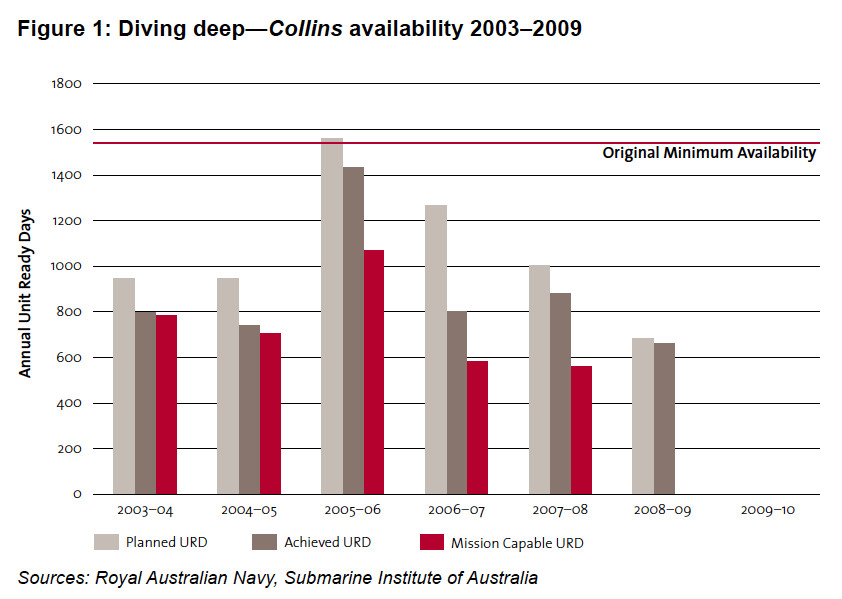
With just 6 submarines in its fleet, Australia’s current deployment set-up leaves little room for error. Even a normal setup of 2 in maintenance, 2 for training but available if needed, and 2 on operations makes for a thin line, given Australia’s long coastline and sea lanes. Almost 15 years after the first Collins Class boat was delivered, they are still short of this goal. When crewing problems are added to the mechanical issues, the failings of its current fleet are creating sharp questions about the Australia’s 2009 White Paper plan to build 12 new diesel-electric fast attack submarines, as the future centerpiece of the 2030 Australian Navy.
A Cursed Class?

returns, 2005
(click to view full)
One of the goals for the Collins Class program was to advance Australian shipbuilding capabilities, by creating state-owned ASC Pty Ltd. to build a foreign submarine design. ThyssenKrupp’s Swedish Kockums subsidiary was chosen to design them, based on the A19 Gotland Class. At 3,000t, their long-range design is the largest diesel-electric submarine type in the world.
Collins was launched in 1993, and delivered in 1996. Its successor boats of class were commissioned in 1998 (Farncomb), 1999 (Waller), 2001 (Deschaineux and Sheean), and 2003 (Rankin). Many of those boats have been laid up for very long periods, and there have been a number of periods when the RAN has had just 1 fully operational submarine available – or less.
That’s a shaky record for a fleet whose final boat of type entered service more than 10 years ago. Launching a submarine building industry is admittedly very difficult, and using what amounts to a new design added to that risk. The Collins Class has performed well in exercises with the US Navy, where it has scored successes against American Los Angeles Class nuclear-powered fast attack subs. On the other hand, it has also encountered a long-running sequence of issues, including significant difficulties with its (Australian chosen) combat systems, noise issues due to mechanical faults, major program cost growth to A$ 6+ billion, schedule slippage, and the reliability issues noted above. As the government’s own Phase 1 Coles Review noted:
“Ownership of a submarine design requires the ‘parent nation’ to invest in facilities and equipment to allow it to operate the submarines effectively – shipbuilding facilities, docks, manpower and training, operational support facilities, engineering and scientific resources, access to the necessary industry resources and skills, and a properly resourced and effective supply chain. Due to the failure to recognize fully what they were taking on, the various agencies involved did not make all the necessary investments post delivery…”
The effects aren’t just mechanical, or financial. Crew retention issues are exacerbated by low mechanical readiness, which restricts training opportunities, and so limits the available pool of crew. That forces higher deployment rates away from home and family among qualified submariners, which in turn feeds back into low recruitment and retention.
Farncomb, and the Future
(click to view full)
The January 2010 issue with HMAS Farncomb is emblematic. It involved failures in 1 of the submarine’s 3 French Jeumont-Schneider, 1,400 kW/ 440-volt DC generators, and has served in many respects as the final straw. As the Australian Department of Defence put it at the time:
“The problem stems from the way some of the generators were manufactured. At no time was the crew at risk but investigations are continuing in order to determine the impact this deficiency might have on the remainder of the submarine fleet.”
That’s a bland way to describe a serious problem. The generators must power all systems on board, from oxygen generation to combat electronics, and also drive the Collins Class’ 7,200 shp Jeumont-Schneider DC motor. Given the dangers inherent in a submarine’s mission, electrical redundancy, back-up capability, and reliability are all critical.
There were fears that fixing HMAS Farncomb’s generator problem could require cutting open the pressurized hull. If that’s the case, repair costs would be high, and Farncomb would join 3 other boats in a long “deep maintenance cycle”. HMAS Deschaineux was due back in the water in early 2010, but didn’t re-enter service until May 2010. HMAS Sheean wasn’t due back in service until 2011, and HMAS Rankin has no set date yet – it is merely “in queue” behind Sheean. While HMAS Collins reportedly had its generators given a clean bill of health, investigation of the entire fleet’s generators was required. The stakes were clear: if additional problems were discovered, the repair schedules for Deschaineux, Sheean, and Rankin would become much less predictable.
This is just one of several major shocks to the program over the years. Farncomb’s issues, and continuing problems with the fleet as a whole, finally led Australia’s government to commission an independent Coles Review in July 2011. Instead of focusing on a post-mortem, it was charged with finding a way forward to fix the problems. By December 2012, the final recommendations were in, and a sustainment review was complete by April 2014.
(click to view full)
This is exactly what Australia needs if it’s going to operate a serious submarine force, because the Collins Class program’s steady pulse of shocks have combined to compromise more than Australia’s strategic present. Left unaddressed, and unremedied, they will compromise Australia’s strategic future. The persistence of serious mechanical issues and very low readiness rates, into 2010 and beyond, raises legitimate questions concerning the long-term risks of Australia’s A$ 36 billion, 12-boat future submarine program.
Australia is a middle power with a small population, without a long submarine building tradition, and without an active submarine construction line. That it overcame these disadvantages to build and field the Collins Class is a respectable achievement, notwithstanding the problems that class as faced in service. At the same time, the strategic stakes in Asia are rising rapidly, and submarines are becoming more important as the country’s neighbors grow their economic and military power into the sea lanes around Australia. An expanded submarine force makes strong strategic sense as a key guarantor of Australian interests and sovereignty – but in some respects, any new program will be starting again from square one. Over a decade can be expected between the commissioning of HMAS Waller in 2003, and construction of any new submarines.
Does repeating the Collins program’s industrial structure for the core of Australia’s future defense risk creating the same cost and readiness issues in the new submarines? If not, why not, especially given the long interval between delivery of HMAS Rankin and future construction of the next submarine type? What are the strategic risks of treating the core of Australia’s future defensive posture as a make work program first, and a defense program second? What savings might be had by simply ordering some or all of the proposed 12 boats from a foreign manufacturer? Should ASC become a wholly-owned subsidiary of whichever firm wins the competition to build Australia’s next 12 boats? Or should the 12-sub program just be scaled back sharply, as too big a risk for cost inflation and low value for money?
Some of these questions are already being raised, by politicians, by media editorials, and now by the government’s own Coles Review. Unless these readiness and technical issues can be turned around, Australia’s governments, of whatever party, should expect more questions – and fewer submarines in both their present and their future.
Updates & Developments
2013 – 2020
Final Coles Review looks at sustainment; Fire on HMAS Waller; Rankin out of FCD, Farncomb in; Shorter FCDs mean changes to industrial processes.
May 11/20: Attack Class Construction The head of Australia’s $32.2 billion Sea 1000 program has confirmed that construction of the pressure hull for the first of 12 Attack Class conventionally powered submarines is scheduled to begin in 2024. This will follow the construction in 2023 of a hull qualification section to prove procedures, equipment, and skills at the submarine construction facility now being built at Osborne North near Adelaide by government-owned Australian Naval Infrastructure to the functional requirements of Sea 1000’s French-owned designer and build partner Naval Group.
Dec 10/14: Simulator upgrades. Thales announces the completion of simulator improvements ordered on June 19/12, which include their C2000-X simulation technology, among changes. Source: company press release.
Nov 20/14: No coverage. A recent incident involving a Russian naval task force that sailed close to Australia’s northern waters highlights issues of force structure, readiness, and basing for the RAN’s submarines. In the end, Australia had to content itself with sending 2 ANZAC Class frigates and an AP-3C Orion aircraft, because there were no submarines that could reach the area in time.
The RAN actually has 3 submarines available, but HMAS Rankin was sailing from Western Australia to Tasmania in the south, and the other 2 active submarines were conducting work-up trials off the coast of Perth in the west. To give readers a geographic idea, sailing from Australia’s western coat to its northeast coast is kind of like sailing from Spain to Estonia. None of Australia’s 3 operational submarines could arrive in time.
This isn’t a failing of the Collins Class. A force of 6 submarines is only going to generate about 3 operational boats, and Australia’s submarine base remains fixed on its inaccessible west coast. Defensively, that’s great. In deployment terms, not so great. Lacking the endurance and constant high-speed capabilities of nuclear-powered boats, Australia needs submarine bases in its north and/or east if it wants to project power forward in a timely way. The 2012 Force Posture Review has recommended this course of action. Sources: The Australian, “Russian ships expose failings of Australian submarine operations”.
Sept 8/14: ASC losing sub-building? News Corp. reports that the government is fast-tracking their pursuit of Japanese Soryu Class submarines, because of growing concerns about the $2+ billion cost of maintaining the Collins boats beyond 2026; some estimates put that cost at more than $2 billion. Hence Soryu, especially given Australia’s urgency:
“The Government cannot afford a submarine capability gap and every day past 2026/27 when Collins class is due to begin decommissioning, adds days of risk,” a senior defence source said.”
This risk profile may even get Australia’s future submarines built abroad. ASC’s poor performance building the Hobart Class Air Warfare Destroyers has reportedly left deep skepticism about trusting them with a project that’s conservatively estimated at $A 36 billion. In contrast, building the Soryus abroad might reduce the cost to a more certain A$ 25 billion. Read “Australia’s Next-Generation Submarines” for full coverage.
Aug 5/4: Support. ASC says that they’ve has been recontracted to provide Collins Class maintenance, but doesn’t say for how long. Under the contract extension, ASC will continue to work on the Collins Class submarines at its headquarters at Osborne in Adelaide, South Australia, and Henderson in Western Australia.
Henderson already hosts significant submarine maintenance work and inventory management, and will be used for all mid cycle and intermediate maintenance work, enabling the focus at Osborne to be on the new 2-year Full Cycle Docking (FCD). Those new FCDs will have to be done in 33% less time, and some early industrial initiatives to meet it have included introduction of a circumferential hull cut (q.v. July 1/14), construction of a new Maintenance Support Tower in Osbirne to provide better access, “remediation” of the supply chain, and the establishment of a rotable pool of spare parts. Sources: ASC, “ASC awarded submarine maintenance contract for SA and WA”.
July 5/14: Misconduct? Former submariner Rex Patrick (q.v. ) has accused senior naval officers of attempting to muzzle his public criticisms of the Collins-class submarine, and has asked the Australian Federal Police to examine the Navy’s conduct. Sources: The Australian, “Collins-class submarine critic calls in AFP over navy ‘plot’”.
July 1/14: HMAS Rankin out of FCD. ASC announces that they’ve completed the Full Cycle Docking (FCD) for HMAS Rankin in South Australia, delivering her early under the agreed integrated master schedule. Rankin will be the last submarine serviced under the RAN’s previous Full Cycle Docking schedule. Sources: ASC, “Rankin handed back to Navy”.
July 1/14: HMAS Farncomb into FCD. HMAS Farncomb arrives at ASC North in readiness for her Full Cycle Docking (FCD), which is the first under Australia’s new 10 years service + 2 year FCD schedule. Sources: ASC, “Farncomb arrives for maintenance under new schedule”.
July 1/14: Industrial. ASC makes a circumferential cut to remove the entire back end of HMAS Collins, a 1st for the company. The engine is being removed entirely to a workshop, and will be swapped into HMAS Farncomb to keep everything on schedule. Why do this?
“Normally, the main motor refurbishment within the submarine takes approximately a year to complete, with other work within the aft end of the boat delayed while this takes place. [This way]… the main motor can be removed and refurbished in a workshop, allowing other work scheduled in that section of the boat to be conducted, including metal loss repairs.”
The cut takes a lot of preparation: removal of all electrical cables, pipes and mechanical items which cross the frame spacing; anechoic tiles over the joint removed; casing brackets and the stinger seat removed; and extra submarine cradles prepped to support the end section. Once prepared, the existing weld joint was cut using an automatic gas thermal cutter, and pulled backwards using a railed transfer system. This will be the approach going forward. Sources: ASC, “Circumferential cut on Collins”.
May 5/14: Industrial. Removing a submarine’s anechoic tiles without damaging them, or the hull, is a long process. ASC thinks they’ve found a way to improve that sharply:
“Prior to each hull cut, a large number of tiles need to be removed…. a cross functional team investigated alternative methods of tile removal, including Ultra High Pressure Water Blasting…. The trial showed that the water blasting would take approximately 35 minutes to remove a tile as opposed to the 17 hours it usually takes. In addition, an engineering assessment of the hull test piece identified that it left the hull in a better state than the previous manual method.”
They think the overall savings on HMAS Farncomb’s Full Cycle Docking will be up to 4,000 worker hours. Sources: ASC, “Tile removal rethink creates significant saving”.
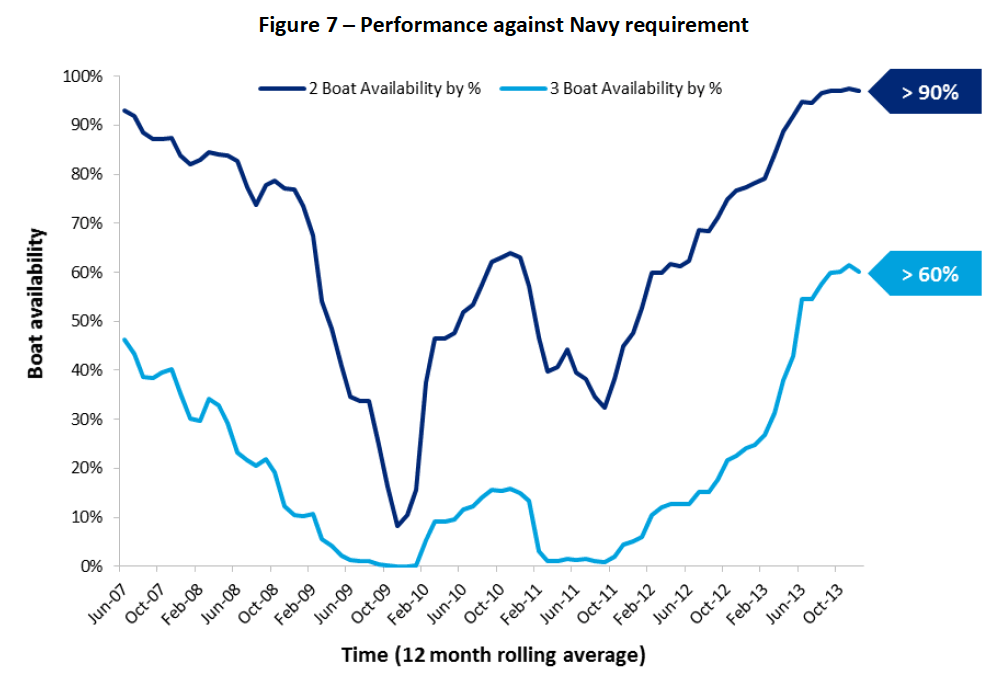
April 8/14: Final Coles Review. The Coles Review finishes its work with a post-implementation final review. It cites considerable improvements, including greater availability of spares, less planned maintenance over-runs, fewer breakdowns, and faster repairs to operational boats when problems occur. Overall, the RAN is up to 2-3 available boats most of the time, after long stretches where the range was 0-2. To get 2 deployable submarines, you actually need a fleet of 6: 3 submarines available for tasking more than 90% of the time, a 4th submarine in short-term maintenance, and 2 more in long-term maintenance.
The challenge will be moving from the current 8 years service + 3 years maintenance interval to a 10+2 framework, which compresses the Full Cycle Docking (FCD) by a factor of about 2, while cutting about 30% of the worker hours. This final report recommends treating the 1st example, HMAS Farncomb in July 2014, it as a dynamic schedule and progressively refining it. Even so, there is significant concern that they’re not going to be able to execute the FCDs in time. Beyond those efforts, the report says that the focus on output vs. efficiency has been justified by circumstances, but the emphasis must flip. Unfortunately:
“It was all too clear to me that the lack of suitably qualified experienced personnel in the DMO to operate within and fulfil their role in an output focused Enterprise, may stall or even reverse the achievement of benchmark availability. It would be an astonishing outcome if the inability to sustain the knowledge and energy now evident in the Collins Class Transformation Program were to lead to its undoing – particularly given there is every indication benchmark performance could be achieved at a lower long-term cost with reduced DMO project oversight. This problem needs to be addressed urgently.”
Workforce development is actually an issue at all levels, but hiring constraints on DMO could make it impossible for them to achiee their goals. An overall IT system to help manage the process is another missing piece. Meanwhile, there’s some key work to do on HMAS Collins, or it won’t be very helpful even if it is ready:
“HMAS Collins will need to be upgraded to match the rest of the Class, otherwise major systems will be unsupportable and she will not be as deployable as the rest of the Class. If a significant amount of upgrade work is not carried out in the period prior to HMAS Collins FCD (she is currently in pre-FCD), then this may have an impact on the overall schedule for HMAS Collins’ FCD.”
There’s more beyond these key highlights – like all of the Coles Reports, it’s quite detailed. Sources: Australia DoD, “Minister for Defence and Minister for Finance – Joint Media Release – Final Coles Review into submarine sustainment” | DMO, “Final Coles Review into Submarine Sustainment” | Full Report [PDF].
Final Coles Review – Sustainment
Feb 27/14: HMAS Waller. The submarine HMAS Waller, fresh out of scheduled maintenance, experiences a fire while traveling on the surface. Nobody dies or is injured, but 4 sailors are helicoptered off for observation. The Navy is still looking into the cause. Sources: Australian DoD, “Fire onboard Royal Australian Navy submarine”.
Waller fire
Feb 25/14: HMAS Waller. ASC Pty Ltd. awards the crew of HMAS Waller their Platypus Cup, to “the Collins Class submarine whose crew best demonstrates the rigorous training needed to ensure the safe and effective operation of the vessel.” Sources: ASC, “HMAS Waller wins Platypus Cup”.
Jan 20/14: The A$ 30-40 billion size of the future submarine project guarantees political scrutiny, and conservative columnist Paul Sheehan decides to start as the new center-right Liberal Party government prepares its 1st budget. It’s a sign worth watching regarding the political fate of the $A 30+ billion future submarine program, and as one might expect, the article isn’t exactly complimentary to the Collins Class.
The Australian DoD takes direct issue with the piece, though it isn’t a great idea to use sentences like “There is no ingrained ‘culture of delusion and arrogance’ within the Australian Defence Force when it comes to the development of capability requirements.” The rest of the reply uses a better form of argument, and includes this statement:
“While we do not comment on the operations of the submarine fleet there have been numerous periods when up to four submarines have been in service. In fact for most of the last two years Navy has continuously had four submarines in service.”
One note: “in service” is not the same as “immediately available for operations.” Sources: Sydney Morning Herald, “Future Submarine project a farce that has missed a mention” | Australia DoD On The Record, “Inaccurate reporting of Navy capability”.
Dec 17/13: ANAO Report. Australia’s National Audit Office releases their 2012-13 Major Projects Report. The Collins Replacement Combat System project has slipped by 36 months over the past year, hitting a total of 108 months (9 years) delay. In comparison, the Collins Class Reliability & Sustainability program is “only” 99 months behind.
The R&S program has seen an overall increase of A$ 339.4 million to A$411.4 million, including A$ 302.8 million for the implementation of additional scope, for a total increase of 471.4%. It actually consists of 22 separate sub-projects,a and only the Special Forces upgrade (on Collins & Dechaineux) and the Torpedo Decoy represent capability upgrades. Of the 22, “Five engineering enhancements have been completed and the two new capabilities are being implemented. However, completion of the remaining 15 engineering enhancements is priority driven and will be continually reassessed throughout the project.” Spending to date amounts to A$ 334.7 million, which will make the management of further work a challenge. Full Operational Capability is scheduled for 2022.
Submarine availability has been one of the factors in both projects, and is the primary reason behind the RCS program’s 2013 slippage. The budget now stands at A$ 450 million and the program has spent A$ 431.9 million. With that said, there hasn’t been much cost change over the past year. HMAS Waller and Farncomb have the CS04 version installed, while HMAS Dechaineux and Sheean have CS05 and its sonar processing improvements installed. HMAS Rankin is testing with CS05, and HMAS Collins will have to wait for its Full Cycle Docking, which has moved. That final installation will be completed in 2018, with Full Operational Capability currently expected to occur in 2019.
Nov 28/13: Upgrade Phase 5B.1. ASC Pty Ltd. receives an A$ 57 million/ $50 million contract from the Australian government to update and modernize the Collins Class Integrated Ship Control Management and Monitoring System (ISCMMS), then turns around ans signs a SEK 180 million / $27.5 million sub-contract with Saab. The contract will run between 2013 – 2016 and will involve Saab’s Security and Defence Solutions operations in Adelaide.
ISCMMS provides maneuvering control and integrated platform systems management. It has been a quiet and reliable success story, but the electronic components need updating to avoid obsolescence problems, and the software needs to be ported to compatible standards. This is SEA 1439 Phase 5B.1 on the DMO’s list of upgrade projects for the Collins fleet. Sources: ASC, “ASC signs multi-million dollar contract” | Saab, “Saab signs contract to upgrade Australian Submarine Sub-System”.
ISCMMS upgrade
Oct 10/13: At the Pacific 2013 maritime security conference in Sydney, DMO’s David Gould is confident that a 7-year life extension would leave Australia with operational submarines, but:
“What could become operationally important in the future is the relative survivability of the submarine in a changing operational environment into the future, to 2030, when you’ve got more new, modern submarines being deployed in this area of the world and so forth.”
Outgoing head of the Future Submarine Program Rear Admiral Rowan Moffitt is most concerned about the expected jumps in sonar capabilities, thanks to technical advances and improved computer processing. The Collins Class already has some problems with noise, so this is a very valid concern. Sources: Sydney Morning Herald, “Extension for submarines”.
Sept 25/13: A confidential report “has identified 68 critical problems on the navy’s Collins-class submarines that it warns pose a high to extreme risk of forcing their retirement before new submarines can be built.” The Australian DoD fires back after the report is published, saying that identifying potential issues and risks involved in life extension was the whole point, and that many of the issues are “already known and are or have been addressed in planned upgrades or through continuous improvement programs…. There has been significant improvement in submarine availability over the last 15 months.”
That may be so, but long-term risks must be credibly addressed, and this is where the RAN has demonstrated great difficulty over the last decade or more. Time will tell. Sources: The Australian, “Secret Defence report signals Collins subs crisis” | Australian DoD, “Submarine reporting in The Australian, 25 September 2013”.
June 24/13: Delays. The Australian reports that HMAS Ranking and HMAS Collins will be in maintenance much later than the advertised 3-year maintenance turnaround deadlines:
“The Rankin is the youngest submarine in the fleet yet it has been docked since 2008. It will not be released by shipbuilder ASC until the middle of next year [mid-2014] at the earliest. The Collins is the fleet’s oldest and has been at the ASC facility in Adelaide since last August. It will not be released until 2018.”
Sources: The Australian | Eric Palmer ELP.
2012
Is the Collins fleet unsalvageable? Submarine rescue vessels.

(click to view full)
Dec 12/12: Reports. The Government releases the Final Report of the Coles Review into Submarine Sustainment, the results of their Collins Class Service Life Evaluation Program, and the findings of the Future Submarine Industry Skills Plan that began at the end of 2011. The 4th element isn’t a report, it’s plans for a new submarine testing facility in Adelaide.
The Service Life Evaluation Program found what the DoD pretty much had to find, given delays in their future submarine program, and the government’s selection of a longer and riskier approach for that effort. Despite the submarines’ record, “there was no single technical issue that would prevent the Collins Class submarines from achieving their theoretical platform life, their planned withdrawal dates, or a [7-year] service life extension…” A confluence of multiple issues with uncertain resolution? They didn’t say.
With respect to the Industry Skills, indigenous design capability for submarine and surface ships is weak, white collar skills are spread thin, and the blue collar workforce is too sparse, especially in supervisors and electrical trades. Sources: Australian DoD, “Reviews of Australian submarines released” | Australian DoD, “Minister for Defence and Minister for Defence Materiel – Joint Media Release – Collins Class Service Life Evaluation Program” | Coles Review | Future Submarine Industry Skills Program.
Several Key Reports
Dec 10/12: Costs. Former submariner and Acoustic Force CEO Rex Patrick (q.v. Oct 7/10) continues to call government estimates into question, describing DMO estimates to date as “spectacularly and consistently wrong”:
“Each of the six boats costs twice as much to sustain and operate as an American nuclear submarine, while falling far short…. “In 2014-15, the accounting cost of Australia’s submarine force will, by Defence’s own numbers, hit $1 billion…. He said the real cost [per boat for operating the Collins Class] is running at “just shy of $100 million…. a number that is made even worse when one considers their availability; a recent US Department of Defence report put the per-boat operating and sustainment cost of the Los Angeles and Virginia class (of nuclear submarines) at $50 million and $59 million respectively…. For the $600 million-plus annual cost of keeping between two and three 20-year-old Collins-class submarines at sea, the RAN [Royal Australian Navy] could buy a brand new, reliable, deployable, high-end submarine every year.”
Sources: The Canberra Times, “Keeping Collins afloat ludicrous: expert”.
O&M costs
Dec 10/12: Costs. Former submariner and Acoustic Force CEO Rex Patrick (q.v. Oct 7/10) continues to call government estimates into question, describing DMO estimates to date as “spectacularly and consistently wrong”:
“Each of the six boats costs twice as much to sustain and operate as an American nuclear submarine, while falling far short…. “In 2014-15, the accounting cost of Australia’s submarine force will, by Defence’s own numbers, hit $1 billion…. He said the real cost [per boat for operating the Collins Class] is running at “just shy of $100 million…. a number that is made even worse when one considers their availability; a recent US Department of Defence report put the per-boat operating and sustainment cost of the Los Angeles and Virginia class (of nuclear submarines) at $50 million and $59 million respectively…. For the $600 million-plus annual cost of keeping between two and three 20-year-old Collins-class submarines at sea, the RAN [Royal Australian Navy] could buy a brand new, reliable, deployable, high-end submarine every year.”
Sources: The Canberra Times, “Keeping Collins afloat ludicrous: expert”.
O&M Costs
Nov 29/12: Submarine rescue. The Dutch firm Damen touts the Royal Australian Navy’s Nov 16/12 order for a Rescue Gear Ship 9316, which will be used to support the country’s submarine fleet. The RGS 9316 will actually be built at a Damen shipyard in Vietnam, and is due to be delivered in 2016. It will be similar to their SD Victoria, built for Serco UK to support Britain’s Royal Navy.
The release also mentions an August 2012 order for an Escape Gear Ship 8316 Submarine Rescue Vessel, to be delivered by 2015. Damen | Marine Log | SD Victoria video.
Submarine rescue vessels
Nov 15/12: Minister for Defence Materiel Jason Clare’s speech at the Submarine Institute of Australia conference sends a signal that the Collins Class can have its life extended. Of course, the government more or less has to believe that, since their Future Submarines project isn’t going to produce new boats in time. The time frame being bandied about is “one more duty cycle” of 8-10 years, and HMAS Collins would be the first to have her hull cut open so the diesels and generators can be accessed.
Meanwhile, the Minister calls out an instance of media bias in his speech:
“The CEO of DMO, Mr Warren King, recently commented: “good news stories about Defence don’t sell papers”. At the supplementary estimates in mid October 2012, the Chief of the Defence Force, General David Hurley explained that one particular journalist – who had had an extremely positive experience on the HMAS Farncomb during its successful efforts at RIMPAC – filed a good news story on Collins and was told by his editor that “it was unpublishable” (p.58 – Foreign Affairs, Defence and Trade Legislation Committee Estimates, 17 October 2012). “
The Collins Class is a deserving target for criticism, but news suppression is not professional nor honest. The fact that it’s distressingly common these days doesn’t make it any more acceptable. See: Minister’s speech transcript | Canberra Times.
Nov 14/12: Sonar upgrade. Australia’s Defence Materiel Organisation signs an A$ 22.2 million contract with Thales Australia to update their submarines’ Scylla sonars. Thales is the original manufacturer, and currently holds the in-service support contract.
The custom-designed processing boards in the Scylla Signal Processing Cabinets will be replaced with commercial alternatives, sharply reducing the number of boards while improving capacity. These changes will require re-hosting the software on a different system, but the payoffs will include reducing electronics that aren’t manufactured any more, improving reliability, lowering power consumption, taking up less space, and saving about a tonne of weight. Once the software is re-hosted, which is no small task, further software development can take advantage of the new hardware’s capacity, in order to improve overall sonar performance.
Most of this work will be performed at Thales Australia’s underwater systems facility in Rydalmere, in western Sydney. Sea trials are scheduled for 2013, followed by physical installation in the 1st of 6 submarines in 2014. It’s all part of an additional A$ 700 million, which has been budgeted over the next 4 years for Collins Class submarine sustainment. Australian DoD | Thales Group.
July 25 – Aug 3/12: Problems continue. After reporting a successful torpedo firing and sinking exercise during RIMPAC 2012, Australia’s DoD reveals that a leak is forcing HMAS Farncomb to return to port immediately. Fortunately, the submarine was at periscope depth, and the problem “has been traced to a split in a hose on the submarine’s weight compensation system.” The Liberal Party’s shadow defence minister, David Johnston, reminds Sydney Morning Herald readers that these kinds of breakdowns are all too common:
“Farncomb is no stranger to this kind of incident… In August it lost both its propulsion motor and emergency back up in deep water off the Western Australian coast. The second, a few months later in the South China Sea, involved a build up of toxic gases that had the crew wearing oxygen masks and blowing its emergency ballast tanks for a rapid ascent.
In May last year another Collins Class submarine, HMAS Dechaineux was forced to return to Singapore for repairs after breaking down on its way to a training exercise, also in the South China Sea. It was the only submarine due to participate in the 5-nation exercise and the embarrassment was amplified when the Navy News published a pre-written account of its daring exploits on the presumption nothing could go wrong.”
Meanwhile, decisions concerning Australia’s replacement submarine plan may not happen in time. Australia DoD | state-funded ABC | The Australian | Sydney Morning Herald.
June 19/12: Simulator upgrades. Thales Australia announces a contract to upgrade the Collins Submarine Platform Training Simulator (PTS), at HMAS (naval base) Stirling’s Submarine Training and Systems Centre (STSC) in Western Australia. The PTS has been in service since 1993, and includes a Propulsion Control Simulator (PCS) and a Submarine Control Simulator (SCS). The upgrades will ensure that the simulators match all the changes that have been made to the submarines themselves. Given ongoing difficulties in recruiting enough submarine crews, an effective and fully up-to-date simulator is a critical link in Australia’s attempt to fix this situation.
Thales is well positioned to provide simulators for the Collins Class, since it provides and supports the sonar suite, towed array, periscope visual system (also getting upgrades under a recent contract), communications mast and other key sensors.
April 23/12: An interview with Minister for Defence Stephen Smith touches on the Collins Class’ ongoing problems, and the decisions to be taken regarding Australia’s future submarines. An excerpt:
“…since the 1990s we have had long-standing, well known, entrenched maintenance and sustainment issues and difficulties with our Collins Class Submarines… under governments of both political persuasions… it would be irresponsible to rush into the Future Submarine Project without seeking to fully understand… in particular the maintenance and sustainment of the Collins class submarine and the inability over almost two decades to get better operational service out of the Collins Class Submarine.
That caused me to establish the Coles Review, the first part of which I received in December of last year, and the second and final part of which I am expecting to receive in the course of the next month or so… [In addition,] one of the studies we have currently under way is a study trying to better define the life of type [DID: expected service lifetime] of the Collins Class Submarine.”
April 21/12: Unsalvageable? Commander James Harrap, a 20-year navy veteran, resigns from the RAN after commanding both HMAS Waller and HMAS Collins. While the boats and their crews had “serviced the navy well and achieved much,” the media obtain a copy of his overall assessment. It is stark and scathing: scrap the class.
“I don’t believe the Collins-class are sustainable in the long term and many of the expensive upgrade plans which have been proposed would be throwing good money after bad… Over the last two years, I believe these problems have become worse… Throughout my command of both Collins and Waller, full capability was never available and frequently over 50 per cent of the identified defects were awaiting stores… Collins has consistently been let down by some fundamental design flaws, leading to poor reliability and inconsistent performance. The constant stream of defects and operation control limitations makes getting to sea difficult, staying at sea harder and fighting the enemy a luxury only available once the first two have been overcome.”
The submarines’ diesel engines come in for special criticism, but they are far from his only target. His final conclusion: “I do not believe we have the capability to independently design and build our own submarines.” The Australian.
2011
Coles Review, RAND lessons learned reports; $105 million per year each for maintenance?; Some periods have seen 0 subs available; Can new submarines be built in time?

Dec 13/11: Coles Review, Phase 1 Following its July 19/11 announcement (q.v.) and Nov 4/11 delivery, Phase 1 of the Coles Review of RAN submarine sustainment is made public. It goes so far as to call the government’s chosen structure to manage Australia’s submarine force “unfit for purpose,” and the report’s own statement of its raison d’etre is a concise summary of the fleet’s visible issues:
“Despite increases in funding for sustainment, and strenuous efforts on the part of the various authorities and agencies involved, the level of submarine availability continues to fall. The length of dockings is increasing and submarines frequently have to return to harbour with problems. Loss of availability had also been caused by lack of crews, and the level of crew availability remains critical to the support of operations. Ministers became increasingly concerned about damage to the national reputation and frustrated at the apparent inability of Defence to sort out the problems. There was also a strong perception, especially in the DMO, that the ASC was operating inefficiently on a forward funded cost-plus contract for sustainment. The two Commonwealth Departments involved – DoFD (as owner and shareholder of ASC) and DoD (as owner, customer and operator of the submarines) – determined that an independent review was needed… Taking these findings together, we found the disparate organisation to be unfit for purpose. Recovery will demand a very serious and concentrated effort to change relationships for the better. This will be a major undertaking which goes well beyond anything the team expected to find…”
Along the way, it describes fractured and mutually hostile organizational responsibility in government, no culture of performance at builder ASC, a “damaging” relationship between ASC and the DMO, poor RAN planning or even commitment to its submarine force, “micromanagement from afar”, high levels of parts cannibalization between submarines, unclear requirements, and unrealistic goals. Its interim process recommendations have all been approved for immediate implementation, and despite its negative appraisal of ASC, they recommend that the In-Service Support Contact (ISSC) being negotiated should proceed as planned, as an interim, step to a more performance-based contract. Notable observations included:
* “…we have been unable to identify any unanimity of view as to the actual requirement for submarine availability even at the most senior levels…”
* “Recent figures indicate that around 85% of lost MRDs are due to operational or safety defects, and of those, about 45% are due to lack of stores. Around 15% of lost days are due to maintenance overrun.”
* While the RAN now has 3 trained crews, that doesn’t mean 3 submarines available for operations unless leave and training are removed from the equation;
* 33% of trained RAN submariners have been qualified for less than 2 years;
* Crews don’t always carry out normal maintenance, and aren’t punished for it;
* “We were unable to establish why it is that FCDs [Full Cycle Dockings] take as long as three years, noting that the second FCD (HMAS FARNCOMB) took barely two years… [that’s] a long time even by modern nuclear submarine standards…”
* “There is a range of key suppliers to the program beyond ASC itself. This list includes Raytheon (combat system integrator), Thales (sonar), Babcock (weapon launch and handling), Pacific Marine Batteries, Drive Train (diesels), BAES (optronics), and the US Navy (tactical command system). There are others who supply specialist products or services without which the program could not succeed.”
* “Of particular note is the issue of [electronic] obsolescence which, 15 years into the program, has the potential to engulf the submarines with further problems…”
Phase 2 is due in April 2012, and will focus on issues of program management, commercial contracts, engineering, and costing. It aims to offer a framework and industry best practice benchmarks against which the DMO, RAN and ASC performance can be measured. Phase 3 will be the final report, but there will also be a Phase 4 follow-up that looks at progress, and implementation of the new ISSC. Coles Review, Phase 1 [PDF] | Australian DoD | Minister transcript: ABC Interview | RAN.
Coles Review, Phase 1
(click to read)
Dec 13/11: RAND Lessons Learned. Australia’s DoD releases RAND’s requested report of lessons learned from US, UK, and Australian submarine programs. RAND Report.
Oct 15/11: $$$$ Australian media look at the Collins Class’ annual costs:
“Figures obtained by the Herald Sun, show the six Collins subs cost about $630 million a year – or $105 million each – to maintain, making them the most expensive submarines ever to put to sea… The annual price for “sustainment” (maintenance and support) is $415.9 million for 2011-12 with operating costs running at $213.4 million for the year, for a total of $629.3 million.
A US Navy Ohio Class nuclear attack submarine – more than three times the size of a Collins boat – costs about $50 million a year to operate.”
See: Herald Sun | Courier Mail, incl. infographic | Australia’s Daily Telegraph.
Oct 5/11: Swedish consulting and software provider Systecon AB announces an order from Australian Submarine Corporation (ASC) for its OPUS10 maintenance support software. OPUS10 optimizes spare parts stocks and support for complex technical systems within defense, transportation, energy and production, and ASC will use OPUS10 in their current re-evaluation and improvement of the Collins Class’ support program.
Sept 15/11: Liberal Party opposition defense spokesman Sen. David Johnston seems to be waking up to the seriousness of Australia’s submarine problems. The Australian:
“The undoubted lead Australia once had in regional submarine capability has, despite the best efforts of our very committed submariners, disappeared,” he told parliament. “Our Collins-class submarines are inherently unreliable, technically challenging to maintain and difficult to crew. We rarely have more than two submarines available to go to sea and there have been instances of late where there have been none, repeat none, available to defend our borders.”
July 25/11: The Australian reports that Australia’s DoD:
“…will seek US help with Australia’s plan to build 12 big conventional submarines to replace the navy’s six troubled Collins-class boats… After initial problems with the Collins fleet a decade ago, the US provided a state-of-the-art combat system and the latest technology to improve the subs’ propulsion systems and make them less noisy.”
July 19/11: Labor Party Defence Minister Stephen Smith admits that there are “long-term difficulties” with the Collins Class submarine fleet, and announces a full independent review led by British private sector expert John Coles. The Minister cites too many stretches where only 1-2 submarines have been available, and there are reportedly doubts that the subs’ diesel engines are robust enough to last until 2025 as planned:
“These problems are significant and highly technically complex. At times we have seen as few as one Collins Class submarine available for operations. This situation is unacceptable but will not be addressed simply by continuation of the status quo… As a consequence, the Government will conduct a review into the optimal commercial framework for the conduct of Collins Class Submarine sustainment… My ambition is that the Coles Review will do for the Collins Class Submarine what the Rizzo Report has done for our amphibious fleet capability: a clear sighted path to improve the sustainment and availability of the Collins Class Submarines… Without having confidence in our capacity to sustain our current fleet of submarines, it is very difficult to fully commence, other than through initial planning, the acquisition program for our Future Submarine. This is consistent with the absolute necessity to work very hard in the early days to get projects right and thereby avoid, reduce, and minimise project difficulties down the track.”
The Coles Review has been asked to provide an interim report by December 2011, and a final version by March 2012. The key questions are how long this will delay Australia’s future submarine program, and whether the review will include political-structural weaknesses in the program, or confine itself to procedures. Minister for Defence ASPI transcript | ASC release | Adelaide Now | Australian Broadcasting Corp. and ABC AM radio | Canberra Times | Queensland’s Courier-Mail | Sydney Morning Herald | The Australian.
July 18/11: Labor Party defense minister Stephen Smith, Jason Clare the Minister for Defence Materiel, and Paul Rizzo release their requested report: “Plan to Reform Support Ship Repair and Management Practices.” It follows serious failures in the legacy amphibious ship fleet, and acknowledgement of widespread issues in the Royal Australian Navy with engineering and ship maintenance generally. Though it isn’t about the Collins Class per se, its recommendations will affect Australia’s submarine programs.
All 24 of Mr. Rizzo’s recommendations are accepted, and he himself will be in charge of chairing the implementation committee he recommended. Two-star Commodore Michael Uzzell is also promoted to a new position: RAN Head of Engineering. Report page with Full Report [PDF format] | Australian DoD release and transcript | Sky News interview.
May 15/11: Australia’s Kokoda Foundation releases “Under the Sea Air Gap: Australia’s Anti-Submarine Warfare Challenge. The study “attempts to identify issues surrounding Australia’s Anti Submarine Warfare capabilities that will require greater scrutiny in the period leading up to the 2014 Defence White Paper.”
Author Brice Pacey is concerned that the design for Australia’s next-generation submarines might not be complete until 2019, and the first boat might not be ready until 2030. With the Collins Class scheduled to begin retiring in the mid-2020s, that would present a problem. Australia would need to either extend the lives of a class that has not performed well or reliably, or accept a vestigial submarine fleet even as it neighbors build up their capabilities. See also Adelaide Now.
April 14/11: Australia’s ASPI think-tank releases “The once and future submarine – raising and sustaining Australia’s underwater capability.” Based on past acquisitions, beginning the future submarine program immediately would only deliver the 1st boat in 2025; further delays would create timing issues with the Collins Class’ retirement. On which subject:
“…the boats have spent so little time in the water due to maintenance and crewing problems that the hulls have not been pressure cycled anywhere near to the extent anticipated. However, a life-of?type extension for the Collins is not an especially appealing prospect for a number of reasons. To start with, the drive train in the Collins has been problematic since day one, and attempts to keep the fleet going into the late 2020s would almost certainly require work to replace the highly problematic diesel engines (which are already ‘orphans’ in the world of maritime diesels). That alone is an undertaking requiring major engineering work, not to mention a lot of money. It is a simple fact of geometry that the engines can only be removed by cutting the pressure hull. Given that less complex mid-cycle dockings are taking 100 weeks to complete (against an anticipated 52 weeks), this exercise would result in considerable downtime. It could be that every five years of additional life would come at the cost of one or two extra years out of the water and/or conducting sea trials for each boat being upgraded. This would further exacerbate the already disappointingly low availability of the fleet.”
2009 – 2010
HMAS Farncomb the lone sub left – then its generators fail; Generator failures, crew recruiting examined in hearings; RAN puts 3 to sea.

(click to view full)
Nov 22/10: The Royal Australian Navy announces that it has 3 Collins Class submarines at sea, adding that both HMAS Collins and HMAS Deschaineux have sailed from Fleet Base West for the ASWEX exercises:
“HMAS Collins had been visiting the east coast of Australia but has returned to her home port to participate in ASWEX. Collins steamed over 10,400 nautical miles around Australia, with port visits in five states and territories. She also qualified 20 new submariners and had 17 sailors complete professional development qualifications.
HMAS Dechaineux has returned to duty after an incident with a civilian tug boat… repairs to the propeller took only a week to complete, at the Henderson shipyard in Western Australia… HMAS Waller is also at sea carrying out training after undergoing scheduled maintenance.”
Nov 9/10: HMAS Dechaineux, which returned to service in May 2010, will miss the Royal Australian Navy’s annual anti-submarine warfare exercises. The submarine was carrying out a routine maneuver with a tugboat while departing its berth at Fleet Base West, when the tug crossed over Dechaineux’s stern; there were no injuries to people, only the submarine.
HMAS Collins, which was at sea, will fill in for the annual exercise. RAN.
Oct 7/10: Under a radical plan authored by Rex Patrick and other former submarines, Australia would retire HMAS Rankin and HMAS Collins immediately, and begin replacing the Collins Class with locally-built, off-the-shelf designs from Europe, instead of waiting until 2025:
“Australia should rapidly acquire four locally built military-off-the-shelf (MOTS) submarines to address the submarine availability issue and address the growing capability gap between the Collins-class submarines and the modern submarines proliferating throughout the region… The Collins-class submarine program has been an unmitigated failure… [HMAS Rankin and HMAS Collins]… are not available anyway, there are no crews for them and maintaining them is placing an ever increasing burden on the navy’s budget.”
Under his plan, the first boat of an initial batch of 4 would be operational for the navy within 5 years, and all 4 would be operational in under 8 years. The Australian | Adelaide Now.
June 17/10: Ministerial release:
“With the recent successful docking of the first submarine at Australian Marine Complex (AMC) in Henderson, Western Australia, ASC have marked a key milestone for the $35 million purpose-built submarine support facility… With this increase in capability ASC is now able to carry out maintenance on as many as three submarines at any one time.”
May 24/10: HMAS Dechaineux returns to service following its Full Cycle Docking at the ASC Pty Ltd. in Adelaide, giving Australia a 2nd operational submarine. Australian DoD photo release.
May 4/10: Australia’s government announces a pair of battery contracts to small/medium firm Pacific Marine Batteries Pty Ltd.
A 6-year, A$ 81 million (currently $75 million) Acquisition Contract will provide 5 lead-acid Collins Class Submarine battery sets.
A parallel 7-year Standing Offer, on the other hand, will provide short notice technical support from the firm. Pacific Marine Batteries will continue to provide an Environmental Protection Authority approved storage facility for up to 4 battery sets (2 in storage and 2 ready for disposal), as well as equipment capable of conditioning the cells before installation, and decommissioning and disposal services.

RIMPAC 2006
(click to view full)
March 30/10: Generator fail. The Australian Senate’s Joint Standing Committee on Foreign Affairs, Defence and Trade hears a range of testimony, including updates regarding Australia’s submarines. The bottom line? The Australian firm that manufactured the generators under license didn’t manufacture them to the same standard as the original French firm. The Chair is Archie Bevis [Labor – Brisbane], and the other speakers are Mr. Kim Gillis, General Manager of the Collins effort at Australia’s Defence Materiel Organisation; and Bob Baldwin [Liberal – Paterson]:
“Mr BALDWIN – As I understand it, the issue is that the windings failed on the generators – is that correct?
Mr Gillis – That is correct. We have worked with a company called machinemonitor who are specialists in this particular area. They are providing the quality control. We have now found the best companies in Australia to do vacuum impregnation, which was the failure of the first system – they were not done properly when they were originally manufactured…
Mr BALDWIN – Are there any indications that generators on other submarines are likely to fail?
Mr Gillis – As to the generators that are on Collins, the original ones were actually manufactured in France. The inspections on those would indicate that they are very solid and we are not expecting to have a failure on those. The remainder of the Collins-class submarines that had their generators manufactured in Australia are susceptible to this particular failure. We are monitoring those. We are looking at the way in which we can ensure that we do not get the same sort of failure. We do have three generators on each submarine. The normal requirement is to only operate two. So what you can do is: by operating them at about 80 per cent of their normal operating profile, you restrict the likelihood of a failure. We have now also been able to prove a world’s best practice way of doing this work. We are also going through the following process: from now on, in the normal process of doing their midcycle dockings, their intermediate dockings or their full-cycle dockings, we are undertaking this work. We will be changing out the complete set of generators in the submarines.
Mr BALDWIN – That was my next question. So on the Collins you are doing all three generators?
Mr Gillis – On Farncomb we are only having to do two because we had already swapped out one of them.
CHAIR (Mr. Bevis) – Is there any liability that the original supplier of these faulty generators is exposed to? Have we looked at that?… [exchange follows] I just make the observation that, if we are in the business of handing out money to Australian or American businesses or anybody else in the development of things, we should sure and hell be in the business of making sure what they provide has been delivered properly and in accordance with the contract. I appreciate that you were giving off-the-cuff testimony and what you said may not have been a considered assessment. But, if that was indeed a considered assessment, it seems to me we were not supplied with what we ordered and we should not bear the total cost of making good the repairs.
Mr Gillis – I think it is a matter of the quality of the product that was demonstrated at the time. Its warranty was for a certain period of time and it had exceeded the original warranty period. When an item like that has passed its warranty period, you do not have very much recourse. We would have liked it to have lasted longer and to an indefinite fit, but it is very unlikely that most companies will warranty a piece of manufacture like that for the life of a submarine.
CHAIR – I fully accept that.”
On HMAS Farncomb, there appears to be one small consolation, which is that the repairs are going faster than planned:
“Mr Gillis – Yes. Just in respect of the generators on Farncomb, the original estimate was that it would take in the order of 23 weeks to undertake the repair of the generators. Just due to the physical dimensions, the requirement to get them in and out was a very big task. The Submarine Program Office – a combination of ASC, the Navy and the DMO – have worked collaboratively to produce a much better system of getting them in and out. We have worked with a company called Hofmann Engineering in Western Australia who are specialists in confined-space engineering. Hofmann undertook the challenge to have them removed, repaired and put back in a period of approximately 57 days. They are currently on track… We are very pleased with the work that has been undertaken to date.”
There’s always a tension between buying proven products, and providing design and industrial work for Australian firms. The Kinnaird Review recommended more off the shelf purchases, and the Collins Class was a major exhibit in that recommendation. Having said that, sub-contracted/ licensed manufacture of exactly the type cited above is also the most common way to reconcile true off-the-shelf purchases with industrial needs. By definition, however, a licensed manufacturer does not have the same experience level and process control as the original manufacturer would. This is one of the inherent risks of “indigenization” – and in this case, the risk came back to bite Australia. Australia Hansard transcript | Sydney Morning Herald.
March 30/10: The Australian Senate’s Joint Standing Committee on Foreign Affairs, Defence and Trade also discussed overall ADF recruiting with Air Chef Marshal Houston. This an especially important issue with respect to the submarine force, which has been hurt by the lack of trained crew:
“Air Chief Marshal Houston – Submarines are going very well. I am very, very happy with the work Chief of Navy has been doing and indeed the work that Phil Minns and his people have been doing on recruitment and retention. In terms of where we are at the moment, we have had an increase of 25 in the submarine force since July. Our target this year is to increase from the current 468 people in the submarine force to 500 by the end of the year. Essentially, if we make that target and then we qualify 100 people a year, we will be well on the way to restoring the submarine force to where it needs to be. That will enable us to establish a fourth crew by the end of next year. Right now with the 468 people, we have three submarines fully manned. I visited one of those crews very recently with the Chief of Nay [sic] – HMAS Dechaineux, which is coming out of full-cycle docking in Adelaide. I was really taken with the high morale on board that vessel.
The other thing that I think is crucial as we go forward is to keep our separation rate with the submarine force below 10 per cent. If we go back to 2008, you will recall that the Chief of Navy put in place a submarine sustainment project under Admiral Moffitt. Admiral Moffitt made a number of recommendations which were all accepted by the Chief of Navy. Since that time, we have gone forward on a very positive and constructive platform. I am very confident that the major problems are behind us. Having said all that, if the economy goes into another boom condition, we are always going to have challenges for both our recruitment and our retention. But at the moment, it is looking good and we are seeing a lot of interest from junior recruits in the business of being a submariner.
Mr BALDWIN – At what stage do you consider you will have six fully qualified crews to man six submarines?
Air Chief Marshal Houston – I talked to the Senate committee about this the other night. Nobody in the world maintains six for six or 50 for 50 or whatever. Submarines just are not like that. Submarines are the most complex weapons system that defence forces operate, and what you should anticipate is that, of those submarines, at least 50 per cent will be in some form of maintenance servicing at any one time. We have benchmarked against all of our friends and allies, and I can assure you that the way we run our submarines is consistent with the way all of our allies run their submarines. Nobody has one crew for each submarine they possess. What they have is sufficient submarine crews to sustain the capability that is defined by the government that owns that capability. In our case, we could not employ six submarine crews.”
Feb 12/10: Australia’s Minister for Defence Personnel, Materiel and Science Greg Combet, announces that a new joint Australian Submarine Program Office will be established in Adelaide as of March 2010, in order to manage the Collins Class’ availability. A tripartite meeting between RAN Chief of Navy Vice Admiral Russell Crane, DMO Program Manager Submarines Mr. Kim Gillis, and ASC Pty Ltd CEO Steve Ludlam met to agree to the new project office’s proposed charter. The office will commence work in March 2010, and will operate as an integrated product team of Navy, DMO and ASC personnel led by DMO’s Director General Submarines, Commodore Bronko Ogrizek. Combet adds that:
“Discussions between the parties have also focused on a way forward for HMAS Farncomb’s generator repairs and a maintenance schedule change which will improve overall submarine availability.”
See: Australian DoD | ASC Pty release.
Jan 25/10: The Collins Class submarine HMAS Farncomb encounters a generator failure, which reduces Australia’s operational Collins Class submarine fleet to 1 boat in 6 – HMAS Waller. Plus HMAS Collins, which is only qualified for training purposes.
The cost of repairs is not yet predictable, and the mechanical issue could extend beyond HMAS Farncomb. Continuing issues with the class also leads to questions concerning the feasibility of, and proposed strategy for, Australia’s next-generation submarine program. DoD Release | Australian Broadcasting Corp. (ABC) | ABC Radio transcript | The Australian | The Australian: op-ed | Defpro.
May 21/09: Adelaide Now reports that problems for the Collins class have worsened:
“With HMAS Waller tied up at the Henderson shipyard south of Perth for urgent battery repairs, the only seaworthy sub is HMAS Farncomb.
The other four boats are either out of active service (HMAS Collins) or out of the water for major maintenance known as full cycle docking (HMAS Sheehan, Rankin and Dechaineux)…”
Additional Readings
* Australia DMO – Collins.
* Kockums AB – The Collins Class Submarine
* Naval Technology – SSK Collins Class (Type 471) Attack Submarine, Australia.
* ASC Pty, Ltd. – Collins Class Fleet.
* Raytheon – Collins Class Submarine Mission System. Based on the USN’s AN/BYG-1. A March 2013 APDR article mentions that ” It seems extraordinary that 12 years later only four out of six Collins submarines have been equipped with this “new” system.”
Reports
* Australian DoD (April 8/14) – Final Coles Review into Submarine Sustainment [PDF]. See also DMO Release.
* Australian DoD (December 2012) – Coles Review. Final Collins Class Sustainment Review, see also accompanying government release, which points to several other reports released at the same time.
* Australian DoD (December 2012) – Future Submarine Industry Skills Program.
* Australian DoD – Collins Class Sustainment Review Phase 1 Report [PDF]. Also known as the “Coles Review”. Delivered to government Nov 4/11.
* RAND 2011 – Learning from Experience: Lessons from the Submarine Programs of the United States, United Kingdom, and Australia. Covers SSBN/SSGN Ohio, SSN-21 Seawolf, and SSN-774 Virginia programs in the USA, Britain’s Astute SSNs, and Australia’s Collins Class SSKs (Volume IV).
* Kokoda Foundation (May 25/11) – Under the Sea Air Gap: Australia’s Anti-Submarine Warfare Challenge. “This study attempts to identify issues surrounding Australia’s Anti Submarine Warfare capabilities that will require greater scrutiny in the period leading up to the 2014 Defence White Paper.”
* ASPI (April 14/11) – “The once and future submarine – raising and sustaining Australia’s underwater capability. See also full report [PDF].
* DID – Australia’s 2009 Defense White Paper.
* ASPI (Oct 29/09) – Strategic Insights 48 – How to buy a submarine: Defining and building Australia’s future fleet. See also full PDF download.
* Security Challenges (Spring 2009, Vol.5 #3) – Taking the Past to the Future: The Collins Submarine Project and Sea 1000.
* ANAO (2008-09) – Management of the Collins-class Operations Sustainment.
* Cambridge University Press (June 2008) – The Collins Class Submarine Story: Steel, Spies and Spin. Book.
* Australian Parliament (2001-02) – Lessons of the Collins Submarine Program for Improved Oversight of Defence Procurement.
* Australian Parliament (2001-02) – How Kockums was Selected for the Collins Class Submarine.
* Australia DoD (July 1/99) – Mcintosh-Prescott report. Covering the shortcomings and issues with Australia’s Collins Class submarine program.
Other Coverage
* DID – ADF: An “Aren’t Deployable” Force?
* DID – Australia’s Next-Generation Submarines
* Asia-Pacific Defense Reporter (May 7/13) – Collins Class upgrades a mixed scorecard. “The Department of Defence has summarized much of what is in the DCP in explaining that there are currently eight sub projects under SEA1439, five approved and three unapproved. The five approved projects are SEA1439 Phase 3, Phase 4A, Phase 4B, Phase 5B.1 and Phase RCE3. All of these phases are at various capability maturity levels.”
* Adelaide Now (Dec 12/12) – Australia’s Collins Class submarines well below international standards: report.
* Sydney Morning Herald (Aug 3/12) – Time for talking on new submarine is over. Explains the program’s timing issues, and also ongoing problems with the Collins Class.
* Australian Defence magazine (April 1/10) – Size Matters, by Rex Patrick. A wide-ranging and educational look at trends in submarine warfare.
* ASPI in Brisbane Courier (Feb 1/10) – Royal Australian Navy lumbered with sub-par hardware
* Australian Parliamentary Library’s FlagPost (Sept 27/09) – More problems with the Collins Class submarines.
* DID (Nov 15/05) – Australia’s Collins Class Subs, Submariners On Track for Upgrades. Summarizes the class’ ongoing issues, and the connections to the proposed upgrades.